Hubbry Logo
Upper-atmospheric lightningUpper-atmospheric lightningMain
Open search
Upper-atmospheric lightning
Community hub
Upper-atmospheric lightning
logo
8 pages, 0 posts
0 subscribers
Be the first to start a discussion here.
Upper-atmospheric lightning
from Wikipedia
Representation of upper-atmospheric lightning and electrical-discharge phenomena
Discovery image of a TLE on Jupiter by the NASA Juno probe.[1]

Upper-atmospheric lightning and ionospheric lightning are terms sometimes used by researchers to refer to a family of short-lived electrical-breakdown phenomena that occur well above the altitudes of normal lightning and storm clouds. Upper-atmospheric lightning is believed to be electrically induced forms of luminous plasma. The preferred usage is transient luminous event (TLE), because the various types of electrical-discharge phenomena in the upper atmosphere lack several characteristics of the more familiar tropospheric lightning.

Transient luminous events have also been observed in far-ultraviolet images of Jupiter's upper atmosphere, high above the altitude of lightning-producing water clouds.[1][2]

Characteristics

[edit]

There are several types of TLEs, the most common being sprites. Sprites are flashes of bright red light that occur above storm systems. C-sprites (short for "columniform sprites") is the name given to vertical columns of red light. C-sprites exhibiting tendrils are sometimes called "carrot sprites". Other types of TLEs include sprite halos, ghosts, blue jets, gigantic jets, pixies, gnomes, trolls, blue starters, sprelves and ELVESs. The acronym ELVES ("emission of light and very low frequency perturbations due to electromagnetic pulse sources") refers to a singular event which is commonly thought of as being plural. TLEs are secondary phenomena that occur in the upper atmosphere in association with underlying thunderstorm lightning.[3]

TLEs generally last anywhere from less than a millisecond to more than 2 seconds. The first video recording of a TLE was captured unexpectedly on July 6, 1989, when researcher R.C. Franz left a camera running overnight to view the night sky.[4][5] When reviewing the footage, two finger-like vertical images were seen on two film frames. The next known recordings of a TLE were taken on October 21, 1989, during orbits 44 and 45 of Space Shuttle mission STS-34, which was conducting the Mesoscale Lightning Observation Experiment.

TLEs have been captured by a variety of optical recording systems, with the total number of recent recorded events (early 2009) estimated at many tens-of-thousands. The global rate of TLE occurrence has been estimated from satellite (FORMOSAT-2) observations to be several million events per year.

History

[edit]

In the 1920s, the Scottish physicist C.T.R. Wilson predicted that electrical breakdown should occur in the atmosphere high above large thunderstorms.[6][7] In ensuing decades, high altitude electrical discharges were reported by aircraft pilots and discounted by meteorologists until the first direct visual evidence was documented in 1989.[8] Several years later, the optical signatures of these events were named 'sprites' by researchers to avoid inadvertently implying physical properties that were, at the time, still unknown.[9] The terms red sprites and blue jets gained popularity after a video clip was circulated following an aircraft research campaign to study sprites in 1994.[citation needed]

Sprites

[edit]
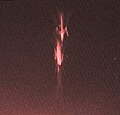
Sprites above Rome seen from Antibes

Sprites are large-scale electrical discharges which occur high above a thunderstorm cloud, or cumulonimbus, giving rise to a quite varied range of visual shapes. They are triggered by the discharges of positive lightning between the thundercloud and the ground.[10] The phenomenon was named after the mischievous sprite, e.g., Shakespeare's Ariel or Puck,[11] and is also a backronym for stratospheric/mesospheric perturbations resulting from intense thunderstorm electrification.[12] They are normally colored reddish-orange or greenish-blue, with hanging tendrils below and arcing branches above. They can also be preceded by a reddish halo, known as a sprite halo. They often occur in clusters, reaching 50 to 90 kilometres (31 to 56 mi) above the Earth's surface. Sprites have been witnessed thousands of times.[13] Sprites have been held responsible for otherwise unexplained accidents involving high-altitude vehicular operations above thunderstorms.[14]

Jets

[edit]

Although jets are considered to be a type of upper-atmospheric lightning, it has been found that they are components of tropospheric lightning and a type of cloud-to-air discharge that initiates within a thunderstorm and travels upwards. In contrast, other types of TLEs are not electrically connected with tropospheric lightning—despite being triggered by it. The two main types of jets are blue jets and gigantic jets. Blue starters are considered to be a weaker form of blue jets.[citation needed]

Blue jets

[edit]

Blue jets emanate upwards from cloud tops at speeds of about 100–140 km/s (60–90 mi/s) and have a conical shape extending up to around 50 km (30 mi) in altitude, lasting 200 to 300 milliseconds.[15] They are also brighter than sprites and, as implied by their name, are blue in color. The color is believed to be due to a set of blue and near-ultraviolet emission lines from neutral and ionized molecular nitrogen. Blue jets are believed to be initiated as "normal" lightning discharges between the upper positive charge region in a thundercloud and a negative "screening layer" present above this charge region. The positive end of the leader network fills the negative charge region before the negative end fills the positive charge region, and the positive leader subsequently exits the cloud and propagates upward.[16] Blue jets are mainly generated by thunderstorms with high rates of negative cloud-to-ground lightning.[15] It was previously believed that blue jets were not directly related to lightning flashes, and that the presence of hail somehow led to their occurrence.[16] They were first recorded on October 21, 1989, on a monochrome video of a thunderstorm on the horizon taken from the Space Shuttle as it passed over Australia.[17] Blue jets occur much less frequently than sprites. By 2007, fewer than a hundred images had been obtained. The majority of these images, which include the first color imagery, are associated with a single thunderstorm. These were taken in a series of 1994 aircraft flights to study sprites.[18] More recently, the source and formation of blue jets has been observed from the International Space Station.[3]

Blue starters

[edit]

Blue starters were discovered on video from a night time research flight around thunderstorms[19] and appear to be "an upward moving luminous phenomenon closely related to blue jets."[17] They appear to be shorter and brighter than blue jets, reaching altitudes of only up to 20 km.[20] "Blue starters appear to be blue jets that never quite make it," according to Dr. Victor P. Pasko, associate professor of electrical engineering.[21]

Gigantic jets

[edit]

Where blue jets are believed to initiate between the upper positive charge region and a negative screening layer directly above this region, gigantic jets appear to initiate as an intracloud flash between the middle negative and upper positive charge regions in the thundercloud. The negatively charged leader then escapes upward from the cloud toward the ionosphere before it can discharge within the cloud. Gigantic jets reach higher altitudes than blue jets, terminating at 90 km.[22][23] While they may appear to be visually similar to carrot-type sprites, gigantic jets differ in that they are not associated with cloud to ground lightning and propagate upward from the cloud at a slower rate.[24]

Observations

[edit]
A gigantic jet photographed from the Gemini Observatory on Mauna Kea on July 24, 2017.

On September 14, 2001, scientists at the Arecibo Observatory photographed a gigantic jet—double the height of those previously observed—reaching around 70 km (45 mi) into the atmosphere.[25] The jet was located above a thunderstorm over an ocean, and lasted less than a second. The jet was initially observed to be traveling up at around 50 km/s (110,000 mph; 180,000 km/h) at a speed similar to typical lightning, increased to 160 and 270 km/s (360,000–600,000 mph; 580,000–970,000 km/h), but then split in two and sped upward with speeds of at least 2,000 km/s (4,500,000 mph; 7,200,000 km/h) to the ionosphere where it then spread out in a bright burst of light.

On July 22, 2002, five gigantic jets between 60 and 70 kilometres (35 and 45 mi) in length were observed over the South China Sea from Taiwan, reported in Nature.[26][27] The jets lasted under a second, with shapes likened by the researchers to giant trees and carrots.

On November 10, 2012, the Chinese Science Bulletin reported a gigantic jet event observed over a thunderstorm in mainland China on August 12, 2010. "GJ event that was clearly recorded in eastern China (storm center located at 35.6°N,119.8°E, near the Huanghai Sea)".[28]

On February 2, 2014, the Oro Verde Observatory of Argentina reported ten or more gigantic jet events observed over a thunderstorm in Entre Ríos south. The storm center was located at 33°S, 60°W, near the city of Rosario.[citation needed]

On August 13, 2016, photographer Phebe Pan caught a clear wide-angle photo of a gigantic jet on a wide-angle lens while shooting Perseid meteors atop Shi Keng Kong peak in Guangdong province[29] and Li Hualong captured the same jet from a more distant location in Jiahe, Hunan, China.[30]

On March 28, 2017, photographer Jeff Miles captured four gigantic jets over Australia.[31]

On July 24, 2017, the Gemini Cloudcam at the Mauna Kea Observatory in Hawaii captured several gigantic jets as well as ionosphere-height gravity waves during one thunderstorm.[32]

On October 16, 2019, pilot Chris Holmes captured a high-resolution video of a gigantic jet from 35,000 feet (11 km) above the Gulf of Mexico near the Yucatán Peninsula.[33] From 35 miles (56 km), Holmes's video shows a blue streamer reach up from the top of a thunderstorm to the ionosphere, becoming red at the top. Only then does a brilliant white lightning leader crawl slowly from the top of the cloud, reaching about 10% of the height of the gigantic jet before fading.

On September 20, 2021, at 10:41 pm (02:41 UTC) facing NE from Cabo Rojo, Puerto Rico, photographer Frankie Lucena recorded a video of a gigantic jet plasma event which occurred over a thunderstorm in the area.[34]

On 15 February 2024, photographer JJ Rao (Nature by JJ) captured a gigantic jet in high-resolution slow-motion video from Derby, in the Kimberley Region of Western Australia.[35]

Other types

[edit]

Elves

[edit]
The photo shows one of the ELVES (emission of light and very low frequency perturbations due to electromagnetic pulse sources). The shot was taken on March 27, 2023, at 21.43 UTC from Possagno, TV, Italy. The lightning that triggered it was in Polverigi, AN, Italy, at a distance of 285 km. Its strength, estimated at 410 kA (kilo-Ampère), which is an order of magnitude stronger than a normal lightning (10 to 30 kilo-Ampère), generated an intense electromagnetic pulse. The red ring marks where the pulse hit the Earth's ionosphere. The duration of the "lightning" is about one millisecond, the "donut" has a diameter measured from the photo of approximately 360 km and a height above the ground of about 90/100 km. The distance for this type of photo must be between 100 and 600 km.

ELVES often appear as a dim, flattened, expanding glow around 400 km (250 mi) in diameter that lasts for, typically, just one millisecond.[36] They occur in the ionosphere 100 km (62 mi) above the ground over thunderstorms. Their color was unknown for some time, but is now known to be red. ELVES were first recorded on another shuttle mission, this time recorded off French Guiana on October 7, 1990.[17] That ELVES was discovered in the Shuttle Video by the Mesoscale Lightning Experiment (MLE) team at Marshall Space Flight Center, AL led by the Principal Investigator, Otha H."Skeet" Vaughan Jr.[citation needed]

ELVES is a whimsical acronym for emissions of light and very low frequency perturbations due to electromagnetic pulse sources.[37][38] This refers to the process by which the light is generated; the excitation of nitrogen molecules due to electron collisions (the electrons possibly having been energized by the electromagnetic pulse caused by a discharge from an underlying thunderstorm).[39][40]

Trolls

[edit]

TROLLs (transient red optical luminous lineaments) occur after strong sprites, and appear as red spots with faint tails, and on higher-speed cameras, appear as a rapid series of events, starting as a red glow that forms after a sprite tendril, that later produces a red streak downward from itself. They are similar to jets.[41][42]

Pixies

[edit]

Pixies were first observed during the STEPS program during the summer of 2000, a multi-organizational field program investigating the electrical characteristics over thunderstorms on the High Plains. A series of unusual, white luminous events atop the thunderstorm were observed over a 20-minute period, lasting for an average of 16 milliseconds each. They were later dubbed 'pixies'. These pixies are less than 100 meters across, and are not related to lightning.[41]

Ghosts

[edit]

Ghosts (greenish optical emission from sprite tops) are faint, green glows that appear within the footprint of a red sprite, persisting after the red has dissipated and re-igniting with the onset of subsequent sprite events.[43][44] Though possible examples of ghosts can be seen in historical images, ghosts were first noted as an exclusive phenomenon by storm chasers Hank Schyma and Paul M Smith in 2019.[45]

The first spectroscopy study to analyze the dynamics and chemistry of ghosts was led by the Atmospheric Electricity group of the Institute of Astrophysics of Andalusia (IAA). This experimental campaign reported the main contributors to the greenish hue of a single event recorded in 2019 to be atomic iron and nickel, molecular nitrogen and ionic molecular oxygen. A weak -but certain- contribution of atomic oxygen, and atomic sodium and ionic silicon were also detected.[46]

Gnomes

[edit]

A gnome is a type of lightning that is a small, brief spike of light that points upward from a thunderstorm cloud's anvil top, caused as strong updrafts push moist air above the anvil. It lasts for only a few microseconds.[41] It is about 200 meters wide, and is a maximum of 1 kilometer in height. Its color is unknown as it has only been observed in black-and-white footage. Most sources unofficially refer to them as "Gnomes".[47]

See also

[edit]

References

[edit]
[edit]
Revisions and contributorsEdit on WikipediaRead on Wikipedia
from Grokipedia
Upper-atmospheric lightning, commonly referred to as transient luminous events (TLEs), encompasses a suite of short-lived electrical discharges and optical phenomena that occur high above thunderstorms in the Earth's mesosphere and lower ionosphere, typically triggered by intense cloud-to-ground lightning strokes. These events, which were first documented in 1989 using low-light television cameras during a thunderstorm observation campaign, represent previously unrecognized manifestations of global atmospheric electricity, redistributing energy from tropospheric storms into the upper atmosphere. Unlike conventional lightning confined to the troposphere, TLEs manifest at altitudes ranging from approximately 20 to 100 kilometers, where the thin air allows for unique discharge morphologies driven by electromagnetic pulses and quasi-static electric fields. The most prominent types of TLEs include sprites, which appear as reddish, jellyfish- or carrot-shaped clusters of light extending downward from 50 to 90 kilometers altitude, often lasting several milliseconds to a few seconds and associated with positive cloud-to-ground lightning. Elves, by contrast, form as rapidly expanding, disk- or ring-shaped glows up to 500 kilometers wide in the lower ionosphere around 90-100 kilometers, resulting from the electromagnetic pulse of a lightning return stroke and frequently linked to terrestrial gamma-ray flashes. Blue jets emerge as conical beams of blue light shooting upward from thunderstorm cloud tops, reaching altitudes of 40-50 kilometers, propagating at speeds around 100 kilometers per second and not directly tied to individual cloud-to-ground strikes. Additional variants, such as gigantic jets, connect cloud tops directly to the ionosphere in towering structures up to 70 kilometers tall, representing rare, powerful discharges that bridge the atmospheric layers. These phenomena play a significant role in upper-atmospheric dynamics, depositing energy and producing reactive species like nitrogen oxides that can influence ozone chemistry and the global electric circuit, though their overall contribution remains under study due to their fleeting nature and low occurrence rates—estimated at hundreds to thousands per day worldwide. Observations from , high-speed ground cameras, and projects like NASA's Spritacular have advanced understanding since the , revealing connections to broader processes and potential impacts on communications and . Despite progress, challenges persist in quantifying their frequency and modeling their physics, as they are rarely visible to the and require sensitive instrumentation for detection.

Introduction

Definition and Scope

Upper-atmospheric lightning refers to transient luminous events (TLEs), which are short-lived optical emissions occurring in the upper atmosphere, from the to the lower (altitudes of approximately 15-100 km) above intense thunderstorms, resulting from electrical breakdowns triggered by underlying discharges. These phenomena manifest as luminous plasma structures driven by the redistribution of charge from powerful cloud-to-ground strokes, typically positive ones, that alter the in the upper atmosphere sufficiently to ionize neutral gases and produce visible glows. The scope of upper-atmospheric lightning encompasses several primary types of TLEs, including sprites, which appear as red, jellyfish-like or carrot-shaped discharges; ELVES (Emission of Light and Very Low Frequency perturbations due to Electromagnetic Pulse Sources), resembling expanding rings of light; and blue jets, cone-shaped emissions extending from cloud tops. Satellite observations, particularly from the Imager of Sprites and Upper Atmospheric Lightning (ISUAL) instrument aboard FORMOSAT-2, have estimated the collective global occurrence rate of these TLEs at approximately 2 million events per year, with elves being the most frequent at about 1.8 million annually, followed by sprites and others. More recent data from the Atmosphere-Space Interactions Monitor (ASIM) on the International Space Station corroborate similar rates, confirming widespread global distribution tied to major convective storms. The term "upper-atmospheric lightning" serves as an umbrella descriptor for these TLEs, introduced to highlight their electrical origins akin to tropospheric lightning while distinguishing their occurrence in the upper atmosphere, though "TLE" is the preferred scientific nomenclature to emphasize their transient, non-channelized nature.

Distinction from Tropospheric Lightning

Tropospheric lightning consists of intra-cloud or cloud-to-ground electrical discharges that occur below approximately 15 km altitude, primarily within thunderstorms where charge separation arises from updrafts carrying ice particles and water droplets of differing charges. These discharges propagate through relatively dense air in the troposphere, facilitating the formation of conductive plasma channels that release stored electrostatic energy. In contrast, upper-atmospheric , often termed transient luminous events (TLEs), manifests as secondary phenomena triggered by underlying tropospheric , occurring at altitudes of approximately 15-100 km in the upper atmosphere from the to the lower , with no direct transport of charge carriers from the clouds themselves. These events arise from the interaction of electromagnetic pulses or quasi-static generated by intense tropospheric strokes with the stratified upper atmosphere, leading to dielectric breakdowns in a region of low and minimal collisional interactions. Unlike tropospheric , TLEs do not originate from in-situ charge buildup but serve as remote responses to the parent discharge below. Energy scales further delineate the two: a typical cloud-to-ground tropospheric dissipates on the order of 10^9 joules, reflecting the massive charge transfers (tens of coulombs at hundreds of millions of volts) within dense atmospheric conditions. TLEs, however, involve far lower energies, ranging from 10^6 to 10^8 joules per event—for instance, sprites deposit about 22 MJ and elves around 19 MJ—due to the limited available charge and the rarified environment constraining plasma development. Additionally, TLEs produce no audible thunder observable from the ground, as their high-altitude, cold plasma emissions occur in thin air incapable of supporting the rapid and acoustic wave propagation that generates thunder in the denser . This environmental disparity underscores TLEs' role as subtle, optically dominant perturbations rather than the acoustically prominent discharges of tropospheric .

Physical Characteristics

Altitudes, Durations, and Scales

Upper-atmospheric lightning phenomena, collectively known as transient luminous events (TLEs), occur at altitudes ranging from approximately 15 km to 95 km above Earth's surface, distinguishing them from tropospheric confined below 15 km. These events exhibit a wide variety of temporal durations, from less than 1 to several seconds, and spatial scales that span horizontal extents of tens to hundreds of kilometers and vertical structures up to 70 km. Such characteristics reflect the diverse electrical breakdown processes in the and lower , often triggered by intense activity. Sprites, one of the most commonly observed TLEs, typically form at altitudes between 50 and 90 km, with initiation often occurring at 70–85 km and downward-propagating tendrils extending lower. Their durations vary from submillisecond initial development to about 1 second for sustained emissions, though some clusters can persist up to 2 seconds. Spatially, sprites exhibit horizontal extents of 10–50 km, with fine structures like streamers on scales of ~100 m, and vertical reaches of 20–40 km. ELVES occur at altitudes around 90 km (80–95 km range), manifesting as expanding rings in the lower with a vertical thickness of ~10 km. These events are extremely brief, lasting less than 1 millisecond. Their spatial scales are the largest among TLEs, with diameters up to 400 km and lateral spreads of 200–500 km. Blue jets and gigantic jets originate from thunderstorm tops at ~15–20 km and propagate upward, with blue jets reaching up to 40–50 km and gigantic jets extending to 70–90 km. Durations for blue jets are typically 200–500 milliseconds, while gigantic jets can last 300–850 milliseconds, including phases of rapid upward propagation. Vertically, gigantic jets can span up to 70 km, with horizontal scales of several kilometers at the base, fanning into conical or tree-like structures. Globally, TLEs are closely associated with intense thunderstorms, occurring at rates of approximately 0.01–3.23 events per minute depending on type (e.g., elves ~3.23/min, sprites ~0.5/min), totaling around 4 events per minute worldwide, with peak frequency in the where 75% of worldwide activity is concentrated. This distribution aligns with the prevalence of deep convective systems in tropical regions, enhancing the likelihood of the strong positive cloud-to-ground flashes that trigger many TLEs.

Optical and Spectral Properties

Upper-atmospheric lightning phenomena display characteristic optical and signatures that arise from atomic and molecular excitations in the and lower , providing insights into their plasma dynamics and energy deposition. These emissions span visible wavelengths, with colors determined by the dominant and excitation mechanisms at specific altitudes. Sprites exhibit predominant hues, primarily from the first positive band system of neutral molecular (N₂ B³Π_g → A³Σ_u⁺), which peaks in the nm range. This feature dominates due to electron-impact excitation of N₂ molecules in the low-density environment above 70 km, producing intense glows that can extend into orange tones at lower edges. Observations confirm that over 90% of sprite stems from these N₂ bands, with minimal contribution from ionized like N₂⁺ under typical conditions. In contrast, blue jets produce prominent blue emissions originating from neutral air heating and processes, exciting the second positive system of N₂ (C³Π_u → B³Π_g) around 380–470 nm and the first negative system of N₂⁺ (B²Σ_u⁺ → X²Σ_g⁺) near 390 nm. These occur at lower altitudes (15–40 km), where denser air leads to contributions alongside collisional ionization, resulting in a bluish-white appearance that fades with height. ELVES feature broadband emissions across ultraviolet to visible wavelengths, lacking the narrow-band dominance seen in sprites or jets, due to rapid electromagnetic pulse-induced excitations at ionospheric heights (~90 km). Recent spectroscopic analysis of associated ghost structures—faint, lingering afterglows atop sprites—reveals green hues from atomic iron lines (e.g., Fe I at ~530–560 nm), alongside contributions from , oxygen, and , as identified in a 2023 high-resolution study. This green afterglow persists for seconds, contrasting the millisecond-scale red sprite body. Across these events, peak brightness levels reach ~10⁹–10¹¹ photons/cm²/s in streamer heads and expanding fronts, establishing their from ground-based and spaceborne observations despite the rarified upper atmosphere. Altitude variations subtly modulate these properties, with higher occurrences favoring redder spectra due to reduced of excited states.

History and Discovery

Theoretical Foundations

In the , Scottish physicist C. T. R. Wilson laid the groundwork for understanding upper-atmospheric lightning through his predictions of induced by fields. Drawing from observations of tracks in cloud chambers under strong electric fields, Wilson proposed that the intense downward electric fields generated by thunderclouds could overshoot beyond the cloud tops, accelerating β-particles (s) to relativistic speeds and causing ionization cascades at high altitudes where air density permits such processes without rapid energy loss. He estimated that fields exceeding approximately 2 × 10^6 V/m could initiate this runaway acceleration, potentially producing visible luminous phenomena far above the . This seminal idea, published in , anticipated discharges in the low-density upper atmosphere despite the absence of direct observations at the time. Building on Wilson's framework, the concept of runaway electron avalanches evolved in the 1970s and 1980s with refined models applied to mesospheric discharges. Researchers extended the runaway mechanism to account for seeding by cosmic ray secondaries in the weaker fields prevalent at mesospheric altitudes (around 50–90 km), where electron multiplication could occur via successive collisions producing additional high-energy particles. Key advancements included theoretical explorations of avalanche dynamics in stratified atmospheres, emphasizing how relativistic electrons could propagate with minimal drag, leading to exponential growth in ionization. Observations of X-ray bursts from within thunderstorms in 1985 provided empirical support, spurring models that linked these avalanches to potential upper-atmospheric effects, such as enhanced conductivity or luminous breakdowns. Pre-1989 numerical simulations further illuminated the role of quasi-electrostatic fields in enabling such discharges by demonstrating their penetration from thunderstorms to mesospheric heights. In a foundational 1973 study, Park and Dejnakarintra modeled the three-dimensional mapping of thundercloud potentials, revealing that the highly conductive ionosphere acts as an equipotential boundary, allowing significant horizontal and vertical field components (on the order of 1–10 kV/m) to extend upward to approximately 90 km without substantial attenuation. These simulations accounted for ionospheric conductivity gradients and showed that vertical charge moments from large thunderstorms could sustain fields exceeding local breakdown thresholds in the mesosphere, providing a conductive pathway for current flow and potential instability. Subsequent refinements in the late 1980s confirmed that impulsive charge redistributions during lightning could transiently amplify these fields, setting the stage for high-altitude electrical coupling. These early theoretical models and simulations provided the conceptual basis for interpreting subsequent observations of transient luminous events, highlighting the interconnected electrical dynamics between tropospheric storms and the upper atmosphere.

Key Observations and Naming

The first video recording of upper-atmospheric occurred on July 6, 1989, when researchers R. C. Franz, R. J. Nemzek, and J. R. Winckler captured footage of a large, upward electrical discharge above a using a low-light television camera at Yucca Ridge Field Station near . This serendipitous observation, initially termed a "columnar upward lightning discharge," marked the initial detection of what would later be classified as sprites. Shortly afterward, during the mission STS-34 in October 1989, the onboard Mesoscale Lightning Experiment recorded anomalous luminous flashes above over Australia and other regions, offering the first space-based glimpses of transient upper-atmospheric events accompanying intense . These early detections, analyzed in subsequent years, confirmed the phenomena's occurrence well above typical cloud tops, distinguishing them from conventional tropospheric . Subsequent confirmation campaigns in the early established standardized for these transient luminous events (TLEs). The term "sprites" was coined in 1990 following visual verifications from ground-based and observations, evoking the fleeting, ethereal quality of mythical sprites to describe their red, jellyfish-like or carrot-shaped structures in the . In 1992, ring-shaped ionospheric disturbances were first described based on their rapid, expanding optical signatures linked to electromagnetic pulses from powerful cloud-to-ground strokes; the term ELVES (Emissions of Light and perturbations due to Sources) was later designated in 1996. By 1994, during the Sprites '94 campaign over the , blue jets were documented as upward-propagating, cone-shaped blue emissions originating from thundercloud anvils and reaching altitudes of 40–50 km at speeds around 100 km/s. Key milestones in the 2000s further expanded recognition of TLE diversity. By 2000, coordinated observation efforts, including the Severe Thunderstorm Electrification and Precipitation Study (STEPS), had documented thousands of sprites globally, with over 1,200 TLEs (primarily sprites) recorded in that campaign alone across multiple nights. In July 2002, ground-based imaging from captured the first examples of gigantic jets—towering, branched discharges spanning from thundercloud tops to the at altitudes up to 70 km—during a sequence of five events over the . These observations underscored the scale and variability of upper-atmospheric lightning, paving the way for broader scientific study. Post-2002 advancements included space-based confirmations, such as the first clear imaging of sprites from the in 2015, which provided unprecedented global coverage. More recently, as of 2023, NASA's Spritacular project has engaged volunteers worldwide in capturing TLEs using smartphones and cameras, leading to thousands of new observations and improved frequency estimates by November 2025.

Generation Mechanisms

Electrical Triggers

Upper-atmospheric lightning phenomena, such as sprites, are primarily triggered by intense positive cloud-to-ground (+CG) lightning strokes originating from thunderstorms. These strokes transfer substantial charge to the ground, often involving continuing currents that transfer more than 100 C, which significantly enhance the electric field above the cloud tops. Observations indicate that such high-charge transfers, typically associated with +CG flashes in the decaying phase of thunderstorms, create the necessary conditions for the initiation of discharges in the mesosphere by rapidly altering the overlying electric field configuration. The quasi-electrostatic fields generated above thunderclouds play a central role in this triggering process, with field strengths exceeding 10 kV/m at altitudes between 50 and 90 km. These fields arise from the redistribution of charge following a +CG stroke, forming a tripolar structure where the cloud top becomes positively charged relative to the , leading to a vertical enhancement that can surpass the local breakdown threshold. Modeling studies show that for sprite initiation, the reduced electric field (E/N) must reach values comparable to the conventional breakdown field in air, often requiring charge moment changes on the order of hundreds of C·km to produce these intensified fields at mesospheric heights. In contrast, elves are initiated by the electromagnetic pulse (EMP) component of lightning strokes, particularly from both positive and negative CG discharges, through resonant interactions with the lower ionosphere. The fast-rising EMP, with frequencies in the ELF to VLF range, propagates upward and heats electrons in the D-region ionosphere (around 85-95 km), causing a rapid expansion of optical emissions in a ring-shaped structure. This process does not rely on quasi-electrostatic buildup but on the broadband EMP's ability to excite ionospheric conductivity enhancements, often occurring within milliseconds of the lightning stroke.

Plasma Dynamics

Upper-atmospheric lightning involves the initiation of electrical breakdown through electron avalanches in the low-density mesospheric air, where the reduced neutral density (around 10^{-3} to 10^{-2} times sea-level values) allows rapid multiplication of free electrons under enhanced electric fields induced by underlying cloud-to-ground lightning discharges. These avalanches occur when the electric field exceeds the local breakdown threshold, leading to the formation of streamers—thin, filamentary plasma channels that propagate at velocities typically on the order of 10^6 to 10^7 m/s. In this process, seed electrons from cosmic rays or preexisting ionization are accelerated, colliding with neutral molecules to produce secondary electrons and ions, thereby sustaining the avalanche until the plasma density reaches approximately 10^{10} m^{-3}, sufficient for streamer onset. The core plasma dynamics center on the ionization and excitation of dominant atmospheric constituents, nitrogen (N_2) and oxygen (O_2), driven by high-energy electron impacts within the streamer heads. Electron collisions directly ionize N_2 and O_2, generating electron densities of about 10^6 to 10^7 cm^{-3} and positive ions such as O_2^+ via charge exchange reactions, while also populating excited states like N_2(A^3\Sigma_u^+) and O_2(a^1\Delta_g) at densities up to 10^7 cm^{-3}. These excitations lead to the luminous emissions characteristic of transient luminous events, with metastable species persisting in the streamer trail for milliseconds to seconds due to reduced collisional quenching in the low-pressure environment. In blue jets, localized heating from the plasma channel—reaching temperatures of several thousand —further contributes to blue continuum emission through excitation and chemiluminescent reactions involving vibrationally excited N_2 molecules. Streamer models elucidate the polarity-dependent dynamics across transient luminous events, with positive streamers (anode-directed) predominant in sprites, propagating downward from ionospheric altitudes toward the thundercloud and branching extensively due to self-enhanced fields at their tips. In contrast, some jets, particularly blue and gigantic variants, involve negative streamers (cathode-directed) that extend upward from the cloud tops, exhibiting more linear propagation and potentially connecting to ionospheric layers. These processes deposit on the order of 10 to 100 kJ per event, primarily into excitation and , influencing local plasma conductivity and event morphology without significant thermal disruption to the ambient atmosphere.

Types

Sprites

Sprites are large-scale, downward-propagating electrical discharges that occur in the upper atmosphere, manifesting as reddish optical emissions primarily due to excited molecules. These transient luminous events typically form at altitudes between 50 and 90 km above intense thunderstorms, extending vertically for tens of kilometers with horizontal scales ranging from a few to tens of kilometers. They are characteristically triggered by positive cloud-to-ground (+CG) lightning strokes that transfer significant charge to the ground, with charge moment changes exceeding 300 C km serving as a key threshold for initiation. The morphology of sprites often includes columnar or carrot-shaped structures, where slender, filamentary tendrils descend from a broader upper region, resembling roots or carrots pointing downward. Columnar sprites, known as C-sprites, appear as clustered, vertically oriented columns that can dominate activity on certain nights, while carrot sprites feature branching tendrils at their bases. A related subtype, sprite halos, consists of diffuse, amorphous glows encompassing the upper portions of sprites or occurring independently, with lateral extents up to 50 km. These structures typically persist for durations of 10 to 100 ms, with individual streamer elements lasting about 1-2 ms before fading. The association of sprites with severe thunderstorms underscores their link to powerful convective systems capable of producing large +CG flashes. The first confirmed video recording of a sprite captured such an event on July 6, 1989, above a in , revealing a luminous discharge extending upward from the cloud tops. This serendipitous observation, made using low-light television imaging during tests for auroral studies, marked the beginning of systematic research into these high-altitude phenomena and highlighted their occurrence over regions of intense meteorological activity.

ELVES

ELVES (Emission of Light and Very low frequency perturbations due to Electromagnetic pulse Sources) are transient luminous events manifesting as diffuse, radially expanding rings of optical emissions in the lower ionosphere, triggered by the fast electromagnetic pulse (EMP) component of lightning discharges. These events represent a rapid, horizontal disturbance without significant vertical extent, distinguishing them from more structured upper-atmospheric phenomena. The formation of ELVES begins with the EMP from a lightning return stroke propagating upward and interacting with the at altitudes of approximately 90 km, where it causes localized heating of electrons. This heating excites ambient molecules, leading to a brief expansion of the ionized region into a ring shape with diameters typically ranging from 250 to 400 km. The entire process unfolds in about 1 ms, making ELVES one of the shortest-lived types of upper-atmospheric lightning. Optically, ELVES appear as red, featureless disks or rings due to emissions from the first positive band system of molecular nitrogen (N₂ B³Π_g → A³Σ_u⁺), peaking in the 600–700 nm wavelength range. Unlike vertically extended events, they exhibit no discernible fine structure or streamers, presenting instead as a smooth, expanding glow. The first observations of what are now identified as ELVES occurred in 1992 during Space Shuttle missions, where transient airglow enhancements above thunderstorms were recorded. Ground-based confirmation and the formal naming followed in 1996, based on intensified video recordings that captured the ring-like morphology. ELVES are associated with all types of lightning but are most intense and frequently observed in connection with positive cloud-to-ground (+CG) discharges, which produce stronger EMPs due to their higher peak currents.

Jets

Jets are upward-propagating electrical discharges that originate from the tops of thunderclouds and extend into the upper atmosphere, characterized by their hue and conical morphology. These phenomena, part of the broader class of transient luminous events (TLEs), differ from downward-directed sprites by their ascent from cloud leaders and their association with positive cloud-to-ground or intracloud discharges that create charge imbalances. Blue jets emerge as narrow cones of blue light from the upper regions of thunderclouds, typically at altitudes of 15-20 km, and propagate upward to terminal altitudes of 40-50 km. They exhibit velocities ranging from 50 to 100 km/s and durations of approximately 200 ms, driven by leader channels extending from cloud tops. The blue coloration arises from the excitation and heating of neutral air molecules in the discharge channel. Observations indicate that blue jets often follow intense convective activity in tropical or mid-latitude thunderstorms, with their conical expansion reflecting the branching of streamers in low-pressure environments. Gigantic jets represent a rarer and more extensive variant, spanning the full height of the from cloud tops at about 15 km up to the lower at 90 km, effectively bridging the charge layers to the overlying atmosphere. First documented in 2002 during observations over the from the , these events propagate in a tree-like structure with leading jets and branching tendrils, transferring substantial charge—up to hundreds of coulombs—between the and . A notable recent example was captured on video on November 30, 2024, near in Western Australia's Kimberley region, highlighting their occurrence in intense tropical convection. Gigantic jets are infrequent, with fewer than 100 confirmed cases globally, and their full vertical extent distinguishes them from standard blue jets. Blue starters serve as shorter precursors to full jets, initiating from cloud tops but terminating at altitudes around 20 km without further into the . These transitional events, lasting tens of milliseconds, exhibit similar emissions and velocities to blue jets but lack the sustained leader development needed for higher extension, often fizzling out due to insufficient charge or density gradients. They are considered embryonic forms of jets, observed in the same environments and providing insights into the initiation thresholds for upward discharges.

Other Variants

Trolls, or transient red optical luminous lineaments (TROLLs), are elongated emissions that appear above sprites following strong electrical discharges in the upper atmosphere. These features manifest as red, bead-like structures with faint tails, typically lasting around 100 milliseconds and resulting from perturbations induced by the sprite's plasma dynamics. Pixies represent small-scale luminous spots observed at tops (~15 km altitude), approximately 10 km in horizontal extent and persisting for less than 16 ms. These events are potentially linked to localized heating from activity, occurring on or near the tops of convective structures. Ghosts are faint, persistent green afterglows that emerge at the tops of sprites, extending up to several kilometers and lasting seconds after the primary red emission fades. Spectroscopic analysis in 2023 confirmed these glows arise from iron atom emissions in the , excited by electrons from the sprite discharge, rather than previously assumed oxygen emissions. Gnomes appear as weak, brief blue spots from cloud tops, often spanning just a few kilometers and enduring 1-10 ms. These diminutive events are associated with low charge transfer in the underlying , distinguishing them from more energetic TLEs.

Observations and Detection

Ground-Based Methods

Ground-based methods for observing upper-atmospheric lightning, also known as transient luminous events (TLEs), rely on terrestrial instrumentation to capture high-resolution optical and radio signatures from locations near active thunderstorms. These techniques provide detailed morphological and temporal data that complement broader surveys, enabling precise correlation with underlying lightning discharges. High-speed cameras operating at frame rates up to 10,000 frames per second (fps) are essential for resolving the rapid morphology of TLEs such as elves, halos, and sprite halos. For instance, during the Taiwan 2020 campaign, a Phantom high-speed camera with 240x320 pixel resolution and a 7.2°x9.6° field of view captured elves as donut-shaped structures with diameters of 115-125 km at altitudes of 75-95 km, lasting less than 1 ms, while halos appeared as disk-shaped glows with 80-85 km diameters around 80 km altitude over several milliseconds. These observations revealed downward propagation in elves and extended glow in halos, with spatial resolution of approximately 0.3 km at 600 km distance, highlighting the link to parent lightning with charge moment changes exceeding +670 C-km. Similarly, intensified high-speed imaging at 10,000 fps has documented small-scale sprite features, including downward and upward streamers, beads, and glows, showing blue emissions (380-450 nm) dominant in streamers due to higher electron energies, with temporal variations in emission ratios from 0.018 to 0.300 across features. Low-light video systems, often intensified for night-time detection in storm-prone regions, have facilitated long-term monitoring campaigns since the late 1990s. These systems, deployed at sites like Yucca Ridge Field Station in , record TLEs such as sprites and halos over distances up to 1,000 km, capturing events like a 396 km-wide negative cloud-to-ground (CG) halo during coordinated observations in 1999. Efforts like those led by Walter Lyons have involved through platforms encouraging amateur submissions of low-light footage, contributing to databases of hundreds of events and aiding in the identification of TLEs associated with both positive and negative CG lightning. Photometer arrays provide precise timing measurements by sampling light intensity across multiple channels and altitudes, distinguishing TLE types based on their spatiotemporal signatures. array photometers, operating at rates up to 3,000 Hz, have identified elves through short-duration (<1 ms) diffuse flashes at 70-85 km altitude linked to lightning electromagnetic pulses, while sprites exhibit longer quasi-electrostatic responses over ~1 ms. These arrays resolve ionization effects, such as those causing early/fast very low frequency (VLF) events from sprite halos, with modeled signatures confirming separation from scattered light or other phenomena. Radio receivers tuned to very low frequency (VLF, 3-30 kHz) and extremely low frequency (ELF, 3-300 Hz) bands detect electromagnetic signatures from TLE-parent lightning, enabling geolocation and correlation with optical events. Ground-based networks, such as those using loop antennas for VLF direction finding and magnetic coils for ELF distance estimation via , have located sprite-producing positive CG flashes with errors as low as 184 km over 11,000 km ranges, as demonstrated during the 2000 STEPS campaign. These receivers capture ELF transients from charge moment changes >300 C-km, correlating VLF perturbations with elves and sprites for global monitoring.

Space-Based Missions

The Imager of Sprites and Upper Atmospheric Lightning (ISUAL) aboard the FORMOSAT-2 satellite, launched in 2004 and operational until 2016, provided the first dedicated space-based observations of transient luminous events (TLEs), including sprites, elves, halos, and gigantic jets. Over its 10-year mission, ISUAL recorded more than 35,000 TLE events globally, with red sprites comprising approximately 6.54% of detections, enabling estimates of a global sprite occurrence rate of approximately 0.5 per minute (or one every two minutes). These observations revealed spatiotemporal structures of sprites, such as their association with positive cloud-to-ground lightning discharges, and contributed to understanding their distribution primarily over continental thunderstorms. The Atmosphere-Space Interactions Monitor (ASIM), installed on the in 2018, enables continuous optical, electrical, and gamma-ray monitoring of TLEs and related phenomena from . ASIM's modular instruments, including cameras, photometers, and detectors, have captured thousands of TLE events, including sprites and elves, over major regions, with a focus on their links to terrestrial gamma-ray flashes and . This ongoing experiment has documented over 900 terrestrial gamma-ray flashes (TGFs) by late 2020, many associated with TLEs like elves, providing high-resolution data on event timing and spectra to refine models of upper-atmospheric electrical coupling; as of 2024, ASIM continues operations following repositioning on the ISS. On , the Geostationary Lightning Mapper (GLM) on , operational since 2016, has improved global lightning detection efficiency, typically 70-90% for flashes as validated in subsequent studies, enabling updated estimates of TLE occurrence rates by correlating parent strokes with upper-atmospheric events.

Planetary Contexts

Terrestrial Phenomena

Upper-atmospheric lightning events, collectively known as transient luminous events (TLEs), exert a notable influence on ionospheric chemistry within 's atmosphere. These phenomena generate oxides () through high-energy streamers in the and lower , with each sprite typically producing around 102110^{21} molecules of NO per event. This input participates in catalytic cycles that deplete (O3_3) in the upper , where background levels are low and perturbations can be regionally significant, though global effects remain minor compared to tropospheric sources. On , upper-atmospheric lightning is predominantly linked to severe convective , occurring primarily above mesoscale convective systems (MCSs) that feature extensive stratiform regions and positive cloud-to-ground (+CG) strokes. Observations indicate that sprites are often observed over such systems, where storm evolution creates the charge imbalances necessary for triggering TLEs, often during the mature to decaying phases of these events. Satellite observations from FORMOSAT-2/ISUAL have estimated global occurrence rates of approximately 1–2 million TLE events per year, with missions like ASIM on the contributing additional observations since 2018 to refine understanding of their distribution, particularly in tropical and mid-latitude regions. These rates underscore the events' integration into Earth's , linking tropospheric thunderstorms to upper-atmospheric dynamics without altering overall energy budgets significantly.

Extraterrestrial Examples

Upper-atmospheric lightning phenomena, analogous to Earth's transient luminous events (TLEs), have been tentatively identified on Jupiter through observations by NASA's Juno spacecraft. In 2020, Juno's ultraviolet spectrograph detected eleven bright, transient flashes in the planet's upper atmosphere, each lasting approximately 1.4 milliseconds and occurring about 260 kilometers above the 1-bar pressure level. These flashes, resembling sprites or elves, were located in regions of cyclonic wind shear associated with deep tropospheric convection, suggesting they are electrically induced by underlying lightning discharges in Jupiter's water-cloud layer. Spectral analysis revealed emissions dominated by molecular hydrogen (H₂) Lyman bands, with absorption features from methane (CH₄) and acetylene (C₂H₂), indicating the events originate from interactions involving stratospheric hydrocarbons, potentially producing red-like emissions similar to those in terrestrial sprites. On , early evidence for possible upward electrical discharges in the upper atmosphere came from radio observations during the Pioneer Venus mission (1978–1992), where the orbiter's electric field detector recorded thousands of impulsive radio bursts interpreted as whistler-mode waves potentially generated by in the lower atmosphere and propagating into the . These bursts, detected primarily over the nightside at altitudes between 150 and 2,900 kilometers, were estimated in refined analyses to occur at rates as high as 0.14 events per second. However, optical confirmations have remained elusive due to Venus's thick cloud cover, and the interpretation as lightning-related is debated. Recent observations from NASA's in 2023 suggest that such whistler waves may arise from non-lightning sources, indicating minimal or no lightning activity on Venus and thus weakening evidence for associated upper-atmospheric discharges. Japan's Akatsuki mission (2015–2025) detected possible lightning signals in the atmosphere but found no indications of upper-atmospheric phenomena. Data on upper-atmospheric lightning for other planets like Mars and Saturn remain limited, with no confirmed TLE observations to date. On Mars, theoretical models suggest the potential for sprite-like events in its thin CO₂-dominated atmosphere during dust storms that generate electric fields, but missions such as Viking and have only detected possible lower-atmospheric discharges without upper-level signatures. Similarly, Saturn's Cassini spacecraft identified intense tropospheric , but any associated upper-atmospheric phenomena are obscured by the planet's deep atmosphere, leaving their existence speculative based on ionospheric impact models. For exoplanets, the possibility of TLEs arises in worlds with thick, electrified atmospheres conducive to , such as hot Jupiters, though direct detection awaits advanced telescopes like the .

References

Add your contribution
Related Hubs
User Avatar
No comments yet.