Hubbry Logo
Transparent FactoryTransparent FactoryMain
Open search
Transparent Factory
Community hub
Transparent Factory
logo
8 pages, 0 posts
0 subscribers
Be the first to start a discussion here.
Transparent Factory
Transparent Factory
from Wikipedia

51°02′40″N 13°45′20″E / 51.04444°N 13.75556°E / 51.04444; 13.75556

The Transparent Factory

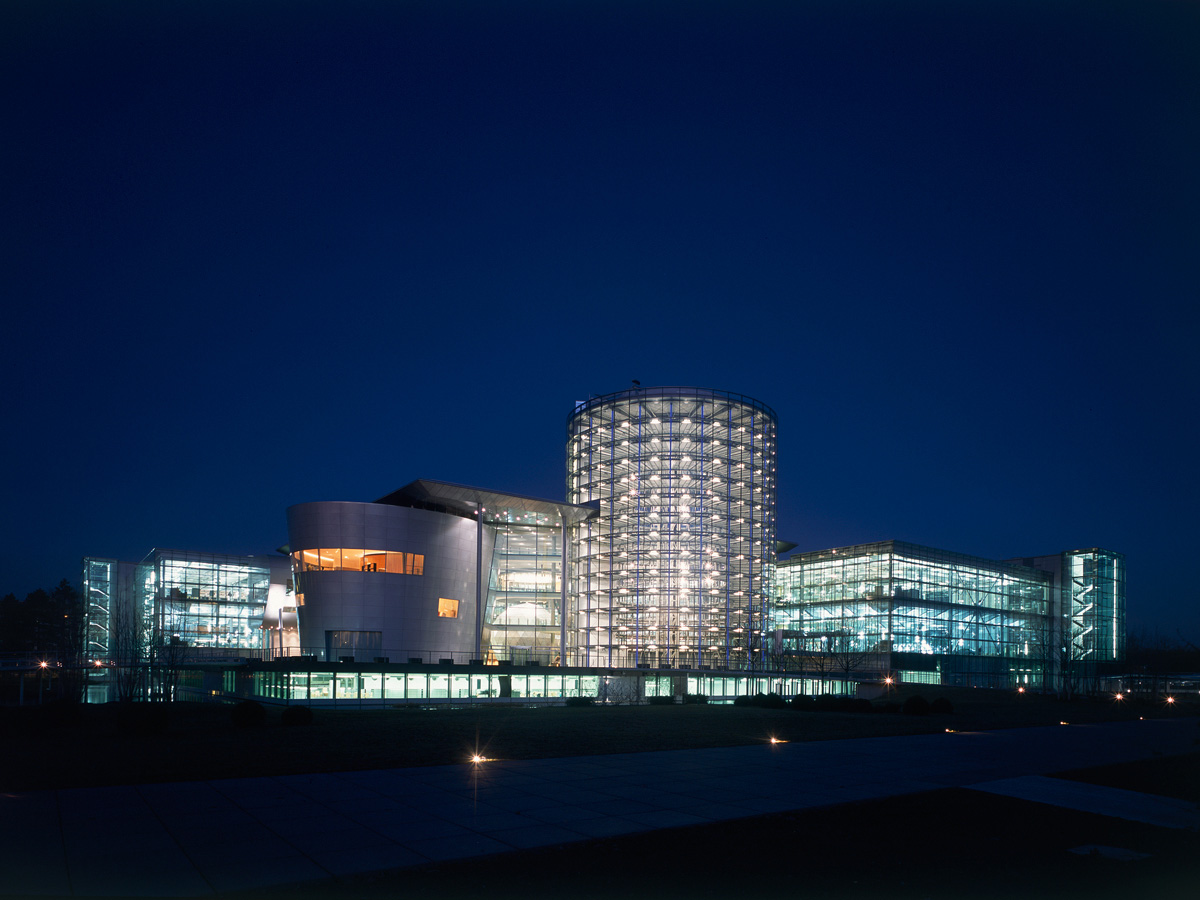
The Transparent Factory is a car factory and exhibition space in Dresden, Germany owned by German carmaker Volkswagen and designed by architect Gunter Henn. It originally opened in 2002, producing the Volkswagen Phaeton until 2016. As of 2017, it produced the electric version of the Golf, and since 2021 it has built ID3s.

Meaning

[edit]

The original German name is Gläserne Manufaktur (meaning factory made of glass). Both the German and English names are a word play on the double meaning of transparent and glassy, referring to both optical transparency and transparency of the production process.

Car factory

[edit]

The factory originally assembled Volkswagen's luxury sedan, the Phaeton. It used 60,000 magnets in its fully automated assembly line. Spare capacity was also used to build Bentley Continental Flying Spur vehicles destined for the European market until 2006, when all work was transferred to Bentley's plant in Crewe, England. Production of the Bentley Flying Spur resumed in late 2013. The factory only handled final assembly. Operations such as stamping and welding and the painting of the steel bodies took place in Zwickau. Painted bodies arrived at the factory by truck. The other 1200 parts and 34 preassembled components were shipped to a logistics center and are transported to the factory by CarGoTrams that run on Dresden's public transport tracks. All vehicle production at the factory ended in March 2016, before restarting again in 2017. The Volkswagen ID.3 is produced here since 2021, sharing production with the Zwickau-Mosel Plant.[1]

Location

[edit]

The Transparent Factory is situated in the city center of Dresden, an 800-year-old baroque city known for its arts and craftsmanship. It stands in a corner of the Großer Garten, where a convention center was located before the Second World War. The factory's walls are made almost completely of glass. Its floors are covered entirely in Canadian maple. Its visitor-friendly layout was designed to accommodate up to 250 tourists per day. There are no smokestacks, no loud noises, and no toxic byproducts. Volkswagen planted 350 trees on the grounds.[2]

Current visitor experience

[edit]

Visitors can test drive VW electric vehicles for 30 minutes, take a virtual tour of Dresden and look at various exhibits relating to VW's electric and hybrid technologies.

Previous visitor experience

[edit]

The Gläserne Manufaktur also provided visitors with a series of educational attractions relating to the VW Phaeton. The attractions, designed by BRC Imagination Arts,[3] include Vision World, a multimedia "global theater" that allows visitors to take the pulse of the planet in real time; a Virtual Test drive, featuring a real VW Phaeton combined with motion base technology and computer-generated scenery; a computer-based Car Configurator that enables visitors to design the VW Phaeton of their dreams; an interactive Techwall explaining the workings of the Phaeton's infotainment system; a Virtual Production Tour; and a media-enhanced Delivery Experience for customers taking possession of new vehicles.

The German TV channel ZDF occasionally filmed a philosophical panel discussion in the Transparent Factory, Das Philosophische Quartett (The Philosophical Quartet).

To stop birds from flying into the glass, an outdoor speaker system emulates bird vocalisations marking the territory as "taken".[4]

Future

[edit]

The factory is to be renovated to enable it to produce luxury and electric cars.

[edit]

References

[edit]
[edit]
Revisions and contributorsEdit on WikipediaRead on Wikipedia
from Grokipedia
The Transparent Factory, officially known as Gläserne Manufaktur, is a groundbreaking automotive manufacturing facility and public exhibition space in , , owned and operated by AG. Opened in 2001, it was designed as a showcase for innovative vehicle production, featuring extensive glass walls that enable visitors to observe the assembly process in real time, blending industrial efficiency with experiential transparency. Architecturally innovative, designed by Gunter Henn, the structure covers over 250,000 square feet with a Canadian floor and utilizes materials like aluminum, , and insulated glass panels spaced for optimal visibility and lighting. Initially dedicated to hand-assembling the luxury sedan from 2001 to 2016, producing a total of 84,253 vehicles, the facility shifted focus in 2020 to produce the all-electric ID.3 model, positioning it as the "Home of ID" for electromobility. This transition underscores Volkswagen's commitment to sustainable transportation, with production incorporating advanced like driverless systems and tool induction. As of November 2025, vehicle assembly continues at the site, though Volkswagen has announced plans to discontinue production by the end of the year amid strategic realignments for cost efficiency and market challenges. Beyond manufacturing, the Transparent Factory serves as a major , offering guided tours, interactive exhibits on electric mobility, test drives of ID models, and events such as conferences and cultural programs, drawing around 110,000 visitors annually. Located at Lennéstraße 1 in Dresden's city center, it integrates seamlessly with and emphasizes dialogue between production and society, exemplifying Industry 4.0 principles through its open design.

Overview

Concept and Significance

The Transparent Factory, or Gläserne Manufaktur, introduced by in 2001, embodies a groundbreaking production model that prioritizes full visibility into the assembly of luxury vehicles, enabling the public to observe the entire manufacturing process from start to finish. This concept merges classical industrial automobile production with elements of fine craftsmanship, transforming the factory into a space where meets human artistry to create high-end models like the Phaeton. By design, it fosters openness, allowing visitors to witness the integration of technology and skilled labor, thereby demystifying and humanizing what is typically a closed industrial operation. As the automotive industry's first fully transparent car factory, the Transparent Factory holds significant symbolic value, representing Volkswagen's commitment to transparency in and serving as a showcase for German engineering excellence. It positions the facility not merely as a production site but as a dialogue between the company, customers, and the public, enhancing brand perception in the premium segment by attracting interest through experiential engagement. From its , environmental responsibility was integral to the concept, with planning investments such as 56,000 euros for planting 350 trees to promote and on site. The factory's significance extends to its role in advancing sustainable practices, exemplified by its achievement of CO2-neutral production in 2018 through the use of sources like carbon-neutral electricity and initiatives for waste reduction, aligning with Volkswagen's broader environmental goals. This model has influenced public engagement in the industry by integrating art exhibitions, cultural events, and demonstrations, thereby elevating into a cultural and educational experience that underscores customer involvement in the premium automotive world.

Historical Development

The concept for the Transparent Factory in Dresden was first announced by Volkswagen on December 20, 1998, as a pioneering facility for handcrafted production of luxury vehicles, emphasizing transparency and environmental integration in an urban setting. Construction began shortly thereafter, with the facility opening on December 11, 2001, after an investment of approximately €185 million in its innovative glass-and-steel structure designed by architect Gunter Henn. The opening marked a milestone in Volkswagen's strategy to showcase advanced manufacturing, initially focusing on the assembly of the Phaeton luxury sedan starting in 2002. Phaeton production continued until March 2016, during which the factory assembled around 84,000 units, employing a workforce that grew to approximately 380 skilled workers by the mid-2000s, many specializing in bespoke customization. The global of 2008 significantly impacted Volkswagen's operations, including scaled-back production at the Transparent Factory due to reduced demand for high-end vehicles, contributing to broader company-wide adjustments in output and temporary hiring freezes across German sites. Following the Phaeton's discontinuation, the facility transitioned to assembly in 2017 with the e-Golf, reflecting Volkswagen's early steps toward amid post-Dieselgate reforms. By 2020, the Transparent Factory played a key role in Volkswagen's electrification strategy, with series production of the ID.3 compact electric hatchback commencing on January 29, 2021, making it the fourth global site for Modular Electric Drive Matrix-based vehicles. This shift underscored the factory's adaptability to sustainable mobility goals. In September 2023, reports emerged of plans to cease vehicle production by the end of 2025 as part of cost-cutting measures amid slowing electric vehicle demand and market competition, a decision formally confirmed in Volkswagen's December 2024 restructuring agreement.

Facility Details

Location and Site

The Transparent Factory is located at Lennéstraße 1 in the 01069 postal code area of , , situated in the heart of the city center near Straßburger Platz. This positioning places it on an 8.3-hectare plot, with the main L-shaped building spanning approximately 55,000 square meters across three stories. As part of Dresden's renowned "" technology hub, the factory integrates seamlessly into the region's high-tech ecosystem, contributing to the local economy through automotive innovation and employment. It lies just a ten-minute walk from the River, enhancing its appeal within the city's scenic and historical landscape, while excellent public transport connectivity—including tram lines 1 and 2 at the nearby Deutsches Hygiene-Museum stop, as well as bus lines 62 and 75—facilitates easy access for workers and visitors alike. As of November 2025, the facility continues to operate, though has announced the end of vehicle assembly by December 2025. The facility also bolsters Dresden's sector, drawing more than 100,000 visitors annually as a key attraction that blends industrial production with cultural and experiential offerings. The site is surrounded by greenery, emphasizing its urban harmony and minimal visual disruption to the surrounding environment. Designed with in mind since its opening in 2001, the factory incorporates eco-friendly features, including an on-site solar-powered e-mobility station operational since 2017 and broader commitments to reduced and consumption as part of Volkswagen's environmental goals.

Architectural Design

The Transparent Factory, known as Gläserne Manufaktur, was designed by the architecture firm HENN under lead architect Gunter Henn to embody principles of openness and integration between industrial production and public interaction. The structure features a glass-dominated facade comprising 27,500 square meters of glazing, which imparts a light, almost floating appearance by minimizing visual barriers and allowing seamless views into the interior. This design choice not only highlights the factory's transparency but also positions it as a in Dresden's urban landscape, contrasting the rigid production geometry with softer, organic elements in surrounding visitor spaces. The building adopts a three-story L-shaped layout spanning approximately 55,000 square meters, with vehicle assembly occurring primarily on the ground floor and lower levels to facilitate efficient , while upper levels offices and administrative functions. The load-bearing framework utilizes pipes for structural support, complemented by a double-facade system that enhances through spaced glass panels roughly 60 centimeters apart, ensuring year-round visibility and comfort without heavy reliance on artificial climate control. Interior finishes emphasize and quality, incorporating materials such as aluminum, parquet flooring, and to create a refined environment atypical for industrial settings. Innovative aspects of the design include fully glazed walls that provide 360-degree external views of the production process, fostering a sense of and dialogue between the facility and the public. The architecture incorporates sustainable elements, such as extensive natural lighting from the expansive glazing and provisions for natural ventilation, which reduce energy demands while maintaining operational visibility in varying weather conditions. These features collectively transform the factory into a multifunctional space that supports not only but also cultural events, underscoring its role as an architectural exemplar of transparent .

Production History

Vehicle Models Produced

The Transparent Factory in initially focused on producing the , a full-size luxury sedan introduced in 2002 and manufactured exclusively at this facility until 2016. The Phaeton featured a range of high-end powertrains, including a 3.2-liter V6, 3.6-liter VR6, 4.2-liter V8, and 6.0-liter W12 engines, emphasizing customization and premium materials in a low-volume assembly process designed for up to 20,000 units annually but averaging far less due to its positioning. Over its 14-year run, the factory produced 84,235 Phaeton vehicles, alongside a limited batch of 2,186 Flying Spur models between 2005 and 2013, highlighting the site's capability for high-end, individualized construction. Following the Phaeton's discontinuation, the facility transitioned to production in 2017, starting with the e-Golf, a battery-electric compact built on the standard platform. This marked the factory's shift toward sustainable mobility, with 50,401 e-Golf units assembled by 2020 in a single-shift operation that ramped up from 36 to 72 vehicles daily. In January 2021, production pivoted to the ID.3, 's first series-production vehicle on the Modular Electric Drive Matrix (MEB) platform, positioning the Transparent Factory as a key site for the company's €30 billion electrification strategy. By 2022, ID.3 output reached approximately 6,500 units annually at the site, maintaining the low-volume, showcase-style manufacturing approach similar to the Phaeton era. As part of Volkswagen's broader cost-saving measures amid slowing demand, the company announced in late 2024 that vehicle production at the Transparent Factory would cease by the end of 2025, impacting ID.3 output in the final year and concluding over two decades of automotive at the site. This decision aligns with the facility's historical role in prototyping and limited-series production rather than high-volume output, having assembled a cumulative total exceeding 150,000 vehicles across all models since opening.

Manufacturing Innovations

The Transparent Factory in employs a low-volume, flexible assembly process optimized for premium and production, distinguishing it from high-throughput plants like . Originally designed for the luxury sedan from 2001 to 2016, the process utilized a multi-level layout spanning three vertical floors, where vehicle bodies arrived pre-painted from other facilities and underwent phased assembly on 29 rotating, parquet-covered segments. These segments facilitated precise positioning at various stations for tasks such as installation, interior fitting, and final quality checks, supported by a precision-phasing system for continuous monitoring. Automated guided vehicles (AGVs) play a central role in , transporting individual parts and preassembled modules—such as seats and instrument panels—from storage to the assembly line, minimizing manual handling and enhancing efficiency in the compact facility. Complementing , the process incorporates extensive hand-finishing by skilled workers to achieve luxury-level quality, resembling a craftsman's workshop rather than ; for instance, components like dashboards were positioned using specialized manipulators on navigable rollers for exact alignment. This hybrid approach allowed for a of approximately 12 minutes per vehicle during Phaeton production, far longer than the 70 seconds at standard plants, enabling customization while maintaining precision. Technological integration aligns with Industry 4.0 principles, positioning the factory as a pilot site for Volkswagen's initiatives. Key features include an electric overhead conveyor (EOC) system for seamless vertical and horizontal material flow across levels, alongside software-driven quality inspections, such as automated visual checks for priming tasks on doors and windows developed at the on-site IT Center. Robotic applications, like the standard fitting of e-Golf headliners by collaborative robots, demonstrate advancements in human-robot interaction, while partnerships with startups have introduced sensor-based training for industrial robots to optimize processes. Since transitioning to electric vehicles like the ID.3 in 2021, the facility has emphasized through Volkswagen's "zero impact factory" initiative, aiming for carbon-neutral operations via reduced resource consumption and end-of-life programs, though specific recycling rates for remain integrated into group-wide targets exceeding 95% material recoverability. The workforce model underscores a "craftsmen" , with around 380 highly employees during the Phaeton era focusing on specialized skills rather than repetitive tasks. Comprehensive programs ensure proficiency in both manual precision work and digital tools, fostering adaptability for shifts to assembly; this skilled labor force supports the factory's role as an innovation hub, where employees contribute to trialing new technologies like AI-driven and digital twins for process optimization.

Visitor Program

Evolution of Experiences

The visitor program at Volkswagen's Transparent Factory in launched in 2002 with the facility's opening, providing guided tours limited to 250 visitors per day that centered on observing the assembly process of the Phaeton luxury sedan. These initial tours were closely integrated with the factory's function as a customer delivery center, enabling purchasers to track their vehicle's customization and final assembly before collection on-site. Throughout the , the program evolved to incorporate exhibits and interactive displays, such as 360-degree dome projections and real-time 3D vehicle configurators, broadening educational content beyond production observation to include automotive innovation themes. Following the cessation of Phaeton production in , the factory entered a transitional phase with reduced output, during which the visitor experiences shifted emphasis to development, featuring demonstrations of the e-Golf assembly starting in and preparing the site for full electromobility integration. The prompted significant adaptations in 2020-2021, including the introduction of options and strict health protocols to maintain accessibility while prioritizing safety, allowing remote engagement with the factory's operations amid physical closures. Key milestones include surpassing 2.5 million total visitors by August 2024 and reaching approximately 2.7 million as of November 2025, reflecting sustained popularity as a tourist and educational destination. In 2021, the program rebranded as the "Home of ID." to underscore electromobility education, coinciding with the launch of ID.3 series production and aligning visitor content with 's strategy.

Current Offerings

The Transparent Factory's visitor program in late 2025 centers on immersive experiences that highlight electromobility while noting the facility's planned transition away from active production by the end of the year. The is the guided factory tour, lasting 45 to 75 minutes depending on and type, offering close-up views of the assembly processes for Volkswagen's electric , including insights into sustainable techniques. These tours are available in multiple languages, bookable online via the official website, and priced at €9 per adult, with reduced rates for children, seniors, and groups. Complementing the tours are hands-on activities such as test drives of the ID. Buzz , conducted on designated routes around the site to demonstrate real-world performance and handling. To manage flow and maintain safety, the program accommodates visitors Monday through Saturday. The Transparent Factory serves as a hub for educational content, featuring interactive exhibits on technology, battery systems, and the environmental benefits of EV production. These displays use installations to explain key concepts like and carbon-neutral assembly. Supporting amenities include an on-site restaurant offering meals with views of the production floor. is prioritized through features like wheelchair-accessible pathways, interpreters upon request, and tactile guides for visually impaired guests, ensuring inclusivity for families, schools, and international travelers. With vehicle production set to discontinue by the end of 2025, the program's future evolution remains under consideration as explores alternative uses for the site. To broaden appeal, offerings integrate with Dresden's tourism ecosystem via combined tickets, such as bundled access with the or Grosser Garten, allowing visitors to pair industrial heritage with cultural landmarks in a single itinerary.

Future Outlook

Production Transition

In December 2023, formally announced the decision to end vehicle production at the Transparent Factory in by the end of 2025, as part of broader efforts to address competitive pressures in the . This move was driven by the company's ongoing cost-saving initiatives, including a €10 billion efficiency program initiated in 2023 to improve profitability amid slowing (EV) demand and market challenges in key regions like and . The announcement was followed by negotiations with the union, culminating in a labor agreement on December 20, 2024, that confirmed the production cessation while securing commitments for employee support. Under the deal, Volkswagen pledged to explore alternative job opportunities for affected workers and provide measures such as severance packages and retraining programs, contributing to overall annual cost savings exceeding €15 billion across the group, including a reduction in labor costs of €1.5 billion per year. The Transparent Factory, which employed around 340 staff in vehicle assembly, faced direct impacts on these positions, though the agreement emphasized no immediate forced layoffs and integration into other operations where possible. Production began a gradual wind-down in 2024, with reduced output reflecting weaker EV sales and capacity adjustments across Volkswagen's German sites. Full cessation is scheduled for December 31, 2025, marking the end of over two decades of vehicle manufacturing at the facility, which had shifted to the ID.3 electric model since 2020. The final ID.3 units are expected to roll off the line by year's end, after which operations will transition away from assembly. As of November 2025, production of the ID.3 continues at the facility. Discussions on repurposing the facility's assets and infrastructure commenced in mid-2025, focusing on non-production uses while aligning with Volkswagen's commitments to the site and local economy. This phase includes evaluating options for the 30,000-square-meter space to support future mobility concepts, with initial concepts emerging from ongoing internal reviews.

Planned Transformations

Following the discontinuation of vehicle production at the end of 2025, is exploring options to repurpose the in into a hub focused on electromobility and future mobility technologies. As of November 2025, negotiations with the Technical University of are underway for a potential joint research campus starting in 2026, enabling collaborative innovation in areas such as vehicle prototyping and testing. has proposed transforming the site into a science center dedicated to advancing the "car of the future," with emphasis on autonomous driving research, including assembly demonstrations of pre-series vehicles, test tracks, and interactive laboratories, though these details remain under discussion. The facility's strategic location within the technology cluster facilitates partnerships for research in and autonomous driving systems. has historically collaborated with Silicon Saxony entities, including the establishment of an IT development center at the site in for software solutions in mobility, and hosting innovation events like the Smart Systems Hub launch in 2024 to foster industry advancements in and digital technologies. These efforts are expected to evolve into a dedicated digital innovation center, potentially incorporating battery technology testing as part of electromobility R&D, though specific details remain under development. Public engagement will continue through an enhanced visitor program, maintaining the site's role as the "Home of ID" experience. Planned features include pre-series and special vehicle assembly demonstrations, on-site test tracks for electric prototypes, and interactive factory laboratories to showcase electromobility innovations. This approach seeks to preserve the Transparent Factory's tourism appeal while integrating educational elements tied to the research campus. In 2025, Volkswagen announced community initiatives to support the roughly 300 affected employees, emphasizing retraining for research roles and ensuring "meaningful work" through partnerships with local stakeholders, thereby sustaining economic contributions to Dresden.

References

Add your contribution
Related Hubs
User Avatar
No comments yet.