


Community hub
Recent from talks
Contribute something
Nothing was collected or created yet.
Crewe
View on Wikipedia
Crewe (/kruː/ ⓘ) is a railway town and civil parish in the unitary authority of Cheshire East in Cheshire, England. At the 2021 census, the parish had a population of 55,318 and the built-up area had a population of 74,120.
Key Information


.jpg)


.JPG)


Crewe is perhaps best known as a large railway junction and home to Crewe Works; for many years, it was a major railway engineering facility for manufacturing and overhauling locomotives, but is now much reduced in size. From 1946 until 2002, it was also the home of Rolls-Royce motor car production. The Pyms Lane factory on the west of the town now exclusively produces Bentley motor cars. Crewe is 158 miles (254 km) north-west of London, 28 miles (45 km) south of Manchester city centre and 31 miles (50 km) south-east of Liverpool city centre.
History
[edit]Medieval
[edit]The name derives from an Old Welsh word criu, meaning 'weir' or 'crossing'.[4] The earliest record is in the Domesday Book, where it is written as Creu. The original settlement of Crewe lies to the east of the modern town and was historically a township in the parish of Barthomley.[5][6] The original settlement formally changed its name to Crewe Green in 1984 to distinguish it from the newer town to its west.[7]
Modern
[edit]The town of Crewe owes its existence to Crewe railway station, which opened in 1837 on the Grand Junction Railway. When the route for the railway was being planned, alternative routes and locations for the main station in this area were considered; Winsford, 7 miles (11 km) to the north, had rejected an earlier proposal, as had local landowners in neighbouring Nantwich, 4 miles (6 km) away. The company then settled on the route through Crewe and the station was built in fields near Crewe Hall. The station was in the township of Crewe, but the land north-west of the station was in the neighbouring township of Monks Coppenhall, which formed part of the parish of Coppenhall.
The company built its main locomotive works to the north of Crewe railway station; a railway colony soon started developing in the area north-west of the station. In 1840, Joseph Locke, chief engineer of the Grand Junction Railway, produced plans for a new town there. The railway company built much of the early town itself in the 1840s and 1850s.[8] Although the nascent town was in the township of Monks Coppenhall rather than the Crewe township, it was known as Crewe from the start.[9][10] The modern town of Crewe was thus named after the railway station, rather than the other way round.

The population expanded rapidly to reach 40,000 by 1871.[8] The town has a large park, Queen's Park, laid out by engineer Francis Webb; the land for which was donated by the London and North Western Railway, the successor to the GJR. It has been suggested that their motivation was to prevent the rival Great Western Railway building a station on the site, but the available evidence indicates otherwise.[11]
Webb took a great interest in local politics and was "the most influential individual in the town".[12] "Described just before his retirement as 'the King of Crewe', Webb came to exercise control over the working lives of over 18,000 men - one third of the total LNWR workforce. Over half these lived in Crewe, around 8,000 being employed at the locomotive works. Several recreational and sporting organisations were a direct result of Webb's influence and others received benefit from his support."[12] These included the LNWR Cricket Club (established in 1850) and the Crewe Alexandra Athletic Club (established in 1867).[13] However, Webb's influence allegedly also extended to intimidation of Liberal Party supporters. In September 1885, the editor of the Crewe Chronicle published charges against Webb, saying "That through the action, direct and indirect, of Tory railway officialism, the political life of Crewe is cramped and hindered beyond recognition".[14] In November 1889, the borough council debated a motion which accused LNWR managers of working with Crewe Tories "to crush Liberalism altogether out of the town": "... by intimidation and persecution of your Liberal workmen, and by making the chances of promotion depend upon subserviency to the Tory political demands of the Management, they have created a state of political serfdom in the works."[14] In December 1889, Liberal statesman William Ewart Gladstone wrote a letter to the Chronicle condemning the company's behaviour in the town.[14]
The railway provided an endowment towards the building and upkeep of Christ Church. Until 1897 its vicar, non-conformist ministers and schoolteachers received concessionary passes, the school having been established in 1842. The company provided a doctor's surgery with a scheme of health insurance. A gasworks was built and the works water supply was adapted to provide drinking water and a public baths. The railway also opened a cheese market in 1854 and a clothing factory for John Compton who provided the company uniforms, while McCorquodale of Liverpool set up a printing works.
During World War II, the strategic presence of the railways and Rolls-Royce engineering works (turned over to producing aircraft engines) made Crewe a target for enemy air raids and it was in the flight path to Liverpool.[15] The borough lost 35 civilians to these.[16] The worst raid was on 29 August 1940 when some 50 houses were destroyed, close to the station.[17]
Crewe crater on Mars is named after the town of Crewe. Crewe was described by author Alan Garner in his novel Red Shift as "the ultimate reality."
Crewe was mentioned in 1984 as the setting of the 19th episode The Flying Kipper, in the first series of Thomas & Friends.
The town unsuccessfully bid for city status as part of the Platinum Jubilee Civic Honours in 2022.[18][19]
Governance
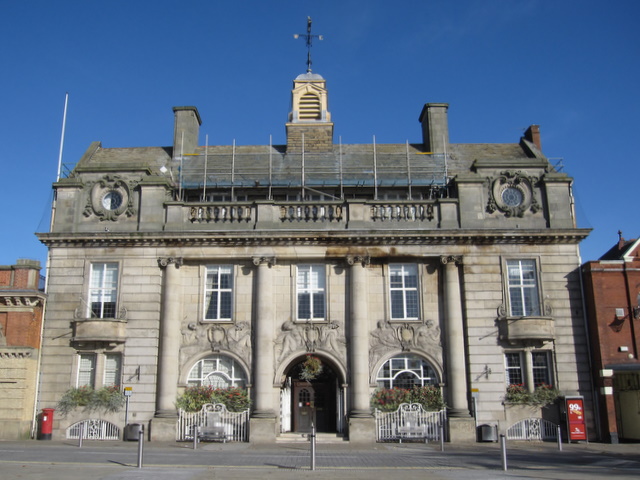
[edit]There are two tiers of local government covering Crewe, at civil parish (town) and unitary authority level: Crewe Town Council and Cheshire East Council. The town council is based at 1 Chantry Court on Forge Street.[20] Cheshire East Council also has its main offices in the town, at Delamere House on Delamere Street, with the Municipal Buildings on Earle Street being used for some council meetings.[21] Some outer parts of the built-up area (as defined by the Office for National Statistics) lie outside the parish, notably in the neighbouring parishes of Leighton, Woolstanwood, Wistaston, and Rope.[22][2]
For national elections, the town forms part of the Crewe and Nantwich constituency.[22]
Administrative history
[edit]The original settlement of Crewe was historically a township in the parish of Barthomley.[5] The area where the modern town developed was in the neighbouring township of Monks Coppenhall, in the parish of Coppenhall. Both Barthomley and Coppenhall parishes formed part of the Nantwich hundred of Cheshire.[23]
In 1859, the township of Monks Coppenhall was made a local government district, administered by an elected local board.[24] The district's name was changed from Monks Coppenhall to Crewe in 1869.[25][26] Townships were redefined as civil parishes in 1866,[27] and whilst the local government district was renamed in 1869, the civil parish was not. As such, there was a Crewe district which contained the parish of Monks Coppenhall, but did not contain the parish of Crewe.[28] An old, local riddle describes the somewhat unusual states of affairs: "The place which is Crewe is not Crewe, and the place which is not Crewe is Crewe."[29]

In 1877, the Crewe local government district was incorporated to become a municipal borough.[30] The borough council later built the Municipal Buildings on Earle Street to serve as its headquarters, opening in 1905.[31]
The railway station remained part of the neighbouring parish of Crewe, rather than the borough of Crewe, until 1936. The borough boundary was significantly enlarged in 1936 to absorb the parish of Church Coppenhall and parts of several other neighbouring parishes, including the area of Crewe parish around the railway station.[32][30] The reduced Crewe parish to the east of the town formally changed its name to Crewe Green in 1984.[7]
The borough of Crewe was abolished in 1974 under the Local Government Act 1972.[30] The area became part of the larger borough of Crewe and Nantwich, also covering the nearby town of Nantwich and surrounding rural areas. The government originally proposed calling the new borough Crewe, but the shadow authority elected in 1973 to oversee the transition changed the name to Crewe and Nantwich before the new arrangements came into effect.[33][34][35]
In 2009, Cheshire East Council was created, taking over the functions of Crewe and Nantwich Borough Council and Cheshire County Council, which were both abolished.[36] The area of the former borough of Crewe had been unparished since the 1974 reforms, but following the 2009 reforms it was decided to create a parish covering the area. A new parish of Crewe was therefore created in 2013, with its parish council taking the name Crewe Town Council.[37]
Climate
[edit]Like most of the United Kingdom, Crewe has an oceanic climate, with warm summers and cool winters and relatively little temperature change throughout the year.[38]
Economy
[edit]
The railways still play a part in local industry at Crewe Works, which carries out train maintenance and inspection. It has been owned by Alstom since 2021.[39] At its height, the site employed over 20,000 people but, by 2005, fewer than 1,000 remained, with a further 270 redundancies announced in November of that year. Currently Alstom employs 6,000 people across the UK and Ireland.[40] Much of the site once occupied by the works has been sold and is now occupied by a supermarket, leisure park and a large new health centre.
There is still an electric locomotive maintenance depot to the north of the railway station, operated by DB Cargo UK. The diesel locomotive maintenance depot, having closed in 2003, reopened in 2015 as a maintenance facility for Locomotive Services Limited, having undergone major structural repairs.[41][42]
The Bentley car factory is on Pyms Lane to the west of town. As of early 2010, there are about 3,500 working at the site.[43] The factory used to produce Rolls-Royce cars, until the licence for the brand transferred from Bentley's owners Volkswagen to rival BMW in 2003.
There is a BAE Systems Land & Armaments factory in the village of Radway Green near Alsager, producing small arms ammunition for the British armed forces.
The headquarters of Focus DIY, which went into administration in 2011, was in the town. Off-licence chain Bargain Booze is also Crewe-based; it was bought-out in 2018 by Sir Anwar Pervez' conglomerate Bestway for £7m,[44] putting drinks retailing alongside its Manchester-based Well Pharmacy.
Several business parks around the town host light industry and offices. Crewe Business Park is a 67-acre site with offices, research and IT manufacturing. Major corporations with a presence in the park include Air Products, Barclays and Fujitsu. The 12-acre Crewe Gates Industrial Estate is adjacent to Crewe Business Park, with smaller industry including the ice cream van manufacturer Whitby Morrison. The Weston Gate area has light industry and distribution. Marshfield Bank Employment Park is to the west of the town and includes offices, manufacturing and distribution. There are industrial and light industrial units at Radway Green.
The town has two small shopping centres: the Victoria Centre and the Market Centre. There are outdoor markets throughout the week. Grand Junction Retail Park is just outside the centre of town. Nantwich Road provides a wide range of secondary local shops, with a variety of small retailers and estate agents.
The Market Centre is the largest shopping centre in Crewe. It is situated in the heart of the town centre with a few national retailers, including B&M, Poundstretcher and Peacocks. There are three large car parks nearby and Crewe bus station is a five-minute walk from the shopping centre. It has a weekly footfall of approximately 100,000 visitors.
Developments
[edit]A planned redevelopment of Crewe's town centre, including the current bus station and main shopping area, was abandoned because of "difficult economic conditions" during 2008.[45]
There were also plans to revamp the railway station which involved moving it to Basford. This was pending a public consultation by Network Rail scheduled for autumn 2008, but no such public consultation was done. The plan was abandoned and maintenance work was carried out on the current station instead.[46]
Cheshire East Council developed a new regeneration master plan for Crewe,[47] which included the opening of a new Lifestyle Centre, with a new swimming pool, gym and library.
After a £3 million refurbishment, the Crewe Market Hall reopened its doors on 19 May 2021, the start of many new developments in Crewe.[citation needed]
Crewe had been planned as the site of a transport hub for the Phase 2a High Speed 2 (HS2) railway line, which received royal assent in 2021 with planned completion in 2027. The plan included a new HS2 railway station, surrounded by a commercial hub providing 37,000 jobs and 7,000 homes by 2043. However on 4 October 2023, Prime Minister Rishi Sunak announced the cancellation of this phase of the HS2 development at the Conservative Party Conference.[48][49]
Transport
[edit]
Railway
[edit]Crewe railway station is located less than a mile from the town centre, although it was not incorporated into the then Borough of Crewe until 1937. It is one of the largest stations in the North West and is a major interchange station on the West Coast Main Line. It has 12 platforms in use.
The station is served by several train operating companies:
- Avanti West Coast operates inter-city trains to London Euston (average journey time of around 1 hour 35 minutes), Glasgow, Edinburgh, Manchester, Liverpool and Holyhead for the ferry connections to Dublin Port[50]
- Transport for Wales Rail provide services to Cardiff, Chester and Wrexham[51]
- London Northwestern Railway operates routes to Birmingham, Stoke-on-Trent, London and Liverpool[52]
- East Midlands Railway runs trains to Newark, Derby and Nottingham[53]
- Northern operates stopping services on two routes to Manchester Piccadilly, via Stockport and via Manchester Airport on the Styal Line.[54]
Roads
[edit]Crewe is on the A500, A530 and A534 roads; it is located less than 5 miles (8 km) from the M6 motorway.[55]
Buses
[edit]Bus services in Crewe are operated predominantly by D&G Bus; their routes link the town with Congleton (route 42), Leighton Hospital (12), Macclesfield (38), Nantwich (84X) and Northwich (31/37).[56]
Stagecoach Merseyside & South Lancashire runs route 84 to Chester and First Potteries operates a single service (route 103) running to Stoke-on-Trent, via Kidsgrove.[57]
Airport
[edit]The closest airport to Crewe is Manchester Airport, which is 30 miles (48 km) away; Liverpool John Lennon Airport is 40 miles (64 km) away.
Culture
[edit]Crewe Heritage Centre is located in the old LMS railway yard for Crewe railway station. The museum has three signal boxes and an extensive miniature railway with steam, diesel and electric traction. The most prominent exhibit of the museum is the British Rail Class 370 Advanced Passenger Train.

The Grade II-listed Edwardian Lyceum Theatre is in the centre of Crewe. It was built in 1911 and shows drama, ballet, opera, music, comedy and pantomime.[58] The theatre was originally located on Heath Street from 1882. The Axis Arts Centre is on the Manchester Metropolitan University (MMU) campus in Crewe. It relocated from the university's Alsager Campus when it closed. The centre has a programme of touring new performance and visual art work.[59] The Axis centre closed at the end of the spring 2019 season with the withdrawal of MMU from the Crewe campus.[60] The Box on Pedley Street is the town's main local music venue.
Both the Lyceum Theatre and the Axis Arts Centre feature galleries. The private Livingroom art gallery is on Prince Albert Street. The town's main library is on Prince Albert Square, opposite the Municipal Buildings.
Crewe has six Anglican churches, three Methodist, one Roman Catholic (which has a weekly Mass in Polish) and two Baptist.[61]
There is a museum dedicated to Primitive Methodism in the nearby village of Englesea-Brook.[62]
The Jacobean mansion Crewe Hall is located to the east of the town near Crewe Green. It is a grade I listed building, built in 1615–1636 for Sir Randolph Crewe. Today, it is used as a hotel, restaurant and health club.
There is a multiplex Odeon cinema on Phoenix Leisure Park on the edge of the town centre, as well as a Mecca bingo hall and a tenpin bowling alley.
Queens Park is the town's main park; £6.5 million was spent on its restoration in 2010.[63] It features walkways, a children's play area, crown green bowling, putting, a boating lake, grassed areas, memorials and a café.[64] Jubilee Gardens are in Hightown and there is also a park on Westminster Street.
In 2019, Crewe hosted Pride in the Park (previously held at Tatton Park in 2018) in Queens Park. The 2020 event, which had been due to take place on 12 September, was cancelled on 20 May, due to the COVID-19 pandemic.[65]
In literature
[edit]A limerick referencing Crewe appears in Roald Dahl's novel, Matilda (1988), when Matilda reads aloud from a collection of humorous verse:
An epicure, dining at Crewe
Found quite a large mouse in his stew.
Cried the waiter, "Don't shout,
And wave it about,
Or the rest will be wanting one, too!"
The limerick predates Matilda and appears without attribution in several earlier publications, including The Swiss Monthly (April 1924),[66] The Outlook (February 1925),[67] and The Comic Muse: An Anthology of Humorous Verse, compiled by J. C. Squire (1925).[68]
Media
[edit]Local news and television programmes are provided by BBC North West and ITV Granada.
The daily Sentinel and the weekly Crewe Chronicle newspapers, both Reach plc-owned, cover the town. Reach's CheshireLive is the digital news channel of the Crewe Chronicle and other Reach titles covering news across Cheshire,[69] and has a section dedicated to Crewe news.[70]
The local radio station is The Cat Community Radio,[71] broadcasting on 107.9FM from the Cheshire College South and West building covering the town along with Nantwich and other local settlements. Other radio stations that cover the area include BBC Radio Stoke, Hits Radio Staffordshire and Cheshire and Greatest Hits Radio Staffordshire & Cheshire (formerly Signal 1 and Signal 2 respectively) and Silk Radio from Macclesfield.
Education
[edit]Cheshire has adopted the comprehensive school model of secondary education, so all of the schools under its control cater for pupils of all levels of ability.[72] Until the late 1970s Crewe had two grammar schools, Crewe Grammar School for Boys, now Ruskin High School and Crewe Grammar School for Girls, now the Oaks Academy (formerly Kings Grove School). The town's two other secondary schools are Sir William Stanier School, a specialist technology and arts academy, and St. Thomas More Catholic High School, specialising in mathematics and computing and modern foreign languages.
Although there are eight schools for those aged 11–16 in Crewe and its surrounding area, Cheshire College South & West is one of only two local providers of education for pupils aged 16 and over, and the only one in Crewe. The college also provides educational programmes for adults, leading to qualifications such as Higher National Diplomas (HNDs) or foundation degrees. In the 2006–07 academic year, 2,532 students aged 16–18 were enrolled, along with 3,721 adults.[73]
Manchester Metropolitan University's (MMU) Cheshire Faculty is based in Crewe, in a part of town which has been rebranded as the University Quadrant. The campus offers undergraduate and postgraduate courses in five areas: business and management, contemporary arts, exercise and sport science, interdisciplinary studies, education and teacher training.[74] The campus underwent a £70 million investment in its facilities and buildings in 2015.[75] The campus was used as a pre-games training camp for the London 2012 Olympic Games.[76]
Since 2016, there has been a University Technical College for 14-19 year olds interested in automotive or railway engineering.[77]
Sport
[edit]
Crewe's local football club is Crewe Alexandra, founded in 1877 and initially managed by railway workers. During the late 20th century, the club enjoyed something of a renaissance under the management of Dario Gradi, playing in the second tier of the professional pyramid for eight seasons in the late 1990s and early 2000s. Crewe Alexandra currently plays in League Two (the fourth tier), having been relegated from League One in April 2022. In 2013, the club won its first major silverware after beating Southend United 2–0 in the EFL Trophy final at Wembley.
From the early 1980s, Crewe Alexandra built a reputation for developing young players through its youth ranks: England internationals Geoff Thomas, Danny Murphy, David Platt, Rob Jones and Dean Ashton, plus Northern Ireland's Neil Lennon and Steve Jones, and Wales's Robbie Savage and David Vaughan all passed through the club. Among their earlier most notable home-grown players was Frank Blunstone, born in the town in 1934, who was transferred from The Alex to Chelsea in 1953 and went on to win five England caps. Internationals Bruce Grobbelaar and Stan Bowles were also on the books at one time in their careers.
Crewe's local rugby clubs are both based in or near Nantwich. The Crewe & Nantwich Steamers (formerly Crewe Wolves), who played in the Rugby League Conference, were based at Barony Park, Nantwich, while Crewe and Nantwich RUFC play their home games at the Vagrants Sports Ground in Willaston.
Speedway racing was staged in Crewe in the pioneer days of the late 1920s to early 1930s; the stadium in Earle Street also operated from 1969 until 1975 when the Crewe Kings raced in British League Division Two, then the National League. At the time the track was the longest and fastest in the UK.[78] Crewe Kings riders included Phil Crump (father of Jason Crump), Les Collins (brother of Peter Collins), Dave Morton (brother of Chris Morton), Geoff Curtis, John Jackson, Jack Millen and Dave Parry. Grand Junction Retail Park occupies the site of the now demolished stadium.[79]
The Crewe Railroaders are the town's American football team, currently competing in the BAFA Central League Division 2 and the subject of the film Gridiron UK, which premiered at the Lyceum Theatre on 29 September 2016.
Crewe also has its own roller derby team, Railtown Loco Rollers, founded in September 2013. They skate at Sir William Stanier Leisure Centre and compete with skaters and teams from all over the North West.
Crewe's main leisure facility is the Crewe Lifestyle Centre, which now houses Crewe's main public swimming pool after the Flag Lane premises closed in 2016.[80] Other notable leisure facilities include Sir William Stanier Leisure Centre and Victoria Community Centre.
Since 17 February 2018,[81][82] Crewe's Queens Park has hosted a parkrun each Saturday morning at 9am.
Notable people
[edit]


Politicians
[edit]- Thomas Nevitt (1864 in Crewe – 1932), member of the Queensland Legislative Council
- William Wheeldon (1898 in Crewe – 1960), British co-operator[83] and local politician from Birmingham and MP
- Gwyneth Dunwoody (1930 – 2008), British Labour Party politician,[84] MP for Exeter from 1966 to 1970, then for Crewe, then Crewe and Nantwich from 1974 to 2008
- Janet Dean (born 1949 in Crewe), British Labour Party MP for Burton from 1997 to 2010
- Tom Levitt (born 1954 in Crewe), Labour Party politician who was the MP for High Peak
- Kali Mountford (born 1954 in Crewe), known as Kali, Labour Party politician and MP for Colne Valley
- Edward Timpson (born 1973), British Conservative MP for Crewe and Nantwich (2008–2017) and Eddisbury (2019–2024)
- Paul Maynard (born 1975 in Crewe), British Conservative MP for Blackpool North and Cleveleys and Rail Minister
- Lauren Moss (born 1987 in Crewe), Australian politician
Public service and commerce
[edit]- Francis Webb (1836 – 1906) English railway engineer who, as LNWR's chief mechanical engineer, also exercised great influence in political and public life in Crewe, once being described as the 'King of Crewe'
- William Hope (1863 – 1933), based in Crewe, pioneer of spirit photography,[85] member of the Crewe Circle
- Ada Nield Chew, (1870 – 1945), suffragist, wrote a series of letters to the Crewe Chronicle, signed "A Crewe Factory Girl"[86]
- Wilfrid Oulton, (1911–1997), RAF Air Vice-Marshal; dealt with British nuclear tests in the Pacific Ocean
- Blaster Bates a.k.a. Derek Macintosh Bates (1923 in Crewe – 2006), an English explosives and demolition expert and raconteur
- Harold Hankins (1930 in Crewe – 2009), electrical engineer[87] and the first Vice-Chancellor of UMIST
- Professor Christine Dean (born in Crewe 1939), London psychiatrist, attended Crewe County Grammar School
- Chris Hughes (1947–2025), one of Britain's top quizzers, featuring in Eggheads. Lived in Crewe
- Mark Price, Baron Price (born 1961 in Crewe), businessman, was MD of Waitrose and Deputy Chairman of John Lewis Partnership
Arts
[edit]- William Cooper (real name Harry Summerfield Hoff) (1910 – 2002), novelist,[88] lived at 99 Brooklyn Street
- John Mark Ainsley (born 1963 in Crewe), English lyric tenor of baroque music and the works of Mozart
- Carl Ashmore (born 1968), children's author
- Any Trouble, a British rock band, originating from Crewe in 1975, best known for their early 1980s recordings
- Carey Willetts (born 1976 in Crewe), British musician, songwriter, and producer
- Lee Oakes (born 1976), British actor, from Haslington near Crewe
- Mackenzie Taylor (1978–2010), British comic, writer and director. Born in Crewe
- Adam Rickitt (born 1978), English actor, singer and model and charity fundraiser
Sport
[edit]- John Warburton (1903–?), football player, mostly for Wrexham and Crewe Alexandra.[89]
- Frank Blunstone (born 1934 in Crewe), footballer who played for Crewe Alexandra, Chelsea and England.[90]
- Sir Philip Craven (born 1950), president of the International Paralympic Committee (IPC) 2001–2017, lives in Shavington.[91]
- Neil Brooks (born in Crewe 1962), Australian Olympic swimming gold medallist
- John Edward Morris (born 1964), former English cricketer, played most for Derbyshire
- David Gilford (born 1965), European Tour and Ryder Cup golfer (1991, 1995) is from Crewe
- Mark Rivers (born 1975 in Crewe), footballer who played as a forward for Crewe Alexandra and Norwich City
- Kevin Street (born 1977 in Crewe), footballer who played for Crewe Alexandra and Shrewsbury Town
- Neil Critchley (born 1978 in Crewe), a former Crewe Alexandra footballer and most recently head coach at Heart of Midlothian.
- Mark Cueto (born 1979), former rugby union international and player for the Sale Sharks
- Craig Jones (1985 in Crewe – 2008), English motorcycle racer who grew up in Northwich
- Shanaze Reade (born 1988), world BMX and track cycling champion
- Muthu Alagappan (born c. 1990 in Crewe), medical student known in the US for his basketball analytics
- Bryony Page (born 1990 in Crewe), an Olympic gold medal-winning trampolinist, raised in the village of Wrenbury, 8.5 miles from the town
Town twinning
[edit]Crewe is twinned with:
- Bischofsheim, near Mainz, Germany
- Dzierżoniów, Poland (since 2005)[92]
See also
[edit]
References
[edit]Citations
[edit]- ^ "Crewe parish". City Population. Retrieved 1 February 2025.
- ^ a b "Towns and cities, characteristics of built-up areas, England and Wales: Census 2021". Census 2021. Office for National Statistics. Retrieved 8 August 2023.
- ^ "Coordinate Distance Calculator". boulter.com. Archived from the original on 8 March 2016. Retrieved 8 March 2016.
- ^ Mills, David (20 October 2011). A Dictionary of British Place-Names. OUP Oxford. ISBN 9780199609086. Archived from the original on 20 November 2016. Retrieved 19 November 2016.
- ^ a b "Crewe Township / Civil Parish". A Vision of Britain through Time. GB Historical GIS / University of Portsmouth. Retrieved 4 January 2024.
- ^ Youngs (1991, pp. 15–16); Dunn (1987, p. 26); Ollerhead (2008, p. 10)
- ^ a b "Cheshire". Local Government Boundary Commission for England. The National Archives. Retrieved 5 January 2024.
- ^ a b Glancey, Jonathan (6 December 2005), "The beauty of Crewe", The Guardian, London, retrieved 10 August 2007
- ^ "Cheshire Historic Towns Survey: Crewe – Archaeological Assessment". Cheshire County Council & English Heritage. 2003. Archived from the original on 3 October 2011. Retrieved 25 August 2010.
- ^ Ollerhead (2008, pp. 7, 10, 16); Chambers (2007, pp. 76, 94)
- ^ [1] Archived 21 June 2015 at the Wayback Machine states: "This can now be totally dispelled as records show the LNWR Co. originally thought their line to Chester would run alongside the river. However, it was discovered the ground was not firm enough and a more northerly route was decided upon. Had the original thought gone ahead it would have taken the land that was eventually used for Queens Park. It is obvious that a rumour became mixed with a proposal to open a station on the present Chester line called Queens Park Halt. To further clarify the situation, an entry on 18 December 1886 in the Minute Book of the board of directors of the LNWR refers to the area being given for a public park."
- ^ a b Redfern, p.121
- ^ Redfern, p.119
- ^ a b c Chaloner, William Henry (1950). The Social and Economic Development of Crewe 1780-1923. Manchester: Manchester University Press. pp. 308–309.
- ^ Discovering Wartime Cheshire 1939-1945. Cheshire County Council Countryside and Recreation. 1985. pp. 47–48. ISBN 0-906759-20-X.
- ^ [2] Archived 8 February 2018 at the Wayback Machine CWGC civilian casualty record, Crewe Municipal Borough.
- ^ Discovering Wartime Cheshire 1939-1945. p. 49.
- ^ "1/11/2021 - Cheshire East Council supports town council's 'city status' bid". www.cheshireeast.gov.uk. Retrieved 27 April 2022.
- ^ Joyner, Lisa (20 May 2022). "Queen's Platinum Jubilee city status: 8 new cities created as part of celebrations". Country Living. Retrieved 29 May 2023.
- ^ "Contact us". Crewe Town Council. Retrieved 1 February 2025.
- ^ "Cheshire East Council Offices". Cheshire East Council. Retrieved 1 February 2025.
- ^ a b "Election Maps". Ordnance Survey. Retrieved 29 January 2025.
- ^ "Monks Coppenhall Township / Civil Parish". A Vision of Britain through Time. GB Historical GIS / University of Portsmouth. Retrieved 1 February 2025.
- ^ "No. 22321". The London Gazette. 1 November 1859. p. 3923.
- ^ Chaloner, William Henry (1950). The social and economic development of Crewe, 1780–1923. Manchester: Manchester University Press. p. 105. OCLC 3743762. Retrieved 4 January 2024.
- ^ "Local Government Supplemental Act 1870". legislation.gov.uk. The National Archives. Retrieved 4 January 2024.
- ^ Youngs (1991, p. xv)
- ^ Youngs (1991, p. 16); Chambers (2007, pp. 76, 94)
- ^ Curran et al. (1984, p. 2)
- ^ a b c "Crewe Municipal Borough". A Vision of Britain through Time. GB Historical GIS / University of Portsmouth. Retrieved 1 February 2025.
- ^ Historic England. "The Municipal Buildings (Grade II) (1136190)". National Heritage List for England.
- ^ Ollerhead (2008, p. 10)
- ^ "The English Non-metropolitan Districts (Names) Order 1973", legislation.gov.uk, The National Archives, SI 1973/551, retrieved 5 September 2022
- ^ "New council asks for change of title". Crewe Chronicle. 6 December 1973. p. 8. Retrieved 5 September 2022.
- ^ "It's Crewe and Nantwich Council". Crewe Chronicle. 24 January 1974. p. 1. Retrieved 5 September 2022.
The Secretary of State for the Environment has consented to the name of Crewe District Council being changed to Crewe and Nantwich District Council...
- ^ "The Cheshire (Structural Changes) Order 2008", legislation.gov.uk, The National Archives, SI 2008/634, retrieved 8 May 2024
- ^ "Cheshire East Borough Council (Reorganisation of Community Governance) (Crewe) Order 2013" (PDF). Local Government Boundary Commission for England. The National Archives. Retrieved 1 February 2025.
- ^ "Crewe Climate".
- ^ "A transformational step for Alstom: completion of the acquisition of Bombardier Transportation". Alstom. Retrieved 29 December 2023.
- ^ "Alstom in the UK and Ireland". Alstom. Archived from the original on 27 October 2023. Retrieved 29 December 2023.
- ^ Crewe Diesel depot is biggest loss as EWS prepares for closure Rail issue 475 26 November 2003 page 6
- ^ Hosking to lease Crewe depot Railways Illustrated issue 135 May 2014 page 10
- ^ Mark Gillies (10 May 2010). "Going Back in Time at the Bentley Factory". Car and Driver blog. Archived from the original on 9 August 2011. Retrieved 25 June 2010.
- ^ Fisher, Martyn (6 April 2018). "Bestway buys Bargain Booze". Better Wholesaling. Archived from the original on 6 April 2018. Retrieved 6 April 2018.
- ^ Developer confident of town upgrades in the face of downturn, Staffordshire Sentinel News and Media, 31 December 2008, retrieved 3 February 2009
- ^ "The Sentinel". Archived from the original on 21 June 2010. Retrieved 13 October 2010.
- ^ "Cheshire East Council Crewe Vision documents". Archived from the original on 13 September 2010. Retrieved 12 October 2010.
- ^ "HS2 Birmingham to Crewe link planned to open six years early". BBC News. 30 November 2015. Archived from the original on 21 January 2016. Retrieved 16 January 2016.
- ^ Pidd, Helen (4 October 2023). "'We feel forgotten': anger in Crewe at scaling back of HS2". The Guardian. Retrieved 4 October 2023.
- ^ "Our latest timetables and ticket info". Avanti West Coast. May 2023. Retrieved 26 July 2023.
- ^ "Timetables". Transport for Wales. May 2023. Retrieved 26 July 2023.
- ^ "Train timetables and schedules". London Northwestern Railway. May 2023. Retrieved 26 July 2023.
- ^ "Timetables". East Midlands Railway. May 2023. Retrieved 26 July 2023.
- ^ "Timetables and engineering information for travel with Northern". Northern Railway. May 2023. Retrieved 26 July 2023.
- ^ "Google Maps".
- ^ "Stops in Crewe". Bus Times. 2023. Retrieved 26 July 2023.
- ^ "Timetables | Potteries". First Bus. Retrieved 9 March 2020.
- ^ "HQ Theatres". lyceumtheatre.net. Archived from the original on 5 September 2010. Retrieved 13 October 2010.
- ^ Axis Arts Centre website Archived 22 March 2010 at the Wayback Machine
- ^ Neil Mackenzie (Spring 2019). "Spring Season 2019 – Welcome and goodbye!". Axis Arts Centre. Archived from the original on 9 May 2019. Retrieved 9 May 2019.
- ^ "Crewe Places of Worship, for Places of Worship in Crewe, Cheshire, UK". city-visitor.com. Archived from the original on 22 July 2011. Retrieved 8 March 2010.
- ^ Englsea Brook Chapel and Museum website Archived 30 April 2010 at the Wayback Machine
- ^ "Queen's Park, Crewe". cheshireeast.gov.uk. Archived from the original on 8 February 2011. Retrieved 13 October 2010.
- ^ "Queens Park, Crewe". www.cheshireeast.gov.uk. Archived from the original on 11 June 2017. Retrieved 9 March 2020.
- ^ "Council cancels this year's Pride event". Cheshire East Council. 20 May 2020. Archived from the original on 26 October 2020. Retrieved 24 October 2020.
- ^ "Sparks from Other Fires". The Swiss Monthly. 1 (7): 156. April 1924.
- ^ "By the Way". The Outlook. 139 (7): 278. 18 February 1925.
- ^ Squire, J. C. (1925). The Comic Muse: An Anthology of Humorous Verse. London: W. Collins Sons. p. 245.
- ^ "About us". CheshireLive. Retrieved 4 February 2025.
- ^ "Crewe - Cheshire Live". www.cheshire-live.co.uk. Retrieved 27 April 2022.
- ^ "The Cat Community Radio". Cheshire East Council. Retrieved 4 February 2025.
- ^ Secondary Education, Cheshire County Council, archived from the original on 14 October 2008, retrieved 3 February 2009
- ^ South Cheshire College (PDF), Ofsted, archived from the original (PDF) on 27 January 2009, retrieved 3 February 2009
- ^ "Profile: Manchester Metropolitan University", Times Online, London: Times Newspapers, 19 June 2008, archived from the original on 8 May 2009, retrieved 25 September 2018
- ^ "MMU Cheshire". Study in Cheshire. Archived from the original on 3 April 2014. Retrieved 25 September 2018.
- ^ "2012 Pre-Games Training Camp". mmu.ac.uk. Archived from the original on 13 July 2014. Retrieved 24 July 2014.
- ^ Darlington CEng FIET, Paul (26 February 2016). "New UTC for Crewe – Rail Engineer". Retrieved 7 May 2021.
- ^ Bamford, R & Jarvis J. (2001). Homes of British Speedway. ISBN 0-7524-2210-3
- ^ Sandhu, Nathan (14 October 2015). "Retail hotspot was once home of the Crewe Alexandra Cricket Club". Crewe Chronicle. Retrieved 16 February 2021.
- ^ "Crewe Lifestyle Centre - Everybody Sport & Recreation". 31 May 2016. Archived from the original on 25 June 2016. Retrieved 15 June 2016.
- ^ "Results | Crewe parkrun".
- ^ Morse, Peter (21 February 2018). "Running: Parkrun has come to Crewe - and it's annoyingly brilliant". Crewe Chronicle. Retrieved 23 May 2023.
- ^ HANSARD 1803–2005 → People (W) Mr William Wheeldon 1898-1960 Archived 5 March 2016 at the Wayback Machine retrieved December 2017
- ^ The Guardian, Edward Pearce, Sat 19 Apr 2008 Archived 12 December 2013 at the Wayback Machine retrieved December 2017
- ^ The Guardian, Fri 29 Oct 2010 Archived 22 December 2017 at the Wayback Machine retrieved December 2017
- ^ Doughan, David (2004). "Chew, Ada Nield (1870–1945)". Dictionary of National Biography. Oxford Dictionary of National Biography (online ed.). Oxford University Press. doi:10.1093/ref:odnb/39080. Retrieved 15 November 2008. (Subscription, Wikipedia Library access or UK public library membership required.)
- ^ The Guardian, John Garside, Wed 5 Aug 2009 Archived 22 December 2017 at the Wayback Machine retrieved December 2017
- ^ The Guardian, Norman Shrapnel, Sat 7 Sep 2002 Archived 22 December 2017 at the Wayback Machine retrieved December 2017
- ^ "Bangor City Players 1876-1939 Who Progressed Into The English Football League". The Citizens Choice. Retrieved 15 February 2020.
- ^ Profile at englandfc.com
- ^ Crewe Lifestyle Centre officially opens Archived 31 May 2016 at the Wayback Machine Cheshire East Council. 27 May 2016
- ^ "Miasta partnerskie". dzierzoniow.pl (in Polish). Dzierżoniów. Archived from the original on 29 December 2012. Retrieved 29 July 2022.
Bibliography
[edit]- Chambers, S (2007), Crewe: A history, Chichester, Sussex: Phillimore, ISBN 978-1-86077-472-0
- Curran, H; Gilsenan, M; Owen, B; Owen, J (1984), Change at Crewe, Chester: Cheshire Libraries and Museums
- Dunn, F. I. (1987), The ancient parishes, townships and chapelries of Cheshire, Chester: Cheshire Record Office and Cheshire Diocesan Record Office, ISBN 0-906758-14-9
- Ollerhead, P (2008), Crewe: History and guide, Stroud, Gloucestershire: Tempus Publishing, ISBN 978-0-7524-4654-7
- Redfern, Allan (1983) "Crewe: Leisure in a railway town" in Walton, John K., and Walvin, James, Leisure in Britain, 1780-1939, Manchester University Press, Manchester, pp.117-136. ISBN 0-7190-0912-X
- Youngs, F. A. (1991), Guide to the local administrative units of England. (Volume 1: Northern England), London: Royal Historical Society, ISBN 0-86193-127-0
External links
[edit]

- Crewe Town Council
- . Encyclopædia Britannica. Vol. 7 (11th ed.). 1911.
| International | |
|---|---|
| Geographic | |
| Other | |

Crewe
View on GrokipediaHistory
Origins and Early Development
The locality encompassing modern Crewe traces its origins to a minor settlement recorded in the Domesday Book of 1086, appearing as Crewe with four households in the hundred of Warmundestrou, within Cheshire.[5] This area lay within the ancient parish of Coppenhall, divided into the townships of Church Coppenhall and Monks Coppenhall, the latter of which included the rural lands where the future town center would emerge.[6] The name Crewe likely derives from Old English "crēwe," denoting a clearing, bay, or cattle fold, reflecting its initial character as an agrarian outpost amid Cheshire's pastoral landscape.[7] Through the medieval period, the region remained under manorial control, with lands held by local lords such as Richard of Vernon in 1086, transitioning to feudal tenures that emphasized agriculture and limited settlement growth.[3] The Crewe family, originating from the township in the neighboring parish of Barthomley, acquired prominence by holding estates in the area from at least the 12th century, adopting the placename as their surname.[8] Ecclesiastical administration fell under Coppenhall's St. Michael All Angels Church, an ancient structure serving scattered farmsteads, with no dedicated chapel or market in Crewe itself until much later.[9] Early modern development was modest, exemplified by Crewe Hall, a Jacobean mansion built between 1615 and 1636 by Sir Randolph Crewe, then Chief Justice of the King's Bench, on lands near the original township.[8] The hall underscored the gentry's influence but did not spur urbanization; Monks Coppenhall continued as a township of dispersed farms and commons, with inhabitants reliant on subsistence farming, dairy, and occasional cloth production typical of Cheshire's pre-industrial economy.[10] By the late 18th century, the population hovered below 200, underscoring the area's stagnation absent major transport or commercial catalysts.[6] This rural baseline persisted until the railway's advent, marking the transition from feudal hamlet to industrial nucleus.Rise as a Railway Hub
The Grand Junction Railway Company, authorised by an Act of Parliament on 6 May 1833, chose the rural area near the village of Crewe in Cheshire for its engineering and operational base owing to its strategic central position on the route connecting Birmingham to the Liverpool and Manchester Railway. The main line from Birmingham to Warrington, passing through Crewe, opened to traffic on 4 July 1837, with a temporary station established at the site.[11][12] Construction of permanent facilities, including the initial locomotive sheds known as the Old Works, began in 1840, marking the inception of what would become Crewe Works; the first locomotive housed there was the Tamerlane.[13][14] Crewe Works formally commenced operations in March 1843 under the Grand Junction Railway, initially employing 1,150 workers focused on locomotive maintenance and construction to support the growing rail network.[15][16] The company constructed approximately 200 cottages to accommodate incoming railway employees, fostering the development of a planned community around the works and station.[14] This infrastructure positioned Crewe as a critical junction, where the north-south Grand Junction line intersected with emerging branches, such as the Crewe and Chester Railway acquired in 1840, enabling efficient servicing of engines and facilitating expansion toward Holyhead for Irish traffic.[17] The establishment of these facilities catalysed rapid urbanisation; Crewe's population surged from a pre-railway village of about 70 inhabitants to over 40,000 within four decades, driven by employment opportunities at the works, which by the mid-19th century produced and repaired locomotives for multiple converging lines.[12] Following the 1846 amalgamation into the London and North Western Railway, Crewe solidified its role as the network's northern hub, with the works expanding to handle thousands of engines annually and underscoring the town's dependence on railway engineering for its economic and demographic growth.[18][19]Industrial Peak and World Wars
Crewe's industrial prominence peaked in the early 20th century, centered on the Crewe Works, which employed around 20,000 workers at its height and produced 7,331 steam locomotives over its operational history.[19][20] The works' expansion solidified the town's role as a premier railway engineering hub, supporting the London, Midland and Scottish Railway and its predecessors in maintaining and innovating locomotive technology amid growing national rail networks.[14] During the First World War, Crewe's railways facilitated critical troop and supply movements across Britain and to the fronts, with the London and North Western Railway's Crewe Works outfitting armoured trains for overseas deployment.[21] The war effort drew heavily on local labor, though many workers enlisted; approximately 1,300 men from Crewe and adjacent Nantwich perished in the conflict.[22] In the Second World War, Crewe Works shifted partially to military production, assembling over 150 Covenanter cruiser tanks between 1939 and 1943 to bolster armored forces.[14] The site's strategic rail importance invited sporadic Luftwaffe raids, including daylight bombings that damaged tracks and facilities, yet Crewe avoided widespread devastation due to its dispersed layout and camouflage efforts.[23][24] Employment at the works hovered around 7,000 to 8,000 during this period, sustaining locomotive repairs vital to wartime logistics.[25]Post-War Decline and Deindustrialization
Following the end of World War II, Crewe's railway sector, centered on the Crewe Works established in 1843, continued to underpin the local economy but faced structural challenges from technological shifts and network rationalization. British Railways' nationalization in 1948 initially preserved the works' role in locomotive maintenance and production, yet the 1955 Modernisation Plan prioritized diesel and electric traction over steam, diminishing demand for the labor-intensive repairs associated with steam engines.[18] This transition accelerated after the plan's implementation, as diesel locomotives required simpler upkeep, leading to workforce reductions at steam-focused facilities like Crewe.[26] The 1960s marked a pivotal downturn, with steam operations ceasing entirely by November 1967 when Crewe South shed closed, ending an era that had defined the town's industrial identity.[18] Employment at Crewe Works stood at approximately 5,500 in 1967 but plummeted amid dieselization and the Beeching Report's 1963 recommendations, which closed unprofitable lines and reduced freight and passenger volumes, thereby shrinking the need for rolling stock overhauls.[18] By July 2007, the workforce had contracted to around 600, reflecting a broader contraction from the site's historical peak of about 20,000 employees during periods of maximum output, when it supported over 8,000 locomotive builds.[27][18][26] Deindustrialization intensified in the 1970s and 1980s amid UK-wide manufacturing job losses, exacerbated by economic stagnation post-1973 oil crisis and policy shifts under the Thatcher government from 1979, which accelerated closures in heavy industry through market-oriented reforms. In Crewe, the railway's dominance waned as alternative sectors like automotive assembly (e.g., Bentley Motors from 1946) offered limited offsets, leaving the town vulnerable to entrenched unemployment and deprivation in post-industrial enclaves.[28][29] These trends fostered social challenges, including poverty levels reminiscent of earlier industrial slumps, as the loss of skilled, unionized railway jobs disrupted community structures tied to the works.[30][26]Recent Regeneration Initiatives
Cheshire East Council oversees Crewe's town centre regeneration programme, valued at over £100 million, which incorporates funding from the government's Towns Fund (£22.9 million) and Future High Streets Fund (£14.1 million allocated in June 2021) to enhance retail, leisure, connectivity, and public spaces.[31][32][33] Recent completions include the £3 million refurbishment of Crewe Market Hall, which reopened in May 2021 with upgraded trader spaces, eateries, and event facilities to boost footfall.[31][33] A new bus station opened in May 2024, improving transport links, followed by a multi-storey town centre car park in July 2024 to address parking shortages and support retail viability.[33] Projects accelerating in 2025 encompass upgrades to four pocket parks (Samuel Street, Lime Tree Avenue, Valley Park, and Westminster Street), with completions throughout the year following public consultations in April.[32] The Mill Street Corridor Phase 2, enhancing walking and cycling routes from the town centre to the railway station, is slated to start in spring 2025 after Phase 1's November 2024 finish.[32] Other initiatives include the Southern Gateway walking/cycling route completion from High Street to Forge Street in spring 2025; TADIC co-working space refurbishment in former council offices finishing in April 2025; Cumberland Arena upgrades starting March 2025 for new studios and accessibility; Mirion Street youth boxing facility completion in spring 2025; and progress on the Crewe Youth Zone ("The Dome") construction, which began in January 2025.[32] In September 2025, the council proposed a housing-led scheme at the Royal Arcade site, potentially delivering over 300 new homes, commercial spaces for retail, restaurants, cafes, or offices, and enhanced public areas with seating, lighting, picnic spots, and event venues, in phased development with a specialist developer; approval was pending committee review, targeting a Spring 2026 opening subject to planning permission.[34] The Civic and Cultural Quarter's pedestrian link is due in March 2025, alongside a shared history centre opening in 2026.[32] These efforts aim to diversify Crewe's economy post-railway decline and HS2 cancellation impacts, though outcomes depend on funding delivery and economic conditions.[31][35]Geography and Environment
Location and Topography
Crewe is situated in the unitary authority of Cheshire East, within the ceremonial county of Cheshire in North West England, United Kingdom, at coordinates approximately 53°06′N 2°26′W.[36] The town lies on the Cheshire Plain, roughly 27 miles (44 km) south of Manchester and 15 miles (24 km) east of Stoke-on-Trent.[37][38] The average elevation of Crewe is 53 metres (174 feet) above sea level.[39] The topography of Crewe reflects the broader characteristics of the Cheshire Plain, featuring relatively flat to gently undulating terrain with only modest variations in elevation; within a 2-mile radius, the maximum elevation change measures 112 feet (34 metres).[40][41] This lowland landscape, part of a larger expanse of rural pasture and crop fields, is constrained visually by surrounding higher ground.[42]Climate and Weather Patterns
Crewe features a temperate oceanic climate (Köppen Cfb), typical of inland northwest England, with mild temperatures year-round, moderate precipitation distributed fairly evenly across seasons, and prevailing westerly winds influenced by Atlantic weather systems.[40] The annual mean temperature averages around 10.5 °C in Cheshire's lowlands, with minimal seasonal extremes due to maritime moderation.[43] Winters are cool and damp, with frequent overcast skies and occasional frost, while summers remain comfortable without oppressive heat or humidity; muggy conditions are absent throughout the year.[40] Average monthly high and low temperatures, derived from historical observations, illustrate the subdued variability:| Month | Avg. High (°C) | Avg. Low (°C) |
|---|---|---|
| Jan | 6.7 | 2.2 |
| Feb | 7.2 | 2.2 |
| Mar | 9.4 | 3.3 |
| Apr | 12.8 | 4.4 |
| May | 15.6 | 7.2 |
| Jun | 18.3 | 10.0 |
| Jul | 20.0 | 12.2 |
| Aug | 20.0 | 11.7 |
| Sep | 17.2 | 10.0 |
| Oct | 13.3 | 7.2 |
| Nov | 9.4 | 4.4 |
| Dec | 7.2 | 2.2 |
Demographics
Population Growth and Trends
Crewe's population underwent significant expansion during the 19th century, driven primarily by the establishment of the Grand Junction Railway works in 1843, which attracted migrant labor from rural areas and beyond to support locomotive manufacturing and maintenance.[45] This industrial pull transformed the settlement from a small agricultural hamlet into a burgeoning town, with growth sustained into the early 20th century through railway employment stability. Census data for the Crewe municipal borough, reflecting consistent boundaries, show a steady rise from 44,960 residents in 1911 to 46,497 in 1921, followed by minor fluctuations to 46,069 in 1931, before increasing to 52,423 in 1951 and 53,195 in 1961.[46] Post-war trends reflected slower expansion amid railway nationalization and initial deindustrialization pressures, though absolute numbers continued to climb modestly. By the 2011 census, estimates for the broader Crewe area approximated 72,900 residents. The 2021 census recorded 55,318 for the civil parish and 74,123 for the built-up area, equating to an annual growth rate of approximately 0.5% for the parish over the decade—below the 7.7% increase seen across Cheshire East (from 370,100 to 398,800).[47][2][48] Recent trends indicate Crewe maintains a younger age structure than the Cheshire East average, with elevated fertility rates among diverse communities contributing to sustained, albeit modest, natural increase and net in-migration tied to infrastructure projects and service sector jobs.[49] Projections for Cheshire East suggest continued expansion, positioning Crewe—designated a high-growth area—as a key contributor, though local challenges like socioeconomic disparities may temper rates without targeted interventions.[50]Ethnic and Cultural Composition
According to the 2021 United Kingdom census, 81.6% of Crewe residents identified as White British, a decline of 8.4 percentage points from 90.0% in 2011. This positions Crewe as the most ethnically diverse area in Cheshire East, with 18.4% of the population reporting other ethnic backgrounds. The "Other White" category nearly doubled over the decade to exceed 9% of residents, reflecting influxes from Eastern Europe, while proportions of Indian and Other Asian groups also rose significantly. Crewe accounts for 43.5% of Cheshire East's Gypsy and Irish Traveller population, numbering 150 individuals in 2021, up from 92 in 2011.[49]| Ethnic Group Category | 2011 (%) | 2021 (%) |
|---|---|---|
| White British | 90.0 | 81.6 |
| Other White | ~4.5 (inferred from total White decline) | >9.0 |
| Non-White British (total other) | 10.0 | 18.4 |
Socioeconomic Profile and Challenges
Crewe exhibits pockets of significant socioeconomic deprivation despite Cheshire East's relatively affluent profile, with 13 of the authority's 18 most deprived lower super output areas (LSOAs) located within the town according to the 2019 Index of Multiple Deprivation.[49] In the 'Crewe 6' wards—Central, North, South, St Barnabas, West, and Sydney—deprivation scores place all LSOAs in the top 10% nationally for child poverty under the Income Deprivation Affecting Children Index.[49] Benefit claimant rates underscore these disparities, reaching 21.4% in Crewe Central and 20.5% in Crewe St Barnabas as of December 2024, far exceeding regional norms.[52] Child poverty in the Crewe and Nantwich constituency stood at 23.7% in recent estimates, contributing to broader regional trends where 24.8% of children lived in low-income households in 2023/24.[53][54] Median household income in Crewe lags behind national figures, estimated at approximately £26,300 in settlement-level data from around 2018, representing 14.7% below the UK median, with recent local salary averages around £32,000 reflecting persistent gaps.[55][56] Employment rates in Cheshire East reached 83.3% for the year ending December 2023, but Crewe's central areas show elevated long-term unemployment akin to England's average, with adults in deprived wards twice as likely to claim Universal Credit as the authority-wide rate in May 2022.[57][49] Only 9.2% of working-age adults with learning difficulties in these areas held paid employment in 2021/22, compared to 10.6% across Cheshire East.[49] Educational attainment reflects structural challenges, with 50% of children in 'Crewe 6' wards achieving good development at reception entry in 2021-22, versus 66% in Cheshire East; secondary pupils in these areas attended good or outstanding schools at a rate of 69%, against 94% authority-wide.[49] While Cheshire East's overall GCSE standard pass rate in English and maths combined was 70.1% in 2024, Crewe's deprived zones contribute to lower outcomes, exacerbating skills gaps in a post-industrial economy.[58] Socioeconomic challenges stem from legacy deindustrialization, yielding high not in education, employment, or training (NEET) rates—34% of Cheshire East's NEET youth resided in Crewe in August 2022—and entrenched health inequalities, including life expectancy in 'Crewe 6' males at 71.7-78.1 years (versus England's 79.5) and excess weight in 42% of year 6 children (versus under 33% in Cheshire East) during 2016-2020 and 2017-19 periods.[49][49] These factors perpetuate cycles of low mobility, with limited green spaces and transport barriers compounding access to opportunities in a town marked by uneven regeneration.[49]Governance and Politics
Local Administration and Boundaries
Crewe is a civil parish and town within the Cheshire East unitary authority, which assumed responsibility for principal local government functions, including planning, education, and social services, upon its establishment on 1 April 2009 under the Cheshire (Structural Changes) Order 2008.[59] This replaced the former two-tier system where the Borough of Crewe and Nantwich handled district-level services alongside Cheshire County Council. Prior to 1974, Crewe operated as an independent municipal borough, incorporated by royal charter on 27 April 1877, governing its own township that had expanded from a rural area into an industrial center.[60] At the parish level, Crewe Town Council provides hyper-local representation, managing community facilities, events, and advocacy on resident issues such as maintenance of parks and war memorials.[61] The council was created on 1 April 2013 through a community governance review under the Local Government and Public Involvement in Health Act 2007, with its first elections held on 4 April 2013, electing 20 councillors.[62] It meets at 1 Chantry Court and focuses exclusively on the town's interests, distinct from Cheshire East's broader remit.[63] The civil parish boundaries delineate the core urban extent of Crewe, formed in 2013 from portions of the former unparished Monks Coppenhall area, encompassing approximately 55 square kilometers of developed land centered on the railway junction.[64] Internally, the parish divides into six town council wards—Crewe Central, Crewe East, Crewe North, Crewe South, Crewe St Barnabas, and Crewe West—each with dedicated councillors to address localized concerns.[65] These differ marginally from Cheshire East's electoral wards, which overlay the parish and include Crewe Central (3 councillors), Crewe East (2), Crewe North (2), Crewe South (3), Crewe St Barnabas (3), and Crewe West (3), reflecting population distributions for fair representation.[65] [66] Cheshire East's wards serving Crewe underwent review by the Local Government Boundary Commission for England, culminating in finalized recommendations on 13 May 2025, effective for the May 2027 elections.[67] This introduced the new Crewe Maw Green ward (3 councillors) in the southwest, redrawing boundaries to equalize electorates—targeting around 5,800 per councillor—while preserving community identities amid Crewe's projected growth.[68] The changes address variances exceeding 10% in some existing wards, ensuring electoral equality without fragmenting ties like those around Gresty Road or the town center.[69] Parish boundaries remain unchanged by this review, which pertains solely to upper-tier council divisions.[67]Political Representation and Elections
Crewe lies within the Crewe and Nantwich parliamentary constituency in the UK House of Commons. The constituency's Member of Parliament since the 2024 general election is Connor Naismith of the Labour Party, who secured the seat on 4 July 2024 with 20,418 votes, achieving a majority of 9,727 over the Conservative candidate.[70][71] This marked a Labour gain from the Conservatives, who had held the seat since 2019 when Kieran Mullan won with 28,704 votes amid national Conservative gains.[72] The 2008 by-election, triggered by the death of Labour MP Gwyneth Dunwoody, saw the Conservatives capture the seat from Labour, capitalizing on the parliamentary expenses scandal and fielding a "toff" campaign strategy that drew controversy for its class-based tactics.[73]| Election Year | Winner | Party | Majority | Turnout |
|---|---|---|---|---|
| 2024 | Connor Naismith | Labour | 9,727 | N/A |
| 2019 | Kieran Mullan | Conservative | N/A | N/A |
| 2008 (by-election) | Edward Timpson | Conservative | 5,740 | 44.1% |