


Community hub
Recent from talks
Contribute something
Nothing was collected or created yet.
BlueMotion
View on Wikipedia | This article contains promotional content. (July 2014) |


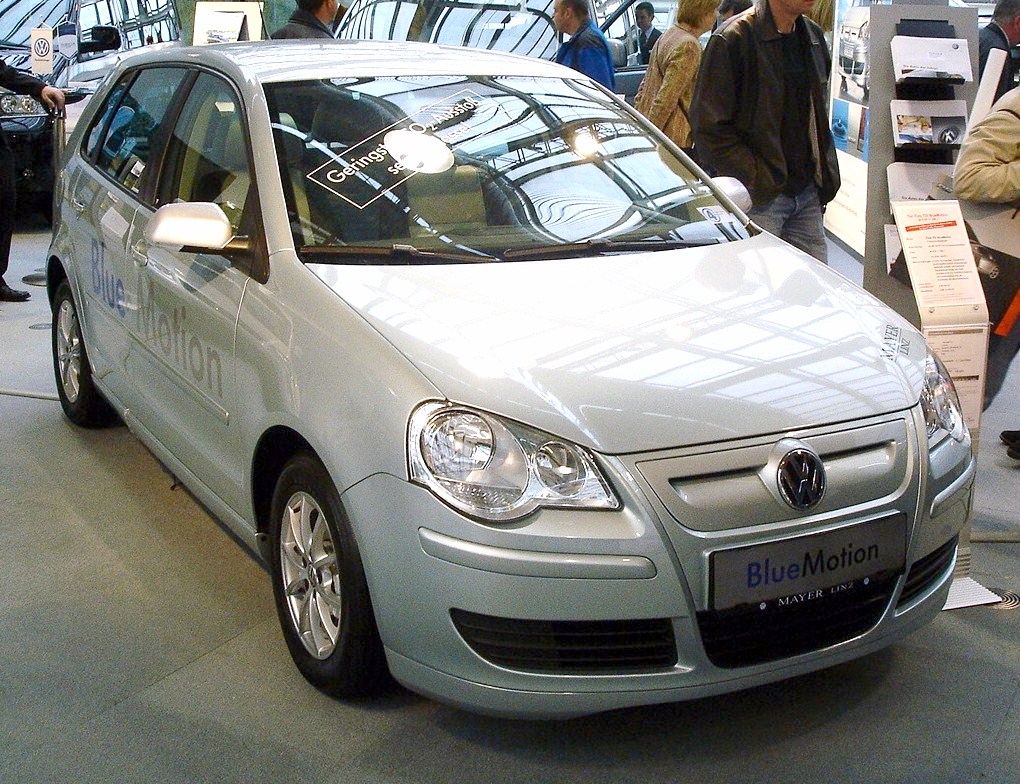
BlueMotion is a trading name for certain car models from the Volkswagen Group, emphasizing higher fuel efficiency.[1][2]
Volkswagen introduced the name in 2006 on the Polo Mk4 BlueMotion,[2][3] and in 2007 a version based on the current Passat Mk6 was released. BlueMotion versions of the Golf Mk5 and Touran, as well as the Sharan, were released in 2008.[4] It was also added to other models in 2009 including the Jetta Mk5, Caddy[5] and Touareg,[6] with others following afterwards. The name refers to Volkswagen Group's corporate color, blue, with the word 'motion' added to denote mobility,[2] and echoes DaimlerChrysler's BlueTec engines with NNOx-reducing reducing technology for diesel-powered vehicle emissions control.
This technology has also been used in SEAT's models like the SEAT Ibiza or the SEAT León under the name 'EcoMotive',[7] and in the Škoda Fabia and Superb, where the technology is called "GreenLine".[8]
The BlueMotion Polo (Mk4) and Ibiza Ecomotive used a special 1.4 L three cylinder Turbocharged Direct Injection (TDI) diesel engine[3] with 59 kW (80 PS; 79 bhp) power and an estimated fuel efficiency of 3.9 L/100 km (72 mpg‑imp; 60 mpg‑US),[2][3] emitting 99 g/km of CO2 (base model), or 102 g/km with the trim package.[3] The Ibiza was subsequently changed to the 1.2 L TDI engine. The BlueMotion Golf Mk6 uses a 1.6 L TDI engine, and Polo Mk5 uses a 1.2 L TDI engine, which produces 87 to 90 g/km of CO2.[9]
Fuel economy
[edit]BlueMotion encompasses a variety of features, including a fuel-efficient engine, an aerodynamic body, a low ride height, an auto stop-start system, a programmed battery charging system, longer gearing, and low rolling resistance tires. On June 30, 2011, a Volkswagen Passat 1.6 TDI BlueMotion set a world record for the greatest distance driven on a single tank of fuel, which was recognized by the Guinness Book of Records. The vehicle achieved 1,526.63 miles (2,456.87 km). The average consumption amounted to 74.8 miles per US gallon (3.14 L/100 km; 89.8 mpg‑imp).[10]
BlueMotion strategy
[edit]BlueMotion technologies include products and technologies to improve fuel economy and reduce emissions. Currently, they cover the TDI (turbocharged diesel direct injection) and TSI (boosted petrol stratified direct injection) engines and the Direct Shift Gearbox (DSG). They are supplemented by technologies like drive variants including EcoFuel (natural gas engines), BiFuel (liquid natural gas engines), MultiFuel (ethanol engines), hybrid systems and electric drives, as well as NOx emissions control, regenerative braking and the Stop-Start system. Products / vehicles, including these, are currently grouped under three Volkswagen brands: 'BlueMotion', 'BlueMotion Te technology', and 'BlueTDI'.[11]
The BlueMotion brands represent the most fuel efficient models[12] that Volkswagen offers of the following:
- Engine
- The engine has a number of modifications, including revised engine mapping, diesel particulate filters and oxidizing catalytic converters[3] help lower fuel consumption and NOx levels. In the later models, there's also a start-stop system that halts and restarts the motor at brief stops.
- Transmission
- The last two gear ratios are longer than on standard TDI engine gearboxes.[2][3]
- Reduced rolling resistance
- Low-resistance tires and better aerodynamics through lowered suspension, redesigned spoilers and additional enhancements underneath the car giving less drag which produces better fuel economy.[2][3]
BlueMotion Technology
[edit]BlueMotion Technology packages can be configured with TSI and TDI engines. The package includes start-stop system, a change gear indicator, and regenerative braking technology.[11] The 2015 Golf (mark VII) is available in a BlueMotion variant.
In Brazil
[edit]Currently BlueMotion in Brazil focuses on reduced rolling resistance and taller gearbox ratios, among other changes.
The Polo BlueMotion, the first model with the BlueMotion label in Brazil, uses the 1.6 TotalFlex (gasoline/alcohol) engine which is found in the other models. In April 2012 VW introduced the Fox BlueMotion with the same engine in Brazil.[13]
Volkswagen Commercial Vehicles
[edit]Volkswagen Commercial Vehicles offers Multivan, Transporter and Crafter vehicles as either BlueMotion models or as BlueMotion Technology variants.[11]
See also
[edit]- Volkswagen emissions scandal
- Efficient Dynamics – BMW's equivalent branding
- BlueTec – Daimler's equivalent branding
- ECOnetic – Ford of Europe's similar branded low emissions range
References
[edit]
- ^ "Case Studies – Volkswagen AG". OriginBranding.com. Retrieved 29 July 2009.
- ^ a b c d e f "Lean and Green: Volkswagen adding fuel-efficient BlueMotion versions to volume car lines". Automotive News Europe. AutoWeek.com. 3 April 2006. Archived from the original on 25 September 2010. Retrieved 26 January 2010.
- ^ a b c d e f g "Volkswagen Polo BlueMotion – Volkswagen has given the green light to UK sales of its new Polo BlueMotion". Auto Express. Dennis Publishing Limited. 1 January 2007. Retrieved 26 January 2010.
- ^ "Volkswagen Sharan Bluemotion". Autocar.co.uk. Retrieved 17 December 2021.
- ^ "Volkswagen Polo BlueMotion Concept Car". AutomobilesReview.com. 3 March 2009. Retrieved 17 December 2021.
- ^ "2009 Volkswagen Touareg BlueMotion". TopSpeed.com. 23 June 2009.
- ^ "New SEAT EcoMotive range" (PDF). SEAT S.A. SEAT.com. 1 September 2009. Archived from the original (PDF) on 29 December 2009. Retrieved 26 January 2010.
- ^ "Skoda Fabia Greenline 1.4 TDi". Autoexpress.co.uk.
- ^ English, Andrew (22 February 2010). "Volkswagen Polo BlueMotion Review". The Daily Telegraph. London.
- ^ "Greatest distance driven on a single tank of fuel", Guinness World Records, 30 June 2011. Retrieved 21 May 2018.
- ^ a b c "VW quidnunc (Whats new?): Volkswagen Commercial Vehicles unveils most efficient T5". vwphaetonfan.blogspot.com.au. Archived from the original on 25 December 2014. Retrieved 22 May 2022.
- ^ North, Orlando VW (29 November 2018). "Information You Should Know About Volkswagen BlueMotion | Features & Specs | Orlando, serving Altamonte Springs FL". www.orlandovwnorth.com. Retrieved 1 March 2024.
- ^ Polo > Volkswagen Brazil Archived 29 June 2011 at the Wayback Machine (in Portuguese)
External links
[edit]| Ownership | |||||||||||||
|---|---|---|---|---|---|---|---|---|---|---|---|---|---|
| Divisions and subsidiaries |
| ||||||||||||
| Shareholdings |
| ||||||||||||
| Products and technologies |
| ||||||||||||
| Discontinued brands | |||||||||||||
| Places | |||||||||||||
| People |
| ||||||||||||
| Motorsport | |||||||||||||
| Other | |||||||||||||


Established 1950, a subsidiary of the Volkswagen Group since 1980s | |||||||||||
| SEAT models |
| ||||||||||
| Cupra models |
| ||||||||||
| People | |||||||||||
| SEAT FIA Championship motorsport titles |
| ||||||||||
| Related topics |
| ||||||||||
A subsidiary of the Volkswagen Group | ||||||||
| Current models |
| |||||||
| Future models | ||||||||
| Discontinued models |
| |||||||
| Concepts/Prototypes |
| |||||||
| Related |
| |||||||

BlueMotion
View on GrokipediaHistory
Origins and Launch (2006–2008)
Volkswagen developed BlueMotion as a technology package to improve fuel efficiency and reduce CO2 emissions in its diesel-powered vehicles, responding to European regulatory demands and market pressures for lower operating costs. The initiative incorporated modifications such as aerodynamic optimizations—including a lowered ride height and smooth underbody panels—low-rolling-resistance tires, extended gear ratios for reduced engine revs at cruising speeds, and refined engine management for better combustion efficiency. These changes aimed to achieve significant fuel savings without substantial performance trade-offs, positioning BlueMotion as Volkswagen's entry into sustainable automotive engineering.[6] The first BlueMotion-equipped model, the fourth-generation Polo BlueMotion, premiered at the Geneva Motor Show in February 2006. Powered by a 1.4-liter TDI turbodiesel engine delivering 80 horsepower and 195 Nm of torque, it recorded a combined fuel consumption of 3.9 liters per 100 kilometers (approximately 72.4 mpg US) and CO2 emissions of 104 grams per kilometer. With a top speed of 176 km/h and 0-100 km/h acceleration in 12.8 seconds, the Polo BlueMotion went on sale in mainland Europe starting June 2006, initiating Volkswagen's broader BlueMotion sustainability efforts.[7][8][6] In 2007, Volkswagen extended BlueMotion to the fifth-generation Golf, launching the Golf BlueMotion with a 1.9-liter TDI engine tuned for economy. This variant achieved 4.5 liters per 100 kilometers in combined cycle testing, setting efficiency benchmarks for compact family cars at the time. By 2008, the technology debuted on minivan models like the Touran and the MPV Sharan, broadening its application and demonstrating Volkswagen's commitment to integrating efficiency across diverse vehicle segments.[9][10]Expansion and Model Integration (2009–2015)
In 2009, Volkswagen significantly expanded the BlueMotion lineup by integrating the technology into the fifth-generation Polo, which featured a three-cylinder TDI diesel engine achieving combined fuel consumption of 3.3 liters per 100 kilometers.[11] This model set new efficiency benchmarks for compact cars, with CO2 emissions as low as 87 grams per kilometer. Simultaneously, the sixth-generation Golf received the SE BlueMotion Technology variant in July 2009, incorporating start-stop systems, optimized gearing, and low-friction components while maintaining comfort-oriented equipment levels.[12] The expansion continued with the addition of BlueMotion to the Jetta Mk5 and Passat models, broadening application to mid-size sedans and wagons.[13] The 2009 Frankfurt Motor Show highlighted this integration through unveilings of BlueMotion-equipped Polo, Golf, and Passat variants, emphasizing aerodynamic refinements and engine tuning for reduced emissions across diverse body styles.[14] By 2010, BlueMotion Technology packages became available on additional derivatives, such as the Touran and Caddy, allowing consumers to select efficiency enhancements without opting for dedicated BlueMotion-badged models. This shift marked a strategic move toward mainstream adoption, with over a dozen models incorporating elements like extended gear ratios and low-rolling-resistance tires by mid-decade. Fuel economy improvements typically ranged from 10-20% over standard variants, verified through European NEDC testing cycles.[13] Further advancements occurred with the seventh-generation Golf in 2012, where BlueMotion variants achieved CO2 emissions below 100 grams per kilometer using refined common-rail diesel engines.[15] In 2014, the Polo lineup expanded to include the TDI BlueMotion, complementing petrol and hybrid explorations, while 2015 introduced the Golf TSI BlueMotion with a 1.0-liter three-cylinder turbocharged petrol engine, exemplifying downsizing trends for gasoline applications and yielding up to 4.5 liters per 100 kilometers in combined use.[16] This period saw BlueMotion evolve from niche efficiency models to integrated options across Volkswagen's passenger car portfolio, prioritizing verifiable reductions in fuel use and emissions through mechanical optimizations rather than reliance on hybrid systems.[17]Post-Scandal Adjustments and Decline (2016–Present)
Following the 2015 Volkswagen emissions scandal, which primarily implicated diesel engines, the company undertook significant adjustments to its BlueMotion lineup, including software fixes for affected models and enhanced compliance with stricter emissions testing protocols like the Worldwide Harmonised Light Vehicle Test Procedure (WLTP) introduced in Europe in September 2017.[18] BlueMotion variants, often featuring efficient diesel powertrains such as the 1.6 TDI, continued to be offered in models like the 2016 Golf and Passat, with official fuel economy claims around 56-76 mpg under NEDC testing.[19] [20] However, diesel sales across Europe dropped sharply—by over 20% in 2017 alone—due to consumer backlash, urban diesel bans in cities like London and Paris, and heightened regulatory oversight, undermining the appeal of BlueMotion's diesel-centric efficiency focus.[21] In June 2016, Volkswagen outlined its "Transform 2025+" strategy, committing €40 billion to electrification and planning up to 80 new electric and hybrid models by 2025, signaling a strategic pivot away from internal combustion engine (ICE) optimization programs like BlueMotion toward battery-electric vehicles (BEVs).[21] This shift marginalized BlueMotion, as its core technologies—such as low-rolling-resistance tires, aerodynamic tweaks, and start-stop systems—became standard across the VW lineup by the late 2010s, diminishing the need for distinct branding.[1] Petrol BlueMotion variants, like the 1.0 TSI in the 2016 Polo, persisted briefly but saw limited adoption amid rising electrification mandates, including the European Commission's 2025 CO2 fleet targets requiring 15% reductions.[22] By the second half of the 2010s, Volkswagen ceased introducing new BlueMotion models, with the branding effectively phased out by around 2018-2019 as the company prioritized its ID. series BEVs, such as the 2020 ID.3 launch.[1] Sales data reflected this decline: BlueMotion-equipped vehicles, once a key differentiator for fuel efficiency, comprised a shrinking share of VW's European output, dropping from prominent integration in 2015 models to absence in post-2020 lineups.[23] Today, VW's efficiency efforts emphasize electrified powertrains, with BlueMotion legacy limited to used markets and no revival amid ongoing diesel phase-out policies across the EU.Technical Components
Aerodynamic and Drivetrain Modifications
BlueMotion variants feature targeted aerodynamic refinements to lower the coefficient of drag and enhance fuel economy. These include a suspension lowered by approximately 15 mm in models like the Golf Mk VI, which reduces the vehicle's height and improves airflow over the body. [12] Additional measures encompass closed or partially blanked front grilles to minimize air intake resistance, deep side skirts for smoother underbody airflow, and light-alloy wheels designed with aerodynamic covers. [24] [3] Underbody panels and optimized exterior elements, such as rear spoilers in certain implementations, further shield components from turbulent air, collectively contributing to drag reductions of up to 10% in some configurations compared to standard models. [25] Drivetrain adjustments in BlueMotion models prioritize transmission gearing for reduced engine speeds at sustained velocities. Manual gearboxes typically receive elongated ratios in the higher gears—such as the fifth and sixth gears—enabling lower RPM operation during cruising, which lowers fuel use without significantly compromising acceleration in lower gears. [24] [1] For instance, the Golf BlueMotion's five- or six-speed manual transmission incorporates these taller ratios to optimize efficiency on motorways, where revs drop notably compared to base variants. [26] [27] These changes, paired with lightweight components where feasible, support claimed improvements in highway mileage by maintaining engines near their most efficient operating points. [28]Engine and Ancillary Systems
BlueMotion-equipped vehicles primarily utilize Volkswagen's turbocharged TDI diesel and TSI petrol engines, which incorporate direct fuel injection, variable turbine geometry turbochargers, and optimized ignition timing to enhance combustion efficiency and reduce fuel consumption.[29] [30] For instance, the Passat BlueMotion Concept features a 1.4-liter EA211 TSI engine delivering balanced power output while prioritizing low-end torque for urban driving cycles.[29] Engine control units are recalibrated with revised mapping to minimize throttle response delays and promote lean-burn operation under light loads, contributing to reported improvements of up to 21% in fuel economy in models like the Polo BlueMotion Technology variant.[31] Ancillary systems integral to BlueMotion's efficiency include the automatic start-stop function, which deactivates the engine during vehicle stops—such as at traffic lights—and restarts it upon accelerator input, thereby eliminating idle fuel draw; this system relies on an enhanced starter motor and higher-capacity battery to handle frequent cycles without degradation.[1] [3] Regenerative braking, implemented via an intelligent alternator, captures kinetic energy during deceleration by increasing electrical generation to recharge the battery, reducing the engine's burden to power onboard systems and yielding fuel savings of approximately 5-10% in mixed driving.[31] [32] Exhaust aftertreatment systems, such as diesel particulate filters (DPF) and selective catalytic reduction (SCR) for NOx control in TDI units, further support compliance with Euro 5 and Euro 6 emission standards while maintaining thermal efficiency; these components are integrated with low-friction coatings on pistons and bearings to lower internal engine drag.[33] Thermal management enhancements, including faster warmup via adjusted coolant flow and insulated manifolds, minimize cold-start fuel penalties, enabling engines like the 1.0-liter TSI in the up! model to achieve combined consumption as low as 4.5 liters per 100 km.[33] [28] Overall, these engine and ancillary integrations prioritize causal reductions in parasitic losses and incomplete combustion over raw power, though real-world efficacy depends on driving patterns and maintenance of components like the DPF regeneration cycle.[34]Variant-Specific Adaptations
BlueMotion adaptations are customized according to the host vehicle's platform, size, and body style to maximize fuel efficiency gains while respecting structural and performance requirements. In compact models such as the Polo, aerodynamic refinements predominate, including modified underbody panels, a burnished radiator grille insert to reduce airflow resistance, and an extended rear spoiler, which collectively lower the drag coefficient to enable combined fuel consumption as low as 3.3 liters per 100 kilometers in the 1.2 TDI variant. These vehicles also incorporate a lightweight three-cylinder diesel engine with revised mapping for torque delivery at low RPMs, paired with regenerative braking and start-stop systems to recapture energy during urban deceleration.[35][13] Mid-size hatchbacks like the Golf integrate similar core technologies but adapt them for higher mass and speed profiles, featuring tighter panel gaps, a reduced ride height by up to 15 millimeters, reprofiled bumpers, deeper side skirts, and rear diffusers to minimize turbulence at highway velocities. Engine adaptations often include active cylinder deactivation (ACT) in petrol TSI variants, allowing seamless transition to two-cylinder operation under light loads, alongside low-friction internals and extended gear ratios calibrated for cruising efficiency. Diesel Golf BlueMotion models emphasize particulate filters and low-rolling-resistance tires optimized for the model's curb weight around 1,300 kilograms.[1] In larger sedans and estates such as the Passat, adaptations shift toward drivetrain and ancillary optimizations due to inherent aerodynamic challenges from extended wheelbases and higher frontal areas; key features include a coasting function that decouples the engine from the transmission during steady speeds to reduce fuel use by up to 5 percent on motorways, revised final-drive ratios for better top-gear economy, and super-low-drag exterior elements like flush door handles in later concepts. The 1.6 TDI engine in Passat BlueMotion variants achieves official figures of 76.3 miles per imperial gallon through these measures, though real-world performance varies with load. For estate variants, enlarged fuel tanks—up to 70 liters—extend range beyond 1,400 kilometers, prioritizing long-haul efficiency over aggressive urban aero tweaks.[36][20] Applications to SUVs and crossovers, such as the Tiguan BlueMotion, face greater constraints from elevated ground clearance and boxier profiles, limiting aero gains to underbody shielding and wheel designs rather than full body kits; emphasis falls on engine remapping, hybrid-assist mild systems in later iterations, and tire compounds with rolling resistance reduced by 20 percent compared to standard fits, yielding modest improvements of 0.5-1.0 liter per 100 kilometers over non-BlueMotion equivalents. Across all variants, petrol BlueMotion implementations post-2010 increasingly incorporate turbocharged downsized engines with direct injection, diverging from the diesel-centric early lineup to comply with evolving emissions standards.[1]Applications Across Models
Passenger Vehicles
BlueMotion variants were applied to several Volkswagen passenger car models, emphasizing compact and midsize hatchbacks, sedans, and estates designed for urban and highway driving. The technology package, including low-rolling-resistance tires, aerodynamic enhancements, and efficient diesel or petrol engines, was first introduced on the Polo supermini in 2006 as the Mk4 Polo BlueMotion, targeting sub-100 g/km CO2 emissions to meet European regulatory incentives for low-emission vehicles.[3] This model used a 1.4-liter TDI engine, delivering combined fuel economy of approximately 55 mpg (UK) or 4.3 liters/100 km, with modifications like extended gear ratios and start-stop systems contributing to real-world efficiency gains of 10-15% over standard variants.[37] Subsequent expansion included the Golf compact in 2008, with the Mk6 Golf BlueMotion employing a 1.6-liter TDI engine achieving 99 g/km CO2 and up to 68 mpg (UK) in combined cycle testing.[38] The Passat midsize sedan and wagon received BlueMotion treatment around 2009-2010, featuring a 2.0-liter TDI or later 1.4-liter TSI petrol engine in concepts, with the diesel variant posting 114 g/km CO2 and extended range capabilities demonstrated in endurance tests exceeding 1,500 miles on a single tank at 75 mpg average.[38][29] Other passenger models like the Jetta sedan and Touran MPV integrated similar packages by 2009, prioritizing diesel efficiency for family-oriented vehicles while maintaining performance levels comparable to non-BlueMotion counterparts, such as 0-60 mph times under 12 seconds for entry-level units.[39] In later iterations, such as the Mk7 Golf BlueMotion from 2012 onward, Volkswagen shifted toward petrol options like the 1.0-liter three-cylinder TSI, reflecting market demands for cleaner gasoline alternatives amid diesel scrutiny, with claimed figures of 60+ mpg (UK) and under 100 g/km CO2.[40] These passenger BlueMotion models often included variant-specific tuning, such as optimized suspension for reduced drag and regenerative braking calibrated for stop-start city commuting prevalent in passenger use cases. By 2015, availability contracted as Volkswagen pivoted to broader efficiency strategies across lineups, but BlueMotion badged cars remained a benchmark for subcompact to executive passenger efficiency in Europe.[1]Commercial and Utility Vehicles
Volkswagen applied BlueMotion technologies to its commercial and utility vehicles, primarily through diesel engine optimizations, low-friction components, and ancillary efficiency features, though aerodynamic modifications were limited by the boxy designs of vans and pickups. These adaptations aimed to reduce fuel consumption for fleet users, with models like the Caddy, Transporter, and Amarok receiving BlueMotion designations or Technology packages starting in the late 2000s.[41][42] The Volkswagen Caddy, a compact panel van, featured BlueMotion variants with 2.0-liter TDI engines tuned for efficiency, such as the 102 hp unit producing 250 Nm of torque and achieving combined fuel consumption of 61.4 mpg (approximately 4.6 L/100 km) and CO2 emissions of 119 g/km in short-wheelbase panel van configuration.[43][44] These models incorporated start-stop systems, extended gear ratios, and low-rolling-resistance tires, available from around 2010 onward, with power outputs ranging from 75 PS to 150 PS in later iterations.[45] The Caddy Maxi BlueMotion, an extended version, maintained similar efficiency traits while offering payloads up to 530 kg and load volumes of 2.0 m³.[44] In the medium-sized Transporter lineup, BlueMotion Technology was integrated into T5 (2003–2015) and T6 (2015–present) generations, featuring 2.0 TDI common-rail engines like the 114 PS variant with 250 Nm torque and BlueMotion-specific tuning for panel vans, kombis, and shuttles.[46][47] The T6 Transporter BlueMotion panel van, launched for order in October 2016, included low-resistance tires, optimized aerodynamics where feasible, and engine enhancements yielding official fuel economy figures around 47–50 mpg in combined cycles, depending on body length and roof height.[42][48] These were offered in short- and long-wheelbase formats with front-wheel drive, prioritizing payload capacities over 1,000 kg while incorporating regenerative braking and idle-stop functions.[46] Utility vehicles like the Amarok pickup received BlueMotion Technology packages, notably with the 180 PS 2.0-liter bi-turbo diesel and automatic transmission introduced around 2016, which added efficiency features such as extended final drive ratios and reduced drag components to support towing up to 3,000 kg.[41] Larger models like the Crafter were referenced in Volkswagen Commercial Vehicles catalogs as eligible for BlueMotion labeling on fuel-efficient variants, though specific implementations emphasized engine mapping and ancillary systems over full aerodynamic kits due to utilitarian body shapes.[49] Overall, these applications provided modest real-world fuel savings of 5–10% compared to standard counterparts, substantiated by fleet testing, but were less transformative than in passenger cars owing to higher load factors and urban delivery cycles.[47]Regional Implementations
BlueMotion technologies were predominantly implemented in European markets, where Volkswagen introduced the suite of fuel-saving features in 2009 to address stringent EU carbon dioxide emission regulations and associated vehicle taxation incentives.[50] The rollout included models like the Polo, Golf, and Passat, with diesel variants emphasizing low-rolling-resistance tires, aerodynamic optimizations, and start-stop systems, achieving combined fuel economy figures such as 88.2 mpg (UK) for the Golf BlueMotion under NEDC testing protocols.[51] In the United Kingdom, the range expanded to encompass hatchbacks, estates, and larger vehicles by 2009, benefiting from company car tax reductions for emissions below 100 g/km CO2.[52] Outside Europe, adoption was selective and adapted to local conditions. In Australia, Volkswagen launched the Golf BlueMotion in May 2011 as a five-door diesel hatchback priced from AUD 28,990, incorporating stop-start technology and targeting buyers seeking efficiency in a market with rising fuel costs, though limited to manual transmission and available in low volumes due to premium pricing.[53] [54] In China, BlueMotion variants of the Passat and Magotan sedans were offered from 2013, featuring interior materials like Alcantara for enhanced appeal in the premium segment, alongside eco-driving campaigns to promote adoption amid growing environmental awareness.[55] These implementations prioritized petrol-compatible tweaks in Asia's varied fuel infrastructures, contrasting Europe's diesel focus. BlueMotion was not marketed or sold in North America, where Volkswagen opted for alternative efficiency badges like TDI for diesel models, reflecting differences in emissions testing standards (EPA vs. EU NEDC) and consumer aversion to the added costs of BlueMotion packages, which commanded premiums without equivalent regulatory drivers.[3] In other Asian markets beyond China, such as Japan or India, no widespread BlueMotion implementations occurred, with Volkswagen instead emphasizing localized hybrid or electrified technologies suited to regional preferences and infrastructure.[56] Overall, regional variations stemmed from regulatory pressures, fuel type dominance, and market economics, with Europe's comprehensive adoption yielding the highest penetration rates.Fuel Efficiency and Performance
Laboratory Claims and Testing Protocols
The fuel efficiency of BlueMotion variants was assessed using the New European Driving Cycle (NEDC), the standardized laboratory protocol for European type approval until its replacement by the Worldwide Harmonized Light Vehicles Test Procedure (WLTP) in 2017.[57] The NEDC simulates driving on a chassis dynamometer, beginning with a cold-start urban phase (ECE-15 cycle) of 4 km at average speeds below 20 km/h with frequent idling and accelerations, followed by an extra-urban phase (EUDC) of 7 km at higher speeds up to 120 km/h.[57] Vehicles undergo a minimum 6-hour soak at 20-30°C prior to testing, with results measured over the full 11 km cycle to determine combined fuel consumption and CO2 emissions.[57] Volkswagen calibrated BlueMotion models to optimize performance under NEDC conditions, emphasizing steady-state highway efficiency and minimal urban transients. For example, the 2006 Polo BlueMotion 1.4 TDI recorded 5.1 L/100 km urban, 3.2 L/100 km extra-urban, and 3.9 L/100 km combined.[58] The 2010 Polo 1.2 TDI BlueMotion improved to 4.0 L/100 km urban, 2.9 L/100 km extra-urban, and 3.3 L/100 km combined, corresponding to CO2 emissions of approximately 87 g/km.[59] Larger models like the Golf TDI BlueMotion variants claimed figures around 3.8-4.8 L/100 km combined, depending on engine displacement and transmission.[60] These laboratory results were obtained in controlled environments without real-world variables such as wind, road surfaces, or driver behavior, allowing precise measurement of modifications like extended gear ratios and stop-start systems.[61] Post-2017 BlueMotion implementations shifted to WLTP, which incorporates longer cycles, varied speeds, and steeper gradients for closer alignment with on-road dynamics, though early claims remained tied to NEDC baselines for historical comparison.[62] Independent labs replicated NEDC protocols to verify manufacturer-submitted data during homologation.[63]Real-World Data and Discrepancies
Real-world fuel consumption for BlueMotion-equipped vehicles frequently falls short of official NEDC laboratory figures, with independent owner surveys indicating averages of 75-80% of claimed values across models. For the Volkswagen Polo 1.2 TDI BlueMotion (2009-2017), the NEDC combined rating stood at 80.7 mpg (UK), yet real-world reports averaged 63.2 mpg, ranging from 50.0 to 79.0 mpg depending on driving conditions such as urban congestion or steady highway use. Similarly, the Golf 1.6 TDI BlueMotion (2009-2013) was rated at 68.9-74.3 mpg under NEDC, but achieved an average of 55.5 mpg in practice, with variability from 43.0 to 70.0 mpg. These gaps stem from the NEDC protocol's mild acceleration profiles, exclusion of air conditioning loads, and capped speeds below typical motorway levels, contrasting with empirical driving involving idling, rapid starts, and payloads.[64][65] Independent media tests corroborate these owner data, showing mixed-driving economies in the 50-60 mpg range for diesel BlueMotion variants despite promotional claims exceeding 80 mpg. A GreenCarGuide evaluation of the Golf BlueMotion TDI reported over 50 mpg in varied conditions and 60+ mpg on rural roads, but noted limitations under aggressive acceleration or laden scenarios. Top Gear's assessment of a later Golf 1.6 TDI BlueMotion highlighted its 88.2 mpg NEDC claim but implied real-world shortfalls in dynamic testing, aligning with broader critiques of NEDC optimism where discrepancies averaged 20-25% against harsher cycles. Highway-focused runs could approach lab figures under ideal low-speed, no-wind conditions, but urban and elevated-speed motoring—common in Europe—yielded 10-30% reductions due to aerodynamic drag and engine inefficiencies beyond test parameters.[66][51][67] Volkswagen's 2015 disclosures amplified discrepancies through admitted irregularities in CO2 certification testing, impacting around 800,000 vehicles including BlueMotion models like the Polo 1.0 TSI, where overstated efficiencies equated to 0.3-0.5 l/100km better claims than verified. These involved procedural deviations yielding ~10 g/km lower reported CO2, directly correlating to inflated fuel economy projections; subsequent audits confirmed higher real emissions and consumption in affected units. Additionally, software manipulations detected in 2019 led to minor restatements of 1 mpg downward for select models, though not tied exclusively to BlueMotion. Post-emissions-fix modifications for compliant operation sometimes degraded economy further, with reports of 10-20% drops in urban cycles due to altered engine mapping and increased regeneration frequency. Transition to WLTP testing from 2017 mitigated some lab-real gaps for newer BlueMotion iterations, but legacy NEDC-era models retained persistent underruns verifiable via onboard diagnostics and fleet tracking.[68][69][70][71]Comparative Effectiveness
BlueMotion variants demonstrate fuel economy improvements of approximately 10-15% over equivalent standard Volkswagen models, primarily through aerodynamic enhancements, low-rolling-resistance tires, and optimized gearing. For instance, the Polo BlueMotion achieved a 13% reduction in fuel consumption compared to the standard Polo, lowering CO2 emissions from 119 g/km to 104 g/km. Similarly, the Passat 1.6 TDI BlueMotion recorded an official combined figure of 76.3 mpg versus 56.4 mpg for the non-BlueMotion version, reflecting gains from extended gear ratios and start-stop systems. These enhancements yield tangible savings in highway-dominant driving, where diesel efficiency shines, but real-world tests often show diminished returns, with Golf BlueMotion models averaging 50-60 mpg in mixed conditions rather than the claimed 88.3 mpg.[52][72][66] In comparison to hybrid competitors like the Toyota Prius, BlueMotion technology proves less effective in urban and stop-start scenarios, where electric assistance provides superior regenerative braking and zero-emission cruising. Real-world data indicate the Prius achieving 53-55 mpg in depleted-battery tests, outperforming BlueMotion diesels that rely on mechanical optimizations without hybridization. Diesel BlueMotion models, such as TDI variants, average around 44 mpg in user-reported mixed driving, trailing the Prius's 55 mpg under similar conditions, though BlueMotion edges ahead on long motorway runs due to diesel's inherent thermal efficiency. Independent reviews highlight that while BlueMotion's incremental tweaks reduce consumption without sacrificing much drivability, hybrid systems deliver broader gains across cycles, often 20-30% better in city environments.[73][74][1]| Model Example | Standard Fuel Economy (Combined, Official) | BlueMotion Fuel Economy (Combined, Official) | Hybrid Competitor (e.g., Prius, Real-World Mixed) |
|---|---|---|---|
| VW Golf/Passat Equivalent | ~56 mpg | 74-88 mpg | 53-55 mpg |