


Community hub
Recent from talks
Contribute something
Nothing was collected or created yet.
Transponder (aeronautics)
View on Wikipedia

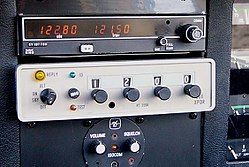
A transponder (short for transmitter-responder[1] and sometimes abbreviated to XPDR,[2] XPNDR,[3] TPDR[4] or TP[5]) is an electronic device that produces a response when it receives a radio-frequency interrogation. Aircraft have transponders to assist in identifying them on air traffic control radar. Collision avoidance systems have been developed to use transponder transmissions as a means of detecting aircraft at risk of colliding with each other.[6][7]
Air traffic control (ATC) units use the term "squawk" when they are assigning an aircraft a transponder code, e.g., "Squawk 7421". "Squawk" thus can be said to mean "select transponder code" and "squawking xxxx" to mean "I have selected transponder code xxxx".[6]
The transponder receives interrogation from the secondary surveillance radar on 1030 MHz and replies on 1090 MHz.
Secondary surveillance radar
[edit]Secondary surveillance radar (SSR) is referred to as "secondary", to distinguish it from the "primary radar" that works by reflecting a radio signal off the skin of the aircraft. Primary radar determines range and bearing to a target with reasonably high fidelity, but it cannot determine target elevation (altitude) reliably except at close range. SSR uses an active transponder (beacon) to transmit a response to an interrogation by a secondary radar. This response most often includes the aircraft's pressure altitude and a 4-digit octal identifier.[7][8]
Operation
[edit]A pilot may be requested to squawk a given code by an air traffic controller, via the radio, using a phrase such as "Cessna 123AB, squawk 0363". The pilot then selects the 0363 code on their transponder and the track on the air traffic controller's radar screen will become correctly associated with their identity.[6][7]
Because primary radar generally gives bearing and range position information, but lacks altitude information, mode C and mode S transponders also report pressure altitude. Mode C altitude information conventionally comes from the pilot's altimeter, and is transmitted using a modified Gray code, called a Gillham code. Where the pilot's altimeter does not contain a suitable altitude encoder, a blind encoder (which does not directly display altitude) is connected to the transponder. Around busy airspace there is often a regulatory requirement that all aircraft be equipped with altitude-reporting mode C or mode S transponders. In the United States, this is known as a Mode C veil. Mode S transponders are compatible with transmitting the mode C signal, and have the capability to report in 25-foot (7.5 m) increments; they receive information from a GPS receiver and also transmit location and speed. Without the pressure altitude reporting, the air traffic controller has no display of accurate altitude information, and must rely on the altitude reported by the pilot via radio.[6][7] Similarly, the traffic collision avoidance system (TCAS) installed on some aircraft needs the altitude information supplied by transponder signals.
IDENT
[edit]All mode A, C, and S transponders include an "IDENT" switch which activates a special thirteenth bit on the mode A reply known as IDENT, short for "identify". When ground-based radar equipment[9] receives the IDENT bit, it results in the aircraft's blip "blossoming" on the radar scope. This is often used by the controller to locate the aircraft amongst others by requesting the ident function from the pilot, e.g., "Cessna 123AB, squawk 0363 and ident".[6][7]
Ident can also be used in case of a reported or suspected radio failure to determine if the failure is only one way and whether the pilot can still transmit or receive, but not both, e.g., "Cessna 123AB, if you read, squawk ident".[7]
Transponder codes
[edit]
Transponder codes are four-digit numbers transmitted by an aircraft transponder in response to a secondary surveillance radar interrogation signal to assist air traffic controllers with traffic separation. A discrete transponder code (often called a squawk code) is assigned by air traffic controllers to identify an aircraft uniquely in a flight information region (FIR). This allows easy identification of aircraft on radar.[6][7]
Codes are made of four octal digits; the dials on a transponder read from zero to seven, inclusive. Four octal digits can represent up to 4096 different codes, which is why such transponders are sometimes described as "4096 code transponders".[10]
The use of the word "squawk" comes from the system's origin in the World War II identification friend or foe (IFF) system, which was code-named "Parrot".[11][12]
Codes assigned by air traffic control
[edit]Some codes can be selected by the pilot if and when the situation requires or allows it, without permission from ATC. Such codes are referred to as "conspicuity codes" in the UK.[13] Other codes are generally assigned by ATC units.[6][7] For flights on instrument flight rules (IFR), the squawk code is typically assigned as part of the departure clearance and stays the same throughout the flight.[6][7]
Flights on visual flight rules (VFR), when in uncontrolled airspace, will "squawk VFR" (1200 in the United States and Canada, 7000 in Europe). Upon contact with an ATC unit, they will be told to squawk a certain code. When changing frequency, for instance because the VFR flight leaves controlled airspace or changes to another ATC unit, the VFR flight will be told to "squawk VFR" again.[6][7]
In order to avoid confusion over assigned squawk codes, ATC units will typically be allocated blocks of squawk codes, not overlapping with the blocks of nearby ATC units, to assign at their discretion.
Not all ATC units will use radar to identify aircraft, but they assign squawk codes nevertheless. As an example, London Information—the flight information service station that covers the southern half of the UK—does not have access to radar images, but does assign squawk code 1177 to all aircraft that receive a flight information service (FIS) from them. This tells other radar-equipped ATC units that a specific aircraft is listening on the London Information radio frequency, in case they need to contact that aircraft.[13]
Emergency codes
[edit]The following codes are applicable worldwide.
| Code | Use |
|---|---|
| 7500 | Aircraft hijacking (ICAO)[6][14] |
| 7600 | Radio failure (lost communications) (ICAO)[6][14] |
| 7700 | Emergency (ICAO)[6][14] |
See List of transponder codes for list of country-specific and historic allocations.
Transponder-related incidents
[edit]- Aeroméxico Flight 498 – August 31, 1986 (one of the aircraft equipped with a Mode A, but not Mode C, transponder)
- Iran Air Flight 655 – July 3, 1988 (incorrect interpretation of transponder code, a factor in mistaken identity and shoot-down)
- Proteus Airlines Flight 706 – July 30, 1998 (mid-air collision; one of the aircraft had its transponder switched off)
- Korean Air Flight 085 – September 11, 2001 (suspected hijack involving the transponder code, false alarm)
- Gol Transportes Aéreos Flight 1907 – September 29, 2006 (midair collision; one of the aircraft had its transponder accidentally switched off)
See also
[edit]References
[edit]- ^ Mangine, Robert (2007). "The Truth About Transponders". Archived from the original on August 16, 2011. Retrieved March 5, 2019.
- ^ Farlex, Inc. (2008). "XPDR". Retrieved December 24, 2008.
- ^ Farlex, Inc. (2008). "XPNDR". Retrieved December 24, 2008.
- ^ Farlex, Inc. (2008). "TPDR". Retrieved December 24, 2008.
- ^ Farlex, Inc. (2008). "TP". Retrieved December 24, 2008.
- ^ a b c d e f g h i j k l Transport Canada (May 20, 2010). "TP 14371 – Transport Canada Aeronautical Information Manual (TC AIM) RAC 1.9 Transponder Operation". Archived from the original on July 9, 2010. Retrieved August 21, 2010.
- ^ a b c d e f g h i j Peppler, I. L. (1996). From The Ground Up (27th revised ed.). Ottawa, Ontario: Aviation Publishers. pp. 238–239. ISBN 0-9690054-9-0.
- ^ Vabre, Phil. "Air Traffic Services Surveillance Systems". The Airways Museum & Civil Aviation Historical Society. Retrieved April 15, 2010.
- ^ Rogers, Tom (September 6, 1998). "Transponder Basics". AVweb. Archived from the original on March 4, 2016. Retrieved March 18, 2014.
- ^ "Chapter 14: Airport Operations". Pilot's Handbook of Aeronautical Knowledge (FAA-H-8083-25C ed.). Federal Aviation Administration. July 17, 2023. p. 25.
- ^ Getline, Meryl (April 17, 2006). "Ask the Captain: Strangle my WHAT?". USA Today. Archived from the original on January 23, 2009. Retrieved March 13, 2008.
- ^ Vabre, Phil. "Air Traffic Services Surveillance Systems, Including An Explanation of Primary and Secondary Radar". The Airways Museum & Civil Aviation Historical Society. Retrieved March 13, 2008.
- ^ a b "ENR 1.6.2 — SSR Operating Procedures". July 29, 2021. Retrieved September 11, 2021.
- ^ a b c Federal Aviation Administration. "JO 7110.66D, National Beacon Code Allocation Plan". Federal Aviation Administration. Retrieved September 23, 2023.
Transponder (aeronautics)
View on GrokipediaHistory
Origins in Military Applications
The development of aircraft transponders originated with military Identification Friend or Foe (IFF) systems during World War II, designed to distinguish allied aircraft from enemy ones amid the proliferation of radar for air surveillance and defense. As ground-based radar stations began detecting incoming aircraft without differentiation, the risk of friendly fire incidents escalated, prompting urgent innovation in cooperative transponder technology that would respond to radar interrogations with identifying signals.[6][7] British forces led early efforts, with the Royal Air Force deploying initial IFF transponders—code-named "Parrot"—by the late 1930s to early 1940s, integrating them into fighters and bombers for real-time identification during operations like the Battle of Britain. These passive-responder devices amplified and retransmitted radar pulses on a specific frequency, providing a visual "pip" on operator screens to confirm friendly status without revealing position to adversaries. By 1940, over 10,000 units were in production, equipping RAF aircraft with basic modes that evolved from single-pulse replies to more secure coded responses.[8][9] The United States adopted and refined similar technology through the Naval Research Laboratory, which prototyped a pulse transponder in 1939, transitioning to active systems by 1941 that incorporated encryption to counter German interception attempts. American IFF Mark III systems, standardized by 1943, featured stabilized antennas and automatic activation, installed on thousands of U.S. Army Air Forces and Navy aircraft, reducing misidentification errors in joint Allied operations. These military transponders laid the groundwork for secondary surveillance radar (SSR) principles, emphasizing interrogation-reply cycles over primary radar echoes.[10][11] Post-1945, Cold War advancements built directly on WWII IFF foundations, with NATO standardizing transponder protocols by the 1950s to address supersonic jet speeds and denser airspace, incorporating altitude-reporting capabilities that foreshadowed civil adaptations while prioritizing military interoperability and anti-spoofing measures.[11]Adoption in Civil Aviation
The adaptation of transponders for civil aviation followed their military origins in Identification Friend or Foe (IFF) systems developed during World War II, as post-war air traffic growth overwhelmed primary radar capabilities and demanded cooperative surveillance for aircraft identification.[7] In the 1950s, the principle of transponder response to radar interrogation was adapted for civil air traffic control to provide enhanced target labeling and reduce clutter on controller displays.[12] The International Civil Aviation Organization (ICAO) played a central role in standardizing Secondary Surveillance Radar (SSR) for global interoperability, initiating efforts in the mid-1950s based on evolved IFF Mark X technology and defining interrogation modes compatible with civil needs. These standards emphasized backward compatibility with existing radar infrastructure while enabling coded replies for identity and altitude. In the United States, the Federal Aviation Administration (FAA) mandated transponder use starting in 1960, requiring aircraft to transmit radar beacons—or "squawks"—for positive identification on secondary radar, which improved separation assurance in congested airspace.[13] This policy shift from voluntary to required equipment in controlled airspace accelerated adoption among commercial and general aviation operators, integrating transponder data with flight plans for real-time tracking. By the mid-1960s, computerized en route systems began fusing transponder signals with radar returns to display three-dimensional flight parameters, achieving nationwide coverage at Air Route Traffic Control Centers by 1975.[13] Globally, transponder mandates proliferated in high-density regions during the 1960s and 1970s, driven by mid-air collision risks and jet age demands, though implementation varied by national authority; for instance, European states aligned with ICAO SSR codes while phasing in altitude-reporting capabilities.[14] Early civil transponders operated primarily in Mode A for identity codes, with Mode C altitude encoding following as airspace rules evolved to require it in terminal areas.[8] This adoption fundamentally enhanced causal reliability in air traffic management by enabling selective interrogation and reducing false targets from ground returns or weather.Technical Principles
Secondary Surveillance Radar Fundamentals
Secondary Surveillance Radar (SSR) is a cooperative air traffic surveillance system that interrogates airborne transponders to obtain encoded responses containing aircraft-specific data, such as identity and altitude, thereby supplementing primary radar returns.[2] The system enhances detection reliability by leveraging active replies rather than passive echoes, reducing vulnerability to clutter, weather interference, and low-observable targets inherent in primary surveillance radar (PSR), which relies solely on reflections from an aircraft's surface.[2][15] The core operational principle involves a ground-based interrogator transmitting precisely timed pulse sequences to trigger transponder responses. Interrogations occur on a carrier frequency of 1030 MHz, while transponders reply on 1090 MHz, employing frequency separation to minimize mutual interference and enable independent processing of signals.[2][1] The interrogation signal typically consists of multiple pulses—such as P1, P3, and optional control pulses like P2 or P6—that define the mode and suppress unwanted replies, with the transponder decoding the query, encoding the response (e.g., a 12-bit or 13-bit code), and transmitting it within microseconds to maintain real-time tracking.[2][1] Key components include the interrogator, which synchronizes with PSR antennas for co-located operation; the airborne transponder, which interfaces with aircraft avionics to supply data like squawk codes or pressure altitude; and dedicated antennas optimized for line-of-sight propagation.[2] This architecture supports effective ranges of 200 to 250 nautical miles under nominal conditions, with replies providing discrete identification to mitigate issues like signal garbling from overlapping aircraft.[1] Advantages over PSR include amplified signal strength (reducing required transmit power by over 1000 times), incorporation of non-geometric data, and inherent resistance to ground clutter due to the active, frequency-shifted responses.[15]Interrogation Modes and Signal Processing
The interrogation process in aeronautics transponders begins with the ground-based secondary surveillance radar (SSR) or airborne systems like TCAS transmitting a series of radiofrequency pulses at 1030 MHz to query the aircraft's transponder. These pulses have precise durations of 0.8 µs and spacings that define the mode, enabling the transponder to decode the request for identity (Mode A), pressure altitude (Mode C), or enhanced data (Mode S).[16][1] The transponder, operating at the same frequencies for interrogation reception, employs pulse detection circuits to measure inter-pulse intervals, validating the signal against suppression criteria such as side-lobe interference via a P2 pulse spaced 0.5 µs from P3, which inhibits replies if paired with P1 in unintended beam positions.[17][16] For Modes A and C, the standard all-call interrogation uses a P1-P3 pair spaced 2.0 µs to trigger responses from all equipped aircraft, with Mode C distinguished by an additional P5 pulse 17 µs after P3 to request altitude data encoded in Gillham code.[16][1] Upon detection, the transponder's signal processing—typically involving analog-to-digital conversion, threshold detection, and timing logic—confirms the mode and absence of suppression pulses, then generates a reply at 1090 MHz after a randomized delay of 3 to 36 µs to reduce synchronous garbling from multiple aircraft.[2][18] The reply format features framing pulses F1 and F2 spaced 20.3 µs (±0.1 µs), each 0.45 µs (±0.1 µs) wide, with up to 12 data pulses positioned in 1 µs intervals between them to represent the four-octet identity code for Mode A or quantized altitude for Mode C, ensuring decodability by the interrogator's receiver.[19][18] Mode S interrogations extend this with selective addressing to mitigate reply overload, using a preamble of P1, P2, P3 (for compatibility), P5 (side-lobe), and P6 (Mode S selector, 1.0 µs after P5) pulses, followed by a pulse-position modulated (PPM) data block of 56 bits (short) or 112 bits (long) containing the 24-bit ICAO aircraft address or all-call code (all ones).[17][17] Transponder processing for Mode S involves demodulating the PPM signal—where bit presence shifts pulses by 0.5 or 1.0 µs—verifying the address match, performing cyclic redundancy check (CRC) for error detection, and applying lockout logic (up to 18 seconds post-all-call acquisition) to silence non-targeted replies, thereby enhancing spectrum efficiency over non-selective Modes A/C.[17][17] Replies occur after an 8 µs fixed delay plus data length, formatted as a preamble followed by the downlink format (DF) message with parity, processed via digital signal techniques in modern units for noise rejection and precise timing.[17] This selective mechanism, standardized since the 1980s, supports data link communications absent in earlier modes.[20]Operational Features
Standard Operation and IDENT
In standard operation, an aircraft transponder responds to interrogations from ground-based secondary surveillance radar (SSR) systems by transmitting a reply signal on 1090 MHz containing the assigned four-digit octal code (Mode A) and, if equipped, the aircraft's pressure altitude encoded in 100-foot increments (Mode C).[7] The SSR interrogator transmits pulses on 1030 MHz to trigger this response, enabling air traffic controllers to identify and track aircraft beyond primary radar range, with the transponder reply providing enhanced accuracy and additional data not available from passive primary returns.[1] The transponder is typically set to "ON" or "ALT" mode by the pilot, with the specific squawk code entered via rotary dials on the control panel, as directed by air traffic control (ATC).[2] During routine flights in controlled airspace, the transponder continuously replies to Mode A/C interrogations, allowing SSR to decode the identity code for correlation with flight plans and display altitude for vertical separation assurance.[21] The IDENT function provides a means for positive radar identification, where the pilot momentarily presses the IDENT button on the transponder panel, causing the unit to append a special 4.5-microsecond pulse (P6 pulse) to the reply code, which results in the aircraft's target symbol intensifying, flashing, or blooming on the controller's radar plan position indicator (PPI) for several sweeps.[22] This feature is invoked upon ATC instruction, such as "squawk IDENT," to distinguish the aircraft from surrounding traffic, particularly in dense airspace or during handoffs between control sectors.[23] It operates independently of the squawk code and does not alter the ongoing Mode A/C replies, ensuring minimal disruption to standard surveillance.[22]Transponder Codes and Assignments
Transponder codes, also known as squawk codes, are four-digit octal numbers from 0000 to 7777 that pilots manually enter into an aircraft's Mode A or Mode A/C transponder to enable identification and tracking by secondary surveillance radar systems operated by air traffic control (ATC).[21] These codes provide a unique identifier for each flight, allowing controllers to distinguish aircraft on radar displays and issue precise instructions for separation and routing.[21] ATC assigns discrete squawk codes to individual aircraft, typically as part of clearance delivery for instrument flight rules (IFR) operations or upon request for visual flight rules (VFR) flights requiring radar services.[24] In the United States, the Federal Aviation Administration's National Beacon Code Allocation Plan (NBCAP), outlined in FAA Order JO 7110.66H effective May 6, 2024, allocates blocks of codes to Air Route Traffic Control Centers (ARTCCs) and terminal facilities to prevent duplication and ensure nationwide consistency.[24] For VFR aircraft not in contact with ATC, standard codes apply, such as 1200 for general VFR traffic.[24] Certain codes are reserved internationally for emergencies and special conditions, as standardized by the International Civil Aviation Organization (ICAO) to facilitate rapid recognition by controllers worldwide.[25] Pilots activate these without ATC instruction during qualifying events to signal urgency.[26]| Code | Assignment | Description |
|---|---|---|
| 7500 | ICAO standard / FAA emergency | Unlawful interference or hijacking; alerts ATC to potential threat without alerting hijackers.[24][25] |
| 7600 | ICAO standard / FAA emergency | Loss of two-way radio communications; indicates the aircraft will proceed under ATC instructions or per published procedures.[24][25] |
| 7700 | ICAO standard / FAA emergency | General emergency; used for any in-flight situation requiring immediate assistance, such as medical issues or system failures.[24][25][21] |