Hubbry Logo
Traverse GapTraverse GapMain
Open search
Traverse Gap
Community hub
Traverse Gap
logo
8 pages, 0 posts
0 subscribers
Be the first to start a discussion here.
Traverse Gap
Traverse Gap
from Wikipedia

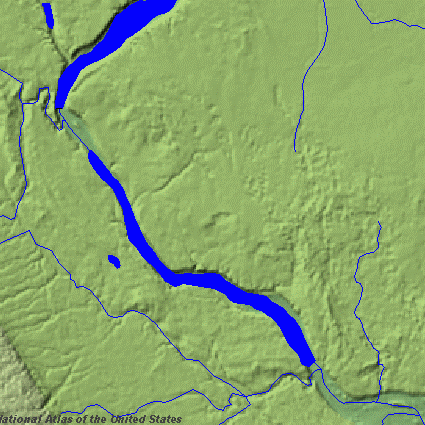
The Traverse Gap is an ancient river channel occupied by Lake Traverse, Big Stone Lake, and the valley connecting them at Browns Valley, Minnesota. It is on the border of the U.S. states of Minnesota and South Dakota. Traverse Gap has an unusual distinction for a valley: it is transected by a continental divide,[1] and in some floods, water has flowed across that divide from one drainage basin to the other. Before the Anglo-American Convention of 1818, it marked the border between British territory in the north and U.S.—or, earlier, French—territory in the south.

Key Information

Geological history

[edit]

The Traverse Gap was cut at the end of the last ice age. The Laurentide Ice Sheet decayed and receded as the Wisconsonian glaciation drew to a close, and Glacial Lake Agassiz formed from its meltwaters. The glacier blocked outlets to the north, and the outlet to the south was dammed by the Big Stone Moraine, a terminal moraine left by the ice sheet's retreat. Lake Agassiz filled until it overtopped the moraine about 11,700 years ago. The resulting enormous outflow of the lake carved a deep spillway through the moraine, through which cascaded Glacial River Warren.[2] This great river not only created the gap, it also cut the valleys of the present-day Minnesota and Upper Mississippi Rivers. River Warren drained Agassiz twice more over the next 2,300 years,[3] separated by intervals when the ice sheet receded sufficiently to uncover other outlets for Lake Agassiz.[4] About 9,400 years ago, Agassiz found a permanent outlet to the north.[3] With its former source now draining elsewhere, River Warren ceased to flow, and the spillway gorge became the Traverse Gap, now occupied by much smaller lakes and watercourses and a flat valley floor containing marshes, agricultural land, and the small community of Browns Valley, Minnesota.[5]

Topography and hydrology

[edit]
Traverse Gap looking south from ice-covered Lake Traverse (bottom of frame) to Big Stone Lake (top). Interbasin flooding is shown: The Little Minnesota River in the Mississippi watershed is entering from the west (meanders at center right margin) and is flooding the Traverse Gap (gray water, surrounding the town of Browns Valley in the center). At lower right, floodwaters from the Little Minnesota are crossing the continental divide and flowing under South Dakota Highway 10 into Lake Traverse in the watershed of Hudson Bay.

Despite the low elevation and flat topography of its floor, the Traverse Gap marks the southernmost point of the Northern Divide between the watersheds of the Arctic and the Atlantic Oceans. On the north, Lake Traverse is the source of the Bois des Sioux River, a source stream of the Red River of the North, which drains via Lake Winnipeg and the Nelson River to Hudson Bay in the Arctic Ocean. To the south, Big Stone Lake is the source of River Warren's remnant, the Minnesota River, tributary to the Mississippi, which drains to the Gulf of Mexico and the Atlantic. Big Stone Lake is now fed by the Little Minnesota River, the headwaters of which are in South Dakota. The Little Minnesota enters the gap from the west and meanders south through the old channel to Big Stone Lake. The Little Minnesota, part of the Mississippi watershed, is less than one mile (1.6 km) from Lake Traverse in the drainage basin of Hudson Bay.[5][6]

The floor of Browns Valley is flat, which allows the waters of one basin to flood across the continental divide into the other basin in times of high water. The maximum elevation on the floor of the valley is 987 feet (301 m) above sea level.[5] The Browns Valley Dike at the south end of Lake Traverse is at the same elevation; this structure was built to reduce the likelihood of flooding south across the continental divide. At 983.9 feet (299.9 m), that divide is lower than the level of the dike, and flooding at Lake Traverse has the potential to drain over the Browns Valley Dike into the Minnesota River watershed. At the south end of the gap, the Big Stone Lake reservoir pool is maintained at 967 feet (295 m), but flooded to over 975 feet (297 m) in 1997. The Little Minnesota River upstream and at a higher elevation near the divide has flooded to a level where it drained across that divide into Lake Traverse.[7] While the natural state of the area has been altered by the dike and control structures on the two lakes, interbasin flooding did occur prior to construction of those improvements.[7] The Traverse Gap therefore allows waters which would naturally flow to the Gulf of Mexico to flow to the Arctic instead,[8] and in the past has allowed water from Lake Traverse to flow in the other direction to Big Stone Lake in the Atlantic basin.[7]

Geography

[edit]

The ancient channel at Browns Valley is a mile (1.6 km) wide and some 130 feet (40 m) deeper than the surrounding terrain through which it was carved.[5] The distance from Lake Traverse to Big Stone Lake is about five miles (8.0 km).[9] The ancient channel through the moraine includes not only the land between those modern lakes, but the lakes themselves.[5]

The continental divide crosses the gap transversely at its northern end. The Minnesota-South Dakota border longitudinally bisects the old channel. Roberts County is on the South Dakota side. To the east is Traverse County, Minnesota and the community of Browns Valley near the continental divide. The southeast part of the gap is in Big Stone County, Minnesota.[9]

Human settlement

[edit]
1895 map of the region of southern Lake Agassiz, showing how the lake (its bed shown in green) funneled into the Traverse Gap at Lake Traverse. The squares are civil townships and sections within those townships under the Public Land Survey System used to subdivide public lands for sale. Minnesota is to the east (right) of the watercourses; North Dakota to the north and west (upper left) and South Dakota to the south and west.

The area has seen human presence for thousands of years. A Paleo-Indian skeleton now known as "Browns Valley Man" was unearthed in 1933 under circumstances which suggested death or interment after deposition of the gravel but before creation of significant topsoil. Found with tools of the Clovis and Folsom types, the human remains have been dated approximately 9,000 years b.p.[4][10]

The Traverse Gap was used by Native Americans, who "from time immemorial ... had placed two weather-beaten buffalo skulls where travelers paused to smoke a pipe at the divide."[11] Its significance was also appreciated by early explorers, including Major Stephen Harriman Long, who led an expedition up the Minnesota River (then called St. Peter River) across the gap and down the Red River:

... we continued our journey in what appeared to have been an old water-course, and, within three miles of the Big Stone Lake, found ourselves on the bank of Lake Travers ... The space between Lakes Travers and Big Stone, is but very-little elevated above the level of both these lakes; and the water has been known, in times of flood, to rise and cover the intermediate ground, so as to unite the two lakes. In fact, both these bodies of water are in the same valley; and it is within the recollection of some persons, now in the country, that a boat once floated from Lake Travers into the St. Peter. Thus, therefore, this spot offers us one of those interesting phenomena, which we have already alluded to, but which are no where perhaps so apparent as they are in this place. Here we behold the waters of two mighty streams, one of which empties itself into Hudson's Bay at the 57th parallel of north latitude, and the other into the Gulf of Mexico, in latitude 29°, rising in the same valley within three miles of each other, and even in some cases offering a direct natural navigation from one into the other.[12]

The native trails were later used by fur traders who had posts at Lake Traverse and Big Stone Lake, and then by Red River ox carts on the earliest of the Red River Trails.[11] Eric Sevareid and Walter C. Port also used the route on their 1930 canoe journey to Hudson Bay, described in Sevareid's book "Canoeing with the Cree".

The area was surveyed and sold to the public in the latter part of the nineteenth century. The rural part of the valley floor contains pastures, cropland, and marshes along the Little Minnesota River. The vale was named "Browns Valley" after one of its pioneer residents, which in turn gave its name to the incorporated community near its northern end. The valley floor is crossed by Minnesota State Highway 28, which becomes South Dakota Highway 10 at the south end of Lake Traverse.[5]

Natural Landmark designation

[edit]

The uppermost part of the bed of Glacial River Warren, including Big Stone and Traverse lakes, has been designated as a National Natural Landmark under the Historic Sites Act under the name of Ancient River Warren Channel.[13] It received this designation in April 1966 from the United States Secretary of the Interior, giving it recognition as an outstanding example of a geological feature of the United States' natural history.[14] The designation describes it as "a channel cut by the Ancient River Warren during the Ice Age, containing the Hudson Bay-Gulf of Mexico divide, with a lake on each side as evidence of the irregularities in Ice Age sedimentation".[13]

See also

[edit]

References

[edit]
[edit]
Revisions and contributorsEdit on WikipediaRead on Wikipedia
from Grokipedia
The Traverse Gap is an ancient river channel and glacial spillway straddling the border between and , connecting to the north with to the south via a narrow valley at Browns Valley, Minnesota, and serving as a critical remnant of prehistoric drainage patterns. Geologically, the gap originated as the primary southern outlet for the massive Glacial Lake Agassiz, a Pleistocene proglacial lake that once covered over 100,000 square miles across parts of modern-day , North Dakota, , Manitoba, and Ontario. Approximately 11,700 years ago, during the late , rising waters in Lake Agassiz breached a barrier near present-day Browns Valley, unleashing catastrophic floods through the Traverse Gap via what geologists term the River Warren—a precursor to the modern . This torrent persisted for several thousand years, with the southern outlet active until northern routes opened around 7,400 years ago, excavating a valley roughly 200 feet deep and 0.5 to 4 miles wide, carving through resistant bedrock and depositing extensive outwash plains. The Traverse Gap's topography underscores its role on the Northern Continental Divide, where it represents one of the lowest points along the divide (at approximately 984 feet above ), though lake levels are maintained at 967 feet by modern dams. North of the gap, waters from feed the , flowing northward to ; south of it, serves as the headwaters of the , directing flow southeastward to the and ultimately the . This unique has led to occasional flooding events that temporarily reverse the divide, merging the basins—such as during extreme precipitation when waters from the north spill southward. Human history in the region is intertwined with the gap's features; archaeological evidence, including the burial site of Browns Valley Man (dated to around 8,000–10,000 years ago), highlights early Indigenous occupation along its margins post-glaciation. In the modern era, the gap supports agriculture on fertile glacial soils, recreational activities around the lakes, and infrastructure like the Browns Valley Dike (constructed 1936–1941, spanning 3,700 feet to prevent flooding). Designated aspects of the area contribute to its recognition as a in 1966, emphasizing its enduring geological and ecological importance.

Geography and Location

Physical Boundaries

The Traverse Gap constitutes a narrow glacial channel measuring approximately 8 km in length, extending between at its northern terminus in and Big Stone Lake at its southern end along the Minnesota-South Dakota border. This channel, now largely occupied by the lakes and the intervening valley, represents the former outlet of Agassiz and serves as a critical hydrological link in the region's landscape. The gap's dimensions include a width of about 1.6 km and a depth of up to 46 m, with the channel excavated into underlying glacial till deposits rising to bluffs approximately 38–46 m high on either side. Centered near , at coordinates 45°36′N 96°50′W, the feature is sharply confined by prominent glacial landforms, including the Big Stone Moraine. These moraines delineate the gap's lateral boundaries, emphasizing its role as a breached barrier in the otherwise elevated terrain. As part of the broader , the Traverse Gap briefly marks the separation between watersheds draining northward to via the Red River and southward to the via the , though detailed hydrological dynamics lie beyond its physical confines.

Regional Context

The Traverse Gap is situated along the border between the states of and , primarily spanning Big Stone County in Minnesota and Roberts County in South Dakota. This position places it within the broader , a vast expanse of glacial wetlands and shallow depressions across the northern that supports diverse aquatic and terrestrial habitats. The gap is embedded in the glacial till plains characteristic of the Northern , where undulating landscapes formed by Pleistocene ice sheets dominate the terrain. To the north lies the expansive , a flat resulting from the drainage of ancient Agassiz, which contrasts with the gap's more varied topography. Adjacent to the Traverse Gap are the headwaters of the Little Minnesota River, which flows eastward into and contributes to the system, thereby influencing the hydrological patterns of the glacial landscape. The region experiences a semi-arid , marked by cold winters and warm summers, with an average annual of approximately 24 inches that sustains the surrounding ecosystems through seasonal rainfall concentrated in spring and summer.

Geological History

Formation During the Ice Age

The Traverse Gap was formed during the final stages of the Pleistocene epoch, specifically at the end of the , approximately 11,700 years ago, when Glacial Lake Agassiz overflowed its southern barrier. This massive proglacial lake, impounded by the retreating Laurentide Ice Sheet, reached a critical volume and breached the Big Stone Moraine near present-day Browns Valley, , initiating the catastrophic drainage that carved the gap across the continental divide. The overflow created , a high-energy outlet that directed southward, transforming a pre-existing topographic low into a defined channel. The erosive power of stemmed from its high-velocity flows, with estimated peak discharges ranging from 10,000 to 100,000 cubic meters per second (approximately 350,000 to 3.5 million cubic feet per second), far exceeding modern river capacities. These torrential discharges eroded the underlying glacial and , deepening the valley by 45 to 70 meters in the Traverse Gap region and widening it to accommodate the immense volume of water and sediment. The process involved abrasive scouring and hydraulic undermining, which progressively lowered the outlet threshold and amplified subsequent flows. Drainage through the Traverse Gap occurred in at least four major flood phases between approximately 12,800 and 10,600 calibrated years , corresponding to distinct lake levels (Herman, Norcross, Tintah, and Campbell phases). Each phase featured peak flows that further incised the channel, with the initial breach around 11,000 radiocarbon years (approximately 12,800 calibrated years ) marking the most intense , followed by intermittent high-discharge events that refined the morphology. By about 9,400 radiocarbon years (approximately 10,600 calibrated years ), the southern outlet was largely abandoned as shifted to northern drainage routes, stabilizing the gap's form.

Post-Glacial Evolution

The cessation of the River Warren's flow through the Traverse Gap occurred around 9,400 years ago, when glacial Lake Agassiz's northern outlet opened via the Red River, redirecting drainage northward and significantly reducing southern outflows. This transition marked the end of major catastrophic flooding, allowing the gap to begin stabilizing as a glacial . Following the floods, the Traverse Gap underwent sedimentation processes that infilled the deeply eroded channel with glacial till, outwash sands, and , gradually narrowing the active floor over millennia. These deposits accumulated from residual glacial and local fluvial activity, preserving much of the gap's form while filling former scour features. The region has experienced minimal tectonic uplift or since the onset of the , with differential isostatic rebound largely complete by the early , contributing to the long-term preservation of the gap's topographic configuration. During the Holocene, subtler adjustments shaped the valley, including gradual incision by smaller streams that downcut into the sedimentary infill and wind erosion that redistributed loess and formed localized dune sands on the valley margins. These processes have refined the landscape without altering the fundamental divide structure established during the late Pleistocene.

Topography and Hydrology

Landforms and Elevation

The Traverse Gap is characterized by a broad, U-shaped valley profile resulting from massive glacial outburst flooding, featuring a relatively flat floor flanked by steep sides that rise sharply to the surrounding moraines. This landform, averaging 4 miles in length and up to 1,300 feet in width, exhibits a depth of approximately 130 feet, with the valley floor largely occupied by Lake Traverse to the north at its normal pool elevation of 976.5 feet above sea level and Big Stone Lake to the south at 966.5 feet. The adjacent Big Stone Moraine forms prominent ridges that bound the gap, contributing to its distinct topographic enclosure. Within the gap, elevation varies subtly but critically, with the continental divide crest occurring at 977 feet above —a remarkably low point for such a feature, distinguishing it as one of the lowest major divides in . This low elevation underscores the gap's role as a narrow sill across which once spilled southward, now marked by a small rise of just separating northward and southward drainage, with minimal drop on the side and about a 10.5-foot drop to . Glacial erosion briefly shaped these contours during the , though the primary landforms persist as post-glacial inheritance. Soils across the Traverse Gap consist predominantly of fine-textured glacial lacustrine silts and clays, deposited in beds and overlying loamy from ice advance; these materials are highly erodible, particularly under agricultural use or heavy rainfall, leading to ongoing . Key features include meandering remnants of the River Warren, evident in elevated terraces that represent former floodplains at varying heights above the current valley bottom, and scattered lakes formed from cutoff meanders of the ancient channel. These elements highlight the dynamic erosional while providing a stable, if erosion-prone, substrate for the region's landscape.

Watershed Divide and Water Flow

The Traverse Gap functions as a , separating the watershed to the north—which drains through and the —from the watershed to the south, which includes and the . This division directs surface waters along divergent paths: northern flows ultimately reach via the and , while southern flows contribute to the . The gap's low-lying topography facilitates this separation despite its glacial origins, making it a critical hydrological boundary in the . In normal conditions, water flow across the divide is minimal and tightly regulated. The outlet of is managed by the Reservation Dam, which maintains the lake's normal pool elevation at 976.5 feet above sea level (as of 2024 USACE operations) to support downstream flows into the Red River basin while preventing spillover southward. is held at its normal pool of approximately 966.5 feet by the dam at Ortonville, ensuring unidirectional drainage: northward from via the and southward from via the outlet to the , with inflows like the Little Minnesota River contributing from the west. This controlled regime supports agricultural and recreational uses but underscores the engineered nature of the divide's . During extreme flood events, however, the divide's low elevation—reaching a maximum of 987 feet along the roadway and dike—allows for dynamic and potentially bidirectional water movement. When levels in Lake Traverse surpass approximately 977 feet, overflow can breach the natural sill toward the south, reversing typical flow directions. A notable example occurred during the 1997 spring floods, when waters in the system enabled temporary spillover across the gap, exacerbating flooding in both basins. Such events highlight the vulnerability of the system to heavy and . The Traverse Gap's hydrological profile as one of the lowest-elevation continental divides in profoundly shapes regional water management and flood risk assessment. At its natural sill of 977 feet, supplemented by infrastructure raised to 987 feet, it requires robust dikes and dams to mitigate spillover risks, influencing policies for the Red River and basins. This feature amplifies the need for coordinated flood control efforts, as seen in ongoing U.S. Army Corps of Engineers projects, to balance storage, release, and protection amid variable conditions.

Ecology and Environment

Flora and Fauna

The Traverse Gap's unique valley environment, shaped by glacial history, harbors remnants of tallgrass prairie vegetation, including dominant species such as big bluestem (Andropogon gerardii) and , alongside sedges in wetter areas. These prairie communities are adapted to the region's variable conditions, with drought-resistant grasses like big bluestem featuring deep root systems that tolerate periodic dry spells and support soil stability. Riparian zones along seasonal streams in the gap feature willows (Salix spp.) and , which thrive in moist, alluvial soils and contribute to bank stabilization. The fauna of the Traverse Gap reflects its position within the Prairie Pothole ecoregion, with wetland complexes on the valley floor serving as critical habitats for migratory birds, including waterfowl such as mallards and Canada geese that utilize potholes for breeding and resting. Over 200 bird species have been recorded in the broader pothole landscapes of the region, encompassing shorebirds like the upland sandpiper (Bartramia longicauda) and waterbirds such as (Sterna forsteri). Mammals common to the area include (Odocoileus virginianus) and coyotes (Canis latrans), which roam the prairie grasslands, while amphibians such as northern leopard frogs (Lithobates pipiens) inhabit vernal pools formed in seasonal wetlands. Rare species highlight the gap's biodiversity value, including the threatened Dakota skipper butterfly (Hesperia dacotae), which depends on native prairie grasses for its lifecycle and is adapted to fire-maintained habitats. These species exhibit adaptations to the gap's fluctuating hydrology, with many tolerant of periodic flooding in potholes and drought on upland prairies; for instance, the hydrological divide influences habitat availability by creating ephemeral wetlands that support breeding and foraging. The valley floor's wetland complexes act as biodiversity hotspots, fostering diverse plant-animal interactions within the Prairie Pothole ecoregion.

Environmental Challenges

The Traverse Gap faces heightened flooding risks exacerbated by , with increased frequency and intensity of heavy precipitation events projected to raise the likelihood of overflows from into the watershed. Historical floods, such as the 1997 Red River Basin event, nearly caused the failure of the White Rock Dam and led to significant erosion along the gap's low-lying divide, resulting in and loss of riparian vegetation. Similarly, the 2000 flooding in the region contributed to further soil scouring and disruption of wetland ecosystems, with water levels breaching low points in the valley and affecting adjacent farmlands. Ongoing maintenance of the Browns Valley Dike, constructed in 1941 by the U.S. Army Corps of Engineers to prevent southward drainage, remains essential to mitigate these risks, involving regular inspections, repairs, and height adjustments to counter rising water volumes from altered hydrological patterns. Surrounding agricultural activities pose substantial environmental pressures on the Traverse Gap, where intensive cropland—covering approximately 87% of Traverse County—drives through and drainage practices, leading to in local waterways and diminished . Pesticide and nutrient runoff from corn and fields contaminates wetlands and streams within the gap, promoting and altering aquatic s. Wetland drainage for farmland expansion has resulted in significant declines, with historical losses estimated at over 90% in the glaciated regions of since 1900, reducing availability for native species such as amphibians and waterfowl. These impacts collectively degrade the ecological integrity of the watershed divide, hindering natural restoration processes. Invasive species further threaten the Traverse Gap's wetlands, where reed canary grass () forms dense monocultures that outcompete native sedges and forbs, reducing plant diversity and altering soil conditions through excessive thatch buildup. Purple loosestrife () similarly invades marshy areas along the gap, displacing indigenous vegetation and decreasing habitat suitability for pollinators and birds, with its rapid spread facilitated by disturbed soils from flooding and agricultural edges. These invasives, widespread in Minnesota's prairie pothole wetlands, exacerbate and require targeted management efforts like application and native replanting to curb their proliferation. Climate change projections indicate warmer temperatures—up to 9.8°F increase in winters and 7.6°F in summers by —and shifting patterns, with a 45% rise in extreme rain events since the mid-20th century, potentially destabilizing the Traverse Gap's fragile divide through intensified . These changes may facilitate a gradual shift from grasslands to woodland encroachment, as milder winters and longer growing seasons enable species like aspen and to invade open habitats, altering the dynamics observed in records. Such transformations could heighten vulnerability to wildfires and further compromise the hydrological balance of the watershed divide. Native flora, including grasses, face additional stress from these shifts, compounding pressures on local .

Human History

Indigenous and Early Settlement

The Traverse Gap area, encompassing Browns Valley and the adjacent lakes, has evidence of habitation back approximately 10,000 years to the Late Paleoindian Plano period. The most notable discovery is the Browns Valley Man , unearthed in 1932 from a in Browns Valley, , by local artifact collector William Jensen; archaeologists documented the site in 1933, though much of the remains and associated artifacts had already been disturbed. conducted in the early 1990s confirms the burial's age at around 10,000 years , with the individual likely a male hunter equipped with distinctive Browns Valley Points crafted from brown . This find, alongside spear points and other tools, indicates early societies adapted to the post-glacial landscape of grasslands and spruce forests, pursuing such as and caribou before shifting to as the environment warmed. Prior to European arrival, the region served as traditional territory for the Sisseton and Wahpeton bands of the Dakota people, who established villages along Lake Traverse and used the Traverse Gap valley for seasonal camps, hunting, and fishing. Chiefs such as Scarlet Plume maintained camps with planting grounds near Lake Traverse, where communities cultivated crops and gathered wild rice, while venturing northwest across the plains to hunt bison herds that migrated through the area. Fishing in Big Stone Lake and the connected waterways provided essential sustenance, with the valley's position as a natural corridor facilitating travel and resource exploitation among Dakota groups like the Sisseton Wahpeton Oyate. Other leaders, including Sweet Corn, Wanata, and Matopa (noted as chief at Lake Traverse in 1834), oversaw these activities, integrating the gap's hydrological features into broader seasonal patterns of mobility and subsistence. European contact began in the early through the fur , with the Red River Trails serving as key overland routes that traversed the gap to connect with Pembina and . These oxcart paths, active from the 1820s onward, followed the Red River south to , passing directly through the low-lying Traverse Gap to reach and the headwaters, facilitating the transport of furs, , and goods by and American traders. In 1835, Joseph R. Brown established a for the in Browns Valley, acquiring about 1,000 acres and engaging Dakota communities in exchanges that intensified cultural interactions. The first systematic non-Native exploration occurred in 1839, when French scientist and cartographer Joseph N. Nicollet led a U.S. Army-backed expedition that mapped the upper Mississippi-Missouri region, including visits to and , where he documented (Dakota) encampments and the area's geography. The 1862 U.S.-Dakota War profoundly affected the Traverse Gap region, though no direct battles occurred there, as the conflict's aftermath accelerated the displacement of Dakota populations from ancestral lands ceded earlier in the 1851 Treaties of Traverse des Sioux and Mendota. These treaties had already transferred vast territories, including the gap area, to the for settlement, confining the Sisseton and Wahpeton to a narrow reservation strip along the from Browns Valley southward. Following the war's violence elsewhere in , which resulted in more than 200 settler deaths and the execution or exile of hundreds of Dakota, the federal government banned the Dakota from the state and dismantled remaining communities, forcing survivors like those under Scarlet Plume to flee or relocate. By 1866, some Sisseton and Wahpeton returned to , but permanent resettlement came only with the 1867 Lake Traverse Treaty, which established a reduced reservation for bands, marking the end of pre-colonial patterns in the valley.

Modern Development

The village of Browns Valley, located within the Traverse Gap, was officially incorporated on February 23, 1881, marking a key milestone in the region's post-frontier settlement expansion. This small community, serving as the original county seat of Traverse County, has experienced steady but limited growth, with its population recorded at 558 residents in the 2020 U.S. (estimates around 450-500 as of 2023). remains the dominant , particularly the cultivation of corn and soybeans, which together account for the majority of cropland in Traverse County, with soybeans covering approximately 167,575 acres and corn 138,917 acres as of the 2017 agricultural (updated to ~160,000 acres soybeans and ~130,000 acres corn in 2022). Key infrastructure developments in the have facilitated connectivity and resource management across the gap. U.S. Highway 75, a primary north-south route, traverses the Traverse Gap through Browns Valley, providing essential linkage between the Dakotas and while supporting regional freight and passenger movement. The Lake Traverse Flood Control Project, authorized under the Flood Control Act of 1936 and completed in 1941 by the U.S. Army Corps of Engineers, includes the Browns Valley Dike, Reservation Dam, and White Rock Dam to regulate water levels and prevent inter-basin flooding. Following the severe , which impacted and surrounding areas, additional flood mitigation efforts were implemented, including reconnaissance studies and enhancements to existing dikes under Section 205 of the Clean Water Act to bolster protection for Browns Valley. Economically, the Traverse Gap region sustains a mix of and emerging sectors. It functions as a vital transportation corridor, with U.S. Highway 75 enabling efficient cross-state travel and commerce between , , and . Tourism contributes through recreational opportunities at , adjacent to the gap, where activities such as , , , and draw visitors to Big Stone Lake State Park and nearby facilities. In recent decades, the area has faced rural depopulation trends typical of western Minnesota, with Browns Valley's population declining from 589 in 2010 to 558 in 2020, driven by out-migration and an aging demographic. Renewable energy initiatives have emerged as a potential counterbalance, including the proposed Traverse Gap Wind project, a 200-300 MW utility-scale wind farm spanning Traverse, Grant, and Stevens Counties, which has been in development since the early 2020s to generate clean power and provide local economic benefits through jobs and landowner payments.

Significance and Designation

Scientific Importance

The Traverse Gap serves as a critical geological site for studying Pleistocene megafloods, particularly the catastrophic outburst of Agassiz through the River Warren channel approximately 13,500 to 10,650 years ago (calibrated years ). This event carved a across the Big Stone Moraine, releasing vast volumes of that reshaped the regional landscape and contributed to the formation of the valley. Evidence from the gap, including erosional features and sediment deposits, provides direct records of flood dynamics, such as peak discharges estimated at 300,000 to 500,000 cubic meters per second, informing computational models of similar glacial lake outbursts worldwide. In hydrological research, the Traverse Gap exemplifies vulnerabilities in continental divides, where low-relief facilitates overflow during extreme or melt events, potentially reversing drainage directions between the and watersheds. Its flat floor, at about 987 feet (maintained by the Browns Valley Dike), has historically allowed bidirectional water flow, as documented in paleohydrological reconstructions, and serves as a in models predicting propagation in similar deglaciated terrains. These models incorporate the gap's geometry to simulate paths and assess risks in low-gradient basins under changing conditions. Archaeologically, the Traverse Gap region, particularly Browns Valley, yields significant Paleo-Indian artifacts, including the Browns Valley Man skeleton discovered in 1931, dated to approximately 8,600 years ago (calibrated) and associated with Late Paleoindian lanceolate bifaces and other burial goods. This site represents one of Minnesota's earliest documented human occupations, offering insights into post-glacial migration patterns and adaptation strategies of as they repopulated the northern plains following megaflood retreat. The artifacts, such as fluted projectile points, contribute to broader theories on the peopling of by evidencing rapid inland dispersal along receding ice margins.

National Natural Landmark

The Ancient River Warren Channel, which includes the Traverse Gap as the uppermost portion of Glacial River Warren's bed, was designated a in 1966 by the . This recognition highlights its role as a key Ice Age feature, with and serving as remnants of Glacial Lake Agassiz on either side of the Hudson Bay-Gulf of continental divide. The designation was granted under the Historic Sites Act of 1935, as the site exemplifies exceptional value in illustrating the national significance of geological processes, particularly Ice Age sedimentation and channel formation. Covering 101,560 acres across Big Stone and Traverse counties in and Grant and Roberts counties in , the landmark demonstrates irregularities in glacial deposition that shaped regional . Management of the site falls to a mix of private and state owners, with the Department of Natural Resources overseeing state-held portions in coordination with the , which provides technical support but does not control access or development. Visitation occurs at the discretion of landowners, and interpretive signs at Browns Valley explain the site's geological history and importance. No substantive alterations to the designation have occurred since 1966, though it aligns with regional initiatives to preserve glacial landscapes.

References

Add your contribution
Related Hubs
User Avatar
No comments yet.