Hubbry Logo
TristerixTristerixMain
Open search
Tristerix
Community hub
Tristerix
logo
8 pages, 0 posts
0 subscribers
Be the first to start a discussion here.
Tristerix
Tristerix
from Wikipedia

Tristerix
Tristerix corymbosus
Scientific classification Edit this classification
Kingdom: Plantae
Clade: Tracheophytes
Clade: Angiosperms
Clade: Eudicots
Order: Santalales
Family: Loranthaceae
Genus: Tristerix
Mart.[1]
Species

Tristerix is a genus of mistletoe in the family Loranthaceae, native to the Andes, ranging from Colombia and Ecuador to Chile and Argentina.[2][3] They are woody perennials usually occurring as aerial parasites, are pollinated by hummingbirds and flowerpiercers, with seed-dispersal generally by birds but occasionally by mammals (Dromiciops).[3] The genus is distinguished from other New World Loranthaceae by its simple, terminal, racemose inflorescences, together with its of 4- or 5-merous flowers, versatile anthers, and the presence of endosperm.[2] Further differences include fused cotyledons and the absence of epicortical roots.[2]

Tristerix pubescens

Phylogeny

[edit]

Tristerix was first described in 1830 by Martius,[1] who published three species: T. viridiflorus (now Macrosolen viridiflorus, T. tetrandus (now T. corymbosus), and T. reinwardtianus (now Macrosolen avenis). In 1868, Eichler placed Loranthus aphyllus and L. tetrandrus in the genus Phrygillanthus.[4] However, in 1973, Barlow & Wiens recognised these two Phrygilanthus species as Tristerix aphyllus and T. corymbosus, respectively, returning Tristerix to use.[5]

Martius described the genus as having three bracts.[1] However, this characteristic applies to only two species of the genus, (T. aphyllus and T. corymbosus). In these, two bracteoles inside a primary bract lie below the ovary.[2] The other members of the genus have no bracteoles.[2] Van Tieghem (1895) divided the genus into two subgenera, those species without bracteoles - Metastachys (with nine species), and those with bracteoles - Tristerix (with two species, T. aphyllus and T. corymbosus).[6] This division is accepted by Kuijt.[2]

A phylogenetic study of ten Tristerix species by Amico et al. (2007) found evidence for three groupings.[3] A simplified consensus cladogram of their conclusions, from analyses which used two different character sets and three methods (maximum likelihood, minimum parsimony, and Bayesian inference) for finding the tree, is given below. Note that the grouping of the Tristerix species with bracteoles remains.

See [2][3][7][8]

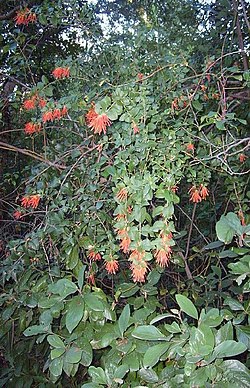
Tristerix corymbosus

References

[edit]
[edit]
Revisions and contributorsEdit on WikipediaRead on Wikipedia
from Grokipedia
Tristerix is a of mistletoes in the family , consisting of 13 of hemiparasitic woody perennials distributed across the Andean region from northern to southern and adjacent areas. These plants are epiphytic parasites that attach to a variety of host trees and shrubs, deriving water and nutrients while performing some through their leaves. The genus is distinguished from other South American by its simple, terminal racemose inflorescences bearing large, showy flowers that are typically brilliant red or red-yellow, tetramerous or pentamerous, with long corolla tubes and versatile anthers. Most Tristerix species are pollinated by birds such as hummingbirds and flower-piercers, with seeds dispersed primarily by birds and occasionally by mammals, facilitating their spread across diverse Andean ecosystems from temperate forests to biomes. The genus exhibits phylogenetic division into Central-North and Central-South clades, with diversification driven by Andean uplift and climatic changes since the Eocene. A notable exception is Tristerix aphyllus, a holoparasitic species endemic to that lacks leaves and stems, living endophytically within hosts such as Echinopsis chiloensis and Eulychnia acida, emerging only to produce orange tubular flowers for reproduction. This extreme reduction highlights the adaptive diversity within the genus, which plays key ecological roles in networks and host-parasite interactions across its range.

Taxonomy and Phylogeny

Etymology and History

The genus name Tristerix is derived from the Greek words tris (three) and stemon (stamen), alluding to the three fertile characteristic of some in the . The Tristerix was first established by Carl Friedrich Philipp von Martius in 1830, based on specimens collected from , particularly from regions in and . Martius described three initial : T. viridiflorus, T. tetrandrus, and T. longebracteatus, marking the initial recognition of the group as distinct within the . Early taxonomic treatments included some misclassifications, such as T. viridiflorus, which was later reclassified into the Macrosolen due to differences in floral and structure. In the late 19th century, Henri van Heurck van Tieghem contributed significantly to the understanding of Tristerix through his 1895 work on classification, where he introduced subgenera to organize the diverse species based on and traits, distinguishing groups like those later aligned with Metastachys. During the 20th century, major revisions refined species boundaries; Brian A. Barlow and Delbert Wiens (1973) re-evaluated segregates from related genera like Phrygilanthus, transferring several species to Tristerix and emphasizing morphological distinctions in anther and corolla features. Job Kuijt's comprehensive 1988 further updated the , accepting 11–13 species and solidifying the subgeneric framework. Recent phylogenetic studies have bolstered these classifications using molecular evidence. Amico et al. (2007) analyzed nuclear ribosomal ITS and chloroplast trnL-F sequences from multiple Tristerix species, revealing three major clades that largely support the subgeneric divisions: subgenus Metastachys (encompassing 9 species lacking bracteoles) and subgenus Tristerix (2 species with bracteoles), while also suggesting minor adjustments to species placements based on evolutionary relationships.

Phylogenetic Position

Tristerix is a within the family , which belongs to the order Santalales, the largest lineage of parasitic flowering encompassing approximately 2,500 species of hemi- and holoparasites. Multi-gene phylogenetic analyses, including (matK, rbcL, accD) and nuclear (SSU, LSU rDNA, RPB2) loci, confirm as a monophyletic family in the parasitic clade of Santalales, with root-parasitic ancestors giving rise to aerial hemiparasites like Tristerix. Within , Tristerix occupies a position in the neotropical Psittacantheae tribe, part of the core subclade that diversified in association with the emergence of tropical forests and radiations during the Eocene (~50 Ma). It shares close relationships with other Andean genera such as Gaiadendron (an early-diverging South American lineage) and Psittacanthus (a more derived neotropical group), based on nuclear and chloroplast DNA phylogenies. Morphological synapomorphies supporting this placement include simple terminal racemose inflorescences and versatile anthers, distinguishing Tristerix from basal genera. At the genus level, Tristerix is monophyletic, as demonstrated by phylogenetic analyses of nuclear ITS and chloroplast trnT-trnF and rpl16 regions across 11 species, revealing two primary clades corresponding to Andean diversification patterns. The northern clade encompasses six species (e.g., T. chodatianus, T. grandiflorus) adapted to high-elevation cloud forests, while the southern clade includes four species (e.g., T. corymbosus, T. aphyllus) in lower-elevation temperate and arid zones. Updated analyses incorporating chloroplast and nuclear DNA further support this structure with central-north and central-south lineages, linking diversification to Miocene Andean uplift events that created topographic barriers and new habitats. Divergence within the genus is estimated to have occurred primarily during the early to middle Miocene (approximately 23–11 Ma), aligning with accelerated orogeny and climatic shifts that promoted speciation along the Andean cordillera. Subgenerically, Tristerix was historically divided into subgenus Tristerix (two southern species with bracteoles and tetramerous flowers) and subgenus Metastachys (nine species lacking bracteoles), but molecular evidence indicates of Metastachys, with its species nested within the Tristerix . The Metastachys-like group exhibits hemiparasitic habits with broader host ranges, contrasting the more specialized and host preferences in the core Tristerix lineage. A key distinguishing feature from related South American genera is the absence of epicortical roots, which are otherwise common for vegetative spread in groups like Psittacanthus. This morphology, combined with fused cotyledons, underscores Tristerix's relictual position among the five ancient South American genera.

Accepted Species

The genus Tristerix currently includes 13 accepted , according to as of 2025, with phylogenetic and biogeographic studies confirming this count through revisions and additional taxa. These are classified into two primary based on morphological and molecular data, with subgenus Metastachys encompassing ebracteolate and subgenus Tristerix including those with bracteoles, though phylogenetic analyses suggest potential and a possible third subgenus for certain taxa. Subgenus Metastachys contains 10 , primarily distributed along the Andean :
  • T. aphyllus (; holoparasitic on cacti, lacking leaves and stems above ground).
  • T. chodatianus (; known from limited collections in highland regions).
  • T. corymbosus ( and ; widespread on hosts, with tubular flowers).
  • T. divaricatus (; characterized by spreading inflorescences).
  • T. grandiflorus ( and ; features large, showy flowers).
  • T. longebracteatus (; distinguished by elongated bracts).
  • T. penduliflorus (; pendulous flowering habit).
  • T. peruvianus (; adapted to montane forests).
  • T. quadraticus (; notable for quadrangular stems).
  • T. secundus ( to ; paired inflorescences in northern clade).
Subgenus Tristerix comprises three species, with debated inclusions based on bracteole presence and phylogenetic position:
  • T. peytonii (; described from recent collections in cloud forests, with diagnostic red flowers).
  • T. pubescens ( to ; pubescent stems and leaves).
  • T. verticillatus ( to ; whorled leaves, southern clade with bracteoles).
Notable synonyms include T. tetrandrus, now synonymized under T. corymbosus due to overlapping traits, and T. reinwardtianus, transferred to Macrosolen based on inflorescence and fruit differences. Diagnostic features across species often involve flower color (typically red) and bracteole absence or presence, aiding identification without detailed morphological analysis. T. peytonii represents a recent addition, described by Kuijt from Ecuadorian material collected in high-elevation forests.

Description

Morphology

Tristerix species are woody perennial hemiparasites that typically grow as aerial shrubs or vines reaching up to 1 m in length, though one species, T. aphyllus, is a holoparasite that remains largely endophytic within its host and lacks leaves. The plants attach to host stems via haustoria formed from the tip during , which penetrates the host bark to establish vascular connections without the aid of epicortical runners characteristic of many other . Stems and branches exhibit sympodial growth, arising endogenously from the in holoparasitic species like T. aphyllus, and are terete to quadrangular in cross-section, ranging from pubescent in young stages to glabrous or grayish in mature ones. Haustoria are slightly thickened and primary in nature, enabling stem parasitism without secondary root attachments. Leaves are often reduced or absent, particularly in T. aphyllus, but when present in hemiparasitic species such as T. longebracteatus and T. secundus, they are opposite and decussate, simple, and lanceolate with entire margins, measuring up to 3.5 cm in length. These leaves are leathery in texture and may subtend inflorescences, providing protection to developing structures. Distinctive features of Tristerix include fused cotyledons in the and a cup-shaped in seeds that functions as a during early development. The genus is further characterized by terminal racemose inflorescences, setting it apart from related genera with paniculate arrangements. Variation in stem and leaf traits occurs across subgenera, such as the presence of bracteoles in subgenus Tristerix.

Flowers and Fruits

The inflorescences of Tristerix species are terminal racemes bearing 4 to 26 flowers, which are pedunculate and develop acropetally, with the proximal flower typically opening and setting first. Bracteoles may be present or absent depending on the or ; for instance, they are leafy and lanceolate in T. longebracteatus but scale-like in T. secundus. These inflorescences become pendant as flowers elongate, facilitating access by pollinators. Flowers in the genus Tristerix are 4- or 5-merous, featuring a tubular corolla that measures 3–16 cm in length across , with diameters of 7–9 mm, and colors ranging from bright scarlet to with or orange bands that serve as nectar guides to attract hummingbirds. The corolla consists of five free s in a single whorl, initially light green and maturing to vivid tones; anthers are versatile, measuring 2–15 mm, and are epipetalous without fused filaments. The calyx develops irregularly with five sepals alternating with the petals, and the comprises five fused carpels forming a solid inferior . Flower is generally actinomorphic, though sigmoid curvature occurs in some like T. secundus due to uneven petal growth. Fruits of Tristerix are globose berries, approximately 5–10 mm in diameter, tightly enclosed by the persistent calyx except at the apical rim, with colors varying from white and green to orange, red, or yellow at maturity depending on and . Each berry contains a single embedded in , surrounded by a fleshy pericarp and a viscid seed coat layer (viscin) that aids to avian dispersers.

Distribution and Habitat

Geographic Range

Tristerix is a genus of hemiparasitic mistletoes endemic to the Andean region of South America, with its distribution spanning from northern Colombia southward to central and southern Chile and adjacent areas in Argentina. The northernmost species, such as Tristerix longebracteatus, occur in subpáramo and páramo habitats of central Colombia at latitudes around 4°N, while southern representatives like Tristerix corymbosus extend to approximately 42°S along the western slopes of the Andes in Chile and northwest Patagonia in Argentina. The genus exhibits a broad latitudinal range from roughly 5°N to 40°S, primarily occupying montane elevations between 1,000 and 4,000 meters, though some species reach higher altitudes up to 4,618 m in the or descend to near in southern distributions. Disjunct populations are evident in transitional biomes, including the shrublands and Patagonian temperate forests, where species like T. corymbosus and the cactus-specific (endemic to ) adapt to drier, lower-elevation environments outside the core Andean cordillera. Historical biogeography reveals that Tristerix originated in the southern during the Eocene, with subsequent northward expansion into the Central by the Early , driven by and associated climatic shifts. Diversification accelerated in two main clades: the Central-South lineage during the Early and the Central-North lineage in the Middle , reflecting the genus's response to uplift-induced rather than a north-to-south progression. Endemism and species turnover are pronounced across the range, with the highest diversity in , where seven of the genus's 13 species occur, including four endemics such as Tristerix pubescens. In , at least three species are recorded, with T. aphyllus strictly endemic to the north-central regions, underscoring regional turnover shaped by topographic barriers. Occurrences are confined to the and adjacent Andean slopes, with no verified reports outside this continental range.

Preferred Habitats and Hosts

Tristerix species primarily inhabit montane environments across the , including cloud forests in the northern regions (such as , , and ) and semi-arid shrublands in the southern areas ( and ), with some species extending into temperate forests and high-elevation páramos. These habitats span a broad altitudinal gradient from near to over 4,600 meters, allowing adaptation to diverse topographic conditions driven by . For instance, Tristerix longebracteatus occurs at 2,000–4,618 m in high Andean zones, while thrives at lower elevations of 0–1,500 m in coastal and interior valleys. The genus prefers cool, temperate climates with moderate to high humidity, typically receiving 500–2,000 mm of annual precipitation, though some species exhibit tolerance to drier conditions. Mean annual temperatures range from 9°C in southern temperate forests to warmer conditions in northern cloud forests, with Tristerix corymbosus documented in areas averaging 9°C and 1,800 mm of rain. Southern Chilean species like T. aphyllus demonstrate drought tolerance in arid, sun-exposed sites, enduring occasional freezing to -5°C, which supports their persistence in semi-arid matorral biomes. Tristerix primarily parasitizes woody angiosperms across more than 20 host genera, with a broad host range spanning at least 19 families, reflecting the genus's generalist tendencies in many species. Common hosts include trees and shrubs from families such as Salicaceae (e.g., Populus and Salix), with T. corymbosus recorded on at least 22 host species, including natives like Nothofagus in temperate forests and various shrubs in matorral habitats. Host specificity varies geographically and by species; northern Andean populations often show greater generalism, while southern species like T. corymbosus exhibit locality-dependent preferences but overall low specificity. Uniquely, T. aphyllus is a holoparasite restricted to cacti hosts in the Cactaceae family, including Echinopsis chiloensis (formerly Trichocereus chiloensis; accepted name Leucostele chiloensis) and Eulychnia acida, marking the only known loranthaceous mistletoe-cactus association.

Ecology and Biology

Parasitism Mechanisms

Tristerix species initiate through a specialized attachment process involving their bird-dispersed seeds, which possess a viscid coat that adheres firmly to the host's bark or upon deposition. Following , the emerges and its apical tip rapidly swells, pressing against the host surface to form a primary that penetrates the bark, establishing initial vascular contact. This penetration occurs via slender, multiseriate filaments that invade through host stomata or directly disrupt the and , allowing the parasite to transition into an endophytic growth phase without triggering hypersensitive host responses. Haustoria in Tristerix exhibit variation aligned with the parasite's nutritional mode: endophytic forms dominate in holoparasitic species such as T. aphyllus, where the develops internally within host tissues, forming extensive parenchymatous strands that spread "mycelium-like" through the cortex and vascular regions. In contrast, hemiparasitic species like T. corymbosus produce more superficial haustoria that remain partially external, facilitating -tapping connections for resource uptake while allowing the parasite to retain for partial autotrophy. Across species, haustoria primarily tap the host's for water and minerals, though holoparasites such as T. aphyllus also form functional connections to acquire organic carbon, with direct vessel-to-vessel linkages ensuring efficient transfer. Resource extraction imposes varying degrees of stress on hosts, with hemiparasites relying on host for and minerals while supplementing nutrition through limited in their chlorophyll-bearing tissues. Holoparasites like T. aphyllus, lacking photosynthetic capacity, depend entirely on host-derived , minerals, and carbon, leading to localized host tissue disruption as endophytic strands proliferate. This results in host damage such as branch dieback, gall-like nodules from haustorial expansion, and reduced growth, though host cells often remain viable without . Host specificity in Tristerix is generally low, with most species exhibiting polyphagous behavior and infecting a broad range of woody hosts across multiple families; however, T. aphyllus represents a specialized exception, restricted to cacti such as Echinopsis chiloensis and Eulychnia acida, where it induces pronounced galls without eliciting defensive hypersensitive reactions.

Pollination and Seed Dispersal

Tristerix species exhibit ornithophilous pollination, primarily facilitated by hummingbirds and flower-piercers, with floral adaptations such as tubular red corollas and copious nectar promoting specialization in bird pollinators. In the southern portions of their range, particularly in Chile, the green-backed firecrown (Sephanoides sephaniodes) serves as the main pollinator, actively probing flowers for nectar and transferring pollen between plants. Northern populations, extending into the Andes of Peru and Colombia, receive visits from both hummingbirds and slaty flower-piercers (Diglossa spp.), which often engage in nectar robbery by piercing the corolla base, potentially reducing but not eliminating effective pollination. This self-incompatible breeding system in species like T. corymbosus enforces outcrossing, ensuring genetic diversity despite occasional illegitimate visits. Seed dispersal in Tristerix occurs mainly through endozoochory, where frugivorous birds and mammals consume the fruits and deposit viable seeds via onto potential host branches. In Chilean temperate forests, the marsupial Dromiciops gliroides acts as the primary disperser for T. corymbosus, swallowing fruits whole and excreting sticky seeds that adhere to vegetation, with gut passage essential for breaking and enhancing rates up to 90% on suitable hosts. In more open habitats, avian dispersers such as tyrant flycatchers (Elaenia spp.) and mockingbirds (Mimus thenca) contribute significantly, enabling longer dispersal distances that facilitate colonization across fragmented landscapes. The seeds' viscid coating promotes secondary dispersal by adhering to bird bills or feet, increasing the likelihood of deposition on distant or novel hosts.

References

Add your contribution
Related Hubs
User Avatar
No comments yet.