Hubbry Logo
Triumph slant-four engineTriumph slant-four engineMain
Open search
Triumph slant-four engine
Community hub
Triumph slant-four engine
logo
8 pages, 0 posts
0 subscribers
Be the first to start a discussion here.
Triumph slant-four engine
from Wikipedia

Triumph Slant-four engine
Overview
ManufacturerTriumph Motor Company
Production1968 - 1981
Layout
ConfigurationI4
Displacement
  • 1,709 cc (104.3 cu in)
  • 1,854 cc (113.1 cu in)
  • 1,985 cc (121.1 cu in)
  • 1,998 cc (121.9 cu in)
Cylinder block materialCast iron
Cylinder head materialAluminium
ValvetrainSOHC
Combustion
Fuel systemCarburettors
Fuel typePetrol
Oil systemWet sump
Cooling systemWater-cooled

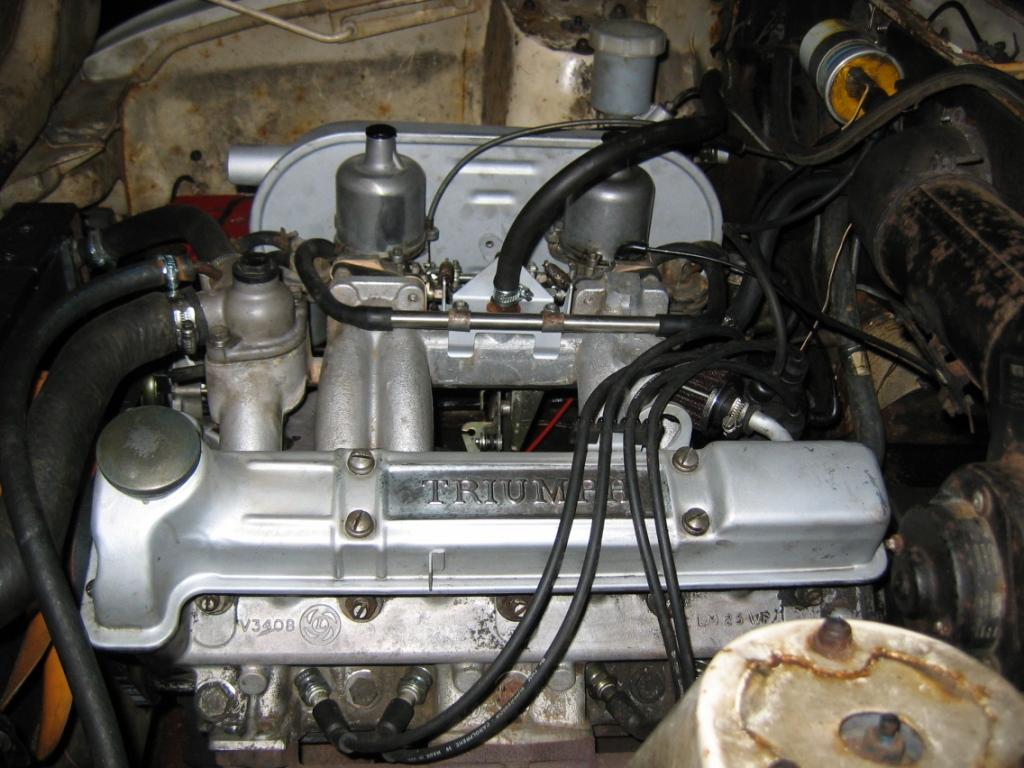
The Triumph slant-four is an inline four-cylinder petrol car engine developed by the Triumph Motor Company. It first appeared in 1968 in the Saab 99. The first Triumph model to use the engine did not appear until 1972. With an original capacity of 1.7 L, displacement grew over time to 2.0 L. Triumph production ended in 1981.

History

[edit]

In 1963 Triumph's Chief Engine Designer Lewis Dawtrey presented the results of his analysis of future engine technology trends and Triumph's anticipated needs.[1] After evaluating rotary, horizontally opposed, V4 and V6 configurations Dawtrey recommended an OHC engine family composed of both Inline-4 and V8 engines that could be built with the same tooling. The new range would be built in capacities of 1.5 L to 3.0 L, allowing it to replace both the four-cylinder Standard SC and derivative Triumph I6 engines whose roots reached back to the Standard Eight of 1953. The recommendation was accepted and development began in-house at Triumph by a design team led by Dawtrey and Harry Webster.[2] The initial model was to be a 1.5 L inline four.

At about the same time Saab was working on designing and building 55 hp 1.2-litre and 68 hp 1.5-litre prototype inline four engines for their upcoming 99 model.[3][4] UK engineering and consultancy company Ricardo was involved in the Saab project and, while not directly involved in development of the slant-four, did have a general engine-development contract with Triumph and was aware of their progress. When Saab determined that developing their own engine would be too expensive and too risky, Ricardo put Saab into contact with Triumph.[1]

Triumph agreed to supply Saab with 50,000 slant-four engines per year for the new 99.[3] Displacement had risen from 1.5 L to 1.7 L. Saab had exclusive use of the slant-four for the first several years of production.[5] Saab retained its existing transaxle, which was configured to be driven from the front of the engine. This required that the slant-four be turned 180° so that the clutch and flywheel were in the front.[6]: 47, 48  A consequence of this is that the "front"-mounted water pump would be facing the firewall/bulkhead and be inaccessible, prompting it to be relocated to the top of the cylinder block.

The engine was used first by Triumph in the Dolomite 1850, which appeared in 1972. The regular Dolomite used the 1.85 L engine, while the sportier Dolomite Sprint, unveiled in June 1973, got both a new cylinder head and an increase in displacement to 2.0 L. The slant-four was also used by Panther in the Dolomite-based Rio (1975–1977). The TR7 debuted in 1975 with the 2.0 L engine and 8-valve cylinder head. A few pre-production TR7 Sprint models received the sportier Sprint engine in 1977. Triumph stopped producing the slant-four when the TR7 was discontinued in 1981.

The V8 member of the engine family first appeared in a Triumph vehicle in 1970, fully two years before the slant-four. Development of the V8 had continued throughout the mid- to late-1960s, with early engines displacing 2.5 L. When Charles Spencer (Spen) King took over as Head of Engineering from Webster, he authorized continued development of the Triumph V8, and was also instrumental in getting the car it powered, the Triumph Stag, into production.[7] The production V8 displaced 3.0 L.

Technical features

[edit]

The slant-four's engine block is of cast iron (called chrome iron in some references). The cylinders are inclined at an angle of 45° from vertical.[6]: 44–49  This allowed the engine to be built with the same tooling needed for a V8, and reduced the overall engine height, permitting lower bonnets. The crankshaft ran in five main bearings. The pistons are aluminium with three rings. All slant-fours are oversquare, with the larger capacity versions being even more so, as the increase in displacement came from increasing the bore diameter while holding the stroke length constant.

The cylinder head was cast from aluminium alloy. Combustion chambers were wedge-shaped. The single overhead camshaft was driven by a single-row 38 in (9.5 mm) chain. The eight valves, two per cylinder, were inline and were operated on by the camshaft through bucket tappets with shims for adjustment.

Sprint 16-valve engine

[edit]
Cross-section of Dolomite Sprint cylinder head, highlighting the single cam operating both inlet and exhaust.
Triumph Dolomite Sprint engine

Triumph added a unique 16-valve cylinder head to the slant-four for the 1973 Dolomite Sprint. At the time there were at British Leyland (BL) both Harry Mundy, who worked on engine development at Jaguar, and Walter Hassan, also at Jaguar but in charge of engine technology development at BL as well. These two shared data on four-valve cylinder heads with King.[6]: 55, 56 

A team of engineers led by King and "with co-operation from Harry Mundy and the engineers at Coventry Climax",[5] developed a 4-valve-per-cylinder head where all of the valves are actuated by a single camshaft rather than the more conventional DOHC arrangement. The valves are arranged in two rows of eight, inclined 27° from vertical. The inlet valves are 1.38 in (35.05 mm) in diameter and are operated by the camshaft lobes through bucket tappets, while the exhaust valves are 1.21 in (30.73 mm) in diameter and are operated through rocker arms.[6]: 58, 59  The design of the cylinder head won a British Design Council award in 1974.[8]

Capacity was increased to 1,998 cc (122 cu in), and larger HS6 SU carburettors were fitted. Other changes to the Sprint engine included a duplex timing chain and alloy timing cover.[6]: 49, 60  The big-end journals were also cross-drilled.[9]

The engine was expected to make 135 bhp,[10] and King returned from holiday "to find an engine running on the bed giving 150 bhp at the first build."[11] Hence, it was initially intended to be named the 'Dolomite 135'. This was changed to 'Dolomite Sprint' and published reasons vary. One oft-repeated rumour is that production lines could not guarantee 135 bhp. However according to Matthew Vale,[6] it was during development that Triumph switched to measuring power from imperial (SAE) to metric (DIN), which calculated outputs approximately 5% lower. In this case 135 bhp SAE is 127 bhp DIN.[6]: 103 

The Dolomite Sprint has been described as "the world's first mass-produced multi-valve car".[12] Multi-valve engines had first appeared in 1912, with the most recent prior to the release of the Sprint engine being the Cosworth BDA and Nissan S20 (1969) and Lotus 907 (1972), but they had not been used in mass-production vehicles until after the introduction of the Dolomite Sprint.

The 16-valve 2.0 L engine was also used in a small number of prototype and pre-production TR7 Sprints built at Triumph's plant in Speke during 1977.[13]

Saab B engine

[edit]

In 1972 Saab brought production of the 1.85 L slant-four in-house to their Scania division at a facility in Södertälje. An uncorroborated letter to the editor of Motor Sport magazine references a Saab press release of July 1970 that indicates that this was planned from the outset.[14] Following the transfer Saab embarked on a redesign of the engine that resulted in the Saab B engine. Displacement increased to 2.0 L, but the bore diameter was 0.3 mm (0.012 in) smaller than the enlarged Triumph version, resulting in a swept volume of 1,985 cc (121.1 cu in).

Saab's B engine shared much with the original Triumph design, including bore centres and bearings, but some previously problematic features, such as the water-pump and its seal, were redesigned.

Slant-four variants

[edit]
Displacement Bore Stroke Compression ratio Induction Power Torque Year(s) Notes
1,709 cc (104.3 cu in) 83.5 mm (3.3 in) 78 mm (3.1 in) 8.8:1 1x Zenith-Stromberg 175 CD 80 hp (59.7 kW) at 5200 rpm 94 ft⋅lb (127.4 N⋅m) at 3000 rpm 1969-1971 Saab 99 - single carb
9.0:1 Bosch D-Jetronic 87 hp (64.9 kW) at 5200 rpm 129 ft⋅lb (174.9 N⋅m) at 3000 rpm 1970 Fuel-injected Saab 99 1.7 L
1,854 cc (113.1 cu in) 87 mm (3.4 in) 78 mm (3.1 in) 9.0:1 2x SU HS4 92 hp (68.6 kW) at 5200 rpm 108 ft⋅lb (146.4 N⋅m) at 3500 rpm 1972 - 1980 Triumph Dolomite 1850
9.0:1 1x Zenith-Stromberg 175 CD 88 hp (65.6 kW) at 5000 rpm 147 ft⋅lb (199.3 N⋅m) at 3000 rpm 1971-1974 Saab 99 - single carb
9.0:1 Bosch D-Jetronic 95–97 hp (70.8–72.3 kW) at 5000 rpm 147 ft⋅lb (199.3 N⋅m) at 3500 rpm 1971 - 1972 Fuel-injected Saab 99 1.85 L
1,998 cc (121.9 cu in) 90.3 mm (3.6 in) 78 mm (3.1 in) 9.5:1 2x SU HS6 127 hp (94.7 kW) at 5700 rpm 122 ft⋅lb (165.4 N⋅m) at 4500 rpm 1972 - 1980 Sprint 16V engine
9.25:1 2x SU HS6 105 hp (78.3 kW) at 5500 rpm 119 ft⋅lb (161.3 N⋅m) at 3500 rpm 1975 - 1981 TR7

Motorsports

[edit]

The 16-valve Sprint engine was raced in FIA Group 1 and Group 2 in Dolomite Sprints prepared by Leyland Special Tuning at Abingdon.[6]: 119–128  Their first season was 1974, but no finishes were achieved that year. In 1975 the engines received larger carburettors and a revised camshaft. With these changes they completed their first event at the Mintex Rally in 7th place. This was followed by a 2nd place in the Avon Tour of Britain and a 3rd at the Lindisfarne Rally. At the Lombard RAC Rally the Dolomite Sprint won the 2-litre class and Group 1 outright and placed 16th overall. For 1976 focus had shifted to the TR7, originally with the Sprint engine but by 1978 all efforts were focused on the TR8.

The private Broadspeed team headed by Ralph Broad did extensive development on the Sprint engine, bringing power up to a claimed 174 bhp (129.8 kW). Sprint-powered Broadspeed cars won the Manufacturer's Championship in 1974 and took the driver's title in 1975. In 1976 the cars took 2nd in the 2-litre class, and won again in 1978.

The Sprint engine also appeared in Formula Three, in Anson Cars and March Engineering chassis. The Sprint-powered March placed 8th in the 1976 season. In 1979 two March cars driven by Nigel Mansell and Brett Riley finished 5th and 8th in the F3 championship and each driver won one race in the Vandervell British F3 Championship.

References

[edit]
Revisions and contributorsEdit on WikipediaRead on Wikipedia
from Grokipedia
The Triumph slant-four engine is a family of inline-four-cylinder, overhead-camshaft petrol engines developed by the , notable for its 45-degree slanted cylinder block that enabled a lower bonnet line in vehicles. Produced from to 1981, it featured a cast-iron block with an aluminum , five-bearing , and wet-sump , with displacements ranging from 1.7 to 2.0 litres and power outputs from approximately 87 to 127 horsepower depending on the variant and configuration. First introduced in the through an exclusive licensing agreement, it powered several Triumph models including the Dolomite saloon, high-performance Dolomite Sprint, and TR7 , while also serving as the basis for the Triumph Stag's 3.0-litre V8 by combining two units. Development of the slant-four began in as a collaborative effort between Triumph and Saab, coordinated by the engineering consultancy & Co., to provide Saab with a modern powerplant for its upcoming 99 model amid challenges in developing an in-house engine. Triumph, under designer Harry Mundy, created the slanted design to optimize packaging and performance, supplying Saab with exclusive rights for the initial years while retaining production capabilities at its Canley factory. The original 1.7-litre (1709 cc) version, with a bore of 83 mm and stroke of 78 mm, produced 87 PS (64 kW) at 5,500 rpm in the Saab 99, featuring a single overhead operating two valves per via bucket tappets. This engine was water-cooled, naturally aspirated, and mounted longitudinally in Saab's front-wheel-drive layout, marking an early example of international engine sharing in the . Once the exclusivity period ended around 1971, Triumph adapted the engine for its own rear-wheel-drive vehicles, starting with the 1.85-litre (1854 cc) variant in the Dolomite saloon, which delivered 91 bhp at 5,200 rpm and 105 lb-ft of at 3,500 rpm using twin Zenith-Stromberg carburettors and a 9.0:1 compression ratio. The standout application came in 1973 with the Dolomite Sprint, featuring a unique 16-valve cylinder head designed with , increasing the displacement to 2.0 litres (1998 cc) with a 90.3 mm bore, yielding 127 bhp at 5,700 rpm and 122 lb-ft of at 4,500 rpm at a 9.5:1 compression ratio—this made it one of the first mass-produced multi-valve production car engines. In the TR7, introduced in 1975, the 2.0-litre version produced 108 hp in European markets and 92 hp in the US due to emissions controls, paired with a five-speed manual or three-speed automatic transmission. The engine faced reliability issues like head gasket failures in later years amid British Leyland's manufacturing challenges. The slant-four's innovative design influenced subsequent engines, including Saab's turbocharged B-series derivatives for the 99 and models.

History and Development

Origins and Design Initiation

The development of the Triumph slant-four engine began in under the leadership of Lewis Dawtrey, Triumph's chief engine designer, as part of a comprehensive initiative to create a modular family of overhead-camshaft (OHC) engines. This family included not only the inline-four configuration but also provisions for a V8 variant, sharing common components such as bore centers and cylinder dimensions to streamline production and reduce costs across Triumph's lineup. Dawtrey's vision emphasized innovative engineering to meet the evolving demands of the in the , focusing on versatility for various vehicle platforms. The was conceived as a modern, compact powerplant suitable for mid-sized cars, incorporating oversquare bore-to-stroke ratios to enable higher engine speeds and improved . This choice allowed for better and reduced reciprocating mass, facilitating rev ranges that supported performance-oriented applications without excessive size or weight. A key feature was the 45-degree slant of the cylinder block, which maintained the necessary deck height for robust construction while permitting a lower bonnet line in vehicle installations, enhancing aerodynamic profiles and driver visibility. Initial collaboration discussions with Saab emerged in the mid-1960s, facilitated by the engineering consultancy & Co., driven by the Swedish manufacturer's need for a reliable four-cylinder as it planned to phase out its two-stroke designs in models like the . Saab sought a four-stroke solution to comply with tightening emissions standards and improve market competitiveness, leading to an agreement where Triumph would supply the slant-four for the upcoming , with Saab providing financial support to accelerate production. This partnership marked an early step toward shared manufacturing, though full-scale output would follow in subsequent years.

Production Timeline and Collaborations

The Triumph slant-four engine entered production in 1968, initially powering the model, with Triumph manufacturing the engines at its factory and supplying up to 50,000 units annually to meet Saab's needs. This marked the first automotive application of the design, which featured a slanted cylinder block to optimize packaging in compact engine bays. The collaboration originated from a 1964 agreement between Triumph and Saab, where Saab provided funding for the engine's development in exchange for exclusive use of the powerplant for several years, along with Saab's engineering contributions to improve emissions compliance and long-term durability. Under this partnership, Triumph handled initial production while benefiting from Saab's expertise, enabling the engine to meet emerging regulatory standards in both European and export markets. Triumph began incorporating the slant-four into its own vehicles in 1972 with the Dolomite 1850 saloon, expanding to variants like the Dolomite Sprint and TR7 through the late 1970s. Production of the engine for Triumph applications continued until 1981, when discontinued it alongside the TR7 due to escalating manufacturing costs, outdated tooling at the Canley plant, and broader financial pressures amid the company's restructuring efforts. Meanwhile, Saab transitioned to in-house manufacturing of its adapted B engine variant starting in January 1972, enlarging the displacement to 1985 cc for improved performance in models like the EMS. By retaining core elements of the original Triumph design—such as the slanted block and single overhead camshaft—while incorporating Saab-specific modifications for turbocharging compatibility, the B engine powered over 588,000 units through 1984 and continued in the series, exceeding 500,000 adaptations in total production.

Technical Description

Core Engine Architecture

The Triumph slant-four engine employs an inline-four cylinder configuration, with the cylinders inclined at a 45-degree angle from the vertical to reduce overall engine height and enable lower hood lines in production vehicles. The cylinder block is constructed from cast iron, providing durability while maintaining a compact footprint compatible with shared manufacturing tooling for V8 variants. This slanted design contributes to a lower center of gravity, enhancing vehicle handling characteristics. The cylinder head is made of aluminum , featuring wedge-shaped chambers that promote efficient and . The engine adopts oversquare bore and stroke dimensions in its base form, exemplified by a 83.5 mm bore and 78 mm , which supports higher engine speeds and responsiveness. Total displacements vary from 1,709 cc to 1,998 cc, achieved primarily through changes in bore size while retaining the 78 mm for consistency across variants. A five-bearing design enhances smoothness and rigidity under load, with bearings of steel-backed phosphor-bronze overlaid with lead-indium for reliable . The engine utilizes a system, where the oil pump is driven via an idler shaft, ensuring full-flow and adequate supply to all components. Accessories are chain-driven from the , supporting efficient operation of ancillary systems. Cooling is provided by a water-cooled system pressurized to 13 lb/in², incorporating an integral thermostat housing and water pump for effective temperature regulation. The single overhead camshaft (SOHC) arrangement interfaces with this architecture to manage valve timing.

Valve Train and Ancillary Systems

The Triumph slant-four engine features a single overhead camshaft (SOHC) mounted in the aluminum cylinder head, supported by five bearings for smooth operation and reduced wear. This design integrates with the engine's slanted cylinder block to enable straightforward cylinder head removal without disturbing the camshaft, enhancing maintenance efficiency. The standard eight-valve configuration has the camshaft lobes operating directly on bucket tappets for the inlet valves and on rocker arms for the exhaust valves, with adjustable solid tappets requiring periodic valve clearance checks—typically 0.008 inches (0.2 mm) for inlets and 0.018 inches (0.45 mm) for exhausts when cold—to maintain precise timing and performance. The SOHC is driven by a single-row from the , ensuring synchronized operation with minimal stretch under normal loads. Later models upgraded to a duplex for improved durability and reduced noise, particularly in emissions-compliant versions. A hydraulic chain tensioner, featuring an oil-resistant rubber slipper, spring-loaded plunger, and activation, maintains proper tension automatically, contributing to the engine's by preventing slippage and excessive on components. This system operates effectively across the engine's operating temperatures, with torque specifications for the set at 7-10 lbf ft to secure alignment. Fuel delivery in the slant-four relies on carbureted induction, with early models using twin Zenith-Stromberg 150 CDS(E)V units for balanced air-fuel mixture, later transitioning to twin SU HS4 carburetors for enhanced throttle response and economy. A mechanical diaphragm , driven by an eccentric on the idler shaft, supplies 2.5-3.5 lb/in² pressure to the carburetors. Ignition evolved from a contact-breaker (with 0.014-0.016 inch gaps) to electronic systems in 1970s emissions variants, improving spark consistency and reducing points wear for better cold starts and fuel efficiency. Ancillary systems support efficient operation through a cross-flow cooling , where circulates via passages optimized for the slanted block, maintaining even temperatures under load. The system includes a pressurized setup at 13 lb/in² with a that bypasses the during warmup before enabling full flow, driven by a 12-bladed water pump on the idler shaft. This compatibility with cross-flow ensures effective heat dissipation without hot spots. Lubrication employs a wet-sump oiling system with a full-flow filter and gear-type pump, also idler-shaft driven, delivering 45-55 lb/in² at operating temperature to critical areas like the , , and bearings via dedicated galleries. ventilation routes through a filter in the cam cover to the carburetors, minimizing emissions and contamination.

Engine Variants

Standard 8-Valve Configurations

The standard 8-valve configurations of the Triumph slant-four engine utilized a cast iron block paired with an aluminum cylinder head, incorporating a single overhead camshaft and five main bearings for crankshaft support. These variants maintained a redline around 6,000 rpm, balancing everyday drivability with reliable performance in passenger cars. The design emphasized durability and ease of production, with the slanted cylinder orientation facilitating shared manufacturing processes with the related V8 engine. The initial 1,709 cc version, produced from 1969 to 1971, featured a bore of 83.5 mm and a of 78 mm, delivering power outputs ranging from 80 to 87 hp at approximately 5,500 rpm and between 94 and 105 lb⋅ft at 3,200 rpm. This displacement was primarily deployed in the , where it provided adequate propulsion for the front-wheel-drive sedan. Compression ratios were typically 9.0:1, fed by a single Zenith-Stromberg . In 1971, Triumph introduced the enlarged 1,854 cc variant with an increased bore of 87 mm while retaining the 78 mm stroke, extending production through 1980. This configuration produced 88 to 97 hp at 5,200 rpm and up to 105 lb⋅ft of torque at 3,500 rpm, with compression ratios varying from 8.0:1 to 9.0:1 depending on market and application. It powered models like the , offering improved mid-range pull suitable for compact saloons, and was later adapted for continued Saab use with minor in-house modifications such as revised valve timing. A further enlarged 1,998 cc eight-valve variant, with a bore of 90.3 mm and stroke of 78 mm, was introduced in 1975 for the TR7 sports car. This version produced 105-108 hp at 5,500 rpm in European markets and up to 119 lb⋅ft of torque at 3,500 rpm, with a compression ratio of around 9.0:1 and twin Zenith-Stromberg carburetors. To meet stricter U.S. emissions standards after 1975, it was detuned with lower 8.0:1 compression and modified carburetion, reducing output to 92 hp initially and as low as 76 hp in later models with catalytic converters.

16-Valve Sprint Configuration

The 16-valve Sprint configuration of the Triumph slant-four engine was introduced in 1973 as a high-performance variant specifically developed for the Sprint saloon. This setup utilized the existing slant-four cylinder block but featured an enlarged displacement of 1,998 cc achieved through a 90.3 mm bore, paired with a 78 mm stroke. It incorporated 16 valves—four per cylinder—actuated by a single overhead camshaft (SOHC) operating through long rockers, enabling improved breathing and higher engine speeds compared to the standard eight-valve design. The engine delivered 127 hp at 5,700 rpm and 122 ft·lb of at 4,500 rpm, supported by a 9.5:1 and twin SU HS6 carburetors. This configuration allowed for a 0-60 mph time of approximately 8.4 seconds and a top speed of 119 mph in the Dolomite Sprint, marking it as one of the fastest production saloons of its era. The design emphasized efficiency and reliability, with the SOHC arrangement simplifying production while accommodating the layout for enhanced power output. The cylinder head was engineered by Harry Mundy in collaboration with engineers from , under the oversight of Spen King's team at , resulting in an innovative single-cam system that was the first of its kind in mass-produced form. This achievement earned the engine a British Design Council Award in 1974 for its pioneering approach to technology in a production automotive context. The award highlighted the head's lightweight aluminum construction and rocker-actuated valve train, which balanced performance gains with manufacturability. Production of the 16-valve Sprint engine was limited, with approximately 22,941 units assembled between 1973 and 1980, primarily for the Dolomite Sprint. In 1977, around 60 prototypes were built to evaluate its integration into the as the TR7 Sprint, though the project did not proceed to full production due to corporate decisions at . These prototypes demonstrated the engine's adaptability to mid-engine layouts, achieving similar power outputs while underscoring the configuration's versatility beyond the saloon application.

Saab B Engine Adaptations

Saab initially sourced the in 1,854 cc displacement for use in the from 1971 to 1972, under a licensing agreement established in 1965. By 1972, Saab transitioned to in-house production of its adapted family at the plant, redesigning the block to be taller to accommodate an increased 90.0 mm bore while retaining the original 78.0 mm stroke, resulting in a displacement of 1,985 cc. This modification allowed for greater power potential and better integration with Saab's layout, where the engine was mounted transversely with drive from the front end. Key engineering adaptations focused on enhancing reliability and cooling efficiency, including revised water jacketing around each and improved manifolds to optimize flow and reduce overheating risks common in the original design. The was also reworked with larger valves, refined ports, and constant-depth combustion chambers to support systems. In the and 900 models, the base B engine configuration delivered approximately 97 hp with carburetion, rising to around 118 hp in fuel-injected variants equipped with Bosch D-Jetronic systems. Production of the B engine continued at through the and into the mid-1980s, with over 500,000 units manufactured to power the and early 900 series, incorporating progressive emissions modifications such as adjusted fueling maps and compatibility for European markets. Distinct from the Triumph original, Saab's versions employed metric fasteners throughout for manufacturing consistency and integrated electronic controls for later Bosch K-Jetronic injection, facilitating turbocharging adaptations while maintaining the core slant-four architecture.

Vehicle Applications

Triumph Automobiles

The Triumph slant-four engine powered several models in the Triumph automobile lineup during the , providing a and efficiency in compact saloons and sports cars. Introduced in the Dolomite series, the engine's inline-four configuration with overhead camshaft offered improved breathing compared to earlier straight-six designs, enabling responsive acceleration in everyday driving. Its adoption in these vehicles marked Triumph's shift toward more modern, Saab-influenced engineering, with displacements tailored to market needs. The saloon, produced from 1972 to 1980, featured the slant-four in its base and high-performance variants, with approximately 100,000 units equipped with this engine across the 1850 and Sprint models. The standard 1,854 cc version delivered 91 bhp, mated to an OHC head on an iron block for reliable mid-range suitable for family use. In contrast, the Dolomite Sprint, launched in 1973, utilized a 1,998 cc displacement with a 16-valve , producing 127 bhp at 5,700 rpm and 122 lb-ft of at 4,500 rpm, enhanced by twin 1¾-inch SU HS6 carburettors and tuned exhaust extractors that optimized low-end delivery. To accommodate the increased power, the Sprint incorporated stiffened engine mounts and a reinforced gearbox, along with a stronger rear and optional for better traction. Total production reached 79,010 for the 1850 models and 22,941 for the Sprint, underscoring the engine's role in sustaining Triumph's saloon sales amid economic challenges. In the sports coupé, manufactured from 1975 to 1981, the slant-four was fitted as the standard in a 1,998 cc eight-valve configuration, yielding 105 in European markets for respectable 0-60 mph acceleration in about 9.1 seconds. The TR7's wedge-shaped body and front suspension created a spacious optimized for the slanted inline-four layout, allowing easy access for maintenance while accommodating potential V8 upgrades. U.S. versions were similarly detuned to 92 hp due to stricter emissions standards, featuring additional catalytic converters and air injection systems that reduced output but ensured compliance. This integration highlighted the engine's versatility in a 1,000 kg , contributing to the TR7's appeal as an affordable entry-level despite its modest power.

Saab Automobiles

Saab first adopted the for its 99 model, which entered production in 1968 and continued until 1984. The initial configuration featured a displacement of 1,709 cc, delivering 80 hp (DIN). This engine powered the early variants, marking the Swedish manufacturer's transition from two-stroke designs to a more conventional four-cylinder layout. Over the model's lifespan, upgrades included a 1,854 cc version producing 88 hp (DIN), followed by the introduction of Saab's in-house B engine adaptation at 1,985 cc with 97 hp in base form. The higher-performance EMS variant of the Saab 99 utilized fuel injection on the 1,985 cc B engine, achieving 110 hp (DIN) with a compression ratio of up to 9.2:1 tailored for European markets to optimize efficiency and power on available fuels. These EMS models emphasized refined performance, with the slant-four's compact design enabling seamless integration into the 99's chassis. The Saab B engine represented an evolution of the original Triumph design, with Swedish engineers redesigning the block and head for improved durability while retaining the characteristic 45-degree cylinder slant. The slant-four's tilted architecture proved particularly advantageous for packaging in the , allowing a low hood line that complemented the model's aerodynamic body style and enhanced overall visibility and drag reduction. In total, more than 588,000 units were produced, all equipped with slant-four derivatives, underscoring the engine's central role in the model's commercial success. The , introduced in 1978 as a successor to , inherited the B engine family for its early production run through 1981, with fuel-injected versions reaching 110 hp (DIN) in models like the EMS and GLE trims. This carryover ensured continuity in performance and reliability during the 900's initial years, before Saab shifted to newer inline-four architectures.

Other Vehicle Uses

Beyond the primary applications in Triumph and Saab vehicles, the slant-four engine found limited use in other automotive projects, primarily prototypes and low-volume luxury models. The Panther Rio, a hand-built luxury saloon produced by Panther Car Company from 1975 to 1977, incorporated the Triumph slant-four in a re-bodied Triumph Dolomite chassis with upscale features like Connolly leather upholstery and walnut trim. The base model used the 1,854 cc eight-valve version producing 91 bhp, while the Rio Especial variant featured the 1,998 cc 16-valve configuration from the Dolomite Sprint, outputting 127 bhp for a top speed of 115 mph and 0-60 mph acceleration in 8.7 seconds. Only 38 units were constructed, highlighting its rarity as a niche application of the engine. In 1977, Triumph engineered a series of TR7 Sprint prototypes by installing the 1,998 cc 16-valve slant-four engine—producing 127 bhp—into the standard TR7's wedge-shaped body to boost performance over the base model's eight-valve unit. Approximately two dozen pre-production examples were built at the factory for evaluation, but escalating development costs, combined with difficulties achieving U.S. emissions compliance, prevented full-scale production. The slant-four has occasionally appeared in enthusiast-built kit cars and custom vehicles as a replacement powerplant, leveraging its compact design and availability from donor cars, though such uses remain infrequent and undocumented in large numbers. No adaptations for marine or industrial purposes have been recorded. Following the cessation of original production in , slant-four engines continue to be supported for restorations through specialists offering rebuilt units and components, ensuring ongoing viability for classic vehicle maintenance.

Motorsports Applications

Rally and Touring Car Racing

The Triumph slant-four engine powered Broadspeed's Dolomite Sprint entries in the British Saloon Car Championship (BSCC) from 1974 to 1978, marking a period of competitive success in production-based . In 1974, the team clinched the manufacturers' championship with consistent performances from drivers and Tony Dron. In 1975, captured the drivers' championship, securing six victories in the Broadspeed-prepared Dolomite Sprint. The racing engines were highly tuned versions of the slant-four, delivering nearly 190 horsepower through modifications such as lubrication to maintain oil pressure under high lateral loads. To comply with FIA Group 1 regulations for series-production touring cars, British Leyland ensured at least 500 Dolomite Sprint units were built for , allowing the model to compete with minimal alterations beyond safety features. Key enhancements included upgraded suspension systems for better handling and lightweight panels to reduce overall weight without compromising structural integrity, enabling the cars to excel on circuits like and . In rally events, the slant-four-equipped Dolomite Sprint proved effective in categories, highlighted by Brian Culcheth and Johnstone Syer's victory in the 1975 RAC Rally's Group 1 class, where they finished 16th overall despite challenging gravel and forest stages. The engine's inherent durability shone in the frequently wet and muddy British rally conditions, providing consistent power delivery and minimal failures that bolstered British Leyland's commitment to saloon car and rally programs throughout the decade.

Single-Seater and Formula Racing

The Triumph slant-four engine, particularly its 2.0-litre 16-valve Sprint variant, was adapted for British Formula 3 racing from 1976 to 1979, marking a significant foray into single-seater competition for British Leyland's powertrain. Prepared primarily by Swindon Race Engines and backed by Unipart sponsorship, the engine powered March Engineering chassis in the hands of the David Price Racing team, competing against dominant Toyota and Ford units. These adaptations highlighted the engine's potential in open-wheel applications, though it struggled for outright victories amid intense competition. The racing version retained the core slant-four —a single overhead operating four valves per cylinder—but underwent extensive modifications to meet 3's 2.0-litre production-derived regulations, which mandated a lubrication system for reliability under high g-forces. Key changes included Bosch-Kugelfischer mechanical with cast magnesium inlet manifolds, widened inlet ports by 1 mm, modified exhaust ports, Cosworth-forged pistons at 12.7:1 compression, a lightened block (11 lb removed), and a tuftrided, polished with heat-treated rods. These enhancements addressed early overheating issues via revised head gaskets and improved water circulation, enabling peak power of 165-168 at 5,800 rpm, with strong top-end performance but modest mid-range compared to rivals. Debuting in the 763 chassis with driver Tony Dron in , the program focused on development rather than results, yielding no podiums as the team refined reliability. Progress came in 1977 with the 773, where achieved a second-place finish and other points-scoring results, and Ian Taylor contributed additional points; the engine's consistency improved, though Novamotor units claimed most wins. The 1978 season saw the ground-effect-inspired 783, with Needell delivering eight top-six results (two seconds) and Riley adding two thirds in five starts, often finishing just behind -powered RT1s at circuits like Donington and . By 1979, the updated 793 continued in select races, but the formula's shift toward more potent Japanese engines limited further success, with Triumph units scoring occasional podiums like Stefan Johansson's efforts. Unipart's investment exceeded £500,000 across the period, underscoring the engine's competitive viability despite no titles. The 16-valve cylinder head's design demonstrated the slant-four's aptitude for high-revving operation, influencing subsequent British engineering efforts in DOHC configurations.

References

Add your contribution
Related Hubs
User Avatar
No comments yet.