Hubbry Logo
Feast of OrthodoxyFeast of OrthodoxyMain
Open search
Feast of Orthodoxy
Community hub
Feast of Orthodoxy
logo
8 pages, 0 posts
0 subscribers
Be the first to start a discussion here.
Feast of Orthodoxy
Feast of Orthodoxy
from Wikipedia
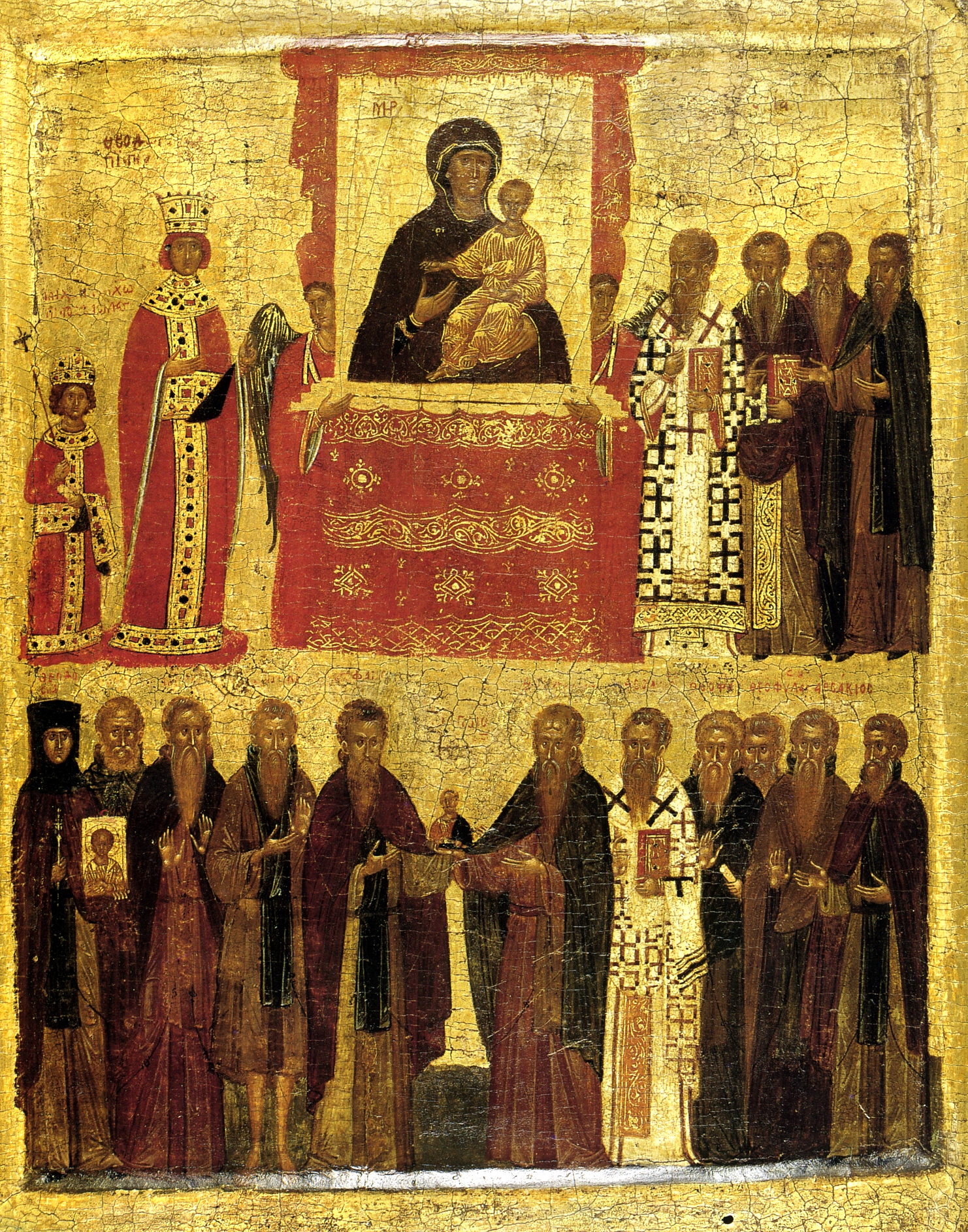
Icon of the Triumph of Orthodoxy illustrating the "Triumph of Orthodoxy" under the Byzantine empress Theodora and her son Michael III over iconoclasm in 843. Late 14th to early 15th century icon (National Icon Collection 18, British Museum).

The Feast of Orthodoxy (or Sunday of Orthodoxy or Triumph of Orthodoxy) is celebrated on the first Sunday of Great Lent in the Eastern Orthodox Church and other churches using the Byzantine Rite to commemorate, originally, only the final defeat of iconoclasm[1] on the first Sunday of Lent in 843, and later also opposition to all heterodoxy.[2]

History

[edit]

Despite the teaching about icons defined at the Seventh Ecumenical Council in 787, the iconoclasts began to trouble the Church again. After the death of the last iconoclast emperor, Theophilos, his young son Michael III, with his mother the regent Theodora, and Patriarch Methodios, summoned the Synod of Constantinople in 843 to bring peace to the Church. At the end of the first session, all made a triumphal procession from the Church of Blachernae to Hagia Sophia, restoring the icons to the church. This occurred on 11 March, 843 (which that year was the first Sunday of Lent). The Synod decreed that a perpetual feast on the anniversary of that day should be observed each year on the first Sunday of Great Lent, and named the day, "the Sunday of Orthodoxy" (ἡ Κυριακὴ τῆς Ὀρθοδοξίας).[3]

Service

[edit]
Icon of the Virgin and Child with angels and Sts. George and Theodore Stratelates, c. 600, one of a very few icons to survive Iconoclasm (encaustic on panel. Saint Catherine's Monastery, Mount Sinai).

A special service is celebrated in, usually, only cathedrals and monasteries.

After orthros (matins) or the Divine Liturgy, a procession is made with icons to some destined spot (often merely around the church). Meanwhile, a Canon, attributed to St. Theodore the Studite, is sung.

Once the procession arrives at the place, the Synodikon (decree of the Synod of Constantinople) is proclaimed aloud by the deacon. This Synodikon begins with the memory of certain saints, confessors and heroes of the faith, to each of whose names the people cry out: "Eternal Memory!" three times. Then follows a long list of heretics of all kinds, to each of which the answer is: "Anathema" once or thrice. These heretics comprise all the major opponents of the Orthodox Faith, Arians, Nestorians, Monophysites, Monothelites, Iconoclasts, and so on. Then comes again "Eternal Memory" to certain pious emperors, from Constantine the Great on.

There are inevitably differences between the Orthodox and Byzantine Catholic lists. The Orthodox acclaim Photius, Michael Cerularius, other anti-Roman patriarchs and many emperors. They curse Pope Honorius among the Monothelites, the opponents of Hesychasm. The Synodicon used by Greek-Catholics tends to omit a large number of these names. Also, there are minor differences between the Synodika of individual autocephalous churches.

In Greek usage, the Creed is normally recited by the cantors in the Divine Liturgy, but on the Sunday of Orthodoxy especially it is often recited by a lay member of the congregation who is a secular official; it is a prerogative offered to the head of State, if present, in continuation of the same privilege held by the Emperors.

The service as it had been used in the Russian Empire differed, with the Emperor and his family being acclaimed, and "Eternal Memory!" proclaimed for each member of the Romanov Dynasty; all who deny the divine right of kings and all who "dare to stir up insurrection and rebellion against it" had been anathematized. In the Russian Orthodox Church Outside of Russia anathemas have been added against modernism and ecumenism.

Liturgical texts

[edit]

The liturgical texts for the Canon, Synodicon etc., and the rubrics are found in either euchologion, Orthodox or Greek-Catholic. The theme of the day is the victory of the True Faith over heresy. "This is the victory that overcomes the world, our faith" (1 John 5:4). Also, the icons of the saints bear witness that man, "created in the image and likeness of God" (Genesis 1:26), becomes holy and godlike through the purification of himself as God's living image.

The First Sunday of Great Lent originally commemorated the Prophets such as Moses, Aaron, and Samuel. The Liturgy's Prokeimenon and alleluia verses as well as the Epistle and Gospel readings appointed for the day continue to reflect this older usage.

Theological significance

[edit]

The name of this Sunday reflects the great significance which icons possess for the Orthodox Church. They are not optional devotional extras, but an integral part of Orthodox faith and devotion. The debate involved important issues: the character of Christ's human nature, the Christian attitude towards matter, and the true meaning of Christian redemption.[4] Icons are held by the Orthodox to be a necessary consequence of Christian faith in the Incarnation of the Word (John 1:14), Jesus Christ. Icons are considered by Orthodox Christians to have a sacramental character, making present to the believer the person or event depicted on them. However, the Orthodox always make a clear doctrinal distinction between the veneration (proskynesis) paid to icons and the worship (latria) which is due to God alone.

References

[edit]
[edit]
Revisions and contributorsEdit on WikipediaRead on Wikipedia
from Grokipedia
The Feast of Orthodoxy, also known as the Sunday of Orthodoxy or the Triumph of Orthodoxy, is an annual celebration in the observed on the first Sunday of , commemorating the restoration of the of holy icons in 843 AD following the resolution of the Iconoclastic Controversy. This feast marks the definitive victory of Orthodox over , a heretical movement that began in the under Byzantine Leo III, who issued edicts against the use and of religious images, viewing them as idolatrous. The controversy, spanning over a century and involving periods of intense persecution often called the "Century of Blood," was affirmed against by the Seventh at in 787 AD, though persisted until its final defeat in 843; the Council affirmed that icons should be —but not worshipped—as representations of Christ, the (Mother of God), and the saints, reflecting the reality of the where God became visible in human form. The restoration in 843 was achieved through the efforts of Empress Theodora, her son Emperor Michael III, and Patriarch Methodios, who organized a from the Church of the Virgin at Blachernai to in , publicly reinstating icons in the churches after their suppression under Emperor Theophilos. This event, celebrated annually since then, underscores the Orthodox Church's commitment to the tangible expression of faith through sacred art, with icons serving as "windows to heaven" that honor the prototypes they depict rather than the material itself, as articulated by theologians like St. John of Damascus and St. Theodore the Studite. In contemporary observance, the feast features the of St. Basil the Great, a with icons, and the reading of the Synodikon of , a liturgical text that proclaims the Church's faith, anathematizes heresies including , and commemorates saints and defenders of . Pan- services are often held, gathering faithful from various jurisdictions to reaffirm unity, while scriptural readings from and emphasize faith and the calling of disciples. Originally, the day also honored figures like , , and , linking the triumph to the broader biblical witness.

Historical Background

Iconoclastic Controversy

The Iconoclastic Controversy refers to a series of religious and political disputes in the over the veneration of religious icons, viewed by opponents as idolatrous violations of the Second Commandment (Exodus 20:4). The theological roots of stemmed from concerns that honoring images equated to worshiping created objects rather than , a position reinforced by interactions with Islamic theology, which strictly prohibited visual representations of the divine to avoid . Emperor Leo III (r. 717–741), an Isaurian of Syrian origin, initiated the movement in 726 by ordering the removal of an icon of Christ from the Chalke Gate in , interpreting recent natural disasters and military setbacks against Arab forces as on such practices. This act was influenced by critiques from Muslim neighbors, who saw Byzantine icon veneration as polytheistic, prompting Leo to seek religious reform amid territorial losses. The first phase of the controversy (726–787) escalated under Leo III's 730 edict, which formally prohibited the production and of icons, leading to of images in churches and public spaces, as well as persecution of iconophiles (defenders of icons). Iconoclast emperors like Leo III and his son (r. 741–775) enforced these policies through imperial decrees, viewing icon as a threat to and imperial authority; intensified the campaign, associating icons with and promoting the as the sole legitimate representation of Christ. In 754, convened the Iconoclastic Council at Hieria near , attended by 338 bishops, which declared icon idolatrous and anathematized its proponents, further entrenching church-state tensions as emperors assumed control over doctrinal decisions. Key iconophile defenders included Germanus I of (r. 715–730), who resigned in protest against the 730 edict and was deposed for refusing to endorse , and St. , a monk in Umayyad who authored three influential treatises (On the Divine Images, ca. 726–730) arguing that icons honored the without idolatry, as they depicted Christ's human form. These efforts highlighted the rift between imperial power and ecclesiastical tradition, with persecutions including exile, mutilation, and a "decade of blood" (762–775) under targeting monks and clergy. The second phase (815–843) revived iconoclasm under Emperor Leo V the Armenian (r. 813–820), who, facing Bulgarian military defeats, attributed them to lingering icon veneration and issued a ban in 815, convening a synod at Hagia Sophia to reaffirm the 754 council's decrees. This resurgence was continued by Leo's successors, Emperor Michael II (r. 820–829) and his son Theophilos (r. 829–842), who maintained prohibitions and persecuted iconophiles, including monastic communities that resisted through theological writings and underground icon production. Monastic opposition, led by figures like Theodore the Studite, underscored the controversy's impact on church-state relations, as emperors sought to centralize religious authority while alienating the monastic establishment, which preserved iconophile traditions. Patriarch Tarasius of Constantinople (r. 784–806), an earlier iconophile who had helped convene the Second Council of Nicaea in 787 to affirm icons, exemplified the enduring clerical resistance that weakened iconoclasm over time. The prolonged conflict strained Byzantine society, dividing theologians, artists, and the populace until its resolution in 843.

Restoration and Establishment

Following the death of Emperor Theophilos in 842, his widow Empress Theodora assumed the role of regent for her young son, , and promptly moved to end the iconoclastic policies that had persisted during her husband's reign. Theodora, who had reportedly maintained iconophile sympathies despite the official ban, lifted the prohibition on icons, initiating a swift restoration process that marked the conclusion of the second phase of the Iconoclastic Controversy. In early 843, under Theodora's patronage, a local synod was convened in with the newly installed Methodios I presiding, after the deposition of the iconoclastic John the Grammarian. This assembly formally restored the veneration of icons, reaffirmed the decisions of the Seventh Ecumenical Council of 787, and issued anathemas against and its proponents, solidifying the orthodox position on religious imagery. The synod's decrees emphasized that icons were to be venerated as representations of the divine, not worshipped as idols, thereby resolving the doctrinal strife that had divided the Byzantine Church for over a century. The triumph was publicly celebrated on March 11, 843—the first Sunday of Great Lent—with a grand procession from the Church of the Virgin at Blachernai to the Hagia Sophia in Constantinople, where icons were solemnly reinstated during a Divine Liturgy. This event, led by Patriarch Methodios, Empress Theodora, and Emperor Michael III, symbolized the definitive victory of iconophile orthodoxy and prompted a synodal decree establishing the Sunday of Orthodoxy as an annual feast commemorating the restoration and the defeat of heresy. In the immediate aftermath, the Church undertook the reconciliation of former iconoclast clergy who recanted their views, allowing many to retain positions after penance, while icons of Christ, the Virgin Mary, and the saints were rapidly repopulated in churches and public spaces. This rebuilding of iconographic traditions helped reinvigorate Byzantine religious and artistic life, with Empress Theodora later venerated as a saint in the Orthodox Church for her pivotal role in preserving doctrinal purity.

Liturgical Observance

Date and Calendar Placement

The Feast of Orthodoxy, also known as the Sunday of Orthodoxy, is annually observed on the first Sunday of in the . This placement occurs within the movable Lenten cycle, which is calculated according to the used by most Orthodox jurisdictions for determining Pascha (), typically falling in late February or early March on the . For instance, in 2025, the feast was celebrated on March 9, while in 2026, it will be on March 1. This date positions the feast one week after Cheesefare Sunday (the Sunday of Forgiveness), which concludes the pre-Lenten period and initiates the strict fasting of on the following Monday, known as . It marks the beginning of the core Lenten themes of repentance, humility, and spiritual purification, serving as a triumphant entry into the 40-day fast leading toward Pascha. The observance originated in 843 as the first such Sunday commemorating the restoration of icon veneration. As part of the broader Triodion period—which spans from the Sunday of the Publican and Pharisee (three weeks prior to ) through —the Feast of Orthodoxy facilitates a liturgical transition from the preparatory Sundays of reflection to the intensified asceticism of the fast. This timing emphasizes spiritual renewal in the weeks following the season (such as in Slavic traditions), redirecting focus from festivity to doctrinal fidelity and communal prayer.

Vespers Service and Procession

The service for the , celebrated on the Saturday evening preceding the first Sunday of , follows the standard structure of Orthodox evening prayer but incorporates specific elements from the Lenten Triodion to commemorate the restoration of icons. The service begins with (the "Little Entrance") and the singing of stichera on "Lord, I have cried" that blend Resurrection themes from the with festal hymns praising the triumph over , such as those invoking the prophets' foretelling of Christ's and the of holy images. After the entrance with the hymn "O Gladsome Light" and readings from the , the service progresses to the Litiya, a where the clergy bear icons, book, and the from the to the church's solea, accompanied by litanies for the living and departed. During the Litiya, special stichera are chanted in Tone Two, emphasizing the unity of the Church and the defense of Orthodox doctrine through icons, followed by the apolytikion () of the feast: "Thy pure image do we venerate, O good One, asking forgiveness of our sins, O Christ our God. For by it Thou didst come and save our souls." This icon-bearing symbolizes the faithful's active participation in the victory of , with icons of Christ, the , and prominent saints like Methodius and elevated on poles and carried by and holding lit candles to represent the of true dispelling . The often extends to a around the church exterior, particularly in good weather, evoking the historic 843 Byzantine led by Empress Theodora from the Church of the Blachernae to , where participants chanted victory hymns over a distance of several miles. Upon returning, the blesses the assembly with , asperging the icons and faithful as a sign of purification and renewal. In monasteries and larger parishes, the and foster communal devotion, with the joining the chanting of the festal "We venerate Thy most pure image, O Good One, and ask forgiveness of our transgressions, Christ God; for through it Thou hast come and saved our souls" during the icon-bearing, underscoring the incarnational theology affirmed by the Seventh Ecumenical Council. This evening rite, rooted in Byzantine imperial that publicly proclaimed the end of , sets the tone for the following day's , where the Synodikon is proclaimed to anathematize heresies and affirm Orthodox truths. Outdoors , when feasible, enhance the symbolic reenactment of the 843 triumph, drawing participants from diverse Orthodox jurisdictions in a display of ecclesial unity.

Divine Liturgy and Synodikon

The for the Feast of Orthodoxy is celebrated on the morning of the first Sunday of according to the rite of St. Basil the Great. This liturgy incorporates icon-themed scriptural readings that underscore themes of divine vision and faithful witness, central to the veneration of holy images. The reading from :24-26, 32-12:2 highlights the faith of , who chose affliction with God's people over worldly honor, and recounts the endurance of prophets and righteous figures who "saw" God's promises from afar, evoking the theophanic glimpses reflected in . The from :43-51 describes Jesus calling and , promising the latter to see "greater things" such as opened and angels ascending on the Son of Man, symbolizing the fuller made visible through icons. Icons carried in from the preceding service are often placed prominently in the church, enhancing the liturgical focus on their restoration. The recitation of the Synodikon of Orthodoxy forms the liturgical climax, typically occurring after the conclusion of the , following the procession with icons. Composed following the 843 Synod of Constantinople, the Synodikon is a declarative text affirming the Orthodox faith, beginning with praise of God, the , and endorsements of the ecumenical councils and patristic traditions. It proceeds to invoke "Eternal Memory" for key iconophile defenders, such as Empress Theodora, who orchestrated the icons' restoration, and Patriarch Methodios, who led the synod, with the congregation responding "Eternal Memory" three times for each. Anathemas are then proclaimed against heresies and heretics, including iconoclasts who rejected sacred images and Nestorians who separated Christ's divine and human natures, eliciting the response "Anathema" three times from the faithful. The Synodikon is intoned or read aloud by the or from the ambo, allowing the assembly to participate actively in its proclamation, which typically lasts 20-30 minutes when rendered in full. In some traditions, portions may be abbreviated to focus on icon-related elements, while the complete form emphasizes doctrinal boundaries against error. The text concludes with prayers for the preservation of the Orthodox among the living, invoking blessings on hierarchs, , and who uphold the of icons and the Church's teachings. This verbal of memory and condemnation reinforces the feast's theme of Orthodoxy's triumph, uniting the community in confession of the true .

Liturgical Texts

The Canon of Orthodoxy

The Canon of Orthodoxy, attributed to Theophanes (8th–9th century), was composed to celebrate the restoration of the veneration of icons following the Iconoclastic Controversy. It comprises nine odes in Tone Four, drawing on biblical imagery to extol icons as witnesses to the Incarnation and to denounce heresy. The Canon follows the standard Byzantine structure, with each ode centered on an irmos, such as the first: "Israel passed through the on foot, as though it were dry land; and through the raging waters the chosen people walked, having as their guide. The same we sing to Christ, who led us over the waters of ." Troparia in each ode praise the defenders of and the role of icons in the . In the liturgy, the Canon is sung at Matins on the eve of the feast, with six troparia per ode, integrating elements from the Octoechos. It reinforces the themes of light over darkness, evoking the 843 triumph under Empress Theodora. The Canon's themes align with the feast's kontakion, which celebrates the Theotokos's role in the Incarnation, enabling icon veneration.

Hymns, Tropes, and Readings

The liturgical celebration of the Feast of Orthodoxy features several key hymns that emphasize the restoration of icon and the triumph of Orthodox doctrine. The , chanted in Tone 2, proclaims: "We Thy most pure image, O Good One, and ask of our transgressions, O Christ God. For choosing of Thy own will to be born of the Ever-Virgin, Thou hast been pleased to be depicted in images for our benefit. Through her, grant us of sins." This , drawn from the Lenten Triodion, underscores the incarnational basis for icons and is sung at the conclusion of and , as well as during the . Complementing it is the in Tone 8: "The uncircumscribable Word of the Father became circumscribed in Thy womb, O ; He restored the blurred icon to its ancient state, and joined it to the divine Spirit. He also granted to the creation a of salvation. Wherefore, we praise the ancient plan of the Father." This text highlights the Theotokos's role in the , enabling the depiction of the divine, and is intoned during following the canons. Tropes, or poetic intercalations, enrich the psalmody of the services, particularly during , where stichera are inserted between verses of 148–150 (the Polyeleos) and other . These tropes weave references to icons and the defeat of into the biblical text; for instance, at "O God, save Thy people and bless Thine inheritance" (:9), expansions invoke the holy icons as channels of and , transforming the psalm into a celebration of 's victory. Similar intercalations appear in the stichera at Lord, I Have Cried ( 140–141) during , such as "Advancing from ungodliness to the true faith and illuminated by the light of divine knowledge, we keep the feast of ," which parallels the of icons later in the service. These elements, integral to the , were standardized in the Lenten Triodion following the 843 Synod of , ensuring their consistent use across Orthodox traditions. Scriptural readings for the feast draw from both Old and New Testaments to prefigure and affirm the of icons as a of God's presence. At Great Vespers on the preceding Saturday, three paremiya (readings) are appointed, the first being 5:13–15, recounting the appearance of the Archangel Michael—sword drawn in reverence—to near , symbolizing the sacred encounter with the divine that icons make accessible to the faithful. Subsequent readings include Judges 6:2, 7, 11–24 (Gideon's ) and selections from 3 Kingdoms (1 Kings) 8, emphasizing God's dwelling among His people. During the , the from :24–26, 32–40 (extended to 12:1–2 in some rubrics) extols the faith of Israel's ancestors, portraying them as exemplars who "endured as seeing Him who is invisible," linking to the visible witness of icons. The Gospel reading is John 1:43–51, where Christ calls and , revealing Himself as the ladder between heaven and earth (echoing Jacob's vision), thus affirming icons as bridges to the incarnate . These texts, fixed in the Triodion post-843, portray the prophets as foreshadowing the iconographic tradition.

Theological Significance

Veneration of Icons

The veneration of icons in Eastern Orthodoxy distinguishes between latria, the worship due solely to God as the Creator, and dulia or proskynesis, the relative honor extended to saints and their depictions, ensuring that icons are not treated as idols but as conduits of reverence to the divine prototype they represent. This practice views icons as "windows to heaven," facilitating a spiritual encounter with the holy figures portrayed without implying divinity in the material image itself. The theological foundation for icon veneration rests on , particularly the , where the eternal Word assumed human flesh in the , rendering visible and depictable what was previously invisible. As affirmed by the Second Council of Nicaea in 787, icons of Christ are valid because they honor the reality of his dual nature—fully divine and fully human—without separating or confusing the two; the council decreed that "the honor which is paid to the image passes on to that which the image represents, and he who reveres the image reveres in it the subject represented." However, the cannot be fully depicted in icons, as the Father remains uncircumscribable, and attempts to portray the Godhead risk by reducing the divine essence to human form. Orthodox icons encompass several types, including Christological depictions such as the Pantocrator (Christ as Ruler of All), which symbolizes his sovereignty and judgment; Marian icons portraying the (Mother of God), often shown with the to emphasize her role in the ; and hagiographic icons of saints, illustrating their lives and martyrdoms to inspire emulation. These are typically crafted using egg tempera on wooden panels, a technique that employs natural pigments mixed with egg yolk for vibrant, durable colors, allowing the image to transcend mere artistry and serve as a theological statement. During the Feast of Orthodoxy, veneration practices include kissing the icons on the hands or feet to express and respect for the , censing them with to signify prayers rising to , and lighting candles before them to illuminate the sacred and symbolize the light of Christ. These acts foster communion with the heavenly realm, affirming the restoration of icon use in 843 as a triumph of orthodox doctrine.

Doctrinal Implications

The Feast of Orthodoxy affirms the concept of orthos doxa, or "right belief," in the Eastern Orthodox tradition, originating from the Greek roots emphasizing correct as essential to the Christian . This celebration extends beyond the restoration of icons to encompass a comprehensive rejection of all heresies that distort the apostolic teaching, including , which subordinated the Son to the Father, and , which denied Christ's full humanity. The Synodikon recited during the feast's services explicitly anathematizes these errors, underscoring 's commitment to the dogmatic definitions of the seven ecumenical councils as the safeguard of true . Ecclesiologically, the feast reinforces the authority of the Church as the pillar of truth, manifested through the decisions of councils such as the Second Council of Nicaea (787) and the Synod of 843, which together affirm the unity of doctrine, , and the sacraments as integral to ecclesial life. By commemorating the triumph over , it highlights the Church's role in preserving the incarnational reality against imperial or heretical impositions, fostering a visible communion that binds believers in shared . This ecclesial emphasis promotes the Church's ongoing conciliar structure, where hierarchical and synodal governance ensures fidelity to tradition amid potential divisions. Soteriologically, the feast ties icon veneration to the doctrine of theosis, or deification, portraying icons as conduits for believers to participate in Christ's victory over sin through the , which sanctifies and matter itself. By rejecting heresies that undermine Christ's dual nature, such as those echoing Manichaean dualism, the celebration affirms that involves the transformation of the whole person—body and —into divine likeness, with icons serving as tangible aids in this process. In modern ecumenical contexts, this doctrine informs dialogues with Protestants, who often critique images as idolatrous, by clarifying icons' role in affirming the without , as explored in Reformed-Orthodox exchanges. The feast's ongoing significance lies in its annual reminder of doctrinal fidelity against contemporary challenges like , which parallels historical heresies by diminishing the sacredness of the material world. Since its establishment in 843, the observance has undergone no major liturgical changes, maintaining its core texts and rites to perpetuate Orthodox identity. In the 20th century, amid broader revivals of patristic theology and , the feast gained renewed emphasis as a bulwark for authentic in an era of ideological threats, reinforcing its timeless call to vigilance.

References

Add your contribution
Related Hubs
User Avatar
No comments yet.