Hubbry Logo
TrollstigenTrollstigenMain
Open search
Trollstigen
Community hub
Trollstigen
logo
8 pages, 0 posts
0 subscribers
Be the first to start a discussion here.
Trollstigen
Trollstigen
from Wikipedia
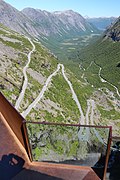
Trollstigen in 2021
visitor center of Trollstigen
Trollstigen after modifications in 2005
Trollstigen viewing platform

Trollstigen (or trollstigvegen; English: The troll path[1][2]) is a serpentine mountain road and pass in Rauma Municipality, Møre og Romsdal County, Norway.

It is part of Norwegian County Road 63 that connects the town of Åndalsnes in Rauma and the village of Valldal in Fjord Municipality. It is a popular tourist attraction for its steep incline of 10% and eleven hairpin bends up a steep mountainside. During the peak of the tourist season, about 2,500 vehicles pass daily pass this landmark.[3][4] During the 2012 season, 161,421 vehicles traversed the route, compared to 155,230 vehicles during 2009.[5]

The road is narrow with many sharp bends, and although several bends were widened during 2005 to 2012,[6] vehicles over 12.4 metres (41 ft) long are prohibited from driving the road. During the 2011 and 2012 seasons, buses up to 13.1 metres (43 ft) were temporarily allowed as a trial.[7][8] At the 700-metre (2,300 ft) plateau are a car park and several viewing balconies overlooking the bends and the Stigfossen waterfall. Stigfossen falls 320 metres (1,050 ft) down the mountainside. The pass has an elevation of approximately 850 metres (2,790 ft).

Trollstigen is closed during late autumn and winter. A normal operating season stretches from mid-May to October but is sometimes be shorter or longer because of weather conditions.

Etymology

[edit]

Trollstigen means the troll path or troll trail, from the Norwegian stig[9] (also spelled sti), from Old Norse stigr.[10]

History

[edit]
Visitor centre opened in 2012

Trollstigen was opened on 31 July 1936 by King Haakon VII after eight years of construction.

A major tourist facility including a restaurant was completed in 2012. Several viewing platforms have been constructed and older constructions improved upon. Trollstigen (along with County Road 63) was officially opened as a national tourist route by the Minister of Transport and Communications on 16 June 2012.[11] Trollstigen itself (and the alpine summits to the west) lies within the Trollstigen landscape protection area,[12] while the alpine area east of Trollstigen, including the Trolltindene range, is part of Reinheimen National Park.[13]

In the summer of 2005, the road was repaired, and about 16 million Norwegian kroner was spent to protect from rockfalls and make driving on the road safer.

In June 2021, Telia Norge commissioned an eco-friendly mobile base station powered entirely by solar, wind and hydrogen to provide mobile phone coverage at Trollstigen for the first time ever.[14]

Opening and closing dates

[edit]
Trollstigen visitor center in April, when the road is still closed during winter
Viewpoint at the Trollstigen road.
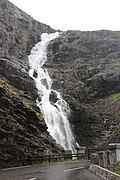
Stigfossen waterfall has a total fall of about 240 meters
Year Open Closed Comment
1994 20 May 27 September[15]
1995 25 May[16]
1996 24 May
1997 6 June 24 September[17]
1998 15 May 15 October[17] closed because of snow
1999 14 May 10 September[18] temporarily closed 9 August because of landslide,[19] early winter closing because of construction work.
2000 26 May[20] 20 August closed early because of construction work[21]
2001 21 May 21 August closed early because of construction work[22]
2002 23 May 16 September Early closing because of maintenance work.[23]
2003 28 May 15 August closed early because of landslide and flooding[24][25]
2004 29 May
2005 1 June 15 November latest closing since 1992
2006 3 May
2007 23 May 17 October[26]
2008 27 May 4 November[27]
2009 20 May 23 October[28] closed because of avalanche
2010 28 May 4 November[29]
2011 13 May[30] 24 November[31]
2012 1 June[5] 5 November[32]
2013 22 May[33] 13 November[34]
2014 8 May[35] 1 December[36][37][38] 8 December[39] temporarily closed 23 November[36]
2015 13 May[40] 24 November[41] 23 November[42]
2016 25 May[43] 3 November[44] Closed because of snow
2017 24 May[45] 13 November[46] 8 November[39]
2018 11 May[47] 26 October,[48] open again 16 November[49] closed for the winter 26 October, open again 16 November because of warm weather[49] Closed 2 December because of storm.[50]
2019 16 May[51] 30 October[52]
2024 17 June[53] rockfall[54]
2025 11 July 15 August[55] roadworks[56]
2026+2027 1 June 15 August[55] roadworks
[edit]

See also

[edit]

References

[edit]
[edit]
Revisions and contributorsEdit on WikipediaRead on Wikipedia
from Grokipedia
Trollstigen, known as the "Troll's Path," is a renowned serpentine mountain in that connects the Romsdal Valley near with the Valldal Valley, featuring eleven dramatic bends along a steep 9–10% incline and rising to an elevation of approximately 850 meters above . This approximately 5-kilometer stretch is part of Norwegian 63 and forms a key segment of the National Tourist Route Geiranger–Trollstigen, celebrated for its engineering marvel and breathtaking vistas of rugged mountains, cascading waterfalls like Stigfossen, and deep fjords. Constructed over eight years (1928–1936), Trollstigen was officially opened on July 31, 1936, by King , transforming an ancient trail used for centuries into a modern roadway that exemplifies Norwegian ingenuity in navigating challenging terrain, though subject to closures for maintenance and risks, such as in 2024 and a delayed 2025 opening. The road's , with its narrow path carved into sheer rock faces and supported by stone walls, has made it a bucket-list destination for drivers and cyclists, though it imposes restrictions such as a maximum length of 12.4–13.3 meters due to the tight bends. Typically open from mid-May to early October, it attracts around 150,000 vehicles per season, but closures occur for weather, maintenance, or risks, with a parallel tunnel providing an alternative route. Enhancing the visitor experience, the route includes architect-designed viewpoints, rest areas, and a modern built into the mountainside by Reiulf Ramstad Arkitekter, blending steel, glass, and natural stone to harmonize with the landscape while offering panoramic overlooks. The area's ties into its name, evoking mythical trolls that supposedly guard the steep passes, adding cultural allure to its natural and historical significance as one of Norway's premier scenic drives.

Overview

Location and Significance

Trollstigen is situated in Rauma Municipality within county, , at approximately 62°28′N 7°40′E. This iconic forms a vital link between the town of in the Romsdalen valley and the village of Valldal in the region, traversing dramatic and mountain landscapes. As an integral segment of the National Tourist Route Geiranger–Trollstigen, it exemplifies Norway's commitment to showcasing its natural beauty through designated scenic drives. The route ascends steeply from near , around 50 meters, to an of 850 meters over its signature 5-kilometer stretch, featuring eleven bends that wind up the mountainside. This engineering feat not only connects remote valleys but also highlights the rugged terrain of the region, with viewpoints offering panoramic vistas of cascading waterfalls and sheer cliffs. In 2012, Trollstigen received formal recognition as part of Norway's National Tourist Routes, underscoring its cultural and historical importance, while the surrounding area falls under the Trollstigen Landscape Protection designation to preserve its pristine environment. Renowned worldwide as an marvel and natural spectacle, Trollstigen draws approximately one million visitors annually in the years leading up to 2024. However, it was closed throughout the 2024 season due to rockfall risks and reopened on July 11, 2025, following extensive safety improvements. Its global fame stems from the thrilling drive through untamed , blending accessibility with awe-inspiring scenery that has captivated travelers since its opening in . The site's significance extends beyond recreation, serving as a symbol of Norwegian ingenuity in harmonizing with .

Route Description

Trollstigen is a dramatic 5 km mountain pass road characterized by 11 numbered bends, stretching from the base near Stigfossen to the edge of Trollveggen. The route winds through steep mountainsides, offering striking views of the lush Romsdalen valley below. Prominently featured along the path is the 320-meter-high Stigfossen , which cascades down the cliffside and is crossed by a distinctive stone bridge midway up the climb. The road's steep average of 10% challenges drivers as it ascends approximately 300 meters in its final stretch to reach the plateau at around 850 meters above . Originally constructed to a narrow width of 3.3 meters to navigate the rugged terrain, sections have since been partially widened to accommodate modern vehicles while preserving the route's iconic narrow character. Several hairpin bends were widened between 2005 and 2012 to improve safety. A year-round provides an alternative route past the landslide-prone Korsmyra section on the broader –Trollstigen route. As part of Norwegian County Road 63, Trollstigen integrates with the broader European route E136 network near , providing a scenic alternative to the valley . During peak tourist season from late May to October, the segment operates as two-way traffic with managed flow to handle high volumes, though larger vehicles are restricted to enhance safety and visitor experience.

Etymology

Name Origin

The name Trollstigen is derived from two key elements in the : "," which refers to the mythical creatures prominent in Norwegian as large, often mischievous or malevolent beings associated with mountains and wilderness, and "stigen," the definite form of "sti," denoting a steep path, , or climb. These creatures, rooted in and later folk tales, are typically depicted as turning to stone upon exposure to , symbolizing the rugged, untamed landscapes they inhabit. Linguistically, the full name translates literally to "the troll's path" or "troll trail," evoking a route navigated by entities through formidable terrain. An alternative and widely accepted interpretation is "," stemming from the word's connection to "stige" (ladder) and the road's visual resemblance to ascending rungs formed by its sharp bends against the steep walls. This dual meaning underscores the road's challenging topography, designed to wind dramatically upward. The name Trollstigen was adopted during the road's construction in the late 1920s and early , aligning closely with the Romsdal region's and traditions, where such names blend everyday with mythical .

Cultural References

Trollstigen's name and dramatic landscape have long been intertwined with Norwegian , where are depicted as massive, nocturnal creatures inhabiting remote mountains and turning to stone upon exposure to sunlight. Local legends associate the area with these mythical beings, suggesting that roam the surrounding peaks of the Romsdalen valley at night, with the road's path evoking ancient troll trails through the rugged terrain. along the route playfully caution drivers about slumbering , reinforcing the 's enduring presence in the region's cultural narrative. The pass has appeared in various media, particularly travel documentaries that highlight 's scenic wonders and mythical heritage. It features prominently in films and videos showcasing the Geiranger-Trollstigen National Tourist Route, such as Travel's exploration of the Golden Route, which emphasizes its hairpin bends and views as emblematic of Norwegian adventure. Documentaries like "Norway Roadtrip" series on further document Trollstigen as a must-see destination, blending its natural beauty with tales of trolls to captivate global audiences. These portrayals often draw on artistic inspirations, including illustrations by , whose 19th- and early 20th-century works depict trolls guarding mountainous passes similar to Trollstigen, influencing modern interpretations of the site's lore. Symbolically, Trollstigen embodies the Norwegian philosophy of friluftsliv—the cultural emphasis on outdoor life and close connection to nature—which forms a core part of . Promoted through tourism campaigns by Innovation Norway and Visit Norway, the route encourages immersive experiences in the , fostering a sense of freedom and resilience amid dramatic landscapes. This portrayal positions Trollstigen not merely as a road but as a gateway to 's romanticized , where and modern recreation intersect to promote sustainable exploration and cultural pride.

History

Early Development

In the 19th century, western Norway's rugged terrain isolated communities in regions like Romsdal and , where travel between valleys such as those around and Valldal relied on trails, paths, and ferries across fjords, limiting economic exchange and access. Following Norway's independence from in 1905, local councils advocated for expanded road infrastructure to integrate remote areas into the national economy, with early discussions emerging in the late 19th and early 20th centuries as part of broader efforts to develop scenic and practical routes. The Norwegian Parliament approved the inclusion of a mountain road across Stigfjell—later known as Trollstigen—in the national road network in 1916, marking a key step toward addressing these connectivity challenges. The project was driven by economic imperatives to stimulate and nascent in Romsdal and by linking isolated farming communities and providing access to dramatic landscapes, thereby reducing dependence on seasonal ferries and paths. The completion of the Rauma railway to in 1924 further underscored Valldal's relative isolation on the opposite side of the mountain, heightening the urgency for a reliable overland connection to integrate the areas economically. During the , initial geological assessments evaluated the steep, unstable terrain along the proposed route, identifying significant obstacles such as sheer cliffs and , which informed the detailed that preceded full construction in 1928.

Construction and Inauguration

Construction of Trollstigen commenced in 1928 and spanned eight years, concluding in 1936 as a monumental effort to connect the valleys of Isterdalen and through the rugged terrain of the Reinheimen mountains. Local farmers and construction crews, organized into teams led by foremen—each bend named after its leader—carved the 9-kilometer route using manual tools and explosives, erecting stone retaining walls and a notable bridge over Stigfossen . The project demanded overcoming severe weather conditions and the inherent dangers of the steep, rocky landscape, where teams blasted and cleared material to achieve an average gradient of 9 percent across 11 sharp turns. On July 31, 1936, King officially inaugurated Trollstigen in a ceremony that celebrated the road's completion as a symbol of Norwegian ingenuity and progress during the . The event underscored the route's transformative potential for regional connectivity, drawing crowds to witness the opening of this vital link between and the areas. The inauguration immediately enhanced accessibility, shortening journeys between isolated communities that had previously relied on lengthy footpaths, bridleways, or detours via boat and overland routes, thereby fostering through easier transport of goods and the dawn of in the region.

Engineering and Design

Key Features

Trollstigen's is defined by its series of 11 bends, which ascend a steep mountainside with an average of 10%, demanding precise to ensure stability on the rugged terrain. These bends, each named after the construction foremen who led the work on them, are integrated into the landscape through a combination of rock-cutting techniques and supporting structures, allowing the road to rise to 858 meters above , with the hairpin section featuring an average of 10% over approximately 5 kilometers. The prioritizes harmony with the natural environment, minimizing disruption while providing a challenging yet . The road's structure relies on local stone for durability, with sections cut directly into the and others bolstered by robust retaining walls to counter the steep slopes. This approach was essential given the challenging conditions during , where manual labor overcame harsh weather and remote access to shape the granite-dominated landscape without modern heavy machinery. A notable example of this integration is the Stigfossen bridge, constructed in 1935 from natural stone, which spans the 320-meter-high waterfall, channeling the water beneath the roadway and enhancing the route's dramatic visual appeal. The labor-intensive nature of the build, involving hundreds of workers in remote conditions, underscores the engineering feat that transformed an impassable valley into a renowned .

Modern Improvements

In response to ongoing concerns about rockfall risks and road maintenance, a section at the bottom of Trollstigen was rebuilt in 2005 as part of broader upgrades to the route, which helped divert a significant portion of through traffic and reduce wear on the historic hairpin bends. These improvements, completed between 2005 and 2008 in conjunction with the area's World Heritage designation, enhanced the road's durability while preserving its scenic character. In 2024, Trollstigen was closed for extensive mitigation work on the hairpin bends, reopening on July 11, 2025, after completion of safety enhancements. The Trollstigen Visitor Centre, opened in June 2012, was integrated into the mountainside at the plateau's edge, featuring a , shop, and space dedicated to the road's and . Designed by Reiulf Ramstad Arkitekter, the 1,800-square-meter facility employs and corten steel to blend with the rugged terrain, creating a seamless transition between indoor amenities and outdoor vistas. Zig-zagging pathways connect the center to elevated viewpoints, allowing visitors to safely observe the winding road below without disrupting the natural landscape. Viewing platforms added as part of the project include cantilevered structures that extend dramatically over steep drops, such as one suspended 200 meters above the valley floor, providing secure vantage points for and appreciation of the route's dramatic . These platforms incorporate weather-resistant materials and protective barriers to ensure visitor safety amid high winds and exposure, while improved and LED along pathways enhance accessibility and nighttime visibility. Sustainability has been a core principle in these renovations, with eco-friendly materials like pigmented concrete that matches local stone and oxidizing corten steel selected to minimize visual and environmental impact over time. The design emphasizes durability and low-maintenance construction, reducing long-term resource use and preserving the fragile alpine ecosystem around Trollstigen.

Tourism and Visitor Experience

Attractions and Facilities

Trollstigen's primary attractions center on its dramatic viewpoints and natural features, offering visitors unparalleled panoramas of the surrounding Romsdalen valley. The Trollstigen plateau, situated at 852 meters above sea level, features two architect-designed viewing platforms that provide sweeping vistas of the winding road below and the steep mountainsides. The largest platform extends 200 meters above the Stigfossen waterfall, allowing safe observation of the cascade as it plunges alongside the historic route. Additionally, the Stigfossen waterfall bridge, part of the original road infrastructure, serves as a key photo opportunity where the falls flow directly beneath the structure, enhancing the site's iconic appeal. Hiking trails from the plateau connect to the nearby Trollveggen, known as the , Europe's tallest vertical rock face at over 1,000 meters. These trails, ranging from moderate day hikes to more challenging ascents like the route to Store Trolltind peak, traverse rugged terrain with rewarding overlooks of the sheer cliffs and valley. Suitable for experienced hikers, the paths start directly from the visitor area and emphasize the area's geological drama. On-site facilities support a comfortable visitor experience, including the Trollstigen Café at the , which offers local such as fresh and mountain-inspired dishes in a setting with panoramic windows. The adjacent souvenir shop stocks regional handicrafts, including troll-themed items and products, while modern restrooms are available throughout the plateau area. Ample accommodates up to several hundred vehicles, with designated spaces for RVs and coaches, ensuring accessibility for larger groups during the open season. Activities at Trollstigen encourage exploration beyond the drive, with guided walks led by local experts focusing on the site's , , and , often lasting 2-4 hours from the plateau. Designated photography spots at the viewpoints, equipped with interpretive signage, highlight optimal angles for capturing the hairpin bends and waterfalls. Electric bike rentals are available in nearby , allowing self-paced tours to the plateau, while connections to Romsdalsfjord cruises depart from the same base, combining road adventure with voyages. Accessibility features include wheelchair-friendly paths leading to the main , with ramps and firm surfaces carved into the rock for easier . These amenities are seasonally available from mid-May to early , weather permitting.

Best Times to Visit

The peak season for visiting Trollstigen runs from to , offering full road access amid extended daylight hours—up to nearly 20 hours—and vibrant wildflowers dotting the surrounding valleys and mountainsides. This period coincides with milder , allowing for optimal exploration of the , though heavy crowds from international tourists are common, particularly on weekends and holidays. Motor vehicles incur a toll of approximately 150 (around €13) as of 2025, payable electronically via Norway's AutoPASS system, to fund maintenance and safety improvements. For a quieter experience with fewer visitors, consider the shoulder seasons of May and September, when autumn foliage transforms the landscape into a tapestry of red, orange, and yellow hues, especially along the lower elevations. Road access may be partial in early May due to lingering snow, but by late May, most sections typically open, providing serene drives with reduced congestion. These months also feature cooler temperatures and occasional clear spells ideal for photography. In 2025, due to rockfall mitigation works, the road opened later than usual on July 11. Special events enhance the summer visit, including periodic classic car rallies that fill the hairpin bends with vintage vehicles. To maximize enjoyment, plan around these to witness the festive atmosphere, but note that the road closes in winter, typically from onward. remains a key factor year-round, with summer averages of 10-15°C (50-59°F) and frequent rain on about 14 days per month in ; mornings often provide the best visibility, as fog tends to lift after sunrise.

Operations and Safety

Seasonal Schedule

Trollstigen typically opens in late May or early June and closes in mid-October each year, with the exact dates determined annually by the Norwegian Public Roads Administration based on conditions and weather assessments. In 2025, a partial opening occurred on April 25, allowing access from Valldal to the Trollstigen plateau for views of the hairpin bends, while the full road reopened on July 11 following repairs from a 2024 . The road closed on October 5, 2025. The opening process involves extensive snow plowing to clear winter accumulations, followed by thorough inspections of the road's structural and features before permitting public access. During the operating season, a system is implemented to manage the narrow roadway and high volumes of vehicles, directing flow primarily uphill from the valleys to the plateau. Operational variations include extended hours in summer, typically from 07:00 to 22:00, to accommodate peak , and toll collection enforced from May through to fund maintenance and improvements. These seasonal openings provide visitors with safe access to Trollstigen's stunning vistas under favorable conditions, enhancing the overall travel experience as explored in the Best Times to Visit section.

Safety Measures and Incidents

Trollstigen faces significant hazards due to its mountainous terrain, including frequent , , and steep drops exceeding 800 meters along narrow sections of that lack guardrails in places. To these risks, the Norwegian Public Roads Administration (Statens vegvesen) performs annual inspections assessing snow conditions, potential, and overall stability before the seasonal opening, often involving specialized teams to clear and evaluate hazards. Additional preventive actions include efforts, such as stabilization of slopes in the hairpin bends, as part of a major project completed between 2024 and 2025 that addressed instability following recent slides. The road also features protection strategies, though it is fully closed during winter to avoid snow-related dangers. Notable incidents include a series of six rockfalls in June 2024 that prompted the closure of the section to all for the remainder of the year, with no injuries reported but significant disruption to . In April 2022, a large from Mount Bispen struck the Trollstigen plateau café, causing extensive structural damage and temporarily closing the road, though again without casualties. Regulations enforce strict vehicle limits to enhance on the narrow, winding route, prohibiting buses longer than 13.3 meters and recommending cautious driving with reduced speeds through the 11 bends. The road may close abruptly during heavy rain or heightened risk, with real-time updates provided via official traffic services.

References

Add your contribution
Related Hubs
User Avatar
No comments yet.