Hubbry Logo
Trouble lightTrouble lightMain
Open search
Trouble light
Community hub
Trouble light
logo
8 pages, 0 posts
0 subscribers
Be the first to start a discussion here.
Trouble light
Trouble light
from Wikipedia
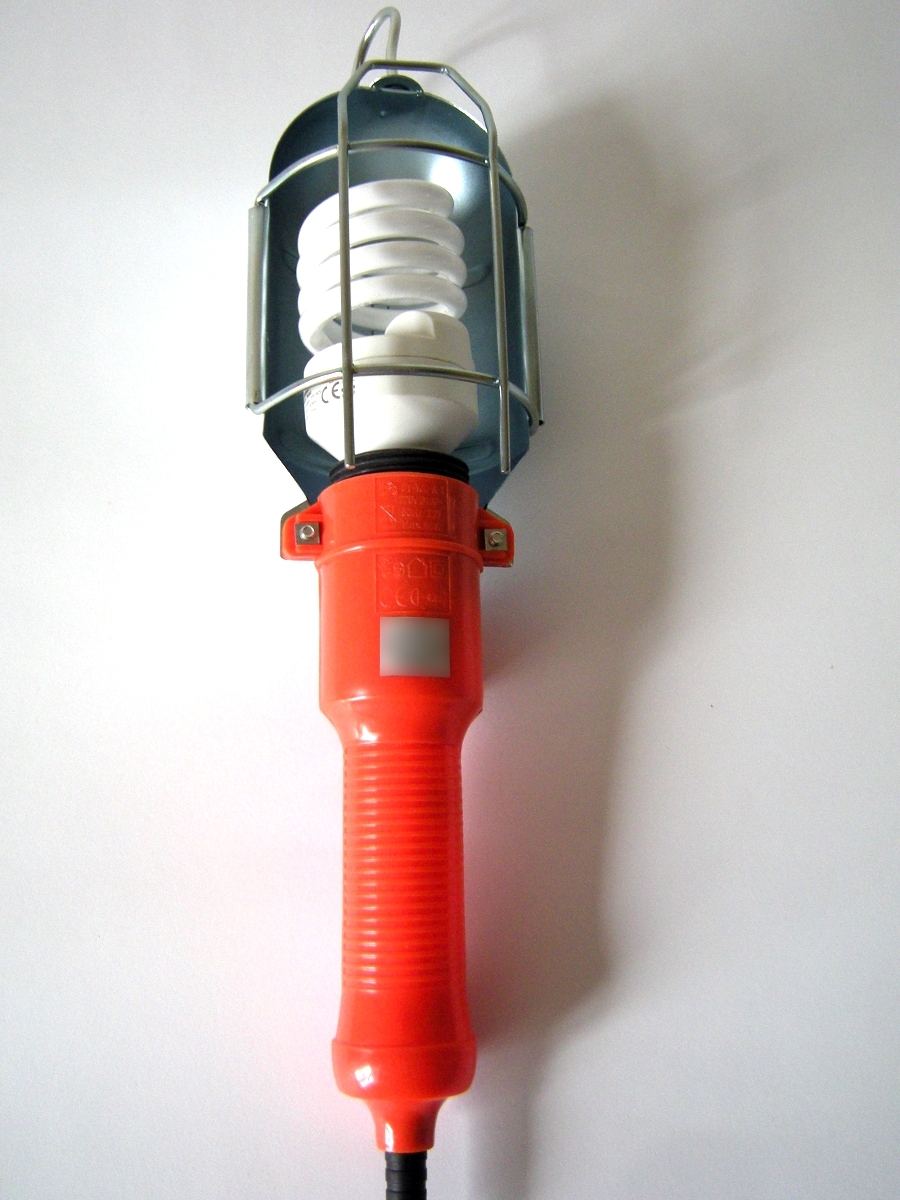
A trouble light using a compact fluorescent lamp. From top to bottom are a hook, a cage, the switch and a handle in one molding

A trouble light, also known as a rough service light, drop light, or inspection lamp, is a special lamp used to illuminate obscure places and able to handle moderate abuse. The light bulb is housed in a protective cage and a handle that are molded to form a single unit. It has a long power line for distant reaching; the handle may also have an electrical outlet on it, allowing the light to also double as an extension cord.

Trouble lights are usually powered by AC wall current, but some are powered by a 12-volt source, such as a car battery. The bulb of the trouble light typically has a heavy filament to withstand dropping, and therefore is also referred to as a drop light.[1] Newer models often use LED arrays as the light source. LEDs are more energy efficient, and may be more durable compared to incandescent lights.

Some trouble lights are also designed to operate on 32 VAC supplied from either a local or centralised transformer, the local one being a plug pack or inline style transformer, and the centralised transformer usually being mounted near the building switchboard and distributed to various special 32 V outlets in work areas to power multiple lights. This is to maximise electrical safety, especially in wet environments or where the cord may be damaged during use and otherwise pose a shock hazard. This was common in Australian mechanical workshops before the advent of battery powered work lights, with the 32 V socket being a non polarised Type A socket or polarised "T" socket to differentiate the 32 V transformer supply from the normal Aus/NZ 240 V mains supply sockets which are Type I.[citation needed]

Trouble lights are intended to be used with "rough service bulbs", a form of incandescent light bulbs which are designed with as many as five support wires holding the filament to allow it to withstand heavy vibrations or movement. Lower voltage bulbs such as those intended to function with 12 volt power supplies also have a higher lumen output per watt of power consumption. Compact fluorescent lamps and recently, light-emitting diodes may also be used in trouble lights.

Trouble lights intended for use in hazardous areas such as in petrochemical plants will have features designed to prevent ignition of flammable gas around the lamp, such as heavy sealed lamp enclosures and guards to protect lamps from breaking.

Applications

[edit]
A trouble light hung temporarily on a television antenna

Trouble lights are often used by automotive mechanics and electricians where localized light is needed where ambient light proves to be insufficient.[2]

References

[edit]
Revisions and contributorsEdit on WikipediaRead on Wikipedia
from Grokipedia
A trouble light, also known as a drop light, rough service light, or inspection lamp, is a heavy-duty, semi-portable corded device designed to provide temporary illumination in obscure, hard-to-reach, or poorly lit areas, particularly those prone to physical abuse or damage during use. These lights are typically constructed with rugged components to withstand drops, impacts, and rough handling in industrial or maintenance environments. Key features of trouble lights include a long, flexible —often 25 to 50 feet in length—for extended reach without needing multiple extension cords, a protective metal or cage (guard) surrounding the to prevent breakage and contain shattered , and a swivel hook or magnetic base for hands-free positioning. Traditional models use incandescent or fluorescent s rated up to 75 watts, while modern variants incorporate energy-efficient LED technology for brighter, longer-lasting output with reduced heat generation. Wire gauges such as 14/3, 16/3, or 18/2 ensure durability and safe current handling, and some designs include built-in outlets for powering additional tools. Trouble lights are primarily used in automotive repair shops, sites, warehouses, and mechanical workshops to facilitate inspections, , and repairs by illuminating confined spaces like compartments or under-vehicle areas. They serve as a reliable alternative to flashlights, offering wider beam coverage and stability for prolonged tasks. considerations are paramount; these lights must feature grounded plugs and protective guards to comply with occupational standards, preventing electrical hazards, burns, or injuries from broken bulbs in temporary or lighting scenarios.

History

Origins and Invention

Prior to the widespread availability of electric power in industrial settings, mechanics and electricians relied on portable oil or kerosene lanterns for illumination during repairs in dimly lit garages and workshops. These devices, common since the mid-19th century, offered only modest light output from wick-fed flames and carried significant fire risks due to open flames near flammable materials and machinery. The limitations of such fixed or handheld non-electric sources—poor brightness, frequent refueling, and safety concerns—necessitated a more reliable, portable alternative as electrification expanded in the early 20th century. The trouble light, also known as a drop light or inspection lamp, emerged in the early to meet the growing demand for durable, electric portable in mechanical and automotive work environments. Emerging amid the rapid industrialization and rise of the automobile industry, it addressed the shortcomings of stationary shop overhead by allowing workers to direct focused illumination into tight or obscured spaces, such as under vehicles or inside machinery. Initial designs incorporated standard incandescent bulbs housed within protective wire cages or guards to shield against impacts and vibrations common in garages and factories, enabling safer and more efficient troubleshooting tasks. Key early innovations came from American manufacturers adapting existing electrical components for rugged portability. A pivotal patent, US 1,500,548, filed in 1922 by inventor William Henry Clement, Jr., and granted in 1924, described a versatile trouble-light fixture using an ordinary incandescent bulb and socket encased in tapered wire coils for protection, along with adjustable clamps for mounting on beams or surfaces in hard-to-reach areas. Lighting giants like contributed by developing rough-service incandescent bulbs in the and , with reinforced filaments to withstand shaking and dropping, making them ideal for integration into these portable fixtures. Early models often featured wooden handles and steel guards for enhanced durability in workshop settings.

Evolution and Modern Adoption

Following , significant advancements in electrical safety prompted the integration of grounded cords into portable trouble lights during the 1950s and . This development aligned with evolving (NEC) requirements, which emphasized equipment grounding to mitigate shock hazards in portable appliances. By the early 1960s, most new designs incorporated three-conductor cords with a dedicated grounding wire, replacing earlier two-wire configurations and enhancing user protection in industrial environments. The marked a pivotal shift from incandescent bulbs to compact fluorescent lamps (CFLs) in trouble lights, driven by energy efficiency mandates and technological improvements that reduced power consumption while maintaining illumination levels. By the , (LED) technology further revolutionized these devices, offering superior durability, lower heat generation, and longer lifespans compared to previous bulb types. This transition was accelerated by U.S. Department of Energy initiatives promoting efficient lighting, resulting in LED-equipped trouble lights that provide higher lumen output with minimal energy use. The creation of the (OSHA) in 1970 influenced trouble light designs , mandating features like substantial guards on portable lamps and proper grounding for cords to prevent accidents. OSHA standard 1910.305 requires handlamps to include molded handles, guards to protect against contact, and approved flexible cords without splices, ensuring reliable performance in hazardous conditions. Globally, similar regulatory frameworks promoted widespread adoption in industrial markets, with designs standardized for safety across automotive, , and applications. Underwriter Laboratories (UL) standards, particularly UL 153 for portable electric luminaires, have continually shaped modern trouble lights by enforcing reinforced protective cages—building briefly on early designs—and specifying durable cord constructions typically ranging from 25 to 50 feet for practical reach without excessive . These guidelines ensure compliance with safety testing for shock, fire, and mechanical hazards, facilitating international and consistent quality in contemporary models.

Design and Components

Physical Structure

Trouble lights feature a rugged, portable design optimized for use in demanding work environments, typically consisting of a single-molded made from durable such as or metal components for enhanced longevity. The housing integrates a sturdy for carrying, often equipped with a or S-hook for hands-free hanging from overhead structures like rafters or vehicles. A protective wire cage, usually 10 to 12 inches in diameter, encases the to prevent damage from incidental contact. The is constructed from heavy-gauge or aluminum, such as 10-gauge zinc-plated with crossbars for structural , enabling it to withstand impacts from accidental drops and rough handling in workshops or garages. Cord attachment incorporates strain-relief fittings at the handle base, securing 16- to 18-gauge grounded power cords that commonly range from 25 to 50 feet in length to access hard-to-reach areas without extension cords. These lights typically weigh 1.5 to 3.5 pounds, providing sufficient heft for stable positioning on surfaces while remaining manageable for transport, with rubberized grips on the handle to enhance and prevent slippage during prolonged use.

Electrical and Lighting Elements

The electrical setup of a trouble light centers on a standard 120V AC power input through a three-prong grounded plug, ensuring safe connection to household outlets and compliance with grounding requirements for portable tools. This is typically paired with a heavy-duty extension cord, such as 16/3 SJTW or SJEO gauge wiring ranging from 25 to 50 feet in length, which supports reliable power delivery while resisting oil, water, and abrasion in workshop environments. Many designs incorporate a built-in grounded outlet on the light's housing, rated for standard tool powering up to 15A, allowing daisy-chaining of additional devices without needing separate extension cords. The switch mechanism employs a rocker or toggle style, rated at 15A for 120V AC circuits, and is ergonomically positioned on the handle for quick, one-handed activation during tasks. This configuration minimizes user interruption, as the switch handles the inductive loads from bulb startup and any connected outlets without arcing or overheating under normal use. At the core of illumination is the bulb socket, featuring a medium E26 base for broad compatibility with rough-service bulbs designed for vibration-prone settings. It accommodates 75-100W incandescent lamps or equivalent CFL and LED alternatives, prioritizing durability with reinforced contacts to prevent filament damage from impacts. A directs the light into a focused beam, yielding 800-1300 lumens from standard bulbs to effectively illuminate confined spaces at 1-5 feet, enhancing visibility for detailed work without excessive glare or spread. The socket integrates seamlessly within the protective , maintaining alignment for consistent output while shielding components from environmental hazards.

Types and Variants

Standard AC-Powered Models

Standard AC-powered trouble lights, also known as drop lights or portable work lights, are the most prevalent variant designed for everyday use in , garages, and maintenance areas. These models operate on standard 120V household (AC) power, typically featuring long, durable cords ranging from 25 to 50 feet in length to provide flexibility in reaching work sites without extension cords. They incorporate incandescent, fluorescent, or LED bulbs housed within robust protective cages, often made of metal or impact-resistant , to shield against drops, bumps, and general workshop abuse such as vibrations from machinery or accidental strikes. A key feature of these lights is their use of rough-service bulbs, which are engineered for environments prone to physical stress. These bulbs employ reinforced filaments with multiple support wires—typically a minimum of five—to prevent sagging or breakage from and shock, extending operational life in demanding conditions compared to standard household bulbs. Incandescent versions often use 75- to 100-watt rough-service A19 or A21 bulbs with frosted finishes for diffused light, fluorescent models typically employ 26-watt tube bulbs for cooler operation and efficiency, while LED models provide equivalent brightness (around 800-1,000 lumens) with lower energy use and reduced heat generation. The cages, usually powder-coated for corrosion resistance, include hooks or handles for easy hanging or carrying, and many include grounded outlets for powering additional tools. Prominent manufacturers include Bayco Products and Utilitech, which offer models tailored for reliability in non-specialized tasks. Bayco's SL-425 and SL-426A series, for instance, feature 25-foot 18/3-gauge cords, metal guards, and impact-resistant housings tested for durability in tough environments, with polarized plugs for safe AC connections. Utilitech models, commonly available through major retailers, similarly emphasize rugged construction with long cords and protective enclosures for general use. These lights are widely available at hardware stores such as Home Depot, , , and , with retail prices typically ranging from $20 to $50 depending on cord length and bulb type (as of 2024). For example, a basic 75-watt Bayco incandescent model with a 25-foot cord retails around $24 to $38, making them an affordable option for homeowners and professionals handling routine repairs.

Low-Voltage and Specialized Variants

Low-voltage trouble lights operate at reduced electrical potentials compared to standard 120V AC models, minimizing the risk of electrical shock in damp or conductive environments while maintaining portability for targeted illumination. These variants typically employ step-down transformers or direct DC connections to achieve voltages like 12V or 32V, allowing safe use in automotive, marine, or applications where standard high-voltage lights pose greater hazards. 12V models are commonly powered by vehicle batteries through cigarette lighter adapters or alligator clips, making them ideal for mobile automotive diagnostics and repairs under the hood or in engine bays. Equipped with or LED bulbs rated for rough service, these lights draw around 4.2 amps and often feature 20-foot cords for extended reach without relying on household outlets. For instance, Bayco's 12V trouble light uses a heavy-duty handle with an integrated switch and supports 50W bulbs, providing focused illumination for working in confined spaces. 32V transformer-powered variants step down from 120V or 240V AC sources to deliver safer operation in wet areas, such as marine decks or tasks, where could otherwise conduct . These systems use dedicated transformers like the Bland I30-76 model, which converts 240V input to 32V output, or isolation transformers such as the Larson Electronics MT-ISX series for 120V input, ensuring compatibility with incandescent or LED bulbs while reducing shock potential in humid conditions. Such designs are prevalent in industrial settings requiring temporary, low-risk illumination near or conductive surfaces. Hazardous location trouble lights, also known as explosion-proof models, incorporate NEMA-rated enclosures to prevent ignition in flammable atmospheres, such as those with vapors, gases, or dusts. Certified for Class I Division 1 environments, these variants feature lenses, sealed housings, and barriers to contain sparks and arcs, with examples like Ericson's LED Omni handlamp providing 2550 lumens via 50-foot cords and NEMA 5-15 plugs for or sites. LDPI's H-LED fixtures further exemplify this category, using robust tested for adverse conditions including corrosive elements. Specialized trouble lights include rechargeable battery-powered versions and those with magnetic bases for hands-free operation. Rechargeable models, such as Tiger Lights' TL2460, utilize lithium-ion batteries for up to 4 hours of runtime at 1000 lumens, supporting 12-24V charging via cigarette lighters or DC adapters, which enhances mobility in remote or off-grid work. Magnetic-base variants, like those from Harbor Freight, attach securely to ferrous surfaces for overhead positioning during repairs, often combining swivel heads with LED arrays for adjustable, cordless illumination in workshops or garages.

Safety Considerations

Potential Hazards

One primary hazard associated with standard 120V trouble lights is electrical shock, which can occur from frayed or damaged cords exposing live wires, particularly when users handle the light in close proximity to their body. This risk is significantly heightened in damp or moist environments, such as automotive repair shops or areas with exposure, where conductivity increases the likelihood of ; OSHA standards mandate that portable lights in such conditions operate at no more than 12 volts to minimize this danger. Fire ignition represents another critical risk, as incandescent bulbs in trouble lights can reach surface temperatures exceeding 250°F (121°C), potentially igniting nearby flammable materials like oil-soaked rags or insulation if the light contacts them. Additionally, sparks from faulty wiring or short circuits in unrated models can trigger explosions in hazardous locations containing combustible vapors, underscoring the need for proper explosion-proof ratings in industrial settings. Physical injuries from trouble lights include cuts or burns from bulb shattering upon impact, which scatters sharp fragments, and falls caused by tripping over the extended cords commonly used with these portable devices. Over prolonged use in outdoor or industrial environments, (UV) radiation degrades the insulation on trouble light cords, leading to brittleness, cracking, and higher failure rates that exacerbate shock and risks. Low-voltage variants, such as 12V models, help mitigate electrical shock hazards in wet conditions by reducing current flow.

Built-in Safety Features

Trouble lights integrate several protective mechanisms to address common hazards such as electrical shock, overheating, and physical from bulb breakage, ensuring safer operation in demanding work settings. Grounded plugs and cords form a core safety element, utilizing three-prong designs that direct fault currents to ground and prevent shocks by interrupting dangerous current paths through the user. These components are compatible with ground fault circuit interrupter (GFCI) outlets, which detect imbalances in current flow and cut power within milliseconds to further minimize shock risks, particularly in damp environments; OSHA allows 120V lights protected by GFCI as equivalent to low-voltage systems in wet locations. Impact-rated cages encase the to shield it from accidental strikes, containing any shattered fragments to avoid injury and maintaining functionality after impacts. Low-voltage variants, operating at 12V or 24V, inherently lower shock potential compared to standard 120V models, making them suitable for wet locations where standard voltages could lead to ; OSHA requires such systems for damp areas to limit current through the body to safe levels.

Applications

Automotive and Mechanical Work

Trouble lights play a crucial role in automotive and mechanical work by delivering portable, focused illumination to access confined spaces during repairs and maintenance. Invented in the early specifically for automobile , these devices feature extensible cords and hooks that allow to position them hands-free while inspecting or adjusting mechanisms in low-light conditions. In engine bay illumination, trouble lights are hung via integrated hooks from the vehicle's hood to provide clear visibility of under-hood components during routine tasks like oil changes and diagnostic checks, enabling precise work on engines and associated systems. Their design supports close-quarter access, with models offering adjustable beams to highlight specific areas without obstructing the mechanic's hands. For under-vehicle applications, the long, flexible cords of trouble lights extend to illuminate hard-to-reach areas such as brake systems or exhaust components when vehicles are raised on lifts or positioned over pits, facilitating thorough examinations without requiring additional mounting. This portability ensures consistent lighting in dynamic shop environments where vehicles may be moved frequently. Workshop integration enhances efficiency, as some trouble lights incorporate built-in grounded outlets to simultaneously power air tools and deliver targeted illumination for preparatory tasks like setup, streamlining workflows in mechanical bays. These lights offer key benefits through their robust , including resistance to oil, grease, and chemical exposure, which withstands the harsh conditions of automotive environments. Standard AC-powered models remain the go-to choice for these mechanical applications due to their reliability and compatibility with shop power sources.

Electrical and Maintenance Tasks

Trouble lights serve as vital portable illumination tools during electrical inspections, particularly for circuit tracing in confined areas such as attics and crawlspaces, where fixed fixtures are often absent or insufficient. Electricians use these lights to visually identify wiring faults, such as breaks, , or improper connections, by positioning the light to highlight cable runs and junctions while systematically testing breakers or using simple loads like the light itself to map circuits. This approach enables precise fault location without the need for extensive disassembly, enhancing efficiency in diagnosing general electrical issues. In appliance repair tasks, trouble lights provide focused, close-range essential for complex systems like refrigerators or HVAC units in cramped enclosures. Technicians rely on the adjustable positioning and high-intensity output of these lights to inspect internal components, such as compressors, wiring harnesses, or control boards, where from fixed overhead lights can obscure details. For instance, during HVAC servicing, the light's or clamp allows hands-free operation in tight mechanical spaces. For general facility upkeep, trouble lights support inspections and routine in large-scale environments like warehouses and sites, illuminating high shelves for checks or low-clearance areas during machinery . Low-voltage variants, operating at 12V or 24V, are frequently selected to minimize shock risks in damp or conductive settings, promoting safer operations around moving equipment or stored materials. These lights' durability against oils and abrasion further suits them for industrial upkeep, reducing the need for temporary or additional power sources. Their evolution from basic incandescent models to safer LED designs has maintained their role in minimizing operational interruptions during fault resolution as of 2025. Many incorporate built-in features, such as non-conductive guards, suitable for wet areas common in scenarios.

References

Add your contribution
Related Hubs
User Avatar
No comments yet.