Hubbry Logo
Tsar TankTsar TankMain
Open search
Tsar Tank
Community hub
Tsar Tank
logo
8 pages, 0 posts
0 subscribers
Be the first to start a discussion here.
Tsar Tank
Tsar Tank
from Wikipedia

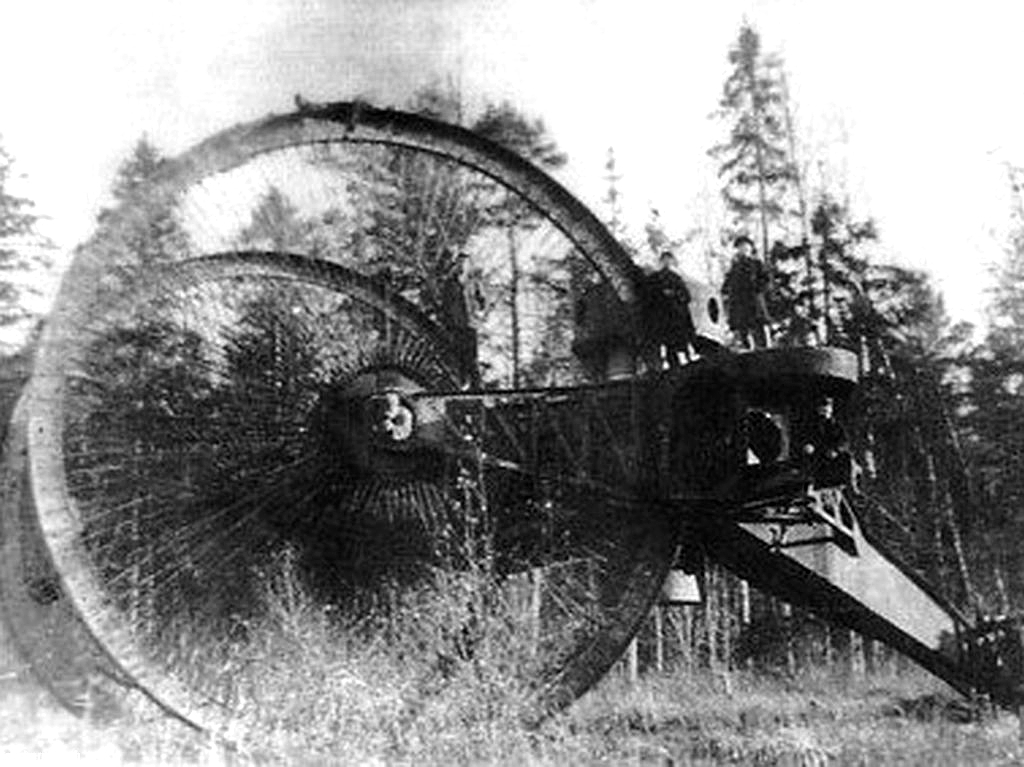
The Tsar Tank (Russian: Царь-танк), also known as the Netopyr' (Russian: Нетопырь, literally "pipistrelle") or Lebedenko Tank (Russian: танк Лебеденко), was a Russian armoured vehicle developed by Nikolai Lebedenko, Nikolay Yegorovich Zhukovsky, Boris Stechkin, and Alexander Mikulin from 1914 onwards. The project was cancelled in 1915 after initial tests deemed the vehicle to be underpowered and vulnerable to artillery fire.

Key Information

History

[edit]

The Tsar Tank differed from modern tanks in that it did not use caterpillar tracks—rather, it used a tricycle design. The two front spoked wheels were nearly 9 metres (30 ft) in diameter, and the rear-mounted third wheel was only 1.5 metres (5 ft) high. According to the memoirs of Lebedenko, the idea of this machine was prompted by Turkic carts, which, thanks to large diameter wheels, were able to easily traverse bumps and ditches. The upper cannon turret reached a height of nearly 8 metres (26 ft). The hull was 12 metres (39 ft) wide with two more cannon in sponsons. Additional weapons were also planned under the belly. Each wheel was powered by a 240 horsepower (180 kW) Maybach engine.[1] Each engine drove a car wheel which transferred power to a matching giant wheel by being pressed against its rim. The design had a top speed of 10 miles per hour (16 km/h).

Lebedenko had a private laboratory in Moscow (Sadovo-Kudrinskaya, 23) where he carried out orders from the military. The decisive audience for the project took place in January 1915 during which Lebedenko presented Nicholas II with a clockwork wooden model of his car with an engine based on a gramophone spring. According to the recollections of the courtiers, the Tsar and the engineer played with a model of the machine which briskly ran along the carpet, easily overcoming stacks of two or three volumes of the "Code of Laws of the Russian Empire". The audience ended with the fact that Nicholas II, impressed by the vehicle, ordered 210,000 rubles to be allocated from his own funds for the project. Nicholas II kept the wooden model of the tank that Lebedenko made for the demonstration. The fate of the model is unknown.

Model of the Tsar tank in a museum

Details of the tank were manufactured at a plant in Khamovniki. The huge wheels were intended to cross significant obstacles. However, the rear steerable roller, due to its small size and the incorrect weight distribution of the machine as a whole, got stuck in soft ground almost immediately after the start of the test. The large wheels were unable to pull it out, despite the use of the most powerful propulsion system at that time, consisting of two captured Maybach engines. These were much more powerful than those used on other tanks of the First World War, having been taken from a damaged German airship. This led to a number of failed tests before the High Commission in August 1915, and in September the project was cancelled. Despite this, Stechkin and Mikulin began to develop a new engine (AMBES) for the vehicle. However, this attempt was unsuccessful, as were attempts to move the Tsar Tank from its place and pull it out of the test area. Until 1917, the tank was guarded at the test site, but then, due to the outbreak of the Russian Revolution, the vehicle was abandoned. Design work on it was no longer carried out and the huge structure of the vehicle rusted for another 6 years in the forest some 60 kilometres (37 mi) from Moscow until 1923, when the tank was finally dismantled for scrap.

References

[edit]
[edit]
Revisions and contributorsEdit on WikipediaRead on Wikipedia
from Grokipedia
The Tsar Tank, also known as the Lebedenko Tank, was an experimental superheavy armored fighting vehicle developed by the during , characterized by its unconventional tricycle-like design with two massive 9-meter-diameter front wheels and a single smaller rear wheel, intended to traverse trenches and obstacles but ultimately proving impractical due to mobility issues. Conceived in 1914 by engineer Nikolai Lebedenko, who worked for a firm contracted by the Russian War Department, the project drew inspiration from an enlarged and involved contributions from prominent figures including Nikolai Zhukovsky, Boris Stechkin, and Alexander Mikulin. Lebedenko pitched the idea to using a wooden model powered by a gramophone spring, which impressed the monarch and secured imperial funding of 250,000 rubles for construction. The prototype, assembled in sub-sections for transport and completed near by July 1915, measured approximately 17 meters long, 12 meters wide, and 9 to 12 meters high, with an estimated weight of 40 tons—though actual construction exceeded this by 50% due to reinforced metal plating. Powered by two 240-horsepower engines originally sourced from German Zeppelins, the vehicle was designed for a top speed of 17 km/h on flat terrain and required a of 10 to 15 operators. Its armament included a central rotating turret mounting s or light cannons, additional sponsons on the flanks, and a ventral turret for anti-infantry defense, reflecting early Russian efforts to counter amid the global race for armored innovations. Initial trials in August 1915, conducted about 60 km from Moscow, showed promise as the tank rolled over rough ground and even crushed a tree, but it soon bogged down when its rear wheel became trapped in a shallow ditch, with the front wheels unable to provide sufficient leverage despite full engine power. A second attempt in August 1917 fared no better, highlighting fundamental flaws in stability, vulnerability to artillery fire due to its height, and the superiority of emerging tracked designs from Britain and France. The project was abandoned shortly thereafter, exacerbated by the 1917 Russian Revolution, leaving the prototype stranded in the field until it was dismantled and scrapped in 1923. Despite its failure, the Tsar Tank remains a notable example of early 20th-century experimental military engineering, symbolizing Russia's ambitious but often misguided push for technological superiority in the war; a full-scale replica was constructed in 2020 at the T-34 Tank Museum in Moscow.

Design

Overall Structure

The Tsar Tank employed a highly unconventional configuration, characterized by two enormous front spoked and a single smaller rear for support and steering. This layout positioned the vehicle's armored hull atop the connecting the front , creating a tuning-fork-like shape that tapered toward the rear. The front measured 9 meters (30 feet) in , constructed with a T-shaped metal framework overlaid in wood for added , while the rear was approximately 1.5 meters (5 feet) in , often described as a double- assembly to facilitate maneuverability. The hull itself spanned 12 meters (39 feet) in width and reached an overall height of 9 meters (30 feet), with the upper turret elevated to nearly 8 meters (26 feet) above the ground. This provided exceptional ground clearance but contributed to stability challenges due to the elevated center of gravity. Constructed from riveted steel plates for armor protection, the hull enclosed multiple crew compartments, ammunition storage areas, and sponsons mounted on the outer flanks to accommodate additional machine guns. The accommodated a of 10 personnel, including a driver, multiple gunners positioned to operate the main and sponson armaments, and a stationed in the elevated central turret for oversight. This size was necessary to manage the vehicle's complex operations and weaponry distribution across its expansive structure. The total mass of the Tsar Tank approximated 60 tons, significantly exceeding initial estimates of around 40 tons due to the use of thicker steel plating, rendering it the largest armored fighting vehicle constructed up to that point in history.

Propulsion and Mobility

The Tsar Tank employed a unique wheeled propulsion system powered by two aircraft engines, each delivering 240 horsepower, which were salvaged from captured German Zeppelins and mounted in the rear of the vehicle. These engines drove the massive front wheels through a friction-based mechanism, where each powered an automobile pressed against the inner rim of the giant spoked wheel via a railway carriage spring suspension, transferring through frictional contact without direct gearing. This unconventional drive arrangement avoided the use of tracks entirely, relying instead on pure wheeled locomotion in a configuration inspired by early 20th-century concepts for overcoming rough terrain with oversized bicycle-like wheels. The system's intended mobility emphasized cross-country performance, with the 9-meter-diameter front wheels designed to roll over battlefield obstacles such as entanglements and enemy trenches, theoretically allowing traversal of ditches up to 3 meters deep by leveraging the wheels' immense size for step-over capability. On , the was projected to achieve a top speed of approximately 16-17 km/h (10 mph), providing sufficient pace for support while maintaining stability through the elevated . The smaller rear , measuring about 1.5 meters in and resembling a rail trolley, served primarily for and balance, enabling directional control by pivoting the without independent . Despite these ambitions, the propulsion and mobility features revealed inherent vulnerabilities rooted in the design's physics. The high center of gravity, exacerbated by the elevated hull positioned atop the front wheels, combined with uneven weight distribution toward the rear, rendered the tank prone to tipping or instability on slopes and uneven ground, limiting its practical effectiveness beyond ideal conditions. The friction drive, while innovative, was susceptible to slippage under load or in adverse weather, further compromising traction without the gripping advantage of tracks.

Development

Conception and Approval

The Tsar Tank project was conceived in late 1914 by Nikolai Lebedenko, a prominent Russian engineer and inventor, amid the escalating challenges of on the Eastern Front. Lebedenko, serving as head of the War Ministry's Experimental Laboratory, sought to develop a super-heavy armored vehicle capable of traversing and overpowering German trench lines, barbed wire entanglements, and shell-cratered terrain that had stalled conventional infantry advances. This idea drew inspiration from Russia's early experiments with wheeled armored cars, such as the Russo-Balt models deployed since 1914, which highlighted the potential of mobile armored platforms but revealed limitations in crossing fortified positions. Lebedenko collaborated closely with aviation pioneer Nikolai Zhukovsky, who provided aerodynamic and structural expertise, as well as young engineers Boris Stechkin and Alexander Mikulin, both students under Zhukovsky, who contributed to the mechanical and propulsion concepts. To secure official backing, Lebedenko crafted a wooden of the proposed tricycle-configured vehicle, powered by a gramophone spring mechanism to simulate movement. In early 1915, he personally demonstrated the model to at the in Petrograd, where it successfully navigated miniature obstacles representing trenches and fortifications, captivating the with its apparent simplicity and potential battlefield dominance. Impressed by the display, granted approval for the project shortly thereafter in 1915, bypassing initial skepticism from military officials and elevating it to a priority initiative under imperial patronage. This royal endorsement not only legitimized the unconventional design but also ensured rapid progression to prototype development. Following approval, approximately 250,000 rubles were allocated for the under Tsarist to cover refinement and at a secure facility. The funding reflected the project's high-risk, high-reward nature, with the Tsar's direct involvement underscoring its strategic importance. Informally dubbed the "Tsar " in honor of II's support, the vehicle was also referred to as the Lebedenko Tank after its primary designer or "Netopyr" (meaning "" in Russian, alluding to its from above), names that captured its unconventional and somewhat whimsical origins.

Construction

Construction of the Tsar Tank prototype commenced in early 1915 at the Khamovniki Workshop in , following approval of the project earlier that year. The assembly process was carried out in relative secrecy, leveraging the workshop's facilities for fabricating large-scale components, with the vehicle built in sub-sections for transport and final assembly completed near by July 1915. The vehicle's hull utilized riveted boilerplate steel for its armor plating, providing basic protection while prioritizing speed of fabrication over advanced metallurgical processes. Internal supports incorporated wooden frameworks to facilitate quicker assembly and reduce reliance on scarce metal resources. Off-the-shelf components were integrated to expedite construction, including two 240-horsepower engines salvaged from captured German Zeppelin airships, along with automotive tires mounted on smaller wheels to drive the massive front wheels via friction. A workforce of skilled laborers, supervised directly by Nikolai Lebedenko, handled the fabrication and assembly tasks. The project incurred costs of approximately 250,000 rubles amid wartime material shortages that affected steel and other supplies across the . During final assembly stages, the armament was installed, consisting of two 76 mm mountain cannons positioned in a rotating turret for forward , complemented by four to eight 7.62 mm Maxim machine guns mounted in sponsons and casemates to provide defensive coverage. This configuration aimed to enable the vehicle to engage enemy positions while traversing rough terrain, though logistical challenges during integration highlighted the prototype's experimental nature.

Testing and Fate

Trials

The initial trials of the Tsar Tank commenced in late and 1915 at a approximately 60 km from , following the completion of construction. These evaluations were overseen by a high commission of officials to assess the vehicle's potential as a breakthrough weapon. The prototype demonstrated reasonable performance on firm and rough during early runs, with the large front wheels enabling it to crush small trees and obstacles while achieving brief maximum speeds of 10-12 km/h. However, the tests quickly revealed significant mobility limitations, as the rear stabilizing wheels frequently became mired in soft or uneven soil, often after advancing just 100-200 meters in damp conditions. A notable failure occurred when the rear wheels sank into a ditch during one run on softer ground, causing the entire structure to tip forward under its own weight, with the two 240 hp Maybach engines proving insufficient to extract it without external assistance. The vehicle's high center of gravity exacerbated this issue, leading to instability during attempts to maneuver or climb even minor elevations. Additionally, the underpowered propulsion struggled with sharp turns, limiting overall agility despite the intended design speed of around 17 km/h on roads. The elevated silhouette, standing nearly 9 meters tall, further highlighted its vulnerability, as it would present an obvious target for artillery fire even from a distance. Photographic documentation captured multiple test iterations, illustrating not only the bogging incidents but also mechanical stresses on the rim-drive mechanism connecting the engines to the wheels, including visible strains from uneven load distribution. These observations underscored the prototype's impracticality in varied conditions, particularly in the muddy terrains common to the Eastern Front. The trials ultimately exposed how the design's ambitious scale—exceeding estimated weight by 50% due to reinforced armor—compromised its operational viability. According to some accounts, the underwent additional testing in August 1917, during which it moved and broke a large tree but again became stuck with its rear roller in the ground. A further test in was also unsuccessful.

Cancellation and Scrapping

Following the unsuccessful trials in , the Russian deemed the Tsar Tank project too expensive (approximately 250,000 roubles) and vulnerable to fire, effectively cancelling further development, though limited additional tests of the occurred in 1917 and . The decision was compounded by shifting priorities toward more reliable tracked designs emerging from Britain and , such as the Mark I tank. The sole prototype, which became mired in soft ground during the 1915 testing about 60 kilometers from , was eventually left exposed to the elements after the later attempts failed. It remained there, gradually rusting amid the chaos of World War I's continuation on the Eastern Front and the ensuing from 1917 to 1922, neglected as resources were diverted to ongoing conflicts. After the in 1917, the Bolshevik authorities showed no interest in the derelict vehicle, viewing it as an emblem of imperial extravagance from the Tsarist era. By 1923, amid severe post-revolutionary industrial shortages, the was dismantled and scrapped for its metal components, with all parts recycled and no intact remnants surviving to the present day. The original design blueprints were lost during the turmoil, though a small-scale wooden model presented to Nicholas II is preserved in Russian archives.

Legacy

Historical Significance

The Tsar Tank represented an early and ultimately failed experiment in super-heavy armored vehicle design during , emphasizing the limitations of wheeled in muddy, trench-ridden battlefields and underscoring the emerging superiority of tracked systems like those in British designs. Developed amid Russia's urgent need to counter German advances on the Eastern Front, the vehicle's configuration with massive 9-meter front wheels aimed to crush obstacles and but proved impractical due to poor terrain adaptability and mechanical unreliability. This project highlighted the risks of prioritizing scale over mobility in early concepts, contributing to a broader recognition that oversized vehicles were ill-suited for . The construction of the Tank cost approximately 250,000 rubles, a substantial from Nicholas II's personal funds, yet it saw no deployment and was abandoned after failed trials. This misallocation exacerbated Russia's industrial constraints during the war, where material shortages already hampered armored development efforts. Despite these setbacks, the project exemplified Russian engineering under duress. At around 60 tons, the Tsar Tank dwarfed contemporaries like the British Mark I, which weighed 28 tons and relied on tracks for better cross-country performance, yet the Russian vehicle's wheeled setup rendered it far less mobile and more vulnerable to and terrain traps. Its trials exposed critical flaws in , where excessive rear loading caused it to bog down, alongside inadequate power-to-weight ratios from its 240-horsepower engines that failed to propel the behemoth effectively over obstacles. These shortcomings, coupled with its susceptibility to due to its towering , informed interwar tank doctrines worldwide, accelerating the shift toward lighter, more agile tracked vehicles and away from super-heavy experiments.

Cultural Impact

The Tsar Tank has been frequently depicted in documentaries and online articles as an emblem of engineering eccentricity, often dubbed the "strangest tank ever built" due to its unconventional design and ultimate failure. For instance, a episode by the Simple History channel highlights its impracticality as a symbol of early 20th-century overambition, while a 2023 article from The Armory Life portrays it as Russia's ill-fated secret weapon, emphasizing its role in illustrating the pitfalls of untested innovation during the war. Similar portrayals appear in gaming media, such as a 2017 video that frames it as a bizarre . In popular entertainment, the Tsar Tank appears as a novelty unit in strategy video games, capitalizing on its odd appearance for humor and historical curiosity. It features prominently in the 2010 game Toy Soldiers, where players defend against waves of the massive vehicle using , underscoring its vulnerability in simulated battles. Hobbyist scale models, often 3D-printed in 1/35 or 1/72 scales based on rare photographs, are widely available through modeling communities and kits, allowing enthusiasts to recreate its giant wheels and armored frame for display or wargaming. Within Russian historical literature, the Tsar Tank is referenced as an example of Tsarist-era extravagance and technical miscalculation, appearing in works like the 2015 book «Armata». «Tsar-Tank» na strazhe Rodiny, which examines it alongside later Soviet designs to contrast imperial folly with revolutionary progress. Its whimsical, steam-era aesthetic has sparked renewed interest in 21st-century and genres, where it inspires fictional narratives of "what if" successes, as seen in writing prompts and online discussions. Replicas and photographic exhibits of the Tsar Tank are displayed in Russian museums, such as the 2020 full-scale model at the Tank History Museum near , which draws visitors to explore its pre-Bolshevik origins. Modern engineering forums continue to analyze hypothetical improvements to its design, debating terrain adaptability in speculative threads, though it exerts no direct influence on contemporary pop culture icons like mechs in or .

References

Add your contribution
Related Hubs
User Avatar
No comments yet.