Hubbry Logo
Turin CathedralTurin CathedralMain
Open search
Turin Cathedral
Community hub
Turin Cathedral
logo
8 pages, 0 posts
0 subscribers
Be the first to start a discussion here.
Turin Cathedral
Turin Cathedral
from Wikipedia

Turin Cathedral or Cathedral of Saint John the Baptist (Italian: Duomo di Torino; Cattedrale di San Giovanni Battista, Latin: Ecclesia Sancti Johannis Baptista) is a Roman Catholic cathedral in Turin, northern Italy. Dedicated to Saint John the Baptist (Italian: San Giovanni Battista). It is the seat of the Archbishops of Turin.

Key Information

It was built during 1491–1498, adjacent to a bell tower which had been built in 1470. Designed by Guarino Guarini, the Chapel of the Holy Shroud (the current location of the Shroud of Turin) was added to the structure in 1668–1694.

History

[edit]

Lombard church

[edit]

The church lies where the theatre of the ancient Roman city was located. Later, the site was developed with the construction of a complex of original three Christian churches, dedicated to the Holy Saviour, Saint Mary of Dompno (Santa Maria de Dompno) and (the largest one) to St. John the Baptist. According to some sources, the consecration of the main church was carried on by Agilulf, the Lombard King of northern Italy from 591 to 613.[3] In 662, Garibald, Duke of Turin (it) was assassinated in the church by a follower of Godepert, whose murder Garibald is believed to have had a part in.

The first three churches were demolished between 1490 and 1492. The construction of the new cathedral, still dedicated to St. John the Baptist, began in 1491. Amedeo de Francisco di Settignano, also known as Meo del Caprino, designed it and completed the construction in seven years. The pre-existing bell tower, was preserved. Filippo Juvarra modified the tower in the 17th century. Pope Leo X officially confirmed the church as metropolitan see in 1515.

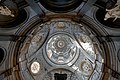
In 1649 Bernardino Quadri prepared a project to enlarge the cathedral, to create a more impressive seat for the Holy Shroud. Quadri had moved from Rome to join the court of Duke Charles Emmanuel II of Savoy in Turin. His design was based on an earlier project by Carlo di Castellamonte: it included building an oval chapel behind the choir. In 1667 Guarino Guarini was invited to complete the project. The construction of the dome took 28 years: it was completed in 1694 under the direction of Marie Jeanne of Savoy, Charles Emmanuel II's widow.

The cathedral is the burial place and major shrine of St. Pier Giorgio Frassati (1901–1925), Turin native, avid athlete, and benefactor of the poor, called the "saint for youth of the Third Millennium." He was beatified by John Paul II in 1990, and canonized by Pope Leo XIV on September 7, 2025.

While the chapel of the Holy Shroud behind the cathedral was undergoing renovation during 2009, the Shroud was kept in a small chapel within the cathedral.

Notable people

[edit]
Maestro di cappelli

Organists

[edit]

Ruggier Trofeo[5]

Funerals and burials

As Turin was the capital city of the Kingdom of Piedmon-Sardinia, the cathedral is one of two in which members of the royal family (including the cadet branches) are buried in, the other being the Basilica of Superga in the outskirts of the city. Several royal consorts and princesses are buried here.

[edit]

References

[edit]
Revisions and contributorsEdit on WikipediaRead on Wikipedia
from Grokipedia
The Cathedral of Saint John the Baptist, known as Turin Cathedral or Duomo di Torino, is the mother church and episcopal seat of the Roman Catholic Archdiocese of in northern Italy. Dedicated to Saint John the Baptist, the city's , it stands in the historic center adjacent to the Royal Palace of and was constructed in the style between 1491 and 1498 on the site of three earlier fourth-century Christian basilicas. The cathedral is globally renowned for safeguarding the , a linen cloth believed by many to bear the image of Jesus Christ, which has been housed there for over four centuries. Commissioned by Cardinal Domenico , the then-bishop of , the structure replaced the ancient basilicas dedicated to Christ the Saviour, Saint John the Baptist (originally a ), and the Virgin Mary, whose remains were excavated and preserved in the cathedral's basement museum. Designed by the Tuscan Amedeo da Settignano, also known as Meo del Caprino, the building introduced architectural elements to the region, featuring a simple yet elegant facade in white marble with a prominent erected in 1470. A notable addition is the adjacent , a masterpiece built between 1668 and 1694 under the direction of , a Theatine and innovative whose design integrates intricate geometries, a soaring dome, and symbolic light effects to evoke spiritual transcendence. The cathedral's significance extends beyond its architectural heritage; it serves as a pilgrimage site drawing millions due to the , publicly displayed periodically since its transfer to in 1578 by the . The connects the cathedral to the Royal Palace, underscoring the intertwined history of and in Savoy , while the overall complex symbolizes the city's religious and cultural identity. Restored multiple times, including after a 1997 fire that damaged the chapel, the site continues to host liturgical events, exhibitions, and archaeological displays that highlight its layered history from to the era.

History

Early Christian and Medieval Foundations

The site of Turin Cathedral occupies a portion of the ancient Roman theater of Augusta Taurinorum, constructed around 15 BC and capable of seating approximately 3,000 spectators; remnants of its stone seating are visible near the modern cathedral. In the 4th century, as Christianity spread in the region following Emperor Constantine's in 313, the site was repurposed for religious use with the construction of three early Christian , reflecting the typical basilical plan adapted from Roman civic architecture for worship. These included the Basilica of the Holy Saviour (or Christ the Saviour), the Basilica of the Virgin Mary, and the Basilica of St. John the Baptist, which initially functioned as a . The basilicas were likely built under the patronage of local bishops, with established as a bishopric around 415, serving as the episcopal seat amid the transitioning Roman provincial administration. During the late 6th century, under Lombard rule, the complex underwent significant developments, with the the Baptist enlarged and consecrated, possibly by King (r. 591–616), who, as of before his ascension, promoted St. John as patron of the Lombard kingdom alongside his wife Queen . This period marked the basilica's evolution into the primary episcopal center, influenced by Lombard Arian-to-Catholic conversions and royal patronage. In 662, during celebrations, Garipald of —suspected in the assassination of King Godepert—was himself murdered within the by Godepert's followers, highlighting the site's role in political intrigue amid Lombard power struggles. By the medieval period, particularly under Carolingian influence from the 8th to 10th centuries, the St. John baptistery solidified its status as the diocese's core, with the complex serving as the enduring episcopal seat through Frankish integration and the consolidation of Christian authority in ; archaeological remains of these structures, including foundations and inscriptions, are preserved in the cathedral's Diocesan Museum. This foundational era laid the groundwork for later reconstructions, culminating in the rebuilding starting in 1491.

Renaissance Construction

The construction of the current Cathedral, dedicated to Saint John the Baptist, was commissioned in 1491 by Cardinal Domenico della , who served as of from 1482 to 1501 and was supported in this endeavor by . The project aimed to replace earlier basilicas on the site, including Lombard-era structures, with a new edifice that would serve as the city's principal church and embody ideals of spiritual and architectural renewal. The design was entrusted to the Tuscan architect Amedeo di Francesco da Settignano, known as Meo del Caprino, a Florentine-trained master active in and since the 1460s, whose work drew on classical precedents to create a structure of dignified simplicity. Construction proceeded rapidly from 1491 to 1498, with the laid on July 22, 1492, under the patronage of Bianca of , regent of the . The cathedral was built adjacent to an existing , erected between 1468 and 1470 at the behest of Bishop Giovanni da Compeyso and dedicated to Saint Andrew, which provided a medieval anchor for the new ensemble. The main structure reached completion in the spring of 1498, utilizing white marble quarried from Chianocco and employing Florentine stonemasons to ensure precision in execution. The cathedral was consecrated on September 21, 1505, by Giovanni Ludovico della Rovere, nephew of Cardinal Domenico and titular Archbishop of Caesarea, in a solemn ceremony that marked its readiness for liturgical use. In 1515, elevated the Diocese of to metropolitan archdiocesan status on May 21, affirming the cathedral's enhanced role as the seat of an archbishop overseeing suffragan sees in the region. Architecturally, the influences are evident in the cathedral's balanced proportions, symmetrical layout in the form of a , and incorporation of classical elements such as pilasters and entablatures, all inspired by Florentine models like those of Brunelleschi and Alberti, adapted to a restrained Piedmontese context with minimal ornamentation. This design not only symbolized the transition from medieval to humanist architecture but also positioned as a center of patronage under and influence.

Baroque Expansions and Modifications

In the 17th century, the Dukes of Savoy initiated significant Baroque expansions to the Cathedral of Turin, transforming its Renaissance framework to better accommodate sacred relics and assert the city's growing prominence as the dynasty's capital. Under the patronage of Charles Emmanuel II, who revived stalled projects in 1657, these modifications emphasized opulent Baroque aesthetics to symbolize Savoyard power and piety. The most prominent addition was the Chapel of the Holy Shroud, designed by the Theatine architect Guarino Guarini and constructed from 1668 to 1694. Guarini was appointed ducal engineer in 1668, overseeing the chapel's integration between the cathedral's apse and the Royal Palace, with construction continuing after his death in 1683. The dome's completion in 1694 occurred under the direction of Marie Jeanne of Savoy, widow of Charles Emmanuel II, marking the chapel's full realization as a Baroque masterpiece. These expansions also included extensions to support royal liturgical functions and processions, funded by resources to align with dynastic goals of elevating 's status. By the late , the chapel's 1694 integration, coinciding with Vittorio Amedeo II's early rule, underscored the Savoyards' ambitions to position as a European center of religious and political prestige.

Architecture

Exterior Features

The façade of Turin Cathedral, constructed between 1491 and 1498 under the direction of Tuscan architect Meo da Caprino on commission from Cardinal Domenico , exemplifies with its white frontispiece sourced from quarries in Bussoleno and Chianocco in the Val di Susa. The lower section features three portals framed by classical pilasters and entablatures, dividing the surface into a tripartite composition that reflects the interior's three naves, while the central tympanum bears the commissioner's —an oak tree with a cardinal's hat and cross—surmounted by reliefs depicting , Christ, musician angels, and Saint John the Baptist. Above the portals, inscriptions note the bishop's name, but the upper sections remain unfinished, leaving the structure's full height of approximately 25 meters without the planned or additional ornamentation, a characteristic that distinguishes it from more complete contemporaries. Adjacent to the cathedral's northern side stands the , erected in 1468–1470 during the episcopate of Giovanni di Compey and dedicated to Saint Andrew, measuring 40 meters (130 feet) in height. Built in a transitional Gothic-Renaissance style, its lower levels feature simple cornices and panels without hanging arches, transitioning to pointed single-light windows on the upper stories, culminating in an open with multifoil ; the tower connects to the main structure via a gallery and is clad in local with marble accents, including the bishop's . This single-tower configuration is unique among Turin's cathedrals, emphasizing a restrained vertical accent rather than symmetrical flanking towers. The cathedral's exterior blends austerity at its core with flourishes introduced by the adjacent Guarino Guarini-designed (1668–1694), whose undulating dome and ornate silhouette visually extend the composition without overwhelming the simpler elevations. Constructed with a core sheathed in white cladding, the building's pale stonework contrasts sharply with Turin's prevalent red- architecture, enhancing its prominence in the urban fabric. Situated at the heart of Piazza San Giovanni, the cathedral integrates seamlessly with the surrounding complex, forming a cohesive piazza defined by its axial alignment and the tower's role as a focal element.

Interior Layout and Design

The interior of Turin Cathedral adopts a plan, characterized by a single central flanked by two narrower aisles and intersected by a , creating a structured flow from the entrance to the . This layout, with its clear geometric forms, separates the from the aisles via robust piers, while side chapels—often hexagonal or semicircular—project along the aisles to accommodate smaller devotional spaces without disrupting the main axis. The entire structure is covered by barrel vaults, emphasizing proportions that balance height and breadth for a sense of elevation and harmony. At the crossing of the and rises a low octagonal dome, which serves as a focal point and allows for subtle vertical emphasis without overwhelming the horizontal lines of the form. The , elevated by four steps beyond a , leads to a polygonal dedicated to Saint John the Baptist, the cathedral's patron saint, reinforcing the liturgical orientation toward the east. Clad in pale stone from the Bussoleno quarry, these elements contribute to a luminous and austere ambiance, with the vaults and piers providing structural integrity while framing the spatial progression. Natural light enters primarily through clerestory windows along the and the octagonal openings in the dome, diffusing illumination across the interior to highlight the vaults and piers without stark contrasts. The overall design supports liturgical processions along the central axis, with the and aisles offering lateral space for movement during ceremonies. Acoustically, the vaulted ceiling and pier-separated volumes enhance resonance, making the space well-suited for choral and organ performances integral to Catholic rites. The extends approximately 67 meters in length, with a total interior width of about 21 meters (central 9.5 meters, aisles 5.8 meters each) and vault heights around 17 meters.

Art and Furnishings

Major Altars and Chapels

The main altar of Turin Cathedral, situated in the presbytery, exemplifies influences adapted in the early eighteenth century, featuring bronze candelabra adorned with the crosses of the . The surrounding black-and-white marble floor incorporates a patterned replicating the Savoy coat of arms, symbolizing the dynasty's patronage and historical ties to the cathedral. This setup underscores the altar's role as the focal point for Eucharistic celebrations, integrating symbolic with liturgical function. The Shroud Chapel, adjacent to the cathedral's apse, houses a prominent double central altar designed by Antonio Bertola in 1694, crafted from black Frabosa accented with gilt-bronze elements and gilded wood carvings to facilitate the relic's veneration and display. The altar's reliquary-like form, elevated on steps and enclosed by a balustrade, allows for bidirectional viewing, reflecting its original purpose in the court's devotional practices. The altar sustained damage in a 1997 fire and underwent restoration, completed in 2021. Along the cathedral's aisles, numerous side are dedicated to various saints and , each equipped with altarpieces blending and styles to honor their patrons. For instance, the of Saints Crispin and Crispian features an early sixteenth-century by Martin Spanzotti and Defendente Ferrari, depicting the Virgin and Child alongside scenes of the saints' martyrdom, originally commissioned by the shoemakers' . Similarly, the of St. Michael the Archangel contains a 1655 canvas by Giovanni Bartolomeo Caravoglia portraying the Virgin and Child with Saints , the Archangel Michael, Filippo Neri, and , while the of the Madonna Grande preserves a fifteenth-century terracotta statue of the Virgin, augmented in the nineteenth century with flanking figures. These serve as intimate spaces for private prayer and commemorations, their altars emphasizing continuity in devotional art across stylistic periods.

Paintings, Sculptures, and Decorative Elements

The interior of Turin Cathedral houses a diverse array of paintings and sculptures that exemplify the transition from to artistry, blending Tuscan influences in its early construction with robust Piedmontese embellishments added in subsequent centuries. Among the most significant works is the early 16th-century altarpiece in the Chapel of Saints Crispin and Crispian, a collaborative by Martino Spanzotti and Defendente Ferrari depicting the Virgin Mary breastfeeding the Child, characterized by its detailed figures and devotional intimacy typical of northern . Other notable canvases include Charles Dauphin's 1663 central in the Chapel of Saints Biagio and Onorato, illustrating the Communion of St. Honore with dramatic lighting and emotional depth, and Giovanni Bartolomeo Caravoglia's 1655 painting in the Chapel of St. Michael the Archangel, showing the Virgin and Child enthroned amid saints in a richly colored, theatrical composition. Sculptural elements further enrich the cathedral's artistic heritage, with a 15th-century painted terracotta of the presiding over the Chapel of the Madonna Grande, its expressive features and vibrant polychromy evoking late medieval devotional traditions; this is complemented by flanking 19th-century marble statues of Saints Joachim and , added to enhance the chapel's neoclassical symmetry. In the connected Shroud Chapel, sculptural reliefs grace the pendentives, incorporating intricate motifs of crosses and family symbols that underscore the chapel's dynastic and geometric complexity. Decorative features, such as Antonio Parentani's 1604 painting on the counterfaçade depicting a religious scene amid architectural framing, add to the layered ornamental narrative. These artworks have been preserved through 20th-century restorations, notably in 1932, which addressed structural and artistic wear while maintaining the originals' integrity amid evolving liturgical needs.

The Shroud of Turin

Arrival and Housing in the Cathedral

The arrived in the city on September 14, 1578, when Emmanuel Philibert of ordered its transfer from , , to the Savoyard capital, where it has been preserved ever since. This relocation honored a pilgrimage request from Cardinal and marked the relic's integration into Savoy family devotion, with the cloth initially housed in the ducal palace and later in temporary ecclesiastical settings. Construction of a dedicated for the Shroud began in 1668 under the direction of Amedeo di Castellamonte, but the project advanced significantly after assumed oversight in 1668, culminating in the structure's completion by 1694. On June 1, 1694, the Shroud was solemnly transferred to this new Guarini Chapel, adjacent to Turin Cathedral, where it remained on a double central altar designed by Antonio Bertola for nearly three centuries. The relic's ownership transitioned from the to the following the death of ex-King Umberto II on March 18, 1983, who bequeathed it to and his successors with the stipulation that it remain in under the Archdiocese's custody. The formally accepted possession on October 18, 1983, ensuring its continued guardianship in the cathedral complex for over 445 years since its arrival. For preservation amid structural concerns, the Shroud was relocated from the Guarini Chapel to (Duomo di Torino) on February 24, 1993, and placed in a secure, temporary behind the main altar. It has since been stored in a climate-controlled within the cathedral, featuring airtight, filled with inert gases to maintain stable temperature and humidity levels, particularly during the ongoing chapel renovations that included phases in 2009.

Exhibitions, Veneration, and Scientific Study

The has been the subject of several major public s since its arrival in , allowing pilgrims and scholars to view the relic under controlled conditions in the cathedral. The first significant public viewing occurred in 1898, when it was displayed for , drawing large crowds and marking the moment when amateur photographer captured the first photographs, revealing the negative image properties of the cloth. In 1931, during another exposition, professional photographer Enrie produced high-quality negatives using scientific methods, which were later distributed widely and contributed to early studies of the image. The 1978 , held over five weeks to commemorate the 400th of the Shroud's arrival in , attracted approximately 3.5 million visitors who viewed it through in a nitrogen-filled case. Subsequent displays included the 2000 Year ostension from August to October, the longest in history at ten weeks and authorized by , which saw millions of attendees including reserved slots for youth groups. The 2010 exposition, from April to May and approved by , drew over 2 million visitors focused on pastoral reflection without allowing new scientific access. Veneration of the Shroud centers on ostension ceremonies in Turin Cathedral, where the relic is unveiled for public adoration during designated periods, often accompanied by prayers and processions. The liturgical Feast of the Holy Winding Sheet of Christ, observed annually on May 4, honors the Shroud with special Masses and devotions in the cathedral, emphasizing its role as a devotional . Pilgrimages to view the Shroud peak during Years, when the influx of faithful underscores its status as a focal point for spiritual renewal and contemplation of Christ's Passion. Scientific investigations of the Shroud have intensified since the late , with the 1978 Shroud of Turin Research Project (STURP) conducting the first comprehensive multidisciplinary analysis during the exhibition, using techniques like and to examine the image and bloodstains, concluding that the image was not formed by pigments or dyes but leaving the mechanism unexplained. The 1988 by laboratories in , , and Zurich dated a sample to 1260–1390 AD, suggesting a medieval origin, though this result remains controversial due to concerns over sample contamination and selection. In 2025, advanced 3D imaging analysis indicated that the image characteristics align more closely with those produced by a bas-relief than a wrapped cloth, supporting a medieval artistic creation hypothesis. Ongoing forensic research continues to probe bloodstain patterns for trauma evidence and theories, including radiation or chemical processes, with studies emphasizing the stains' consistency with wounds. Recent events tied to the Shroud include the reopening of the Guarini Chapel after a 21-year restoration following a 1997 fire, restoring the secure housing space adjacent to the for . For the 2025 Jubilee Year, no physical display was planned to preserve cloth, but a digital exhibit titled "Avvolti" offered a multimedia with high-resolution replicas and interactive elements from April 28 to May 5, complemented by a "Shroud " in Piazza Castello for free virtual viewings; the event attracted over 32,800 visitors and nearly two million online views.

Clergy and Notable Associations

Archbishops and Leadership

The Archdiocese of traces its episcopal succession to the late 4th century, when it was established as a under the metropolitan see of , with early bishops such as Maximus of serving during the transition from Roman to barbarian rule. During the Lombard period (568–774), the maintained continuity under the Arian-influenced Lombard kings, with bishops navigating the religious and political shifts until the Frankish restored full Catholic . This lineage evolved through medieval counts and Savoyard influence, culminating in the elevation to a metropolitan archdiocese on May 21, 1515, by , granting it suffragan sees including , Alba, and Acqui. A pivotal figure in the cathedral's development was Cardinal Domenico , appointed of in 1482 and serving until 1501, who commissioned the construction of the current Renaissance-style in 1491 to replace earlier basilicas, entrusting the project to the Tuscan architect Meo da Caprino. His tenure marked a significant investment in the city's religious , blending papal connections with local administration. In the , Cardinal Maurizio di Savoia, from 1633 to 1660, played a key role in Shroud-related leadership. Modern archbishops have continued oversight of the cathedral's administration, including restorations and exhibitions. For instance, 20th-century leaders like Cardinal Michele Pellegrino (1965–1977) and Cardinal Anastasio Ballestrero (1977–1991) supervised major Shroud expositions in 1978 and 2000, coordinating scientific studies and pilgrim access while maintaining liturgical protocols. The current , Cardinal Roberto Repole, appointed in 2022 and elevated to cardinal in 2024, leads the archdiocese including ongoing 2025 Jubilee Year events as of November 2025, with programs on themes like "What Do You Seek?" for adults and youth initiatives tied to the cathedral's liturgical calendar, emphasizing spiritual renewal without a full Shroud display. Under his guidance, the archdiocese manages ongoing maintenance of the cathedral and its relics, fostering ecumenical dialogue and .

Burials, Baptisms, and Cultural Figures

The Cathedral of Saint John the Baptist in Turin serves as the final resting place for several notable figures, most prominently (1901–1925), a lay Catholic known for his devotion to the poor and social activism. Frassati, who died of at age 24, was initially buried in the family in the Pollone Cemetery, but following his by on May 20, 1990, his remains were transferred to a dedicated in the cathedral's third chapel on the left aisle. His on September 7, 2025, by further elevated his legacy, drawing pilgrims to the site where his tomb remains a focal point for . The cathedral also holds historical ties to the through funerals and initial burials of royal consorts and princesses. For instance, (1644–1724), wife of Duke Charles Emmanuel II of , had part of her remains interred in the cathedral following her death, though her primary burial was at and remains were later relocated to the in 1836 as part of the dynasty's consolidation of royal tombs. More recently, the cathedral hosted the funeral of Vittorio Emanuele of , Prince of Naples (1937–2024), the son of Italy's last king, Umberto II, on February 10, 2024, underscoring its enduring role in ceremonial traditions before his ashes were placed at . As the seat of the Archdiocese of , the cathedral's has long been a site for the initiation into the faith of prominent locals and nobility. Saint John Bosco (1815–1888), the renowned priest and founder of the Salesian order, received his in 1815 in the Church of Saints Lawrence and Andrew in Morialdo near , marking the beginning of a life dedicated to youth education amid the city's industrial challenges. Other notables, including members of the court and intellectual figures, underwent here, reflecting the cathedral's central role in the spiritual life of the Piedmontese elite during the 18th and 19th centuries. The cathedral's musical heritage features notable organists and composers who contributed to its liturgical traditions. In the 20th century, Massimo Nosetti (1960–2013) served as titular organist, performing extensively on the cathedral's historic instrument and promoting Italian organ repertoire through recitals and recordings that blended and contemporary works. Earlier traditions trace back to the , with organists like Ruggier Trofeo (c. 1550–1614) composing sacred music for the cathedral, influencing Piedmont's polyphonic choral practices. These figures helped establish the cathedral as a hub for sacred music, where compositions often integrated local Savoy-era influences with broader European styles. Frassati's association with the cathedral extends to cultural and social events, particularly 20th-century youth movements inspired by his example of faith-driven action. Groups such as the Dominican Youth Movement and chapters in have organized pilgrimages and retreats at his tomb, promoting his motto "Verso l'alto" (To the heights) as a call to and outdoor , especially during the 2025 Jubilee Year when his relics were venerated in before returning to the cathedral. Savoy dynasty ceremonies, including royal weddings and requiems, further embedded the site in Turin's cultural fabric, blending aristocratic ritual with public devotion.

References

Add your contribution
Related Hubs
User Avatar
No comments yet.