Hubbry Logo
AstiAstiMain
Open search
Asti
Community hub
Asti
logo
8 pages, 0 posts
0 subscribers
Be the first to start a discussion here.
Asti
Asti
from Wikipedia
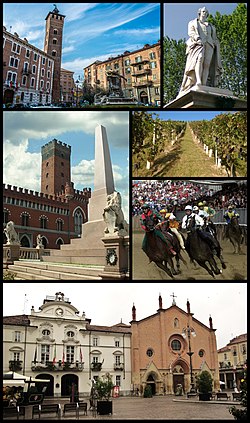
Panoramic view of Asti

Key Information

Asti (UK: /ˈæsti/ AST-ee, US: /ˈɑːsti/ AH-stee;[3][4][5] Italian: [ˈasti] ; Piedmontese: Ast [ˈɑst]) is a comune (municipality) of 74,348 inhabitants (1–1–2021) located in the Italian region of Piedmont, about 55 kilometres (34 miles) east of Turin, in the plain of the Tanaro River. It is the capital of the province of Asti and it is deemed to be the modern capital of Montferrat.

Location of Asti within its province

History

[edit]

Ancient times and early Middle Ages

[edit]

People have lived in and around what is now Asti since the Neolithic period. Before their defeat in 174 BC by the Romans, tribes of Ligures, the Statielli, dominated the area and the toponym probably derives from Ast which means "hill" in the ancient Celtic language.

In 124 BC the Romans built a castrum, or fortified camp, which eventually evolved into a full city named Hasta. In 89 BC the city received the status of colonia, and in 49 BC that of municipium. Asti became an important city of the Augustan Regio IX, favoured by its strategic position on the Tanaro river and on the Via Fulvia, which linked Derthona (Tortona) to Augusta Taurinorum (Turin). Other roads connected the city to the main passes for what are today Switzerland and France.

The city was crucial during the early stages of the barbarian invasions which stormed Italy during the fall of the Western Roman Empire. In early 402 AD, the Visigoths had invaded northern Italy and were advancing on Mediolanum (modern Milan) which was the imperial capital at that time. Honorius, the young emperor and a resident in that city, unable to wait for promised reinforcements any longer, was compelled to flee from Milan for safety in the city of Arles in Gaul. However, just after his convoy had left Milan and crossed the River Po his escape route through the Alps was cut off by the Gothic cavalry. This forced him to take emergency refuge in the city of Hasta until more Roman troops could be assembled in Italy. The Goths placed Hasta under siege until March when General Stilicho, bringing reinforcements from the Rhine, fought and defeated them at the Battle of Pollentia. After this first victorious defence, thanks to a massive line of walls, Hasta suffered from the barbarian invasions which stormed Italy after the fall of the Western Empire, and declined economically.

In the second half of the 6th century, it was chosen as a seat for one of the 36 Duchies in which the Lombards divided Italy. The territory of Asti comprised a wide area, stretching out to Albenga and the Maritime Alps. This remained when northern Italy was conquered by the Franks in 774, with the title of County.

In the late Carolingian age, Asti was ruled directly by his bishops, who were the main landlords of the area. Most important are Audax (904-926) and Bruningus (937-966), who moved the episcopal seat to the Castel Vecchio ("Old Castle"), where it remained until 1409. The bishopric of Asti remained a powerful entity well into the 11th century when Pietro II received huge privileges by emperor Henry II. In the second half of the century, Bishop Otto tried to resist the aims of the powerful countess Adelaide of Susa, who damaged the city several times. During Otto's reign, a commune and the consul magistrates are mentioned for the first time (1095).

Local power

[edit]

Asti was one of the first free communes of Italy, and in 1140 received the right to mint coins of its own by Conrad II. As the commune, however, had begun to erode the lands of the bishop and other local feudatories, the latter sued for help to Frederick Barbarossa, who presented under the city walls with a huge army in February 1155. After a short siege, Asti was stormed and burnt. Subsequently, Asti adhered to the Lombard League (1169) against the German emperor, but was again defeated in 1174. Despite this, after the Peace of Constance (1183), the city gained further privileges.

The 13th century saw the peak of the Astigiani economic and cultural splendour, only momentarily hindered by wars against Alba, Alessandria, Savoy, Milan (which besieged the city in 1230) and the Marquesses of Montferrat and Saluzzo. In particular, the commune aimed to gain control over the lucrative trade routes leading northwards from the Ligurian ports. In this period, the rise of the Casane Astigiane resulted in contrasting political familial alliances of Guelph and Ghibelline supporters. During the wars led by Emperor Frederick II in northern Italy, the city chose his side: Asti was defeated by the Guelphs of Alessandria at Quattordio and Clamandrana, but thanks to Genoese help, it recovered easily. After Frederick's death, the struggle against Thomas II of Savoy became fierce: the Astigiani defeated him on 23 February 1255, at the Battle of Montebruno, but Thomas (who had been taken prisoner) replied ordering all traders from Asti to be arrested in Savoy and France. This move showed worry on the part of Asti's neighbouring states over the excessive power gained by the city, which had captured Alba and controlled both Chieri and Turin.

This state of affairs led to the intervention of Charles I of Anjou, then King of Naples and the most powerful man in Italy. After some guerrilla actions, Asti signed a pact of alliance with Pavia, Genoa and William VII of Montferrat. In 1274 the Astigiani troops were defeated at the Battle of Cassano, but, on 12 December 1275, were victorious over the Angevins at the Battle of Roccavione, ending Charles' attempt to expand in Piedmont. In the 1290s, after William VII had also been defeated, Asti was the most powerful city in Piedmont. However, internal struggles for the control of trading and banking enterprises soon divided the city into factions. The most prominent faction was the powerful bankers of the Solari family, who, in 1314, gave the city to king Robert of Naples.

In 1339, Ghibelline exiles recaptured the city, expelling the Solari and their Neopolitan allies. Shortly thereafter in 1340, Luchino Visconti, Lord of Milan took control of Asti, an act which the rulers of the commune formally accepted in 1342 to protect against the potential of a Solari counteroffensive.[6] To protect the new burgs of the city, Visconti built a citadel and a second ring of walls. In 1345, at the Battle of Gamenario, the Ghibelline Astigiani and John II of Montferrat defeated the Neapolitans in a clash between Guelph forces from the Kingdom of Naples and the Ghibellines supported by the Lombard communes. After the Battle of Gamenario, John II expanded the territory of Montferrat and ultimately in 1356 took Asti from the Visconti ending 16 years of control by Milan.[7] John ruled over Asti until 1372, but seven years later the city council submitted to Galeazzo II Visconti's authority. Later in 1389, when Galeazzo's daughter Valentina Visconti married Louis of Valois, Duke of Orléans, Asti would be included as part of her dowry.

French and Savoyard domination

[edit]

With the exception of several brief periods under Visconti, Montferrat and Sforza rule, Asti remained under Valois control; it eventually became a direct subject of the French Crown. The situation changed in the early 16th century, during the wars between Charles V and Francis I of France. In 1526 it was besieged in vain by Charles' condottiero Fabrizio Maramaldo. Three years later, Asti was conveyed as a result of the Treaty of Cambrai to the Holy Roman Empire by which it was ruled until 1531 when Emperor Charles V gave the territory as a fiefdom to his cousin Beatrice of Portugal, Duchess of Savoy. Later at the time of Beatrice's death in 1538, Asti was inherited by her son and included on the Savoys' heritage.

Asti was one of the main Savoyard strongholds in later wars. In 1616, besieged by the Spanish governor of Milan, it was defended by Duke Charles Emmanuel I himself. In 1630–31, the city suffered a high mortality rate from an outbreak of the plague. Some years later Asti was conquered by the Spanish, although Savoy regained the city in 1643. Another unsuccessful Spanish siege occurred in 1650. In November 1703, during the War of Spanish Succession, Asti fell to France again; it was reconquered in 1705 by Victor Amadeus II. In 1745 French troops invaded the city once more, but it was liberated the following year.

The cathedral of Asti
View of Asti and the Collegiata di San Secondo – Antonio Bignoli 1857.

In 1797 the Astigiani, enraged by the continuous military campaigns and by their resulting poor economic situation, revolted against the Savoyard government. On July 28 the Repubblica Astese was declared. However, it was suppressed only two days later. The revolutionary chiefs were arrested and executed. The following year the Savoyards were expelled from Piedmont by the French revolutionary army, and Asti was occupied by general Montrichard. After a short reversal, the French returned after the victory at Marengo (1800) near to Alessandra. Napoleon himself visited Asti on 29 April 1805, but was received rather coldly by the citizens. The city was demoted and incorporated with Alessandra under the department of Marengo. After the end of the French empire, Asti returned to Piedmont in 1814; the city followed Piedmontese history until the unification of Italy in 1861.

Geography

[edit]

Climate

[edit]

Asti has a continental climate which is moderated by the proximity of the Mediterranean sea: its winters are warmer, and its summers cooler than Turin. Rain falls mostly during the spring and autumn; during the hottest months, rain is less common, but stronger when it does occur, usually in thunderstorms. During November and December in particular, the town of Asti can be prone to fog, which is less common in the higher-altitude areas that surround it.

Climate data for Asti (1998–2020)
Month Jan Feb Mar Apr May Jun Jul Aug Sep Oct Nov Dec Year
Mean daily maximum °C (°F) 6.8
(44.2)
9.8
(49.6)
15.1
(59.2)
19.0
(66.2)
23.3
(73.9)
28.2
(82.8)
30.7
(87.3)
30.1
(86.2)
25.1
(77.2)
18.6
(65.5)
11.9
(53.4)
7.1
(44.8)
18.8
(65.9)
Daily mean °C (°F) 2.4
(36.3)
4.4
(39.9)
9.0
(48.2)
13.1
(55.6)
17.4
(63.3)
22.1
(71.8)
24.2
(75.6)
23.8
(74.8)
19.2
(66.6)
13.7
(56.7)
7.8
(46.0)
3.0
(37.4)
13.3
(56.0)
Mean daily minimum °C (°F) −1.9
(28.6)
−0.9
(30.4)
2.8
(37.0)
7.2
(45.0)
11.6
(52.9)
15.9
(60.6)
17.8
(64.0)
17.6
(63.7)
13.3
(55.9)
8.8
(47.8)
3.8
(38.8)
−1.0
(30.2)
7.9
(46.2)
Average precipitation mm (inches) 42
(1.7)
49
(1.9)
55
(2.2)
70
(2.8)
87
(3.4)
42
(1.7)
43
(1.7)
48
(1.9)
56
(2.2)
66
(2.6)
98
(3.9)
52
(2.0)
708
(28)
Average precipitation days 5 5 5 7 8 5 4 4 5 6 8 6 68
Source: Climi e viaggi[8]

Demographics

[edit]
Historical population
YearPop.±%
186134,083—    
187136,917+8.3%
188138,215+3.5%
190144,533+16.5%
191146,361+4.1%
192145,810−1.2%
193148,714+6.3%
193648,898+0.4%
YearPop.±%
195152,000+6.3%
196161,044+17.4%
197176,151+24.7%
198177,681+2.0%
199173,557−5.3%
200171,276−3.1%
201173,899+3.7%
202173,723−0.2%
Source: ISTAT
Piazza Roma.

Government

[edit]

Main sights

[edit]

Sections of the ancient city walls remain on the north side of the city and in the late 20th century building work uncovered a section of Roman wall in the center of the city.

The area to the northwest of the city, between the centre and the cathedral, is rich in medieval palaces and merchants' houses, many with monumental towers. Asti was known as the city of 100 towers (although there were 120 in total) of which several still remain, among them, the Tower of the Comentini (13th century), the octagonal Torre de Regibus and Torre Troyana (13th century), as well as the ancient Torre Rossa, built during the reign of the Roman Emperor Augustus.

Asti is the home to several old churches. These include:

  • Cathedral of Santa Maria Assunta (built in the 13th century over another Cathedral), one of the biggest in Piedmont, in Romanesque-Gothic style. The monument belfry is from 1266. the façade is characterized by three portals, each surmounted by a big rose window. The interior, with a nave and two aisles, houses a cycle of 18th-century frescoes, some altarpieces by Gandolfino d'Asti and precious silver artworks from the 15th-16th centuries. The presbytery has a noteworthy mosaic floor, from the pre-existing church. Next to the last pilasters of the nave are two 14th-century artworks, the funerary seal of bishop Baldracco Malabaila and the equestrian portrait of Arricino Moneta.
  • Collegiata di San Secondo (13th century) in the old medieval centre next to the Palazzo Civico. It is dedicated to the city's patron saint, Secundus of Asti. The crypt is from the 6th century. The façade has three notable Gothic portals, while the interior houses a polyptych by Gandolfino d'Asti and other works.
  • Santa Maria Nuova (11th century).
  • San Martino, First mentioned in 886, the old Gothic edifice was dismantled in 1696 and rebuilt along Baroque lines in 1736.
  • Sant'Anastasio (8th-12th century), whose museum has some antique capitals and sculptures.
  • Santa Caterina Baroque church
  • Baptistery of San Pietro(12th century) building from the High Middle Ages in the city. It has an octagonal plan with a wide dome.
  • San Pietro in Consavia (15th century), with elegant external decorations. It is the seat of the Archaeological Museum, with Roman and Egyptian works.

There is a synagogue and a museum depicting the history of Asti's Jewish community, whose presence is documented since 812.

Events

[edit]
Palio di Asti.

One of the most famous events held in Asti is the famous Palio di Asti, in which all the old town wards, called "Rioni" and "Borghi", plus nearby towns compete in a bareback horse race. This event recalls a victory in battle against the rival city Alba, during the Middle Ages. After the victorious battle, a race was held around Alba's walls, and from then on, every year in Asti. Asti's Palio is the oldest recorded one in Italy, and in modern times is held in the triangular Piazza Alfieri, preceded by a medieval pageant through the old town on the 3rd Sunday of September.

A Moscato d'Asti.

Wine

[edit]

The three neighbouring Provinces of Asti, Cuneo, and Alessandria incorporate the Langhe and Monferrato Hills region in the centre of Piedmont, limestone and sandstone deposits laid down by the retreating Adriatic some 5 million years ago[citation needed], and are home to some of Italy's most known red wines, plus some white ones.

Asti is the centre of production of the sparkling Asti (DOCG, often known as Asti Spumante). Asti is typically sweet and low in alcohol (often below 8%). It is made solely from the moscato bianco white muscat grape. Other wines include a premium version known as Moscato d'Asti (DOCG) and the red Barbera.

The first products from the province of Asti to become known internationally are Martini and Rossi, Gancia, and Riccadonna, which made commercial wines like Asti Spumante; red wines such as Barbera d'Asti, Freisa d'Asti, Grignolino d'Asti, Bonarda, Grignolino and Ruché di Castagnole Monferrato are also becoming widespread worldwide. These wines and many others can be sampled during the week-long Douja d'Or wine exhibition, which is held at the same time as the Palio and Sagre.

The first documentation on the variety Freisa d'Asti is from the beginning of the 16th century.

Food

[edit]

Asti is also famous for its Asti's Festival of Festivals, held in September, a week before the Palio. During the festival, most of the towns in Asti's province meet in a great square called "Campo del Palio", where they offer typical food and wine for which they are known. On the Sunday of the Sagre, all the towns involved stage a parade with floats depicting traditional farming with everyone in costume along Asti's roads to reach "Campo del Palio" square.

Asti province becomes a gourmand's delight from October to December in the white truffle or "tartufo bianco" season. Although neighbouring Alba is better known for its October truffle fair, some of the best truffles are found around Asti's hills, and every weekend there is a local truffle festival.

Sport

[edit]

The main football club of the town was Asti Calcio F.C. (ex-A.C.D. Asti), which folded in 2017. Another football club, A.S.D. Colline Alfieri Don Bosco (ex-A.C. Celle, from Celle Enomondo), relocated to the city and was renamed to "A.S.D. Alfieri Asti" in 2017. Since 2019, it has been known as A.S.D. Asti.

Former futsal league champion, A.S.D. Asti Calcio a 5, is also based in Asti.

Transport

[edit]

Asti railway station, opened in 1849, forms part of the Turin–Genoa and Castagnole–Asti–Mortara railways. It is also a junction for two other lines, to Genoa and Chivasso, respectively.

Vittorio Alfieri

People

[edit]

People from Asti include:

Frazioni

[edit]

The Asti comune consists of the following frazioni:

Casabianca, Castiglione, Mombarone, Montegrosso, Montemarzo, Poggio D'Asti, Quarto D'Asti, Revignano, San Marzanotto, Serravalle, Sessant, Stazione Di Portacomaro, Vaglierano, Valgera, Valleandona, Valletanaro, Variglie, Viatosto, Avidano, Baciglio, Balestrino, Barbantana, Belangero, Beneficio-Stangona, Biamini, Bramairate, Bricchetto, Bricco Modena, Briccolino, Burie, Cà Dei Coppi, Carretti, Cascin Ruasin, Cascina Angelo, Cascina Conti, Cascina Fanfarina, Cascina Fontana, Cascina Gioia, Cascina Stella, Cascine Artiglione, Cascine Roasio, Ceresa, Cravera, Distretto, Fornaca, Ghirlandina, Gianotti, Giberto, Lama-Garoppa, Madonna Di Caniglie, Madonna Di Viatosto, Malandroni, Manina, Manzoni, Matei, Meridiana, Olivero, Palucco, Quaranta, Quarto, Roccaschiavino, Rocche Di Callianetto, Rossi, San Giuseppe, San Grato, San Marzanotto Piana, San Sebastiano, Stazione Di Sessant, Torrazzo, Vaglierano Basso, Vairo, Valcossana-Grilletto, Valenzani, Valfea, Valmairone, Vareglio.[9]

International relations

[edit]

Asti is twinned with:

See also

[edit]

References

[edit]
[edit]
Revisions and contributorsEdit on WikipediaRead on Wikipedia
from Grokipedia
Asti is a comune and the capital city of the Province of Asti in the Piedmont region of northwestern Italy, located approximately 55 kilometres east of Turin in the Monferrato hills at an elevation of 123 metres above sea level. With a population of 73,503 inhabitants as estimated for 2025, the city is a historic center founded as the Roman colony of Hasta Pompeia in 89 BC, which evolved into a medieval free commune prosperous in banking and trade, evidenced by its original 125 towers reduced to 12 surviving structures amid Guelph-Ghibelline conflicts. Renowned as a wine capital, Asti produces over 90 million bottles annually of sparkling DOCG wines like Asti Spumante and Moscato d'Asti from the Moscato Bianco grape, contributing to the UNESCO-listed Piedmontese wine landscapes. The city's medieval heritage is highlighted by landmarks such as the 13th-century Romanesque-Gothic Cathedral of Santa Maria Assunta, the 44-metre Torre Troyana, and Palazzo Alfieri, birthplace of Enlightenment dramatist Vittorio Alfieri (1749–1803), whose works emphasized individual liberty and influenced European theater. Asti annually hosts the Palio di Asti in September, a bareback horse race tracing origins to the 13th century, accompanied by historical processions representing its 14 medieval borghi and reinforcing communal traditions amid a landscape of vineyards and castles.

History

Ancient origins and Roman era

The settlement of Asti originated as a pre-Roman Ligurian foundation at the confluence of the Borbore stream and Tanaro River, named "Ast" from the Ligurian term denoting an "elevated place." Roman forces established control over the Ligurian territories in the late BCE, with the site formalized as the of Hasta Pompeia in 89 BCE, marking its integration into the Roman administrative framework as a key outpost in the region. Under Roman rule, Hasta underwent , including the construction of the Via Fulvia—a major road tracing modern Corso Alfieri—that linked the settlement to broader networks for military movement and commerce, elevating it from a rural village to a fortified center with public buildings, monumental walls, and gates. Surviving structures, such as the Torre Rossa (Red Tower), exemplify the defensive infrastructure developed during this era. As the principal Roman city in ancient , Hasta functioned as a strategic hub for regional administration and , leveraging its position along consular roads to support economic exchanges in agricultural goods and transit between the and Ligurian ports.

Medieval autonomy and conflicts

By the late , Asti had emerged as one of the earliest free communes in , with records indicating the establishment of a consular by 1095, independent of episcopal or imperial oversight. This shift from feudal dependencies to self-rule was driven by the growing influence of merchant and artisanal classes, fostering economic expansion through control of regional routes linking to and beyond. The commune's prosperity stemmed from commerce in wine, , and emerging exchanges, supported by a network of over 120 towers erected by noble families as symbols of and defense. Asti actively participated in the Lombard League, formed in 1167 as an alliance of northern Italian cities to counter Holy Roman Emperor Frederick I Barbarossa's campaigns to reimpose imperial authority. In 1174, imperial forces under Barbarossa defeated Asti, sacking the city, but the league's broader coalition prevailed at the Battle of Legnano in 1176, compelling the emperor to negotiate. The resulting Peace of Constance in 1183 affirmed the communes' rights to fortify cities, levy tolls, and govern locally, temporarily securing Asti's independence amid ongoing tensions with imperial loyalists. Throughout the 13th century, Asti aligned predominantly with the faction, favoring papal authority over imperial claims, which intensified internal divisions between pro-papal merchants and Ghibelline nobles tied to local feudal houses. These factional wars erupted into open conflict, notably the Battle of Montebruno against the Ghibelline , where Asti's forces clashed with invading troops under Thomas II, highlighting the commune's vulnerability to territorial incursions from neighboring powers. Chronic strife eroded communal unity, enabling partial encroachments by Milanese interests, which exploited Asti's divisions to assert influence through alliances and military pressure by the century's close.

Early modern domination and unification

In 1531, the County of Asti was annexed by the House of Savoy, transitioning from fragmented control under powers like the Sforza and Holy Roman Empire to direct Savoyard sovereignty, which positioned the city as a key defensive stronghold in Piedmont amid ongoing European power struggles. This incorporation followed the Treaty of Cambrai's implications and Charles V's concessions, integrating Asti into the Duchy of Savoy's expanding territories despite intermittent French pressures, as France had previously exerted influence through Valois holdings until the early 16th century. Under Savoyard administration, Asti functioned as a fortified outpost, with its towers and walls reinforced to counter invasions, including French incursions into Piedmont during the 1536 campaign led by Francis I. By the , Savoyard governance introduced administrative centralization and agricultural reforms aimed at boosting productivity in the region's vineyards and farmlands, while Asti experienced a resurgence in architectural development, including palaces that reflected the dynasty's cultural patronage. These changes, under rulers like , who elevated to kingdom status in 1713 via the Treaty of Utrecht, emphasized fiscal efficiency and military readiness, with Asti's strategic location enhancing its role in Piedmont's defensive network against Austrian and French threats. Asti's integration into the Kingdom of Sardinia positioned it centrally in the Risorgimento, the 19th-century drive for Italian unification, where Piedmontese forces under the Savoyard crown played a pivotal role from onward. Local involvement included participation in revolutionary upheavals, such as the 1848 uprisings against Austrian dominance, culminating in Asti's formal alignment with the unified proclaimed on March 17, 1861, following Piedmont's annexations in and . Artifacts documenting these events, spanning 1797 to 1870, underscore Asti's contributions through patriot networks and alignment with figures like Camillo Cavour, though without major battles on its soil.

Geography

Location and physical features

Asti is located in the southeastern portion of , , serving as the capital of its namesake province. The city lies approximately 56 kilometers southeast of within the valley of the Tanaro River, which flows through the region and influences local . At an elevation of 132 meters above , Asti occupies a position in the transition zone between the Po River plain to the north and more rugged terrains to the south. The physical landscape surrounding Asti forms part of the Monferrato hills, characterized by gently rolling terrain that rises gradually from the river valley. This hilly morphology, shaped by sedimentary deposits, predominates in the area, with elevations varying from the valley floor up to several hundred meters in the surrounding ridges. The proximity to the Ligurian Apennines, about 50 kilometers to the south, and the expansive Po plain, immediately to the north, delineates Asti's position within Piedmont's diverse topography. Geologically, the region features soils derived from marine sediments, including mixtures of clay, , , and , which contribute to the area's distinctive . These formations, primarily from the Tertiary period, support a adapted to agricultural uses, particularly , though the focus here remains on the inherent physical attributes. The Monferrato hills encompassing Asti were designated as part of the UNESCO "Vineyard Landscape of Piedmont: Langhe-Roero and Monferrato" in , recognizing their cultural and natural significance.

Climate and environment

Asti features a , with marked seasonal variations influencing local and daily life. Summers are hot and dry, with averaging a mean of 24°C, including daytime highs often exceeding 28°C, while winters are cold and occasionally snowy, with means around 1°C and lows dipping below freezing. Annual averages approximately 830 mm, distributed relatively evenly but peaking in spring and autumn due to frontal systems from the and Mediterranean influences, contributing to critical for hillside farming. The surrounding Monferrato hills generate microclimates that enhance diurnal temperature swings and air circulation, aiding the ripening of heat-sensitive crops by mitigating excessive and risks at lower elevations. These conditions, however, expose the area to environmental hazards such as persistent autumn that reduces penetration and sporadic hailstorms, which have intensified in frequency amid broader northern Italian patterns, potentially damaging up to 20-30% of vulnerable harvests in severe events. Conservation initiatives in Asti emphasize preservation within agricultural landscapes, including reduced use and corridors in hillside areas to support pollinators and organisms, as evidenced by studies on assemblages in local ecosystems. Facing pressures—such as erratic precipitation and heat spikes leading to yield variability of 10-15% in recent decades—regional responses incorporate adaptive strategies like cover cropping for and selective trials, though only about 9.5% of Piedmontese vineyards currently employ supplemental amid constraints. These efforts draw from empirical monitoring by agricultural consortia, prioritizing resilience without over-reliance on unproven interventions.

Demographics

Population dynamics

The population of the comune of Asti has experienced a steady decline since the early , dropping from 76,534 residents recorded in the census to 73,691 as of January 1, 2024. This represents an average annual decrease of approximately 0.4%, driven primarily by negative natural balance rather than net out-migration within . Projections for 2025 estimate further reduction to around 73,500, continuing the trend observed in official ISTAT registers. Contributing factors include persistently low birth rates, with Asti's crude birth rate falling to 5.6 per 1,000 inhabitants in recent years, well below the replacement level of approximately 2.1 children per woman and the national average of 6.7 per 1,000 in 2023. Deaths have outnumbered births, yielding a natural saldo of -381 in the latest annual data, exacerbated by an aging demographic structure where the median age exceeds 47 years. The mirrors this pattern, with its contracting from 217,573 at the 2011 census to 207,310 as of January 1, 2025, a cumulative decline of over 4.7%. Rural municipalities have seen sharper depopulation due to limited economic opportunities, while the urban center of Asti maintains relative stability through its role as provincial capital, hosting administrative, educational, and service institutions that anchor a portion of the . This urban-rural divergence underscores broader Piedmontese trends of concentrated in administrative hubs amid peripheral exodus.

Composition and migration patterns

As of January 1, 2024, foreign residents constitute 11.9% of Asti's population, totaling 8,700 individuals, leaving native as the overwhelming majority at approximately 88.1%. The foreign demographic is led by , numbering 2,725 or 31.3% of non-Italians, followed by at 1,346 (15.5%) and at 1,044 (12.0%). Religious affiliation in Asti aligns with Piedmont's traditional profile, featuring a Catholic majority sustained by longstanding parish structures and cultural practices. A historical Jewish presence dates to the medieval era, with Asti among Italy's earliest Jewish settlements established by the , though deportations during and assimilation have reduced it to traces today. Immigration has yielded modest diversification, incorporating via Moroccan and other African arrivals alongside Orthodox elements from Romanian and Albanian groups, but without significantly altering the Catholic predominance. Since the 2000s, Asti has recorded negative net migration, especially among young adults drawn to in proximate hubs like amid limited local prospects. This trend is counterbalanced to some extent by seasonal inflows of agricultural laborers, primarily for harvesting, sourced from and to support the wine industry.

Economy

Agricultural base and wine industry

The agricultural economy of Asti province is predominantly centered on , which occupies a significant portion of the and serves as the primary driver of rural and output. The hilly , covering 97% of the province's , is ideally suited for cultivation, supporting over 10,000 hectares dedicated to Asti DOCG vineyards as of recent surveys. This sector benefits from cooperative frameworks, such as the Consorzio Asti DOCG, which coordinates production standards, quality controls, and market promotion among approximately 4,000 producers, including growers and wineries. Asti's wine industry revolves around the Asti DOCG designation, encompassing both Asti Spumante—a fully sparkling —and , a lightly frizzante variant, both produced exclusively from Moscato Bianco grapes via partial fermentation in autoclaves to preserve natural sweetness and aromatics. In 2024, total bottling surpassed 102 million units, comprising about 60 million bottles of Asti Spumante and 42 million of , reflecting a recovery from prior years' declines due to climatic variability and yield adjustments. Complementary varieties include DOCG, a sweet sparkling red wine from the grape, cultivated across 26 municipalities in Asti and adjacent provinces, adding diversity to the sparkling portfolio with its strawberry-like profiles. Exports underpin the sector's viability, with over 90% of Asti DOCG production shipped abroad, generating stable revenues amid minor volume fluctuations (e.g., -0.8% in the first nine months of 2024), supported by EU safeguards that enforce geographic and qualitative criteria. Key markets include the , , and other non-EU destinations, where demand for affordable, aromatic sparklers sustains more than 70% of wine-related income. Beyond wine, secondary crops such as cereals, for local , and limited orchards contribute to diversification, though they represent a minor share compared to viticulture's dominance in and .

Industrial and service sectors

Asti's industrial sector is characterized by small-scale manufacturing, primarily in food processing equipment, machinery, and textiles, reflecting the province's rural and agricultural orientation that limits large-scale heavy industry. Notable firms include TSG Italia SRL, which generates approximately €91.88 million in revenue from commercial and service industry machinery, and Pess Technologies SRL, focused on specialized equipment with €1.68 million in output, both located in Asti city. Textile and clothing-related production also persists, encompassing embroidery machines and wholesale of fabrics and accessories. The service sector employs a substantial portion of Asti's workforce in retail, education, and public administration, though participation rates in services lag behind the Piedmont regional average of 34.5%. Tourism has emerged as a growth area, leveraging wine routes, historical heritage sites, and events to attract visitors, with the sector identified for high development potential due to proximity to Turin and cultural assets. Unemployment rates in Asti align closely with Piedmont's figure of 6.1% as of 2023, remaining below national averages amid stable service-oriented employment.

Recent economic challenges

Asti's wine sector, central to the local economy, has faced declining sales amid persistent oversupply and intensifying competition from alternatives like . Bottled volumes of Asti Designation of Origin wines dropped from 100 million bottles in 2023 to 90 million in 2024, with projections estimating a further decline to 85 million in 2025. This contraction reflects broader challenges in the Italian market, where domestic and export demand has weakened, exacerbated by a saturated inventory from prior bumper harvests and shifting consumer preferences toward , which has maintained stronger export performance. To counteract falling prices and stabilize the market, the Asti DOCG implemented yield restrictions for the 2025 harvest, capping production at 90 quintals per —down from 100 quintals—with 5 quintals allocated to reserves. While weather conditions promise excellent grape quality, overall quantity remains uncertain due to these curbs and variable climatic factors, potentially limiting total output but aiming to preserve value in a low-demand environment. External pressures have compounded these issues, including a 15% U.S. on EU wines imposed in 2025, which threatens to erode export revenues critical for Asti producers reliant on the American market. The tariffs are projected to cost the industry over €300 million annually, with no exemptions secured for sparkling categories like Asti, amid ongoing global market volatility and stagnant agricultural growth in regions like . These factors contribute to a cautious outlook, as producers navigate reduced turnover and delayed investments in an environment of oversupply fears despite a favorable 2025 harvest volume.

Government and administration

Local governance structure

Asti operates as a comune under Italy's municipal framework, governed by a directly elected mayor (sindaco) who holds executive powers and a city council (consiglio comunale) of 30 members elected proportionally, responsible for approving budgets, bylaws, and oversight of municipal policies. The mayor appoints a junta (giunta comunale) of assessors to manage specific sectors like public works and social services. As the provincial capital, Asti integrates municipal functions with the Province of Asti, whose president is elected indirectly by a provincial assembly comprising mayors and councilors from the 118 constituent comunes, focusing on supra-municipal coordination. The current mayor, Maurizio Rasero of the center-right Forza Italia party, assumed office on June 27, 2017, following elections where his coalition secured a majority, and continues to lead as of 2025 with a term extending post-reelection cycles aligned to Italy's five-year municipal mandates. Rasero concurrently serves as president of the Province of Asti since September 16, 2022, elected by provincial councilors to oversee competencies including secondary road maintenance, environmental planning, and vocational education. Municipal powers encompass urban planning, local public transport, waste collection, cultural heritage preservation, and promotion of events like the Palio di Asti, funded partly through property taxes (IMU) and service fees, while aligning with Piedmont regional directives on viticulture and tourism development. Provincial governance complements this by managing inter-commonal infrastructure and territorial policies, subject to national laws under Title V of the Italian Constitution, which decentralizes authority to local entities while ensuring fiscal accountability through state transfers amid demographic pressures.

Administrative divisions

The of Asti includes numerous frazioni, defined as smaller rural hamlets and localities subsumed under the comune's administrative for coordinated , service delivery, and . These divisions primarily serve agricultural zones, with municipal policies emphasizing regulations to sustain and farming activities while providing essential such as roads, , and tailored to sparse populations. Prominent frazioni encompass Casabianca, Castiglione, Mombarone, Montegrosso, Montemarzo, Poggio d'Asti, Quarto d'Asti (including its Inferiore and Superiore subdivisions), Revignano, San Marzanotto, Serravalle, Sessant, and Stazione Vecchia, alongside others like Canova, Palucco, Valenzani, Variglie, and Viatosto. These areas operate with semi-autonomous community functions, such as local parish oversight for civil registry and events, but remain fully integrated into the 's fiscal and planning framework to prevent fragmented development. As of 2025, frazioni collectively house around 16,000 inhabitants, roughly 23% of Asti's total municipal population of approximately 70,000, characterized by low densities that prioritize preservation of against suburban expansion. This structure supports rural viability through targeted investments in connectivity and environmental safeguards, countering depopulation trends in peripheral zones.

Culture and heritage

Architectural landmarks

The Cathedral of Santa Maria Assunta exemplifies in , with its construction spanning the 13th and 14th centuries on earlier foundations dating to the 5th or ; it features a facade, terracotta and elements, and a prominent rising above the historic core. The structure underwent multiple rebuilding phases over seven centuries, incorporating polychrome marble portals and an interior with frescoes and a high altar designed in 1732 by Benedetto Alfieri. Asti's medieval skyline is defined by surviving towers from its era as a city of over 100 such structures in the 17th century, with approximately a dozen remaining today, often truncated at the top; notable examples include the Torre Troyana, a 44-meter brick tower erected by the Cortesi family around the late 12th to early 13th century, now serving as the city clock tower and offering panoramic views via 199 steps. The Torre Rossa, with its 16-sided Roman base and upper Romanesque sections reaching 24 meters, represents the sole extant remnant of Roman-era fortifications in Asti. Palazzo Alfieri, a medieval noble residence owned by the Alfieri family since the , was renovated in 1736 by architect Benedetto Alfieri, introducing features while preserving its historic core; it now houses the National Center for Alfierian Studies. Fragments of the medieval city walls persist, underscoring Asti's defensive past amid communal rivalries. The Rotunda of San Pietro in Consavia, constructed between 1100 and 1130, functioned originally as a church and later as a from 1741, highlighting early medieval circular in the region. Preservation of these landmarks aligns with broader efforts to maintain Asti's historic center within the UNESCO-designated Vineyard Landscape of : Langhe-Roero and Monferrato, inscribed in for its cultural and viticultural heritage.

Festivals and traditions

The Palio di Asti is a medieval horse race held annually on the first Sunday of September, such as September 7 in 2025, featuring bareback competitions among riders representing Asti's 21 historic districts known as contrade. Originating in 1275 with documented races tied to feasts of Saint Secundus, the event recreates 12th- to 15th-century customs through parades of over a thousand costumed participants, including flag-waving demonstrations (sbandieratori) and district rivalries that foster community identity. The race occurs in Piazza Alfieri, drawing crowds to witness the high-stakes bareback sprint, which underscores Asti's agrarian and communal heritage amid growing tourism. Complementing the Palio, the Douja d'Or wine competition spans the second and third weekends of , showcasing national and DOCG wines through tastings, awards, and cultural events in historic venues, organized by the Asti since 1967. The concurrent Festival delle Sagre, on the second of , celebrates Piedmontese rural traditions with performances of folk dances, , and tastings of local dishes like and baci cafon, representing village sagre (harvest festivals) in a centralized event that preserves agrarian customs. Seasonal fairs further highlight Asti's traditions, including the Regional Truffle Fair in November, where attendees sample white from nearby Alba, paired with wine tastings and cooking demonstrations emphasizing Monferrato's foraging heritage. From November 15 to December 21, the Il Magico Paese di Natale transforms Piazza Alfieri with over 130 stalls offering artisanal crafts, regional foods, and festive lights, blending local Piedmontese specialties with broader Italian holiday customs while attracting visitors despite commercialization pressures. These events maintain historical practices like communal feasting and performative arts, though increased has introduced adaptations for broader appeal without diluting core district-based rivalries and seasonal rituals.

Culinary traditions

Asti's culinary traditions reflect the broader Piedmontese emphasis on fresh, seasonal ingredients and meticulous preparation techniques rooted in agrarian heritage. Local dishes often feature handmade egg-based pastas, such as agnolotti del plin, small ravioli pinched closed by hand and typically filled with a mixture of roasted meats like or , seasoned simply with or meat jus to highlight the dough's tenderness. These are prepared in family kitchens using recipes passed down generations, prioritizing raw materials from nearby farms over industrialized alternatives. Meats and cheeses form another cornerstone, with braised beef—known as brasato—slow-cooked in robust local reds like to achieve fork-tender texture infused with , cloves, and vegetables, adapting traditional methods to Asti's . The region's cheeses, particularly Robiola di Roccaverano DOP, exemplify artisanal production: this soft, rindless goat's milk cheese, aged briefly in cool caves, develops a creamy paste with tangy, herbaceous notes from the Langa Astigiana hills' pastures, produced exclusively in Asti and adjacent provinces using from free-grazing herds. Such products underscore a commitment to unadulterated flavors, contrasting with modern export versions that may incorporate stabilizers. Synergies with local wines guide pairings, as Asti Spumante's gentle sweetness and effervescence complement desserts like fruit tarts or , cutting through richness without overpowering delicate profiles. Seasonal foraged elements, including white truffles from proximate Alba areas, are shaved raw over simple bases like tajarin pasta or eggs during autumn harvests, amplifying earthy through minimal intervention rather than fusion innovations. This approach preserves causal links between soil, livestock rearing, and table, favoring verifiable, hyper-local sourcing over trend-driven adaptations.

Sports and recreation

Local sports clubs

A.C.D. Asti competes as the city's primary professional football club in Serie D Group A, the fourth tier of Italian football, where it played 38 matches in the 2024–25 season, achieving 12 wins, 12 draws, and 14 losses. The club, known historically for regional competitiveness, draws participation from local youth academies and maintains a presence in Serie D qualifiers. Volleyball enjoys strong involvement through clubs like Asti Volley and PlayAsti, which field women's teams in national leagues with rosters supporting multiple seasons of competitive play. These organizations emphasize development, utilizing municipal gyms for and matches that foster local talent in 's regional circuits. Cycling benefits from Asti's hilly terrain, with amateur riders participating in local events that align with routes used in the , such as the 2020 Stage 19 finish in the city. Community clubs and routes promote endurance , contributing to the region's reputation for preparing riders for professional pelotons. , a traditional pastime, sees widespread recreational participation on municipal courts, often integrated into social leagues that enhance cohesion without formal high-level achievements.

Major events

The Palio di Asti, an annual bareback horse race of medieval origin, constitutes the principal equestrian competition in the city, held on the first Sunday of in Piazza Alfieri. Jockeys representing Asti's 21 contrade (boroughs) compete in qualifying heats over a 1,000-meter course, with the final race determining the winner who claims the palio banner. The event draws thousands of spectators and precedes a multi-day program of trials starting in late August, emphasizing local tradition over professional athletics. Endurance running events tied to Asti's wine heritage include the Ultra Trail del (UTDM), which traverses vineyards in the Moscato d'Asti DOCG area within Asti province. This trail race offers distances from 7 km food-and-wine walks to ultra-marathon challenges exceeding 50 km, promoting enotourism through routes amid hilly landscapes and cellars. Participants engage in amateur-focused athleticism, with events accommodating runners, walkers, and youth via a kids' . Regional cycling gran fondos, such as those in nearby San Damiano d'Asti, originate endurance routes through Piedmont's Monferrato hills, often incorporating Asti-area terrain for cyclists. These non-professional mass-participation rides emphasize scenic vineyard climbs over elite competition, aligning with Asti's lower-profile sports scene relative to Turin's professional venues. Unlike Turin's gran fondos with broader international draw, Asti-linked events prioritize local endurance and cultural immersion.

Transportation and infrastructure

Road and rail networks

Asti is accessible via the A21 motorway (Autostrada dei Vini), which spans from to and links the city to eastward and westward through prominent wine regions, with dedicated exits at Asti Est and Asti Ovest. This 280-kilometer route, inaugurated progressively since 1968, supports high-volume traffic for regional and . The A33 Asti-Cuneo motorway provides southward connectivity to , integrating with the A21 at Rocca Schiavino and featuring a partially operational 54.7-kilometer alignment, including free-flow tolling on the Asti-Alba section implemented in September 2024 to streamline transit. Complementing these are state roads such as the SS457 di Moncalvo, a 38.8-kilometer route connecting Asti to and facilitating access to the Monferrato hills for local agricultural and viticultural activities. Asti railway station, established in 1849, functions as a key node on the Turin–Alessandria–Genoa line, enabling regional services to (average 36 minutes, with express options as low as 23 minutes) and . Trains operate frequently, including multiple daily departures such as early morning and midday services to Centrale, supporting commuter and visitor flows. Subsidiary lines extend to Alba, , and , enhancing intra-regional links within . The station comprises eight tracks for operations, managed by .

Public transit and connectivity

Intra-city public transport in Asti is primarily provided by the COAS Consorzio Astigiano, which operates urban bus lines connecting key districts and points of interest such as the historic center and Movicentro station. These services, managed in part by ASP Asti, include routes like those serving Nizza Monferrato-Mombercelli and Asti-Tigliole, with timetables designed for daily and access to central areas. Complementing buses, Asti offers a bike-sharing system through VAIMOO, enabling short-term rentals for sustainable local mobility, particularly useful for navigating the flatter urban terrain. The historic center features pedestrian zones, including Via and paths along medieval streets like Via Repubblica Astese, restricting vehicle access to promote walking and reduce intra-city car use. For inter-urban connectivity, regional trains from Asti station link to in approximately 27-40 minutes via services, facilitating indirect access to networks at Porta Nuova or Torino , where lines connect to national and international destinations. Bus options extend to nearby towns and , often integrated with rail for broader coverage. Asti lies about 66 km by road from Turin-Caselle Airport (TRN), reachable by combining train to (around 40 minutes) and onward bus or shuttle, with total travel times of 1-2 hours depending on connections. Sustainability efforts include the deployment of 16 eCitaro electric buses in 2025—12 standard 12-meter models and four shorter 10.6-meter variants—marking Europe's first use of the eCitaro K articulated design for local routes, aimed at lowering emissions in a facing demographic pressures from . These initiatives support reduced by enhancing efficient, low-emission alternatives amid Asti's shrinking resident base, which stood at around 74,000 in recent censuses.

Notable residents

Historical figures

Secundus of Asti (died c. 119), an early during the reign of Emperor , is venerated as the of Asti and one of the first documented religious figures from the region. According to hagiographic , he converted to Christianity, refused to renounce his faith under persecution by local authorities, and was beheaded outside the city walls; his body was reportedly buried by fellow believers, leading to his cult's establishment. His feast day is celebrated on March 29, with additional civic honors on the first Tuesday of May since 1818. In the medieval period, Astesanus of Asti (died c. 1330), a Franciscan and canon yer, emerged as a significant whose confessional manual Summa de casibus conscientiae (completed 1317) synthesized for priests handling cases. This eight-book work, structured with indices for practical use, addressed moral dilemmas, sins, and ecclesiastical penalties, influencing later penitential literature across . During the early , Gandolfino d'Asti (active 1493–1518), a painter born in Asti and trained under his father Giovanni da Roreto, contributed to Piedmontese art with religious panels and altarpieces in , featuring detailed figures and local seen in works like those in Asti Cathedral. His style bridged Gothic and Renaissance elements, active in Asti, , and . Vittorio Alfieri (1749–1803), born into nobility in Asti, became a pivotal Enlightenment dramatist and precursor to Italian , authoring 19 tragedies such as and Mirra that emphasized themes of liberty, tyranny, and individual heroism, drawing from classical models while critiquing absolutism. Orphaned young and self-educated after , he traveled , renounced noble privileges, and wrote his , Vita di Vittorio Alfieri da Asti scritta da esso, chronicling his intellectual evolution. His works inspired Risorgimento patriots by fostering national consciousness through vernacular Italian drama.

Modern personalities

Giovanni Goria (30 July 1943 – 21 May 1994) was an Italian economist and politician born in Asti, who served as from 28 July 1987 to 13 April 1988 as a member of the party. He represented the Cuneo-Alessandria-Asti constituency in the from 1976 until his death from in Asti. Paolo Conte, born 6 January 1937 in Asti, is a , composer, and pianist whose career spans , cabaret, and narrative song styles, beginning with local performances in the 1960s and gaining prominence after releasing The Best of Paolo Conte in 1975. His gravelly voice and piano-driven compositions have influenced international audiences, with recordings like Aguaplano (1993) showcasing his thematic focus on urban life and irony. Giorgio Conte, born 23 April 1941 in Asti and younger brother of , is a and known for witty, melodic songs such as "Onda su onda" (1967, later popularized by Mina) and "La mia moto ." His style blends jazz influences with Italian pop, and he has performed extensively in Italy while contributing to film soundtracks and theater. Giorgio Faletti (25 November 1950 – 4 July 2014), born in Asti, was a multifaceted figure who began as a cabaret comedian and racing driver before achieving success as a singer with albums like Ulisse (1987) and later as an author of thrillers, including Io uccido (2002), which was translated into multiple languages. He died in from .

References

Add your contribution
Related Hubs
User Avatar
No comments yet.