Hubbry Logo
Type 99 rifleType 99 rifleMain
Open search
Type 99 rifle
Community hub
Type 99 rifle
logo
8 pages, 0 posts
0 subscribers
Be the first to start a discussion here.
Type 99 rifle
Type 99 rifle
from Wikipedia

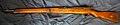
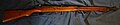
The Type 99 rifle or Type 99 carbine (九九式短小銃, Kyūkyū-shiki tan-shōjū) was a bolt-action rifle of the Arisaka design used by the Imperial Japanese Army during World War II.

Key Information

History

[edit]

During the Second Sino-Japanese War in the 1930s, the Japanese Army found that the 7.7mm cartridge being fired by the Type 92 heavy machine gun in China was superior to the 6.5×50mm cartridge of the Type 38 rifle. This necessitated the development of a new weapon to replace the outclassed Type 38, and finally standardize on a single rifle cartridge.[3] The Imperial Japanese Army (IJA) developed the Type 99 based on the Type 38 rifle but with a caliber of 7.7mm. The Type 99 was produced at nine different arsenals. Seven arsenals were located in Japan, with the other two located at Mukden in Manchukuo and Jinsen in Korea.

The IJA had intended to completely replace the Type 38 with the Type 99 by the end of the war. However, the outbreak of the Pacific War never allowed the army to completely replace the Type 38 and so the IJA used both rifles extensively during the war. As the war progressed, more and more cost saving steps were introduced in order to speed up production. Late war rifles are often called "last ditch" or "substitute standard" due to their crudeness of finish. They are generally as crude as the 1945 dated Mauser K98k of Germany, or worse.

The Type 99 was produced in four versions, the regular issue Type 99 carbine, the Type 99 long rifle (a limited production variant), the take-down Type 2 paratroop rifle, and the Type 99 sniper rifle. The standard rifle also came with a wire monopod and an anti-aircraft sighting device. The Type 99 was the first mass-produced infantry rifle to have a chrome lined bore to ease cleaning. All of these features were abandoned by mid-war.

Use by other countries

[edit]

During the Korean War, approximately 126,500 short and 6,650 long Type 99 rifles were re-chambered under American supervision at the Tokyo arsenal to fire the standard .30-06 Springfield cartridge. Apparently intended for the South Korean "gendarmerie", few rifles appear to have been issued at the end of the war in 1953. These rifles were fitted with lengthened magazine wells and had small notches cut in the top of the receivers to accommodate the .30-06 round's 1/3 inch greater length.[4] Accuracy suffered, due to the difference in cartridges, rifling rate and characteristics, but they were nonetheless functional. Conversions to both .30-06 and 7.62 NATO as well 7.62 Russian have also been performed by civilians, often along with sporterising modifications.

After 1946, the Republic of China re-chambered an unknown number of Type 99 rifles to fire the 8×57 IS cartridge.,[2] as well as the 7.62×39mm cartridge, which were converted using SKS barrels.[5] Indonesian forces used a large number of Type 99 rifles in the fighting against the Dutch during the Indonesian National Revolution (1945–1949), although late Japanese production was less reliable. Sniper rifles were also used.[6] The Royal Thai Army received Japanese rifles of all types after 1945 and converted some short Type 99 rifles to fire the U.S. .30-06 cartridge during the early 1950s.[4]

Nomenclature

[edit]

In the West, Japanese equipment is commonly referred to as "Type XX", rather than "Model XX". In the case of a firearm, "model" is a more accurate interpretation of the Shiki (式) character, but the word "type" has become well-established by collectors for decades.

Design

[edit]
The flip-up anti-aircraft rear sights of a Type 99 rifle. The calipers on the sides are to determine the speed of the targeted aircraft. The vertical ladder is for adjusting the range of fire for land targets.

To gain the superior hitting power of the larger 7.7mm cartridge, several 6.5mm Type 38 rifles were modified for the new round. Although the tests proved satisfactory, the army decided that the added recoil and larger chambering for the 7.7mm cartridge would require an entirely new rifle to be built for the cartridge.[3] It utilized a cock-on-closing action and an unusual safety mechanism, operated by pressing in the large knurled disk at the rear of the bolt with the palm of the hand and rotating it in a 1/8 clockwise turn, which is often misunderstood by Western shooters who are used to the Mauser's thumb lever safety. It featured a quick-release bolt and antiaircraft sights, as well as a dust cover for the bolt and a monopod. As a bolt-action rifle, the Type 99 was well developed, but as with all manually operated rifles used during World War II, they were often outclassed by semi-automatic rifles and submachine guns in close quarters combat.

The Type 99 has one of the strongest actions ever made for a bolt action,[7] but many late-war (often nicknamed "last ditch") rifles had been simplified as Japan struggled industrially. The “last ditch” rifles are marked by the complete lack of finish, as well as shortcuts taken to ease production. The "last ditch" rifles are usually distinguished by their crudeness: poorly finished stock, wooden buttplate held in with nails, lack of an upper forward handguard, very obvious tooling marks in the metal, lack of the monopod, non-adjusting fixed sights and an unfinished bolt knob and handle. Despite these simplifications for ease of production, the quality and safety of the bolt action mechanism had not been compromised.

In some cases, these rifles may actually be training rifles intended for firing cartridges with a wood projectile only. The training rifles were made of mild steel and were never intended for ball ammunition. It is possible that reports of Type 99 rifles blowing up were simply the results of soldiers testing captured weapons. Unaware that they were using drill rifles, they fired ball ammunition in them with poor results and possible injuries. It is possible that this may have unjustly led to the Arisaka having a reputation (at least for the last ditch rifles) for being of poor construction.

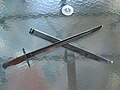
The Type 99 can be fitted with a Type 30 bayonet.[8] The Type 30 bayonet had a very long, slender blade, and was grooved to reduce weight. The early models featured a hooked quillion. These bayonets attached to a lug under the barrel and were further stabilized by a loop that fitted around the muzzle. Unmounted, it handled like a machete.

Variants

[edit]

Long rifle

[edit]

The initial production rifle of the Type 99. Made only by Nagoya Arsenal and Toyo Kogyo under Kokura Arsenal supervision. Only about 38,000 were produced, 8,000 at Nagoya and 30,000 at Toyo Kogyo between summer of 1940 and spring of 1941 when production was switched to the much more common new Type 99 carbine of which millions were made. The long rifle was found to be more cumbersome than the carbine, and provided only marginally better performance. Thus, it was sidelined in favor of the carbine, which was much more practical, required less resources to produce, proving more than satisfactory.

Like the early Type 99 carbines, these Long rifles were made with a monopod, anti-aircraft lead arms on the rear sight and a dust cover.[9]

Carbine

[edit]

In 1942, a Type 99 with a 660 mm (26 in) barrel was designed, and became the basis for the Type 99 sniper rifle.

7.92×57mm conversions

[edit]

Majority of the Type 99s were converted to fire 7.92×57mm ammo for the National Revolutionary Army.[2]

.30-06 Springfield conversions

[edit]

The Type 99 rifles used by South Korea were converted to .30-06 ammo, and was supplied to South Korean military prior to the Korean War.[10]

Around 133,300 of them were reported to be used worldwide.[11]

Type 99 sniper rifle

[edit]
[edit]

Availability

[edit]

Although the Arisaka rifle has never been exported to the United States, many are available as thousands have been brought home by US Military personnel returning from the Pacific theater. In many cases, the imperial chrysanthemum atop the receiver has been defaced by the surrendering Japanese in order to preserve the Emperor’s honor: the mark indicated that the rifle was the Emperor's personal property.[12]

Rifles with an intact chrysanthemum often bring a premium on the collector market, sometimes almost double the price for a like model defaced rifle. As well, rifles retaining the original matching dust cover, anti-aircraft sights and monopod often hold extra value as well. “Last ditch” rifles hold a lower value than the early war rifles.

Users

[edit]

References

[edit]
Revisions and contributorsEdit on WikipediaRead on Wikipedia
from Grokipedia
The Type 99 rifle, officially designated as the Type 99 Arisaka, is a bolt-action developed by the and adopted in 1939 as the successor to the earlier . Chambered for the more powerful cartridge—introduced in 1932 to address the perceived shortcomings of the 6.5×50mm round used in prior models—it featured a redesigned, shorter action while retaining core Mauser-inspired elements like a cock-on-closing bolt, internal 5-round box magazine, and rotating safety lever. With an overall length of approximately 49.5 inches in its initial configuration, a 31-inch barrel, and an of up to 600 meters, the Type 99 was engineered for improved and , including a unique rear sight graduated for both and anti-aircraft use, as well as a folding for stability. Production of the Type 99 began in 1939 at arsenals and private factories, ramping up significantly after the outbreak of in 1941, with an estimated 3.5 million units manufactured by 1945 despite wartime material shortages that led to simplified "last ditch" variants using stamped metal parts and rougher finishes. It served as the standard-issue infantry rifle for Japanese forces across the Pacific and Asian theaters, seeing extensive combat from to , where its reliability in harsh jungle conditions was noted, though it suffered from occasional quality issues in later production runs. Key variants included the initial (Type 99 Choki), a shorter (Type 99 Tancho) with a 25.8-inch barrel that became the standard model for , and the compact Type 99 (Type 99 Tokushuuru) at 37.5 inches overall for and paratroopers, all sharing the same 7.7mm chambering but adapted for specialized roles. A variant, introduced in 1942, featured a 2.5x or scope mounted on the model, though production was limited. The 's emphasized durability with a dust cover on the bolt and urushi-lacquered wood stocks, but its semi-rimmed cartridge sometimes caused feeding issues in rapid fire. Post-war, surplus Type 99s were widely imported to the , influencing modern sporterized firearms and remaining popular among collectors for their historical significance in representing Japan's final bolt-action military .

Development and History

Origins and Design Influences

The Type 99 rifle emerged in the late 1930s as the Imperial Japanese Army's response to the perceived shortcomings of the Type 38 rifle's 6.5×50mmSR cartridge, which lacked sufficient stopping power for evolving combat needs observed during the Second Sino-Japanese War. To address this, designers rechambered the new rifle for the more potent round, already standardized for heavy machine guns like the Type 92, aiming to enhance range, penetration, and logistical compatibility across infantry weapons. This shift prioritized greater ballistic performance over the lighter recoil of the 6.5mm, reflecting Japan's preparations for broader Pacific conflicts. The Type 99's design drew directly from the lineage, evolving the Type 38's bolt-action mechanism while incorporating refinements for wartime efficiency. Named after Colonel Nariakira , the series' originator, it retained the controlled-round-feed bolt inspired by late-19th-century European studies during Japan's Meiji-era military modernization. Key influences included the German Mauser 98 action, evident in the robust receiver and turn-down bolt handle, but adapted with unique Japanese features like a folding for prone shooting stability. The initial long rifle variant adopted in 1939 retained the Type 38's 31-inch (797 mm) barrel length, while adding anti-corrosion chrome-lining and simplified machining to accelerate . A short rifle variant with a 25.9-inch (657 mm) barrel was later approved in 1940 for improved handling in close-quarters and . These modifications balanced Mauser-derived reliability with practical adaptations to Japan's resource constraints and environmental challenges, marking the as the final major evolution of the design before .

Adoption and Early Production

The Type 99 rifle was officially adopted by the in 1939, corresponding to the Japanese imperial calendar year 2599, from which it derived its designation. This adoption marked a significant upgrade from the earlier , which had been in service since 1905 and chambered in the lighter 6.5x50mm Arisaka cartridge. The Type 99 was redesigned to fire the more powerful 7.7x58mm round, offering improved ballistic performance and range suitable for , while incorporating enhancements like a and improved sights for better effectiveness. The rifle's development was driven by lessons from conflicts such as the Second Sino-Japanese War, where the need for a shorter, lighter weapon with greater stopping power became evident. Early production of the Type 99 began in at the Arsenal, focusing initially on the variant with a 797 mm barrel and an overall length of approximately 1,257 mm. This configuration was intended for standard infantry use but proved cumbersome in dense terrain and urban combat. Manufacturing was supervised by the Kokura Arsenal, with initial output limited due to the transition from Type 38 production lines and resource constraints amid Japan's expanding military commitments. By summer 1940, production expanded to include the Toyo Kogyo factory, but total early yields remained modest; only about 38,000 were completed between late 1939 and spring 1941, comprising roughly 8,000 from and 30,000 from Toyo Kogyo. These rifles featured high-quality machining and full-length wooden , reflecting pre-war standards before wartime shortages affected later models. In response to feedback on the long rifle's handling, the approved a shorter variant in , with production ramping up in 1941 at multiple arsenals including and . The short rifle, measuring 1,118 mm overall with a 657 mm barrel, prioritized mobility for Japanese troops accustomed to close-quarters fighting. Early production emphasized precision craftsmanship, including dust covers on the bolt and anti-aircraft rear sights, though output was still constrained by the need to equip existing forces with Type 38 rifles. By the end of 1941, as prepared for broader Pacific engagements, the Type 99 began supplanting the Type 38 in frontline units, with initial series runs serialized in blocks of 100,000 per arsenal to track manufacturing progress. This phase laid the foundation for the rifle's , which would total approximately 3.5 million units by war's end, though early years highlighted the challenges of scaling up amid industrial retooling.

Technical Design

Bolt-Action Mechanism

The bolt-action mechanism of the Type 99 rifle is a manually operated, turning-bolt design that evolved from the Type 38, incorporating Mauser-inspired elements for reliability in combat conditions. It employs two frontal locking lugs on the bolt body that rotate into recesses within the receiver to secure the action when closed, providing a strong and secure lockup capable of withstanding the pressures of the cartridge. Unlike the cock-on-opening action of the Mauser 98, the Type 99 features a cock-on-closing system, where the striker is tensioned by the rotation of the bolt handle into the locked position, resulting in a lighter and faster cycling motion for the operator. The bolt assembly comprises five primary components: the bolt body, , , cocking piece, and safety wing, allowing for straightforward field disassembly and . Extraction is handled by a full-length, non-rotating extractor mounted on the bolt face, which grips the cartridge rim, while a fixed ejector in the receiver wall propels the empty case clear upon bolt retraction. The integrated safety mechanism distinguishes the Type 99's bolt design, featuring a large knurled disk at the bolt's rear that must be depressed axially before rotating to engage. In the forward position, it blocks the to prevent accidental discharge; in the rearward position, it locks the bolt against rotation, securing without dismounting the rifle. This palm-operated enhances usability in prone or confined positions, though it requires deliberate action to avoid unintended activation. Overall, the mechanism supports a five-round internal staggered-column box loaded via en bloc stripper clips inserted through the receiver's top when the bolt is open, ensuring efficient reloading under fire. The rifle features a sliding bolt dust cover attached to the receiver, which protects from dust and debris while allowing smooth operation.

Sights and Safety Features

The Type 99 rifle featured a front sight consisting of an inverted V-shaped blade, typically protected by semi-circular "ears" on early production models to prevent damage during handling or . These ears were gradually omitted in later wartime variants to simplify , leaving the blade exposed but still functional for standard aiming. The design prioritized durability and quick in field conditions. The rear sight was an adjustable leaf type, graduated in 100-meter increments from 100 to 1,500 meters, allowing for long-range engagement typical of bolt-action rifles of the era. Early models included distinctive folding "wings" or anti-aircraft extensions on the rear sight base, equipped with three notches calibrated for aircraft speeds of approximately , , and 500 kilometers per hour; these were intended for use with a rifle grenade discharger or to provide lead angles against low-flying planes, though their practical utility was limited. As production constraints intensified toward the war's end, these anti-aircraft features were removed in "last ditch" rifles, resulting in a simplified, fixed notch sight that sacrificed versatility for ease of production. Safety features on the Type 99 centered on a distinctive disk- or wing-shaped mechanism located at the rear of the bolt, differing from the wing safeties on earlier designs like the Type 38. To engage the , the operator pressed the large knurled knob inward using the palm of the hand, then rotated it approximately 90 degrees clockwise; this action rotated the laterally to misalign its tip from the primer strike point, preventing accidental discharge, while also locking the bolt in place to block chamber access. Early production safeties featured finely knurled knobs for secure grip, but late-war examples simplified to rough vertical grooves or flat metal tabs to expedite assembly, maintaining basic functionality despite reduced refinement. The mechanism integrated with the rifle's cock-on-closing , ensuring the was cocked only upon full bolt closure, adding an inherent layer of operational safety.

Production and Variants

Manufacturing Arsenals and Output

The Type 99 rifle was manufactured primarily at arsenals and supervised private factories across and occupied territories to support the Imperial Japanese Army's wartime needs. Key production sites included the Nagoya Arsenal, which initiated manufacturing in 1939 and remained the largest producer, as well as the Kokura Arsenal and its supervised facility at Toyo Kogyo in . Additional Japanese facilities such as the Arsenal and private contractor Izawa Jyuko also contributed, particularly for later series. In occupied regions, the Hōten Arsenal in Mukden () and the Jinsen Arsenal in Korea (modern-day ) joined production efforts starting in 1942–1943 to distribute the manufacturing burden amid resource constraints. Initial output focused on the variant from 1940 to 1941, with Arsenal producing approximately 8,000 units and Toyo Kogyo manufacturing around 30,000 under oversight, totaling about 38,000 long rifles before the design shifted to the more compact short rifle for better handling. alone accounted for over 1.1 million short rifles across multiple series through 1945, reflecting its central role in scaling production. As Allied bombing and material shortages intensified, other arsenals ramped up, often simplifying components like rougher machining and basic wood stocks to maintain volume. Overall production of the Type 99 exceeded 3.5 million rifles by the war's end in , making it a cornerstone of Japanese small arms output and one of the most prolifically manufactured bolt-action rifles of . This figure encompasses all variants, with the short rifle comprising the vast majority; the effort involved serial numbering in blocks of per series at each facility to track output efficiently. Late-war "last ditch" models from facilities like Hōten and Jinsen exemplified the push for quantity over quality, using substitute materials to sustain supply lines.

Standard Variants

The Type 99 was primarily produced in two standard configurations: the and the short rifle, both chambered in and featuring the characteristic Mauser-style bolt-action mechanism with a turned-down bolt handle for quicker cycling. These variants differed mainly in barrel length and overall dimensions to balance range accuracy with battlefield maneuverability, with the short rifle becoming the dominant model issued to infantry during . The variant, introduced in 1939 as the initial production model, had a 31-inch (787 mm) barrel and an overall length of approximately 50 inches (1,270 mm), weighing about 8.8 pounds (4 kg) unloaded. It included a full-length wooden handguard extending nearly to the muzzle and was equipped with adjustable rear sights graduated up to 2,000 meters, emphasizing . Early production was limited to the Nagoya Arsenal, with only around 38,000 units manufactured before shifting to the shorter design, as the longer profile proved less practical for mechanized and close-combat operations. In contrast, the short rifle variant, adopted as the standard issue from 1940 onward, featured a 25.8-inch (656 mm) barrel and an overall length of about 44 inches (1,117 mm), reducing weight to roughly 7.7 pounds (3.5 kg) for improved portability. It retained the anti-aircraft rear sight wings unique to the Type 99 series but used a shorter handguard pattern. Mass production occurred at multiple facilities, including Toyo Kogyo and Kokura Arsenal, totaling over 2.5 million units by 1945, making it the most widely distributed Arisaka rifle of the war. This variant's design prioritized versatility, with provisions for the Type 30 bayonet and compatibility with earlier Arisaka components during wartime shortages.

Modified and Conversion Variants

During the post-World War II period, numerous Type 99 rifles were modified or converted to accommodate different calibers and operational requirements, primarily by Allied and former Axis powers seeking to repurpose captured stockpiles. These alterations often involved rechambering the barrel to fire more readily available ammunition, along with minor adjustments to the bolt and extractor for reliable feeding. Such conversions extended the rifle's service life in various conflicts and training roles, though they sometimes compromised the original design's precision due to the dimensional differences between the native 7.7×58mm Arisaka cartridge and foreign rounds. A significant series of conversions occurred under U.S. oversight at the Tokyo Arsenal between 1950 and 1952, transforming captured Type 99 rifles into chamberings for the Republic of Korea (ROK) Army amid the Korean War's urgent arms shortage. Designated "Rifle, U.S., Type 99, Japanese Cal. .30," these weapons retained much of the original action but featured reamed chambers, reinforced bolts, and in some instances, replacement wooden stocks to fit U.S. specifications. Markings on the receiver typically included "U.S. CAL. .30" stamped alongside the original Japanese arsenal cartouches. Approximately 130,000 units were produced, with some also issued to the Japanese Force for internal security duties. These rifles provided a stopgap solution until sufficient M1 Garands became available, demonstrating the adaptability of the Type 99 design despite its wartime origins. In , both Nationalist and (PLA) forces undertook conversions of Type 99 rifles to the cartridge, aligning them with vast pre-existing Mauser-derived stockpiles from German and domestic production. The Nationalists initiated such modifications during the to bolster their infantry armament, rechambering barrels and adjusting feeds at arsenals like those in Chungking. Following their 1948 capture of the Mukden Arsenal, Communist forces continued and expanded these efforts, producing the "North China Type 35" as a standardized 7.92mm variant of the Type 99 short rifle. These conversions involved boring out the chamber and replacing the bolt face, often with simplified markings like Chinese characters for "Type 35" added to the receiver. Modified Type 99s in 7.92mm remained in militia service across through the 1960s, valued for their robustness in . Beyond military applications, civilian gunsmiths and elsewhere performed informal modifications on surplus Type 99s imported after 1945, typically sporterizing them by shortening the barrel, reshaping the stock for , and drilling for scope mounts. These "bubba" conversions, while popular among shooters for their affordability, often degraded the rifle's historical integrity and collectible value, with no standardized features or documentation. Such alterations highlight the Type 99's enduring appeal as a platform for customization, though they pale in comparison to the scale of wartime and conversions.

Operational Use

World War II Service

The Type 99 rifle became the primary bolt-action infantry weapon of the during , entering service in 1939 and rapidly supplanting the Type 38 as production ramped up. Chambered in the more powerful 7.7x58mm cartridge, it provided enhanced compared to earlier 6.5mm designs, with an of up to 400 meters (≈440 yards) and a maximum of approximately 2,700 meters (≈2,950 yards). Over 3.5 million units were manufactured by war's end, equipping front-line troops across theaters from to the Pacific islands. In the Pacific Theater, the Type 99 saw heavy use in major campaigns, including the 1942 invasion of the Philippines, the of 1942–1943, and the 1945 . Japanese tactics, which prioritized aggressive assaults and bayonet charges, leveraged the rifle's robust construction and compatibility with a long for close-quarters fighting in dense jungles and island fortifications. Its chrome-lined bore contributed to durability in humid conditions, though the bolt-action mechanism limited its rate of fire against semi-automatic opponents like the U.S. . A notable example of its deployment occurred during the in February–March 1945, where Japanese forces under General employed to prolong the fight and maximize American losses. The Type 99 armed defenders in entrenched positions, but a final on March 25—defying orders—saw over 300 soldiers, many wielding the rifle, launch a desperate nighttime assault. U.S. forces repelled it with flamethrowers and , killing most attackers and leaving behind damaged weapons, including charred Type 99 rifles recovered from the battlefield. The charge inflicted casualties on American forces before being repelled, with Kuribayashi dying the following day. Late-war production constraints, including shortages of skilled labor and materials, resulted in lower-quality Type 99 rifles with rough finishes, brittle stocks, and occasional reliability issues in tropical environments. Despite these shortcomings, the rifle's overall sturdiness made it a reliable mainstay for Japanese infantry, symbolizing their tenacious defense until Japan's surrender in 1945.

Post-War and Other Conflicts

Following the end of World War II, the Type 99 rifle saw continued service in several conflicts, primarily through captured stocks repurposed by various forces. In the immediate post-war period, Japanese forces in occupied territories like Vietnam and Indonesia retained their arms until formal surrenders in 1948, with Type 99 rifles used by holdout units during local independence struggles. During the (1945–1949), both Nationalist and Communist forces employed captured Type 99 rifles alongside other Japanese small arms seized from depots in . Communist militias, in particular, integrated these bolt-action rifles into their arsenals due to ammunition availability from wartime stockpiles. The most extensive post-war use occurred in the (1950–1953), where the Type 99 reappeared on multiple fronts. South Korean forces, facing equipment shortages, modified approximately 133,000 captured Type 99 short rifles to chamber the American cartridge; these conversions involved rechambering the barrel, lengthening the magazine well, and notching the receiver for the larger cartridge head, though the rifles suffered reduced accuracy and reliability as a result. The U.S. military facilitated some of these conversions and supplied them to South Korean and Korean Augmentation to the United States Army (KATUSA) units. North Korean and Chinese People's Volunteer Army troops also utilized Type 99 rifles during the conflict, drawing from pre-war Japanese captures in and . U.S. forces reported encountering these 7.7×58mm Arisakas among Communist small arms hauls, as documented in the 1953 U.S. Army Military Intelligence Guidebook, which listed the Type 99 as available to North Korean and Chinese units alongside Soviet and other captured weapons. In the (1946–1954), the captured and employed Type 99 rifles from Japanese wartime stocks in , using them as standard bolt-action infantry weapons early in the conflict before transitioning to more modern arms. Limited use persisted into the (1955–1975), particularly by militias in rural areas, though by the 1960s, these were largely supplanted by AK-47s and other assault rifles.

Legacy and Collectibility

Modern Availability

In the United States, Type 99 Arisaka rifles are classified as Curio and Relic (C&R) firearms by the Bureau of Alcohol, Tobacco, Firearms and Explosives (ATF), qualifying them for ownership by licensed collectors due to their age exceeding 50 years and original military configuration. This status facilitates interstate acquisition by C&R holders without requiring a standard Federal Firearms License (FFL) transfer, though state laws may impose additional restrictions, such as serialization requirements in California. As surplus World War II artifacts, these rifles remain legal for civilian ownership in most jurisdictions where semi-automatic and bolt-action long guns are permitted, provided they are not modified into prohibited configurations. Collectors should note potential safety issues, particularly with late-war "last ditch" variants, which may have improper headspace; professional inspection is recommended before firing. Modern availability centers on the secondary collector's market, where original or refurbished examples are sourced from importers, auctions, and dealers specializing in . Platforms like GunBroker and Guns International regularly list Type 99 rifles, with dozens of listings active as of November 2025, often shipped to FFL dealers for non-C&R buyers. No new production exists, as manufacturing ceased in 1945; all specimens are historical imports, many bearing import marks from post-war U.S. demilitarization efforts. Common variants include standard long rifles and shorter training models, with availability influenced by condition—intact "mum" () stamps on early production pieces being scarcer due to Allied defacement practices. Market values for used Type 99 rifles average approximately $407 as of November 2025, with a 12-month trend showing a slight decline from $471, reflecting steady supply from estate sales and deaccessions. Prices typically range from $125 for heavily worn or sporterized examples to $1,100 for very good condition specimens, with pristine, matching-numbered examples with reaching up to $1,500, such as those from Nagoya Arsenal. Demand remains robust among WWII militaria enthusiasts, though rising import regulations and collector preferences for unaltered originals have stabilized the market without significant shortages.

Historical Significance

The Type 99 rifle symbolizes Japan's industrial mobilization during , representing the transition from high-quality early production to resource-strapped "last ditch" variants that highlighted the empire's wartime economic challenges. Its robust design influenced postwar evaluations of Japanese small arms, with captured examples repurposed by Allied forces for training in the and by insurgent groups in during decolonization conflicts. In historiography, the Type 99 embodies the Imperial Japanese Army's final bolt-action , underscoring the nation's reliance on traditional Mauser-derived technology amid rapid modernization pressures. Its prevalence in museums, such as the National Museum of the Pacific War, and depictions in media like films (, 2006) and video games ( series) emphasize its role in Pacific theater narratives, often highlighting both its reliability in harsh environments and production quality declines. No significant new developments or replicas have emerged as of 2025, preserving its status as a key artifact of 20th-century .

References

Add your contribution
Related Hubs
User Avatar
No comments yet.