Hubbry Logo
Type 100 submachine gunType 100 submachine gunMain
Open search
Type 100 submachine gun
Community hub
Type 100 submachine gun
logo
8 pages, 0 posts
0 subscribers
Be the first to start a discussion here.
Type 100 submachine gun
from Wikipedia

The Type 100 submachine gun (一〇〇式機関短銃, Hyaku-shiki kikan-tanjū) is a Japanese submachine gun used during World War II and the only submachine gun produced by Japan in any quantity. It was made in two basic variants referred to by American and British observers as the Type 100/40 and the Type 100/44, the latter also known as the Type 100 (simplified).[4] A small number of the earlier version were converted into using folding stock, sometimes referred to by the Allies as the Type 100 navy, which was made for parachutists.[4]

Key Information

Development

[edit]

Prototypes

[edit]

Japan was late in introducing the submachine gun to its armed forces. Although around 6,000 models of the SIG Bergmann 1920 (a licensed version of the German MP 18) and a few Solothurn S1-100s were purchased from Switzerland and Austria in the 1920s and 1930s, and were used in the invasion of China in 1937,[1] mass production of a native submachine gun did not begin until 1944. In the interim, Imperial Japan ordered 350 MAB 38/43 submachine-guns from their Italian allies and they were delivered in 1943.[6]

While the western European imports were used, Japanese development of submachine guns had stalled. After earlier prototypes designed and built by the Nambu Arms Manufacturing Company, the Experimental Model 1 and Experimental Model 2 submachine guns, proved inadequate, new requirements were formulated in August 1937 by the Army. The new simpler design was based on the imported European "Bergmann type" submachine guns, which had been used effectively in both Battles of Shanghai by Japanese marines. This led to the development of the Experimental Model 3 submachine gun in 1938. The earliest version was known as Model 3A, but after some changes Model 3B was introduced in April 1939. It received generally positive results in testing and it was recommended to produce a batch of 200 weapons for military tests with infantry, cavalry, and reserve units. Further requirements were made for increased accuracy and a way to mount the standard Type 30 bayonet. A portion of the weapons for cavalry units were mounted with a bipod and a sight up to 1,500 meters to assess it capabilities in comparison with the bulky Type 11 light machine gun.

Early version

[edit]
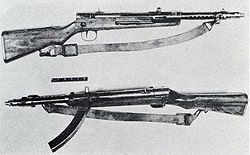
Early model Type 100 captured in Burma

In November 1939 came the release of the Type 3C, which included a double-slot muzzle brake. After almost full completion of the testing cycle of this version it was adopted by the Imperial Japanese Army in the summer of 1940 as the Type 100 submachine gun (known in western literature as the "Type 100/40"). However, no major order was made for the new weapon as the interest of the army had turned to the new 7.7 mm Type 99 light machine gun. There was no need for a "submachine gun" in the Imperial Army tactics. Under a low-priority military contract the Type 100 began to be deployed in August 1942, with numbers not exceeding 1,000 units, of which around 200 were converted to folding stock models for use by army paratroopers.[1][7][8] These were converted (along with similar designs for Arisaka rifles) after trouble with weapons being dropped in bags separately from the paratroopers, such as in the Battle of Palembang, and were intended to be stored in a bag attached to the stomach of the jumper. The paratrooper version was referred to by the allies as the "Type 100 navy".

Limited numbers of the early Type 100 model were delivered to the Solomon Islands in late 1942 for military trials. A small batch was delivered to Guadalcanal, but the rest of the shipments were sunk before reaching their targets. A few very early models, without the muzzle brake, but with a bipod and a sight up to 1,500 meters (the "cavalry variant" of the Model 3B), were captured by the British in the late stages of the Burma Campaign, brought in by Japanese reinforcements.[7] Of the paratrooper variant, some were captured on Luzon during the Philippines Campaign.[8]

Late version

[edit]
Late model Type 100 at the US Army Museum, Honolulu
A Giretsu Kuteitai paratrooper armed with a Type 100 in Kengen Airfield, Kumamoto, May 1945

As the war continued, the demand for submachine guns increased greatly. In January 1944, under contract to the army, larger scale production of the Type 100 started.[9] In connection with the lower quality "substitute standard" variants of other Japanese weapons to increase speed and reduce cost of manufacture, a number of changes were made to simplify the Type 100. This led to the later 1944 model of the Type 100, known in the west as the "Type 100/44". The 1944 variant was slightly longer, with simple iron sights and a greatly simplified muzzle brake consisting of two ports drilled in the barrel.[1] The rear sights included a peep hole. The large bayonet mounting bar was eliminated, with the bayonet to be fitted to the barrel instead; consequently, the muzzle protruded more from its perforated jacket. Corners were cut in production, leaving many Type 100s with roughly finished stocks with roughly welded metal.[1] The resulting weapon demonstrated good reliability with low recoil and satisfactory accuracy for close-range work. Some 7,500 were made produced in total.[4]

According to Japanese historian Shigeo Sugawa [jp], a small amount of early Type 100 models were produced by the Chuo Kogyo Company, while the late model was produced at the Nagoya Arsenal's Toriimatsu Factory from May 1944 until the end of the war, at a pace of approximately 1,000 per month. He estimates that the total number produced is about 10,000, nearly 9,000 of them being later models.[10]

The later version Type 100s were used by special units of the Imperial Army and were encountered in the hands of paratrooper raiding units in the Philippines Campaign and in the Battle of Okinawa, notably used by Giretsu Kuteitai airlifted special forces. After the war, a limited number was supplied by the American administration to arm the Japanese police.[9]

Users

[edit]

References

[edit]
[edit]
Revisions and contributorsEdit on WikipediaRead on Wikipedia
from Grokipedia
The Type 100 submachine gun (百式機関短銃, Hyaku-shiki Kikan-tanjū) was a blowback-operated, full-automatic developed by the Nambu Arms Manufacturing Company for the (IJA) during , chambered for the pistol cartridge and fed from a 30-round detachable box magazine. It featured a metal body with wooden furniture, including an integrated and , a side-mounted magazine well, and a perforated barrel jacket for cooling, making it a simple yet rugged design intended for close-quarters combat. Weighing approximately 3.8 kg (8.4 lb) empty, it measured 890 mm (35 in) in overall length with a 228 mm (9 in) barrel, achieving a of about 335 m/s (1,100 ft/s) and a cyclic between 450 and 850 rounds per minute depending on the variant. Development of the Type 100 began in the late as sought to modernize its weapons in response to the growing influence of submachine guns in global conflicts, with early prototypes inspired by European designs like the German MP18 and Bergmann models imported in limited numbers during the . The weapon was formally adopted in 1942 as the Type 100/40 (Showa 15, or Imperial Year 2600), including a variant (Type 100/40(N)) with a folding metal stock, with initial production at the yielding around 10,000 units, though wartime resource shortages and Allied bombing campaigns severely limited output to approximately 10,000 to 25,000 units total across variants by 1945. A revised Type 100/44 variant, introduced in 1944 at the , featured simplifications such as a higher (up to 850 rpm) and removal of the and bipod from early models, along with a basic iron sight setup. In service from 1942 to 1945, the Type 100 saw limited but notable use by IJA paratrooper units, such as the and , in operations including the , the in 1944–1945, and the . It was also employed by forces and, post-war, by U.S. occupation authorities for Japanese police units, with captured examples later used by Chinese, North Korean, and North Vietnamese forces during the (1950–1953) and subsequent conflicts. Despite its reliability with the low-powered round and double-stack magazine design, the Type 100 was criticized for occasional jamming and underpowered performance compared to Allied submachine guns like the Thompson or , contributing to its status as a "too few and too late" weapon in Japan's arsenal.

Development

Background and prototypes

The recognized the need for a during the Second Sino-Japanese War, which began in 1937, as close-quarters combat in urban and forested environments, such as the , highlighted the limitations of bolt-action rifles for rapid fire support. This demand was influenced by encounters with European designs like the German MP18 and the American , which demonstrated the tactical advantages of automatic weapons in infantry assaults. Early experiments began at the Nambu Arsenal in 1938, focusing on adapting a simple blowback operating mechanism to the 8x22mm cartridge for reliable full-automatic fire. These efforts produced the Experimental Model 3 by spring 1939, incorporating basic features like a wooden stock and vertical magazine to evaluate feasibility. Key prototypes emerged in 1939, including wooden mockups for ergonomic assessment and initial metal versions with vertical 30- or 40-round magazines, some equipped with adjustable sights and even folding bipods for testing versatility. Field trials conducted in 1940 exposed significant reliability issues, particularly jamming in muddy conditions and overheating in humid, tropical environments, prompting iterative redesigns to improve durability. Following these refinements, the weapon underwent formal adoption as the Type 100 in early , after extensive testing addressed prior shortcomings, though production was approved only in limited numbers due to wartime resource constraints prioritizing and aircraft.

Type 100/40 model

The Type 100/40 , also known by its naval designation, represented the initial production variant of the Type 100 series, finalized and adopted by the Imperial Japanese military in early . This model incorporated a fixed wooden stock for stability during firing, a beneath the perforated barrel jacket to accommodate standard Japanese bayonets, and a cyclic of approximately 450 rounds per minute, which was relatively low compared to contemporary but suited to the weapon's cartridge. Production of the Type 100/40 was limited, with an estimated 10,000 units manufactured before , primarily at the Kokura Arsenal. These low output figures stemmed from severe material shortages, Allied bombing campaigns disrupting supply lines, and the higher priority given to rifle production for standard infantry units, which constrained resources for specialized weapons like submachine guns. A variant featured a folding metal for airborne operations and was produced in limited numbers, estimated at 200 to 7,500 units. To address reliability issues observed in earlier prototypes, such as jamming in dusty environments and overly complex internals, designers introduced an improved dust cover over the action and a simplified trigger group for more consistent operation. However, the model retained the intricate side-mounted 30-round box , which fed from the right side and required careful alignment to avoid malfunctions during combat. The Type 100/40 was initially introduced to paratroopers and in mid-1942, marking its debut in elite units requiring compact automatic firepower for close-quarters assaults. Initial deployments occurred on Pacific islands, where these units used the weapon in amphibious operations and island-hopping campaigns against Allied forces.

Type 100/44 model

The Type 100/44 was introduced in 1944 as a wartime revision of the original design, incorporating lightened stamped metal construction to enable easier amid escalating material shortages. This simplified approach reduced the unloaded weight to approximately 3.8 kg, removed the featured on the earlier Type 100/40 model, and boosted the cyclic to 800 rounds per minute via a weaker recoil spring. By the war's end, production had reached about 8,000 units, achieved through further part simplifications that conserved critical resources like metals. Notable changes emphasized improved overall reliability from operational feedback, including better sealing against environmental factors, although magazine jamming remained a challenge during sustained rapid fire. With growing defensive demands in 1944–1945, the Type 100/44 saw increased allocation to frontline formations beyond initial special forces use.

Design and features

Operating mechanism

The Type 100 submachine gun operates on a simple blowback principle, firing from an to cycle the action using the recoil energy from the pistol cartridge, eschewing a mechanism to prioritize manufacturing simplicity and cost efficiency. This design relies on the cartridge's relatively low pressure and recoil impulse to drive the bolt rearward after firing, extracting and ejecting the spent case while loading a fresh round from the magazine. The firing sequence begins with the operator charging the weapon via the right-side bolt handle, which cocks the bolt and holds it open against the recoil spring. The Type 100/40 variant was full-automatic only with a rate of approximately 450 rounds per minute. In contrast, the later Type 100/44 simplified the fire control, maintaining full-automatic fire only at a higher rate of about 800 rounds per minute to streamline wartime production. Upon trigger pull, the bolt is released forward, stripping a cartridge from the 30-round box magazine and chambering it before the fixed strikes the primer to ignite the round. Safety features include a manual lever positioned in front of the trigger guard that blocks trigger movement to prevent accidental discharge, alongside a dust cover over the ejection port that, when closed, locks the bolt in place to exclude debris. However, the dust cover's latching mechanism proved unreliable in certain conditions, potentially allowing unintended bolt movement. The Type 100's mechanism drew inspiration from the German MP 28 submachine gun but was adapted for the lighter Japanese cartridge, yielding reduced recoil for improved controllability during sustained fire while limiting the to around 150 meters due to the ammunition's modest . Magazine insertion occurs from the left side, with the feed lips aligned to support the blowback cycle's smooth operation.

Construction and ergonomics

The Type 100 submachine gun employed a tubular steel receiver in its early models, encased in wooden furniture that included a one-piece or folding stock depending on the variant. This design provided a sturdy yet relatively lightweight frame suitable for support, with the wooden components forming the foregrip, , and buttstock. Later variants, introduced in 1944, simplified the construction through extensive use of and reduced , transitioning toward more economical stamped elements in non-critical areas to achieve weight savings and faster production while retaining the core tubular receiver profile. Ergonomically, the weapon featured an integrated pistol grip molded into the lower receiver, promoting a compact hold for close-quarters maneuverability. Fixed were standard, consisting of a blade front sight and a rear tangent or peep sight adjustable for ranges up to 1,000 meters on early models, though later versions used a simpler non-adjustable peep sight calibrated for 100 meters to streamline manufacturing. The /40 model included an optional side-folding wooden stock for use, enhancing portability in confined spaces like , while the /44 variant typically employed a fixed wooden stock for stability; unloaded weight was approximately 3.8 kg (8.4 lb) for the /40, contributing to its role as a lightweight squad automatic. Overall length measured 890 mm (35 in), with a 228 mm barrel. Durability was enhanced by a chrome-lined barrel to resist corrosion and wear, particularly in the humid Pacific theater environments where the weapon saw deployment. However, the wooden furniture proved vulnerable to warping and degradation in tropical conditions, and the folding mechanism on early models was noted as a potential weak point under rough handling. compatibility was limited to early models via a dedicated lug under the for attaching the , a feature omitted in later variants to reduce complexity. Basic sling mounts were incorporated on the and foregrip for carry, with no provisions for suppressors, underscoring the design's emphasis on unadorned, portable support.

Feeding system and accessories

The Type 100 submachine gun was chambered for the rimmed 8x22mm cartridge, a standard round for Japanese that facilitated reliable extraction in blowback-operated firearms despite its relatively low power. It utilized a 30-round double-stack detachable box magazine, curved for ergonomic fit and inserted horizontally from the left side of the receiver, which necessitated a complex feed ramp to guide rounds into the chamber. The double-stack, double-feed design contributed to overall reliability, though late-war production quality sometimes compromised spring tension and follower alignment. Magazines were typically loaded off the weapon using stripper clips or individual rounds pushed through the top-mounted ejection port, a process that exposed feed lips to environmental contaminants and led to frequent jamming from dirt accumulation in field conditions. Initial U.S. testing revealed extraction failures in up to 75% of cycles with early batches, though subsequent refinements improved performance to acceptable levels. Accessories for the Type 100 were minimal, reflecting its rushed wartime design; early Type 100/40 models included a compartment in the wooden buttstock for a basic cleaning kit, while later Type 100/44 variants omitted this feature in favor of simplified construction. No provisions existed for optics or grenade launchers, limiting versatility to close-quarters roles. Bayonet compatibility was present only on the Type 100/40 variant via a welded lug beneath the barrel for the standard Type 30 bayonet, complete with a sheath; the simplified Type 100/44 lacked this attachment. Logistically, magazines were interchangeable between the Type 100/40 and Type 100/44 variants, aiding supply chains, but the weapon's full-automatic fire—cyclic rate between 450 and 800 rounds per minute depending on the variant—resulted in high ammunition consumption, exacerbating shortages during the latter stages of .

Operational history

Deployment in World War II

The Type 100 submachine gun entered service with Imperial Japanese forces in 1942, primarily issued to elite units such as s of the and for specialized operations including airborne assaults and island invasions in the early . The folding-stock variant of the initial Type 100/40 model was particularly suited to these roles, seeing deployment with units during the invasion of the in early 1942. Limited quantities were also trialed in forward areas, with examples reaching defensive positions in the later that year, where they were captured by Allied troops on . By 1944, amid escalating Allied advances, production shifted to the simplified Type 100/44 model, which was distributed to Army like the airborne units and garrison troops in vulnerable Pacific outposts. This expansion included issuances for defensive roles in the , where the weapon supported Japanese holdouts during the 1944-1945 campaign. In Okinawa, suicide commandos carried Type 100/44s during their desperate raid on Yontan airfield in May 1945, highlighting its role in late-war . Due to constrained output—totaling around 10,000 units of the Type 100/40 and 7,000 to 8,000 of the Type 100/44—the remained scarce, resulting in only sporadic use and restricting broader frontline assignments until the final phases of desperation in 1945.

Combat effectiveness and limitations

The Type 100 exhibited notable strengths in close-quarters combat scenarios, such as jungle ambushes and urban engagements during the , where its rapid volume of fire surpassed that of standard bolt-action rifles like the Type 38 Arisaka. The weapon's 8x22mm Nambu pistol cartridge generated low recoil, enabling effective controllability during full-automatic fire at distances up to 100 meters, which facilitated in dense vegetation or confined spaces. However, the Type 100 suffered significant limitations that curtailed its battlefield utility. Its short effective range, typically under 200 meters, and the underpowered pistol-caliber round provided insufficient penetration against Allied light vehicles, entrenched positions, or even heavy cover, rendering it ineffective beyond close-range encounters. Reliability issues were prominent in adverse conditions; early models experienced extraction failures in up to 75% of cases when using Type 94 pistol ammunition, though performance improved to satisfactory levels with standard Japanese pistol rounds in later tests. Japanese design choices, including a chrome-plated bore to mitigate jungle moisture and corrosion, addressed some environmental challenges but did not fully resolve jamming risks in or . User feedback from captured weapons highlighted mixed results. U.S. Army Ordnance evaluations noted the high cyclic rate of 800–1,000 rounds per minute as excessive, leading to poor sustained fire control and rapid depletion without proportional combat advantage. Japanese operational reports, as analyzed in assessments, indicated occasional feeding problems during prolonged engagements, exacerbated by the weapon's complex blowback mechanism and wartime shortcuts. Allied intelligence described the Type 100 as a rudimentary that, while vicious in sudden close assaults, lacked the robustness of Western submachine guns like the Thompson. Overall, the Type 100's impact on Japanese defensive tactics in late-war operations, such as those in the and Okinawa, remained marginal due to its introduction in and limited production totaling around 17,000–18,000 units, which failed to offset the 's numerical and logistical disadvantages against Allied forces.

Users

Imperial Japanese forces

The Type 100 submachine gun was used by both the (IJA) and the (IJN), particularly by and units for close-quarters and amphibious operations. The folding-stock variant, produced at the in approximately 3,000 units starting in late , was tailored for paratroopers in these elite formations to facilitate compact carriage during drops and close-quarters engagements. Training emphasized urban and shipboard combat tactics, integrating the weapon for in confined spaces. The IJA employed the Type 100 from 1942, including by paratrooper units such as the , while the IJN used it with (SNLF). The standard infantry version, manufactured at the Kokura Arsenal in about 7,000 units, and the simplified Type 100/44 model from the Atsuta Arsenal (7,000–8,000 units) were issued sparingly due to production and shortages.

Captured and foreign use

During , Allied forces captured numerous Type 100 submachine guns from Japanese positions, particularly in theaters such as and the Pacific islands. Complete specimens of all known variants, including early models with bipods and bayonets as well as versions with folding stocks, were obtained for and evaluation purposes. These captures allowed Allied ordnance experts to examine the weapon's design and performance firsthand. U.S. Army tests on captured examples confirmed the Type 100's blowback operation was reliable with standard ammunition, though its cyclic rate of 800 to 1,000 rounds per minute was deemed excessively high, leading to poor controllability. A limited number of folding-stock variants were specifically tested by U.S. forces, but the weapon was not adopted for service due to its unfamiliar cartridge and inferiority to established Allied submachine guns like the M1 Thompson or . British and other troops similarly documented captures but did not integrate the Type 100 into their arsenals, viewing it primarily as a curiosity for tactical analysis. Post-war, some captured Type 100s were issued by U.S. occupation authorities to Japanese police units. They also saw limited use by Chinese forces (both Nationalist and Communist) during and after the Second Sino-Japanese War, remaining in circulation through the (1945–1949) for guerrilla operations, and employed by volunteers in the (1950–1953). Captured examples were further used by North Korean forces in the and by North Vietnamese forces during the (1946–1954). No significant production or modifications occurred outside , and use dwindled as other arms became available.
Add your contribution
Related Hubs
User Avatar
No comments yet.