Hubbry Logo
TzitzimitlTzitzimitlMain
Open search
Tzitzimitl
Community hub
Tzitzimitl
logo
8 pages, 0 posts
0 subscribers
Be the first to start a discussion here.
Tzitzimitl
Tzitzimitl
from Wikipedia

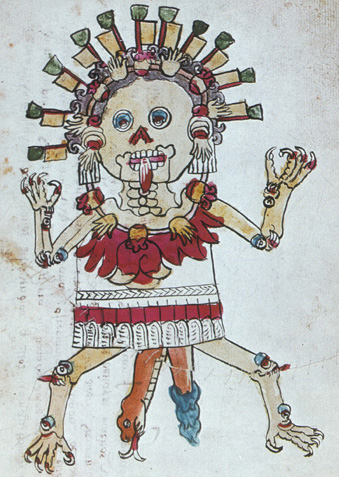
A Tzitzimītl[a] (plural Tzitzimīmeh[b])[1] is a type of celestial deity associated with stars in Aztec mythology. They were depicted as skeletal female figures wearing skirts often with skull and crossbones designs. In post-conquest descriptions they are often described as "demons" or "devils", but this does not necessarily reflect their function in the Cemanahuacan belief system of the Aztecs.[2]

Depiction of a Tzitzimitl from the Codex Magliabechiano.
Depiction of Itzpapalotl, Queen of the Tzitzimimeh, from the Codex Borgia.

The Tzitzimimeh were female deities and related to fertility. They were associated with the Cihuateteo and other female deities such as Tlaltecuhtli, Cōātlīcue, Citlālicue and Cihuacōātl, and they were worshipped by midwives and parturient women. The leader of the tzitzimimeh was the goddess Itzpapalotl, who was the ruler of Tamoanchan, the paradise where the Tzitzimimeh resided.

The Tzitzimimeh were also associated with the stars and especially the stars that can be seen around the Sun during a solar eclipse. This was interpreted as the Tzitzimimeh attacking the Sun, thus causing the belief that during a solar eclipse, the tzitzimime would descend to the earth and possess men. It was said that if the Tzitzimimeh could not start a bow fire in the empty chest cavity of a sacrificed human at the end of a 52-year calendar round, the fifth sun would end and they would descend to devour the last of men.[3] The Tzitzimimeh were also feared during other ominous periods of the Aztec world, such as during the five unlucky days called Nemontemi which marked an unstable period of the xiuhpōhualli (solar year count) and during the New Fire ceremony marking the beginning of a new calendar round; both were periods associated with the fear of change.

The Tzitzimimeh had a double role in Aztec religion: they were protectresses of the feminine and progenitresses of mankind. They were also powerful and dangerous, especially in periods of cosmic instability.[4][page needed]

[edit]
  • Tzitzimitl was one of 8 monsters from around the globe to appear as antagonists in the Be Cool, Scooby-Doo! episode titled "Mysteries On The Disorient Express."
  • Tzitzimitl is also what the Warlady Skyy Appletini is referred to in the popular webcomic Erfworld.
  • In the tabletop RPG Pathfinder, the Tzitzimitl are powerful undead creatures associated with outer space.[6]
  • Tzitzimitl are featured on the Cartoon Network series Victor and Valentino as recurring antagonists. In the episode "A New Don", they are depicted as tall black figures with multiple heads, a constellation style texture, and also have the ability to enter a person's body and control them with sunlight being their weakness. They reappear in "Starry Night" where they take over the bodies of Vic and Val's friends and try to glean information about their grandmother from them. In "Carmelita" it is revealed that they can also take over inanimate objects as one took over a car. They also appear to be in league with the series' main antagonist Tez. It is revealed in season 3's episode "Another Don" that prominent character Isabella has been Tzitzimitl in disguise since the beginning of the series.
  • The tzitzimimeh are antagonists in Onyx Equinox, though they are associated with Mictecacihuatl. Though mostly highly aggressive and murderous, an allusion to their role in childbirth can be seen when they calm down the still infant goddess.
  • Tzitzimilitl are demons that can be summoned by the player in numerous video games of the Megami Tensei franchise, including Shin Megami Tensei IV: Apocalypse, Persona 4 and its upgraded version Persona 4 Golden, and the PSP version of Persona 2: Innocent Sin. They are depicted in Kazuma Kaneko's artwork as red-robed female figures with countless arms sprouting from their skull, their many hands catching stars from the sky, while their bodies end at a distended belly containing the stars they have devoured. A single Tzitzimitl can be found in the first area of Shin Megami Tensei 5 with an subquest where she asks the protagonist to catch stars spread out in the area for her.

Notes

[edit]

References

[edit]
Revisions and contributorsEdit on WikipediaRead on Wikipedia
from Grokipedia
In , the Tzitzimime (singular: tzitzimitl) are a class of celestial deities depicted as skeletal figures with star-adorned bodies, bloodstained claws, shell skirts, and accessories like necklaces of human hearts and paper banner crowns, embodying both generative and destructive forces linked to the and cosmic cycles. These entities, often portrayed with blue eye sockets and joints marked by stars, originate as spirits of women who died in , deceased gods, or royalty, descending from constellations to threaten humanity during events like solar eclipses or the five inauspicious nemontemi days at the end of the 365-day calendar year. Their primary role involves heralding darkness and potential , as they were believed to devour the living if the rituals sustaining the sun—such as the held every 52 years—failed, yet they also possessed ambivalent powers to heal illnesses or assist in when petitioned by midwives and curers through sacred stone platforms symbolizing their garments. The Tzitzimime trace their mythological lineage to the primordial goddess Citlalinicue, the "Skirt of Stars," who bestowed her celestial powers upon her daughters and granddaughters, establishing them as a matrilineal cadre of creator deities with ties to fertility and sacrifice. Closely associated with prominent Aztec goddesses such as Cihuacoatl (the serpent woman who aids parturition), Itzpapalotl (the obsidian butterfly ruler of a paradise for fallen warriors and sacrificial victims), Coatlicue (the earth goddess with a skirt of serpents), and Tlaltecuhtli (the monstrous earth deity), the Tzitzimime reinforced social and ritual norms by punishing transgressions like neglect of offerings or moral lapses, thereby serving as enforcers of cosmic order in pre-Hispanic Nahua cosmology. Representations of these beings appear in key codices, including the Codex Borgia, Codex Mendoza, and Codex Tudela, where they are shown descending on ropes during ritual scenes, underscoring their integral place in Aztec iconography and worldview. Following the Spanish conquest in the early , colonial chroniclers masculinized and demonized the Tzitzimime, recasting them as diabolical monsters akin to the Christian to suppress indigenous beliefs, though their original female, multifaceted nature persisted in Nahua oral traditions and rituals. This transformation highlights the tension between pre-colonial reverence for their dual roles in and post-conquest efforts to eradicate them as symbols of pagan terror, influencing modern interpretations in Mesoamerican studies.

Etymology and Terminology

Etymology

The literal meaning of the term tzitzimitl (singular) remains unknown, as noted by in the Florentine Codex (Book 7). The exact is uncertain due to the complexities of morphology. The plural form, tzitzimimeh (often transcribed as tzitzimime in early Spanish sources), extends this to denote a of such entities, emphasizing their group role in mythological narratives. Phonetically, tzitzimitl is pronounced in International Phonetic Alphabet as [t͡siˈt͡simiːt͡ɬ], with the "tz" as an [t͡s], a long "i" in the second syllable, and the terminal "tl" as a lateral [t͡ɬ] characteristic of . The plural tzitzimimeh follows as [t͡sit͡siˈmiːmeʔ], featuring a at the end to indicate the plural marker -h. Historical variations in Spanish colonial transcriptions, such as "tzitzimime," arose from European orthographic adaptations of sounds unfamiliar to Spanish scribes, often simplifying the and . The term first appears in documented form within Bernardino de Sahagún's 16th-century ethnographic work, the (completed around 1577), where it describes airborne demons or celestial forces in Books 1, 6, and 8, providing the earliest written attestations from indigenous informants. Sahagún's accounts, based on consultations with Nahua elders, preserve the term's usage in contexts of solar eclipses and cosmic threats, underscoring its integration into post-conquest records while retaining pre-Hispanic linguistic integrity. The plural form of Tzitzimitl is Tzitzimimeh, referring collectively to these celestial entities in texts and descriptions. In colonial-era manuscripts, the singular term appears with orthographic variations such as "zizimitl," as seen in the anonymous Spanish commentary to the , reflecting inconsistencies in early transcriptions of by European scribes. Tzitzimimeh are conceptually linked to other female spectral figures in Aztec lore, particularly the , deified women who perished in and were believed to haunt crossroads; while distinct, they were occasionally conflated as subordinate star demons sharing themes of , death, and nocturnal peril. They also connect to earth-related monsters like , with certain monumental sculptures interpreted as hybrid Cihuacoatl-Tzitzimitl forms that blend terrestrial and celestial destructive forces, though traditionally Tzitzimimeh emphasize stellar origins over chthonic ones. Post-conquest profoundly shaped perceptions of Tzitzimimeh, as Spanish chroniclers recast them as malevolent demons akin to the Christian ; for instance, Dominican friar described them in demonic terms within his accounts of Aztec rites, aligning indigenous cosmology with European theological frameworks to facilitate evangelization. This evolution underscores how colonial texts transformed ambivalent creator-destroyer beings into unambiguous agents of evil.

Description and Appearance

Physical Characteristics

Tzitzimitl are depicted in Aztec codices as predominantly skeletal figures, characterized by emaciated bodies with exposed bones that emphasize their otherworldly, deathly essence. Their forms feature a fleshless, skeletal head and elongated limbs, often shown in dynamic poses suggesting descent from the heavens, with joints at the knees, elbows, and wrists marked by symbols or monstrous faces resembling eyes, evoking their celestial origins as star demons. The facial features include large, round eyes set in hollow or blue sockets, conveying , vacant gaze, paired with a gaping that sometimes protrudes a shaped like a sacrificial . Disheveled cascades wildly, occasionally adorned with elements that mimic flickering flames or stellar patterns in primary illustrations. While primarily feminine in form, some representations appear androgynous, lacking explicit breasts due to the skeletal structure, yet retaining a gendered agility suited for swift aerial attacks. Their hands and feet end in sharp, bloodied claws or talons designed for tearing flesh, underscoring their predatory nature, as seen in vivid depictions from colonial-era manuscripts. These physical traits, drawn from sources like the (folio 76r) and Codex Tudela (folio 46r), highlight a shadowy, ethereal presence that blurs the line between the living and the cosmic void.

Symbolic Attire and Attributes

Tzitzimitl figures are often depicted in Aztec iconography wearing skirts woven or bordered with shells and bones that rattle like , symbolizing their celestial origins and the ominous sound of . These skirts, frequently adorned with motifs of skulls and crossed bones, represent the duality of and regeneration, as the skeletal elements evoke ancestral spirits while the shell borders connect to the night sky's starry expanse. In the Codex , such skirts appear on female tzitzimime like Citlalinicue, fringed with crossed bones that link to themes of through their association with creation myths. Capes of human skulls and bones further emphasize the destructive aspect, draped over their skeletal forms to signify devoured victims and the chaos of cosmic dissolution. Paper banners embedded in their hair serve as crowns, denoting sacrificial offerings and the transient nature of life, as these banners were ritual items burned in ceremonies to appease the deities. Necklaces composed of human hearts, hands, and blood underscore the consumption of sacrificial victims, portraying tzitzimime as devourers who sustain the through ingested life force. Among their attributes, tzitzimime clutch stone knives depicted on their garments, symbolizing ritual sacrifice and the severing of life ties, while shell collars or tipped aprons evoke the rattling and nocturnal threats. These elements, seen in codices like the Magliabechiano and Borgia, blend icons—such as starry patterns—with symbols like hearts and bones, illustrating the tzitzimime's role in the cycle of birth and annihilation.

Mythological Origins

Place in Aztec Cosmology

In Aztec cosmology, the universe was structured into thirteen layered heavens above the , with the Tzitzimitl occupying a significant position within this celestial hierarchy, particularly associated with the starry skies and paradisiacal realms such as Tamoanchan, often identified as the twelfth heaven. Tamoanchan served as the paradise where the Tzitzimitl resided under the rulership of Itzpapalotl, embodying a domain of origin and fertility intertwined with stellar phenomena. As inhabitants of these upper realms, the Tzitzimitl were conceptualized as stars that detach and descend during periods of darkness, personifying the dynamic and precarious nature of the within the broader cosmic order. The Tzitzimitl played a crucial cyclic role as guardians of the , opposing the sun Tonatiuh in battles and , where the sun's victory, sustained by human rituals, ensures its daily rise and the continuity of the Fifth Sun era. This interaction underscored the fragility of the current cosmic age, where between light and darkness was maintained through such celestial struggles, reflecting the ' understanding of time as inherently unstable and requiring constant renewal. Their presence in the heavens thus contributed to the rhythmic order of the cosmos, tying the nocturnal stars to the diurnal solar path in a system vulnerable to disruption. The mythological origins of the Tzitzimitl trace back to precursor events of cosmic destruction and regeneration, emerging from the cataclysms that ended previous world ages. Central to their genesis is the figure of Citlalinicue, a primordial Tzitzimitl who birthed 1,600 stellar deities, some of which fell to earth amid heavenly collapses, linking the Tzitzimitl directly to the creation of the stars from dismembered divine entities during the formative chaos. This narrative connects their existence to the sacrificial foundations of the Fifth Sun, where deities like Coatlicue underwent dismemberment to birth celestial bodies, emphasizing the Tzitzimitl's role in the regenerative cycles born from prior destructions.

Associations with Deities and Spirits

In , the Tzitzimimeh were led by Itzpapálotl, the obsidian who ruled as their queen and patroness of the paradise Tamoanchan, often depicted as a skeletal warrior advising rulers on cosmic matters. This hierarchical structure positioned Itzpapálotl at the apex, embodying the destructive yet generative forces of the stars. The Tzitzimimeh also exhibited hybrid forms linked to , the earth monster , reflecting shared motifs of primordial creation and fertility through their roles as celestial enforcers tied to the earth's monstrous aspects. Furthermore, the —spirits of noble women who died in —served as earthly manifestations of the Tzitzimimeh, functioning as divine midwives and patrons of the western sky while sharing their skeletal, ominous . Spiritually, the Tzitzimimeh shared kinship with Mictlantecuhtli, the lord of the , through overlapping skeletal motifs that portrayed him as a sky-bearing Tzitzimitl ruling Mictlan alongside his consort Mictecacíhuatl. They were sometimes merged with the Centzon Huitznahua, the "four hundred southerners" representing southern stars, as both groups embodied the perilous stellar entities threatening the world during cosmic disruptions. The Tzitzimimeh displayed dual influences, with fertility ties evident in the myth of , the , whose grandmother was a Tzitzimitl pursuing her in a tale of creation and separation that underscored the demons' progenitive powers. In contrast, their destructive aspects aligned with , the night god linked to the primordial Tzitzimitl Citlalinicue through themes of warfare, hurricanes, and the nocturnal sky's chaotic potential.

Role in Aztec Beliefs

Destructive Aspects

In Aztec cosmology, the Tzitzimitl embodied profound destructive forces, serving as celestial demons poised to unleash upon humanity. These star entities were believed to descend from the heavens during solar eclipses, manifesting as visible threats that aimed to devour people, with particular peril to pregnant women and children, whom they targeted for consumption or transformation. This fear stemmed from the perception that eclipses represented moments when the stars overwhelmed the sun, allowing the Tzitzimitl to plunge earthward in a frenzy of destruction. Their antagonism was especially feared at the end of each 52-year cycle during the , where failure to relight the fire was believed to signal their triumph and the end of the Fifth Sun. Eclipses marked moments of vulnerability for the sun, as the temporary darkening signaled its weakness; without human sacrificial blood to nourish it, the sun risked permanent defeat, inviting the Tzitzimitl to eradicate all life. documented this in his , noting that the entities "descend headlong to earth to devour human beings" during such celestial disruptions, underscoring their role in upholding—or threatening—the precarious balance of the cosmos through opposition to ritual offerings. If the Fifth Sun ultimately failed, as prophesied at the end of each 52-year cycle, the Tzitzimitl would triumph, plunging the world into eternal darkness and . Heightened dread surrounded the Tzitzimitl during Nemontemi, the five barren intercalary days concluding each solar year, when societal activities halted amid over their potential descent. These "useless" days amplified fears of cosmic instability, with communities concealing vulnerable individuals—especially pregnant women—in granaries to evade the demons' clutches, reflecting the pervasive anxiety that any lapse could precipitate immediate havoc. Sahagún's accounts in the highlight this period's terror, linking it to broader apprehensions of the Tzitzimitl as enforcers of doom when the calendar's rhythm faltered.

Protective and Dual Nature

In , the Tzitzimitl possessed a paradoxical dual nature, serving as both harbingers of destruction—such as during solar eclipses when they descended to devour humanity—and benevolent forces essential to creation and renewal. This duality manifested in their embodiment of sacred , where they balanced apocalyptic threats with generative powers that sustained cosmic order and fertility cycles tied to the stars. Principal figures like Citlalinicue, known as "she of the star-skirt," exemplified this by giving birth to a flint knife from which 1,600 deities emerged while also wielding the potential to destroy the earth, thus linking stellar movements to cycles of fertility and regeneration. A key aspect of their protective role involved curing illnesses through rituals that invoked their ambivalent generative attributes. The most significant Tzitzimitl were creator deities capable of both causing and preventing , with mothers dressing sick children in symbolic costumes—such as those featuring Huitzilopochtli's skull-and-crossbones cape—to petition these entities for healing. This practice underscored their capacity to channel destructive energies into restorative ones, particularly in contexts of vulnerability like childhood ailments. Tzitzimitl also functioned as guardians of , especially in , where they acted as spiritual midwives and progenitresses. Female variants, including Citlalinicue and Cihuacoatl, patronized parturient women and midwives, offering protection during labor and embodying the transformative power of motherhood. Coatlicue, another associated figure, sacrificed herself to enable the sun's motion, highlighting their role in facilitating birth and cosmic continuity. This protective dimension extended to practices during the nemontemi—the five inauspicious days closing the Aztec year—when pregnant Tenochca women were concealed in grain bins to evade Tzitzimitl.

Cultural and Ritual Significance

In Aztec cosmology, the Tzitzimitl were closely linked to solar eclipses, which were interpreted as ominous signs of their descent from the heavens. During these events, the temporary darkening of the sun was perceived as the stars overwhelming the solar disk, allowing the skeletal star demons, known as Tzitzimimeh, to invade the earth and devour humanity. This association underscored broader fears of cosmic catastrophe, as depicted in on the Aztec Calendar Stone, where Tzitzimime imagery surrounds representations of the sun god Tonatiuh in his eclipse-afflicted form. Eclipses thus served as primary manifestations of the Tzitzimitl's destructive potential, heightening societal anxiety about the fragility of the Fifth Sun era. The Nemontemi, or five unlucky days concluding the 365-day Xiuhpohualli calendar, represented another critical period of vulnerability to the Tzitzimimeh. These intercalary days, falling outside the structured 18 veintenas of 20 days each, were deemed inauspicious and transitional, prompting the suspension of normal activities such as , , and to avert disaster. Aztec beliefs held that the Tzitzimimeh were particularly active during Nemontemi, lurking at crossroads and poised to descend en masse, exacerbating fears of world-ending chaos at the year's close. This period's isolation from the tonalpohualli's divinatory cycle amplified perceptions of it as a liminal void susceptible to celestial incursions. Tzitzimitl were also tied to the movements of stars, particularly in its roles as the star, symbolizing their ominous flickering descent toward . As celestial entities embodying stars, the Tzitzimimeh were envisioned as diving from the sky during periods of darkness, with —personified as Tlahuizcalpantecuhtli—occasionally manifesting in a Tzitzimitl form to evoke warfare and upheaval. This connection highlighted Venus's dual nature as a harbinger of both renewal and peril, mirroring the Tzitzimitl's role in cosmic cycles where stellar paths foretold potential invasion.

Role in Ceremonies and Daily Life

The , known as Xiuhmolpilli, was a central Aztec ritual performed every 52 years to renew the cycle and avert the descent of the Tzitzimimeh, ensuring the sun's continued rise and preventing cosmic destruction. During this event, all household fires across the empire were extinguished, plunging society into darkness symbolizing potential , after which priests ascended a —often Huixachtlan—to kindle a new fire in the chest cavity of a sacrificial victim, typically a captive . Human sacrifices were integral, offered to appease the Tzitzimimeh and reaffirm the gods' pact sustaining the world, with the new flame then distributed to relight hearths and temples. This ceremony underscored the Tzitzimimeh's role as harbingers of doom at cyclical transitions, compelling communal participation to maintain cosmic order. In daily life, implemented precautions against Tzitzimimeh incursions, particularly during periods of vulnerability like the five nemontemi days at the year's end, when societal activities halted and people fasted to ward off misfortune. Warriors and priests invoked protective rituals, such as incantations and offerings to deities like Huitzilopochtli, to shield communities from nocturnal attacks, while emphasizing vigilance in daylight to avoid the demons' shadowy ambushes. Women, especially pregnant ones, followed customs like hiding in granaries during nemontemi, donning fiber masks as amulets to prevent transformation into Tzitzimimeh-like spirits, reflecting the beings' association with feminine peril and stellar chaos. These practices permeated social norms, fostering a culture of ritual preparedness against the dual threat of destruction and transformation. Tzitzimimeh also influenced midwifery and rites, where their protective duality was invoked for safe births amid fears of celestial threats like eclipses, during which they were believed to descend and devour newborns. Midwives, or tlamatlquiticitl, integrated invocations to Tzitzimimeh figures such as Coatlicue in postpartum rituals, using herbal remedies and steam baths alongside offerings to ensure maternal and , blending destructive warnings with generative blessings. This integration highlighted the Tzitzimimeh's role in cycles, where successful rites reinforced social continuity and honored their progenitive aspects.

Depictions and Sources

In Pre-Columbian Codices

In pre-Columbian codices, Tzitzimitl are depicted as celestial entities integral to Aztec and divinatory contexts, often portrayed as skeletal or semi-skeletal figures embodying both generative and ominous forces. These representations emphasize their as sky-bearers and demons within the cosmological framework, without the overtly demonic connotations introduced in later colonial interpretations. The , a pre-conquest from central , illustrates Tzitzimitl in sections related to the tonalpohualli, the 260-day divinatory . On plates 49–52, descending couples are identified as Tzitzimime, shown as sky-bearers with fringed skirts adorned with bones, skulls, and crossbones, symbolizing their descent from the heavens during cosmic transitions. Plate 29 further depicts the descent of Tzitzimitl figures on ropes, emerging alongside wind deities in a narrative of celestial movement and renewal, positioned hierarchically near Itzpapalotl, the flint-skinned ruler of the Tzitzimime. Stylistic features include vibrant colors highlighting starry motifs at joints—such as knees, elbows, and wrists marked with eye-like star symbols—and shell-bordered skirts evoking generative powers tied to Citlalinicue, the starry-skirted progenitor. These elements underscore the pre-conquest duality of Tzitzimitl as creators and potential destroyers, integrated into calendrical prophecies rather than purely malevolent threats.

Post-Conquest and Colonial Representations

Following the Spanish conquest of the in 1521, representations of the Tzitzimitl underwent significant transformations in colonial-era documents, as European chroniclers reinterpreted indigenous cosmologies through a Christian lens. Spanish friars such as and portrayed the Tzitzimitl primarily as malevolent , stripping away much of their prehispanic dual nature as celestial entities capable of both destruction and protection. In Sahagún's , completed around 1577, the Tzitzimitl is described as a "demon of the air" and a fiend tormenting humans from the sky, blending native star-deity attributes with Catholic notions of infernal beings . Similarly, Durán's Historia de las Indias de Nueva España y islas de Tierra Firme (ca. 1581) equates the Tzitzimitl with diabolical forces, emphasizing their role in apocalyptic threats during solar eclipses and the end of 52-year cycles, while associating them with the Christian to underscore the perceived of Aztec beliefs. The , a mid-16th-century Mixtec-Aztec created in the early colonial period but with pre-conquest stylistic roots, depicts Tzitzimitl in scenes linked to cosmic disruptions. Folio 76r portrays a clawing skeletal figure with a shell-bordered , paper banners in the , and a necklace of hearts and hands, interpreted as attacking during solar eclipses to devour the sun and bring darkness. This depiction aligns with tonalpohualli contexts, where Tzitzimitl are hierarchically associated with Itzpapalotl and other deities, using bold lines and vibrant pigments to accentuate starry joints and bony attributes that blend fertility symbols with ominous forms. The emphasis remains on their ambivalent nature—capable of healing through rites while posing eclipse-related dangers—reflecting indigenous views of cosmic balance amid emerging colonial influences. Colonial codices like the (ca. 1541) and Codex Tudela (ca. 1553–1560) reflect these shifts through hybrid imagery that incorporates European artistic conventions. In the , folio 67r depicts a warrior adorned in a Tzitzimitl costume featuring skeletal motifs and starry elements, but the overall presentation aligns with Spanish administrative purposes, transforming the figure into a symbol of military hierarchy rather than a multifaceted . The Codex Tudela, on folio 46r, illustrates a skeletal Tzitzimitl with clawed limbs and a grimacing face, often interpreted in accompanying Spanish annotations as a hellish specter offering blood sacrifices, which amplifies themes of evil over any generative or protective qualities. These depictions introduce hellish motifs, such as associations with the underworld and demonic temptation, evident in the Florentine Codex's textual descriptions that fuse Tzitzimitl with figures like Mictlantecuhtli, recast as akin to . Artistically, 16th-century chronicles adopted European styles, including more rigid outlines and symbolic additions like flames or exaggerated skeletal forms to evoke dread, contrasting with the fluid, symbolic lines of pre-conquest codices. This evolution marked a loss of the Tzitzimitl's fertility aspects—such as links to and through progenitors like Citlalinicue—in favor of purely apocalyptic warnings that served goals of eradicating native religions. By the mid-16th century, the Tzitzimitl's gender shifted predominantly to male in textual accounts by and Durán, reflecting broader colonial efforts to demonize and masculinize indigenous spiritual entities.

Modern Interpretations

In the animated series , the tzitzimimeh serve as key antagonists aligned with the underworld goddess Mictecacihuatl, portrayed as teleporting celestial demons that transform into wandering stars and intensify their assaults during near-new moon phases, reflecting their traditional ties to cosmic darkness. These skeletal entities pursue protagonists with relentless aggression, slashing and injuring them before retreating to the sky, underscoring their role as harbingers of doom in a narrative rooted in Mesoamerican lore. The video game franchise features Tzitzimitl as a formidable of the race, often encountered in titles like and Shin Megami Tensei: Dx2, where it wields star-infused abilities such as the passive "Star of Darkness" that boosts dark damage output by 20% and pierces resistances. In , players engage in a subquest involving Tzitzimitl that requires collecting scattered stars, highlighting its stellar mythology through gameplay mechanics tied to night and themes. This adaptation emphasizes Tzitzimitl's destructive celestial nature, positioning it as a high-level chaos-aligned entity capable of apocalyptic threats. Tzitzimime appear as recurring antagonists in the Cartoon Network series , depicted as tall, solid-black female humanoids adorned with tiny white star-like spots across their bodies, evoking their origins as demons in comedic yet spooky adventures. They possess characters and vanish into starry patterns upon defeat, blending with humor in episodes that explore Mesoamerican myths through the lens of childhood mischief in a Mexican town. In games like Pathfinder, Tzitzimitl are reimagined as celestial aberrations, immense skeletal figures that herald planetary doom with powers drawn from solar eclipses and abyssal darkness, capable of consuming light sources and inflicting fear on entire worlds. These creatures, detailed in sources like the Bestiary 3, attack suns to trigger end-times scenarios, serving as high-challenge (CR 19) bosses that embody apocalyptic horror in fantasy campaigns. The Be Cool, Scooby-Doo! episode "Mysteries on the Disorient Express" incorporates Tzitzimitl as a monstrous worn by a spy aboard a global train, merging with the show's signature humorous unmasking formula amid international . This portrayal lightens the entity's fearsome skeletal and stellar traits into a comedic foil, allowing the Mystery Inc. gang to solve the case while nodding to cultural . Modern revivals of Tzitzimitl in Mexican folklore appear in contemporary art, where artists emphasize their horror elements through digital illustrations of skeletal star demons with claw-like features and cosmic motifs, often shared on platforms like ArtStation as tributes to pre-Hispanic myths. These depictions contribute to cultural festivals like Day of the Dead by inspiring horror-themed installations and costumes that highlight the entity's dual role as destroyer and celestial guardian, fostering renewed interest in Aztec cosmology. As of 2025, no major new pop culture adaptations have emerged, though Tzitzimime continue to appear in niche media and online discussions of Mesoamerican mythology.

Scholarly Analysis

Modern scholars interpret the Tzitzimitl as complex figures embodying feminine duality within Aztec cosmology, particularly through their associations with and . Cecilia Klein argues that these entities, often depicted as skeletal females adorned with celestial motifs, represent an ambivalence between creation and destruction, where symbolize cosmic and signifies both nourishment and peril in rituals of birth and . This duality underscores their role as protectors of , linked to deities like Citlalinicue, who governed stellar and aqueous forces essential for life's cycles. Complementing these views, Mary Miller and Karl Taube highlight iconographic elements such as skirts and in Tzitzimitl representations, interpreting these as symbols that merge deathly imagery with regenerative motifs like jade beads, evoking the earth's productive yet perilous nature. Debates persist regarding the primacy of the Tzitzimitl's benevolent versus destructive aspects, with scholars critiquing colonial sources like Bernardino de Sahagún's accounts for emphasizing their malevolent traits due to Christian biases, thereby overshadowing their pre-Hispanic protective functions in and . Recent studies address these incompletenesses by examining roles in Mesoamerican cosmology, revealing how the Tzitzimitl challenged binary notions of , serving as enforcers of social and cosmic balance rather than mere harbingers of doom. Twenty-first-century research further ties the Tzitzimitl to astronomical phenomena, such as eclipse predictions in Aztec calendars, where their descent during solar obscurations symbolized threats to the sun's vitality, prompting rituals to avert catastrophe and reaffirm calendrical stability. Susan Milbrath's analyses of the Aztec Calendar Stone illustrate how Tzitzimitl imagery encodes lore, bridging mythological terror with sophisticated . As of 2025, scholarly interest persists in Tzitzimitl's role in gender and cosmic duality, with ongoing analyses in Mesoamerican iconography but no groundbreaking new publications identified.

References

Add your contribution
Related Hubs
User Avatar
No comments yet.