Hubbry Logo
Wire brushWire brushMain
Open search
Wire brush
Community hub
Wire brush
logo
8 pages, 0 posts
0 subscribers
Be the first to start a discussion here.
Wire brush
Wire brush
from Wikipedia
Wire brush
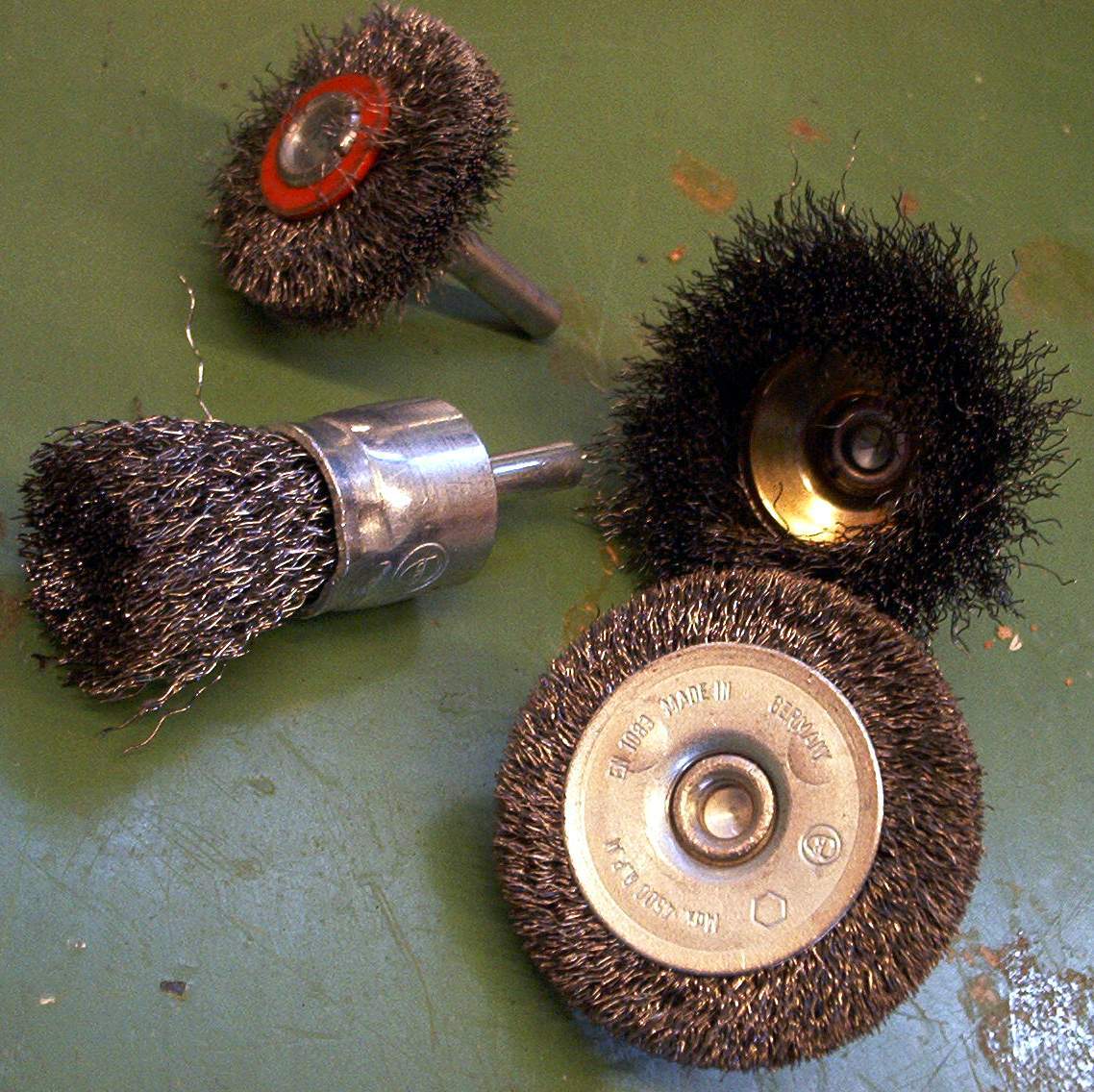
Round wire brushes

A wire brush is a tool consisting of a brush whose bristles are made of wire, most often steel wire. The steel used is generally a medium- to high-carbon variety and very hard and springy. Other wire brushes feature bristles made from brass or stainless steel, depending on application. Wires in a wire brush can be held together by epoxy, staples, or other binding. Wire brushes usually either have a handle of wood or plastic (for handheld use) or are formed into a wheel for use on angle grinders, bench grinders, pistol-grip drill motors, or other power tools.

Uses

[edit]
8 in (203 mm) wire brush mounted to a bench grinder

The wire brush is primarily an abrasive implement, used for cleaning rust and removing paint. It is also used to clean surfaces and to create a better conductive area for attaching electrical connections, such as those between car battery posts and their connectors, should they accumulate a build-up of grime and dirt. When cleaning stainless steel, it is advisable to use a stainless steel bristle wire brush, as a plain carbon steel brush can contaminate the stainless steel and cause rust spots to appear. Brass bristle brushes are used on softer surfaces or when it is necessary to clean a harder surface without marring it. Brass bristle brushes are also used in potentially flammable environments where non-sparking tools are required. Wire brushes are also used to clean the teeth of large animals, such as crocodiles and pigs. They are also used widely in surface engineering to clean the castings prior to painting.

History

[edit]

The origins of the wire brush are unknown, although it is believed that the Romans used similar tools in the manufacture of roof tiles. As the Roman Empire fell, the tool fell out of use.[citation needed]

Barbeque grill cleaning

[edit]

A number of surgeons recommend that wire brushes not be used to clean barbecue grills.[1] In some cases, bristles break off the brush which then become deposited in food cooked on the grill. Ingestion of these bristles can cause gastrointestinal perforation.[2][3]

On May 20, 2020, American food writer and grilling authority Derrick Riches[4] called for a ban on the manufacture and sale of wire-bristle grill-cleaning brushes.[5]

See also

[edit]

References

[edit]
[edit]
Revisions and contributorsEdit on WikipediaRead on Wikipedia
from Grokipedia
A wire brush is a tool consisting of bristles made from wire, most often steel or other metals such as stainless steel or brass, designed for abrasive cleaning and surface preparation tasks. Wire brushes are available in various forms, including hand-held versions for manual use and attachments for power tools such as angle grinders, drills, and bench grinders, with common configurations like cup, wheel, and end brushes featuring crimped or knotted filaments to suit different flexibility and aggression levels. Their primary applications include removing rust, paint, weld spatter, and burrs from metal surfaces, as well as cleaning barbecue grills and preparing substrates for welding or finishing. While effective, wire brushes pose safety risks, particularly from filament breakage that can propel wires as projectiles, potentially causing lacerations or in ; in contexts, detached bristles have led to ingestions resulting in internal injuries requiring . Operators must adhere to precautions like using undamaged brushes at appropriate speeds and wearing protective gear to mitigate these hazards.

Construction and Materials

Bristle Types and Properties

Wire brush bristles are primarily constructed from metallic wires or synthetic filaments, with dictating mechanical properties such as , tensile strength, and resistance. bristles, typically made from high-carbon steel alloys, exhibit high rigidity and abrasiveness due to their elevated (often around 50-60 HRC), enabling effective material removal through shear forces on surfaces, though they are prone to rusting in moist environments. bristles, commonly Type 304 or 316 alloys, offer superior resistance owing to content (at least 10.5%) forming a passive layer, maintaining integrity in acidic or humid conditions while providing comparable abrasiveness to but with reduced risk. Brass bristles, composed of copper-zinc alloys, possess lower hardness (around 80-120 HB) than steel equivalents, resulting in gentler abrasion that minimizes surface gouging on softer metals via reduced shear stress, alongside non-sparking characteristics from their non-ferrous composition, which limits ignition risks in explosive atmospheres. Nylon bristles, often impregnated with abrasive particles like silicon carbide, serve as non-metallic alternatives with inherent flexibility from polymer chains, yielding lower frictional heat generation compared to metals (coefficients of friction around 0.2-0.4 versus 0.6-0.8 for steel) and avoiding metallic contamination, though they degrade faster under high temperatures exceeding 200°C. Bristle diameter, ranging from fine (0.008 inches) to coarse (0.020 inches or thicker), directly influences performance: thicker wires enhance durability and aggressive cutting action through greater cross-sectional strength, resisting breakage under high loads, but diminish flexibility, potentially causing uneven pressure and localized gouging on irregular or delicate substrates due to reduced deflection. Finer diameters increase flexibility via lower (proportional to the fourth power of diameter per beam theory), promoting conformability and finer surface finishes with extended life from distributed , albeit at the cost of reduced material removal rates. Fill density, defined as bristles per unit area, modulates contact and dissipation: higher densities amplify effective abrasiveness by increasing simultaneous bristle engagement, yielding uniform finishes through consistent shear distribution, but elevate frictional heating from cumulative contact points and reduce adaptability to contoured surfaces owing to collective . Lower densities enhance flexibility for irregular geometries, distributing force over fewer points to mitigate overheating, though they compromise finish uniformity and accelerate individual bristle .

Handle and Attachment Designs

Handles for handheld wire brushes are commonly fabricated from durable or impact-resistant to ensure stability and longevity during manual surface preparation tasks. These materials provide sufficient rigidity to maintain control and leverage, particularly in precision-oriented applications where consistent application is required. Wooden handles, often measuring around 10 inches in length, offer natural ergonomic contours that distribute force evenly, reducing strain on the user's wrist and fingers during extended use. Ergonomic features, such as non-slip grips and curved profiles, are integrated into many designs to mitigate hand fatigue and enhance , especially in industrial or repetitive scenarios. For instance, handles with reinforced construction prevent flexing under load, prioritizing precision over adaptability to irregular contours, though this can limit versatility on highly curved surfaces where excessive rigidity may hinder contour-following. Vibration-dampening properties in or composite handles further support prolonged handling by absorbing tool-induced oscillations, balancing user comfort against the need for firm control. Attachment designs for integrating wire brushes with power tools emphasize secure, standardized mechanisms to accommodate high-speed without detachment risks. Threaded arbors, typically featuring a 5/8-11 inch configuration, enable direct mounting onto grinders and die grinders, facilitating rapid setup for mechanical brushing operations. These arbors provide a rigid connection that transmits efficiently while minimizing wobble, essential for maintaining contact in deburring or removal. Complementary adapters or clamps, used with bench grinders and rotary tools, allow for quick-release functionality and broad compatibility across equipment types, though they introduce minor trade-offs in rotational balance compared to integral threaded mounts. Such designs prioritize and precision by ensuring concentric alignment, reducing the potential for vibration-induced inaccuracies during powered use.

Configurations and Variants

Handheld Models

Handheld wire brushes are manually operated tools featuring a or block affixed with stiff wire , designed for direct scrubbing of surfaces without mechanical power. Common configurations include block-style brushes with ergonomic straight or curved for versatile grip during precision work, push variants with broader bristle arrays and extendable poles for sweeping larger flat areas like patios or decks, and twisted-in-wire models where filaments are secured between twisted stem wires for enhanced aggression in confined or irregular spots. These models prioritize portability and immediate usability, requiring no electricity or batteries, which makes them highly accessible for on-site or remote tasks. Their low production costs—often under $10 for basic units—stem from simple construction using stamped metal wires and molded plastic or wood handles, rendering them economical for infrequent or disposable applications. In practice, handheld brushes suit small-scale maintenance, such as removing light from hand tools or hardware, and hobbyist projects like stripping from metal parts prior to refinishing. Their manual control allows nuanced pressure application on delicate surfaces, avoiding the over-aggression of powered alternatives, though this demands user effort and limits efficiency on extensive areas. Bristle durability varies by material—stainless steel resists better than —but manual variants generally exhibit faster degradation from repeated high-force strokes, as users compensate for absent rotational speed by increasing direct leverage, leading to bending or filament detachment over time.

Rotary and Power Tool Attachments

Wire brushes adapted for rotary power tools, such as grinders, drills, and bench grinders, feature specialized shapes including , , and end configurations to enable efficient surface preparation via high-speed rotation. brushes, often equipped with threaded arbors like 5/8"-11 UNC, provide broad coverage for flat or mildly contoured metal surfaces, removing , scale, or weld effectively on grinders operating at speeds up to 8,500 RPM. brushes, mounted via arbors or shanks, suit edge and fillet work, while end brushes target tight crevices and internal diameters in die grinders or drills. Filament designs differ by application: crimped wire offers flexibility for finishing and light deburring on uneven surfaces, exposing fresh edges as it wears, whereas knotted or twist-knot configurations deliver stiffer action for aggressive removal of heavy deposits, with reduced wire shedding compared to loose crimped setups. , , or wires are common, selected based on resistance and compatibility. Attachment standards ensure compatibility, with 1/4-inch hex shanks predominant for drill-powered brushes to enable quick changes and secure hold under loads up to 10 Nm on variable-speed tools. Brushes are rated for specific maximum RPM—typically 4,500 to 12,000—to match tool output and avoid filament breakup, enhancing durability and cleaning efficacy proportional to rotational transfer. Performance metrics emphasize handling and filament density; for instance, higher-density knotted cups sustain on tough coatings, while crimped wheels minimize gouging on delicate finishes. Compatibility extends to quick-change systems on rotary tools, reducing swap time in fabrication workflows.

Industrial-Scale Brushes

Industrial-scale wire brushes include cylinder, strip, and conveyor-integrated designs optimized for automated, high-throughput manufacturing processes. Cylinder brushes, typically spiral-wound with steel or stainless steel wire, rotate to perform wide-face brushing, descaling, and deburring on metal parts along production lines. These configurations feature dense fill patterns to handle continuous operation, with steel wire selected for its economy and resistance to wear in demanding environments. Strip brushes, embedded in rigid metal channels, mount along conveyor edges for sweeping , holding products in place, or wiping surfaces during transit. In and assembly, they enable automated deburring of high-volume parts by maintaining consistent contact without manual adjustment. Stainless steel variants provide enhanced durability against and mechanical stress in prolonged use. Conveyor-integrated wire brushes clean belts and components in real-time, preventing accumulation of , residue, or chips that could disrupt flow. Their integration into automated lines supports scalability, as high-density wire arrays sustain performance under constant rotation speeds up to industrial standards. Deployment of these brushes facilitates labor cost reductions through , minimizing manual cleaning and intervention in ; industry analyses indicate conveyor enhancements, including brush systems, can cut operational labor by 20-40% in continuous processing sectors like .

Applications and Uses

Surface Cleaning and Preparation

Wire brushes are utilized to mechanically abrade metal surfaces, removing loose scale, weld spatter, and surface contaminants to prepare substrates for or . This process creates a clean profile that enhances or weld by exposing underlying metal free of obstructive layers. Industry standards such as ISO 8501-1 define St 2 (thorough hand and power tool cleaning) and St 3 (very thorough cleaning) grades, where wire brushing eliminates visible loose material to achieve a faint or uniform metallic sheen, suitable for applications requiring moderate cleanliness levels prior to protective coatings. The abrasive action of wire bristles disrupts thin oxide layers through physical shearing, promoting direct metal-to-coating contact without chemical residues that could compromise bond integrity. Empirical observations in surface preparation confirm that such mechanical cleaning improves interfacial bonding, reducing incidences of delamination in coated structures by ensuring contaminant-free substrates. In construction and metal fabrication, this preparation prevents adhesion failures that lead to premature coating degradation, as unclean surfaces foster weak mechanical interlocks under environmental stress. Power-assisted wire brushing extends efficacy for larger areas or tougher contaminants compared to manual methods, though it remains less aggressive than blasting for heavily scaled surfaces. Adhesion tests on mechanically prepared samples demonstrate higher strengths than on untreated ones, underscoring the causal role of surface profiling in load transfer from substrate to overlay. These techniques are routinely applied in structural steelwork to meet specifications for durable finishes, with the absence of chemical byproducts facilitating immediate .

Rust, Paint, and Debris Removal

Steel wire brushes excel in rust removal from ferrous metals via mechanical abrasion, dislodging oxide layers without chemical agents. This method, documented in conservation practices for machined surfaces, effectively eliminates loose rust deposits prior to finer finishing. For non-ferrous substrates like aluminum or copper alloys, brass wire brushes are utilized to prevent deep scratching, as brass's lower hardness relative to steel minimizes surface marring while still achieving contaminant clearance. Controlled surface treatments, such as wire brushing on rusted , have shown measurable improvements in resistance; one study found enhanced passivation in simulated environments after brushing, reducing pitting susceptibility by altering the surface microstructure to inhibit further ingress. This aligns with empirical observations that brushing removes defects and strengthens the near-surface layer, though outcomes depend on gauge and applied. In automotive restoration, wire brushes strip paint from body panels by abrading coatings down to bare metal, aiding preparation for refinishing; however, overzealous use risks warping thin or embedding wire fragments, necessitating controlled speeds and periodic inspection. Wire brushes facilitate debris removal in engine maintenance, clearing carbon buildup, residues, and particulates from components like heads; specialty twisted-wire variants prove effective for internal surfaces, with industry reports confirming reliable dirt and extraction during rebuilds without compromising tolerances. Verifiable stems from the bristles' ability to access crevices, outperforming manual wiping in particulate yield per pass, though integration with solvents optimizes results for embedded contaminants.

Deburring, Finishing, and Polishing

Wire brushes are employed in deburring processes to remove burrs—raised particles and shavings produced during operations such as milling or —from metal parts, thereby preventing interference in assembly and reducing potential stress concentrations. In gear , deburring with wire brushes eliminates edge defects and minimizes stress risers, contributing to smoother meshing and reduced operational . Rotary wire brush systems can achieve consistent edge rounding with radii up to 2.0 mm on components, enhancing part durability without excessive material removal. For surface finishing, wire brushes provide controlled abrasion to refine edges and faces, supporting both aesthetic appeal and functional performance in applications like toolmaking, where smooth surfaces minimize and . Brass wire brushes, prized for their relative softness, are particularly effective on non-ferrous and softer metals such as and aluminum, delivering a high-polish finish without the substrate. The application of wire brushes follows a progressive abrasion sequence analogous to sanding hierarchies, starting with coarser wires or higher-pressure setups for initial burr excision and transitioning to finer gauges or lighter filaments for , which iteratively refines surface topography from rough to near-mirror states. This method ensures uniform edge radius improvement and surface integrity, with automated systems applying targeted pressure to optimize flat-surface finishing post-edge deburring.

Safety Risks and Controversies

Bristle Breakage and Ingestion Injuries

Bristle breakage in wire brushes, especially those employed for grill cleaning, can result in detached metal filaments embedding in uncooked or grilled food, leading to unintentional human and subsequent internal injuries. These sharp fragments, typically 0.5 to 2 inches in length, migrate through the , causing perforations in the , , , or colon. The Centers for Disease Control and Prevention documented this hazard in July 2012, noting cases of internal trauma in both pediatric and adult patients following bristle during barbecuing activities. Empirical data from the National Electronic Injury Surveillance System (NEISS) indicate an estimated 1,698 visits across the from 2002 to 2014 attributable to ingested wire- fragments from grill brushes, with injuries peaking during summer grilling seasons. Ingested bristles often evade initial detection due to their small size and metallic sheen blending with grill residues, only manifesting as symptoms like severe , , or fever days to weeks post-ingestion. Perforations necessitate urgent interventions, including , , or open for retrieval and repair, with complications such as or fistulas reported in case series. Fatal outcomes, though uncommon, have been verified; one autopsy-confirmed instance involved a terminal perforation from a grill brush wire, progressing to fibrinopurulent and death. Near-fatal cases, including esophageal requiring emergency extraction, further underscore the perforation risk. Breakage primarily stems from fatigue failure in the wire filaments under cyclic loading during aggressive scrubbing, where repeated torque and flexing exceed the material's endurance limit, particularly in consumer-grade brushes with crimped stainless steel wires. Crimped configurations, favored for flexibility in light-duty applications, isolate filaments to mitigate vibration-induced stress but remain vulnerable to shedding when bristles wear thin or encounter high torque on hardened grill residues. Lower-quality brushes with loosely packed or under-secured wires accelerate detachment, as inadequate anchoring amplifies localized stress concentrations during use.

Operational Hazards and Mitigation

High-speed rotary wire brushes generate frictional sparks and eject flying , including wire fragments and substrate particles, which can ignite flammable vapors, dusts, or residues in industrial environments and cause penetrating eye injuries such as corneal abrasions or lacerations. These hazards arise from the physics of wire-substrate impacts at rotational speeds often exceeding 3,000 RPM, where converts to and forms, with sparks reaching temperatures over 1,000°C capable of initiating . Prolonged or aggressive brushing induces surface through material removal, quantifiable via profilometry showing increased values ( averages) up to 2-5 μm beyond baseline after extended contact, and localized frictional buildup—potentially exceeding 200°C on metals—leading to thermal warping or in thin sheets under 1 mm thickness. Excessive exacerbates these effects by overbending filaments, accelerating and per basic frictional principles where force directly correlates with and thermal output. Mitigation relies on personal protective equipment (PPE) such as ANSI Z87.1-certified safety goggles or full-face shields to intercept debris and sparks, alongside to prevent hand lacerations from ricochets. Operators must adhere to manufacturer-specified maximum speeds—typically 6,000-12,000 SFPM depending on brush diameter—to limit input, and match wire material to substrate (e.g., wires on to minimize galvanic reactions and ) for reduced frictional anomalies. The SPOT protocol—controlling speed, pressure (light contact only), orientation (perpendicular to avoid gouging), and time (short bursts)—addresses causal factors through user technique, prioritizing mechanical restraint over blanket prohibitions. In explosive-risk settings, non-ferrous alternatives like or wires further suppress spark generation by lacking ferromagnetic properties that amplify ignition.

Debates on Regulation and Alternatives

Following the 2012 Centers for Disease Control and Prevention (CDC) report documenting cases of internal injuries from ingested wire bristles shed during grill cleaning, debates intensified over whether to impose regulatory restrictions on wire brushes or prioritize user education and alternatives. Consumer safety advocates and medical organizations, such as the American Medical Association (AMA), have urged heightened scrutiny, with the AMA in 2018 recommending caution to mitigate health risks from loose bristles lodging in food. Legislative efforts, including a 2025 New York State proposal to prohibit the manufacture, sale, and use of wire-bristle grill brushes, reflect arguments for outright bans to protect public health by eliminating a preventable hazard, particularly given the difficulty in detecting ingested filaments via standard imaging. Opponents of stringent , including industry representatives, contend that such measures represent overreach, as incidents remain rare under proper and protocols, and comprehensive bans could limit effective tools for surface without proportional benefits. No federal U.S. regulations specifically mandate standards or recalls for wire-bristle brushes, despite awareness campaigns, with voluntary guidelines like the 2020 Canadian Standards Association (CSA) standard emphasizing performance criteria to minimize bristle detachment rather than . Proponents of this view highlight empirical trade-offs, noting that while risks are low in absolute terms and mitigable through pre-use checks, precautionary bans overlook the utility of wire brushes in heavy-duty applications where alternatives underperform. Alternatives promoted in regulatory discussions include bristle-free or brushes, wooden scrapers, chain mail scrubbers, and or heat-based methods, which eliminate ingestion risks but often require more effort for stubborn buildup like or carbonized residue. These options, such as scraper-integrated tools, have gained market traction for grill , with testing showing comparable on lighter deposits but slower results on entrenched compared to wire variants. Debates underscore a tension between absolute risk elimination via substitution—which may compromise efficiency in industrial or preparatory contexts—and data-driven approaches favoring informed use, as evidenced by the persistence of wire brushes in settings absent enforced alternatives.

Historical Development

Pre-20th Century Precursors

Early brushing tools, serving as precursors to rigid wire implements, emerged in ancient Egypt around 3500 BC, where artisans fashioned rudimentary scrubbers from split palm leaves and animal hairs, including boar bristles, for surface cleaning and preparation tasks such as polishing artifacts or preparing materials for application. These organic filaments, bound to wooden or bone handles, provided abrasive action through natural stiffness but lacked the durability and uniformity of metal wires, relying instead on renewable biological sources for general scrubbing rather than specialized metal descaling. By the Roman era, cleaning techniques advanced with more structured brushes incorporating stiff fibers or early metallic elements for tasks like tile manufacturing, though evidence points to composite tools rather than dedicated wire arrays. Wire drawing techniques, traceable to circa 2000 BC in Egypt for crafting fine gold wires via manual pulling through stone dies, enabled limited metal filament production primarily for jewelry and decorative purposes, not bulk abrasive tools. This process's inefficiency—requiring labor-intensive hammering and drawing without mechanization—constrained wire to sporadic, small-scale use, precluding organized brushes until industrial wire uniformity emerged later. In medieval smithing, the persistent need for forge scale removal in drove empirical adaptations, but absent scalable wire production, practitioners favored mechanical alternatives like hammers to fracture layers, followed by chisels, files, or stones for finishing, as uniform wire filaments were impractical for tool assembly. These methods reflected causal necessities of pre-industrial workflows, where surface preparation prioritized direct force over filament abrasion, with no archaeological or textual records indicating proto-wire brushes before the 19th century's wire manufacturing advances.

19th and 20th Century Innovations

In the late 19th century, wire brushes evolved from rudimentary insect-control devices toward more durable cleaning tools, driven by early patents emphasizing wire bristle attachment to handles. A key example is U.S. Patent 532,259, granted to Frank H. Richardson in 1895, which detailed a fine-wire bristle brush designed explicitly for insect extermination, featuring tempered wires for resilience and a handle for ergonomic use. This design laid groundwork for abrasive applications by demonstrating secure wire fixation methods, shifting focus from ad hoc swatters to structured implements verified through patent records. Similarly, U.S. Patent 644,303, issued to Samuel S. Fitch in 1900, improved wire brush construction with highly tempered, springy wires for firm, permanent assembly, enhancing durability for repeated mechanical stress. The establishment of specialized manufacturers further standardized wire brushes during this period. Osborn Manufacturing Company, founded in 1887 by John J. Osborn in , , initially produced brushes, butcher blocks, and street brooms but expanded into industrial wire varieties by the early , leveraging mechanized production for broader market adoption. In parallel, innovations in bristle configuration advanced utility; the Mill-Rose Company commenced production of twisted-in-wire brushes in 1919, integrating filaments directly into a wire core for superior cleaning in tubes, bores, and fittings, a that persisted due to its efficiency in removing debris without filament loss. The saw wire brushes integrate into industrial workflows, particularly post-World War II amid manufacturing expansion. Channel-set construction, where wires are inserted into pre-formed metal channels for secure retention, enabled scalable of rotary and strip brushes, facilitating their use in deburring and surface preparation. This method proliferated in sectors like automotive assembly, where brushes addressed postwar demands for efficient part finishing, as factories scaled output with standardized tools. U.S. 1,878,323, granted to Carl A. H. Bade in , exemplified removable brush units with replaceable wire elements, optimizing longevity in high-volume operations. These developments marked a decisive pivot from domestic fly-control origins to engineered abrasives, substantiated by escalating patent filings for fatigue-resistant wire configurations.

Post-2000 Market and Technological Trends

The global market for industrial wire brushes has expanded significantly since 2020, driven by resurgence in sectors and increased integration with automated systems. Valued at approximately USD 553 million in 2023, the market is projected to reach USD 934.5 million by 2031, reflecting a (CAGR) of 6.0%, with demand fueled by applications in surface preparation and deburring across automotive, , and industries. This growth aligns with broader trends in industrial , where wire brushes are increasingly incorporated into robotic arms and CNC machinery for precision tasks, enhancing in high-volume production environments. Technological refinements have focused on durability and performance rather than revolutionary breakthroughs, including advancements in wire formulations that improve resistance and longevity under demanding conditions. variants, prized for their heat tolerance and reduced wear compared to , have seen iterative improvements in composition to withstand prolonged exposure in wet or high-humidity settings without compromising cutting action. attachments, such as rotary cup and wheel brushes compatible with drills and grinders, have proliferated to support automated workflows, enabling faster material removal while maintaining operator control in semi-automated setups. Safety concerns have shaped post-2000 trends, particularly following heightened awareness of detachment risks. A 2012 Centers for Disease Control and Prevention (CDC) report documented internal injuries from ingested wire dislodged during grill cleaning, prompting consumer advisories and a shift toward designs like knotted or twisted wire configurations that enhance retention and reduce shedding through improved rigidity and balance. These modifications, while not eliminating all risks, have been promoted for heavy-duty applications to minimize vibration and filament loss. Concurrently, demand has risen in restoration hobbies—such as antique tool refurbishing and automotive detailing—where wire brushes facilitate removal on small-scale projects, though safety campaigns have encouraged alternatives like abrasives for consumer to mitigate ingestion hazards.

Manufacturing and Economic Aspects

Production Methods

The primary fabrication techniques for wire brushes involve processing metal filaments—typically , , or —through , cutting, and forming steps to create bristles suitable for attachment to cores or handles. Wire reduces rod stock to precise diameters, often 0.15 to 0.50 mm for general-purpose brushes, ensuring uniformity and tensile strength essential for under abrasion. Cut lengths of these filaments are then crimped to impart wave-like flexibility, reducing rigidity and enhancing surface contact without fracturing, or bent into U-shapes for staple-set configurations. Attachment methods vary by design: staple-set brushes secure U-bent wires into pre-drilled holes in wooden, , or metal cores using metal staples or for fixation, while twisted variants achieve higher by winding multiple filaments between two stem wires and tightly twisting the assembly, often automated for consistency in packing. Crimping and cutting occur via specialized machines that bundle and shear wires to length, minimizing variability in filament alignment. Automation dominates modern production through filling machines that precisely insert and crimp wires into cores at rates exceeding 100 tufts per minute, enabling scalable output from handheld prototypes in small batches to continuous for power tool wheels and industrial drums. incorporates per standards like ASTM E8, applying loads up to 1,000 N to validate wire elongation and breaking strength, thereby mitigating risks of bristle detachment under operational stress.

Materials Sourcing and Quality Control

Steel wire for wire brush bristles is primarily sourced from specialized mills producing high-carbon or tempered , with global production heavily concentrated in , which accounted for over 50% of worldwide crude output in 2023, influencing supply chains for downstream wire products. wire, used for non-sparking applications, derives from copper-zinc alloys such as Alloy 260 (70% , 30% ), obtained through and processes from refined and feedstocks. Import dependencies expose manufacturers to impacts, such as U.S. Section 232 tariffs imposing up to 25% duties on imports since 2018, which elevate costs and disrupt pricing stability for North American producers reliant on Asian suppliers. Quality control in wire brush production emphasizes bristle integrity to ensure durability and consistent performance, with metrics including wire diameter uniformity (typically 0.008 to 0.020 inches for fine to coarse grades), straightness deviation limited to under 0.5% per linear foot via gauging, and tensile strength tests exceeding 200,000 psi for high-carbon filaments. strength between bristles and the core (often via crimping or twisting) is verified through pull-out tests, requiring retention under loads of at least 50 pounds per filament bundle to prevent detachment during operation. resistance evaluations involve salt spray exposure per ASTM B117 standards, targeting no more than 5% surface pitting after 96 hours for stainless variants, while industrial-grade brushes adhere to ISO 9001:2015 management systems and ISO/TC 17/SC 17 specifications for wire products. Inferior sourcing of low-grade wire, such as under-tempered from unregulated mills, correlates with elevated breakage rates—up to 30% higher in low-end products—due to microstructural weaknesses that accelerate under cyclic loading, underscoring the penalties of prioritizing cost over . Manufacturers mitigate this through supplier audits and protocols, sourcing from certified mills to maintain filament coherence and minimize defect propagation in end assemblies.

References

Add your contribution
Related Hubs
User Avatar
No comments yet.