Hubbry Logo
USBKillUSBKillMain
Open search
USBKill
Community hub
USBKill
logo
8 pages, 0 posts
0 subscribers
Be the first to start a discussion here.
Contribute something
USBKill
USBKill
from Wikipedia
USBKill
DeveloperHephaest0s
Stable release
1.0-rc4 / January 18, 2016; 9 years ago (2016-01-18)
Repository
Written inPython
Operating systemBSD, Linux, macOS, other Unix-like systems
Size15.6 KB
TypeAnti-forensic
LicenseGNU General Public License
Websitegithub.com/hephaest0s/usbkill

USBKill is anti-forensic software distributed via GitHub, written in Python for the BSD, Linux, and OS X operating systems. It is designed to serve as a kill switch if the computer on which it is installed should fall under the control of individuals or entities against the desires of the owner.[1] It is free software, available under the GNU General Public License.[2]

The program's developer, who goes by the online name Hephaest0s, created it in response to the circumstances of the arrest of Silk Road founder Ross Ulbricht, during which U.S. federal agents were able to get access to incriminating evidence on his laptop without needing his cooperation by copying data from its flash drive after distracting him.[3] It maintains a whitelist of devices allowed to connect to the computer's USB ports; if a device not on that whitelist connects, it can take actions ranging from merely returning to the lock screen to encrypting the hard drive, or wiping all data on the computer. However, it can also be used as part of a computer security regimen to prevent the surreptitious installation of malware or spyware or the clandestine duplication of files, according to its creator.[4]

Background

[edit]

When law enforcement agencies began making computer crime arrests in the 1990s, they would often ask judges for no knock search warrants, to deny their targets time to delete incriminating evidence from computers or storage media. In more extreme circumstances where it was likely that the targets could get advance notice of arriving police, judges would grant "power-off" warrants, allowing utilities to turn off the electricity to the location of the raid shortly beforehand, further forestalling any efforts to destroy evidence before it could be seized. These methods were effective against criminals who produced and distributed pirated software and movies, which was the primary large-scale computer crime of the era.[1]

By the 2010s, the circumstances of computer crime had changed along with legitimate computer use. Criminals were more likely to use the Internet to facilitate their crimes, so they needed to remain online most of the time. To do so, and still keep their activities discreet, they used computer security features like lock screens and password protection.[1]

For those reasons, law enforcement now attempts to apprehend suspected cybercriminals with their computers on and in use, all accounts both on the computer and online open and logged in, and thus easily searchable.[1] If they fail to seize the computer in that condition, there are some methods available to bypass password protection, but these may take more time than police have available. It might be legally impossible to compel the suspect to relinquish their password; in the United States, where many computer-crime investigations take place, courts have distinguished between forcing a suspect to use material means of protecting data such as a thumbprint, retinal scan, or key, as opposed to a password or passcode, which is purely the product of the suspect's mental processes and is thus protected from compelled disclosure by the Fifth Amendment.[5]

The usual technique for authorities—either public entities such as law enforcement or private organizations like companies—seizing a computer (usually a laptop) that they believe is being used improperly is first to physically separate the suspect user from the computer enough that they cannot touch it, to prevent them from closing its lid, unplugging it, or typing a command. Once they have done so, they often install a device in the USB port that spoofs minor actions of a mouse, touchpad, or keyboard, preventing the computer from going into sleep mode, from which it would usually return to a lock screen which would require a password.[6]

Agents with the U.S. Federal Bureau of Investigation (FBI) investigating Ross Ulbricht, founder of the online black market Silk Road, learned that he often ran the site from his laptop, using the wireless networks available at branches of the San Francisco Public Library. When they had enough evidence to arrest him, they planned to catch him in the act of running Silk Road, with his computer on and logged in. They needed to ensure he was unable to trigger encryption or delete evidence when they did.[3]

In October 2013, a male and female agent pretended to have a lovers' quarrel near where Ulbricht was working at the Glen Park branch. According to Business Insider, Ulbricht was distracted and got up to see what the problem was, whereupon the female agent grabbed his laptop while the male agent restrained Ulbricht. The female agent was then able to insert a flash drive into one of the laptop's USB ports, with software that copied key files.[3] According to Joshuah Bearman of Wired, a third agent grabbed the laptop while Ulbricht was distracted by the apparent lovers' fight and handed it to agent Tom Kiernan.[7]

Use

[edit]

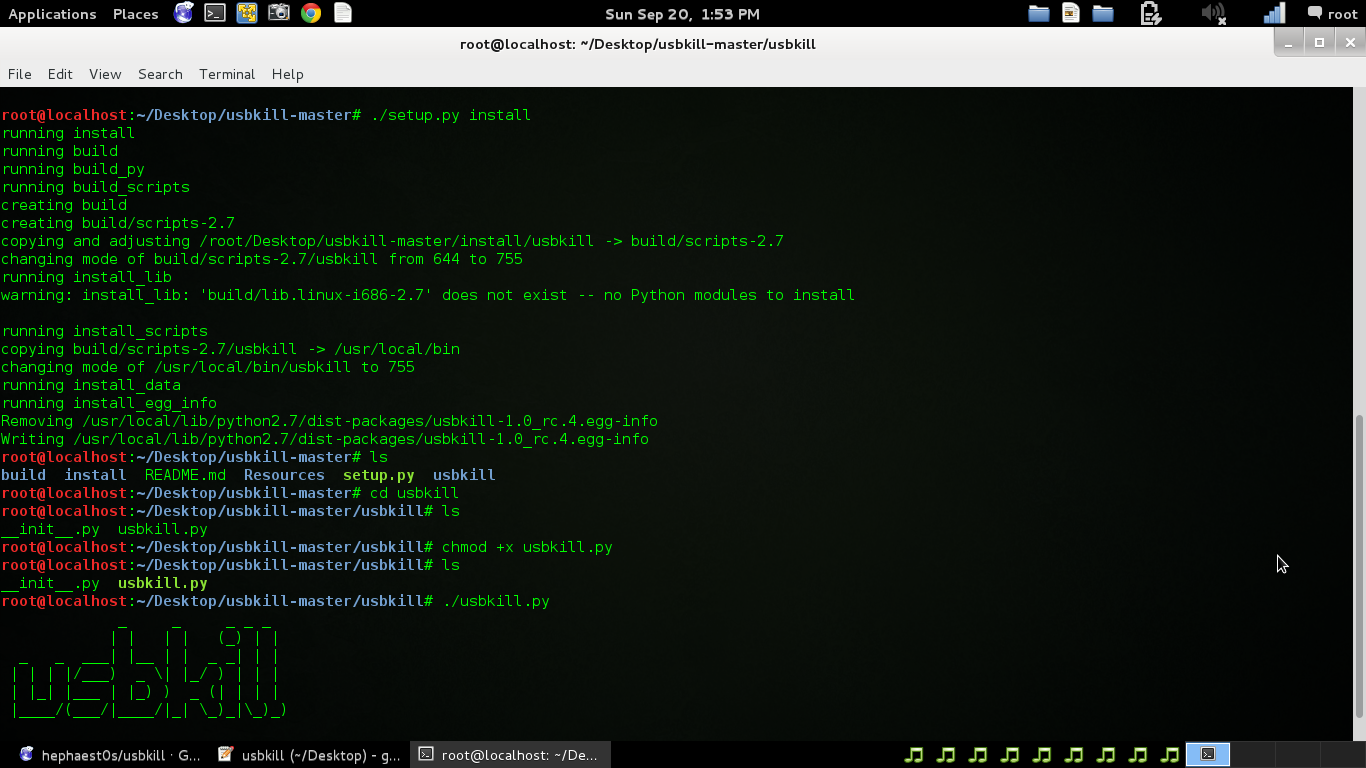
In response to the circumstances of Ulbricht's arrest,[4] a programmer known as Hephaest0s developed the USBKill code in Python and uploaded it to GitHub in 2014. It is available as free software under the GNU General Public License and currently runs under both Linux and OS X.[4]

The program, when installed, prompts the user to create a whitelist of devices that are allowed to connect to the computer via its USB ports, which it checks at an adjustable sample rate. The user may also choose what actions the computer will take if it detects a USB device not on the whitelist (by default, it shuts down and erases data from the RAM and swap file). Users need to be logged in as root. Hephaest0s cautions users that they must be using at least partial disk encryption along with USBKill to fully prevent attackers from gaining access;[4] Gizmodo suggests using a virtual machine that will not be present when the computer reboots.[8]

It can also be used in reverse, with a whitelisted flash drive in the USB port attached to the user's wrist via a lanyard serving as a key. In this instance, if the flash drive is forcibly removed, the program will initiate the desired routines. "[It] is designed to do one thing," wrote Aaron Grothe in a short article on USBKill in 2600, "and it does it pretty well." As a further precaution, he suggests users rename it to something innocuous once they have loaded it on their computers, in case someone might be looking for it on a seized computer to disable it.[6]

In addition to its designed purpose, Hephaest0s suggests other uses unconnected to a user's desire to frustrate police and prosecutors. As part of a general security regimen, it could be used to prevent the surreptitious installation of malware or spyware on, or copying of files from, a protected computer. It is also recommended for general use as part of a robust security practice, even when there are no threats to be feared.[4]

Variations and modifications

[edit]

With his 2600 article, Grothe shared a patch that included a feature that allowed the program to shut down a network when a non-whitelisted USB is inserted into any terminal.[6] Nate Brune, another programmer, created Silk Guardian, a version of USBKill that takes the form of a loadable kernel module, thus "[remaking] this project as a Linux kernel driver for fun and to learn."[9] In the issue of 2600 following Grothe's article, another writer, going by the name Jack D. Ripper, explained how Ninja OS, an operating system designed for live flash drives, handles the issue: it uses a watchdog timer, in the form of a memory-resident bash script, that cycles a loop through the boot device (i.e., the flash drive) three times per second to see if it is still mounted, and reboots the computer if it is not.[10]

See also

[edit]

References

[edit]
[edit]
Revisions and contributorsEdit on WikipediaRead on Wikipedia
from Grokipedia
usbkill is an open-source anti-forensic kill-switch software that monitors USB ports for hardware changes and triggers an immediate system shutdown to prevent unauthorized data access. Written in Python, it targets , BSD, and OS X operating systems, executing configurable actions such as wiping RAM or swap space upon detection of USB insertion or removal. Developed by the pseudonymous creator hephaest0s, the tool addresses vulnerabilities like those exploited by USB Rubber Ducky devices used in rapid data extraction during physical seizures. Key features include a customizable check interval (default 250 ms), USB device whitelisting to avoid false triggers, and compatibility with full-disk encryption setups to enable secure hibernation or data sanitization. Hosted on with over 4,500 stars, usbkill emphasizes user-configurable defenses against forensic recovery, such as melting the program itself on shutdown and optional integration with secure-delete utilities for file erasure. While intended for privacy protection, its deployment raises considerations of potential misuse in evading lawful investigations, though its primary design prioritizes rapid, non-reversible denial of access to encrypted data.

History

Origins and Conception

USBKill was conceived as an anti-forensic tool to mitigate risks associated with physical seizure of devices containing sensitive , particularly in scenarios involving raids or where an unlocked system could be accessed before or wiping measures activate. The software addresses vulnerabilities exploited by tactics such as mouse jigglers to prevent screensaver lockouts or unauthorized USB insertions for , enabling rapid system shutdown triggered by monitored USB port changes, such as the removal of a tethered USB key worn by the user. This design draws from first-hand awareness of cases where authorities confiscated operational laptops, underscoring the need for hardware-independent, software-based kill switches compatible with full-disk setups. The project originated from the efforts of an anonymous developer operating under the pseudonym Hephaest0s, who implemented it in Python for cross-platform use on , BSD, and OS X systems. Development focused on lightweight monitoring of USB device states at configurable intervals (defaulting to 250 milliseconds) to detect insertions or removals, followed by customizable actions like immediate power-off, RAM and swap wiping via tools such as secure-delete, and optional whitelisting of trusted devices. Hephaest0s emphasized its utility for high-risk environments, such as encrypted servers on low-power devices like , where physical access threats are elevated. The initial public release occurred via on May 9, 2015, marking the first commit and establishing usbkill as an open-source repository under no explicit license but with disclaimers urging users to pair it with robust for . Early highlighted its non-destructive nature—merely halting operations to thwart forensic recovery—while cautioning against reliance without complementary layers, reflecting a pragmatic approach to causal threats in adversarial settings. Subsequent announcements, such as in security blogs around mid-2015, positioned it as a defensive rather than an offensive tool, aligning with its core conception as a privacy-preserving emergency protocol.

Key Developments and Milestones

The USBKill device emerged from prototypes developed in , with early testing demonstrating its ability to disable laptops and other hardware via USB port surges. Commercial availability began in mid-2016, when the Hong Kong-based manufacturer released the initial model as an (ESD) testing tool for penetration testers and security professionals. In January 2017, USBKILL.com introduced the V3 iteration, incorporating feedback from the community to enhance discharge reliability and speed; it was offered in two variants—an anonymous black casing for discreet use and a branded version. This update maintained compatibility with standard USB-A ports while improving surge repetition rates to overwhelm target devices more effectively. The most significant advancement occurred on September 15, 2020, with the announcement of the V4 series, which featured a complete architectural overhaul for greater stability, higher discharge voltages, and expanded trigger options including timed, remote, and magnetic modes. The V4 lineup included Basic, Pro, and Classic editions tailored to different user needs, such as offline attacks or application-integrated controls, and incorporated an internal for prolonged dormancy. These developments solidified USBKill's role in hardware , with documented success against desktops, servers, and legacy USB-A equipped laptops.

Technical Mechanism

Electrical Principles and Operation

The USBKill device functions by harvesting electrical power from the host's USB port VBUS line, which provides approximately 5 volts DC at currents of 1 to 3 amperes, and employing an internal voltage multiplication process to generate a high negative DC potential of around -200 to -240 volts. This step-up occurs via a circuit that accumulates charge in capacitors, enabling the device to store sufficient energy for destructive output without external power sources in basic configurations. Upon reaching the target voltage and activation—via manual button, timer, motion sensor, or other triggers in V4 models—the capacitors discharge their stored energy as rapid pulses directly into the host's USB data lines (D+ and D-), overwhelming ESD protection diodes, MOSFETs, and integrated circuits connected to the interface. This targeted delivery to data lines circumvents some VBUS-specific safeguards, such as fuses or TVS diodes optimized for power surges, propagating damage to upstream components like USB controllers and system motherboards. The operational cycle involves repeated charging from the host supply followed by discharges occurring multiple times per second in continuous mode, sustaining stress until the host circuitry fails catastrophically or the device is unplugged. In V4 variants, an integrated supports pre-charged "offline" discharges, allowing immediate high-voltage output without initial host power draw, which can evade detection in powered-off or low-power states. This mechanism exploits the USB standard's lack of mandatory high-voltage isolation on data paths, rendering unprotected ports vulnerable to irreversible breakdown via junction avalanche or .

Triggering and Delivery Modes

The USBKill device, particularly in its V4 Pro variant, supports multiple configurable trigger modes that determine the conditions under which the destructive electrical discharge is initiated. These modes are selected via the accompanying Android application or dedicated , allowing for flexibility in deployment scenarios such as penetration testing or forensic data protection. Classic mode activates the discharge immediately upon insertion into a USB port, relying on power drawn from the host device to initiate the attack without external intervention. Magnetic trigger mode employs a to detect proximity to a , such as the included covert ring accessory, enabling discreet activation by passing the magnet over the device after insertion. Timed attack mode schedules the discharge for a specific date and time, with the internal battery supporting dormancy for over 200 days without host power. Remote and smartphone-based triggers provide wireless control options for standoff operation. The remote trigger utilizes a dedicated USBKill Remote accessory, transmitting Bluetooth signals up to 100 meters to initiate a single or continuous attack, with the remote's battery enabling long-term standby. Smartphone trigger integrates with the USBKill V4 app on Android devices, allowing configuration and activation via , including options for single-device or multi-device targeting within range. These wireless modes require initial pairing and can be set for low-power sleep states to conserve energy post-insertion. Upon triggering, the device executes one of two primary delivery modes that dictate the nature of the electrical payload discharged into the host's USB data lines. Single mode delivers a one-time high-voltage surge, typically sufficient to overwhelm unprotected circuitry by shorting power lines through multiplied voltage from the internal bank. Continuous mode, in contrast, repeatedly cycles discharges at intervals configurable via the app, escalating damage potential against resilient hardware by sustaining stress until the host's power delivery is disrupted or the USBKill's battery depletes. Both modes leverage the device's offline battery for attacks on ports with power authentication, bypassing reliance on host-supplied voltage seen in earlier iterations. Configuration of delivery modes occurs pre- or post-insertion via app or remote, ensuring adaptability to target specifications.

Versions and Modifications

Early Iterations

The initial prototype of the , developed in March 2015 by Russian security researcher Dark Purple, featured a compact circuit board with a DC-DC converter, capacitors, and a (FET) to step up the USB port's 5V input into a -110V discharge pulse directed at the device's data lines, exploiting inadequate surge protection in . By October 2015, Dark Purple introduced version 2.0, which upgraded the design to deliver repeated -220V negative pulses—doubling the voltage of the prior model—for enhanced reliability in inducing hardware failure, as demonstrated in tests that rendered a X60 inoperable within seconds by overwhelming its circuitry. These prototypes prompted commercialization efforts; a Hong Kong engineering team, after the 2015 public disclosure, produced limited private units and refined three internal iterations focused on stability before launching their own Version 2.0 publicly around 2016, aiming to expose persistent USB vulnerabilities and urge manufacturers to implement robust (ESD) safeguards.

Advanced Models like V4

The USBKill V4, released on September 15, 2020, represents a complete hardware redesign from prior iterations, emphasizing enhanced performance, stability, and adaptability for professional . It delivers output voltages up to -215V, enabling more potent electrical discharges capable of overwhelming target device systems. Key advancements include an integrated rechargeable battery supporting offline mode operations, where discharges can occur without host power via 1Hz pulses of unlimited duration, facilitating scenarios like post-power-off attacks on dormant hardware. Available in three variants—Pro, Basic, and Classic—the V4 lineup tailors functionality to user needs while maintaining backward compatibility with USB standards. The Pro version introduces wireless control via , allowing remote triggering, configuration, and monitoring through a smartphone app, alongside multiple discharge modes (e.g., single , continuous, or timed sequences) and trigger options such as motion sensors or timed delays. The Basic variant focuses on core discharge capabilities without wireless features, prioritizing simplicity and cost-effectiveness, while the Classic retains a trigger-upon-insertion mechanism akin to earlier models but with upgraded voltage stability and reduced failure rates under load. All models incorporate improved covertness through smaller form factors and adaptive adapters for USB-A, , and other ports, ensuring broader device compatibility across laptops, tablets, and embedded systems. Testing demonstrates the V4's efficacy against modern hardware, including successful disruptions of power circuits in devices from manufacturers like Apple and since 2015, though outcomes vary by target safeguards such as fused ports. These models prioritize industrial reliability, with feedback-driven enhancements reducing operational inconsistencies reported in predecessors, such as inconsistent voltage delivery during extended use. Deployment kits often include modular components for customization, underscoring the V4's role in advanced penetration testing where precision and repeatability are paramount.

Applications and Uses

Legitimate Security Testing

USBKill devices are employed by penetration testers and cybersecurity professionals to evaluate vulnerabilities in hardware reliant on USB ports. Red teams, simulating adversarial attacks, use the device to disable mission-critical systems, thereby assessing organizational responses to sudden hardware failure and the effectiveness of access controls on unattended devices. This application underscores the risks of USB ports as entry points for destructive physical attacks, prompting organizations to implement stricter policies on peripheral connections. In controlled testing environments, USBKill serves as a tool for validating surge protection mechanisms in , including computers, servers, and mobile devices. teams deploy it to verify that systems withstand high-voltage discharges, often revealing that over 95% of unprotected USB-equipped devices suffer permanent damage from such surges. For instance, tests on desktops and servers demonstrate the device's utility in exposing inadequate shielding, enabling defenders to prioritize hardware hardening like inline fuses or port isolators. Law enforcement and ethical hackers further utilize USBKill to test "fail-to-open" protocols in secure facilities, where triggering a device can force behavioral shifts or simulate data destruction scenarios during seizures. Advanced models like the V4 allow timed or remote activation via mobile apps, facilitating realistic exercises that mimic insider threats or lost device exploitation without requiring constant physical access. Such testing has been documented in evaluations of USB-C ports on devices like the , highlighting persistent vulnerabilities despite evolving standards. These applications are conducted exclusively with explicit authorization to avoid legal repercussions, emphasizing USBKill's role in proactive risk mitigation rather than exploitation.

Forensic and Anti-Seizure Applications

The USBKill V4's advanced trigger modes, including remote activation via a dedicated controller up to 100 meters away, app control, timed attacks configurable for dormancy up to 200 days, and magnetic triggering, facilitate its deployment in scenarios aimed at preventing unauthorized access during potential device seizures. By installing the device in a host system and configuring it for delayed or conditional discharge, users can initiate hardware destruction—via high-voltage pulses into USB lines—to render storage controllers inoperable, such as damaging SSD interfaces or HDD platter mechanisms, thereby complicating forensic without relying on software alone. This physical impairment approach contrasts with wipes, as it targets persistent hardware failures that persist post-power cycle, though success varies by device protections like fused USB ports. In , USBKill serves and security professionals for testing the vulnerability of seized hardware to power surge exploits, simulating real-world attacks to assess recovery feasibility from damaged components. Investigators have documented characteristic artifacts from USBKill discharges, including anomalous voltage spikes in system event logs, charred USB port residues, and controller chip failures identifiable via or impedance testing, enabling attribution of damage to deliberate surge events rather than natural failure. Such aids in reconstructing timelines of anti-forensic actions, as the device's discharge leaves non-erased metadata on undamaged peripherals or , potentially revealing premeditated deployment intent. While not marketed explicitly for evading seizures, the V4's offline battery operation and configurable pulses (single: 5 discharges; continuous: until halted) support covert integration into sensitive systems, such as embedding in custom enclosures for remote detonation if physical custody is threatened. However, empirical tests indicate inconsistent data inaccessibility across targets—e.g., platter HDDs may retain recoverable platters post-controller failure, while SSDs often suffer total array loss—necessitating complementary measures like full-disk for robust protection. Forensic countermeasures include pre-seizure port isolation via blockers and post-incident chip-off recovery techniques, underscoring USBKill's role in highlighting systemic USB flaws rather than foolproof denial.

Risks, Misuse, and Controversies

Notable Incidents of Abuse

In April 2019, Sai Akuthota, a 27-year-old former student expelled from in , used a commercially available device to intentionally damage 66 items of computer equipment, including laptops, desktop computers, monitors, and digital podiums, across multiple campus buildings. The attacks occurred between October 2018 and March 2019, with Akuthota inserting the device into powered-on USB ports to discharge high-voltage surges, rendering the hardware inoperable; he recorded videos of the acts, verbally expressing intent to "kill" the targeted machines. The total damage amounted to $58,471, as assessed by the college's IT department. Akuthota pleaded guilty to charges of criminal possession of computer equipment and petit in Albany County Court, agreeing to full restitution of the damages as part of the plea deal; he faced potential but sentencing details emphasized repayment over incarceration. This incident highlighted the device's —purchased online for under $50—and its potential for targeted sabotage by disgruntled individuals, prompting discussions on for institutional hardware. No other widely documented cases of hardware deployment in criminal have been reported in reputable sources, though the device's design has raised concerns about analogous misuse in adversarial contexts. The distribution and use of USBKill devices have prompted ethical debates centered on the tension between promoting awareness and enabling potential harm. Proponents, including the device's creators, argue that openly demonstrating USB vulnerabilities through tools like USBKill encourages manufacturers to implement better surge protection, akin to responsible disclosure practices in software security. However, critics contend that making high-voltage destruction accessible via inexpensive, portable hardware lowers barriers to and targeted , potentially incentivizing malicious actors over defensive improvements. Legally, possession and purchase of USBKill remain permissible in most jurisdictions, as the devices are marketed for legitimate penetration testing and no widespread bans exist on ownership for personal or professional use on consenting systems. Use against non-owned equipment, however, constitutes criminal damage to property; a notable case occurred in April 2019 when a former student at in , pleaded guilty to destroying approximately 66 university computers valued at $58,000 using a device, resulting in charges and restitution. In anti-forensic contexts, deploying USBKill to prevent data seizure by authorities raises further legal questions, potentially intersecting with obstruction of justice statutes, though no specific precedents directly prohibiting such defensive use on personal devices have been widely reported. Security discussions highlight USBKill's role in exposing a fundamental flaw: many devices lack inherent protection in USB interfaces, allowing physical access to cause irreversible damage to components like motherboards and power circuits. This has fueled arguments for standardized hardware safeguards, such as active voltage clamping, but also underscores limitations—effectiveness requires close physical proximity, rendering it impractical for remote threats while amplifying risks in scenarios like inspections or recovery. Debates persist on whether such tools enhance overall resilience by simulating insider attacks or erode trust in USB ecosystems by demonstrating persistent, low-tech vulnerabilities despite decades of awareness.

Countermeasures and Protections

Hardware and Firmware Safeguards

Modern USB implementations incorporate overcurrent protection on the VBUS line, typically using polymeric positive temperature coefficient (PTC) devices or electronic fuses that detect excessive current—such as from a VBUS-to-ground short—and automatically limit or interrupt power delivery to prevent damage to the port controller or downstream components. These mechanisms comply with USB specifications requiring host ports to provide up to 500 mA (USB 2.0) or 900 mA () with safeguards against faults, rendering many basic USBKill short-circuit modes ineffective on compliant hardware. Data lines (D+ and D-) are commonly protected by transient voltage suppressor (TVS) diodes or low-capacitance diode arrays, which clamp overvoltages and shunt ESD or surge energy to ground, diverting high-voltage discharges from reaching sensitive transceivers. However, these components, often rated for IEC 61000-4-2 ESD levels up to 15 kV contact discharge, may be overwhelmed by the sustained high-energy pulses (e.g., -220 V at several amperes) generated by devices, potentially leading to partial or complete failure if not augmented with higher-energy-rated protectors. External hardware mitigations include inline surge protectors, such as the USBKill Shield, which insert between the USB cable and port to monitor for anomalous voltage spikes, block malicious discharges via internal circuitry, and signal detection with an LED while permitting normal 5 V charging. Additional modifications, like adding high-power Zener diodes across lines to clamp voltages above 5.1 V or employing galvanic isolators for bidirectional signal separation, can enhance resilience but require custom integration and may introduce latency or compatibility issues. Firmware-based safeguards offer limited defense against physical surges, as USB controller primarily manages enumeration, power negotiation, and port enabling rather than real-time hardware fault isolation. UEFI/BIOS settings can disable unused USB ports or legacy support to reduce exposure vectors, but insertion of a USBKill device bypasses these by triggering damage before intervention. In specialized embedded systems, watchdogs might monitor port currents via integrated sensors and trigger power cutoffs, though this remains uncommon in consumer hardware.

Best Practices for Mitigation

Mitigating the threat posed by devices, which exploit physical access to USB ports to deliver destructive electrical surges, primarily involves operational and procedural measures to prevent unauthorized insertions, as software-based defenses cannot interrupt the hardware-level power discharge. Organizations should implement strict policies prohibiting the insertion of any unverified or unknown USB devices into workstations or servers, coupled with enforcement through access logs and disciplinary actions for violations. Physical barriers such as USB port caps, locks, or blockers provide a low-cost, effective deterrent by rendering ports inaccessible without legitimate tools or keys, thereby eliminating the insertion vector in unattended or shared environments. These measures are particularly recommended for high-value assets, where ports can be capped when not in use for authorized peripherals. Employee programs must emphasize of USBKill risks, instructing personnel to treat all unsolicited or found USB devices as potential threats and to them without insertion, as may such devices to bypass vigilance. Regular simulations or exercises simulating USB drop attacks can reinforce this, reducing accidental or coerced insertions. In environments requiring USB functionality, procedural controls like centralized device approval processes—where only whitelisted, inspected peripherals are permitted—and routine physical inspections of equipment can further minimize exposure, though these must be paired with broader to deny adversaries brief access windows. For portable devices, best practices include never leaving them unattended in public or unsecured areas and avoiding connections to untrusted charging stations, which could facilitate surreptitious swaps. While no procedural measure guarantees absolute protection against determined physical attacks, these practices collectively raise the bar by prioritizing denial of opportunity over reactive defenses.

Impact and Reception

Exposure of Vulnerabilities

The USBKill device exposes fundamental hardware vulnerabilities in USB interfaces, primarily the lack of robust and surge protection mechanisms that allow malicious devices to exploit the standard 5V for destructive discharges. By charging internal capacitors from the host device's USB port and then releasing high-voltage pulses (typically up to 220V negative or positive spikes) into the lines (D+ and D-) or VBUS line, USBKill demonstrates how unprotected ports can suffer immediate component , such as blown fuses, damaged controllers, or fried motherboards, without any software mediation. This stems from the USB specification's design assumption of benign peripherals, which does not mandate sufficient hardware safeguards against adversarial power manipulation, rendering billions of devices susceptible to physical via a simple plug-in attack. Testing with USBKill variants, such as the V3 and V4 models, has repeatedly shown high failure rates across , including flagship smartphones. For instance, the and were destroyed in seconds when connected, highlighting deficiencies even in devices with advanced implementations that rely on protocol-level authentication rather than low-level electrical isolation. Similarly, the proved vulnerable to USBKill V4 Professional tests, where custom adapters bypassed power delivery negotiation, confirming that authentication schemes like those in Apple's ecosystem do not fully mitigate raw electrical attacks on exposed ports. These demonstrations underscore a broader systemic issue: many USB hosts, from laptops to embedded systems, incorporate minimal transient voltage suppression (TVS) diodes or fuses that are easily overwhelmed by repeated or amplified pulses, as evidenced by USBKill's tracked test results on over hundreds of device models spanning industries. Beyond immediate destruction, USBKill reveals cascading risks in supply-chain and contexts, where attackers could deploy disguised devices to disable without relying on exploitable or . This has prompted recognition in penetration testing communities that USB ports represent a "trusted interface" blind spot, often unprotected against hardware Trojans that exploit power asymmetry—hosts supply power unidirectionally without verifying peripheral intent. While some enterprise hardware incorporates enhanced ESD () protection rated for higher joule , consumer-grade implementations frequently fall short, as USBKill's consistent success rates in independent validations illustrate the gap between USB standards (e.g., USB-IF compliance) and real-world adversarial resilience. The USBKill hardware devices, primarily used for USB port , have gained adoption among penetration testers, hardware manufacturers, agencies, and industrial clients as a standard tool for simulating power surge attacks. This niche market reflects broader security industry awareness of physical USB vulnerabilities, though quantitative adoption metrics remain limited due to the specialized nature of the product. The Hong Kong-based company behind USBKill operates amid 16 competitors as of June 2025, holding a fifth-place ranking in terms of activity and visibility. Ongoing hardware developments center on the USBKill V4 model, which enhances discharge voltage multiplication for more effective testing across data lines, available in kit and professional configurations for custom assembly. The associated open-source software variant, usbkill, persists on with community forks adapting it for platforms like , enabling USB-triggered shutdowns without physical damage. Emerging alternatives, such as —a hardware kill cord for laptops—demonstrate parallel innovation, with its v0.7.0 release in July 2023 adding soft-shutdown triggers, fixes, and broader OS compatibility to reduce risks in anti-forensic scenarios. These developments underscore a trend toward refined, less destructive tools in response to ethical concerns over hardware-killing devices, though USBKill maintains a focus on aggressive for vulnerability exposure.

References

Add your contribution
Related Hubs
Contribute something
User Avatar
No comments yet.