Hubbry Logo
Union BuildingsUnion BuildingsMain
Open search
Union Buildings
Community hub
Union Buildings
logo
8 pages, 0 posts
0 subscribers
Be the first to start a discussion here.
Union Buildings
Union Buildings
from Wikipedia

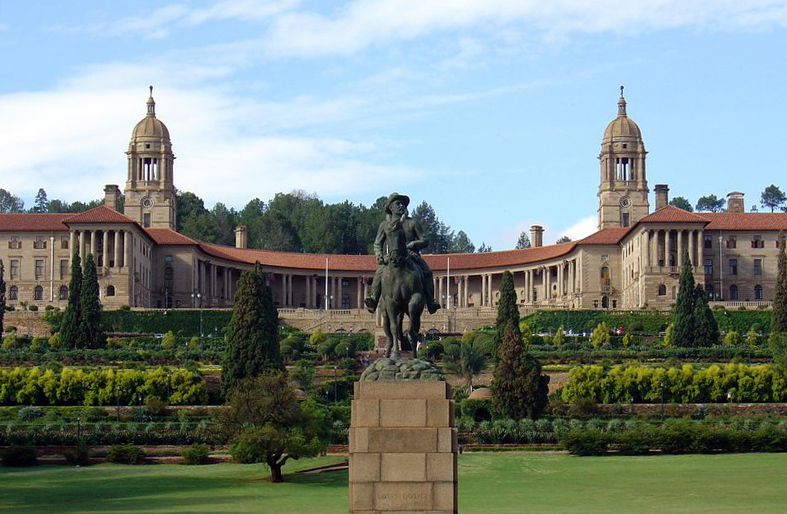
The Union Buildings (Afrikaans: Uniegebou) form the official seat of the South African Government and also house the offices of the President of South Africa. The imposing buildings are located in Pretoria, atop Meintjeskop at the northern end of Arcadia, close to historic Church Square. The large gardens of the Buildings are nestled between Government Avenue, Vermeulen Street East, Church Street, the R104 and Blackwood Street. Fairview Avenue is a closed road through which only officials can enter the Union Buildings.[3] Though not in the centre of Pretoria, the Union Buildings occupy the highest point of Pretoria, and constitute a South African national heritage site.[4][5]

Key Information

The Buildings are one of the centres of political life in South Africa; "The Buildings" and "Arcadia" have become metonyms for the South African government. It has become an iconic landmark of Pretoria and South Africa in general, and is one of the most popular tourist attractions in the city and an emblem of democracy.

The Buildings are the location of presidential inaugurations.

Architecture

[edit]
The eastern wing of The Union Buildings represents the English population of South Africa

These buildings, built from light sandstone, were designed by the architect Sir Herbert Baker[6] in the English monumental style and are 285 m long. They have a semi-circular shape, with the two wings at the sides, this serves to represent the union of a formerly divided people.[7] The clock chimes are identical to those of Big Ben in London.[8] The east and west wings, as well as the twin-domed towers, represent two languages, English and Afrikaans, and the inner court was designed and built to symbolise the Union of South Africa.[9] These buildings are considered by many to be the architect's greatest achievement and a South African architectural masterpiece. The Nelson Mandela statue in Sandton City's Nelson Mandela Square was commissioned originally to stand on the spot where Nelson Mandela gave his inaugural address.[10]

The building was sited on a disused quarry, which now makes up the amphitheatre. The matching statues on top of the domed towers are Atlas, holding up the world, sculpted by Abraham Broadbent. The statue on the domed rostrum in the amphitheatre between the wings is Mercury, a mythic Roman messenger and a god of trade, sculpted by George Ness. The closest suburb to the Union Buildings is Arcadia, which is named after the classical idealisation of the ancient Greek region of the same name . Pretoria has the second largest number of embassies in the world, after Washington, D.C., most of which are located in or near Arcadia.

View from the gardens

The design of each level differs, and therefore each stone had to be individually cut. The Architectural styles of the building ranges from the lower levels' Edwardian style to the top levels' Cape Dutch design with shutters on the windows. The windows from bottom to top are elongated and become shorter towards the top floor. This is to give the illusion of height.

The Union Buildings are the site of presidential inaugurations. The official offices of the president are on the left-hand side of the Union Buildings, and the South African national flag is flown on the left-hand side if the president is in office.[11]

The Buildings are divided into three sections; the left offices, amphitheatre, and right offices. All are 95 metres in length. Each office block contains three inner courtyards providing light and air to the offices. Each block has a basement and three floors above ground. The central curved building behind the colonnade houses the committee rooms, a library and conference rooms while the basement contains the kitchen, dining rooms and lounges.

The interior is treated in the Cape Dutch style: carved teak fanlights, heavy doors, dark ceiling beams contrasting with white plaster walls and heavy wood furniture.[12]

History

[edit]
Circa 1925

The Boer Republics of the ZAR and the Orange Free State were united with the Cape Colony and Natal Colony in 1910 to become the Union of South Africa. Pretoria then became the administrative capital of the whole of South Africa, with Cape Town the legislative capital. Between 1860 and 1994, the city was also the capital of the province of Transvaal, superseding Potchefstroom in that role. The new Union required a governmental building which could signify unity and host the new government.

Marthinus Wessel Pretorius, later to become first president of the Transvaal Republic, was the original owner of the farm 'Elandsfontein' on which Meintjieskop stands. In 1856 Andries Francois du Toit (1813–1883), in exchange for a Basotho pony, acquired part of the farm, which he named 'Arcadia' and on which the Union Buildings were later constructed.[13] He was also Pretoria's first magistrate and was responsible for the layout of the city. During this period he sold his land to Stephanus Jacobus Meintjies (1819–1887), after whom the hill is named.

In 1909 Herbert Baker was commissioned to design the Government Building of the Union of South Africa (which was formed on 31 May 1910) in Pretoria. Pretoria was to become the administrative centre for the new government. In November 1910 the cornerstone of the Union Buildings was laid.

Lord Selborne and Henry Charles Hull, a member of the first Union Cabinet, chose Meintjieskop as the site for Baker's design.[13] The site was that of a disused quarry and the existing excavations were used to create the amphitheatre, which was set about with ornamental pools, fountains, sculptures, balustrades, and trees.

The design consisted of two identical wings, joined by a semi-circular colonnade forming the backdrop of the amphitheatre. The colonnade was terminated on either side by a tower. Each wing had a basement and three floors above ground. The interiors were created in the Cape Dutch style with carved teak fanlights, heavy doors, dark ceiling beams contrasting with white plaster walls and heavy wood furniture. Baker used indigenous materials as far as possible. The granite was quarried on site while Buiskop sandstone was used for the courtyards. Stinkwood and Rhodesian teak were used for timber and wood panelling. The roof tiles and quarry tiles for the floors were made in Vereeniging.

The cornerstone was laid in November 1910, shortly after the Union of South Africa – for which the buildings are named – was formed. Taking 1,265 workers over three years to build, the structure was completed in 1913 at a total cost of £1,310,640 for the building and £350,000 for the site.

Designed by Sir Herbert Baker in 1908, building began in 1909 and was completed in 1913. It took approximately 1,265 artisans, workmen and labourers almost three years to construct, using 14 million bricks for the interior office walls, 5,000,000 cubic feet (140,000 m3) of freestone, 74,000 cubic yards (57,000 m3) of concrete, 40 000 bags of cement and 20,000 cubic feet (570 m3) of granite.

Originally built to house the entire Public Service for the Union of South Africa, it was then the largest building in the country and possibly the largest building work undertaken in the Southern Hemisphere at that time.

Several other sites were considered, including Muckleneuk Ridge, on the opposite side of the city, and Pretorius Square, in the centre of Pretoria, where the City Hall now stands. However, Herbert Baker was strongly in favour of Meintjieskop, which was within 1.6 kilometres of the centre of Pretoria and reminded him strongly of some of the acropolises of Greece and Asia Minor, where he had studied Mediterranean architecture.

The concept of an acropolis and a building that agreed with renowned British Architect Sir Christopher Wren's theory that a public building should be a national ornament which establishes a nation, draws people and commerce and makes people love their country easily persuaded the then powers that be, who were at the time, preoccupied with the ideal of establishing a new and united nation.

The British high commissioner at the time, Lord Selborne, remarked;

People will come from all over the world to wonder at the beauty of the site and to admire the forethought and courage of the men who selected it.

Historic naval gun outside the buildings

The design of the buildings was largely determined by the nature of the site. Baker envisaged identical wings of rectangular office blocks, each representing one of the two official languages. They were to be linked by a semicircular wing, and the space in-between the two wings was levelled to form an amphitheatre as in the Greek fashion for gatherings of national and ceremonial importance.

Baker wanted the buildings to be built of imported granite, but any idea of using anything but South African stone for the most important government building of the new state was unthinkable to those who commissioned it, as a result, the terraces and retaining walls in the grounds are built predominantly of mountain stone quarried on site, the foundation of the building is of granite, while freestone was used for the exterior walls, the amphitheatre and major courtyards.

For the overall design of the building, Baker chose the neo-classic architecture of the Italian Renaissance, and also combined an idiom of the English Renaissance, as well as significant elements of Cape Dutch detail, such as in the carved main doorways and fanlights and in much of the wrought-iron brass work and balustrades of the smaller areas.

Historical events

[edit]

On 9 August 1956, 20,000 women marched to the doors of the Union Buildings, chanting "Wathint' Abafazi, wathint' imbokodo!" which means "strike the women, strike the rock", to protest against the pass laws of 1950. This historical event is commemorated by the public holiday National Women's Day.

Wilma Cruise and Marcus Holmes were approached to design a memorial to commemorate the Women's March. They made use of the "imbokodo". The imbokodo is a grinding stone used by the women to grind maize. Cruise and Holmes rested the imbokodo, representing nurture and sustenance, on bronze plates, representing the earth and fire. There are two sets of stairs leading to the memorial. On each step, raised in bronze letters are the words from 'The Demand of the Women of South Africa for the Withdrawal of Passes for Women and Repeal of the Pass Laws.' On approaching the imbokodo, visitors trigger infrared beams, which activate history's "whispered voices", echoed in all 11 official languages, the rally cry, repeated softly.[14]

In 1986, significant restoration of the Union Buildings was undertaken by Johan de Ridder and T.W. Baker as the appointed architects.[15]

On 10 May 1994, the inauguration of Nelson Mandela, South Africa's first democratically elected president after the end of Apartheid, and his vice-presidents, heralded the beginning of a new era in South Africa's history.[6][16]

Part of Nelson Mandela's inaugural address:

"Today, all of us do, by our presence here, and by our celebrations in other parts of our country and the world, confer glory and hope to newborn liberty.

Out of the experience of an extraordinary human disaster that lasted too long, must be born a society of which all humanity will be proud.

Our daily deeds as ordinary South Africans must produce an actual South African reality that will reinforce humanity's belief in justice, strengthen its confidence in the nobility of the human soul and sustain all our hopes for a glorious life for all.

All this we owe both to ourselves and to the peoples of the world who are so well represented here today. ....... We understand it still that there is no easy road to freedom.

We know it well that none of us acting alone can achieve success.

We must therefore act together as a united people, for national reconciliation, for nation building, for the birth of a new world.

Let there be justice for all.

Let there be peace for all.

Let there be work, bread, water and salt for all.

Let each know that for each the body, the mind and the soul have been freed to fulfill themselves.

Never, never and never again shall it be that this beautiful land will again experience the oppression of one by another and suffer the indignity of being the skunk of the world.

Let freedom reign.

The sun shall never set on so glorious a human achievement!

Let us as a Rainbow nation keep this in focus and move forward!"

On 31 December 1999 the South African flagship Millennium celebration was held here. In attendance was the then deputy president Jacob Zuma, and other ministers.

On 10 December 2013, the Union Buildings Amphitheatre was renamed the Nelson Mandela Amphitheatre.[17]

On 16 December 2013, a 9-metre high bronze statue of Mandela was unveiled at the Union Buildings.[18]

Gardens and grounds

[edit]
The terraced gardens

The building is surrounded by beautifully terraced gardens of indigenous plants. Various monuments adorn the expansive lawns, including the Delville Wood War Memorial and a statue of the country's first Prime Minister, General The Rt Hon. Louis Botha. The lawn in front of the Union Buildings is often the location for public gatherings, whether they be protest or celebration, such as the presidential inauguration.[19]

Notable are the terraced gardens, planted exclusively with indigenous plants, surrounding the buildings as well as the 9,000 seat Nelson Mandela amphitheatre.

Statues and memorials

[edit]

Within the grounds are various monuments, statues and memorials. Starting at the bottom of the gardens, a large statue of General Louis Botha (first prime minister of the Union of South Africa) on horseback dominates the lawn. About halfway up the terraces, the Delville Wood War Memorial is a tribute to South African troops who died during the First World War as well as a plaque in memory of those that died during the Korean War.

Two levels above that is a statue of President Nelson Mandela. This replaced the statue of General J.B.M. Hertzog, a former Prime Minister, which can still be found on the grounds.

The South African Police Memorial is located at the top right of the gardens.

The South African National Film, Video and Sound Archives is also located in the grounds of the Union Buildings, adjacent to the Police Memorial.

Laws governing the buildings

[edit]

Because of the significance of the Voortrekker Monument and the Union Buildings in the national consciousness, a law in Pretoria limits the height of any building between the Voortrekker Monument and the Union Buildings such that the view between them remains unobstructed.[20]

Powers and duties

[edit]

The Union Buildings share duties with Cape Town as the seat of the South African Government. Pretoria shares duties with Cape Town and Bloemfontein as the capital cities of South Africa.

The official seats of the President are the Union Buildings in Pretoria and the Tuynhuys in Cape Town.

[edit]
The Union Buildings at Sunrise

See also

[edit]

References

[edit]
[edit]
Revisions and contributorsEdit on WikipediaRead on Wikipedia
from Grokipedia
The Union Buildings (Afrikaans: Uniegebou) are the official seat of the South African government, housing the offices of the President and serving as the administrative headquarters in atop Meintjieskop hill. Designed by British architect , construction commenced in 1909 and concluded in 1913 after employing 1,265 workers to erect the structure from local light in an Edwardian classical style blending , , and influences. The semicircular complex, approximately 275 meters long, consists of two symmetrical wings—originally representing the English and Afrikaans components of the Union—connected by a central colonnade, symbolizing the political reconciliation following the Anglo-Boer Wars and the formation of the Union of South Africa in 1910. Overlooking terraced gardens and an amphitheater with capacity for 9,000, the site has hosted pivotal events such as the 1956 Women's March against apartheid laws and Nelson Mandela's 1994 presidential inauguration, underscoring its enduring role in national governance and heritage as a declared National Heritage Site since 2013.

Overview and Significance

Location and Physical Description

The Union Buildings are situated atop Meintjieskop, a prominent hill in , the administrative capital of , within the province. The site lies at the northern end of the Arcadia suburb, at coordinates approximately 25°44′ S latitude and 28°12′ E longitude, providing elevated vantage points over the surrounding urban and nearby landmarks such as Church Square. This positioning at roughly 1,370 meters above enhances the complex's commanding presence. Physically, the Union Buildings form a sprawling U-shaped complex, consisting of two elongated east and west wings linked by a semi-circular colonnaded that serves as a central gathering space. The structure measures approximately 285 meters in length, with a width of about 100 meters across the wings and a height reaching up to 60 meters at key points. Constructed primarily from locally quarried light-colored sandstone, the buildings exhibit a rugged yet elegant texture, complemented by granite plinths and detailed stonework that withstands the local climate. The design emphasizes symmetry and grandeur, with terraced gardens and pathways integrating the architecture into the hillside terrain.

Governmental Role and Symbolic Importance

The Union Buildings function as the official administrative seat of the South African government, housing the offices of the President and key executive departments. Situated on Meintjieskop hill in , they were designated the administrative capital under the 1910 arrangements, separating executive functions from the legislative seat in and the judicial capital in . This division persists today, with the buildings serving primarily for presidential administration rather than parliamentary sessions or judicial proceedings. Architecturally, the site's layout underscores its governmental centrality, occupying 1.2 square kilometers at Pretoria's highest elevation, symbolizing authority and oversight. The complex was originally intended to accommodate the entire Union public service, reflecting the centralized executive power established post-1910. In practice, it hosts daily operations of the , including policy formulation and national ceremonies, while maintaining security protocols befitting its role as the executive nerve center. Symbolically, the Union Buildings embody the 1910 political unification of the British colonies and , with the east and west wings representing the English- and Afrikaans-speaking white communities, and the central signifying their . This design intent, rooted in the era's colonial imperatives, has endured as a marker of South African statehood, though its original exclusionary focus on white unity drew later critique amid broader societal shifts. Post-1994, the site gained layered significance through events like the 1956 Women's March against pass laws and Nelson Mandela's 1994 as the first post-apartheid president on its steps, transforming it into a venue for democratic milestones and national reconciliation narratives. Today, it stands as a declared national heritage site, evoking both historical continuity and contested legacies of governance.

Architectural Design

Designer, Influences, and Style

The Union Buildings were designed by British architect Sir Herbert Baker, who received the commission in 1909 from the Union of 's first prime minister, , and his deputy, , to create a grand administrative complex symbolizing national unity. Baker, already established in through earlier projects like the in , envisioned a structure that would embody imperial stability and democratic aspiration on the Meintjieskop ridge. Construction drew on Baker's prior experience adapting classical forms to rugged terrains, with the design finalized by 1910 to accommodate both English and administrative functions in separate wings. Baker's influences stemmed primarily from his 1905 travels in , where he sketched palazzos, villas, and terraced landscapes that informed the Union Buildings' elevated siting, symmetrical composition, and cascading colonnades. These drew from precedents like in for the robust, rusticated bases and grand proportions, adapted to convey hierarchy and permanence amid Pretoria's koppies. Additional imperial motifs reflected Baker's collaboration with contemporaries like , incorporating English elements such as domed pavilions to evoke British dominion while prioritizing local granite for authenticity. The overall style is neo-Classical Revival with Italian Renaissance undertones, featuring pedimented porticos, Corinthian columns, and a semi-circular facade that prioritizes and monumental scale over ornamentation. This approach contrasted with more eclectic Victorian modes, emphasizing first-principles of proportion and site integration to foster a sense of enduring , though critics later noted its hierarchical layout reinforced colonial authority. Baker's execution balanced formalism with landscape harmony, using indigenous materials to mitigate the style's European origins against South Africa's .

Key Structural Features and Materials


The Union Buildings consist of two identical rectangular office wings linked by a semicircular that forms a central designed for public gatherings, reflecting the union of South Africa's former colonies. This semi-circular layout spans over 275 meters in length, with the wings symbolizing the English and components of the nation. The structure incorporates in Greek fashion, deep-set loggias, and raked seating in the , emphasizing both administrative functionality and ceremonial space.
Construction utilized extensive local materials, including 500,000 cubic feet of freestone—primarily light sandstone quarried across —for the exterior walls, despite architect Herbert Baker's preference for imported . Foundations employed 20,000 cubic feet of , while terraces and retaining walls used mountain stone quarried on-site at Meintjeskop. Interior walls comprised 14 million bricks, supported by 74,000 cubic yards of and 40,000 bags of . Timber for woodwork and paneling was sourced from Rhodesian forests, and roofing tiles manufactured in . Key elements like the columns in the central loggias and various vaults were produced using the most advanced machinery available in , highlighting the building's sophistication. Fountains and carved doorways with fanlights and wrought-iron work further adorn the neoclassical , blending durability with ornamental detail.

Construction and Early History

Commissioning, Planning, and Funding

The Union Buildings were commissioned in 1909 by the Transvaal government to British architect Sir to serve as the central administrative offices for the , formed on May 31, 1910, following the unification of the , Natal, Transvaal, and . The project was politically motivated, with leaders and directing the commission to symbolize national reconciliation between Boer and British elements while bolstering Botha's position as the first of the Union. Baker, who had previously designed structures in such as the railway station, was selected due to his experience with imperial and colonial architecture in . Planning commenced with site selection in 1908, when identified Meintjeskop—a hill overlooking —for its strategic elevation, natural defenses, and potential to evoke an acropolis-like prominence, rejecting alternatives like Muckleneuk Ridge. By 1909, the site on Meintjes Kopje was finalized with input from General Smuts and Lord Selborne, despite objections over its exposure to northern winds. 's designs, blending , Italianate, and influences, featured two office wings representing the former British and , connected by a semicircular for ceremonial unity; plans were submitted to the Minister of for cabinet approval, with the laid on November 26, 1910, by the Duke of Connaught. Funding derived from the Transvaal government's residual budget, with its final pre-Union allocation of approximately £1.5 million dedicated to the project as a legacy act. The overall cost totaled £1,310,640 for and £350,000 for site acquisition and preparation, sourced through appropriations under the Department of Public Works. Early planning expenses included £10,000 approved in November 1909 for site leveling, road access, and initial groundwork, reflecting the transitional fiscal priorities ahead of Union consolidation.

Building Process and Completion (1910–1913)

The cornerstone of the Union Buildings was laid on 26 November 1910 by the Duke of Connaught, marking the formal start of construction on Meintjieskop in Pretoria. The project proceeded under the oversight of the Public Works Department, with contractors including Meischke Brothers for the two main office blocks and Prentice and Mackie for the amphitheatre colonnade section. Urged by Prime Minister Louis Botha for rapid completion to house the new Union government, the work emphasized neoclassical features like colonnaded porticos and courtyards, using pinkish light sandstone for exteriors quarried from regional sources and on-site mountain stone for terraces and retaining walls. Construction mobilized approximately 1,265 artisans, skilled workmen, and general laborers, who over the ensuing three years incorporated vast quantities of materials: 14 million bricks for interior partitions, 500,000 cubic feet of freestone for outer walls and the , 74,000 cubic yards of , 40,000 bags of , and 20,000 cubic feet of for foundations. The process involved extensive on-site quarrying and terracing of the natural hilltop site, transforming a disused into the central while adapting to the terrain's acropolis-like elevation for symbolic grandeur. Baker's influenced on-site decisions, blending English and Italian elements with local adaptations, though direct supervision details remain tied to departmental records including over 1,000 construction photographs preserved from the period. The buildings reached substantial completion by October 1913, enabling occupancy by administrative functions of the newly formed , with final costs estimated around £1.18 million for the structure itself. This timeline reflected efficient execution despite the scale, as the complex—spanning 285 meters in length—served immediately as the seat of executive power, underscoring its role in unifying disparate colonial administrations through monumental architecture.

Historical Events and Usage

Union Era and Interwar Period

The Union Buildings, completed in 1913, immediately became the administrative headquarters of the , accommodating the Prime Minister's office, cabinet meetings, and the bulk of the public service apparatus following the unification of the , Natal, Transvaal, and on May 31, 1910. Under the first Prime Minister, , the complex symbolized the reconciliation between English-speaking and Afrikaans-speaking white populations, with its two wings representing the former and British colonies. Governmental operations centered here included policy formulation on land distribution via the 1913 Natives Land Act and suppression of the 1914 , reflecting the Union's pro-Allied stance in despite internal divisions. Key early events underscored the site's role in national ceremonies and protests. In 1915, received a triumphant welcome at the upon returning from leading South African forces to conquer German South-West Africa, bolstering Union military prestige. That same year, on August 4, approximately 300 Afrikaner women marched to the buildings to demand the release of General and other imprisoned leaders of the 1914 rebellion, who opposed South Africa's entry into on the British side; the demonstration highlighted ethnic tensions but did not alter government policy. In the interwar years (1919–1939), the Union Buildings remained the nerve center for executive functions under prime ministers and , overseeing responses to economic downturns like the and legislative efforts such as the 1922 Statute of Westminster, which advanced dominion autonomy within the . The grounds hosted commemorative elements, including the Delville Wood War Memorial erected to honor over 11,000 South African troops who served in , with particular reference to the 1916 where heavy casualties occurred. Political realignments, including Hertzog's 1933 fusion with Smuts to form the United Party, were managed from these offices, solidifying Pretoria's status as the administrative capital amid ongoing debates over bilingualism and white unity. Usage emphasized ceremonial and bureaucratic continuity, with the structures' scale—originally the largest parliamentary building globally—accommodating expanding needs without major alterations until later decades.

World War II and Apartheid Administration

During , the Union Buildings served as the administrative headquarters for South Africa's government under , who assumed office on September 5, 1939, and led the Union into alignment with the Allies following Parliament's vote to declare war on the next day. The complex housed key executive functions, including coordination of mobilization, with South African forces contributing over 334,000 personnel to Allied campaigns in , , and beyond. Parts of the buildings were adapted for administrative purposes to facilitate wartime and policy execution, reflecting the structure's role in supporting Smuts's pro-Allied stance amid domestic opposition from pro-Nazi elements within the Afrikaner community. After the National Party's electoral victory on May 26, 1948, the Union Buildings became the executive nerve center for the apartheid regime, with Prime Minister and subsequent leaders— (1954–1958), H.F. Verwoerd (1958–1966), B.J. Vorster (1966–1978), (1978–1989), and (1989–1994)—operating from offices there to direct policies of racial separation. This included oversight of legislation such as the 1950 Population Registration Act, which mandated racial classification of all citizens, and the of the same year, enforcing residential segregation, with cabinet deliberations and administrative enforcement coordinated from the site. The buildings symbolized centralized state authority, hosting routine governance amid growing internal resistance, though major legislative debates occurred in elsewhere in . The complex also drew anti-apartheid demonstrations as a focal point of executive power, notably the August 9, 1956, march by roughly 20,000 women protesting extension of pass laws to females; petitioners laid their grievances at the Union Buildings' steps, highlighting public contestation of policies administered from within. Under the apartheid administrations, the structures maintained their preeminence as the seat of the Prime Minister's office until the 1984 constitutional reforms introduced a state presidency, after which assumed the role on September 14, 1984, continuing operations from the site amid escalating sanctions and unrest. This era underscored the buildings' continuity as the locus of executive decision-making, even as apartheid's causal foundations—rooted in demographic anxieties and resource allocation preferences among the white electorate—faced empirical challenges from and by the late 1980s.

Post-Apartheid Transition and Modern Governance

On 10 May 1994, the Union Buildings hosted the of as South Africa's first democratically elected president, marking the formal end of apartheid rule and the establishment of a multiracial constitutional . The ceremony, conducted on the amphitheatre steps before an audience of over 4,000 guests including 21 heads of state, featured Mandela's and address emphasizing and unity. This event repurposed the site—previously associated with white minority governance—as a symbol of inclusive transition, with the assuming executive power following its electoral victory in April 1994. Post-transition, the Union Buildings retained their central role in executive administration, serving as the official seat of the South African government and the primary location for the Presidency's operations. The President's offices, including those for policy coordination and , are housed in the eastern wing, while the western wing accommodates ceremonial functions and diplomatic receptions. No fundamental alterations to its administrative structure occurred immediately after 1994, reflecting continuity in governance logistics amid political change. In contemporary usage, the complex functions as the hub for presidential decision-making, with conducting duties from there as of 2025. It continues to host national inaugurations, such as Ramaphosa's in June 2024, drawing crowds from across the country and reinforcing its status as the executive's focal point. Additionally, the grounds commemorate historical protests, including annual Women's Day events recalling the 1956 march against pass laws, integrating past dissent into democratic rituals. The site's elevated position overlooking underscores its symbolic prominence in state symbolism, with over 1 million annual visitors accessing public areas for tours and events.

Grounds, Gardens, and Memorials

Landscape Design and Features

The of the Union Buildings integrates seamlessly with the , shaped by the rugged of Meintjeskop hill in , where the structures occupy a prominent crest overlooking the city. Sir Herbert Baker, the principal architect, incorporated terracing and siting strategies influenced by gardens and hilltop villas, adapting classical formality to the local environment for a sense of grandeur and rootedness. The grounds span extensive terraced gardens constructed primarily from indigenous sandstone quarried directly on site, ensuring material harmony with the surrounding Highveld landscape. These gardens feature exclusively native South African , including proteas, aloes, and other drought-resistant suited to the region's , promoting ecological adaptation over ornamental imports. Over 350 plant are represented, creating layered vistas that descend the slopes and frame the buildings' facades. A key feature is the 9,000-seat amphitheater hewn into the eastern hillside, designed for public gatherings and echoing ancient Roman theaters while utilizing the natural contours for acoustics and seating. Pathways and retaining walls of local stone weave through the terraces, directing views toward Pretoria's skyline and the distant mountains, enhancing the site's symbolic elevation as a seat of . The overall layout avoids excessive formal symmetry, favoring organic integration with the terrain to evoke permanence and national unity.

Statues, Monuments, and Commemorative Elements

The grounds of the Union Buildings feature several prominent statues and monuments that commemorate significant historical figures and events in South African history, particularly those associated with the formation of the Union, military sacrifices, and the transition to democracy. A key element is the equestrian statue of General Louis Botha, the first Prime Minister of the Union of South Africa (1910–1919), who played a pivotal role in unifying the former colonies after the Second Anglo-Boer War. Sculpted by Coert Steynberg, the bronze statue depicts Botha on horseback and was unveiled in 1946, positioned on the lawns in front of the buildings facing Church Street to symbolize leadership during the Union's early years. The Delville Wood Memorial, located halfway up the terraced gardens, honors the approximately 2,536 South African soldiers who died during the in July 1916, a major engagement on the Western Front where South African forces suffered heavy casualties while holding a wooded position against German assaults. This replica of the central archway from the original South African National Memorial in —designed by Sir with sculptures by Alfred Turner—includes symbolic elements such as a horse and two men representing sacrifice and was inaugurated in 1929 by Sir Percy Fitzpatrick, a key advocate for its construction. In a more recent addition, the nine-meter-tall bronze statue of , weighing 3.5 tons, stands prominently in the gardens below the buildings and was unveiled on December 16, 2013, shortly after his death, as the largest statue depicting the former president who led South Africa's transition from apartheid. The sculpture portrays Mandela with arms outstretched in a of , reflecting his role in negotiating the end of minority rule and establishing the democratic constitution. These elements, integrated into the terraced landscape designed by , collectively underscore themes of unification, wartime valor, and post-apartheid renewal, though their interpretations have evolved with South Africa's political changes.

Governing Laws and Heritage Status

The Union Buildings are protected as a under South Africa's National Heritage Resources Act (Act No. 25 of 1999), which establishes the South African Heritage Resources Agency (SAHRA) as the custodian for identifying, declaring, and managing sites of national significance for their historical, cultural, architectural, or symbolic value. This declaration occurred on 16 December 2013, recognizing the buildings' role in symbolizing the unification of English and Afrikaner communities following the 1910 , as well as their architectural design by Sir Herbert . The Act mandates impact assessments for any alterations, demolitions, or developments affecting the site, ensuring preservation of its integrity while allowing for adaptive use as the official . In July 2024, the Union Buildings were inscribed on the World Heritage List as part of the serial property ", Liberation and : Legacy Sites," comprising multiple locations tied to South Africa's , including the Union Buildings for their association with post-apartheid governance and efforts. This international status imposes additional obligations under the 1972 , ratified by , requiring the state to safeguard the site's outstanding universal value through sustainable management plans, monitoring, and international reporting, with potential funding and from . The inscription highlights the buildings' evolution from a symbol of colonial union to a venue for democratic ceremonies, such as 's 1994 inauguration, without altering domestic legal protections. Governance of the site integrates heritage mandates with its operational role under the Presidency of , where executive decisions on maintenance, access, and security fall under administrative protocols rather than standalone legislation specific to the buildings. SAHRA collaborates with the Department of and for compliance, prohibiting unauthorized changes that could compromise the site's fabric or setting, such as the surrounding gardens and . Violations of these protections can result in fines or criminal penalties under the NHRA, emphasizing the site's dual function as a preserved and active administrative hub.

Maintenance, Restoration, and Access Policies

The Union Buildings are maintained by the Department of Public Works and Infrastructure (DPWI), which serves as the custodian of South Africa's national government immovable assets, including routine upkeep, security, and landscaping to ensure operational functionality. This includes addressing wear from environmental exposure on the sandstone structure, though reports have highlighted instances of neglect, such as visible cracks, , and deterioration exacerbated by limited public access reducing oversight. Maintenance costs, encompassing refurbishments and utilities, are budgeted through DPWI allocations rather than external payments. Restoration efforts adhere to heritage conservation principles under the National Heritage Resources Act of 1999, overseen by the South African Heritage Resources Agency (SAHRA), which mandates a Conservation Plan to preserve the site's architectural integrity as a declared . Projects have focused on rehabilitating the original facade using specialized materials and techniques, such as Anglo American sandstone for repairs, while modernizing internal facilities without compromising historical elements. firms like Emzansi have contributed to refurbishments that balance preservation with contemporary standards, including structural reinforcements. SAHRA's unit monitors compliance to prevent unauthorized alterations. Access policies prioritize security given the site's role as the presidential office and government seat, prohibiting entry to interiors while permitting visits to the grounds and gardens, subject to checks at entry points. Guided tours of select areas require advance applications submitted 30 days prior via The Presidency's form, limited to organized groups or schools on weekdays between 10:00 and 15:00, with participant lists and authorization from group heads. Weekend and holiday closures have affected areas like the statue precinct, citing security concerns, leading to frustrations among tour operators over irregular public park access. These restrictions, tightened since the early 2000s, aim to mitigate risks while allowing limited to the amphitheater and lawns.

Controversies and Debates

Associations with Colonialism and Exclusion

The Union Buildings were constructed between and 1913 to serve as the administrative headquarters for the newly formed , a political entity established on May 31, , through the unification of the , , , and under British dominion. This Union symbolized reconciliation between English and Afrikaner settlers following the Anglo-Boer War (1899–1902), with the building's two wings explicitly representing these "two white races." However, the of 1908–1909 that drafted the Union constitution deliberately excluded Black, Coloured, and Indian representatives, resulting in a governance structure that denied voting rights to the majority Black population nationwide, except for a qualified franchise in the . Designed by British architect in an imperial style influenced by classical and vernacular elements, the structures embodied "colonial nationalism," celebrating white settler dominance while reinforcing racial hierarchies amid contemporaneous segregationist legislation like the 1913 Natives Land Act, which restricted Black land ownership to 7% of the territory. During the apartheid era (1948–1994), the Union Buildings functioned as the seat of the National Party government, overseeing policies of racial exclusion, forced removals, and pass laws that curtailed Black mobility and rights; notable protests, such as the 1956 Women's March against pass laws, targeted the site as a symbol of state oppression. Post-apartheid, the retention of the Union Buildings as the presidential office has sparked debates over its associations with exclusionary legacies. Critics, including the ANC Youth League and , have called for renaming or repurposing the complex to address its ties to colonial and segregationist histories, viewing it as a persistent emblem of in a democratic landscape. Conversely, defenders such as Democratic Alliance MP Desiree van der Walt argue it represents South African unity rather than apartheid specifically, particularly following Nelson Mandela's 1994 inauguration there, which recontextualized the site within . These associations persist amid broader discussions on heritage preservation versus , with restricted public access post-1994 limiting broader societal reclamation.

Post-Apartheid Critiques and Defenses

In the post-apartheid era, critiques of the Union Buildings have centered on its name and historical associations with the 1910 Union of South Africa, which formalized white minority rule and excluded the black majority from political participation. Activists and politicians, such as African Transformation Movement leader Vuyo Zungula, argued in 2019 that retaining the name perpetuates a legacy of exclusion and called for its renaming to better reflect democratic values. Similarly, ANC veteran Sipho Pityana advocated in 2016 for renaming the complex after Nelson Mandela to honor the first democratic president and signify a break from colonial-era symbolism. Scholar Angelo Fick echoed this in 2022, questioning the persistence of "Union Buildings" nearly three decades into democracy and linking it to an outdated, racially exclusionary "union." These calls align with broader post-apartheid efforts to recontextualize or rename sites tied to pre-1994 governance, though no formal policy changes have resulted, with discussions as early as 2006 indicating potential bureaucratic delays in any renaming process. Defenses of retaining the Union Buildings as the administrative seat emphasize its architectural and functional value, as well as its symbolic transformation through democratic milestones. Democratic Alliance MP Desiree van der Walt stated that the complex is not an apartheid symbol but a enduring emblem of South Africa, reinforced by events like national celebrations. The South African Heritage Resources Agency describes it as having evolved into a key symbol of post-1994 democracy, hosting Nelson Mandela's presidential inauguration on May 10, 1994, before 80,000 attendees, which repurposed the site from oppression—site of the 1956 women's anti-pass law march—to reconciliation. The 2013 unveiling of a 4.5-meter bronze Mandela statue at the amphitheatre further reframed its iconography, with analysts noting it altered the complex's apartheid-era associations by foregrounding democratic leadership. Proponents argue that practical considerations, including its central location and established infrastructure, outweigh symbolic changes, allowing the buildings to embody continuity amid South Africa's transition without necessitating relocation or repurposing.

Recent Developments and Contemporary Role

Major Events and Protests (2020–2025)

In June 2024, the Union Buildings hosted the presidential inauguration of following his re-election by the , where he was sworn in for a second full term amid a formation after the lost its parliamentary majority. The ceremony drew international dignitaries and emphasized themes of national renewal, with Ramaphosa pledging to address economic challenges and inequality. Protests at the site intensified in 2025 amid economic pressures and policy disputes. On April 24, 2025, members of the Economic Freedom Fighters (EFF), uMkhonto weSizwe Party (MKP), and South African Communist Party (SACP) demonstrated outside the Union Buildings against Ukrainian President Volodymyr Zelensky's visit to South Africa, voicing opposition to perceived foreign policy alignments. In May 2025, the EFF organized a "VAT Victory March" from the Union Buildings to the National Treasury, celebrating the government's reversal of a proposed value-added tax increase and expecting up to 10,000 participants clad in red attire while chanting against fiscal policies deemed anti-poor. Further demonstrations included a January 2025 Khoisan group occupation rejecting the Traditional and Khoisan Leadership Bill, with protesters vowing to remain until demands for consultation were met. In March 2025, Women for Change handed over a petition highlighting government inaction on gender-based violence and accountability failures. October 2025 saw multiple marches: people with disabilities on October 3 demanding better support; a South African Church Defenders action on October 8 opposing unspecified policies; thousands on October 5 calling for the removal of Commission for the Promotion and Protection of the Rights of Cultural, Religious and Linguistic Communities chairperson Thoko Mkhwanazi-Xaluva; and around 300 from StandUpSA and Enough is Enough on October 20 under the "RamaphosaMustGo" banner, protesting governance amid economic woes. Earlier protests included an October 2024 march by over 1,000 defenders seeking protections for activists and whistleblowers against violence and . In August 2022, trade unions rallied against soaring living costs, frequent power outages, and exceeding 30 percent, highlighting systemic economic grievances. Official events continued alongside, such as the May 7, 2025, launch of Phase II of Operation Vulindlela by Ramaphosa to accelerate structural reforms in , , and .

Ongoing Uses and Adaptations

The Union Buildings serve as the official seat of the and house key offices of the , which coordinates including policy implementation, cabinet operations, and national administration. Constructed to accommodate the entire public service of the pre-Republic Union government, the complex now focuses on high-level executive activities, with the president's offices located in the eastern wing and supporting administrative units in adjacent structures. The between the east and west wings continues to host national ceremonies, state receptions, and official gatherings, underscoring its role in symbolic state functions such as inaugurations and commemorations. Post-apartheid, this space has adapted to democratic rituals, including the 1994 inauguration of , while retaining its original design for public address and unity symbolism. Public access is primarily limited to the surrounding gardens and exterior views, promoting the site as a heritage and attraction with panoramic overlooks of ; however, interior tours are restricted, and ground access has faced intermittent closures, particularly on weekends, leading to operational challenges for visitors. No major structural modifications have been implemented for modern accessibility or technology integration, preserving the amid ongoing heritage status, though security enhancements support its continued administrative primacy.

References

  1. https://commons.wikimedia.org/wiki/File:Union_Buildings_Pretoria_01.jpg
Add your contribution
Related Hubs
User Avatar
No comments yet.