Hubbry Logo
search
logo

Unit sphere

logo
Community Hub0 Subscribers
Read side by side
from Wikipedia
Some 1-spheres: x2 is the norm for Euclidean space.

In mathematics, a unit sphere is a sphere of unit radius: the set of points at Euclidean distance 1 from some center point in three-dimensional space. More generally, the unit -sphere is an -sphere of unit radius in -dimensional Euclidean space; the unit circle is a special case, the unit -sphere in the plane. An (open) unit ball is the region inside of a unit sphere, the set of points of distance less than 1 from the center.

A sphere or ball with unit radius and center at the origin of the space is called the unit sphere or the unit ball. Any arbitrary sphere can be transformed to the unit sphere by a combination of translation and scaling, so the study of spheres in general can often be reduced to the study of the unit sphere.

The unit sphere is often used as a model for spherical geometry because it has constant sectional curvature of 1, which simplifies calculations. In trigonometry, circular arc length on the unit circle is called radians and used for measuring angular distance; in spherical trigonometry surface area on the unit sphere is called steradians and used for measuring solid angle.

In more general contexts, a unit sphere is the set of points of distance 1 from a fixed central point, where different norms can be used as general notions of "distance", and an (open) unit ball is the region inside.

Unit spheres and balls in Euclidean space

[edit]

In Euclidean space of dimensions, the -dimensional unit sphere is the set of all points which satisfy the equation

The open unit -ball is the set of all points satisfying the inequality and closed unit -ball is the set of all points satisfying the inequality


Volume and area

[edit]
Graphs of volumes (V) and surface areas (S) of unit n-balls

The classical equation of a unit sphere is that of the ellipsoid with a radius of 1 and no alterations to the -, -, or - axes:

The volume of the unit ball in Euclidean -space, and the surface area of the unit sphere, appear in many important formulas of analysis. The volume of the unit -ball, which we denote can be expressed by making use of the gamma function. It is where is the double factorial.

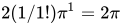
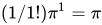
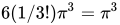
The hypervolume of the -dimensional unit sphere (i.e., the "area" of the boundary of the -dimensional unit ball), which we denote can be expressed as For example, is the "area" of the boundary of the unit ball , which simply counts the two points. Then is the "area" of the boundary of the unit disc, which is the circumference of the unit circle. is the area of the boundary of the unit ball , which is the surface area of the unit sphere .

The surface areas and the volumes for some values of are as follows:

(surface area) (volume)
0 1
1 2 2
2 6.283 3.141
3 12.57 4.189
4 19.74 4.935
5 26.32 5.264
6 31.01 5.168
7 33.07 4.725
8 32.47 4.059
9 29.69 3.299
10 25.50 2.550

where the decimal expanded values for are rounded to the displayed precision.

Recursion

[edit]

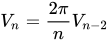
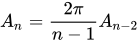
The values satisfy the recursion: for .

The values satisfy the recursion: for .
Non-negative real-valued dimensions

[edit]

The value at non-negative real values of is sometimes used for normalization of Hausdorff measure.[1][2]

Other radii

[edit]

The surface area of an -sphere with radius is and the volume of an -ball with radius is For instance, the area is for the two-dimensional surface of the three-dimensional ball of radius The volume is for the three-dimensional ball of radius .

Unit balls in normed vector spaces

[edit]

The open unit ball of a normed vector space with the norm is given by

It is the topological interior of the closed unit ball of

The latter is the disjoint union of the former and their common border, the unit sphere of

The "shape" of the unit ball is entirely dependent on the chosen norm; it may well have "corners", and for example may look like in the case of the max-norm in . One obtains a naturally round ball as the unit ball pertaining to the usual Hilbert space norm, based in the finite-dimensional case on the Euclidean distance; its boundary is what is usually meant by the unit sphere.

Let Define the usual -norm for as:
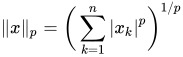
Then is the usual Hilbert space norm. is called the Hamming norm, or -norm. The condition is necessary in the definition of the norm, as the unit ball in any normed space must be convex as a consequence of the triangle inequality. Let denote the max-norm or -norm of .

Note that for the one-dimensional circumferences of the two-dimensional unit balls, we have: is the minimum value. is the maximum value.

Generalizations

[edit]

Metric spaces

[edit]

All three of the above definitions can be straightforwardly generalized to a metric space, with respect to a chosen origin. However, topological considerations (interior, closure, border) need not apply in the same way (e.g., in ultrametric spaces, all of the three are simultaneously open and closed sets), and the unit sphere may even be empty in some metric spaces.

Quadratic forms

[edit]

If is a linear space with a real quadratic form then may be called the unit sphere[3][4] or unit quasi-sphere of For example, the quadratic form , when set equal to one, produces the unit hyperbola, which plays the role of the "unit circle" in the plane of split-complex numbers. Similarly, the quadratic form yields a pair of lines for the unit sphere in the dual number plane.


See also

[edit]

Notes and references

[edit]
[edit]
Revisions and contributorsEdit on WikipediaRead on Wikipedia
from Grokipedia
In mathematics, the unit sphere, often denoted as $ S^n $, is the hypersurface consisting of all points in $ (n+1) $-dimensional Euclidean space $ \mathbb{R}^{n+1} $ that are exactly distance 1 from the origin, defined by the equation $ |x| = 1 $, where $ | \cdot | $ denotes the Euclidean norm.[1] For $ n = 2 $, this corresponds to the familiar two-dimensional surface of a sphere in three-dimensional space.[2] The unit sphere generalizes the concepts of the unit circle ($ S^1 )andtheordinary[sphere](/page/Sphere)() and the ordinary [sphere](/page/Sphere) ( S^2 $) to higher dimensions, serving as a fundamental object in geometry, topology, and analysis.[2] It is a compact, smooth $ n $-dimensional manifold without boundary, and any sphere of radius $ r > 0 $ is homeomorphic to the unit sphere via scaling.[1] Key properties include its surface area, given by $ S_n = \frac{2 \pi^{(n+1)/2}}{\Gamma((n+1)/2)} $ for the $ n $-sphere, which reaches a maximum around $ n \approx 7.25695 $, and its role as a coset space $ S^n \cong O(n+1)/O(n) $ in the context of orthogonal groups.[2][1] In topology, the unit sphere exemplifies non-trivial homotopy groups, with $ \pi_k(S^n) $ being non-zero only for certain $ k \geq n $, influencing the study of manifolds and embeddings. Applications extend to physics, where it models directional data on surfaces, and to optimization, as the constraint set in problems like those on the unit ball's boundary. The infinite-dimensional analog, $ S^\infty $, arises as the colimit of finite-dimensional spheres and is contractible in certain topological categories.[1]

Definitions in Euclidean Space

Sphere and Ball

In nn-dimensional Euclidean space Rn\mathbb{R}^n, the unit sphere, denoted Sn1S^{n-1}, is defined as the set of all points x=(x1,,xn)x = (x_1, \dots, x_n) satisfying x2=1\|x\|_2 = 1, where x2=i=1nxi2\|x\|_2 = \sqrt{\sum_{i=1}^n x_i^2} denotes the Euclidean norm.[3] This equation describes the locus of points exactly at distance 1 from the origin, forming a hypersurface that separates the interior and exterior regions of the space.[4] The unit ball, denoted BnB^n, consists of all points xRnx \in \mathbb{R}^n such that x21\|x\|_2 \leq 1, encompassing both the unit sphere as its boundary and the solid interior region.[3] Unlike the unit sphere, which is purely a surface, the unit ball is a closed and bounded set including all points within or on the sphere.[5] The unit sphere Sn1S^{n-1} is a compact (n1)(n-1)-dimensional hypersurface embedded in Rn\mathbb{R}^n, inheriting its topology from the ambient space and serving as the topological boundary of the unit ball BnB^n.[6] This compactness ensures that the sphere is closed and bounded, with no boundary of its own as a manifold.[1] In two dimensions (n=2n=2), the unit sphere is the familiar unit circle, which can be parametrized as x=(cosθ,sinθ)x = (\cos \theta, \sin \theta) for θ[0,2π)\theta \in [0, 2\pi).[7] In three dimensions (n=3n=3), it corresponds to the standard unit sphere, a surface well-known from classical geometry.[3]

Coordinate Representations

In n-dimensional Euclidean space Rn\mathbb{R}^n, the unit sphere Sn1S^{n-1} is defined as the set of points (x1,x2,,xn)(x_1, x_2, \dots, x_n) satisfying the equation
i=1nxi2=1. \sum_{i=1}^n x_i^2 = 1.
This Cartesian coordinate representation implicitly describes the hypersurface where the Euclidean norm equals unity, serving as the foundational geometric constraint for points on the sphere.[8] To parametrize points explicitly on the unit sphere, hyperspherical coordinates generalize the familiar spherical coordinates from three dimensions to arbitrary n2n \geq 2. These coordinates consist of n1n-1 angular variables: n2n-2 colatitude angles θ1,θ2,,θn2[0,π]\theta_1, \theta_2, \dots, \theta_{n-2} \in [0, \pi] and one azimuthal angle ϕ[0,2π)\phi \in [0, 2\pi). The transformation to Cartesian coordinates for a point on the unit sphere (where the radial coordinate r=1r = 1) is given by
x1=cosθ1,x2=sinθ1cosθ2,x3=sinθ1sinθ2cosθ3,xn1=(j=1n2sinθj)cosϕ,xn=(j=1n2sinθj)sinϕ. \begin{align*} x_1 &= \cos \theta_1, \\ x_2 &= \sin \theta_1 \cos \theta_2, \\ x_3 &= \sin \theta_1 \sin \theta_2 \cos \theta_3, \\ &\vdots \\ x_{n-1} &= \left( \prod_{j=1}^{n-2} \sin \theta_j \right) \cos \phi, \\ x_n &= \left( \prod_{j=1}^{n-2} \sin \theta_j \right) \sin \phi. \end{align*}
This parametrization covers the entire sphere, with singularities at the poles where certain angles cause coordinate degeneracies, analogous to the azimuthal angle in three dimensions. An equivalent formulation uses n1n-1 angles θ1,,θn1\theta_1, \dots, \theta_{n-1} all ranging from 0 to π\pi except θn1[0,2π)\theta_{n-1} \in [0, 2\pi), yielding
xi=(j=1i1sinθj)cosθifor i=1,,n1, x_i = \left( \prod_{j=1}^{i-1} \sin \theta_j \right) \cos \theta_i \quad \text{for } i = 1, \dots, n-1,
xn=j=1n1sinθj, x_n = \prod_{j=1}^{n-1} \sin \theta_j,
which provides a recursive structure for embedding lower-dimensional spheres iteratively.[8][9] Hyperspherical coordinates are particularly useful for integration over the unit sphere, as the induced surface measure (or volume element on the sphere) arises naturally from the Jacobian of the transformation. The angular part of the metric determinant yields the surface element
dσ=sinn2θ1sinn3θ2sinθn2dθ1dθ2dθn2dϕ, d\sigma = \sin^{n-2} \theta_1 \sin^{n-3} \theta_2 \cdots \sin \theta_{n-2} \, d\theta_1 \, d\theta_2 \cdots d\theta_{n-2} \, d\phi,
enabling the evaluation of integrals of rotationally invariant functions by separating radial and angular components, though the full volume form applies to the enclosing ball. This structure exploits the sphere's symmetry, reducing multidimensional integrals to products over successive lower-dimensional spheres.[8][10] The hyperspherical coordinate system is orthogonal, meaning the basis vectors tangent to the coordinate curves are mutually perpendicular at every point, as verified by their dot products vanishing (e.g., ereθk=0\mathbf{e}_r \cdot \mathbf{e}_{\theta_k} = 0 and eϕeθk=0\mathbf{e}_\phi \cdot \mathbf{e}_{\theta_k} = 0). This orthogonality simplifies the expression of the Laplacian and other differential operators on the sphere. The transformation from hyperspherical to Cartesian coordinates preserves the Euclidean inner product up to scaling by the metric factors, ensuring that rotations in Rn\mathbb{R}^n correspond to transformations among the angular variables via the orthogonal group O(n)O(n), which acts transitively on the sphere.[8][10]

Geometric Measures

Surface Area

The (n-1)-dimensional surface area of the unit sphere Sn1S^{n-1} embedded in Rn\mathbb{R}^n quantifies the "size" of its boundary hypersurface. This measure arises naturally in multivariable calculus and geometry, particularly when integrating over spherical domains or analyzing radial symmetries. For the unit sphere, where the radius is 1, the surface area Sn1S_{n-1} is given by the formula
Sn1=2πn/2Γ(n/2), S_{n-1} = \frac{2 \pi^{n/2}}{\Gamma(n/2)},
where Γ\Gamma denotes the gamma function.[2] This expression simplifies for low dimensions, providing intuitive checks. In two dimensions, the unit sphere is the circle S1S^1, with circumference S1=2πS_1 = 2\pi. In three dimensions, the unit sphere S2S^2 has surface area S2=4πS_2 = 4\pi. These cases align with classical geometry, confirming the formula's consistency across dimensions.[2] The formula derives from integration in hyperspherical coordinates, where the volume element in Rn\mathbb{R}^n decomposes as dV=rn1drdΩn1dV = r^{n-1}\, dr\, d\Omega_{n-1}, with dΩn1d\Omega_{n-1} representing the infinitesimal surface element on the unit sphere and dΩn1=Sn1\int d\Omega_{n-1} = S_{n-1} the total angular measure. To evaluate Sn1S_{n-1}, consider the Gaussian integral over Rn\mathbb{R}^n:
Rnex2dx=πn/2. \int_{\mathbb{R}^n} e^{-\|x\|^2}\, dx = \pi^{n/2}.
Switching to hyperspherical coordinates yields
πn/2=0er2Sn1rn1dr. \pi^{n/2} = \int_0^\infty e^{-r^2} S_{n-1} r^{n-1}\, dr.
Substituting t=r2t = r^2 (so dt=2rdrdt = 2r\, dr and rn1dr=12t(n/2)1dtr^{n-1}\, dr = \frac{1}{2} t^{(n/2)-1}\, dt) transforms the integral to
πn/2=Sn120ettn/21dt=Sn12Γ(n2), \pi^{n/2} = \frac{S_{n-1}}{2} \int_0^\infty e^{-t} t^{n/2 - 1}\, dt = \frac{S_{n-1}}{2} \Gamma\left(\frac{n}{2}\right),
solving for Sn1S_{n-1} as above. This approach leverages the gamma function's integral representation Γ(z)=0ettz1dt\Gamma(z) = \int_0^\infty e^{-t} t^{z-1}\, dt.[2][11] As a Riemannian manifold with the induced Euclidean metric, the unit sphere Sn1S^{n-1} possesses constant sectional curvature 1, endowing it with the standard round geometry that underlies its topological and differential properties.[12][13]

Enclosed Volume

The volume VnV_n of the nn-dimensional unit ball in Euclidean space, which is the region enclosed by the unit sphere, is given by the formula
Vn=πn/2Γ(n2+1), V_n = \frac{\pi^{n/2}}{\Gamma\left(\frac{n}{2} + 1\right)},
where Γ\Gamma denotes the gamma function.[14] This expression arises from evaluating the integral in spherical coordinates, where the volume is computed as
Vn=01Sn1rn1dr V_n = \int_0^1 S_{n-1} r^{n-1} \, dr
with Sn1S_{n-1} denoting the surface area of the unit sphere in nn dimensions, which provides the angular measure for the radial integration.[14] The integral can be solved explicitly to yield the gamma function form, often derived via connections to Gaussian integrals over Rn\mathbb{R}^n.[14] For specific low dimensions, the formula simplifies to familiar results. In two dimensions, the unit disk has area V2=πV_2 = \pi.[14] In three dimensions, the unit ball has volume V3=43πV_3 = \frac{4}{3} \pi.[14] In high dimensions, the volume VnV_n exhibits concentration near the equator: for large nn, most of the mass lies within a thin slab around the equatorial hyperplane perpendicular to any fixed coordinate axis.[15] Specifically, for n3n \geq 3 and small ϵ>0\epsilon > 0, the proportion of volume within ϵ\epsilon of the equator satisfies
Vol(B1(0){x:x1ϵ})(12ϵn1exp(ϵ2(n1)2))Vn, \operatorname{Vol}\left( B_1(0) \cap \{ x : |x_1| \leq \epsilon \} \right) \geq \left(1 - \frac{2\epsilon}{\sqrt{n-1}} \exp\left( -\frac{\epsilon^2 (n-1)}{2} \right) \right) V_n,
illustrating how the volume thins rapidly away from this central band.[15]

Recurrence Formulas

Recurrence relations provide an efficient way to compute the volumes and surface areas of unit n-balls and (n-1)-spheres for successive integer dimensions, avoiding direct evaluation of more complex integrals. These formulas link the measures in dimension n to those in dimension n-2, allowing iterative calculation starting from low-dimensional cases. They are particularly useful for numerical computations in higher dimensions where closed-form expressions may be cumbersome.[16] For the volume VnV_n of the unit n-ball in Euclidean space, the recurrence is given by
Vn=2πnVn2 V_n = \frac{2\pi}{n} V_{n-2}
for n2n \geq 2, with initial conditions V0=1V_0 = 1 (the "volume" of a 0-dimensional point) and V1=2V_1 = 2 (the length of the unit interval).[16] This relation arises from expressing the n-dimensional volume as an iterated integral over slices or using polar coordinates, reducing the problem to lower dimensions via Fubini's theorem. A proof sketch involves relating the volume to the Gaussian integral ex2dx=π\int_{-\infty}^{\infty} e^{-x^2} \, dx = \sqrt{\pi}, which serves as the base case; higher-dimensional Gaussian integrals factor into products that project onto lower-dimensional subspaces, yielding the recursive factor after change of variables and normalization to the unit ball.[16] Applying the recurrence yields explicit values for small n: V2=πV_2 = \pi, V3=4π3V_3 = \frac{4\pi}{3}, V4=π22V_4 = \frac{\pi^2}{2}, and V5=8π215V_5 = \frac{8\pi^2}{15}. These computations require only about n/2 steps, making the method computationally advantageous for integer n up to moderate sizes, as each step involves simple multiplication and division.[16] The surface area Sn1S_{n-1} of the unit (n-1)-sphere, which bounds the unit n-ball, satisfies Sn1=nVnS_{n-1} = n V_n. This follows from differentiating the scaled volume formula Vn(r)=VnrnV_n(r) = V_n r^n with respect to the radius r, yielding the "infinitesimal shell" contribution at r=1, or equivalently from integrating the surface area: Vn=01Sn1tn1dt=Sn1nV_n = \int_0^1 S_{n-1} t^{n-1} \, dt = \frac{S_{n-1}}{n}.[17] Substituting the volume recurrence gives
Sn1=2πn2Sn3 S_{n-1} = \frac{2\pi}{n-2} S_{n-3}
for n3n \geq 3, with initial conditions S0=2S_0 = 2 (two antipodal points) and S1=2πS_1 = 2\pi (unit circle circumference). This can also be derived using integration by parts on the angular integrals in the volume expression.[16][17] Examples include S2=4πS_2 = 4\pi, S3=2π2S_3 = 2\pi^2, and S4=8π23S_4 = \frac{8\pi^2}{3}, computed iteratively in a similar stepwise manner. These recurrences offer a practical complement to the closed-form expressions using the Gamma function discussed in prior sections on geometric measures.[16]

Extensions to Other Dimensions

Non-Integer Dimensions

The unit sphere and ball can be extended to non-integer dimensions α > 0 through analytic continuation of their defining measures using the Gamma function, which generalizes the factorial to real and complex arguments. The surface area of the unit sphere in α dimensions is given by
Sα=2πα/2Γ(α/2), S_\alpha = \frac{2 \pi^{\alpha/2}}{\Gamma(\alpha/2)},
while the volume of the unit ball is
Vα=πα/2Γ(α/2+1). V_\alpha = \frac{\pi^{\alpha/2}}{\Gamma(\alpha/2 + 1)}.
These expressions arise from integrating the Gaussian over Rα\mathbb{R}^\alpha and reducing to polar coordinates, where the Gamma function emerges from the radial integral 0rα1er2dr=12Γ(α/2)\int_0^\infty r^{\alpha-1} e^{-r^2} dr = \frac{1}{2} \Gamma(\alpha/2). For integer α = n, they recover the standard formulas, such as S2=2πS_2 = 2\pi and V3=4π/3V_3 = 4\pi/3. In non-integer dimensions, these measures lack direct geometric interpretation, as visualization relies on integer lattices, but they appear formally in contexts like power series expansions and Fourier transforms where fractional dimensionality parameterizes convergence or scaling. For instance, in analytic continuations of orthogonal polynomial integrals, the Gamma-based formulas ensure consistency across real α without invoking discrete structures. As α approaches 0 from above, Vα1V_\alpha \to 1 and Sα0S_\alpha \to 0, corresponding to a 0-dimensional "ball" as a single point (volume 1 by convention); while the 0-dimensional sphere is conventionally two points with measure 2, the analytic limit of the surface area formula is 0. As α → ∞, both Vα0V_\alpha \to 0 and Sα0S_\alpha \to 0, reflecting concentration of measure near the equator in high dimensions, with the volume peaking near α ≈ 5 and surface area near α ≈ 7 before decaying exponentially due to Stirling's approximation of the Gamma function, Γ(z)2π/z(z/e)z\Gamma(z) \sim \sqrt{2\pi/z} (z/e)^z. These extensions find applications in dimensional regularization within quantum field theory, where integrals over momentum space are continued to d = 4 - ε dimensions to isolate divergences, with sphere volumes providing the angular measure Ωd=Sd\Omega_d = S_d in the formulas. In fractal geometry, fractional-dimensional spheres model scaling in irregular spaces, such as Hausdorff dimension d_H = α for volumes VRαV \propto R^\alpha, aiding analysis of self-similar sets without integer topology.

Arbitrary Radii

In Euclidean space Rn\mathbb{R}^n, the geometric measures of balls and spheres scale with the radius r>0r > 0 due to the homogeneity of the Euclidean norm 2\| \cdot \|_2, where rx2=rx2\|rx\|_2 = r \|x\|_2 for any scalar r>0r > 0 and vector xx. This implies that the nn-ball of radius rr, defined as Bn(r)={xRn:x2r}B_n(r) = \{ x \in \mathbb{R}^n : \|x\|_2 \leq r \}, is the image of the unit ball Bn(1)B_n(1) under scalar multiplication by rr. Since this transformation is linear with Jacobian determinant rnr^n, the volume scales by rnr^n: Vn(r)=rnVn(1)V_n(r) = r^n V_n(1). Similarly, the (n1)(n-1)-sphere of radius rr, Sn1(r)={xRn:x2=r}S^{n-1}(r) = \{ x \in \mathbb{R}^n : \|x\|_2 = r \}, scales by rn1r^{n-1} in surface area, as it is the boundary of the scaled ball.[18] The explicit volume formula for the nn-ball of radius rr is
Vn(r)=πn/2rnΓ(n2+1), V_n(r) = \frac{\pi^{n/2} r^n}{\Gamma\left( \frac{n}{2} + 1 \right)},
where Γ\Gamma denotes the gamma function; this follows from integrating in hyperspherical coordinates and scaling the unit case.[18] Likewise, the surface area of the (n1)(n-1)-sphere of radius rr is
Sn1(r)=2πn/2rn1Γ(n2), S_{n-1}(r) = \frac{2 \pi^{n/2} r^{n-1}}{\Gamma\left( \frac{n}{2} \right)},
derived as the derivative of the volume with respect to rr (up to a factor), Sn1(r)=nVn(r)/rS_{n-1}(r) = n V_n(r) / r, and equivalently rn1r^{n-1} times the unit surface area.[19]
For example, in three dimensions (n=3n=3), the surface area simplifies to S2(r)=4πr2S_2(r) = 4\pi r^2, which approximates the total surface area of planetary bodies like Earth (mean radius approximately 6371 km, yielding about 510 million km²).[18][20] This formula is applied in geophysics and astronomy to model surface coverage, such as land distribution or solar irradiance on spherical approximations of planets.[20]

Generalizations Beyond Euclidean Space

Normed Vector Spaces

In a finite-dimensional normed vector space (V,)(V, \|\cdot\|), the unit sphere is the set S={xVx=1}S = \{ x \in V \mid \|x\| = 1 \}, while the unit ball is B={xVx1}B = \{ x \in V \mid \|x\| \leq 1 \}. These generalize the Euclidean unit sphere and ball, where the norm induces a geometry that need not be rotationally symmetric. The unit ball BB is always convex, as the triangle inequality x+yx+y\|x + y\| \leq \|x\| + \|y\| and homogeneity λx=λx\|\lambda x\| = |\lambda| \|x\| for λR\lambda \in \mathbb{R} ensure that for any x,yBx, y \in B and t[0,1]t \in [0,1], tx+(1t)yBtx + (1-t)y \in B. A prominent family of norms is the p\ell_p norms on Rn\mathbb{R}^n, defined for 1p<1 \leq p < \infty by
xp=(i=1nxip)1/p, \|x\|_p = \left( \sum_{i=1}^n |x_i|^p \right)^{1/p},
and for p=p = \infty by x=max1inxi\|x\|_\infty = \max_{1 \leq i \leq n} |x_i|. These yield distinct unit spheres: in R2\mathbb{R}^2, the p=1p=1 case forms a diamond (with vertices at (±1,0)(\pm 1, 0) and (0,±1)(0, \pm 1)), the p=2p=2 case a circle, and the p=p=\infty case a square (with vertices at (±1,±1)(\pm 1, \pm 1)). The p\ell_p unit ball is strictly convex for 1<p<1 < p < \infty, meaning its boundary contains no nontrivial line segments; this holds in particular for the Euclidean norm (p=2p=2), where the sphere is a smooth hypersurface. However, for p=1p=1 and p=p=\infty, the unit ball is not strictly convex, featuring flat faces along which line segments lie. The p\ell_p unit sphere fails to be a smooth manifold for p=1p=1 and p=p=\infty, as the norm is not differentiable at points where coordinates achieve extrema (e.g., along axes for p=1p=1), resulting in corners and kinks on the boundary. In contrast, for 1<p<1 < p < \infty, the sphere is a smooth (n1)(n-1)-dimensional submanifold of Rn\mathbb{R}^n. Computing volumes and surface areas of unit balls and spheres in general norms is challenging, often requiring numerical methods or case-specific techniques, as no universal closed-form expressions exist beyond symmetric cases. For p\ell_p norms, explicit formulas are available via integrals reducible to the beta function B(a,b)=01ta1(1t)b1dt=Γ(a)Γ(b)Γ(a+b)B(a,b) = \int_0^1 t^{a-1} (1-t)^{b-1} \, dt = \frac{\Gamma(a) \Gamma(b)}{\Gamma(a+b)} for a,b>0a,b > 0. The volume of the p\ell_p unit ball in Rn\mathbb{R}^n is
Vn(p)=[2Γ(1+1p)]nΓ(1+np), V_n(p) = \frac{\left[ 2 \Gamma\left(1 + \frac{1}{p}\right) \right]^n}{\Gamma\left(1 + \frac{n}{p}\right)},
derived by expressing the volume as an nn-fold integral over the positive orthant and substituting Dirichlet coordinates, which yield products of beta functions. The surface area Sn(p)S_n(p) of the corresponding unit sphere follows by differentiating the volume with respect to radius or via polar-like coordinates, scaling as Sn(p)=nVn(p)S_n(p) = n V_n(p). These measures highlight how the p\ell_p geometry transitions from polyhedral (p=1p=1) to rounded (p=2p=2) to again polyhedral (p=p=\infty) shapes, with volumes peaking near p=2p=2 in low dimensions.

Metric Spaces

In a metric space (X,d)(X, d), the unit sphere centered at a base point oXo \in X is defined as the set So={xXd(o,x)=1}S_o = \{ x \in X \mid d(o, x) = 1 \}, while the unit ball is Bo={xXd(o,x)1}B_o = \{ x \in X \mid d(o, x) \leq 1 \}.[21] This generalizes the Euclidean notion but strips away vector space structure, allowing XX to be any set equipped with a distance function satisfying the metric axioms.[22] Unlike Euclidean spheres, these sets lack inherent geometric regularity and may fail basic topological properties. For example, in the discrete metric space where d(x,y)=1d(x, y) = 1 if xyx \neq y and d(x,x)=0d(x, x) = 0, the unit sphere SoS_o comprises all points in X{o}X \setminus \{o\}, forming a countable discrete collection of isolated points if XX is countably infinite.[22] This sphere is neither compact (lacking finite subcovers for its open cover by singletons) nor connected (decomposable into disjoint open subsets if X>2|X| > 2).[23] In contrast, within a hyperbolic metric space, such as the Poincaré disk model, the unit sphere around oo is a connected, compact curve homeomorphic to a circle, influenced by the space's constant negative curvature.[24] Topologically, the unit sphere's properties depend heavily on the ambient space's structure. Compactness holds if SoS_o is closed and totally bounded, but in general complete bounded metric spaces, the closed unit ball BoB_o is compact only under total boundedness, with the sphere as its boundary inheriting limited guarantees.[25] The homotopy type varies widely; for instance, it may resemble the standard nn-sphere in finite-dimensional cases but can be contractible or otherwise in infinite or irregular settings, relating to topological constructions like the suspension of lower-dimensional spheres.[1] Without additional measure-theoretic structure, no canonical volume exists on SoS_o; analysis instead emphasizes cardinality (finite or infinite in discrete examples) or Hausdorff dimension, which quantifies "roughness" in fractal metric spaces like the Sierpinski gasket, where subsets such as unit spheres exhibit non-integer dimensions between 1 and 2.[26] In normed vector spaces, where the metric derives from a norm, the unit sphere often mirrors Euclidean homotopy types, though the focus here remains on metric-induced topology without linearity.[1]

Quadratic Forms

In the context of a real finite-dimensional vector space equipped with a symmetric bilinear form, a quadratic form $ Q(\mathbf{x}) = \mathbf{x}^T A \mathbf{x} $, where $ A $ is a symmetric matrix, provides a natural generalization of the Euclidean norm. For $ A $ positive definite, the unit sphere is defined as the level set $ S = { \mathbf{x} \in \mathbb{R}^n \mid Q(\mathbf{x}) = 1 } $. This set forms a compact hypersurface known as an ellipsoid embedded in the ambient Euclidean space, contrasting with the round unit sphere obtained when $ A = I_n $, the identity matrix.[27][28] By the spectral theorem for symmetric matrices, $ A $ admits an orthogonal diagonalization $ A = P D P^T $, where $ P $ is orthogonal and $ D = \operatorname{diag}(\lambda_1, \dots, \lambda_n) $ with $ \lambda_i > 0 $ for all $ i $. Substituting $ \mathbf{y} = P^T \mathbf{x} $ transforms the equation to $ \sum_{i=1}^n \lambda_i y_i^2 = 1 $, or equivalently, $ \sum_{i=1}^n \frac{y_i^2}{1/\lambda_i} = 1 $. This describes an axis-aligned ellipsoid in the $ \mathbf{y} $-coordinates, with semi-axes lengths $ 1/\sqrt{\lambda_i} $ along the eigenvectors of $ A $. The transformation $ P $ rotates and orients the ellipsoid in the original coordinates, preserving the underlying Euclidean geometry induced by the inner product $ \langle \mathbf{x}, \mathbf{y} \rangle_A = \mathbf{x}^T A \mathbf{y} $. In this inner product space, $ S $ is isometric to the standard unit sphere.[28][29] The volume enclosed by such an ellipsoid can be computed via affine transformations from the Euclidean case, scaling by the absolute value of the determinant of the matrix $ B $ where $ A = B^T B $. The surface area, however, requires more complex computations, often without closed-form expressions except in special cases, and generally involves the eigenvalues of $ A $, such as through series expansions or numerical methods. For indefinite quadratic forms, the level set $ Q(\mathbf{x}) = 1 $ yields non-compact surfaces like hyperboloids, which generalize the sphere to pseudo-Euclidean geometries but deviate from the compact "unit sphere" topology.[27][30]
User Avatar
No comments yet.