


Community hub
Recent from talks
Contribute something
Nothing was collected or created yet.
United Nations Security Council Resolution 82
View on Wikipedia
| UN Security Council Resolution 82 | ||
|---|---|---|
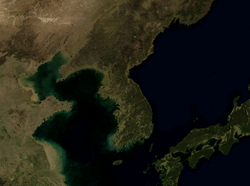
 Satellite view of the Korean Peninsula | ||
| Date | June 25, 1950 | |
| Meeting no. | 473 | |
| Code | S/1501 (Document) | |
| Subject | Complaint of aggression upon the Republic of Korea | |
Voting summary |
| |
| Result | Adopted | |
| Security Council composition | ||
Permanent members | ||
Non-permanent members | ||
| ||


| Part of a series on |
| North Korea and the United Nations |
|---|
  |
Resolution 82 was adopted by the United Nations Security Council (UNSC) on 25 June 1950. It condemned the "armed attack on the Republic of Korea by forces from North Korea", while calling for "the immediate cessation of hostilities" and for "the authorities in North Korea to withdraw forthwith their armed forces to the 38th parallel".[1] The measure was adopted with 9 voting for, none opposed, and one abstention by Yugoslavia. The Soviet Union was absent, as it was boycotting the UN at the time for its recognition of the Republic of China as China's representative to the organization.[2]
The Korean Peninsula had been divided along the 38th parallel north since the end of World War II between the occupation forces of the United States and the Soviet Union. Each sought to prop up a government on its side of the border, and as the Cold War began to take shape, tensions rose as a proxy conflict developed in Korea. This culminated in the North's invasion of the South on 25 June. Led by the US, the UN backed South Korea, considering it the only lawful government on the peninsula.
The resolution called on North Korea to immediately halt its invasion and to move its troops back to the 38th parallel. Seen as a diplomatic victory for the United States, the resolution was completely ignored by North Korea. This brought the UN and the US to take further action, setting the stage for a massive international involvement and expansion of the Korean War.
Background
[edit]
Division of Korea
[edit]At the end of World War II, the Korean Peninsula, which up to that point had been occupied by the Empire of Japan, was divided along the 38th parallel north.[3] The Soviet Union (USSR) had moved forces into the northern half of the country, overseeing its establishment as the communist Democratic People's Republic of Korea (DPRK) under Kim Il Sung, a figure who had previously risen to notability for his successes fighting the Japanese.[4] American forces occupied the south, overseeing the establishment of the Republic of Korea under Syngman Rhee, an ardently anti-communist autocrat.[5] As tensions rose between the US and the USSR, each government in Korea claimed it had sovereignty over the whole country.[4]
On 14 November 1947, the General Assembly's Resolution 112 established a temporary commission to monitor free elections in Korea.[6] The UN had intended to reunify Korea under one government,[4] but the UN commission was unable to enter North Korea. After observing elections in South Korea, the General Assembly stated on 12 December 1948 in their Resolution 195, that the nation was to be established under one government as soon as possible, and the US and Soviet occupation forces there were to withdraw.[7]
As the pressure built, the North Korean government became more aggressive, with skirmishes between North and South becoming common. UN military observers were assigned to monitor the situation, ostensibly to prevent it from escalating.[8] General Assembly Resolution 293, passed on 21 October 1949, recognized only the southern government as legal.[6] North Korea in turn denied the legality of the UN activities in Korea, and said it would drive the UN forces out of the country.[4]
Outbreak of war
[edit]I felt certain that if South Korea was allowed to fall Communist leaders would be emboldened to override nations closer to our own shores. If the Communists were permitted to force their way into the Republic of Korea without opposition from the free world, no small nation would have the courage to resist threats and aggression by stronger Communist neighbors. If this was allowed to go unchallenged it would mean a Third World War, just as similar incidents had brought on the Second World War. It was clear to me that the foundations and the principles of the United Nations were at stake unless this unprovoked attack on Korea could be stopped.
On the night of 25 June 1950, ten divisions of the North Korean People's Army launched a full-scale invasion of the Republic of Korea. The force of 89,000 men moved in six columns, catching the Republic of Korea Army by surprise, resulting in a rout. The smaller South Korean army suffered from widespread lack of equipment, and was unprepared for war.[10] The numerically superior North Korean forces overcame isolated resistance from the 38,000 South Korean soldiers on the frontier before it began moving steadily south.[11] Most of South Korea's forces retreated in the face of the invasion.[12] The North Koreans were well on their way to South Korea's capital of Seoul within hours, forcing the government and its shattered army to retreat further south.[12]
News of the invasion quickly spread around the world via ambassadors and correspondents in Korea. Journalists in the United States were reporting on the invasion within five hours of the initial attack, and United States Ambassador to Korea John J. Muccio sent a telegram to the US State Department at 10:26 KST June 24.[13] As the combat grew more intense, US Secretary of State Dean Acheson informed President Truman, who had been resting at his Missouri home over the weekend), and Trygve Lie, the Secretary-General of the UN, of the situation. The attack was particularly troubling to Truman, who likened it to the Japanese attack on Pearl Harbor, and to Lie, who was reminded of the invasion of Norway during World War II. Fearing the attack would spur another general war between great powers, Truman resolved to act as quickly as possible to prevent an escalation of the conflict.[9] Muccio met with Rhee, who informed him the South Korean Army would run out of ammunition within ten days, and would not be able to hold back the invasion on its own. He requested the United Nations and the United States assist South Korea in the conflict.[14]
Lie convened the Security Council for its 473rd meeting at 14:00 June 25 in New York City.[15] He began the meeting with a detailed report from the UN Commission on Korea, explained the situation to the delegates, and insisted that the UN take action to restore peace in Korea.[16] According to the UN Commission on Korea, the situation was assuming the character of full-scale warfare.[6] Then, US diplomat Ernest A. Gross gave Muccio's report on the situation.[17]
The United States introduced a resolution stating that North Korea's invasion was a breach of peace in violation of Chapter VII of the UN Charter.[15] Gross requested that South Korea's ambassador to the United Nations, Chang Myon, be present for the meeting, which was granted. The Yugoslavian delegate requested that a North Korean diplomat be present as well, but this request was not granted. North Korea was not a member of the UN and had no representation in the organization. Myon read a prepared statement calling the invasion a crime against humanity, and said that as the UN had played a major role in the founding of South Korea, it was their responsibility to help defend it from aggression.[17] The UNSC debated the resolution and made amendments and revisions to its wording before passing it.[15]
The Soviet UN ambassador was not present at the UNSC meeting due to their ongoing boycott of the UN, which meant that the Soviets were unable to veto the resolution.[18]
The resolution
[edit]The Security Council,
Recalling the finding of the General Assembly in its resolution 293 (IV) of 21 October 1949 that the Government of the Republic of Korea is a lawfully established government having effective control and jurisdiction over that Part of Korea where the United Nations Temporary Commission on Korea was able to observe and consult and in which the great majority of the people of Korea reside; that this Government is based on elections which were a valid expression of the free will of the electorate of that part of Korea and which were observed by the Temporary Commission, and that this is the only such Government in Korea,
Mindful of the concern expressed by the General Assembly in its resolutions 195 (III) of 12 December 1948 and 293 (IV) of 21 October 1949 about the consequences which might follow unless Member States refrained from acts derogatory to the results sought to be achieved by the United Nations in bringing about the complete independence and unity of Korea; and the concern expressed that the situation described by the United Nations Commission on Korea in its report menaces the safety and well-being of the Republic of Korea and of the people of Korea and might lead to open military conflict there,
Noting with grave concern the armed attack on the Republic of Korea by forces from North Korea,
Determines that this action constitutes a breach of the peace; and
ICalls for the immediate cessation of hostilities;
Calls upon the authorities in North Korea to withdraw forthwith their armed forces to the 38th parallel;
IIRequests the United Nations Commission on Korea:
- (a) To communicate its fully considered recommendations on the situation with the least possible delay;
- (b) To observe the withdrawal of North Korean forces to the 38th parallel;
- (c) To keep the Security Council informed on the execution of this resolution:
IIICalls upon all Member States to render every assistance to the United Nations in the execution of this resolution and. to refrain from giving assistance to the North Korean authorities.
— −text of UN Security Council Resolution 82[1]
The resolution passed with 9 votes for—the United States, the United Kingdom, the Republic of China, France, Cuba, Ecuador, Norway, Egypt, and India. Aleš Bebler, delegate from Yugoslavia, abstained from voting.[19] Lie was a strong supporter of the resolution, as he saw the conflict as a challenge to the authority of the UN.[20]
Aftermath
[edit]The resolution was seen as a political victory for the United States, as it identified North Korea as the aggressor in the conflict.[20] Earlier in the day, independent of the UN resolution, Truman had ordered the Joint Chiefs of Staff to contact General of the Army Douglas MacArthur, who was in charge of US forces in the Far East. He ordered MacArthur to prepare ships for the evacuation of US citizens from Korea, and authorized him to send ammunition and supplies to Pusan to support South Korean forces in the Seoul–Kimpo area. These would be escorted by US military units. He instructed MacArthur to send a survey team into the country to assess the situation and determine how to aid South Korea. Truman also ordered the mobilization of the US Navy for movement into the region.[21][22]
The US delegation later contacted the Soviet delegation and sent a message requesting that the Kremlin use its influence over North Korea to compel it to comply with the resolution, but the Soviet Union denied the request.[19] With the ineffectiveness of the resolution in de-escalating the conflict, the UNSC convened on June 27 to discuss further actions to take, resulting in UNSC Resolution 83, which recommended military intervention by other UN member nations to restore peace in Korea.[20] Within days, ships and aircraft from several nations, as well as the first major formations of US troops, were moving to South Korea, setting the stage for a full-scale conflict.[21]
In 2010, Colum Lynch wrote a column in Foreign Policy magazine that criticized the resolution as one of the ten worst UN resolutions in history. After the Soviet Union ended its boycott of the council, it used its veto power to block any further resolutions against North Korea. In response, Acheson introduced a new procedure to the UN General Assembly to allow a member state to bypass the UNSC and seek approval in the General Assembly, including recommendations on the use of force, UNSC Resolution 377. When this was passed, it allowed for open-ended General Assembly emergency special sessions to address threats to international peace and security for which the UNSC was unable to pass a resolution. Lynch wrote that the creation of this rule caused unintended negative consequences for the United States in 1997 when several Arab states began the Tenth emergency special session of the United Nations General Assembly to address the Israeli–Palestinian conflict and Israel's occupation of the West Bank and the Gaza Strip. This session, convened as a way around a US veto, spanned 30 meetings over the next ten years, and has never formally been closed.[23]
See also
[edit]References
[edit]Citations
[edit]- ^ a b Wellens 1990, p. 252
- ^ "United Nations Security Council - Cold War, Peacekeeping, Veto Power | Britannica". www.britannica.com.
- ^ Appleman 1998, p. 2
- ^ a b c d Appleman 1998, p. 5
- ^ Appleman 1998, p. 4
- ^ a b c Wellens 1990, p. 251
- ^ Edwards 2010, p. 304
- ^ Appleman 1998, p. 6
- ^ a b Millett 2000, p. 245
- ^ Alexander 2003, p. 1
- ^ Alexander 2003, p. 2
- ^ a b Appleman 1998, p. 35
- ^ Millett 2000, p. 244
- ^ Millett 2000, p. 246
- ^ a b c Appleman 1998, p. 37
- ^ Millett 2000, p. 247
- ^ a b Millett 2000, p. 248
- ^ Meisler, Stanley (2011-11-11). United Nations: A History. Open Road + Grove/Atlantic. ISBN 978-0-8021-9499-2.
- ^ a b Millett 2000, p. 249
- ^ a b c Edwards 2010, p. 306
- ^ a b Appleman 1998, p. 38
- ^ Millett 2000, p. 250
- ^ Lynch 2010.
Sources
[edit]- Alexander, Bevin (2003), Korea: The First War We Lost, New York City, New York: Hippocrene Books, ISBN 978-0-7818-1019-7
- Appleman, Roy E. (1998), South to the Naktong, North to the Yalu: United States Army in the Korean War, Washington, D.C.: Department of the Army, ISBN 978-0-16-001918-0, archived from the original on 2014-02-07, retrieved 2011-10-04
- Edwards, John M. (2010), Historical Dictionary of the Korean War, Lanham, Maryland: Scarecrow Press, ISBN 978-0-8108-6773-4
- Lynch, Colum (May 21, 2010), The 10 worst U.N. Security Council resolutions ever, Foreign Policy, archived from the original on May 27, 2013, retrieved October 29, 2011
- Millett, Allan R. (2000), The Korean War, Volume 1, Lincoln, Nebraska: University of Nebraska Press, ISBN 978-0-8032-7794-6
- Wellens, Karel (1990), Resolutions and statements of the United Nations Security Council (1946–1989), Leiden, Netherlands: Brill Publishers, ISBN 978-0-7923-0796-9
External links
[edit] Works related to United Nations Security Council Resolution 82 at Wikisource
- Text of the Resolution at undocs.org


United Nations Security Council Resolution 82
View on GrokipediaUnited Nations Security Council Resolution 82 was a measure adopted unanimously on 25 June 1950 by the Security Council, condemning the armed invasion of the Republic of Korea (South Korea) by forces of the Democratic People's Republic of Korea (North Korea) that had commenced hours earlier, and determining that the action constituted a breach of international peace.[1][2] The resolution called for an immediate halt to hostilities and the withdrawal of North Korean troops north of the 38th parallel, the demarcation line established after World War II to separate Soviet and American occupation zones on the Korean Peninsula.[1] The adoption occurred during the 474th meeting of the Council, with nine votes in favor and Yugoslavia casting the sole dissenting vote, amid the Soviet Union's boycott over the seating of the Republic of China (Taiwan) as the representative of China, which prevented a veto and enabled the resolution's passage. This marked the initial UN response to what empirical records confirm as a deliberate cross-border incursion by North Korean forces, authorized by Kim Il-sung with Soviet backing, initiating the Korean War.[3][4] Resolution 82 laid the groundwork for subsequent actions, including Resolutions 83 and 84, which recommended military assistance to South Korea and established a unified command under the United States, mobilizing a multinational coalition that repelled the invasion and restored the pre-war boundary by 1951.[1] Its significance lies in demonstrating the UN's capacity for collective security against unprovoked aggression, though the ensuing conflict highlighted limitations in enforcing withdrawal without sustained force, as North Korea refused compliance and Chinese intervention prolonged the war.[2][5]
Historical Context of the Korean Division
Post-World War II Division and Occupation
Following Japan's surrender on August 15, 1945, U.S. military planners, led by Dean Rusk and Charles Bonesteel, proposed dividing the Korean Peninsula at the 38th parallel to facilitate the acceptance of Japanese capitulations, assigning Soviet forces to the north and U.S. forces to the south; the Soviets accepted this arrangement on August 16, 1945, as a temporary measure intended to lead to a unified trusteeship under Allied oversight, rather than an ideological partition.[6] This division, drawn arbitrarily across 869 miles without regard for geographic, cultural, or economic coherence, positioned approximately 16 million Koreans north of the line under Soviet influence and 21 million south under American administration, setting the stage for divergent political developments.[6] In the north, Soviet occupation authorities from August 1945 rapidly consolidated communist control by installing Korean People's Committees and enacting land reforms on March 5, 1946, which redistributed over 5.4 million acres of farmland from Japanese owners, collaborators, and landlords to about 700,000 peasant households without compensation, thereby garnering peasant support while enabling purges of domestic rivals and nationalists to elevate Kim Il-sung, a Soviet-trained guerrilla leader, as head of the provisional government by February 1946.[7] These measures, including the suppression of non-communist factions and the establishment of a state security apparatus, entrenched a Stalinist model that prioritized industrial nationalization and ideological conformity, diverging sharply from pre-war agrarian structures.[8] In the south, the U.S. Army Military Government in Korea (USAMGIK), established in September 1945, prioritized anti-communist stability by suppressing leftist groups, such as during the Autumn Harvest Uprising of 1946, and backing Syngman Rhee, an exiled nationalist with staunch anti-communist credentials, as a counterweight to Soviet influence despite his authoritarian tendencies and amid ongoing internal unrest from guerrilla activities and labor strikes.[9] Rhee's government, formalized after U.S.-supervised elections, emphasized right-wing alliances and military buildup, reflecting the causal entrenchment of division as occupations hardened into ideological fortresses. The joint U.S.-Soviet commission for unification collapsed by May 1946 over disagreements on including Korean stakeholders, leading the United Nations General Assembly on November 14, 1947, to call for peninsula-wide elections under UN supervision via Resolution 112 (II).[10] Soviet authorities refused entry to the UN Temporary Commission on Korea (UNTCOK) in the north, blocking unified elections and prompting separate proceedings: the Democratic People's Republic of Korea (DPRK) formed on September 9, 1948, after northern elections on August 25, while the Republic of Korea (ROK) emerged on August 15, 1948, following southern elections on May 10.[11] This Soviet non-cooperation empirically precluded a singular Korean state, institutionalizing the 38th parallel as a de facto border between rival regimes.[11]Formation of North and South Korea
The Republic of Korea (ROK) was formally established on August 15, 1948, in the zone south of the 38th parallel, following elections supervised by the United Nations Temporary Commission on Korea (UNTCOK) on May 10, 1948, which excluded the Soviet-occupied north due to Moscow's refusal to permit observation.[12] Syngman Rhee, a long-time independence activist and anti-communist, was elected president by the National Assembly on July 20, 1948, and inaugurated as the ROK's first leader, with the government adopting a presidential system modeled on democratic principles, including a constitution emphasizing civil liberties and free enterprise, though Rhee's administration quickly exhibited authoritarian traits such as suppression of leftist opposition and reliance on electoral manipulations amid widespread corruption among officials.[13][14] In contrast, the Democratic People's Republic of Korea (DPRK) was proclaimed on September 9, 1948, in the northern zone under Kim Il-sung, a Soviet-trained guerrilla leader installed by Moscow's occupation authorities after their initial preference for moderate nationalist Cho Man-sik was overridden due to Cho's opposition to trusteeship and communism.[15] Kim's regime rapidly imposed a totalitarian structure, centralizing power through the Korean Workers' Party, nationalizing industry, and conducting purges of domestic rivals and non-communist elements with direct Soviet military and advisory support, establishing one-party rule that prioritized ideological conformity over pluralistic governance.[16][17] On December 12, 1948, the United Nations General Assembly adopted Resolution 195 (III), affirming the ROK government resulting from the southern elections as the only lawful authority in Korea and calling for withdrawal of occupying forces, a determination rejected outright by the Soviet Union, which recognized the DPRK as the sole legitimate Korean state and viewed the UN action as an infringement on its sphere of influence.[18] This divergence entrenched dual claims to sovereignty over the entire peninsula, with the ROK oriented toward Western alliances and market-oriented reconstruction despite internal frailties, while the DPRK aligned with Stalinist models of state control. Economically, the north inherited a more industrialized base from Japanese colonial infrastructure, augmented by Soviet technical assistance and resource extraction agreements formalized in early pacts, enabling rapid collectivization and heavy industry focus under central planning.[19] The south, predominantly agrarian and disrupted by post-liberation chaos, received U.S. economic aid channeled through the Economic Cooperation Administration starting in 1948 to stabilize the currency, foster private sector recovery, and counter communist expansion, though implementation was hampered by bureaucratic inefficiencies and graft.[20] These disparities, shaped by superpower patrons, underscored the ideological chasm: the DPRK's command economy versus the ROK's nascent, aid-supported framework emphasizing anti-communist resilience and limited market reforms.[21]Prelude to Invasion
Border Incidents and Military Buildup (1948–1950)
From late 1948 onward, North Korean forces conducted a series of cross-border raids and incursions into South Korean territory along the 38th parallel, escalating tensions and signaling aggressive expansionist aims under Kim Il-sung's leadership. Declassified U.S. diplomatic records indicate that North Korean troops initiated major clashes, including the April 1949 Kaesong incident and a large-scale invasion of the Ongjin Peninsula in the summer of 1949, where they overran southern positions and inflicted heavy casualties on Republic of Korea (ROK) defenders.[22] [23] These actions, often involving battalion-sized units, resulted in hundreds of deaths and demonstrated North Korea's intent to probe and weaken southern defenses, contrasting with South Korean responses that were largely reactive and limited by arms restrictions. North Korea's military buildup during this period far outpaced South Korea's, enabled by extensive Soviet matériel and training support. By early 1950, the Korean People's Army (KPA) had expanded to approximately 135,000 combat-ready troops, bolstered by over 200 Soviet-supplied T-34 tanks, heavy artillery, and Yak fighter aircraft, transforming it into a mechanized force capable of offensive operations.[24] In contrast, the ROK Army numbered around 98,000 personnel but was equipped primarily with light infantry weapons, as U.S. policy deliberately withheld heavy arms like tanks and artillery to avoid provoking war and to emphasize defensive posture.[25] This asymmetry, rooted in North Korea's ideological drive for forcible unification and Soviet backing, heightened the peninsula's volatility. Diplomatic efforts for peaceful unification faltered amid North Korea's rejection of internationally supervised elections and insistence on bilateral talks that favored communist terms. Kim Il-sung repeatedly petitioned Soviet leader Joseph Stalin for authorization to launch a full invasion, with requests dating back to 1949 but initially denied due to concerns over U.S. intervention; approval was finally granted in early 1950 following coordination with Mao Zedong, as revealed in declassified Soviet archives.[26] [27] These developments underscored the failure of negotiation channels, as North Korea prioritized military preparation over genuine reconciliation, setting the stage for broader conflict.Soviet and Chinese Support for North Korea
Soviet leader Joseph Stalin authorized North Korean Premier Kim Il-sung's invasion plans during Kim's secret visit to Moscow from March 30 to April 25, 1950, granting final approval in early April after initial reluctance in 1949, on the condition of Chinese agreement.[28][26] This decision reflected Stalin's calculus to probe U.S. commitment to Asian defenses following the 1949 communist takeover in China, enabling communist expansion without direct Soviet troop involvement, while diverting American resources from potential European threats.[28][29] The USSR furnished extensive military aid, including roughly 120 T-34 medium tanks that formed the vanguard of the North Korean People's Army assault, alongside artillery, small arms, and ammunition sufficient to equip 10 infantry divisions and supporting units.[30][31] Soviet military advisors, numbering 25 to 35, embedded with North Korean commands to refine operational plans, train forces, and coordinate logistics, ensuring the offensive's feasibility as a rapid, armored thrust across the 38th parallel.[32][31] Declassified Soviet archives, including telegrams and meeting records from Kim's Moscow consultations, document deliberate preparations for forcible unification, contradicting narratives of an organic civil uprising by revealing orchestrated aggression backed by Moscow's strategic endorsement.[33] Chinese Communist Party Chairman Mao Zedong offered tacit pre-invasion support after his October 1949 victory in the Chinese Civil War, prioritizing North Korea as a buffer zone to shield Manchuria from U.S.-led forces on the peninsula.[34][35] In spring 1949–1950, Beijing repatriated up to three ethnic Korean divisions—approximately 25,000 battle-hardened troops—from the People's Liberation Army to reinforce Kim's forces, enhancing the Korean People's Army's manpower for the offensive.[34][36] Mao's alignment, secured via Kim's consultations in Beijing around May 1950, fulfilled Stalin's precondition and integrated Chinese strategic interests in containing American influence in East Asia, though direct PLA combat units arrived only post-invasion.[34][37] These commitments from both powers causally enabled the North's capability to launch a coordinated, mechanized attack on June 25, 1950, transforming border skirmishes into full-scale war.[26][38]The Invasion and Immediate Crisis
North Korean Attack on June 25, 1950
At 0400 hours local time on June 25, 1950, the North Korean People's Army launched a full-scale, unprovoked invasion across the 38th parallel into the sovereign territory of the Republic of Korea, employing seven infantry divisions comprising approximately 90,000 troops, supported by over 150 Soviet-supplied T-34 tanks and a marked superiority in artillery and aircraft that the Republic of Korea Armed Forces could not effectively counter due to their limited mechanization and air assets.[39] [40] The coordinated assault targeted multiple points along the parallel, with the main effort directed toward Seoul via the Uijongbu corridor, exploiting the element of surprise and overwhelming Republic of Korea positions through sheer numerical and firepower advantages.[41] [42] The rapid North Korean advance resulted in the fall of Seoul on June 28, 1950, after three days of intense fighting, during which Republic of Korea forces suffered heavy losses estimated in the thousands killed, wounded, or captured, alongside significant civilian casualties from combat and deliberate executions.[43] [44] Eyewitness reports and later investigations documented North Korean massacres of civilians, local officials, and prisoners in newly occupied areas, including summary killings to eliminate perceived opposition, contributing to a pattern of atrocities that intensified the humanitarian crisis in the initial phase of the invasion.[45] [46] The Republic of Korea government appealed to the United Nations that same day, formally notifying Secretary-General Trygve Lie of the armed attack originating from North Korea, while U.S. Ambassador to the United Nations Henry Cabot Lodge conveyed evidence of the unprovoked North Korean initiative to the Security Council during its emergency session, emphasizing the breach of international peace.[47] [48]South Korean and U.S. Initial Response
The Republic of Korea Armed Forces, numbering approximately 98,000 personnel but lacking heavy tanks, artillery, and air support, mounted only sporadic resistance against the North Korean People's Army's coordinated assault on June 25, 1950, leading to a rapid southward withdrawal as forward positions collapsed under the weight of superior numbers and equipment.[42] President Syngman Rhee's government, recognizing the imminent fall of the capital, began evacuating Seoul on June 27, 1950, ahead of North Korean forces that captured the city by June 28.[49] This retreat reflected the ROK military's defensive posture, oriented toward internal security rather than large-scale conventional warfare, which left it vulnerable to the invaders' mechanized thrusts.[47] In Washington, President Harry S. Truman was briefed on the invasion late on June 25, 1950 (U.S. time), prompting immediate consultations with the Joint Chiefs of Staff and Secretary of State Dean Acheson to verify the scope of North Korean aggression through diplomatic cables and intelligence reports from the U.S. embassy in Seoul.[50] These assessments, drawing on prior observations of ROK military limitations, confirmed no capacity or intent for South Korean-initiated offensive action beyond isolated border skirmishes, attributing the attack squarely to Pyongyang's premeditated designs.[51] Truman directed preliminary preparations for support on June 26, formalizing orders for U.S. air and naval forces to furnish cover and logistical aid to beleaguered ROK units without committing ground troops, consistent with a strategy of deterring further communist advances in Asia amid broader containment imperatives.[47] General Douglas MacArthur, as Commander in Chief, Far East, received initial field reports of the North Korean offensive's speed and coordination on June 25, describing it in communications to Washington as a massive, unprovoked incursion exploiting surprise to shatter ROK lines with tank-led infantry assaults.[52] This evaluation underscored the tactical disparity, with North Korean T-34 tanks and artillery enabling deep penetrations that fragmented South Korean defenses, prompting MacArthur to urge accelerated air interdiction to blunt the momentum while awaiting further directives.[53] U.S. actions prioritized stabilization over escalation, focusing on intelligence validation and limited intervention to signal resolve against aggression without provoking Soviet escalation.[54]Procedural and Diplomatic Background for Resolution 82
Soviet Boycott of the UN Security Council
The Soviet Union began boycotting United Nations Security Council meetings on January 13, 1950, when its delegate, Yakov Malik, walked out following the Council's rejection of a Soviet resolution demanding the expulsion of the Republic of China (based in Taiwan) from the permanent seat allocated to China under the UN Charter.[55] The USSR viewed the UN as a "puppet" of the United States for maintaining the Nationalist Chinese representation despite the 1949 communist victory on the mainland, and the boycott was intended to pressure Western powers into seating the People's Republic of China instead.[56] This action extended to all UNSC proceedings, with the Soviet representative absent from deliberations and votes.[55] The boycott continued uninterrupted until August 1, 1950, spanning the critical period when North Korean forces invaded South Korea on June 25.[57] During this absence, the Soviet Union forfeited its veto power, enabling the UNSC to adopt Resolution 82 condemning the invasion without opposition from a permanent member.[55] Upon resuming participation, Soviet representatives, including Andrei Gromyko, denounced the Korean-related resolutions as procedurally invalid and illegal due to the Council's incomplete composition without the USSR.[58] However, this contention overlooked the voluntary nature of the boycott, which constituted a waiver of attendance rights under UNSC rules allowing decisions by present members; legal analyses affirmed the resolutions' validity, as the Charter does not require all permanent members for quorum in cases of self-imposed absence.[58] [59] Strategically, the boycott—conceived by Joseph Stalin to isolate the UN on the China issue—proved counterproductive, as it removed the sole potential veto against collective action responding to the Soviet-endorsed North Korean offensive, which Stalin had privately approved in April 1950 expecting a swift, localized victory without major U.S. involvement.[28] This procedural lapse facilitated unanimous condemnation among attending members, underscoring a miscalculation in Soviet tactics that prioritized symbolic protest over geopolitical pragmatism amid escalating tensions on the Korean Peninsula.[57]U.S. Initiative and Drafting Process
The United States, acting swiftly upon reports of the North Korean invasion of the Republic of Korea on June 25, 1950, initiated the drafting of a Security Council resolution in response to a formal complaint lodged by the South Korean government with the United Nations. U.S. Ambassador Warren R. Austin introduced draft resolution S/1501 during an emergency session convened that same day, framing the North Korean military incursion across the 38th parallel as a clear breach of international peace rather than internal civil unrest. This determination rested on intelligence confirming the massed deployment and coordinated advance of North Korean forces, which overwhelmed South Korean defenses in multiple sectors, violating Article 2(4) of the UN Charter prohibiting the threat or use of force against territorial integrity or political independence.[60] Prior to introduction, the U.S. State Department conducted urgent consultations with key allies, including the United Kingdom and France, to align on the resolution's language and secure broad support among non-permanent members present. These discussions emphasized evidentiary focus on the unprovoked aggression—evidenced by the invasion's scale, including armored and infantry assaults from the north—while avoiding broader geopolitical attributions to maintain the resolution's procedural neutrality. The draft was deliberately minimalist, limiting demands to an immediate cessation of hostilities and withdrawal of North Korean forces behind the parallel, thereby facilitating potential unanimity without invoking enforcement measures that might alienate undecided parties.[61][60] This U.S.-led approach underscored a commitment to collective security mechanisms against perceived communist expansionism, leveraging the Soviet Union's ongoing boycott of the Security Council—which had begun in January 1950 over the People's Republic of China's seating—to circumvent veto risks and expedite action. By prioritizing factual condemnation over interpretive debates, the initiative aimed to establish an unambiguous UN position on the aggression's illegitimacy under international law.[62]Provisions and Adoption of the Resolution
Key Text and Demands
The preamble of Resolution 82 recalled prior General Assembly resolutions recognizing the Republic of Korea (ROK) as the sole legitimate government in Korea and expressed grave concern over the armed attack initiated by North Korean forces against the ROK on June 25, 1950.[1] It determined that this armed attack constituted a breach of the peace under Chapter VII of the UN Charter, thereby framing the North Korean incursion as an unprovoked violation of international stability without attributing causation to prior border incidents or ROK actions.[1] The operative clauses demanded that North Korean authorities immediately cease hostilities by withdrawing all their armed forces to the 38th parallel, the pre-invasion demarcation line established in 1945, thereby seeking restoration of the status quo ante bellum.[1] It further requested the United Nations Commission on Korea (UNCK), established by the General Assembly in 1948, to urgently communicate these demands to North Korean authorities, observe compliance on the ground, and report developments to the Security Council.[1] Member states were called upon to support the UN's execution of the resolution—limited to diplomatic and observational efforts—and to refrain from providing any assistance to North Korean authorities, underscoring a policy of non-aid to the aggressor without mandating active intervention.[1] Documented as S/1501, the resolution was adopted on June 25, 1950, at the Security Council's 473rd meeting by a vote of 9 in favor to 0 against, with Yugoslavia abstaining; the Soviet Union was absent due to its boycott over the Republic of China's UN seat.[1] Its narrow scope emphasized de-escalation through withdrawal and observation, lacking any authorization for military enforcement or collective force, and aligned with principles permitting the ROK's inherent right to self-defense under Article 51 of the UN Charter pending further Council action.[1]Voting and Unanimity Among Present Members
Resolution 82 was adopted on June 25, 1950, during the Security Council's 473rd meeting by a recorded vote of 9 in favor, 0 against, and 1 abstention from Yugoslavia.[1] The affirmative votes included those of the permanent members present and voting—the United States, United Kingdom, France, and Republic of China—as well as the non-permanent members Cuba, Ecuador, Egypt, India, and Norway.[2] This outcome reflected near-unanimity among the members in attendance, with the Soviet Union voluntarily absent due to its ongoing boycott over the Chinese representation issue, thereby forgoing any opportunity to exercise its veto.) The procedural validity of the adoption adhered to Article 27 of the UN Charter, which at the time required an affirmative vote of seven members for Security Council decisions, including the concurring votes of permanent members present and voting for non-procedural matters.[63] With nine affirmative votes exceeding the threshold and all attending permanent members supporting the resolution, quorum requirements were satisfied, as the Council operated with 11 total members and sufficient participation to conduct business.[64] Yugoslavia's abstention, while marking the sole reservation among those present, did not alter the outcome and aligned with its emerging non-aligned posture amid tensions with the Soviet bloc, though it implicitly accepted the documented evidence of North Korean forces crossing the 38th parallel.[1] The vote's strong consensus among participating members served as an immediate international signal affirming the Republic of Korea's territorial sovereignty and characterizing the North Korean advance as an unprovoked armed attack, in direct contravention to Pyongyang's assertions of aiding a domestic uprising or liberation.) By determining a "breach of the peace" without dissent from those present, the resolution empirically prioritized verifiable reports of the invasion's scale—over 70,000 North Korean troops deployed southward on June 25—over competing narratives, establishing a factual baseline for subsequent UN responses.)Short-Term Aftermath
Passage of Resolutions 83 and 84
Following North Korea's failure to comply with Resolution 82, which demanded the withdrawal of its forces north of the 38th parallel, the invading army pressed its offensive, capturing Seoul on June 28, 1950, and forcing Republic of Korea (ROK) troops into retreat toward the southeastern Pusan Perimeter by early July.[43][65] On June 27, 1950, the UN Security Council adopted Resolution 83, recommending that member states "furnish such assistance to the Republic of Korea as may be necessary to repel the armed attack and to restore international peace and security in the area."[66][67] The resolution passed by 7 votes in favor to none against, with one abstention from Yugoslavia and absences from the Soviet Union and China due to ongoing boycott.[66] President Truman, who had already directed U.S. air and naval forces to support ROK defenses on June 27, publicly described the U.S. commitment as a "police action" under UN auspices to suppress the North Korean "bandit raid," avoiding a formal congressional declaration of war to emphasize collective enforcement of Security Council demands rather than unilateral aggression.[68][69] This framing aligned with Resolution 83's authorization for member assistance, as North Korean non-compliance and rapid advances—reducing ROK-held territory to under 10% of the peninsula by mid-July—necessitated escalated multinational intervention to prevent total collapse.[65] By July 7, 1950, with U.S.-led forces (initially under separate national commands) stabilizing defenses amid ongoing North Korean assaults, the Security Council adopted Resolution 84, requesting the United States to form and lead a unified command to coordinate operations against North Korean forces, including authority to use the UN flag in operations.[70][71] The measure passed 7-0, with abstentions from Egypt, India, and Yugoslavia, again without Soviet or Chinese participation.[70] Sixteen UN member states ultimately contributed ground combat troops to the unified command, enabling a coordinated repulsion of the invasion and counteroffensive planning.[71][72]Establishment of Unified UN Command
United Nations Security Council Resolution 84, adopted on July 7, 1950, recommended that member states furnish assistance to the Republic of Korea through a unified command under United States auspices, authorizing the use of the United Nations flag in operations against North Korean forces.[70] On July 8, 1950, U.S. President Harry S. Truman designated General Douglas MacArthur as the commander of this unified command, formalizing the United Nations Command (UNC) structure to coordinate multinational military efforts in repelling the North Korean invasion.[73] The UNC operated under U.S. leadership but flew the UN flag alongside national flags, symbolizing collective security action rather than unilateral intervention, with MacArthur serving as Commander in Chief, United Nations Command (CINCUNC).[74] The UNC rapidly integrated contributions from multiple nations, with the United States providing the overwhelming majority of troops, equipment, and logistics—over 90% of ground forces by late 1950—while allies supplied complementary units to enable coordinated operations.[43] Sixteen countries dispatched combat contingents, including the United Kingdom (infantry brigades), Australia (artillery and naval forces), Turkey (brigade combat teams noted for effectiveness in key battles), Canada, France, and others, alongside medical and logistical support from additional nations, totaling 22 contributors by war's end.[71] This multinational composition, headquartered in Tokyo under MacArthur's oversight, facilitated joint planning and execution, adhering to UN mandates for restoring peace without subsuming national commands entirely under U.S. control.[75] A pivotal demonstration of the UNC's operational efficacy occurred with the Inchon amphibious landing on September 15, 1950, codenamed Operation Chromite, which involved U.S. Marines supported by British, Australian, and South Korean elements under unified direction.[76] The assault, executed despite logistical challenges like extreme tides, severed North Korean supply lines and encircled their forces south of Seoul, compelling a rapid retreat and recapturing the capital by September 29, 1950.[77] Military assessments confirm this maneuver reversed the defensive posture at the Pusan Perimeter, validating the resolution-enabled command structure's capacity for decisive collective action.[53]Controversies and Opposing Viewpoints
Soviet and Communist Critiques of Legitimacy
Upon returning to the Security Council on August 1, 1950, the Soviet Union declared United Nations Security Council Resolution 82 and subsequent measures invalid, arguing that their passage during the boycott constituted a procedural irregularity depriving the USSR of its veto right and undermining the Council's quorum requirements under the UN Charter.[78] Soviet representatives, including Andrei Gromyko, contended that the resolutions facilitated illegal U.S. aggression in what they framed as an internal Korean civil war provoked by American-backed forces in the South.[79] This critique aligned with broader communist narratives portraying the UN intervention as an imperialist violation of sovereignty, with the USSR vetoing further anti-North Korean resolutions to block enforcement.[80] North Korean and Chinese communist propaganda echoed these claims, depicting the June 25, 1950, invasion by North Korean forces as a legitimate unification effort against a "fascist" Republic of Korea regime installed by U.S. imperialists, rather than unprovoked aggression.[81] Official statements from Pyongyang dismissed Resolution 82 as "illegal" and asserted that southern provocations, including alleged border incursions, justified the operation as a response in a civil conflict, ignoring international recognition of the two Koreas as separate entities since 1948.[82] The People's Republic of China, upon entering the war in October 1950, reinforced this by labeling UN actions as tools of U.S. expansionism aimed at encircling socialist states.[83] Declassified Soviet archives, however, contradict these portrayals by documenting Joseph Stalin's explicit approval of Kim Il-sung's invasion plans in meetings on April 25 and August 5, 1949, and final greenlight in early 1950, including Soviet assistance in drafting operational strategies.[84] These records indicate the offensive was a premeditated North Korean initiative, coordinated with Moscow, absent any substantiated evidence of Republic of Korea invasion preparations; U.S. intelligence assessments confirmed no such southern plans existed prior to June 25, 1950.[85][86] Such disclosures from primary diplomatic cables underscore the ideological motivations behind communist legitimacy critiques, which prioritized narrative control over empirical initiation of hostilities.[87]Debates on North Korean Aggression and Provocation Claims
The primary debate surrounding North Korean aggression in the lead-up to June 25, 1950, centers on whether the Democratic People's Republic of Korea (DPRK) launched an unprovoked full-scale invasion or responded to provocations by the Republic of Korea (ROK). Communist bloc narratives, including initial DPRK claims and later revisionist accounts, asserted that South Korean forces initiated hostilities through border incursions, framing the northern advance as defensive or retaliatory.[88] [89] These views, often propagated by Soviet-aligned sources, cited sporadic clashes along the 38th parallel since 1948, including guerrilla activities and artillery exchanges, as evidence of ROK aggression justifying a northern counteroffensive.[90] However, such claims lack substantiation from declassified DPRK and Soviet archives, which reveal premeditated invasion planning by Kim Il-sung, approved by Joseph Stalin in early 1950 after months of deliberation, rather than reactive measures to isolated incidents.[33] [87] Empirical evidence from captured North Korean documents, interrogations of prisoners of war, and post-Cold War archival releases confirms that DPRK forces violated the de facto armistice status established after the 1948 division by launching a coordinated assault with 135,000 troops, 150 tanks, and artillery barrages across the parallel at dawn on June 25, 1950, overrunning ROK positions in Ongjin, Kaesong, and Chuncheon within hours.[27] Prior border skirmishes, while mutual and numbering in the dozens from 1949–early 1950, involved small units and did not escalate to the invasion's scale, which deployed the bulk of the Korean People's Army southward in a blitzkrieg-style operation planned since April 1950.[91] U.S. and UN policy demonstrated restraint, with American combat troops withdrawn from the peninsula by 1949 and Dean Acheson's January 1950 National Press Club speech omitting Korea from U.S. defense perimeters, signals interpreted by Kim and Stalin as opportunities rather than provocations.[29] Revisionist arguments equating these incidents to the invasion's causation falter against the asymmetry: skirmishes caused hundreds of casualties annually, whereas the DPRK offensive aimed at total conquest, as evidenced by orders to capture Seoul in three days.[90] Yugoslavia's abstention in the UN Security Council vote on Resolution 82 reflected qualms over procedural haste and perceived dominance by Western great powers, rather than endorsement of DPRK provocation claims; its delegate protested the resolution's framing but did not contest the factual record of northern forces breaching the parallel.[92] This position aligned with Tito's independent stance post-1948 Soviet split, prioritizing multipolar caution over denial of aggression, and contrasted with absent Soviet opposition.[88] Notwithstanding fringe historiographical efforts to symmetrize blame—often reliant on unverified communist propaganda without cross-corroboration—declassified materials from Moscow and Pyongyang establish DPRK initiative as the causal trigger, undermining narratives of equivalence between pre-invasion friction and deliberate war-making.[93] [33]Long-Term Impact and Legacy
Influence on the Korean War's Conduct
Resolution 82 provided the initial legal determination that North Korea's invasion constituted a breach of the peace, paving the way for subsequent UN actions that authorized military assistance to South Korea and facilitated a unified command structure under the United States. This framework enabled the rapid deployment of UN forces, primarily American, which arrived in July 1950 to bolster collapsing South Korean defenses near the Pusan Perimeter. By September 1950, the UN counteroffensive, launched via the Inchon amphibious landing, reversed North Korean gains and recaptured Seoul by mid-September.[43][53] The resolution's endorsement of repelling the aggression underpinned UN Command operations that advanced north of the 38th parallel in October 1950, reaching the Yalu River by late November before Chinese intervention halted the momentum. Chinese forces, numbering over 200,000, launched massive offensives in late 1950 and early 1951, pushing UN lines back south, but General Matthew Ridgway's defensive strategies and counterattacks stabilized the front around the 38th parallel by spring 1951, where it remained through the July 1953 armistice. This tactical stalemate preserved South Korean territory south of the parallel, preventing communist unification of the peninsula despite initial North Korean superiority in numbers and surprise.[94][53] The war's conduct under UN auspices resulted in approximately 2 million total military and civilian casualties, including over 36,000 American deaths, more than 1 million Chinese and North Korean military losses, and hundreds of thousands of South Korean military and civilian fatalities. Despite these costs, the intervention maintained Republic of Korea independence against a coordinated communist assault backed by Soviet logistics, demonstrating the efficacy of multilateral force in restoring the pre-invasion boundary.[95][53] Critics argue that the UN framework's emphasis on limited objectives—repelling aggression without broader escalation into China or the Soviet sphere—prolonged the conflict by constraining decisive operations, leading to two years of attritional fighting after 1951 rather than a swift victory. Proponents counter that such limits averted a wider war while deterring future overt Soviet proxy aggressions by establishing a credible collective response mechanism.[96][53]Precedent for UN Collective Security
Resolution 82, adopted on 25 June 1950, marked the first instance in which the UN Security Council determined the existence of a breach of the peace under the UN Charter and called for the cessation of hostilities following an armed attack by one state against another.[2] This action initiated the Council's engagement with collective security mechanisms, paving the way for subsequent resolutions that authorized member states to provide military assistance to repel the aggression.[97] Although Resolution 82 itself stopped short of explicit enforcement under Chapter VII, it tested the integration of Article 51's provisions for individual and collective self-defense with Security Council oversight, affirming that states could act defensively pending Council measures while enabling a coordinated international response.[98][99] The resolution's passage highlighted the Security Council's dependence on the absence of vetoes from permanent members, as the Soviet Union was boycotting sessions over the representation of China by the Republic of China, allowing unanimous support among those present.[92] This procedural anomaly exposed systemic limitations in the veto structure, which often paralyzed action during Cold War divisions, as evidenced by the Soviet return and subsequent vetoes that stalled further Council initiatives.[100] In response, the United States and allies advanced General Assembly Resolution 377(A) on 3 November 1950, known as "Uniting for Peace," empowering the Assembly to recommend collective measures when the Council faced deadlock due to vetoes.[101] Such developments underscored the Charter's realist design, prioritizing great-power consensus over equitable enforcement, yet empirically enabling defensive action against verifiable aggression in this case. Despite biases inherent in the permanent seats—favoring aligned powers and reflecting post-World War II power distributions—the precedent affirmed the viability of UN-authorized collective security in scenarios of opportunistic alignment against empirical threats.[102] Resolution 82's framework contributed to the successful mobilization of forces under unified command, demonstrating causal efficacy in halting advances through multilateral deterrence rather than unilateralism, though it revealed the institution's vulnerability to absences or walkouts by key actors like the Soviet Union and, by extension, its allies.[43] This early test reinforced the Charter's emphasis on rapid response to breaches, prioritizing containment of aggression over idealistic universality, even as it critiqued the veto's role in perpetuating selective enforcement.[97]References
- https://en.wikisource.org/wiki/United_Nations_General_Assembly_Resolution_195