Hubbry Logo
UnstartUnstartMain
Open search
Unstart
Community hub
Unstart
logo
8 pages, 0 posts
0 subscribers
Be the first to start a discussion here.
Unstart
Unstart
from Wikipedia
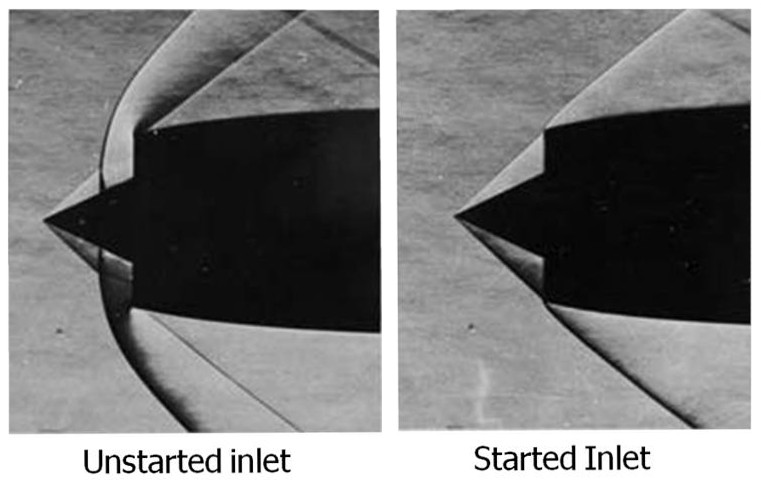
Schlieren flow visualization showing unstart of axisymmetric intake at Mach 2. Unstarted shock structure evident on left, started intake on right.

In supersonic aerodynamics, an unstart refers to a generally violent breakdown of the supersonic airflow. The phenomenon occurs when mass flow rate changes significantly within a duct. Avoiding unstarts is a key objective in the design of the engine air intakes of supersonic aircraft that cruise at speeds in excess of Mach 2.2.

Etymology

[edit]

The term originated during the use of early supersonic wind tunnels. “Starting” the supersonic wind tunnel is the process in which the air becomes supersonic; unstart of the wind tunnel is the reverse process.[1] The shock waves that develop during the starting or unstart process may be visualized with schlieren or shadowgraph optical techniques.

In some contexts, the terms aerodynamic disturbance (AD) and unstart have been synonymous.

In aircraft engine intakes

[edit]

The design of some air intakes for supersonic aircraft can be compared to that of supersonic wind tunnels, and requires careful analysis in order to avoid unstarts.[2] At high supersonic speeds (usually between Mach 2 to 3), intakes with internal compression are designed to have supersonic flow downstream of the air intake's capture plane. If the mass flow across the intake's capture plane does not match the downstream mass flow at the engine, the intake will unstart. This can cause violent, temporary loss of control until the intake is restarted.[3]

Few aircraft, although many ramjet-powered missiles, have flown with intakes which have supersonic compression taking place inside the intake duct. These intakes, known as mixed-compression intakes, have advantages for aircraft that cruise at Mach 2.2 and higher.[4] Most supersonic aircraft intakes compress the air externally, so do not start and hence have no unstart mode. Mixed compression intakes have the initial supersonic compression externally and the remainder inside the duct. As an example, the intakes on the North American XB-70 Valkyrie had an external compression ratio (cr) at Mach 3 of 3.5 and internal cr about 6.6,[5] followed by subsonic diffusion. The Lockheed SR-71 Blackbird and XB-70 Valkyrie had well-publicised[6][7] unstart behaviour. Other aircraft that have flown with internal compression include the Vought F-8 Crusader III, the SSM-N-9 Regulus II cruise missile[8] and the B-1 Lancer.[9]

Partial internal compression was considered for the Concorde (the Supersonic Transport Aircraft Committee, in 1959, had recommended an SST to cruise at Mach 2.2[10]) but an "external configuration was chosen for the inherent stability of its shock system, it had no unstart mode".[11] Even though there was some internal compression terminated by a normal shock local to the ramp boundary layer bleed slot inside the intake,[12] the intake was aerodynamically self-compensating with no trace of any unstart problem.[13] Early in the development of the B-1 Lancer its mixed external/internal intake was changed to an external one, technically safer but with a small compromise in cruise speed.[14] It subsequently had fixed intakes to reduce complexity, weight and cost.[15]

Work in the 1940s, for example by Oswatitsch,[16] showed that supersonic compression within a duct, known as a supersonic diffuser, becomes necessary at Mach 2 to 3 to increase the pressure recovery over that obtainable with external compression. As flight speed increases supersonically the shock system is initially external. For the SR-71 this was until about Mach 1.6 to Mach 1.8[17] and Mach 2 for the XB-70.[18] The intake is said to be unstarted. Further increase in speed produces supersonic speeds inside the duct with a plane shock near the throat. The intake is said to be started. Upstream or downstream disturbances, such as gusts/atmospheric temperature gradients and engine airflow changes, both intentional and unintentional (from surging), tend to cause the shock to be expelled almost instantaneously. Expulsion of the shock, known as an unstart, causes all the supersonic compression to take place externally through a single plane shock. The intake has changed in a split second from its most efficient configuration with most of its supersonic compression taking place inside the duct to the least efficient as shown by the large loss in pressure recovery, from about 80% to about 20% at Mach 3 flight speeds.[19] There is a large drop in intake pressure and loss in thrust together with temporary loss of control of the aircraft.

Not to be confused with an unstart, with its large loss in duct pressure, is the duct over-pressure resulting from a hammershock.[20] At speeds below the intake starting speed, or on aircraft with external compression intakes, engine surge or compressor stall can cause a hammershock. Above the intake starting speed, unstarts can cause stalls depending on the intake systems design complexity. Note that a hammershock can also occur with an external compression intake that has no unstart modes.[21] Hammershocks have caused damage to intakes. For example, the North American F-107 during flight at high speed experienced an engine surge which bent the intake ramps. The Concorde, during development flight testing, experienced significant damage to one nacelle after both engines surged.[22]

Intentional

[edit]

When an unstart occurred on the SR-71, a very large amount of drag from the unstarted nacelle caused extreme rolling/yawing. The aircraft had an automatic restart procedure which balanced the drag by unstarting the other intake. This intake had its own tremendous amount of drag, with the spike fully forward to capture the shock wave in front of the intake.[23]

Avoidance

[edit]

Decelerating from Mach 3 required a reduction of thrust which could unstart an intake with the reduced engine airflow. The SR-71 descent procedure used bypass flows to give unstart margin as the engine flow was reduced.

Thrust reduction on the XB-70 was achieved by keeping the engine flow stable at 100% rpm even with idle selected with the throttle. This was known as "rpm lock-up" and thrust was reduced by increasing the nozzle area. The compressor speed was maintained until the aircraft had slowed to Mach 1.5.[7]

Theoretical basis

[edit]

Using a more theoretical definition, unstart is the supersonic choking phenomenon that occurs in ducts with an upstream mass flow greater than the downstream mass flow. Unsteady flow results as the mismatch in massflow cannot gradually propagate upstream in contrast to subsonic flow. Instead, in supersonic flow, the mismatch is carried forward behind a 'normal' or terminal shock wave that abruptly causes the gas flow to become subsonic. The resulting normal shock wave then propagates upstream at an effective acoustic velocity until the flow mismatch reaches equilibrium.

There are other ways of conceptualizing unstart which can be helpful. Unstart can be alternatively thought of in terms of a decreasing stagnation pressure inside of a supersonic duct; whereby the upstream stagnation pressure is greater than the downstream stagnation pressure. Unstart is also the result of a decreasing throat size in supersonic ducts. That is the entrance throat is larger than the diffusing throat. This change in throat size gives rise to the decreasing mass flow which defines unstart.[24]

The choking reaction of unstart results in the formation of a shock wave inside of the duct.

Shock instability or buzz

[edit]

Under certain conditions, the shock wave in front or within a duct may be unstable, and oscillate upstream and downstream especially when interacting with the boundary layer. This phenomenon is known as buzz.[25] Stronger shock waves interacting with low momentum fluid or boundary layer tend to be unsteady and cause buzz. Buzz conditions can cause structural dynamics-induced failure if adequate margins are not incorporated into design.[26]

References

[edit]
Revisions and contributorsEdit on WikipediaRead on Wikipedia
from Grokipedia
Unstart is a sudden and often violent aerodynamic instability in the supersonic inlets of high-speed engines and systems, where a normal propagates upstream, expelling the internal shock structure and disrupting the supersonic , thereby causing a drastic reduction in , thrust loss, and potential vehicle control issues. This phenomenon is particularly prevalent in mixed-compression or internal-compression inlets designed for Mach numbers above 1.5, such as those in supersonic jets and hypersonic vehicles, where maintaining stable shock positioning is essential for efficient air capture and compression. The primary causes of unstart stem from flow choking mechanisms that create a pressure imbalance between the and downstream components, including physical blockages that reduce the effective flow area, mass addition from , and heat release during , all of which can force the terminal shock to move upstream beyond the inlet's . In inlet-isolators, for instance, separation induced by shock- interactions exacerbates this instability, leading to unsteady flow behaviors like buzzing or oscillatory shockwaves. Effects include not only immediate degradation and limited oxygen delivery to the but also transient mechanical loads, acoustic disturbances, and in asymmetric cases, severe yawing motions that pose risks to stability, as observed in historical flight tests of vehicles like the YF-12. Mitigation strategies focus on predictive modeling, real-time detection via sensors, and active control systems to restart the or prevent propagation, with ongoing research emphasizing simulations and high-enthalpy ground testing to enhance stability margins in advanced air-breathing engines. Unstart remains a key design challenge in supersonic and hypersonic , influencing the safety and performance of , reconnaissance platforms, and future civilian high-speed concepts.

Fundamentals

Definition and Etymology

Unstart is defined as the sudden expulsion of the internal shock system from a supersonic or hypersonic , resulting in a disruption of the normal airflow capture and a significant degradation in performance. This phenomenon occurs in mixed-compression or internal-compression inlets when excessive backpressure or disturbances cause the terminal normal shock to move upstream and exit the entrance, leading to flow spillage, increased drag, and potential . In hypersonic contexts, unstart similarly involves the disgorging of the shock , which reduces mass flow through the and can trigger combustion instabilities. The term "unstart" derives from the prefix "un-" denoting reversal or negation combined with "start," which refers to the process of establishing stable supersonic compression within the inlet by swallowing the initial shock waves. This nomenclature reflects the reversal of the inlet's started state, where the shock system is properly positioned internally for efficient operation. The concept emerged during the development of advanced supersonic propulsion systems in the mid-20th century, particularly with aircraft like the , whose variable-geometry inlets were designed to mitigate such events. Early documented use of "unstart" in aviation literature dates to the 1960s, appearing in technical reports investigating isolation techniques for multi-engine configurations to prevent propagation of unstart disturbances. These reports, focused on variable geometry inlets for high-speed flight, highlighted unstart as a critical instability in mixed-compression designs, influencing subsequent inlet control strategies.

Principles of Supersonic and Hypersonic Intakes

Supersonic engine intakes are designed to capture and compress incoming air efficiently at high Mach numbers, typically decelerating the flow to subsonic speeds suitable for in or engines. These intakes are classified into three primary types based on the location of supersonic compression: external compression, internal compression, and mixed compression. External compression intakes perform the supersonic compression ahead of the lip using ramps or cones that generate a series of waves, which progressively slow and compress the airflow while minimizing total pressure losses compared to a single normal shock. Internal compression intakes achieve supersonic compression entirely within the duct aft of the lip, often through isentropic compression via smooth contours or multiple oblique shocks, though they are more susceptible to separation and starting issues. Mixed compression intakes combine both approaches, with initial external oblique shocks from ramps or spikes followed by internal compression via reflected oblique shocks and a terminal normal shock at the throat, offering a balance of high pressure recovery and structural efficiency, as exemplified in the SR-71 Blackbird's axisymmetric design. In all types, the oblique shocks reduce the step-by-step before a final normal shock transitions the flow to subsonic conditions, enabling efficient diffusion in the subsonic section. For regimes (Mach numbers above 5), designs extend these principles but adapt to extreme loads and the need for sustained high-speed . , operating up to approximately Mach 6, fully decelerate the airflow to subsonic speeds using enhanced shock systems similar to supersonic designs, prioritizing high compression ratios for subsonic stability. In contrast, scramjet (supersonic ramjet) maintain supersonic flow through the combustor to avoid excessive dissociation of the air, achieving partial compression via oblique shocks and isolator sections without full deceleration, which reduces shock losses but requires precise management of -induced rises. This distinction arises because scramjets operate at higher Mach numbers where subsonic would generate unmanageable heat, often integrating the with the vehicle's for ingestion and compression. Key performance metrics for these intakes include pressure recovery, mass flow capture ratio, and the operational states of start and unstart. Pressure recovery, defined as the ratio of total pressure at the face to total pressure, quantifies compression and is maximized by using multiple weak oblique shocks rather than strong normal shocks, with typical values exceeding 0.9 for optimized designs at design Mach numbers. The mass flow capture ratio measures the fraction of air entering the relative to the maximum possible (based on capture area), ideally approaching 1.0 at cruise to ensure adequate fueling without spillage drag. A started inlet has its shock system swallowed internally, allowing full supersonic compression and high performance, whereas an unstarted condition expels the shocks forward of the cowl, drastically reducing mass flow capture and pressure recovery while increasing drag. Understanding these principles requires prerequisite knowledge of , particularly the effects of on compression. At supersonic s (M > 1), airflow cannot turn abruptly without generating waves, which increase pressure and density while decreasing according to the shock relations, necessitating staged compression to avoid excessive rise. Variable geometry features, such as adjustable ramps, translating cones, or pivoting cowls, are essential for self-starting, as they enable the area to contract sufficiently during to swallow the initial shock train and then expand for off-design operation, preventing unstart at low speeds or high angles of attack. For instance, cone or ramp angles are optimized to the flight , ensuring the terminal shock positions correctly at the for sonic conditions.

Mechanisms of Unstart

Intentional Unstart

Intentional unstart refers to the deliberate disruption of supersonic airflow in intakes to achieve specific operational or testing objectives, such as simulating modes during ground evaluations. In ground testing, engineers induce unstart to assess structural integrity and responses under adverse conditions, replicating scenarios that could occur due to external disturbances. This controlled process contrasts with passive operations, allowing for safer management of high-Mach dynamics. Common methods for inducing intentional unstart involve manipulating variable geometry components or airflow parameters to destabilize the shock train within the . Actuation of or spill opens pathways for excess air to exit the duct, effectively pushing the normal shock forward and causing unstart, as seen in the SR-71's forward used to modulate pressure during maneuvers. Alternatively, artificial increases in backpressure—achieved via adjustments or simulated blockages in test setups—can choke the flow, leading to shock expulsion; this technique is frequently employed in wind tunnels to study unstart propagation. Transverse jets or internal blockages (e.g., 50-100% obstruction) provide precise control in experimental settings, enabling repeatable induction without permanent damage. Historical applications include deliberate unstarts conducted on the during Mach 3 flight tests in the to evaluate yaw and roll effects, informing designs for later vehicles like the SR-71, which incorporated crosstie systems for synchronized engine recovery post-induction. These tests highlighted unstart's yaw-inducing forces, up to 25% of maximum control power in some cases. Safety protocols emphasize sequenced actuation to mitigate risks from sudden pressure surges, which can generate peak yaw moments exceeding 100,000 ft-lb in . Procedures mandate gradual door opening or backpressure ramp-up, often integrated with automatic controls that monitor spike position and pressure ratios to prevent overshoot. In flight, pilots follow checklists prioritizing stable attitude before induction, with backup manual overrides; ground tests incorporate structural monitoring to limit loads below 1.5 times design limits, ensuring no cascading failures. These measures, refined through iterative testing, have enabled safe exploration of unstart boundaries in high-speed .

Unintentional Causes

Unintentional unstart in supersonic and hypersonic inlets often arises from external disturbances that disrupt the precise alignment of shock waves with the intake geometry. Changes in angle of attack during high-Mach maneuvers can cause the incident shock to spill over the inlet lip, leading to a sudden reduction in captured airflow and expulsion of the internal shock system. Sideslip angles induced by crosswinds or aircraft yaw can similarly misalign the flow, amplifying oblique shock interactions and triggering unstart through asymmetric pressure gradients. Atmospheric gusts, particularly vertical or lateral perturbations, have been shown to provoke unstart in internal-contraction inlets by altering the local Mach number and causing transient shock oscillations. Internal factors within the propulsion system can also inadvertently initiate unstart through transient pressure imbalances. Engine transients, such as throttle changes or compressor stalls, generate backpressure surges that propagate upstream, choking the flow and pushing the shock train out of the inlet. Fuel injection imbalances in scramjet combustors introduce uneven mass addition, which can distort the flow field and induce localized blockages leading to unstart. Additionally, progressive boundary layer growth along the inlet walls promotes flow separation, especially under adverse pressure gradients, destabilizing the supersonic core flow and facilitating shock-induced unstart. In hypersonic applications, such as engines, thermal effects and instabilities pose unique unintentional risks. Excessive heat release from can cause thermal choking in the isolator, where rapid temperature rises reduce the local and trigger upstream shock propagation, as observed in studies of ethylene-fueled . instabilities, including oscillatory heat addition from fuel-air mixing variations, generate pressure waves that amplify in the isolator, leading to unstart via pseudo-shock formation; recent 2025 analyses highlight how these gradients in and fuels exacerbate at Mach 6-8 conditions. Threshold conditions for unintentional unstart are particularly sensitive at elevated Mach numbers, where small perturbations can cascade into full flow disruption. For many mixed-compression inlets, unstart becomes prone above Mach 2.0 due to the intensification of shock-boundary layer interactions, with internal duct flows rarely exceeding Mach 2-3 before instability onset. In hypersonic regimes, critical backpressure ratios exceeding 1.5-2.0 during transients can immediately expel the shock system, underscoring the narrow operational margins.

Theoretical Foundations

Fluid Dynamics Basics

In compressible flows, particularly those encountered in high-speed , the behavior of gases deviates significantly from incompressible assumptions due to substantial density variations induced by velocity changes. governs the dynamics in supersonic and hypersonic regimes, where the Mach number M=v/aM = v / a (with vv as flow speed and aa as the ) exceeds unity, leading to phenomena such as shock waves and expansion fans. These flows are described by the Euler equations for inviscid cases or the Navier-Stokes equations when is considered, emphasizing , momentum, and energy. Isentropic expansion and compression represent idealized reversible processes in , where remains constant, allowing for efficient energy transfer without losses. In isentropic expansion, such as in a diverging section for supersonic acceleration, and temperature decrease while velocity increases, following relations like p/pt=[1+γ12M2]γ/(γ1)p / p_t = \left[1 + \frac{\gamma - 1}{2} M^2 \right]^{-\gamma / (\gamma - 1)}, where ptp_t is total and γ\gamma is the specific heat ratio. Conversely, isentropic compression occurs in converging sections for subsonic acceleration to sonic conditions, maintaining constant per the second of for reversible adiabatic processes. However, real flows often deviate from isentropicity due to irreversibilities, with playing a critical role in shock formation: convergence of compression waves in supersonic flow generates a discontinuity where rises abruptly, marking the transition to irreversible compression. This increase across shocks reflects dissipative effects like viscous heating, contrasting with the constant- assumption in isentropic analyses. The Rankine-Hugoniot relations provide the fundamental jump conditions across a normal shock wave, derived from conservation laws applied to the discontinuity. For a normal shock in a calorically perfect gas, the pressure ratio is given by p2p1=2γM12(γ1)γ+1,\frac{p_2}{p_1} = \frac{2 \gamma M_1^2 - (\gamma - 1)}{\gamma + 1}, where subscript 1 denotes upstream conditions and 2 downstream, with M1>1M_1 > 1 as the upstream . The density ratio follows as ρ2ρ1=(γ+1)M12(γ1)M12+2,\frac{\rho_2}{\rho_1} = \frac{(\gamma + 1) M_1^2}{(\gamma - 1) M_1^2 + 2}, indicating a compression that reduces Mach number to subsonic values downstream. The temperature ratio is then T2T1=(p2p1)(ρ1ρ2),\frac{T_2}{T_1} = \left( \frac{p_2}{p_1} \right) \left( \frac{\rho_1}{\rho_2} \right), highlighting the heating effect across the shock. These relations underscore the irreversible nature of shocks, with total pressure loss proportional to the entropy rise. Boundary layer effects introduce viscous interactions that profoundly influence high-speed flows, often leading to as a precursor to disruptions like unstart. In supersonic inlets, adverse gradients from shock waves interact with the viscous , thickening it and causing reversal of the near-wall flow, which detaches from the surface and forms a separation bubble. This separation arises because the 's low cannot withstand the imposed rise, resulting in increased drag and reduced pressure recovery; viscous effects dominate in regions of shock- interaction, where amplifies the separation zone. Inlet flow management varies markedly across speed regimes due to compressibility effects. Subsonic inlets (M < 1) rely on diffusion with diverging geometry and thick lips to capture and slow flow isentropically, minimizing separation through gradual deceleration. Supersonic inlets (1 < M < 5) incorporate sharp lips and shock systems—such as external compression via oblique shocks—to decelerate flow to subsonic speeds for the engine, balancing shock losses with boundary layer control to avoid separation. Hypersonic inlets (M > 5), often in scramjet designs, manage predominantly supersonic combustion flow with minimal deceleration, using isentropic compression surfaces to reduce shock entropy losses while contending with intense viscous heating and dissociation effects.

Shock Wave Interactions

In supersonic and hypersonic inlets, shock wave interactions play a central role in the transition between started and unstarted states. In a started configuration, the incoming supersonic flow is compressed through a series of oblique shock waves generated by the inlet geometry, such as ramps or wedges, which deflect the flow and reduce the Mach number while maintaining supersonic conditions downstream. These oblique shocks are weaker than normal shocks, resulting in lower total pressure losses and efficient compression. However, during unstart, typically triggered by excessive backpressure or flow disturbances, a strong normal shock forms within the inlet and propagates upstream toward the capture area. This movement expels the supersonic flow, causing spillage over the inlet lip and a significant reduction in mass flow capture, as the normal shock decelerates the flow to subsonic speeds ahead of the inlet entrance. The Kantrowitz limit defines the theoretical boundary for self-starting capability in supersonic inlets, representing the minimum throat-to-capture area ratio that allows the inlet to swallow the initial shock without external assistance. Derived from one-dimensional isentropic flow assumptions combined with normal shock relations, this limit ensures that the mass flow through the matches the captured flow after a normal shock at the entrance, with sonic conditions at the . The ratio is given by AthroatAcapture=(ρ1ρ2)(AA2),\frac{A_\text{throat}}{A_\text{capture}} = \left( \frac{\rho_1}{\rho_2} \right) \left( \frac{A^*}{A_2} \right), where ρ2ρ1=(γ+1)M2(γ1)M2+2\frac{\rho_2}{\rho_1} = \frac{(\gamma + 1) M^2}{(\gamma - 1) M^2 + 2}, the post-shock Mach number is M2=2+(γ1)M22γM2(γ1)M_2 = \sqrt{ \frac{2 + (\gamma - 1) M^2}{2 \gamma M^2 - (\gamma - 1)} }
Add your contribution
Related Hubs
User Avatar
No comments yet.