
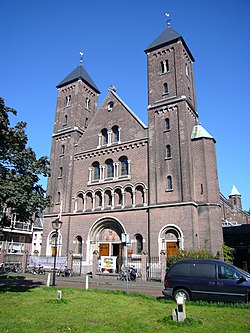


Community hub
Recent from talks
Contribute something
Nothing was collected or created yet.
Union of Utrecht (Old Catholic)
View on Wikipedia| Union of Utrecht of the Old Catholic Churches | |
|---|---|
| Utrecher Union der Altkatholischen Kirchen | |
 | |
| Abbreviation | UU |
| Classification | Old Catholic |
| Governance | Episcopal |
| Metropolitan of Utrecht | Bernd Wallet |
| Associations | World Council of Churches[1] |
| Full communion | Anglican Communion Church of Sweden Philippine Independent Church Mar Thoma Syrian Church |
| Region | Europe |
| Headquarters | Utrecht, Netherlands |
| Origin | 1889 Utrecht, Netherlands |
| Separated from | Roman Catholic Church |
| Separations | Union of Scranton Old Roman Catholic Churches |
| Members | c. 58,806 |
| Official website | utrechter-union |

The Union of Utrecht of the Old Catholic Churches, most commonly referred to by the short form Union of Utrecht (UU), is a federation of Old Catholic churches, nationally organized from schisms which rejected Roman Catholic doctrines of the First Vatican Council in 1870; its member churches are not in communion with the Roman Catholic Church.[2]
The 1889 Declaration of Utrecht is one of three founding documents together called the Convention of Utrecht.[2] Many provinces of the Union of Utrecht of the Old Catholic Churches are members of the World Council of Churches.[1] The UU is in full communion with the Evangelical Lutheran Church of Sweden;[3] the Anglican Communion through the 1931 Bonn Agreement; the Philippine Independent Church, the Spanish Reformed Episcopal Church, and the Lusitanian Catholic Apostolic Evangelical Church through a 1965 extension of the Bonn Agreement; and, the Mar Thoma Syrian Church through the 2024 Thiruvalla agreement.[4][5]
As of 2016,[update] the UU includes six member churches: the Old Catholic Church of the Netherlands (OKKN), the Catholic Diocese of the Old Catholics in Germany, the Christian Catholic Church of Switzerland, the Old Catholic Church of Austria, the Old Catholic Church of the Czech Republic, and the Polish Catholic Church in Poland.[a][6] The church had approximately 400,000 members in 1992,[7] yet according to statistics from 2016-2025,[8][9][10][11][12][13] the Union of Utrecht's current membership was an estimated 58,806 members.
History
[edit]Foundation and enlargement
[edit]The mother church, the Old Catholic Church of the Netherlands, was established in the 18th century as a result of tensions between the local Catholic hierarchy and the Roman Curia. The other churches, such as the Catholic Diocese of the Old Catholics in Germany, and the Christian Catholic Church of Switzerland, followed suit after the First Vatican Council, which defined the dogma of papal infallibility.[2]
Missionary activity and schisms
[edit]In the former Yugoslavia, the union had three organized Old Catholic episcopal jurisdictions: Old Catholic Church of Croatia (created in 1922-1923, first bishop Marko Kalojera consecrated in 1924 in Utrecht),[14] Old Catholic Church of Slovenia (with bishops Radovan Jošt and Anton Kovačevič), and Old Catholic Church of Serbia (with bishop Milan Dobrovoljac (1954-1966). Three churches formed "Union of Old-Catholic Churches in Yugoslavia" (1954). This union eventually ceased to exist with break-up of Yugoslavia (1991-1992) and even before that, the Old Catholic bishopric in Serbia was extinguished, and the same happened with bishoprics in Slovenia and Croatia. Finally, remaining Old Catholic parishes in Croatia and other parts of former Yugoslavia were placed under jurisdiction of the Old Catholic Church of Austria.[2][6]
In 1997, the International Old Catholic Bishops' Conference retracted its 1976 declaration opposing the admission of women into the clergy, allowing the churches to do so and, knowing this would lead to a break in communionship across the member churches, established a 6 year period to restore full communion.[15][16] In turn, in 1998 the Polish National Catholic Church's General Synod put in place a set of guidelines heavily restricting intercommunion with Old Catholic Churches that ordained women including forbidding its bishops from being part of consecrations of any bishops from such churches, and vice versa.[16] The conference stated in 2003 that full communion "could not be restored and that therefore, as a consequence, the separation of our Churches follows.", which effectively expelled the Polish National Catholic Church.[15][16]
The Old Catholic Church of Austria approved the blessing of same-sex unions in 1998 without IBC deliberation; in contrast, the Polish National Catholic Church disapproved the blessing of same-sex unions in 2002 and "described homosexual practice as sinful".[16] The Polish National Catholic Church established the Union of Scranton in 2008, and no other North American body has been recognized by the International Old Catholic Bishops' Conference.
The Old Catholic Church of Slovakia was a member church of the Union of Utrecht from 2000 but it was removed from membership in 2004.
In July 2011, the Christian Catholic Church of Switzerland ended its mission to Old Catholic parishes in Italy. "In cooperation with ecumenical partner churches" the parishes were "offered a model that guarantees their continued pastoral care".[17]
Organization
[edit]Individual Union of Utrecht member churches maintain a degree of autonomy, similar to the practice of the Anglican Communion. Each diocese of the member churches has a diocesan bishop, and countries with more than one diocese have a bishop who is appointed as "bishop in charge" or a similar title. The primate (primus inter pares leader) of the union is the Archbishop of Utrecht (not to be confused with the Roman Catholic Archbishop of Utrecht). From 2000 to 2020, the archbishop was Joris Vercammen, a former Roman Catholic who served on the central committee of the World Council of Churches.[18][19] In 2020, Joris Vercammen was succeeded by Bernd Wallet.[20][21][22][23][24]
Theology and practices
[edit]The Old Catholic churches reject the universal jurisdiction of the pope, as well as the Roman Catholic dogma of papal infallibility (1870), which was used to proclaim the Roman Catholic dogmas of the Assumption of Mary (1950). While Old Catholics affirm the Real Presence of Christ in the Eucharist, they do not emphasize transubstantiation as the sole dogmatic explanation for this presence. Old Catholics of Utrecht generally refrain from using the filioque[25] and deum de deo[citation needed] clauses in the Nicene Creed and also reject a dogmatic understanding of Purgatory; however, they generally do recognize a purification by Christ's grace after death and include prayers for the dead in their liturgy and devotions. They maintain such basic western Catholic practices as baptism by affusion (pouring of water) and the use of unleavened bread in the Eucharist. Additionally, they have many aspects in common with the Orthodox, Lutheran and Anglican churches, such as optional clerical celibacy.[26][7] Utrechter churches accept the doctrines of the Christian Church before the Great Schism of A.D. 1054.[7]
See also
[edit]Notes
[edit]- ^ The organization Polish Catholic Church in Poland, a member church of the UU, is not to be confused with the Catholic Church in Poland or confused with the Polish National Catholic Church, a former member church of the UU.
References
[edit]- ^ a b "Old-Catholic churches". World Council of Churches. Retrieved 27 March 2021.
- ^ a b c d "Utrechter Union - History". www.utrechter-union.org. Retrieved 2023-05-06.
- ^ "Bilateral Relations". Church of Sweden. 24 September 2020. Retrieved 27 March 2021.
- ^ Berlis, Angela (n.d.). "Relations with the Anglican Church". utrechter-union.org. Translated by Conklin, Daniel G. Utrecht, NL: Utrechter Union der Altkatholischen Kirchen. Archived from the original on 2016-04-28. Retrieved 2016-04-28.
- ^ "Thiruvalla Agreement". Retrieved 14 February 2024.
- ^ a b "Member Churches". utrechter-union.org. Utrecht, NL: Utrechter Union der Altkatholischen Kirchen. Archived from the original on 2016-04-10. Retrieved 2016-04-28.
- ^ a b c Harris, Ian Charles; Mews, Stuart; Morris, Paul; Shepherd, John (1992). Contemporary Religions: A World Guide. Longman. p. 262. ISBN 978-0-582-08695-1.
The Old Catholic Church numbers about 400,000 members worldwide and compromises those churches belonging to the Union of Utrecht. These churches accept the doctrines of the Church before 1054 (the year of the Great Schism which divided the Eastern and Western churches) and reject more modern doctrines such as the infallibility of the pope. Clergy may marry and...
- ^ "Old-Catholic Church in the Netherlands | World Council of Churches". www.oikoumene.org. 1948-01-01. Retrieved 2025-08-04.
- ^ "Meldungen > Meldungen • Katholisches Bistum der Alt-Katholiken in Deutschland". www.alt-katholisch.de. Archived from the original on 2017-03-23. Retrieved 2025-08-04.
- ^ Office, Federal Statistical. "Languages and religions". Archived from the original on 2020-06-08. Retrieved 2025-08-04.
- ^ "Religionszugehörigkeit 2021: drei Viertel bekennen sich zu einer Religion" (PDF). Statistik Austria. 2021.
- ^ "Náboženská víra". Sčítání 2021 (in Czech). Retrieved 2025-08-04.
- ^ Dominik Rozkrut, ed. (2023). "Mały Rocznik Statystyczny Polski". Warszawa: Główny Urząd Statystyczny. pp. 117–118. ISSN 1640-3630.
- ^ Hrvatska starokatolička crkva: Naša povijest
- ^ a b "Communiqué of the IBC meeting in Prague/CZ, 2003" (Press release). Amersfoort: Utrechter Union der Altkatholischen Kirchen. 2003-11-29. Archived from the original on 2016-05-01. Retrieved 2016-05-01.
- ^ a b c d Orzell, Laurence J. (May 2004). "Disunion of Utrecht: Old Catholics fall out over new doctrines". Touchstone. 17 (4). Chicago: Fellowship of St. James. ISSN 0897-327X. Archived from the original on 2004-08-30.
- ^ Weyermann, Maja (2011-06-21). "International Old Catholic Bishops Conference (IBC) withdraws from the parishes in Italy" (Press release). Utrecht, NL: Utrechter Union der Altkatholischen Kirchen. Archived from the original on 2016-04-30. Retrieved 2016-04-30.
- ^ "Communiqué of the IBC meeting in Breslau/PL 2000" (Press release). Utrecht, NL: Utrechter Union der Altkatholischen Kirchen. 2000-07-29. Archived from the original on 2016-05-02. Retrieved 2016-05-02.
- ^ "Archbishop Joris Vercammen". oikoumene.org. World Council of Churches. Archived from the original on 2008-07-09.
- ^ "Bernd Wallet (48) New Archbishop Old Catholic Church of the Netherlands". EN24 News. Retrieved 8 March 2020.[dead link]
- ^ "Bernd Wallet verkozen tot nieuwe aartsbisschop Oud-Katholieke Kerk". Friesch Dagblad (in Dutch). 17 February 2020. Retrieved 13 March 2020.
- ^ "Canceled again: Consecration and installation of the new Archbishop Bernd Wallet". Union of Utrecht of Old Catholic Churches. Retrieved 13 November 2020.
- ^ "Bernd Wallet aartsbisschop van Utrecht". Oud-Katholieke Parochie St. Agnes, Egmond. Bisschoppelijk Bureau. Retrieved 8 March 2020.
- ^ "Bernd Wallet verkozen tot nieuwe aartsbisschop van Utrecht". Oud-Katholieke Kerk van Nederland. Bisschoppelijk Bureau. Retrieved 8 March 2020.
- ^ Guretzki, David (2009). Karl Barth on the Filioque. Barth studies. Farnham, UK: Ashgate. p. 11. ISBN 978-0-7546-6704-9.
- ^ "Agreement - Between The old Catholic churches united in the Union of Utrecht and The church of Sweden" (PDF). Retrieved 2024-01-29.
External links
[edit]| General |  | |
|---|---|---|
| African provinces | ||
| Pan-American provinces | ||
| Asian provinces |
| |
| European provinces |
| |
| Oceanian provinces | ||
| Extra-provincial churches | ||
| Churches in full communion | ||

| International | |
|---|---|
| National | |

Union of Utrecht (Old Catholic)
View on GrokipediaHistorical Origins
Jansenist Roots in the Netherlands
The influence of Jansenism, a 17th-century theological movement rooted in the writings of Cornelius Jansen emphasizing human depravity and irresistible grace, took hold in the Netherlands' Catholic mission territory amid ongoing doctrinal tensions with Rome. The Church of Utrecht, functioning under apostolic vicars since the 16th-century Reformation disrupted the hierarchy, harbored Jansenist-leaning clergy who opposed papal condemnations such as the 1653 bull Cum Occasione and later the 1713 Unigenitus, viewing them as deviations from Augustinian orthodoxy. This environment fostered resistance to centralized Roman authority, particularly as the Dutch church relied on local chapters for governance in a Protestant-dominated state.[4][5] Petrus Codde, apostolic vicar and titular Archbishop of Utrecht from 1688, exemplified this friction; sympathetic to Jansenist ideas influenced by figures like Antoine Arnauld, he was summoned to Rome in 1702 by Pope Clement XI to face heresy accusations. Suspended that year and formally dismissed in 1704, Codde refrained from episcopal functions until his death in 1710, prompting the Utrecht chapter—a body of canons asserting ancient electoral rights—to reject papal nominees and maintain internal autonomy. This refusal, driven by fears that submission would erode local independence, split the Dutch clergy: a minority aligned with Rome, while the majority upheld Codde's legacy, operating without vicarial oversight and preserving sacramental continuity through self-governance.[4][6] The schism solidified in 1723 when the chapter elected Cornelius Steenoven as archbishop amid ongoing vacancies, consecrating him the following April by Dominique Varlet, Bishop of Babylon in partibus infidelium, who had been validly ordained by Rome but acted without mandate while in Holland. Varlet's subsequent consecrations of additional bishops, despite papal excommunications labeling them schismatic, ensured the transmission of apostolic succession—valid in form per Catholic sacramental theology, though illicit—via a chain unapproved by the Holy See. By the 1730s, this had yielded a self-sustaining episcopal structure dependent on lay trustees and clerical consensus, free from Roman interference, which empirically endured through documented ordinations and pastoral records despite numerical decline to a few thousand adherents. Such developments, precipitated by doctrinal disputes over grace and papal overreach in a peripheral mission, established a model of ecclesiastical self-reliance foundational to later Old Catholic ecclesiology.[7][8]Response to the First Vatican Council
The First Vatican Council's promulgation of papal infallibility on July 18, 1870, via the constitution Pastor aeternus, served as the proximate catalyst for widespread dissent among European Catholic intellectuals, clergy, and laity who prioritized historical conciliar authority over enhanced papal primacy.[9] This decree, asserting the pope's infallible teaching ex cathedra without error on faith and morals, was rejected by opponents as a departure from patristic tradition and early church governance, where ecumenical councils held definitive interpretive power.[10] In Germany, theologian Johann Joseph Ignaz von Döllinger emerged as a leading voice of opposition, contending in publications like The Pope and the Council (1869, presciently anticipating the dogma) that infallibility lacked scriptural and historical foundation, drawing on empirical evidence from church fathers and medieval councils to defend conciliarism.[11] His stance, shared by academics in Munich and Bonn, culminated in excommunication by Bavarian authorities in 1871, galvanizing a network of anti-ultramontane scholars who viewed the dogma as causally exacerbating tensions between local episcopal autonomy and Roman centralization.[12] Swiss theologians and clergy similarly contested the decree, interpreting it as incompatible with reformed Catholic traditions influenced by Zwinglian legacies and Enlightenment critiques, leading to early schisms in dioceses like Basel and an emphasis on collegial decision-making over monarchical papal claims.[13] These rejections manifested in practical steps toward independence, including the 1871 Munich Congress (September 22–24), where roughly 300 delegates from Germany, Switzerland, and Austria rallied to affirm pre-Vatican ecclesiology and organize resistance.[10] The 1872 Cologne Congress (September 20–22), attended by 350 delegates alongside Anglican and Utrecht observers, intensified this momentum by endorsing episcopal elections outside Roman jurisdiction and critiquing the dogma's imposition amid the council's incomplete sessions due to the Franco-Prussian War.[10] Such assemblies provided the intellectual scaffolding for subsequent bishopric formations, like Joseph Hubert Reinkens's election as German Old Catholic bishop on May 16, 1873, and consecration on June 12, 1873, by Utrecht's Bishop Johannes Heykamp, ensuring apostolic continuity without papal approval.[13] This response underscored a causal realism in ecclesial reform: the dogma's novelty empirically fractured unity, prompting a return to verifiable historical precedents of shared governance rather than unsubstantiated ultramontane expansions.[14]Formation of the Union
The 1889 Agreement and Declaration of Utrecht
The Convention of Utrecht, comprising the foundational Agreement, Declaration, and Regulations, was adopted on September 24, 1889, in Utrecht by bishops from the Old Catholic churches of the Netherlands, Germany, and Switzerland, establishing mutual recognition of orders and full ecclesial communion among them.[1] The signatories included Archbishop Johannes Heykamp of Utrecht, Bishop Casparus Johannes Rinkel of Haarlem, Bishop Cornelius Diependaal of Deventer, Bishop Joseph Hubert Reinkens of the Old Catholic Church of Germany, and Bishop Eduard Herzog of the Christ Catholic Church of Switzerland.[15] This agreement formalized a synodal-episcopal structure emphasizing collegial governance over centralized authority, thereby preserving national church autonomy in response to Roman Catholic developments post-1870.[1] The Declaration of Utrecht, the doctrinal core of the Convention, adheres to the ancient faith as defined by St. Vincent of Lérins—holding universally, everywhere, and always—while rejecting post-Reformation and post-Tridentine innovations perceived as deviations from primitive Catholic norms.[15] It explicitly repudiates the Vatican Council's 1870 decrees on papal infallibility and universal jurisdiction, affirming instead the historic primacy of the Roman see without supremacy or immediate power over other bishops.[15] Similarly, it dismisses the 1854 dogma of the Immaculate Conception for lacking basis in Scripture or patristic tradition, alongside condemnations of papal bulls like Unigenitus (1713) and Auctorem fidei (1794), and the Syllabus of Errors (1864), as incompatible with early church teaching.[15] Doctrinally, the Declaration upholds the creeds and decisions of the first seven ecumenical councils (Nicaea I to Nicaea II, 325–787 CE) as normative, while accepting Trent's dogmatic elements only insofar as they align with antiquity and rejecting its disciplinary impositions, such as mandatory clerical celibacy, to restore pre-Tridentine practices.[15] On the Eucharist, it maintains the ancient realist understanding of Christ's real presence without transubstantiation or sacrificial repetition, countering perceived medieval accretions.[15] By prioritizing these affirmations, the document served as a principled defense of ecclesial decentralization, enabling independent national churches to govern synodally without hierarchical subordination, a causal response to Vatican I's centralizing tendencies that prioritized empirical fidelity to conciliar tradition over ultramontane expansions.[1][15]Initial Member Churches
The initial member churches of the Union of Utrecht consisted of three autonomous national entities: the Old Catholic Church of the Netherlands (Church of Utrecht), the Old Catholic Church of Germany, and the Christ Catholic Church of Switzerland. These churches formalized their confederation on September 24, 1889, through the adoption of the Declaration of Utrecht during a meeting of their bishops in Utrecht.[1] The Dutch delegation included Archbishop H. Heykamp of Utrecht, Bishop C.J. Rinkel of Haarlem, and Bishop C. Diependaal of Deventer, representing the longstanding Jansenist tradition preserved in the Netherlands. Bishop Joseph Hubert Reinkens, consecrated in 1873 and leader of the German Old Catholics since their separation post-Vatican I, signed for Germany. Bishop Eduard Herzog, similarly consecrated for the Swiss church in 1876, completed the founding episcopal signatories.[1][15] The organizational agreement emphasized reciprocal recognition of holy orders, sacraments, and ministerial acts across the churches, while maintaining the independence of each national synod and rejecting any centralized primacy beyond fraternal consultation among bishops. This framework fostered early coherence as a loose federation of autocephalous sees, without hierarchical subordination.[15] By 1890, these initial churches encompassed modest communities, with the Swiss Christ Catholic Church reporting around 25,000 members, primarily in German-speaking cantons, indicative of the Union's concentrated European base and appeal to post-Vatican I dissenters.[16]Development and Expansion
Growth of National Churches
In 1897, the Union of Utrecht incorporated the Polish National Catholic Church (PNCC), established by Polish immigrants in the United States and Canada seeking autonomy from Roman Catholic hierarchy amid ethnic tensions and doctrinal disputes over papal infallibility.[1] This affiliation temporarily extended the Union's reach into North America, adding parishes formed from schisms in Roman dioceses and bolstering the federation's appeal to groups rejecting Vatican I definitions.[1] Early 20th-century expansions included the formal alignment of Austrian Old Catholic communities, which had originated in the 1870s amid opposition to ultramontanism and Kulturkampf policies, providing a stable Central European foothold through established dioceses and state recognition.[17] Concurrently, nascent Croatian Old Catholic efforts emerged, linked administratively to Austrian oversight, reflecting the Union's adaptation to regional Catholic dissent. These incorporations capitalized on lingering anti-Roman sentiments from 19th-century conflicts, fostering national expressions of Old Catholicism independent of Roman control. Post-World War I geopolitical shifts, including the dissolution of the Austro-Hungarian Empire, prompted further consolidations; in 1923, an independent Old Catholic Church was founded in Croatia as a successor entity, administered under the Union's framework to sustain ecclesial continuity amid national realignments.[1] By the 1930s, these developments stabilized the Union's national churches, with growth linked causally to sustained resistance against centralized Roman authority in Central Europe, enabling synodal governance in diverse linguistic and cultural contexts.[1]Missionary Activities and Early Schisms
The Union of Utrecht's missionary efforts in the early 20th century were modest and primarily focused on North America, targeting immigrant communities rather than broad evangelization. In 1914, Count Rudolph de Landas Berghes, a bishop aligned with Old Catholic initiatives, arrived in the United States to consolidate scattered groups under Utrecht's influence, resulting in ordinations such as that of William Francis Brothers and the establishment of temporary parishes.[18] These activities yielded short-lived diocesan structures, often comprising fewer than a dozen congregations, but lacked sustained institutional support from the confederal framework.[1] No verifiable records indicate significant missionary outreach to Africa during this period; any peripheral contacts, such as through independent Old Catholic lines, did not integrate into Utrecht's structure and dissipated without forming enduring dioceses. The emphasis remained on European consolidations, with outward extensions hampered by resource constraints and the absence of centralized directive authority, leading most North American ventures to evolve into autonomous entities by the 1920s.[1] Early schisms underscored the fragility of the Union's loose federation, particularly amid disputes over authority and ethnic particularism around 1910. In December 1910, English Old Catholic leader Arnold Harris Mathew severed ties with Utrecht, citing irreconcilable differences in ecclesiastical governance and doctrinal oversight, which fragmented Anglo-Catholic sympathizers into independent alignments.[19] Concurrently, tensions with Polish Old Catholic groups in America, exemplified by the post-1907 fragmentation following Bishop Anthony Kozlowski's death, arose from demands for ethnic linguistic autonomy and local control, prefiguring broader rifts as parishes prioritized national identities over supranational unity.[20] These internal fractures, compounded by debates over reforms like clerical marriage in German and Swiss churches—which prompted Dutch reservations in the early 1900s—highlighted causal vulnerabilities in the confederal model, where national churches' sovereignty often eroded cohesive expansion.[1] By the 1920s, the majority of mission-derived bodies had been absorbed into independent Old Catholic or parallel denominations, demonstrating the structure's challenges in enforcing adherence amid divergent local imperatives.[18]Doctrinal Framework
Core Affirmations and Rejections
The churches of the Union of Utrecht profess fidelity to the ancient Catholic faith as preserved in the undivided Church of the first millennium, adhering to the rule articulated by St. Vincent of Lérins: that which has been believed everywhere, always, and by all.[21] This commitment manifests in affirmation of the Nicene-Constantinopolitan Creed in its original form without the Filioque clause, which the Union regards as a mistaken unilateral addition lacking ecumenical consensus and contrary to the patristic witness of the early councils.[22] They uphold the dogmatic decisions of the first seven ecumenical councils as authoritative expressions of this primitive doctrine, rejecting subsequent innovations perceived as departures from scriptural and traditional foundations.[15] Central to these affirmations is the retention of the seven sacraments—Baptism, Confirmation, Eucharist, Penance, Anointing of the Sick, Holy Orders, and Matrimony—as efficacious means of grace instituted by Christ and practiced in the early Church.[21] In the Eucharist, the Union maintains the real, objective presence of Christ's body and blood under the forms of bread and wine, received in a commemorative, unbloody sacrifice that represents the once-for-all redemptive offering on Calvary and fosters ecclesial communion among participants, without positing a new immolation or propitiation.[15] Clerical celibacy is affirmed as a praiseworthy discipline for those called to it but remains voluntary, aligning with apostolic precedent and rejecting compulsory enforcement as an inadmissible innovation.[21] In explicit rejection, the Union denounces the First Vatican Council's 1870 decrees on papal infallibility and the universal ordinary jurisdiction of the Roman pontiff over the entire episcopate, viewing them as unsubstantiated claims of supremacy that undermine the collegial structure of the primitive Church; while honoring Rome's historical primacy as primus inter pares, it denies any inherent jurisdictional dominance.[15] Further repudiated are the 1854 dogma of the Immaculate Conception, deemed unsupported by Scripture or early tradition, and select papal encyclicals such as Unigenitus (1713), Auctorem fidei (1794), and the Syllabus of Errors (1864), alongside the disciplinary canons of the Council of Trent, insofar as they deviate from patristic norms—though Trent's core dogmatic affirmations are accepted only to the extent they echo ancient teaching.[21] These positions, codified in the 1889 Declaration of Utrecht, stem directly from opposition to perceived overreach by the Roman Curia, prioritizing empirical continuity with pre-Schism ecclesial practice over post-medieval elaborations.[15]Evolution of Theological Positions
In the mid-20th century, the Old Catholic Churches of the Union of Utrecht deepened their ecumenical engagements, particularly through participation in the World Council of Churches established in 1948, which emphasized shared confessions of Christ and prompted reevaluations of doctrines like apostolic succession and the nature of holy orders.[23] This involvement, building on earlier recognitions such as the 1931 Bonn Agreement affirming Anglican orders, encouraged a theological flexibility that contrasted with the Union's founding emphasis on pre-ultramontane Catholic orthodoxy, fostering dialogues that highlighted convergences with Protestant and Orthodox traditions on ministerial validity.[24] During the 1970s and 1980s, internal debates within the Union addressed pastoral responses to divorce and contraception, resulting in positions that permitted remarriage after divorce under episcopal discretion and treated artificial contraception as a matter of informed conscience rather than absolute moral prohibition.[25] Proponents justified these stances through appeals to scriptural compassion and historical pastoral leniency in the undivided Church, while opponents argued they eroded the indissolubility of marriage and opened doors to subjectivism akin to secular influences.[4] A pivotal shift materialized in 1994, when the German Old Catholic Church, a core Union member, adopted a resolution authorizing women's ordination to the priesthood, with initial ordinations occurring on May 27, 1996.[25] Advocates framed this as reclaiming egalitarian principles from the early Church's ministerial practices, evidenced by references to deaconesses in patristic sources, yet critics contended it represented an accommodation to modern cultural pressures and a convergence with Anglican Protestantism, potentially impairing the Union's claimed continuity with apostolic tradition.[4] These evolving positions, while expanding inclusivity, coincided with membership stagnation or decline in several Union churches, from approximately 115,000 adherents in 1970 to under 100,000 by the 1990s, though direct causation remains contested amid broader secularization trends.[4]Ecclesiology and Governance
Synodal-Episcopal Structure
The Union of Utrecht employs a decentralized synodal-episcopal governance model, wherein each national Old Catholic church functions autonomously without a universal head or primate, a principle rooted in the 1889 Declaration of Utrecht's rejection of centralized papal authority and emphasis on local ecclesial self-determination.[15][26] This federalist approach positions the diocese as the core unit of organization, with bishops exercising collegial oversight within their territories while synods provide participatory input from clergy and laity, thereby distributing authority to avert singular points of doctrinal or administrative failure akin to those perceived in Vatican I's definitions.[26] National synods, composed predominantly of lay delegates from parishes alongside clerical members, convene at intervals ranging from annually to every five years depending on the church's constitution, handling matters of administration, finance, and in some cases theological orientation.[27][26] These bodies typically elect bishops through processes involving both lay and clerical votes, as practiced in the German and Swiss churches, though variations exist—such as the Dutch reliance on diocesan chapters dominated by clergy—reflecting adaptations to local traditions while maintaining episcopal primacy in sacramental and pastoral functions.[26] Synodal decisions range from advisory (e.g., in the Netherlands) to binding on operational issues, fostering empirical checks on episcopal actions but exposing tensions in balancing collegiality with hierarchical continuity.[27] Episcopal consecrations uphold claims to apostolic succession by requiring participation of at least three bishops, a longstanding Western practice retained for validity and verifiable through documented lineages linking back to undisputed sources predating the 19th-century schisms.[28][29] This quorum ensures ritual integrity without dependence on Roman approbation, enabling national churches to sustain ordinations independently; however, the absence of enforced uniformity across the Union heightens risks of divergent interpretations or fragmentation, as evidenced by varying synodal empowerments that demand ongoing negotiation rather than top-down resolution.[26]Role of the International Bishops' Conference
The International Old Catholic Bishops' Conference (IBC), established concurrently with the Union of Utrecht in 1889, functions as the principal forum for coordination among the autonomous national Old Catholic churches, emphasizing voluntary alignment on shared principles outlined in the Declaration of Utrecht rather than hierarchical oversight.[30] Chaired by the Archbishop of Utrecht as president, it convenes regularly—typically annually—to address matters of doctrine, pastoral practice, and inter-church relations, promoting consensus without imposing jurisdiction over independent member churches.[31] Decisions of the IBC carry moral and spiritual weight but remain non-binding, reflecting the confederal nature of the Union where national synods retain sovereignty over internal governance, liturgy, and discipline.[32][33] This limited authority underscores a commitment to collegial dialogue over centralized enforcement, as evidenced by the IBC's role in endorsing the 1931 Bonn Agreement with Anglican churches, which affirmed mutual recognition of ministries and eucharistic hospitality without mandating uniformity in national Old Catholic policies.[34] The Conference's scope is confined to fostering inter-church recognition and resolving disputes involving dependent parishes or emerging communities lacking full national structures, explicitly avoiding interference in the affairs of established churches such as those in the Netherlands, Germany, or Switzerland.[30] For instance, it appoints oversight delegates for unincorporated missions but defers to synodal autonomy elsewhere, ensuring doctrinal and sacramental communion through periodic joint statements rather than prescriptive edicts.[30] This structure has sustained the Union's viability amid theological divergences, prioritizing relational ties over illusory uniformity.[31]Liturgical and Pastoral Practices
Sacraments and Worship
The Old Catholic Churches of the Union of Utrecht affirm the seven sacraments inherited from the early Church—baptism, confirmation, Eucharist, penance, anointing of the sick, holy orders, and matrimony—administering them in forms that sustain ritual continuity with Western Catholic tradition while eschewing post-Tridentine Roman impositions deemed non-essential to apostolic practice. Baptism is conferred by triple immersion or affusion with water and the Trinitarian formula, ensuring sacramental validity as mutually recognized in ecumenical accords such as the 1931 Bonn Agreement with the Anglican Communion.[35] Central to worship is the Eucharist, celebrated in Masses derived from the Roman Rite with localized adaptations that preserve core elements like the institution narrative while incorporating invocations of the Holy Spirit, as seen in Dutch reforms adapting early anaphoras such as that of the Apostolic Tradition introduced in 1968.[36] In the Dutch Old Catholic Church, the Mass remains substantially faithful to the Roman liturgical structure, differing only in insignificant textual or ceremonial details from standard pre-conciliar forms.[37] These practices function as liturgical bridges to the undivided Church, prioritizing empirical preservation of patristic and medieval rites over centralized Roman standardization. Penance involves individual auricular confession and absolution, offered for reconciliation but without the Roman precept of annual obligation for grave sins, aligning with a pastoral emphasis on voluntary spiritual renewal rather than juridical mandate. Worship overall unfolds in episcopal-synodical settings, with eucharistic liturgies in vernacular or Latin, accompanied by hymns and prayers reflecting national customs, such as neo-Gallican influences in breviaries that informed broader Old Catholic devotional life without supplanting the Roman Mass framework.[37]Ordination and Ministry Policies
The Union of Utrecht's Old Catholic churches historically adhered to male-only ordination for priests and deacons, consistent with pre-schism Catholic practice, while permitting clergy marriage prior to or, in some cases, after ordination.[38] This allowed for married priests and even bishops, diverging from Roman Catholic celibacy requirements but aligning with Eastern traditions of permitting presbyteral marriage.[4] From the 1990s onward, several member churches introduced women's ordination, beginning with deacons and extending to priests, reflecting national variations within the federation's synodal autonomy. The Old Catholic Church in Germany ordained its first women deacons and priests in 1996, followed by Austria in 1998 for both orders.[39] The Swiss Old Catholic Church ordained its first female priests in 2001, after earlier deaconesses.[40] These policies emphasize inclusivity and adaptation to contemporary pastoral needs, enabling broader participation in ministry amid secularization, though deacon ordination for women remains inconsistent across churches.[41] Remarriage for clergy follows similar allowances as for laity, permitting new ecclesiastical marriages after divorce or annulment, provided no impediments exist, which supporters view as compassionate realism toward human frailty. Critics, however, argue such provisions, combined with women's ordination, erode traditional sacramental fidelity and apostolic continuity, contributing to internal schisms like the 2003 departure of the Polish National Catholic Church.[1] Overall clergy numbers in Union churches remain small—e.g., the Dutch church, the largest, serves about 10,000 members with limited priests—amid broader European declines, though direct causal links to these policies lack comprehensive empirical data.[42] Proponents highlight enhanced pastoral relevance, while detractors cite risks of doctrinal dilution and membership stagnation as trade-offs.[4]Ecumenical Engagements
Relations with Anglican and Orthodox Churches
The Union of Utrecht's Old Catholic Churches formalized intercommunion with the Anglican Communion through the Bonn Agreement, concluded on September 2, 1931, at a conference in Bonn, Germany, involving representatives from the Old Catholic churches of the Netherlands, Germany, and Switzerland, alongside the Church of England.[14] The International Old Catholic Bishops' Conference ratified the agreement on September 7, 1931, with subsequent endorsement by the Anglican Lambeth Conference in 1932.[14] This pact affirmed three cardinal principles: mutual recognition of each communion's catholicity while preserving its distinctives; reciprocal admission of members to participate in the Holy Eucharist and other sacraments; and acknowledgment of the validity of each other's ministerial orders, enabling shared sacramental life without hierarchical unification.[43][44] These arrangements have facilitated practical ecumenical cooperation, such as joint liturgical celebrations and clergy exchanges, while respecting confessional boundaries that preclude organic merger, as evidenced by sustained separate governance structures over nine decades.[44] The mutual acceptance of orders contrasts with Roman Catholic rejection of Anglican ordinations, underscoring the Old Catholics' validation of Anglican apostolic succession derived from historical episcopal continuity.[34] Relations with Eastern Orthodox Churches trace back to exploratory contacts in the 1870s following Old Catholic separation from Rome, evolving through phases of theological dialogue focused on shared rejection of papal infallibility but hindered by divergences on the Filioque clause in the Nicene Creed and ecclesial primacy.[22] Formal joint commissions emerged in the 1970s, addressing Trinitarian doctrine and sacraments, yet progress stalled amid unresolved doctrinal variances, including Old Catholic retention or interpretive flexibility on the Filioque—omitted in some liturgies but not universally rejected—and Orthodox insistence on exclusive patristic procession from the Father.[22][38] No intercommunion or sacramental sharing has resulted, with dialogues yielding limited agreements on secondary issues like icon veneration but highlighting causal barriers from incompatible creedal formulations and ordination practices, preventing mergers and confining engagement to academic and occasional joint statements.[22] Empirical outcomes include sporadic bilateral meetings, such as those in the Bonn Union conferences, but persistent separation, as Orthodox Churches maintain eucharistic reserve toward non-Orthodox bodies absent full doctrinal alignment.[45]Broader Dialogues and Communions
The Old Catholic Churches of the Union of Utrecht, excluding the Old Catholic Church in the Czech Republic, maintain membership in the World Council of Churches, facilitating engagements with Protestant denominations on shared theological concerns such as ecclesiology and sacraments.[23] This involvement underscores a commitment to multilateral ecumenism, though specific bilateral dialogues on the Eucharist with Protestant bodies during the 1980s and 2000s yielded limited convergence, often highlighting persistent divergences in eucharistic realism and sacrificial understanding.[46] Relations with the Polish National Catholic Church (PNCC) exemplified temporary alignment, with the PNCC joining the Union of Utrecht in 1913 and sharing full communion until doctrinal tensions culminated in separation.[47] The rift formalized in 2003, when the International Bishops' Conference of Utrecht effectively excluded the PNCC over the latter's rejection of women's ordination and remarriage after divorce—practices increasingly adopted by Utrecht churches—leading the PNCC to establish the autonomous Union of Scranton in 2008.[48] No restoration of communion has occurred, isolating Utrecht from Scranton-affiliated bodies and underscoring irreconcilable positions on apostolic ministry and moral teachings.[49] These broader ecumenical pursuits bolster the Union's witness against Roman Catholic ultramontanism by demonstrating viable catholicity beyond papal primacy, yet empirically correlate with stagnant growth, as Utrecht's total membership remains under 60,000 amid diluted confessional boundaries that deter converts seeking unaltered tradition. The pattern reveals ecumenism's causal trade-off: enhanced interdenominational dialogue reinforces anti-Roman pluralism but undermines appeal to those prioritizing doctrinal coherence over provisional unity.[50]Controversies and Critiques
Internal Liberalization and Schisms
Following the adoption of women's ordination to the priesthood in several member churches, the Union of Utrecht experienced significant internal tensions in the late 20th and early 21st centuries. The Christ Catholic Church of Switzerland ordained its first female priest, Denise Wyss, on February 19, 2000, marking a formal shift toward gender-inclusive ministry that extended to the episcopate in subsequent years. Similarly, the Old Catholic Church of the Netherlands opened all three orders to women by 1996, reflecting a broader post-1970s trend toward aligning ecclesiastical practices with contemporary egalitarian norms in Western Europe.[51] These developments precipitated the departure of the Polish National Catholic Church (PNCC) from the International Old Catholic Bishops' Conference in November 2003, primarily in protest against women's ordination, which PNCC leaders viewed as incompatible with traditional apostolic succession and male-only priesthood rooted in early Christian practice.[1] The rift deepened over blessings of same-sex unions; the Old Catholic Church of Austria authorized such rites as early as 1998 without broader consensus, while the PNCC's 2002 General Synod explicitly condemned homosexual practice as sinful and rejected relational blessings.[42] By 2008, the PNCC formalized its separation by establishing the Union of Scranton, a rival communion emphasizing fidelity to pre-liberal Old Catholic doctrines, later joined by entities like the Nordic Catholic Church.[52] National churches in Germany and Switzerland further liberalized by the 2010s, permitting remarried divorced clergy to serve without mandatory laicization, diverging from stricter Roman Catholic norms while building on the Union's longstanding allowance for clerical marriage.[53] Policies on LGBTQ+ inclusion varied but trended permissive, with some dioceses conducting same-sex blessings and affirming committed partnerships, framed by progressive factions as pastoral adaptation to modern societal realities. Traditionalist critics, including departed groups like the PNCC, contend these shifts constitute doctrinal heresy, eroding the Union's original anti-ultramontanist yet confessionally conservative foundations established in 1889, with causal evidence in schisms that fragmented unity and accelerated membership erosion—such as Switzerland's decline from the 1970s onward amid broader European secularization.[4] Empirical data show total Union membership stabilizing at around 70,000 by the early 2000s across Europe, a fraction of peak post-Vatican I numbers, underscoring the tension between liberal innovations and retention of orthodox adherents.[54] Proponents counter that such reforms enhance relevance in pluralistic societies, though schisms highlight unresolved conflicts over scriptural and patristic authority versus cultural accommodation.[55]Roman Catholic Objections
The Roman Catholic Church regards the Union of Utrecht churches as schismatic, primarily due to their rejection of the dogmas on papal primacy and infallibility defined by the First Vatican Council in 1870. This rejection constitutes a refusal of submission to the Supreme Pontiff, as outlined in Canon 751 of the Code of Canon Law, which defines schism as "the refusal of submission to the Supreme Pontiff or of communion with the members of the Church subject to him." Such schism incurs a latae sententiae excommunication under Canon 1364, severing the Old Catholics from full ecclesial communion despite their retention of valid apostolic succession and sacraments ex opere operato.[56] Doctrinally, the denial of papal infallibility—affirmed in the council's constitution Pastor Aeternus as a divinely revealed truth necessary for safeguarding the deposit of faith—represents a rupture with the Church's magisterial authority. Pope Leo XIII, in his 1896 encyclical Satis Cognitum, underscored the causal necessity of visible unity under the Roman Pontiff for the Church's indefectibility, arguing that fragmentation undermines the divine institution's purpose and leads to doctrinal error. The Old Catholics' formation in the 1870s, particularly in Germany and Switzerland, explicitly protested these definitions, prioritizing episcopal collegiality over Petrine supremacy, which Rome views as a causal break from the apostolic tradition requiring hierarchical unity for authentic Catholicity.[9] Consequently, the Holy See does not recognize the jurisdiction of Old Catholic bishops or priests, rendering their ministries illicit for the faithful, even as sacramental validity is acknowledged in principle. This position persists in official Vatican documents and dialogues, labeling the Union as schismatic without intercommunion or shared authority, emphasizing that true ecclesial bonds demand assent to the full deposit of faith, including post-1870 developments.[57]Assessments of Doctrinal Drift
Conservative theologians have assessed the Union of Utrecht's doctrinal developments as a progressive liberalization that aligns it more closely with liberal Protestant denominations, particularly through the adoption of women's ordination, which undermines the traditional Catholic understanding of male headship in apostolic ministry rooted in scriptural precedents such as 1 Timothy 2:12. William J. Tighe argues that this shift, beginning with deaconesses in the Dutch church in the 1970s and extending to priestly ordination in member churches like Germany by 1994, mirrors Anglican innovations and erodes the Union's claim to authentic catholicity by prioritizing contemporary egalitarian ideals over patristic and conciliar norms.[4] This convergence is evident in further accommodations, such as ritual blessings of same-sex unions approved in several Utrecht churches since the early 2000s, which critics contend dilute the supernatural orientation of sacramental life by accommodating secular moral relativism rather than upholding the Church's historic witness to objective truth.[4] While the Union merits recognition for sustaining anti-infallibilist scholarship that rigorously critiques Vatican I's ultramontane excesses through collegial episcopal governance—a preservation of pre-modern catholic principles against centralized papal absolutism—evaluators note causal drawbacks in institutional stagnation and diminished evangelical vitality. Tighe observes that these liberalizations have not yielded doctrinal renewal but rather a loss of transcendent emphasis, as ethical teachings increasingly reflect cultural accommodation over first-millennium consensus, leading to internal critiques of eroded fidelity to the supernatural foundations of faith.[4] Empirical indicators include schisms driven by perceived deviations, such as the Polish National Catholic Church's 2003 withdrawal from the Union, where PNCC bishops explicitly cited the acceptance of female ordination as a violation of shared anti-modernist commitments outlined in the 1889 Declaration of Utrecht, which mandates adherence to the Vincentian rule of universality, antiquity, and consensus.[42] Such assessments debunk notions of stable catholicity by highlighting how incremental drifts—while initially framed as pastoral adaptations—causally foster broader erosion, with bishop statements from dissenting jurisdictions underscoring a declining practical adherence to the Declaration's safeguards against innovation. Orthodox observers, for instance, suspended eucharistic communion with Utrecht churches in the 1990s partly over ordination policies deemed incompatible with apostolic tradition, reinforcing views of the Union's trajectory as one of progressive divergence from undivided Church patrimony.[22] This pattern suggests that while anti-infallibilist gains endure intellectually, the net effect is a hollowed-out ecclesial body, where liberalization's impacts manifest in reduced doctrinal coherence and supernatural witness.[4]Contemporary Status
Membership and Demographics
The Union of Utrecht's member churches collectively report approximately 115,000 members worldwide, predominantly in Europe.[31] These figures derive from self-reported statistics by the International Old Catholic Bishops' Conference, which oversees the federation. The majority are affiliated with national churches in Germany, the Netherlands, Austria, and Switzerland, with negligible presence elsewhere.[3] Membership is heavily concentrated in Germany, estimated at around 40,000, alongside roughly 10,000 in the Netherlands and 12,000 in Switzerland as of 2023.[31] [58] Urban centers such as Bonn, Utrecht, and Basel host the bulk of parishes, reflecting historical origins tied to industrial and academic hubs rather than rural diffusion. Beyond Europe, affiliated communities remain minimal, with no significant expansion reported in the Americas or Asia. Demographic trends indicate an aging membership base, with low baptism and conversion rates contributing to stagnation or decline from late-20th-century peaks. For example, the Christkatholische Kirche der Schweiz, founded in 1871 with over 45,000 adherents, had dwindled to 12,137 by recent counts, underscoring a long-term contraction pattern across the Union.[59] [60] Self-reported data highlight fewer young adherents, with parishes often sustained by older generations amid broader secularization in host countries.[31]Challenges and Future Prospects
The Union of Utrecht encounters ongoing threats to internal cohesion due to disparate national policies among its member churches, particularly in areas of liturgical practice and ethical teachings, which have fostered tensions within the International Bishops' Conference. The 2003 secession of the Polish National Catholic Church, prompted by objections to the ordination of women in several member churches, exemplifies these strains and has heightened external isolation by diminishing the Union's transatlantic footprint and complicating alliances with more orthodox bodies.[32][42] Ecumenical prospects remain circumscribed by irreconcilable views on papal primacy, the core doctrinal barrier to the original schism from Rome, which impedes substantive unity with entities affirming the bishop of Rome's universal jurisdiction. Official dialogues acknowledge this as the principal obstacle, rendering deeper communions provisional at best absent resolution.[61][62] The potential for further conservative departures looms, as seen in the establishment of rival structures like the Union of Scranton by dissenters opposing progressive doctrinal adaptations.[63] Verifiable patterns of declining church attendance in key European strongholds, such as the Netherlands, underscore broader secularization pressures, with member churches increasingly reliant on state-linked institutions for sustainability. Future viability hinges on halting additional liberalizations to retain orthodox elements, though prevailing trajectories indicate persistent erosion in vocations and adherence amid regional Christian attrition.[64][42]References
- https://en.wikisource.org/wiki/Declaration_of_Utrecht