Hubbry Logo
ValinomycinValinomycinMain
Open search
Valinomycin
Community hub
Valinomycin
logo
8 pages, 0 posts
0 subscribers
Be the first to start a discussion here.
Valinomycin
Valinomycin
from Wikipedia

Valinomycin
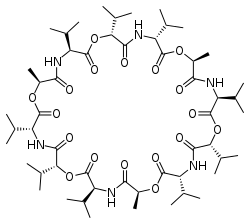
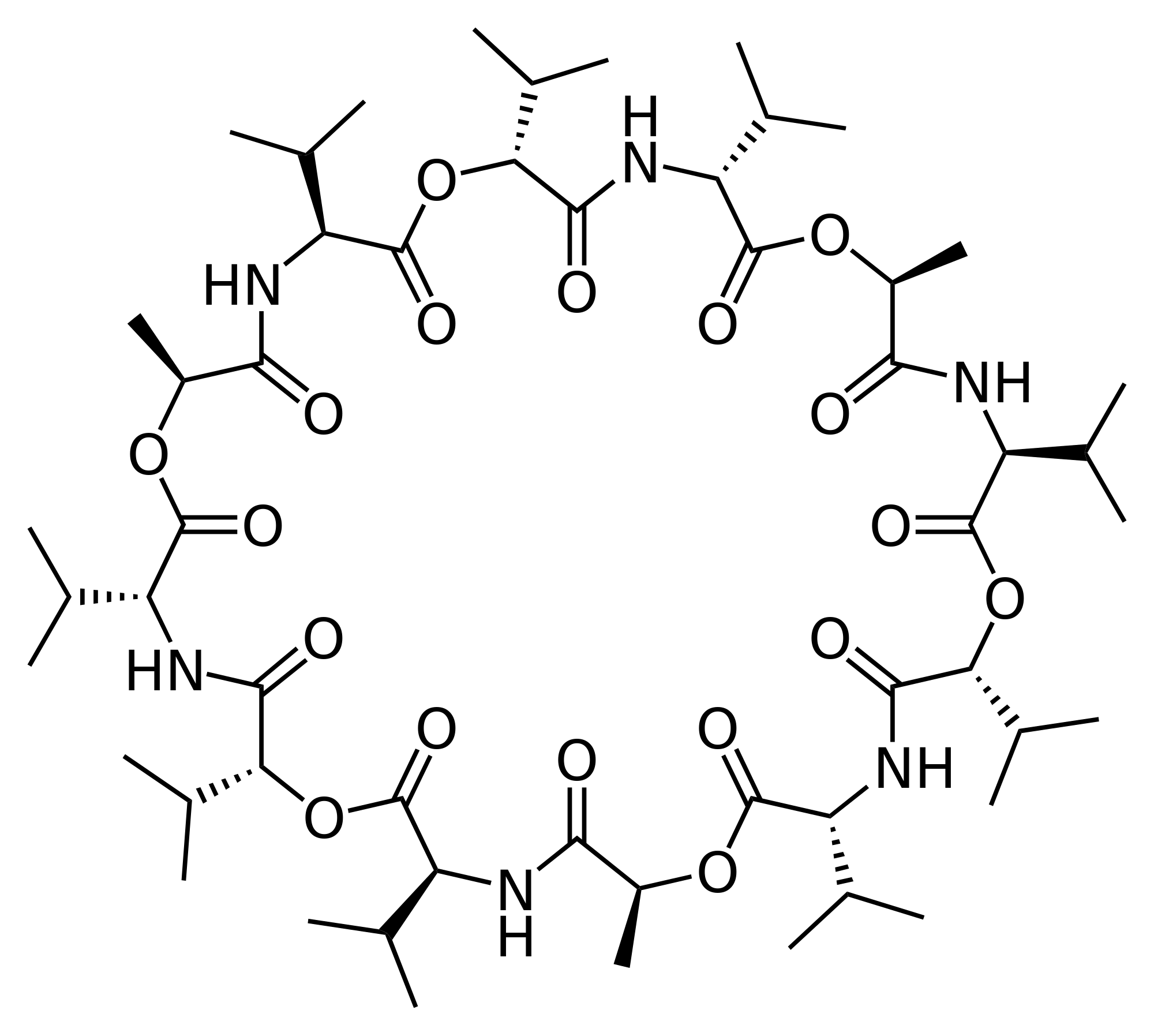
Skeletal formula of valinomycin
Ball-and-stick model of the valinomycin molecule
Names
IUPAC name
cyclo[N-oxa-D-alanyl-D-valyl-N-oxa-L-valyl-D-valyl-N-oxa-D-alanyl-D-valyl-N-oxa-L-valyl-L-valyl-N-oxa-L-alanyl-L-valyl-N-oxa-L-valyl-L-valyl]
Identifiers
3D model (JSmol)
ChEBI
ChEMBL
ChemSpider
DrugBank
ECHA InfoCard 100.016.270 Edit this at Wikidata
EC Number
  • 217-896-6
UNII
UN number 2811 2588
  • InChI=1S/C54H90N6O18/c1-22(2)34-49(67)73-31(19)43(61)55-38(26(9)10)53(71)77-41(29(15)16)47(65)59-36(24(5)6)51(69)75-33(21)45(63)57-39(27(11)12)54(72)78-42(30(17)18)48(66)60-35(23(3)4)50(68)74-32(20)44(62)56-37(25(7)8)52(70)76-40(28(13)14)46(64)58-34/h22-42H,1-21H3,(H,55,61)(H,56,62)(H,57,63)(H,58,64)(H,59,65)(H,60,66)/t31-,32-,33-,34+,35+,36+,37-,38-,39-,40+,41+,42+/m0/s1 ☒N
    Key: FCFNRCROJUBPLU-DNDCDFAISA-N ☒N
  • InChI=1S/C54H90N6O18/c1-22(2)34-49(67)73-31(19)43(61)55-38(26(9)10)53(71)77-41(29(15)16)47(65)59-36(24(5)6)51(69)75-33(21)45(63)57-39(27(11)12)54(72)78-42(30(17)18)48(66)60-35(23(3)4)50(68)74-32(20)44(62)56-37(25(7)8)52(70)76-40(28(13)14)46(64)58-34/h22-42H,1-21H3,(H,55,61)(H,56,62)(H,57,63)(H,58,64)(H,59,65)(H,60,66)/t31-,32-,33+,34-,35+,36+,37-,38-,39+,40+,41+,42+/m1/s1
    Key: FCFNRCROJUBPLU-DNDCDFAIBE
  • [1]: C[C@@H]1C(=O)N[C@@H](C(=O)O[C@H](C(=O)N[C@@H](C(=O)O[C@@H](C(=O)N[C@@H](C(=O)O[C@H](C(=O)N[C@H](C(=O)O[C@H](C(=O)N[C@H](C(=O)O[C@H](C(=O)N[C@H](C(=O)O1)C(C)C)C(C)C)C(C)C)C)C(C)C)C(C)C)C(C)C)C)C(C)C)C(C)C)C(C)C
Properties
C54H90N6O18
Molar mass 1111.338 g·mol−1
Appearance White solid
Melting point 190 °C (374 °F; 463 K)
Solubility Methanol, ethanol, ethyl acetate, petrol-ether, dichloromethane
UV-vismax) 220 nm
Hazards
Occupational safety and health (OHS/OSH):
Main hazards
Neurotoxicant
GHS labelling:
GHS06: Toxic
Danger
H300, H310
P262, P264, P270, P280, P301+P310, P302+P350, P310, P321, P322, P330, P361, P363, P405, P501
Lethal dose or concentration (LD, LC):
4 mg/kg (oral, rat)[1]
Except where otherwise noted, data are given for materials in their standard state (at 25 °C [77 °F], 100 kPa).
☒N verify (what is checkY☒N ?)

Valinomycin is a naturally occurring dodecadepsipeptide used in the transport of potassium and as an antibiotic. Valinomycin is obtained from the cells of several Streptomyces species, S. fulvissimus being a notable one.

It is a member of the group of natural neutral ionophores because it does not have a residual charge. It consists of the enantiomers D- and L-valine (Val), D-alpha-hydroxyisovaleric acid, and L-lactic acid. Structures are alternately bound via amide and ester bridges. Valinomycin is highly selective for potassium ions over sodium ions within the cell membrane.[2] It functions as a potassium-specific transporter and facilitates the movement of potassium ions through lipid membranes "down" the electrochemical potential gradient.[3] The stability constant K for the potassium-valinomycin complex is nearly 100,000 times larger than that of the sodium-valinomycin complex.[4] This difference is important for maintaining the selectivity of valinomycin for the transport of potassium ions (and not sodium ions) in biological systems.

It is classified as an extremely hazardous substance in the United States as defined in Section 302 of the U.S. Emergency Planning and Community Right-to-Know Act (42 U.S.C. 11002), and is subject to strict reporting requirements by facilities which produce, store, or use it in significant quantities.[5]

Structure

[edit]

Valinomycin is a dodecadepsipeptide, that is, it is made of twelve alternating amino acids and esters to form a macrocyclic molecule. The twelve carbonyl groups are essential for the binding of metal ions, and also for solvation in polar solvents. The isopropyl and methyl groups are responsible for solvation in nonpolar solvents. [6] Along with its shape and size this molecular duality is the main reason for its binding properties. K ions must give up their water of hydration to pass through the pore. K+ ions are octahedrally coordinated in a square bipyramidal geometry by 6 carbonyl bonds from Val. In this space of 1.33 Angstrom, Na+ with its 0.95 Angstrom radius, is significantly smaller than the channel, meaning that Na+ cannot form ionic bonds with the amino acids of the pore at equivalent energy as those it gives up with the water molecules. This leads to a 10,000x selectivity for K+ ions over Na+. For polar solvents, valinomycin will mainly expose the carbonyls to the solvent and in nonpolar solvents the isopropyl groups are located predominantly on the exterior of the molecule. This conformation changes when valinomycin is bound to a potassium ion. The molecule is "locked" into a conformation with the isopropyl groups on the exterior [Citation Needed]. It is not actually locked into configuration because the size of the molecule makes it highly flexible, but the potassium ion gives some degree of coordination to the macromolecule.

Applications

[edit]

Valinomycin was recently reported to be the most potent agent against severe acute respiratory-syndrome coronavirus (SARS-CoV) in infected Vero E6 cells.[7] Valinomycin has been shown to inhibit completely vaccinia virus in cell based assay in human cell line.[8]

Valinomycin acts as a nonmetallic isoforming agent in potassium selective electrodes.[9][10]

This ionophore is used to study membrane vesicles, where it may be selectively applied by experimental design to reduce or eliminate the electrochemical gradient across a membrane.[citation needed]

References

[edit]
[edit]
Revisions and contributorsEdit on WikipediaRead on Wikipedia
from Grokipedia
Valinomycin is a nonribosomal cyclododecadepsipeptide with the molecular formula C₅₄H₉₀N₆O₁₈ and a molecular weight of 1111.3 g/mol, produced by the bacterium fulvissimus. It functions primarily as a selective , facilitating the transport of K⁺ ions across membranes by forming a stable complex that disrupts cellular ion gradients and membrane potentials. First isolated in 1955 from fermentation broths of species by researchers Heinrich Brockmann and Gerhard Schmidt-Kastner, valinomycin's was initially proposed in 1957 and later refined through and spectroscopic analyses. The molecule consists of a 36-membered macrocyclic ring composed of three repeating units of D-valine, L-valine, D-hydroxyisovaleric acid, and L-lactic acid, creating a bracelet-like conformation with a hydrophobic exterior and a polar interior cavity that specifically coordinates ions via oxygen atoms from and carbonyl groups. Valinomycin exhibits broad-spectrum biological activities, including potent antibacterial effects against by dissipating , antifungal properties against species like Candida albicans, and antiviral activity, such as an EC₅₀ of 0.85 μM against SARS-CoV-2. It also demonstrates insecticidal efficacy and antitumor potential, inducing in cancer cells like ovarian carcinoma (CaOV-3) with an IC₅₀ of 0.1 nM through mitochondrial membrane disruption. Despite its toxicity limiting clinical use, valinomycin has applications in biochemical research as a tool for studying ion transport and in for heterologous production in hosts like , yielding up to 13 mg/L. Its biosynthesis involves a synthetase (NRPS) complex, enabling engineering for novel analogs.

Chemical Properties

Molecular Structure

Valinomycin is a dodecadepsipeptide antibiotic characterized by a cyclic structure composed of twelve residues arranged in three repeating tetrameric units: D-α-hydroxyisovaleryl-D-valyl-L-lactyl-L-valyl. This arrangement incorporates three molecules each of D-valine, L-valine, L-lactic acid, and D-α-hydroxyisovaleric acid, with alternating amide (peptide) and ester linkages that form a 36-membered macrocyclic ring. The molecular formula of valinomycin is \ceC54H90N6O18\ce{C54H90N6O18}, with a molecular weight of approximately 1111.3 g/mol. In its three-dimensional conformation, valinomycin adopts a bracelet-like when complexed with ions, featuring a central polar cavity lined by six carbonyl oxygen atoms from the groups, which coordinate the bound cation. The exterior surface is hydrophobic, primarily due to the outward-facing isopropyl and methyl side chains of the and residues, facilitating solubility in membranes. This architecture creates a selective internal approximately 1.3–1.4 in radius, optimized for ions. The specific of the residues—alternating and configurations—plays a crucial role in enabling this conformation and the resulting selectivity for binding. The chiral arrangement ensures that the backbone folds into a , pseudo-threefold symmetric , where the oxygen atoms are positioned to encircle and dehydrate the potassium ion effectively, while excluding smaller ions like sodium due to cavity size constraints. This stereochemical precision arises from the natural biosynthetic incorporation of these enantiomers, contributing to the molecule's ionophoric efficiency.

Physical and Chemical Characteristics

Valinomycin appears as a crystalline at and has a of 190 °C. This compound is highly lipophilic, with negligible solubility in but good solubility in various organic solvents, including (approximately 50 mg/mL), (5 mg/mL), DMSO (10–50 mg/mL), and DMF (30 mg/mL). Its (log P) is 9.1, underscoring its strong affinity for nonpolar environments and membrane partitioning behavior. Valinomycin exhibits long-term when stored as a lyophilized powder at -20 °C in a dry, desiccated environment, remaining viable for at least 24 months without significant degradation, as evidenced by consistent and data across samples of varying ages. The compound displays characteristic spectroscopic properties, including UV absorption maxima in the 206–229 nm range due to peptide bonds. (NMR) spectroscopy reveals distinct proton signals (e.g., 0.8–5.5 ppm range for aliphatic and protons) and carbon shifts confirming the depsipeptide framework, while (IR) spectra show key absorption bands at approximately 1650 cm⁻¹ ( carbonyl) and 1730 cm⁻¹ ( carbonyl), validating the cyclic ester- structure.

Biological Production

Discovery and History

Valinomycin was first isolated in 1955 from the mycelium of fulvissimus by Heinrich Brockmann and Gerhard Schmidt-Kastner at the , who identified it as a novel effective against pathogenic fungi such as Trichophyton gypseum and , as well as species. This discovery occurred during the of screening from soil actinomycetes, highlighting valinomycin's potential as an agent. In the late 1950s and early 1960s, further studies characterized valinomycin's antibacterial activity against select , including and species, though its antifungal properties remained prominent. Researchers at pharmaceutical firms, including early investigations by groups exploring depsipeptide antibiotics, noted its broad-spectrum potential but limited clinical development due to toxicity concerns. The complete structure of valinomycin was elucidated in 1963 by Mikhail M. Shemyakin and colleagues at the Shemyakin–Ovchinnikov Institute of Bioorganic Chemistry, revealing it as a 36-membered cyclic dodecadepsipeptide (C54H90N6O18) with three repeating units of L-valyl-D-α-hydroxyisovaleryl-L-lactoyl-D-valine. This breakthrough, based on degradative analysis and synthesis, was later corroborated by of its complex in 1969. In 1967, Bernard C. Pressman at the Johnson Research Foundation demonstrated valinomycin's role as a potassium-specific , selectively facilitating K+ transport across lipid bilayers and mitochondria, which explained its uncoupling effects on . This recognition marked a turning point, integrating valinomycin into foundational studies of homeostasis and membrane permeability during the 1960s–1970s, influencing Nobel-recognized advances in (e.g., 1991 to Neher and Sakmann for discoveries on ion channels). Valinomycin has seen no major regulatory approvals as a or therapeutic agent; it remains unapproved under EU Regulation 1107/2009 and unregistered as a by the U.S. EPA as of 2025, primarily due to its high and narrow therapeutic window.

Biosynthesis

Valinomycin is primarily produced by various species of the Streptomyces, including S. fulvissimus and S. griseus, through a specialized biosynthetic pathway in these soil-dwelling actinobacteria. These microorganisms assemble the cyclic depsipeptide as a , leveraging nonribosomal peptide synthesis to incorporate and hydroxy acids without reliance on ribosomal machinery. The biosynthesis proceeds via a synthetase (NRPS) pathway involving a large multimodular complex called valinomycin synthetase, or the Vlm complex, composed of two subunits: Vlm1 (approximately 370 ) and Vlm2 (approximately 284 ). The process initiates with the adenylation (A) domains activating and loading L-valine onto peptidyl carrier protein (PCP) domains, followed by iterative cycles that incorporate additional substrates such as pyruvate (converted to L-lactate via ketoreductase, KR, activity), α-ketoisovalerate (reduced to D-hydroxyisovaleric acid), and more L-valine (epimerized to D-valine by the epimerization, E, domain). (C) domains then alternate the formation of and bonds between these units, building a linear tetrameric precursor of three valyl and one hydroxyisovaleryl/lactyl units per cycle, repeated thrice for the dodecameric structure. The thioesterase (TE) domain of Vlm2 catalyzes the final cyclization and release, yielding the 36-membered macrocyclic ring. The underlying genetics reside in the vlm gene cluster, a conserved locus exceeding 19 kb that encodes the NRPS modules (vlm1 and vlm2), along with supporting genes such as a type II thioesterase (vlmTEII) for proofreading misloaded substrates and enhancing efficiency. This cluster is highly similar across producing Streptomyces strains, reflecting evolutionary conservation, and its expression is influenced by environmental factors, including nutrient availability and elicitors; for example, bacterial and yeast extracts can boost production, while fungal elicitors suppress it. Laboratory efforts to optimize valinomycin yields have focused on conditions and , particularly in strains like Streptomyces sp. ZJUT-IFE-354 and S. tsusimaensis. Through for medium optimization (e.g., adjusting carbon sources, , and inducers), titers have reached up to 457 mg/L in submerged fermentation, representing a significant improvement over wild-type levels. Genetic modifications, such as deleting competing pathway genes or "stapling" NRPS modules to improve stability and activity, have further elevated production to approximately 2.8 mg/L in engineered heterologous hosts like , with optimized systems achieving up to 13 mg/L through coexpression of supporting enzymes like TEII; cell-free systems enabling rapid prototyping and yields of around 30 mg/L via coupled transcription-translation. As of 2025, these strategies continue to evolve, emphasizing in non-native hosts like to scale up for research applications.

Mechanism of Action

Ionophoric Activity

Valinomycin functions as a carrier , facilitating the selective transport of ions (K⁺) across bilayers by forming a lipophilic complex with the . This selectivity arises from the ion's coordination within the depsipeptide cavity, where six carbonyl oxygen atoms form an octahedral complex around K⁺, with a of approximately 10⁶ M⁻¹, compared to only 10¹ M⁻¹ for Na⁺, yielding a selectivity of about 10,000:1 for K⁺ over Na⁺. The transport mechanism involves the neutral valinomycin-K⁺ complex, which is highly soluble in the hydrophobic core of the membrane due to the surrounding nonpolar residues. The free valinomycin binds K⁺ on one side of the bilayer, forming the complex that diffuses across the membrane; upon reaching the opposite side, the ion is released in response to the , and the carrier returns to repeat the cycle. This mobile carrier model contrasts with channel-forming ionophores like , which create aqueous pores for continuous ion flow rather than shuttling discrete complexes. Valinomycin confers high membrane permeability to K⁺, enabling rapid equilibration of K⁺ across the . In conditions of high external K⁺ concentration, this activity promotes K⁺ efflux, depolarizing the toward the equilibrium potential (E_K), as described by the : EK=RTFln([K+]out[K+]in)E_K = \frac{RT}{F} \ln \left( \frac{[K^+]_{out}}{[K^+]_{in}} \right) where R is the , T is , F is Faraday's constant, and [K⁺]out and [K⁺]in are the external and internal concentrations, respectively.

Cellular and Physiological Effects

Valinomycin disrupts in cells by facilitating selective K⁺ transport across , leading to altered membrane potentials. In excitable cells such as pancreatic beta cells, this increased K⁺ permeability causes membrane hyperpolarization, which inhibits electrical activity and blocks generation. Specifically, exposure to 100 nM valinomycin results in complete suppression of spike activity within minutes, accompanied by an average hyperpolarization of 10 mV, thereby preventing necessary for cellular excitation. In eukaryotic cells, valinomycin induces through mitochondrial K⁺ influx, which dissipates the mitochondrial and impairs ATP synthesis while elevating (ROS) production. This process begins with rapid loss of mitochondrial ΔΨm, followed by cytoplasmic acidification that activates proteases, ultimately leading to in cell lines like murine pre-B cells. The K⁺ influx also promotes mitochondrial swelling, as observed in liver mitochondria where valinomycin stimulates energy-dependent, reversible swelling supported by succinate oxidation. Additionally, this uncouples , reducing cellular energy efficiency and secondarily inhibiting processes like protein synthesis in synaptosomes by depleting ATP. Valinomycin exhibits potent antibacterial effects primarily against by collapsing the proton motive force, which inhibits growth and disrupts energetics. Its activity is -dependent, with highest efficacy at alkaline where the (ΔΨ) predominates, as demonstrated against like and . In these , valinomycin-mediated K⁺ transport dissipates ΔΨ, leading to depolarization that halts essential processes reliant on the . Studies in liver cells further highlight inhibition, such as reduced respiration due to K⁺ loss and uncoupling, underscoring broader physiological impacts on energy metabolism.

Applications

Research and Laboratory Uses

Valinomycin serves as a key tool in patch-clamp for studying (K⁺) channels and membrane potentials by increasing membrane permeability to K⁺, thereby clamping the potential near the K⁺ equilibrium potential (E_K). This allows researchers to isolate channel currents without interference from other , as demonstrated in studies of Na⁺ transport in colonic vesicles where valinomycin with K⁺ reduced H⁺ gradient-dependent uptake by approximately 45%. In whole-cell configurations, it facilitates precise control of ionic gradients, enabling detailed analysis of voltage-gated channel kinetics and selectivity in neuronal and epithelial cells. As a prototypical ionophore, valinomycin is widely employed as a model in studies of across artificial bilayers and liposomes, providing insights into carrier-mediated mechanisms. Its high selectivity for K⁺ over Na⁺ (selectivity ratio >10,000:1) enables quantification of electrogenic rates and ion-pairing dynamics in systems, such as phosphatidylcholine bilayers where it forms stable complexes facilitating K⁺ translocation. Experiments with supported bilayers and giant unilamellar vesicles have used valinomycin to mimic biological channels, revealing how and composition influence insertion and conductance, with single-channel currents reaching 100-200 pS in K⁺-containing electrolytes. Recent applications include its use in electrochemical sensors for detection in , leveraging its selectivity. In mitochondrial research, valinomycin induces K⁺/H⁺ exchange to probe respiratory chain function by dissipating the proton motive force and uncoupling . Addition of valinomycin with K⁺ promotes massive K⁺ influx, leading to matrix swelling and stimulation of electron transport rates up to 5-10 fold, which helps quantify H⁺/site stoichiometries (typically 4 H⁺ per 2 electrons in succinate oxidation). This approach has been instrumental in elucidating mechanisms, as seen in rat liver mitochondria where valinomycin-mediated K⁺ uptake correlates with H⁺ ejection ratios approaching 2:1 under state-4 respiration. Valinomycin exhibits applications in cell biology for selectively inducing K⁺ imbalance in cancer cells, promoting through mitochondrial disruption in combination therapies. In models, liposomal valinomycin enhances cytotoxicity by 2-5 fold via K⁺ efflux-induced , selectively targeting multidrug-resistant lines while sparing normal cells at equivalent doses. Similarly, in neuroblastoma xenografts, it downregulates MYCN expression and synergizes with standard chemotherapeutics, achieving tumor regression rates of 50-70% through K⁺-dependent overload in transformed cells. Laboratory protocols for valinomycin typically employ concentrations from 1-100 nM for electrophysiological and mitochondrial assays to avoid non-specific effects, escalating to 0.1-5 μM in for toxicity studies. In patch-clamp setups, it is dissolved in DMSO (stock 10 mM) and added to the bath solution at 10-50 nM with 5-140 mM KCl to equilibrate potentials, monitored via current-voltage ramps. For or bilayer experiments, 0.1-1 μM is incorporated during vesicle formation, with transport assessed by ion-sensitive dyes or fluorescence over 10-30 minutes. In treatments, 1-10 μM is applied for 24-48 hours in serum-free media, often combined with 5-50 μM chemotherapeutics, with viability quantified by MTT assays.

Industrial and Potential Therapeutic Applications

Valinomycin is produced industrially through microbial fermentation processes, primarily using Streptomyces species such as S. fulvissimus or S. lavendulae, with optimized conditions achieving titers up to 457 mg/L in shake-flask cultures and over 2 mg/L in bench-scale bioreactors via fed-batch strategies in engineered Escherichia coli. These methods leverage nonribosomal peptide synthetase gene clusters for scalable biosynthesis, enabling commercial availability for specialized applications despite challenges in achieving higher yields for mass production. In agricultural contexts, valinomycin serves as a for controlling and fungi by disrupting potassium gradients in target organisms, though it is not registered as a . Its ionophoric activity induces rapid membrane , leading to and death in nematodes and certain larvae, with demonstrated efficacy against species like plant-parasitic nematodes in experimental settings. Therapeutically, valinomycin shows potential in anticancer applications through synergistic interactions with chemotherapeutics, enhancing tumor cell death by amplifying mitochondrial potassium efflux and apoptosis induction; for instance, liposomal formulations combined with cisplatin exhibit up to 90% cell kill in ovarian cancer lines via median-effect analysis. In veterinary medicine, it has limited use against protozoan pathogens like Babesia gibsoni in canines, where it inhibits parasite proliferation in erythrocytes without broad adoption due to toxicity concerns. Ongoing structure-activity relationship studies focus on developing less toxic analogs, such as hydroxylated variants, to improve selectivity and reduce off-target effects while retaining ionophoric potency; computational analyses reveal that modifications at specific depsipeptide positions lower activation energies for , guiding rational design for safer therapeutic candidates.

Toxicity and Safety

Toxicity Profile

Valinomycin demonstrates high in animal models, particularly through parenteral routes. The intravenous LD50 in mice is approximately 0.18 mg/kg, indicating severe systemic effects at low doses. This toxicity manifests primarily as , driven by disruption of , which leads to cardiac arrhythmias and failure due to altered potentials in cardiomyocytes. In vitro studies reveal potent cytotoxicity of valinomycin across various cell lines, attributed to mitochondrial dysfunction from transport across membranes. For instance, the in cells is 0.001 μM after 72 hours of exposure, reflecting rapid induction of via collapse of the mitochondrial . Similar low micromolar or nanomolar values are observed in hepatic (HepG2) and other cell lines, underscoring its broad cytolytic potential. Organ-specific toxicity includes and , stemming from ion dysregulation that impairs mitochondrial function in these tissues. In models, valinomycin treatment results in membrane depolarization and elevated , contributing to liver cell damage. Limited data on renal effects suggest potential tubular injury, though valinomycin does not exacerbate when combined with agents like in xenograft models. It induces DNA double-strand breaks in mammalian cells (e.g., HeLa and CHO-K1) as detected by γH2AX , likely secondary to mitochondrial stress rather than direct DNA interaction; no data are available on genotoxicity in bacterial assays such as the , and carcinogenicity remains unstudied, particularly for chronic exposures. In laboratory contexts, primary exposure routes are dermal contact and , both enabling rapid absorption and systemic distribution, with dermal LD50 values around 5 mg/kg in rabbits.

Safety and Environmental Considerations

Valinomycin is classified under the Globally Harmonized System (GHS) as acutely toxic by the oral and dermal routes (H300: Fatal if swallowed; H310: Fatal in contact with skin), requiring stringent handling precautions in laboratory environments. Personnel must use appropriate , including chemical-resistant gloves, protective clothing, safety goggles, and face shields, to prevent skin and eye contact. Handling should occur exclusively in a well-ventilated to minimize risks, with immediate of spills using absorbent materials followed by thorough cleaning. In the and , valinomycin is not approved for use as a under Regulation (EC) No 1107/2009 and is designated as a highly hazardous (Types I and II), restricting its application to purposes with environmental safeguards. In the United States, it lacks registration as a with the Agency (EPA) and is regulated primarily as a under the Toxic Substances Control Act (TSCA). These classifications emphasize controlled distribution and use to prevent unintended exposure or release. Environmental data for valinomycin remain limited, but its high (log P = 4.49) suggests significant potential in organisms. Certain safety assessments classify it as toxic to aquatic life with long-lasting effects (H411), indicating moderate ecological upon release, though specific ecotoxicity metrics such as LC50 values for or are unavailable. No detailed studies on adsorption, aqueous mobility, or kinetics (e.g., microbial ) were identified, underscoring the need for caution to avoid environmental . Waste management involves treatment as hazardous material, with at licensed facilities recommended to ensure complete destruction and prevent persistence in ecosystems. Advancements in , including cell-free expression systems, enable heterologous production and engineering for novel analogs, potentially reducing reliance on resource-intensive . As of November 2025, no major updates to the profile from or large-scale animal studies have been reported, though research continues into mitigated formulations for therapeutic applications.

References

Add your contribution
Related Hubs
User Avatar
No comments yet.