Hubbry Logo
Variable-range hoppingVariable-range hoppingMain
Open search
Variable-range hopping
Community hub
Variable-range hopping
logo
7 pages, 0 posts
0 subscribers
Be the first to start a discussion here.
Variable-range hopping
from Wikipedia

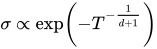
Variable-range hopping is a model used to describe carrier transport in a disordered semiconductor or in amorphous solid by hopping in an extended temperature range.[1] It has a characteristic temperature dependence of
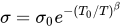
where is the conductivity and is a parameter dependent on the model under consideration.

Mott variable-range hopping

[edit]

The Mott variable-range hopping describes low-temperature conduction in strongly disordered systems with localized charge-carrier states[2] and has a characteristic temperature dependence of
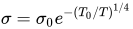
for three-dimensional conductance (with = 1/4), and is generalized to d-dimensions

.

Hopping conduction at low temperatures is of great interest because of the savings the semiconductor industry could achieve if they were able to replace single-crystal devices with glass layers.[3]

Derivation

[edit]

The original Mott paper introduced a simplifying assumption that the hopping energy depends inversely on the cube of the hopping distance (in the three-dimensional case). Later it was shown that this assumption was unnecessary, and this proof is followed here.[4] In the original paper, the hopping probability at a given temperature was seen to depend on two parameters, R the spatial separation of the sites, and W, their energy separation. Apsley and Hughes noted that in a truly amorphous system, these variables are random and independent and so can be combined into a single parameter, the range between two sites, which determines the probability of hopping between them.

Mott showed that the probability of hopping between two states of spatial separation and energy separation W has the form:

where α−1 is the attenuation length for a hydrogen-like localised wave-function. This assumes that hopping to a state with a higher energy is the rate limiting process.

We now define , the range between two states, so . The states may be regarded as points in a four-dimensional random array (three spatial coordinates and one energy coordinate), with the "distance" between them given by the range .

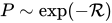
Conduction is the result of many series of hops through this four-dimensional array and as short-range hops are favoured, it is the average nearest-neighbour "distance" between states which determines the overall conductivity. Thus the conductivity has the form
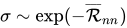
where is the average nearest-neighbour range. The problem is therefore to calculate this quantity.

The first step is to obtain , the total number of states within a range of some initial state at the Fermi level. For d-dimensions, and under particular assumptions this turns out to be


where . The particular assumptions are simply that is well less than the band-width and comfortably bigger than the interatomic spacing.

Then the probability that a state with range is the nearest neighbour in the four-dimensional space (or in general the (d+1)-dimensional space) is

the nearest-neighbour distribution.

For the d-dimensional case then

.

This can be evaluated by making a simple substitution of into the gamma function,

After some algebra this gives
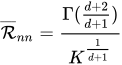
and hence that

.

Non-constant density of states

[edit]

When the density of states is not constant (odd power law N(E)), the Mott conductivity is also recovered, as shown in this article.

Efros–Shklovskii variable-range hopping

[edit]

The Efros–Shklovskii (ES) variable-range hopping is a conduction model which accounts for the Coulomb gap, a small jump in the density of states near the Fermi level due to interactions between localized electrons.[5] It was named after Alexei L. Efros and Boris Shklovskii who proposed it in 1975.[5]

The consideration of the Coulomb gap changes the temperature dependence to
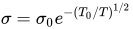
for all dimensions (i.e. = 1/2).[6][7]

See also

[edit]

Notes

[edit]
Revisions and contributorsEdit on WikipediaRead on Wikipedia
from Grokipedia
Variable-range hopping (VRH) is a theoretical model describing electrical conduction in disordered solids, such as amorphous semiconductors and lightly doped crystalline insulators, at low temperatures, where charge carriers transport via thermally activated hops between localized electronic states, with the characteristic hopping distance increasing as temperature decreases to optimize the trade-off between spatial separation and energy mismatch relative to the . This mechanism dominates when the is insufficient for carriers to overcome barriers to nearest-neighbor sites, favoring longer-range hops to more energetically favorable distant sites within the localized state manifold. VRH was first proposed by British Nevill F. Mott in 1969 to explain conduction in non-crystalline materials exhibiting activated but weakly temperature-dependent resistivity. In Mott's original formulation, assuming a constant density of states N(EF)N(E_F) at the Fermi energy EFE_F and exponential localization of wavefunctions with inverse length α\alpha, the DC conductivity in three dimensions follows the relation σ(T)=σ0exp[(T0T)1/4],\sigma(T) = \sigma_0 \exp\left[ -\left( \frac{T_0}{T} \right)^{1/4} \right], where σ0\sigma_0 is a prefactor on the order of the extended-state conductivity, TT is temperature, and the characteristic temperature T0=18kBN(EF)α3T_0 = \frac{18}{k_B N(E_F) \alpha^3} incorporates the localization length α\alpha and Boltzmann constant kBk_B. This T1/4T^{-1/4} dependence generalizes to T1/(d+1)T^{-1/(d+1)} in dd dimensions, distinguishing VRH from nearest-neighbor hopping, which yields a simple Arrhenius form σexp(Ea/kBT)\sigma \propto \exp(-E_a / k_B T) with fixed activation energy EaE_a. In 1975, A. L. Efros and B. I. Shklovskii refined the model by incorporating long-range Coulomb interactions between localized electrons, which suppress the density of states near EFE_F over an energy scale of order e2α/κe^2 \alpha / \kappa (with dielectric constant κ\kappa), creating a "Coulomb gap" and altering the hopping energetics. The Efros-Shklovskii (ES) VRH regime predicts a dimension-independent dependence σ(T)=σ0exp[(T0T)1/2],\sigma(T) = \sigma_0 \exp\left[ -\left( \frac{T_0}{T} \right)^{1/2} \right], with T0e2κkBaT_0 \approx \frac{e^2}{\kappa k_B a}, where aa is a characteristic localization radius, typically observable at lower s or higher disorder than Mott VRH, with crossovers between the two regimes depending on parameters like carrier and . VRH conduction has been experimentally verified in diverse systems, including chalcogenide glasses, impurity bands in doped semiconductors, granular metals, and colloidal films, where it governs below characteristic temperatures often in the range of 1–100 K. Extensions of VRH incorporate magnetic fields, which can suppress the gap and induce Mott-like behavior, as well as finite-size effects in low-dimensional nanostructures.

Physical Background

Hopping Conduction Mechanism

In disordered materials, such as amorphous semiconductors and doped insulators, charge transport at low temperatures primarily occurs through hopping conduction, where charge carriers move between localized electronic states rather than extended band states. This mechanism dominates when the thermal energy is insufficient to excite carriers into delocalized states above the mobility edge, leading to thermally activated transitions between sites within the localized state regime. The process involves phonon-assisted tunneling, allowing carriers to overcome energy barriers between sites of varying energies and positions. The physical basis for hopping arises from the inherent disorder in these systems, which causes wavefunctions to localize below the mobility edge—a boundary separating extended and localized states. In such insulators or semiconductors, random potentials from impurities or structural irregularities result in an of wavefunctions, characterized by a localization 1/α1/\alpha, preventing diffusive band-like motion and confining carriers to finite regions. This localization phenomenon, fundamentally tied to disorder, ensures that direct overlaps between distant states are negligible, making sequential hops the primary transport pathway. As a baseline, nearest-neighbor hopping (NNH) describes transport where carriers primarily jump to the closest localized sites, with the dictated by the energy difference between the initial site ii and the neighboring site jj. The transition rate for such hops is captured by the Miller-Abrahams formula, which accounts for both the spatial overlap and the energetic barrier: νij=ν0exp(2αrij)exp(EjEikT)for Ej>Ei,νij=ν0exp(2αrij)for EjEi,\begin{align} \nu_{ij} &= \nu_0 \exp(-2\alpha r_{ij}) \exp\left(-\frac{E_j - E_i}{kT}\right) \quad \text{for } E_j > E_i, \\ \nu_{ij} &= \nu_0 \exp(-2\alpha r_{ij}) \quad \text{for } E_j \leq E_i, \end{align} where ν0\nu_0 is the phonon frequency (attempt rate), α\alpha is the inverse localization length, rijr_{ij} is the inter-site distance, EiE_i and EjE_j are the site energies, kk is Boltzmann's constant, and TT is the . This rate emphasizes that downhill hops (lower ) occur more readily without beyond tunneling. At lower temperatures, where kTkT becomes comparable to or smaller than the typical spacing between nearest-neighbor sites, the NNH model becomes inefficient due to high barriers. Carriers then favor variable-range hops to more distant sites that offer smaller mismatches, trading increased tunneling probability (via larger rijr_{ij}) for reduced . This optimization balances spatial and energetic costs, enabling conduction over varying ranges that grow with decreasing , thus transitioning from fixed-range NNH to variable-range hopping (VRH).

Localized States in Disordered Systems

In disordered systems, such as lattices with random potentials, wavefunctions can become localized due to quantum interference effects, preventing classical and leading to insulating behavior. This phenomenon, known as , was first theoretically described in three dimensions by in 1958, where he modeled transport in an "impurity band" of a lattice with randomly placed impurities, showing that sufficiently strong disorder confines wavefunctions to finite regions rather than allowing them to extend throughout the material. The localization arises from the random potential landscape created by disorder, which disrupts the coherence of electron propagation; in three-dimensional systems, wavefunctions decay exponentially away from their centers, with a localization that decreases as disorder strength increases. Below a critical energy threshold, known as the mobility edge, all states are localized, while above it, states become extended and conductive; this energy-dependent transition was proposed by N.F. Mott to distinguish the regime where can propagate freely from one where they are trapped. At low temperatures, the typically lies within the localized state regime in moderately disordered materials, suppressing metallic conduction and favoring thermally activated processes. In disordered semiconductors, localized states emerge prominently due to structural imperfections, including impurities, defects, and the absence of long-range order in amorphous structures. Impurities introduce potential fluctuations that trap electrons in bound states within the bandgap, while defects such as dangling bonds or coordination irregularities in amorphous networks, like (a-Si:H), create deep gap states that further contribute to localization. The amorphous structure itself, lacking periodic translation , broadens the into tails of localized states extending into the gap, arising from variations in local bonding and atomic positions. The (DOS) in these systems reflects this disorder, often exhibiting exponential tails near the band edges due to the statistical distribution of potential fluctuations from defects and amorphous topology. For the Mott variable-range hopping model, the DOS is typically assumed to be nearly constant near the within the localized regime, providing a of states available for thermal activation, though real materials show these exponential tails dominating transport properties at low energies.

Mott Variable-Range Hopping

Core Assumptions

The Mott variable-range hopping (VRH) model describes charge transport in disordered materials at low temperatures, where electrons hop between localized states over varying distances to minimize the barrier. Proposed by Nevill Mott in 1969 as an extension of his work on conduction in amorphous semiconductors, the model emphasizes that at sufficiently low temperatures, nearest-neighbor hopping becomes improbable due to high energies, favoring longer-range hops that trade increased spatial separation for reduced energy mismatches. A foundational assumption is a constant density of states g(E)=g0g(E) = g_0 near the Fermi energy EFE_F, implying no significant pseudogap or depletion in available states at the relevant energies, which allows for the statistical estimation of optimal hopping paths. This constant g0g_0 enables the model to predict the availability of states within an energy window of order kTkT around EFE_F, without correlations depleting the spectrum. The model explicitly neglects electron-electron interactions, treating hopping as a single-particle process where occupied and unoccupied states exchange electrons independently of Coulomb effects. Hopping is phonon-assisted to conserve during transitions between non-resonant states, with phonons providing or absorbing the necessary difference EiEjkT|E_i - E_j| \approx kT for hops spanning distances much larger than the average inter-site separation. The localized states arise from spatial disorder in the material, such as random impurity potentials or structural irregularities, leading to exponentially decaying wavefunctions ψ(r)exp(αr)\psi(r) \sim \exp(-\alpha r), where α1\alpha^{-1} is the localization length characterizing the spatial extent of each state. This decay governs the tunneling probability, exponentially suppressing hops beyond a few localization lengths. The model applies in the low-temperature regime where kTkT is much smaller than the typical energy spacings between localized states near EFE_F, rendering direct thermal excitation to extended states negligible, yet allowing variable-range hops that optimize the trade-off between spatial and energetic barriers.

Derivation of Conductivity Law

The derivation of the conductivity law in Mott's variable-range hopping (VRH) model relies on a percolation theory framework to identify the dominant hopping paths that connect localized states across a macroscopic sample at low temperatures. In disordered systems with localized states, conduction occurs via phonon-assisted tunneling between sites, where the hopping rate between two sites separated by distance RR and energy difference WW is given by νexp(2αRWkT)\nu \propto \exp\left(-2\alpha R - \frac{W}{kT}\right), with α=1/ξ\alpha = 1/\xi the inverse localization ξ\xi, kk Boltzmann's constant, and TT . The overall conductivity σ\sigma is dominated by the bottleneck hops in a percolating network, corresponding to the maximum value of the exponent β=2αR+W/kT\beta = 2\alpha R + W/kT along the optimal path; minimizing this β\beta determines the temperature dependence. Under the core assumption of a constant density of states g0g_0 near the Fermi level, the typical energy WW required for a hop over distance RR is set by the condition that there is approximately one accessible state within a sphere of radius RR and an energy window of width WW. The volume of the sphere is V=43πR3V = \frac{4}{3} \pi R^3, so the number of states is g0VW1g_0 V W \approx 1, yielding W1g0V=34πg0R3.W \approx \frac{1}{g_0 V} = \frac{3}{4\pi g_0 R^3}. This relation reflects the percolation criterion in the simplest approximation, where the critical number of overlapping sites is order unity; more refined treatments adjust this to a percolation constant Bc2.8B_c \approx 2.8 for three-dimensional networks, but the form remains similar. Substituting into the exponent gives β(R)=2αR+34πg0kTR3.\beta(R) = 2\alpha R + \frac{3}{4\pi g_0 k T R^3}. To find the optimal hop distance RoptR_\mathrm{opt} that minimizes β\beta, differentiate with respect to RR: dβdR=2α94πg0kTR4=0,\frac{d\beta}{dR} = 2\alpha - \frac{9}{4\pi g_0 k T R^4} = 0, which solves to Ropt4=98παg0kT,Ropt=(98παg0kT)1/4.R_\mathrm{opt}^4 = \frac{9}{8\pi \alpha g_0 k T}, \quad R_\mathrm{opt} = \left( \frac{9}{8\pi \alpha g_0 k T} \right)^{1/4}. At this optimum, the two terms in β\beta satisfy 2αRopt=3WkT2\alpha R_\mathrm{opt} = 3 \frac{W}{kT}, so βmin=2αRopt+2αRopt3=83αRopt\beta_\mathrm{min} = 2\alpha R_\mathrm{opt} + \frac{2\alpha R_\mathrm{opt}}{3} = \frac{8}{3} \alpha R_\mathrm{opt}. Substituting RoptR_\mathrm{opt} yields βmin(1/T)1/4\beta_\mathrm{min} \propto (1/T)^{1/4}. The minimal exponent is thus βmin=(T0/T)1/4\beta_\mathrm{min} = \left( T_0 / T \right)^{1/4}, where the characteristic temperature T0T_0 encapsulates the material parameters. In the standard form accounting for the percolation threshold, T0=18α3g0kT_0 = \frac{18 \alpha^3}{g_0 k}, leading to the conductivity σ=σ0exp[(T0T)1/4],\sigma = \sigma_0 \exp\left[ -\left( \frac{T_0}{T} \right)^{1/4} \right], with prefactor σ0\sigma_0 depending on microscopic details like phonon frequency and overlap integrals. This T0T_0 arises from refining the simple unity condition to g0kTVBcg_0 k T V \approx B_c, where Bc4/3B_c^{4/3} contributes the factor of approximately 18 in three dimensions. The T1/4T^{-1/4} scaling emerges directly from the dimensional optimization in three-dimensional space, balancing the exponential decay in distance against the thermal accessibility of states over larger volumes at lower temperatures.

Efros-Shklovskii Variable-Range Hopping

Role of Electron-Electron Interactions

In disordered systems with localized electron states, electron-electron repulsion via interactions plays a pivotal role in modifying the single-particle (DOS) near the EFE_F, leading to the formation of a soft gap. This gap arises as a deviation from the constant DOS assumed in earlier models without interactions, suppressing the availability of states at EFE_F and altering low-temperature transport properties. The physical origin of the Coulomb gap stems from the energy cost associated with adding or removing an from a localized site in the presence of charged neighboring sites. When an electron is added to an empty site or removed from an occupied one, the repulsion from surrounding charged centers increases the excitation , effectively depleting the DOS at EFE_F. This many-body effect ensures that the lowest-energy single-particle excitations require finite , creating a quadratic suppression in the DOS: g(E)EEF2g(E) \propto |E - E_F|^2 for EEF<Ec|E - E_F| < E_c, where EcE_c characterizes the gap width. The Efros-Shklovskii (ES) model, which incorporates these interactions, assumes a disordered where wavefunctions are strongly localized due to potential fluctuations, with the localization much smaller than the average inter- distance, and the is half-filled (compensated) such that both and holes are present in the localized states. These assumptions allow for a self-consistent treatment of the potential from random charged impurities, validating the quadratic DOS form in three dimensions. The model was developed by Alexei Efros and Boris Shklovskii in to address discrepancies between observed low-temperature conductivity in doped semiconductors and predictions from non-interacting hopping theories. The width of the Coulomb gap, Ece2/κr0E_c \approx e^2 / \kappa r_0, where ee is the electron charge, κ\kappa is the dielectric constant, and r0r_0 is the average inter-electron distance (inversely related to the unperturbed DOS g0g_0), scales with the strength of disorder: stronger localization from increased disorder reduces the effective screening and enlarges EcE_c. This interaction-dominated regime is valid when the Coulomb energy exceeds the disorder-induced broadening of states, typically in moderately disordered insulators at low temperatures.

Derivation Accounting for Coulomb Gap

In the Efros-Shklovskii (ES) model, the derivation of the variable-range hopping (VRH) conductivity law incorporates the quadratic density of states (DOS) arising from the Coulomb gap, which suppresses states near the Fermi level μ\mu. Unlike the constant DOS assumed in the Mott model, the interaction-modified DOS in three dimensions takes the form g(ϵ)=κ32πe6ϵμ2g(\epsilon) = \frac{\kappa^3}{2\pi e^6} |\epsilon - \mu|^2, where κ\kappa is the dielectric constant and ee is the electron charge; this quadratic dependence g(E)Eμ2g(E) \propto |E - \mu|^2 significantly alters the available states for hopping. The percolation approach to transport considers hops between localized states in the interaction-modified energy landscape, where the effective energy window WW for viable transitions is set by the Coulomb energy scale We2/(κR)W \approx e^2 / (\kappa R), balancing the electrostatic repulsion between the charged initial site and the target site at distance RR. This replaces the thermally random energy fluctuations of the Mott picture with a distance-dependent barrier. The hopping rate is then governed by the combined tunneling and thermal activation factors, leading to an exponent that must be minimized for the dominant percolation path. To derive the optimal hop, the total exponent ϕ\phi in the conductivity prefactor is expressed as ϕ=2αR+e2κRkBT\phi = 2\alpha R + \frac{e^2}{\kappa R k_B T}, where α=1/ξ\alpha = 1/\xi is the inverse localization length ξ\xi, kBk_B is Boltzmann's constant, and TT is ; the first term accounts for tunneling probability exp(2αR)\exp(-2\alpha R), while the second reflects the thermal overcoming of the exp(e2κRkBT)\exp\left(-\frac{e^2}{\kappa R k_B T}\right). Minimizing ϕ\phi with respect to RR yields dϕdR=2αe2κ(kBT)R2=0\frac{d\phi}{dR} = 2\alpha - \frac{e^2}{\kappa (k_B T) R^2} = 0, so Ropt=(e22ακkBT)1/2T1/2R_\mathrm{opt} = \left( \frac{e^2}{2\alpha \kappa k_B T} \right)^{1/2} \propto T^{-1/2}. Substituting back gives the minimum ϕmin=22αe2κkBT=(TEST)1/2\phi_\mathrm{min} = 2 \sqrt{2\alpha \frac{e^2}{\kappa k_B T}} = \left( \frac{T_\mathrm{ES}}{T} \right)^{1/2}
Add your contribution
Related Hubs
User Avatar
No comments yet.