Hubbry Logo
Anderson localizationAnderson localizationMain
Open search
Anderson localization
Community hub
Anderson localization
logo
7 pages, 0 posts
0 subscribers
Be the first to start a discussion here.
Anderson localization
from Wikipedia

In condensed matter physics, Anderson localization (also known as strong localization)[1] is the absence of diffusion of waves in a disordered medium. This phenomenon is named after the American physicist P. W. Anderson, who was the first to suggest that electron localization is possible in a lattice potential, provided that the degree of randomness (disorder) in the lattice is sufficiently large, as can be realized for example in a semiconductor with impurities or defects.[2]

Anderson localization is a general wave phenomenon that applies to the transport of electromagnetic waves, acoustic waves, quantum waves, spin waves, etc. This phenomenon is to be distinguished from weak localization, which is the precursor effect of Anderson localization (see below), and from Mott localization, named after Sir Nevill Mott, where the transition from metallic to insulating behaviour is not due to disorder, but to a strong mutual Coulomb repulsion of electrons.

Introduction

[edit]

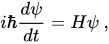
In the original Anderson tight-binding model, the evolution of the wave function ψ on the d-dimensional lattice Zd is given by the Schrödinger equation
where the Hamiltonian H is given by[2]
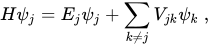
where are lattice locations. The self-energy is taken as random and independently distributed. The interaction potential is required to fall off faster than in the limit. For example, one may take uniformly distributed within a band of energies and

Starting with localized at the origin, one is interested in how fast the probability distribution diffuses. Anderson's analysis shows the following:

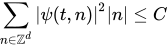
  • If is 1 or 2 and is arbitrary, or if and is sufficiently large, then the probability distribution remains localized: uniformly in . This phenomenon is called Anderson localization.
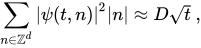
  • If and is small, where D is the diffusion constant.

Analysis

[edit]
Example of a multifractal electronic eigenstate at the Anderson localization transition in a system with 1367631 atoms.

The phenomenon of Anderson localization, particularly that of weak localization, finds its origin in the wave interference between multiple-scattering paths. In the strong scattering limit, the severe interferences can completely halt the waves inside the disordered medium.

For non-interacting electrons, a highly successful approach was put forward in 1979 by Abrahams et al.[3] This scaling hypothesis of localization suggests that a disorder-induced metal-insulator transition (MIT) exists for non-interacting electrons in three dimensions (3D) at zero magnetic field and in the absence of spin-orbit coupling. Much further work has subsequently supported these scaling arguments both analytically and numerically (Brandes et al., 2003; see Further Reading). In 1D and 2D, the same hypothesis shows that there are no extended states and thus no MIT or only an apparent MIT.[4] However, since 2 is the lower critical dimension of the localization problem, the 2D case is in a sense close to 3D: states are only marginally localized for weak disorder and a small spin-orbit coupling can lead to the existence of extended states and thus an MIT. Consequently, the localization lengths of a 2D system with potential-disorder can be quite large so that in numerical approaches one can always find a localization-delocalization transition when either decreasing system size for fixed disorder or increasing disorder for fixed system size.

Most numerical approaches to the localization problem use the standard tight-binding Anderson Hamiltonian with onsite-potential disorder. Characteristics of the electronic eigenstates are then investigated by studies of participation numbers obtained by exact diagonalization, multifractal properties, level statistics and many others. Especially fruitful is the transfer-matrix method (TMM) which allows a direct computation of the localization lengths and further validates the scaling hypothesis by a numerical proof of the existence of a one-parameter scaling function. Direct numerical solution of Maxwell equations to demonstrate Anderson localization of light has been implemented (Conti and Fratalocchi, 2008).

Recent work has shown that a non-interacting Anderson localized system can become many-body localized even in the presence of weak interactions. This result has been rigorously proven in 1D, while perturbative arguments exist even for two and three dimensions.

Experimental evidence

[edit]

Anderson localization can be observed in a perturbed periodic potential where the transverse localization of light is caused by random fluctuations on a photonic lattice. Experimental realizations of transverse localization were reported for a 2D lattice (Schwartz et al., 2007) and a 1D lattice (Lahini et al., 2006). Transverse Anderson localization of light has also been demonstrated in an optical fiber medium (Karbasi et al., 2012) and a biological medium (Choi et al., 2018), and has also been used to transport images through the fiber (Karbasi et al., 2014). It has also been observed by localization of a Bose–Einstein condensate in a 1D disordered optical potential (Billy et al., 2008; Roati et al., 2008).

In 3D, observations are more rare. Anderson localization of elastic waves in a 3D disordered medium has been reported (Hu et al., 2008). The observation of the MIT has been reported in a 3D model with atomic matter waves (Chabé et al., 2008). The MIT, associated with the nonpropagative electron waves has been reported in a cm-sized crystal (Ying et al., 2016). Random lasers can operate using this phenomenon.

The existence of Anderson localization for light in 3D was debated for years (Skipetrov et al., 2016) and remains unresolved today. Reports of Anderson localization of light in 3D random media were complicated by the competing/masking effects of absorption (Wiersma et al., 1997; Storzer et al., 2006; Scheffold et al., 1999; see Further Reading) and/or fluorescence (Sperling et al., 2016). Recent experiments (Naraghi et al., 2016; Cobus et al., 2023) support theoretical predictions that the vector nature of light prohibits the transition to Anderson localization (John, 1992; Skipetrov et al., 2019).

Comparison with diffusion

[edit]

Standard diffusion has no localization property, being in disagreement with quantum predictions. However, it turns out that it is based on approximation of the principle of maximum entropy, which says that the probability distribution which best represents the current state of knowledge is the one with largest entropy. This approximation is repaired in maximal entropy random walk, also repairing the disagreement: it turns out to lead to exactly the quantum ground state stationary probability distribution with its strong localization properties.[5][6]

See also

[edit]

Notes

[edit]

Further reading

[edit]
[edit]
Revisions and contributorsEdit on WikipediaRead on Wikipedia
from Grokipedia
Anderson localization is a quantum mechanical phenomenon in which wave functions of particles, such as electrons, in a disordered medium become exponentially confined to finite regions of space, resulting in the complete absence of diffusion and transport. This effect arises from the interference of multiple scattered waves in the presence of random potentials, preventing the propagation of waves over long distances. Proposed by physicist Philip W. Anderson in his seminal 1958 paper—work that contributed to his 1977 Nobel Prize in Physics—the concept was originally developed to explain the lack of electron mobility in impure semiconductors and amorphous materials at low densities. The behavior of Anderson localization strongly depends on the dimensionality of the system. In one and two dimensions, all eigenstates are localized for any nonzero disorder strength, leading to insulating behavior. In three dimensions, however, a transition occurs: weak disorder allows extended, delocalized states conducive to metallic conduction, while sufficiently strong disorder induces localization and an insulating phase. This dimensionality dependence was formalized in the scaling theory of localization, introduced by Abrahams, Anderson, Licciardello, and Ramakrishnan in 1979, which uses renormalization group arguments to describe how conductance scales with system size and predicts the absence of diffusion in lower dimensions. Anderson localization has profound implications for understanding the metal-insulator transition in disordered solids, where it provides a mechanism for the suppression of electrical conductivity without invoking electron-electron interactions. Beyond electrons, the phenomenon applies to other wave systems, including electromagnetic, acoustic, and matter waves. Experimental confirmation came initially through indirect evidence in alloys, but direct observations have been achieved in controlled settings, such as the localization of matter waves in one-dimensional optical lattices with ultracold atoms in 2008. Subsequent experiments have demonstrated it in two dimensions using quasiperiodic kicked rotors with cold atoms and in on disordered nanogratings. These advancements have extended the study to quantum technologies and wave propagation in complex media.

Overview and History

Definition and Basic Principles

Anderson localization refers to the phenomenon in which waves in a disordered medium fail to and instead become confined to finite regions of space, resulting in exponentially decaying wavefunctions away from their initial position. This absence of arises due to quantum or effects in the presence of disorder, such as random impurities or potentials, which trap the waves rather than allowing them to propagate freely. At its core, the basic principles of Anderson localization stem from the scattering of waves by disorder, which creates multiple paths for the wave to travel. In classical , repeated scattering events lead to diffusive where the wave spreads out over time, but in the quantum or coherent wave regime, these paths interfere with each other—constructively for paths that return to the origin and destructively for those that extend outward—effectively localizing the wave and preventing net . This interference is particularly pronounced in low dimensions and strong disorder, distinguishing it sharply from classical where coherence is absent and spreading persists indefinitely. Intuitively, consider a , such as an 's quantum wavefunction, , or waves, introduced into a disordered environment; instead of broadening and exploring the medium as in , the packet remains confined due to the self-reinforcing interference that enhances backscattering and suppresses forward . This effect applies broadly to all coherent waves in random potentials, generalizing beyond to electromagnetic, acoustic, and other wave types. Predicted in 1958 by in the context of electron transport in disordered lattices, it highlights how disorder can transform a conducting medium into an insulator through wave localization.

Historical Development

The concept of Anderson localization emerged from Philip W. Anderson's seminal paper, which demonstrated the absence of for electrons in certain random lattices, particularly in the context of amorphous solids where disorder prevents wavefunction overlap and leads to exponentially localized states. This work initially addressed spin and electrical conduction in disordered semiconductors but laid the groundwork for understanding how strong disorder could trap electrons, challenging the prevailing view of diffusive transport in impure materials. Anderson's ideas met with initial skepticism and received limited attention for over a decade, largely due to the absence of direct experimental confirmation and the dominance of perturbative approaches to weak disorder. In the early , N.F. Mott and W.D. Twose extended the analysis to one-dimensional systems, proving that all electronic states become localized for any nonzero disorder strength in such geometries. By the late and into the , further theoretical developments addressed mechanisms in localized regimes; Mott proposed as a conduction process where electrons tunnel between distant localized states to minimize , explaining low-temperature conductivity in disordered insulators. Concurrently, David J. Thouless explored level spacing statistics and conductance in disordered systems, introducing concepts like the Thouless energy scale—comparable to the inverse dwell time—which linked spectral properties to and highlighted the role of quantum interference in localization. Debates intensified in the regarding the dimensionality dependence of localization, with questions arising about whether extended states could exist in three dimensions despite disorder, contrasting the clear localization in lower dimensions. Anderson's contributions to disordered systems were recognized with the 1977 , shared with Nevill F. Mott and John H. Van Vleck, for fundamental investigations into the electronic structure of magnetic and disordered materials. A pivotal breakthrough came in 1979 with the scaling theory of localization proposed by Elihu Abrahams, Anderson, D.C. Licciardello, and T.V. Ramakrishnan, which used arguments to show that conductance flows to zero in one and two dimensions for any disorder, implying all states are localized there, while a metal-insulator transition occurs in three dimensions. By the early 1980s, theoretical consensus had solidified around the dimensional picture: all eigenstates are localized in one- and two-dimensional disordered systems without additional symmetries or interactions breaking time-reversal invariance, resolving earlier controversies through the scaling framework.

Theoretical Foundations

Tight-Binding Model

The tight-binding model provides a foundational framework for studying electron behavior in disordered solids, originating from where it was developed to describe band structures in periodic crystals through approximations of atomic orbitals. In this model, electrons are treated as single particles confined to a lattice of sites, with motion occurring via nearest-neighbor hopping due to quantum tunneling, while disorder is introduced through random variations in site energies. This approach was adapted by to investigate the effects of disorder on electron , demonstrating how randomness can suppress . The model assumes non-interacting particles on a periodic lattice, where the primary source of disorder is diagonal, manifesting as random on-site potentials or site energies drawn from a , such as a or Gaussian form, without off-diagonal in hopping terms. These assumptions simplify the system to focus on the interplay between coherent hopping and energetic mismatches induced by disorder, neglecting electron-electron interactions and assuming a fixed lattice . Qualitatively, the model predicts that for weak disorder—where the disorder strength is small compared to the hopping states remain extended, allowing for diffusive similar to Bloch waves in ordered systems. In contrast, strong disorder leads to localized states, where wavefunctions decay exponentially away from their central site, preventing long-range and resulting in an insulating phase. A key measure of this localization is the localization length ξ, which quantifies the spatial extent of these states and decreases as disorder strength increases, eventually becoming comparable to the lattice spacing in highly disordered regimes. The mathematical representation of this model is the Anderson Hamiltonian, which encapsulates the hopping and disorder terms on the lattice.

Scaling Theory of Localization

The scaling theory of localization provides a phenomenological framework to understand the metal-insulator transition in disordered systems by examining how the dimensionless conductance gg evolves with increasing system size LL. Introduced by Abrahams, Anderson, Licciardello, and Ramakrishnan in 1979, this approach employs renormalization group ideas, treating conductance as the key scaling variable that flows under changes in length scale. The core concept involves a renormalization group flow where gg scales with LL, leading to fixed points that determine whether the system behaves as a metal (with finite conductance in the thermodynamic limit) or an insulator (with conductance approaching zero). This flow is described by the function β(g)\beta(g), defined as the logarithmic derivative β(g)=dlngdlnL\beta(g) = \frac{d \ln g}{d \ln L}, which captures how disorder strength influences transport properties across scales. The theory predicts strong dimensional dependence in localization behavior. In one and two dimensions, the flow of β(g)\beta(g) drives all states to localization for any nonzero disorder, with no stable metallic fixed point; conductance decreases logarithmically or faster with size in 2D due to quantum interference effects. In three dimensions, a metal-insulator transition becomes possible, where states above a mobility edge remain delocalized (metallic), while those below localize, separated by an unstable fixed point at a critical conductance. The lower is identified as dc=2d_c = 2, below which localization is inevitable, marking the boundary where diffusive metallic behavior ceases to exist. This scaling framework resolved ongoing debates about localization in two dimensions by incorporating effects, which arise from constructive interference in paths and gradually suppress conductance, leading to insulating behavior even for weak disorder. Starting from microscopic models like the tight-binding Hamiltonian, the theory coarse-grains conductance to reveal these universal flows without relying on detailed perturbation calculations.

Mathematical Formulation

Anderson Hamiltonian

The Anderson Hamiltonian provides the mathematical framework for modeling single-particle quantum states in a disordered lattice, building on the tight-binding model where electrons are restricted to lattice sites with nearest-neighbor hopping. It is expressed as H=iϵiii+ti,j(ij+h.c.),H = \sum_i \epsilon_i |i\rangle\langle i| + t \sum_{\langle i,j \rangle} \left( |i\rangle\langle j| + \mathrm{h.c.} \right), where ϵi\epsilon_i represents the random on-site energy at lattice site ii, drawn independently from a such as a uniform box distribution over [W/2,W/2][-W/2, W/2] or a Gaussian, tt is the constant hopping between nearest-neighbor sites i,j\langle i,j \rangle, and h.c. denotes the Hermitian conjugate. This formulation captures the essential physics of disorder-induced interference effects on wave propagation, as originally proposed by Anderson. The corresponding time-independent Schrödinger equation for an eigenstate ψ=iψii\psi = \sum_i \psi_i |i\rangle with energy EE reads, at each site ii, (ϵiE)ψi+tδψi+δ=0,(\epsilon_i - E) \psi_i + t \sum_{\delta} \psi_{i+\delta} = 0, where the sum runs over the nearest-neighbor displacements δ\delta. The random ϵi\epsilon_i introduce quenched disorder, leading to exponentially decaying eigenfunctions in the localized phase, with the strength of disorder controlled by the width WW relative to tt. For weak disorder (WtW \ll t), perturbative methods like the locator expansion can approximate solutions, but stronger disorder requires approaches. Solutions to the Anderson Hamiltonian are obtained through numerical methods tailored to system dimensionality and size. For finite lattices, exact diagonalization of the full yields all , enabling direct computation of localization properties, though limited to small systems (typically up to a few hundred sites in 1D or 3D). In one dimension, more efficient techniques include the transfer-matrix method, which iteratively propagates the wavefunction ratio ψn+1/ψn\psi_{n+1}/\psi_n across sites to compute transmission or reflection coefficients, and real-space renormalization group approaches that decimate high-energy sites to reveal effective low-energy Hamiltonians. Localization in the Anderson model manifests through the of eigenfunction amplitudes, ψ(r)eγr|\psi(r)| \sim e^{-\gamma r}, where γ>0\gamma > 0 is the quantifying the inverse localization length, obtained from the logarithmic growth of the norm in 1D.

Localization-Delocalization Transition

In three-dimensional systems described by the Anderson Hamiltonian, the localization-delocalization transition occurs at a finite critical disorder strength Wc16.5W_c \approx 16.5, where eigenstates shift from extended (delocalized) to exponentially localized as disorder increases beyond this threshold. This transition is characterized by a mobility edge in the energy spectrum, which delineates the boundaries between extended states near the band center from localized states in the band tails at both band edges for a given disorder strength. The mobility edge arises due to the energy-dependent nature of localization, with states near the band center localizing first as disorder grows. The in the disorder-energy plane features an insulating phase dominating for strong disorder W>WcW > W_c, where all states are localized, while for weaker disorder, a metallic phase with extended states exists up to the mobility edge. At the critical point, the system exhibits universal , including a that diverges as ξWWcν\xi \sim |W - W_c|^{-\nu} with ν1.57\nu \approx 1.57, and a dynamic exponent z=d=3z = d = 3 governing the scaling of time with , τLz\tau \sim L^z. Wavefunctions at criticality display multifractal properties, with anomalous scaling dimensions reflecting non-uniform probability distributions that are neither fully extended nor localized. A key conceptual criterion for the transition is the Thouless condition, which compares the mean level spacing δ\delta in a finite to the Thouless conductance gg; localization occurs when g<1g < 1, as the discrete level spacing exceeds the energy scale set by diffusive transport. Wegner scaling ensures that the remains finite and smooth across the transition, without singularities, due to the continuous nature of the metal-insulator boundary in the description. In the orthogonal ensemble, effects preclude a true metallic phase in dimensions d2d \leq 2, leading to inevitable localization for any disorder strength, though a transition persists in d=3d=3.

Experimental Evidence

Early Observations

The initial experimental confirmations of Anderson localization effects emerged in the through measurements of in thin metallic films and narrow wires, where logarithmic corrections to conductivity were observed, consistent with two-dimensional theory. In thin magnesium films, low-temperature magnetoconductance exhibited negative that aligned quantitatively with predictions for quantum interference in disordered 2D systems. Similarly, studies on very small-diameter gold-palladium wires showed anomalies attributable to localization-enhanced backscattering, with conductance fluctuations further supporting one-dimensional localization signatures. Key experimental setups involved doped semiconductors, such as inversion layers, where low-temperature transport revealed conductivity dominated by localization. In these quasi-two-dimensional systems, the conductivity followed the form σexp((T0T)1/2)\sigma \sim \exp\left( -\left(\frac{T_0}{T}\right)^{1/2} \right), indicative of Mott-Anderson localization in the presence of - interactions, as observed in phosphorus-doped structures. A notable demonstration came from experiments on phosphorus-doped , where an insulator-metal transition was tuned by varying the doping concentration near the critical density of approximately 3.7×10183.7 \times 10^{18} cm3^{-3}, with conductivity showing a sharp crossover sharper than scaling predictions. Isolating pure localization effects proved challenging due to confounding electron-electron interactions, which could mimic or mask localization signatures in transport data. Researchers addressed this by applying scaling theory fits to conductance measurements across sample sizes and temperatures, distinguishing interaction-driven corrections from disorder-induced localization. A significant milestone in the 1990s involved ultrasonic attenuation experiments in disordered elastic media, confirming wave localization beyond electronic systems. In inhomogeneous aluminum plates, sub-megahertz propagation displayed energy confinement and reduced transmission, direct evidence of Anderson localization for classical waves in two dimensions.

Recent Advances

In the field of , significant experimental progress occurred in the post-2000 era with the observation of Anderson localization of in disordered photonic lattices. In 2007, researchers demonstrated transverse localization of beams in two-dimensional disordered photonic lattices, where random variations in led to of the beam width, confirming the predicted inhibition of diffusive transport. This work paved the way for extensions to three-dimensional systems, with later experiments in 2020 revealing a transition from diffusive to localized propagation in disordered particle ensembles, providing clearer signatures of the three-dimensional localization regime. Furthermore, random lasers emerged as a platform exhibiting localized lasing modes due to Anderson localization; a 2021 study showed that in strongly gain media, lasing occurs preferentially in disorder-induced localized states, enhancing mode stability and coherence compared to extended diffusive modes. Acoustic experiments in the 2010s further validated Anderson localization for classical waves beyond . In disordered media such as random arrays of scatterers, waves mimic behavior by exhibiting halted and exponential intensity decay. A key 2015 experiment observed transversal Anderson localization of in one-dimensional acoustic arrays with random coupling strengths, where injected pulses showed subdiffusive spreading and localized profiles, directly analogous to tight-binding models for s. These findings extended to seismic scales, with studies of elastic waves in heterogeneous media demonstrating localization that influences propagation and subsurface imaging. Ultrahigh-precision studies using ultracold atoms provided controlled environments to probe localization in quantum many-body systems. In the , Bose-Einstein condensates (BECs) loaded into one-dimensional optical speckle potentials—generated by interference to create random variations—exhibited clear Anderson localization, with atomic wave packets showing arrested expansion and exponential density tails upon release. Three-dimensional extensions confirmed localization in dilute Fermi gases expanding into disordered potentials, revealing noninteracting matter waves confined to subwavelength scales without thermal decoherence. More recent work utilized ultracold atoms; and collaborators developed bichromatic state-dependent speckle potentials to engineer tunable disorder, enabling precise measurements of localization transitions in BECs and highlighting interactions' role in delocalization. A landmark 2022 experiment demonstrated Anderson localization for wave packets entirely outside the disorder's spectral band, using arrays of coupled optical waveguides with engineered random couplings. In this setup, input wave packets at frequencies above the disorder spectrum still localized exponentially, with localization lengths as short as a few sites, revealing that interference effects dominate even in spectrally detached regimes. Advancements in experimental techniques have enhanced the study of localization dynamics. Time-resolved imaging, such as time-of-flight expansion in ultracold atom setups, allows direct tracking of wave packet evolution from ballistic to localized arrest, quantifying diffusion coefficients and localization lengths with single-particle resolution. Additionally, incorporating topological features provides protection against full localization; in 2018, photonic topological Anderson insulators were realized in helical waveguide arrays, where disorder-induced localization in the bulk coexists with robust, delocalized edge states protected by topology, enabling dissipation-resistant transport. In 2023, Anderson localization of electromagnetic waves was experimentally demonstrated in three dimensions using random packings of , halting diffusive propagation and confirming long-debated 3D light localization. A 2024 experiment further showed that nonlinearity enhances Anderson localization of surface gravity waves propagating over random in a .

Comparison with Classical Diffusion

In classical diffusion, particles undergoing random walks in disordered media exhibit a mean-squared displacement that scales linearly with time, r2t\langle r^2 \rangle \sim t, resulting in a finite diffusion constant DD and a non-zero conductivity σ\sigma even in the presence of scattering centers. This behavior arises from uncorrelated scattering events, where the probability of return to the origin decreases as t3/2t^{-3/2} in three dimensions, allowing sustained transport over long distances. Classical theories, such as the , predict that disorder merely reduces the without halting diffusion entirely, leading to ohmic conductivity that persists in all dimensions for weak to moderate disorder. In the quantum regime, Anderson localization emerges due to wave interference effects that are absent in classical descriptions. Coherent backscattering, a key quantum interference , doubles the return probability to the starting point by constructively interfering time-reversed paths, thereby enhancing localization and suppressing diffusive transport for sufficiently strong disorder. This interference-driven enhancement of backscattering contrasts sharply with classical random walks, where no such phase-coherent returns occur, leading to a gradual breakdown of as disorder strength increases. A fundamental distinction lies in the role of phase coherence: classical Boltzmann transport theory neglects quantum phases, treating scattering as incoherent and predicting persistent diffusion without localization, whereas quantum mechanics incorporates coherent multiple scattering that can trap waves. For instance, in one dimension, classical diffusion allows particles to explore the entire chain indefinitely with r2t\langle r^2 \rangle \sim t, but quantum effects cause all eigenstates to localize exponentially with a localization length ξ\xi that remains finite for any nonzero disorder, halting transport completely. Weak localization represents a perturbative quantum correction to classical , where interference slightly reduces conductivity; in two dimensions, this manifests as a logarithmic in resistance, δσln(L/)\delta \sigma \sim -\ln(L/\ell), with LL the system size and \ell the , signaling the onset of stronger localization effects at larger scales. The scaling theory of localization further elucidates why classical fails in low dimensions, as quantum fluctuations amplify disorder effects over increasing length scales.

Extensions to Other Systems

Anderson localization, originally formulated for electron waves in disordered solids, has been generalized to photonic systems, where light propagation is confined in random dielectrics such as disordered photonic crystals. In these structures, random variations in the lead to of light intensity, mimicking electronic localization and enabling the formation of photonic band-tail states. This phenomenon underpins random lasers, which rely on disorder-induced multiple for optical feedback without traditional cavities, achieving lasing through localized modes. Additionally, it facilitates the of optical insulators, where light is blocked in specific directions due to the absence of extended states, offering potential for robust waveguiding in disordered media. The concept extends to acoustic waves in disordered media, where sound is halted by random heterogeneities, resulting in localized vibrational modes. In strongly heterogeneous elastic environments, analysis reveals that exhibit Anderson-like localization, with dominating over diffusion at sufficient disorder strengths. This has implications for in Earth's heterogeneous crust, where multiple in stratified lithologies leads to localized energy trapping, influencing signal and crustal dynamics. For matter waves, Anderson localization manifests in ultracold atomic gases and Bose-Einstein condensates (BECs) subjected to disordered optical potentials, where atomic wavefunctions become exponentially confined. Experiments with non-interacting BECs in quasiperiodic lattices have demonstrated one- and two-dimensional localization, confirming the halt of diffusive expansion due to disorder. In magnetic systems, spin waves also undergo localization in disordered ferromagnets, with numerical studies showing Anderson localization in one dimension and in higher dimensions, altering magnonic transport. These extensions enable applications in , where disorder in arrays can create protected localized states that suppress decoherence and enhance fault-tolerant operations. In topological materials, disorder induces a topological Anderson insulator phase, transforming trivial band structures into nontrivial ones with robust edge states, as observed in atomic wires and photonic lattices. A notable advancement in occurred in the with the observation of transverse Anderson localization, where disordered optical fibers confine light beams laterally without waveguides, enabling image transport through random media. Recent 2025 experiments have further explored atomic localization in laser speckle potentials, achieving direct measurement of three-dimensional Anderson transitions in ultracold atoms, building on post-2016 Nobel insights into topological phases.

References

Add your contribution
Related Hubs
User Avatar
No comments yet.