



Community hub
Recent from talks
Contribute something to knowledge base
Content stats: 0 posts, 0 articles, 1 media, 0 notes
Members stats: 0 subscribers, 0 contributors, 0 moderators, 0 supporters
Subscribers
Supporters
Contributors
Moderators
Hub AI
Circulatory system AI simulator
(@Circulatory system_simulator)
Hub AI
Circulatory system AI simulator
(@Circulatory system_simulator)
Circulatory system
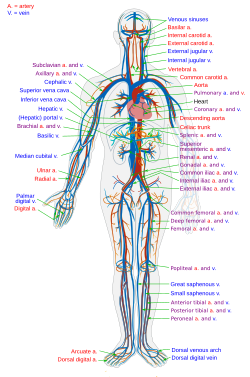
In vertebrates, the circulatory system is a system of organs that includes the heart, blood vessels, and blood which is circulated throughout the body. It includes the cardiovascular system, or vascular system, that consists of the heart and blood vessels (from Greek kardia meaning heart, and Latin vascula meaning vessels). The circulatory system has two divisions, a systemic circulation or circuit, and a pulmonary circulation or circuit. Some sources use the terms cardiovascular system and vascular system interchangeably with circulatory system.
The network of blood vessels are the great vessels of the heart including large elastic arteries, and large veins; other arteries, smaller arterioles, capillaries that join with venules (small veins), and other veins. The circulatory system is closed in vertebrates, which means that the blood never leaves the network of blood vessels. Many invertebrates such as arthropods have an open circulatory system with a heart that pumps a hemolymph which returns via the body cavity rather than via blood vessels. Diploblasts such as sponges and comb jellies lack a circulatory system.
Blood is a fluid consisting of plasma, red blood cells, white blood cells, and platelets; it is circulated around the body carrying oxygen and nutrients to the tissues and collecting and disposing of waste materials. Circulated nutrients include proteins and minerals and other components include hemoglobin, hormones, and gases such as oxygen and carbon dioxide. These substances provide nourishment, help the immune system to fight diseases, and help maintain homeostasis by stabilizing temperature and natural pH.
In vertebrates, the lymphatic system is complementary to the circulatory system. The lymphatic system carries excess plasma (filtered from the circulatory system capillaries as interstitial fluid between cells) away from the body tissues via accessory routes that return excess fluid back to blood circulation as lymph. The lymphatic system is a subsystem that is essential for the functioning of the blood circulatory system; without it the blood would become depleted of fluid.
The lymphatic system also works with the immune system. The circulation of lymph takes much longer than that of blood and, unlike the closed (blood) circulatory system, the lymphatic system is an open system. Some sources describe it as a secondary circulatory system.
The circulatory system can be affected by many cardiovascular diseases. Cardiologists are medical professionals which specialise in the heart, and cardiothoracic surgeons specialise in operating on the heart and its surrounding areas. Vascular surgeons focus on disorders of the blood vessels, and lymphatic vessels.
The circulatory system includes the heart, blood vessels, and blood. The cardiovascular system in all vertebrates, consists of the heart and blood vessels. Some sources use the terms cardiovascular system and vascular system interchangeably with circulatory system.
The circulatory system is further divided into two major circuits – a pulmonary circulation, and a systemic circulation. The pulmonary circulation is a circuit loop from the right heart taking deoxygenated blood to the lungs where it is oxygenated and returned to the left heart. The systemic circulation is a circuit loop that delivers oxygenated blood from the left heart to the rest of the body, and returns deoxygenated blood back to the right heart via large veins known as the venae cavae. The systemic circulation can also be defined as two parts – a macrocirculation and a microcirculation. An average adult contains five to six quarts (roughly 4.7 to 5.7 liters) of blood, accounting for approximately 7% of their total body weight. Blood consists of plasma, red blood cells, white blood cells, and platelets. The digestive system also works with the circulatory system to provide the nutrients the system needs to keep the heart pumping.
Circulatory system
In vertebrates, the circulatory system is a system of organs that includes the heart, blood vessels, and blood which is circulated throughout the body. It includes the cardiovascular system, or vascular system, that consists of the heart and blood vessels (from Greek kardia meaning heart, and Latin vascula meaning vessels). The circulatory system has two divisions, a systemic circulation or circuit, and a pulmonary circulation or circuit. Some sources use the terms cardiovascular system and vascular system interchangeably with circulatory system.
The network of blood vessels are the great vessels of the heart including large elastic arteries, and large veins; other arteries, smaller arterioles, capillaries that join with venules (small veins), and other veins. The circulatory system is closed in vertebrates, which means that the blood never leaves the network of blood vessels. Many invertebrates such as arthropods have an open circulatory system with a heart that pumps a hemolymph which returns via the body cavity rather than via blood vessels. Diploblasts such as sponges and comb jellies lack a circulatory system.
Blood is a fluid consisting of plasma, red blood cells, white blood cells, and platelets; it is circulated around the body carrying oxygen and nutrients to the tissues and collecting and disposing of waste materials. Circulated nutrients include proteins and minerals and other components include hemoglobin, hormones, and gases such as oxygen and carbon dioxide. These substances provide nourishment, help the immune system to fight diseases, and help maintain homeostasis by stabilizing temperature and natural pH.
In vertebrates, the lymphatic system is complementary to the circulatory system. The lymphatic system carries excess plasma (filtered from the circulatory system capillaries as interstitial fluid between cells) away from the body tissues via accessory routes that return excess fluid back to blood circulation as lymph. The lymphatic system is a subsystem that is essential for the functioning of the blood circulatory system; without it the blood would become depleted of fluid.
The lymphatic system also works with the immune system. The circulation of lymph takes much longer than that of blood and, unlike the closed (blood) circulatory system, the lymphatic system is an open system. Some sources describe it as a secondary circulatory system.
The circulatory system can be affected by many cardiovascular diseases. Cardiologists are medical professionals which specialise in the heart, and cardiothoracic surgeons specialise in operating on the heart and its surrounding areas. Vascular surgeons focus on disorders of the blood vessels, and lymphatic vessels.
The circulatory system includes the heart, blood vessels, and blood. The cardiovascular system in all vertebrates, consists of the heart and blood vessels. Some sources use the terms cardiovascular system and vascular system interchangeably with circulatory system.
The circulatory system is further divided into two major circuits – a pulmonary circulation, and a systemic circulation. The pulmonary circulation is a circuit loop from the right heart taking deoxygenated blood to the lungs where it is oxygenated and returned to the left heart. The systemic circulation is a circuit loop that delivers oxygenated blood from the left heart to the rest of the body, and returns deoxygenated blood back to the right heart via large veins known as the venae cavae. The systemic circulation can also be defined as two parts – a macrocirculation and a microcirculation. An average adult contains five to six quarts (roughly 4.7 to 5.7 liters) of blood, accounting for approximately 7% of their total body weight. Blood consists of plasma, red blood cells, white blood cells, and platelets. The digestive system also works with the circulatory system to provide the nutrients the system needs to keep the heart pumping.
Recent media
Recent media