Hubbry Logo
VerdinVerdinMain
Open search
Verdin
Community hub
Verdin
logo
8 pages, 0 posts
0 subscribers
Be the first to start a discussion here.
Verdin
Verdin
from Wikipedia
Not found
Revisions and contributorsEdit on WikipediaRead on Wikipedia
from Grokipedia
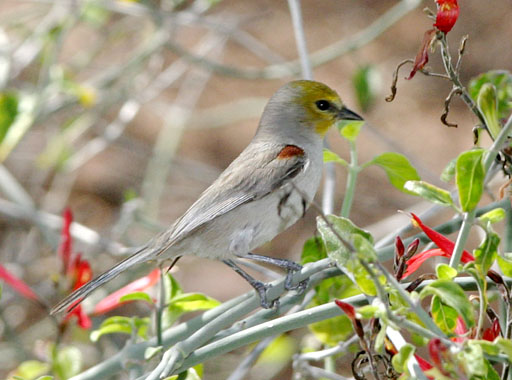
The Verdin (Auriparus flaviceps) is a tiny, non-migratory belonging to the Remizidae, known for its slender build, sharply pointed bill, and distinctive featuring a mostly gray body, bright yellow head and throat, and a small (chestnut) patch on the shoulders. Native to arid desert scrub habitats in the and , this adaptable species forages actively in pairs or small groups, , spiders, and small fruits from foliage and branches while rarely descending to the ground. Verdins are renowned for their elaborate nest-building behavior, constructing spherical or gourd-shaped nests from thorny twigs, spider webs, and plant down, often suspended in cholla cacti or mesquite trees to deter predators. Their vocalizations include sharp chit-it-it calls and varied songs that help maintain territories year-round in hot, dry environments where they remain resident rather than migrating. Despite their small size—measuring about 4.5 inches in length and weighing around 8 grams—Verdins play a key ecological role in desert ecosystems by controlling insect populations and serving as prey for larger birds and reptiles. The species is classified as least concern on the IUCN Red List, though populations have declined in recent decades according to surveys, with threats from habitat loss due to urban development and invasive species.

Taxonomy

Etymology

The "Verdin" derives from the French "verdin," a term originally applied to small songbirds with bright plumage, such as the (Emberiza citrinella), stemming from "vert" meaning "green" but extended to yellowish species in regional usage by early European naturalists. This name was adopted in English around the 1880s for the American species, likely influenced by Spanish "verdín" used in , reflecting linguistic exchanges among explorers in the and . The scientific name Auriparus flaviceps was established when the genus Auriparus was introduced in 1864 by American naturalist . "Auri-" comes from the Latin "aurum," meaning "gold," alluding to the bird's bright yellow head, while "parus" references the tit genus (now in Paridae), highlighting its superficial resemblance to chickadees and tits in behavior and form. The specific epithet "flaviceps" combines Latin "flavus" (yellow) and "-ceps" (headed), directly describing the species' distinctive yellow crown and face.

Classification

The Verdin (Auriparus flaviceps) is classified in the family Remizidae, a group primarily composed of penduline tits, and represents the sole from this family native to . This placement underscores its unique phylogenetic position as the only member of Remizidae, distinct from superficially similar North American parids like chickadees and titmice. The species was first described by Swedish zoologist Carl Jakob Sundevall in 1850 as Aegithalus flaviceps, based on specimens collected in Mexico. The genus Auriparus was subsequently established by American naturalist Spencer Fullerton Baird in 1864 to better reflect its distinct characteristics, separating it from Old World genera. Taxonomists recognize six subspecies of A. flaviceps, each adapted to specific desert regions with subtle geographic variations in plumage coloration, intensity of yellow head feathering, and body size. For instance, A. f. acaciarum (described by Joseph Grinnell in 1931) inhabits the Sonoran Desert and exhibits paler gray upperparts and reduced rufous shoulder patches compared to more northern populations, while A. f. ornatus (described by George Newbold Lawrence in 1851) in the Chihuahuan Desert shows slightly larger overall size and brighter yellow on the head and throat. Other subspecies include A. f. flaviceps (the nominate form in central Mexico), A. f. lamprocephalus (Oberholser, 1897; southern Baja California, with more vivid yellow head), A. f. hidalgensis (Phillips, 1986; central Mexico, smaller-bodied), and A. f. arizonensis (van Rossem, 1936; southeastern Arizona and adjacent areas, intermediate in plumage tone). These variations are clinal, with bill size and shape also differing regionally to suit local foraging demands. Phylogenetic analyses have reinforced the monotypic status of Auriparus in and its close affinity to Eurasian and African Remizidae. A seminal study by Sheldon and Gill (1996) used to confirm that Verdins form a monophyletic with Old World penduline tits, supporting the family's boundaries and highlighting an ancient divergence event. More recent multilocus phylogenies, such as those examining Paridae and Remizidae, have upheld this classification without evidence of additional relatives. The roots of the binomial, denoting a "golden-headed" , align with its distinctive but are explored further in the etymology section.

Description

Physical characteristics

The Verdin (Auriparus flaviceps) is a diminutive , measuring 90–110 mm (3.5–4.3 in) in length, with an average wingspan of 162 mm (6.4 in) and a of 6–8 g. plumage is predominantly gray on the body and wings, accented by a bright yellow head and throat, along with a conspicuous or patch on the shoulders that is often visible in flight or when the wings are spread. The bird possesses a slender, sharply pointed bill that is pale grayish in color and well-suited for probing and . Juveniles display duller, more uniform gray- plumage without the shoulder patches or bold head markings, gradually molting to adult colors over the course of their first year. is subtle, characterized by males having slightly brighter head coloration than females, with no distinct seasonal variations in .

Vocalizations

The Verdin produces a variety of loud calls relative to its small size, which serve essential roles in communication within its arid . The primary contact call is a sharp "tschep" or "chip," often repeated in rapid series such as "chip-chip-chip" while or maintaining pair bonds. The alarm call is a high-pitched "tseet" or "seep," emitted repeatedly upon detecting predators to alert nearby individuals. During agitation or scolding, it delivers a rapid chatter like "tsip-tsip-tsip" or "gee-gee-gee-gee," typically in response to threats or disturbances. The consists of a simple, variable whistled warble or trill, usually 2–3 long and lasting about 2–3 seconds, such as "tseet-tsor-tsor" or "kleep-er-zee" with the final note rising in pitch. Males primarily use this for territory defense and mate attraction during the breeding season. Acoustically, Verdin vocalizations are high-pitched, with frequencies typically ranging from 4–6 kHz for the whistled , facilitating clear transmission in the low-ambient-noise conditions of desert environments. These frequency-modulated sounds allow effective propagation over open without significant interference. Contextually, calls differ between breeding pairs and flock interactions; pairs rely on repetitive "tschep" contact calls for coordination during and nesting, while "tseet" calls function in mixed-species flocks to signal dangers and prompt collective evasion. In breeding displays, males incorporate songs to reinforce pair bonds, though detailed roles are elaborated elsewhere.

Distribution and habitat

Geographic range

The Verdin (Auriparus flaviceps) is a non-migratory resident primarily occupying desert lowlands and scrub habitats across the and . Its core range encompasses southeastern , southern , extreme southwestern , , , western , and extreme southwestern in the United States, extending southward into where it occurs throughout (except the northwestern corner north of Ensenada) and in lowlands along the and interior valleys from the U.S. border south to about the Transverse Volcanic Axis in central . While generally sedentary, the exhibits some local movements in response to seasonal food availability, and juveniles may disperse up to several kilometers from natal sites during their first winter. Six subspecies are recognized, each adapted to specific portions of the overall range. The subspecies A. f. acaciarum occupies the Sonoran Desert portions of the southwestern U.S., including coastal southern California, and extends into northern Baja California and central Sonora, Chihuahua, and Durango in northwestern Mexico. A. f. ornatus is distributed in the Chihuahuan Desert from southern New Mexico and western Texas (including a northward extension into southwestern Oklahoma) southward into northeastern Mexico. The remaining subspecies are confined to Mexico: A. f. flaviceps in central Baja California and southern Sonora to northern Sinaloa; A. f. lamprocephalus in southern Baja California; A. f. sinaloae in northwestern Sinaloa; and A. f. hidalgensis in north-central Mexico. Historically, the Verdin's range has shown modest expansions in certain areas, including a northward shift from into southwestern during the 1960s and 1970s, likely facilitated by drought conditions that altered vegetation patterns. In , the species may have expanded slightly northward over the past century, possibly due to increased availability of suitable brushlands from land-use changes. Conversely, local extirpations have occurred in heavily urbanized regions, such as parts of County in and the extreme northeastern , where habitat loss from residential and commercial development has eliminated populations. Overall, these shifts reflect localized responses to environmental and human-induced changes within a stable core distribution.

Habitat preferences

The Verdin (Auriparus flaviceps) primarily inhabits desert scrub habitats characterized by mesquite thickets ( spp.) and thorny shrubs such as ( spp.), paloverde (Parkinsonia spp.), and smoke tree (Psorothamnus spinosus), particularly within the Sonoran and Chihuahuan Deserts. These environments provide essential thorny vegetation along washes and riparian zones, where the bird avoids open grasslands and low, sparse flats that lack sufficient cover. At the microhabitat level, Verdins require dense foliage for concealment and protection, often selecting sites near water sources like washes or riparian areas to support survival in arid landscapes. They typically occupy elevations between 1,000 and 5,000 feet, favoring lower elevations but extending to higher ones in central where suitable cover persists. Well-adapted to arid conditions, Verdins exhibit tolerance for extreme heat and low moisture through behaviors like constructing insulated nests, and they preferentially use protective plants such as (Larrea tridentata) or (Olneya tesota) for nesting sites, which offer thorns against predators and shade in intense sunlight. Habitat fragmentation poses challenges, as Verdins show a strong preference for connected shrublands over isolated patches, where discontinuous vegetation reduces foraging efficiency and increases exposure to environmental stressors.

Behavior and ecology

Breeding

Verdins form monogamous pairs in late winter, typically by early March, and maintain these bonds through the breeding season, with vocal displays such as chattering calls playing a key role in pair integration and territory establishment. Pairs defend breeding territories averaging 23.7 acres (about 9.6 hectares) for observed pairs in Arizona, with defense focused primarily on the area surrounding the nest site by both sexes. Breeding occurs from through , peaking in spring from mid- to May, during which males construct several display nests that the female inspects and selects from, with both partners completing the chosen breeding nest. These nests are conspicuous spherical or ovoid structures, 15–25 cm in diameter, woven from thorny twigs, grasses, and leaves, and lined with feathers, spiderwebs, and plant down; they are placed in the outer foliage of thorny shrubs, small trees, or cacti such as cholla, typically 1–4 m above the ground and oriented to face for cooling. Females lay clutches of 3–6 eggs (mean 3.82), which are pale blue-green to greenish-white and lightly marked with reddish-brown spots concentrated at the larger end; incubation is performed solely by the female and lasts 14–18 days, during which the male remains nearby, vocalizing to deter intruders. Both parents engage in biparental care, with the female initially feeding the nestlings during the first week after hatching, after which the male provides equal or greater provisioning; young after 17–21 days in the nest and remain dependent on adults for and for an additional 18 days, during which the male often leads them to roost sites. Pairs commonly raise 1–2 per year, with second clutches initiated shortly after the first fledges and the male assuming full responsibility for the initial brood to allow the female to begin the next. In undisturbed habitats, breeding success is relatively high, with hatching rates of approximately 49% and fledging success around 29% across studied nests, though these are significantly influenced by predation pressures.

Foraging and diet

The Verdin (Auriparus flaviceps) maintains a primarily insectivorous diet, consisting of small arthropods such as , caterpillars, scale insects, leafhoppers, and wasp larvae, and , along with their eggs and adults. It supplements this with plant-based foods, including berries and small fruits from species like palm (Washingtonia), agarita, mesquite, hackberry, and wolfberry, as well as pulp from seedpods of paloverde, mesquite, and ; occasional from flowers and sugar water at feeders is also consumed. Foraging occurs mainly through , where the bird actively searches foliage, flowers, and crevices in shrubs and low trees, often hanging upside down or using its feet to inspect leaf undersides and bark. It employs hover- to probe blossoms and may strike larger prey like caterpillars against branches to tenderize them before consumption, while its slender bill facilitates precise extraction from tight spaces. Outside the breeding season, Verdins often in small mixed-species flocks with birds like Black-tailed Gnatcatchers and Black-throated Sparrows, enhancing efficiency in arid environments. Dietary composition shifts seasonally to match resource availability, with a greater reliance on during summer when abundance peaks, and increased consumption of seeds, berries, and fruits in fall and winter. Daily activity intensifies at dawn and dusk, particularly in cooler morning and late afternoon periods, allowing the bird to capitalize on optimal temperatures below 32°C while minimizing midday heat stress. As a small in arid habitats, the Verdin exhibits a high field metabolic rate—approximately 33.6 kJ/day in winter and 22.8 kJ/day in summer—reflecting elevated energy demands for continuous and despite its compact size. This adaptation supports year-round residency in desert scrub, where it procures about 3.6–5.4 g of fresh food daily to sustain its endothermic .

Conservation

Status

The Verdin (Auriparus flaviceps) is classified as Least Concern on the IUCN Red List following its 2022 assessment, attributed to its extensive geographic range of over 2,950,000 km² and a global population estimate of 7.2 million mature individuals, which exceeds thresholds for higher threat categories. Regionally, populations remain stable across its core range in Mexico, where the species is widely distributed in desert habitats. In the United States, it is designated as a Bird of Regional Concern in the Southwest by the U.S. Fish and Wildlife Service, reflecting local declines in states such as California. The Verdin receives legal protection under the U.S. Migratory Bird Treaty Act, which prohibits its take without authorization. It is not included on any appendices of the . Monitoring efforts integrate citizen-science data from eBird with standardized surveys from the North American Breeding Bird Survey to track abundance and trends across its range. Verdin populations in have declined by an estimated 42% from 1970 to 2017, corresponding to a net loss of approximately 2.6 million individuals and an average annual rate of 1.3%. This trend equates to a cumulative decrease of roughly 60% over comparable periods when accounting for earlier data from 1968 to 2015, driven primarily by habitat alterations and environmental stressors. However, in core desert regions such as parts of the , populations remain stable or exhibit slight increases, reflecting resilience in less disturbed areas. The primary threats to Verdins stem from habitat loss associated with and . Residential and commercial development in the correlates with reduced Verdin abundance, particularly in highly urbanized settings like parks, where native cover is fragmented. In , land-clearing for , resorts, and courses has significantly diminished suitable habitat. Fire suppression practices exacerbate these issues by promoting shrub encroachment, which alters the open structure of habitats preferred by the species and reduces opportunities. Climate change poses an escalating risk by modifying precipitation patterns and intensifying droughts, which delay nesting by up to and lower through heightened nest predation and . Additional pressures include predation from domestic cats, which kill billions of birds annually across and threaten Verdins in suburban fringes of their range. use diminishes insect prey populations, directly impacting this primarily insectivorous bird. by brown-headed cowbirds represents a potential risk, though Verdins' enclosed dome nests offer partial defense against egg-laying intrusions. Looking ahead, Verdins face heightened vulnerability to drought intensification projected for the by 2050, potentially contracting their breeding range and amplifying habitat stressors under continued warming scenarios.

References

Add your contribution
Related Hubs
User Avatar
No comments yet.