


Vessel (structure)
View on Wikipedia
Vessel is a structure and visitor attraction built as part of Hudson Yards in Manhattan, New York City, New York. Built to plans by the British designer Thomas Heatherwick, the elaborate honeycomb-like structure rises 150 feet and consists of 154 flights of stairs, 2,500 steps, and 80 landings for visitors to climb. Vessel is the main feature of the 5-acre (2.0 ha) Hudson Yards Public Square. Funded by Hudson Yards developer Related Companies, its final cost is estimated to have been $200 million.
Key Information


The concept of Vessel was unveiled to the public on September 14, 2016. Construction began in April 2017, with the pieces being manufactured in Italy and shipped to the United States. Vessel topped out in December 2017 with the installation of its highest piece, and it opened to the public on March 15, 2019. Upon its opening, Vessel received mixed reviews, with some critics praising its prominent placement within Hudson Yards, and others deriding the structure as extravagant. Vessel was also initially criticized for its restrictive copyright policy regarding photographs of the structure, as well as its lack of accessibility for disabled visitors, although both issues were subsequently addressed.
In January 2021, following three suicides at Vessel, it was closed to the public indefinitely. Vessel reopened in May 2021, then indefinitely closed again after another suicide two months later. It reopened in October 2024 following the installation of more safety barriers.
Description
[edit]Structure
[edit].jpg)
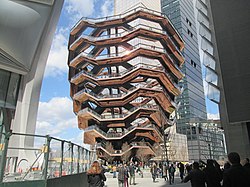
Vessel is a 16-story, 150-foot-tall (46 m)[1] structure of connected staircases among the buildings of Hudson Yards, located in the 5-acre (2.0 ha) Hudson Yards Public Square.[2] Designed by Thomas Heatherwick,[3] Vessel has 154 flights, 2,500 steps, and 80 landings,[3] with the total length of the stairs exceeding 1 mile (1.6 km).[4] The copper-clad steps, arranged like a jungle gym[5] and modeled after Indian stepwells,[4][6] can hold 1,000 people at a time.[3] The structure also has ramps and an elevator to comply with the Americans with Disabilities Act of 1990 (ADA),[2] though only three of Vessel's landings are ADA-accessible as of 2019[update].[7]
Vessel is 50 feet (15 m) wide at its base, expanding to 150 feet (46 m) at the apex.[3] Stephen Ross, the CEO of Hudson Yards' developer Related Companies, said that its unusual shape was intended to make the structure stand out like a "12-month Christmas tree".[2] Heatherwick said that he intends visitors to climb and explore the structure as if it were a jungle gym.[8] At the top of the structure, visitors can see the Hudson River.[4]
Surroundings
[edit]Vessel is located in and was designed in concert with the Hudson Yards Public Square, designed by Thomas Woltz of Nelson Byrd Woltz Landscape Architects.[9] The 5-acre (2 ha) space hosts 28,000 plants and 225 trees in total.[10] A canopy of trees is located in the southern area of the plaza. The southeast entrance to the plaza also includes a fountain. A "seasonally expressive" garden stands across from Vessel outside the entrance to the New York City Subway's 34th Street–Hudson Yards station.[11] The plaza is also connected to the High Line, an elevated promenade that extends south of Hudson Yards.[12]
Cost and assembly
[edit]Although Vessel had originally been slated to cost $75 million,[2] the projections were later revised to between $150[3] and $200 million.[4] Heatherwick attributed the greatly increased price tag to the complexity of building the steel pieces.[2] The pieces of Vessel were assembled in the comune of Monfalcone in Italy.[2] Ships transported the sections of the sculpture to Hudson River docks.[4]
Name
[edit]"Vessel" was planned to be the structure's temporary name during construction, with a permanent name to be determined later.[12] After Vessel opened, Hudson Yards asked the public to give it a formal name, creating a website devoted to that effect.[13]
History
[edit].jpg)

In an interview with Fortune magazine, Ross said that he "wanted to commission something transformational, monumental", which led to the concept for Vessel.[4] Ross was looking to five unnamed artists who were renowned for designing similar plazas, then asked them for in-depth proposals. He rejected all of the plans, at which point a colleague introduced Ross to Heatherwick.[2] Six weeks after they talked, Ross accepted Heatherwick's proposal immediately because it "had everything I wanted".[2] In an interview with designboom, Heatherwick said that his design for Vessel originated from a childhood experience when he "fell in love with an old discarded flight of wooden stairs outside a local building site".[6] The media first reported Heatherwick's commissioning in October 2013.[9][14]
The concept of Vessel was unveiled to the public on September 14, 2016,[4] in an event attended by hundreds of people including New York City Mayor Bill de Blasio.[3][2] Hosted by Anderson Cooper, the event featured a performance from the Alvin Ailey American Dance Theater that evoked the interlocking design of Vessel's staircases.[2]
In April 2017, the first major piece of the sculpture was installed at Hudson Yards.[15] Construction started on April 18[16] with the installation of the first 10 pieces of the 75-piece structure.[17] It was projected for completion in the spring of 2019,[18] with the other 65 pieces arriving in five batches.[19] The structure topped out in December 2017.[20][21] In October 2018, it was announced that the opening of Vessel had been scheduled for March 15, 2019, and that tickets to enter the structure would become available in February.[22] By January 2019, Hudson Yards officials were soliciting public suggestions for a rename of Vessel. Though the structure had no official name, the Hudson Yards website called it the "Hudson Yards Staircase".[23] Vessel opened as scheduled on March 15, 2019.[24][25]
Hudson Yards initially claimed to own any photo taken of Vessel. This drew criticism, not least because the developers had been given $4.5 billion of public money,[26] and Hudson Yards quickly stopped claiming to own others' photos of Vessel.[1][27][28] Starting in 2025, Vessel was illuminated at night during the winter holiday season.[29]
Suicides
[edit]On February 1, 2020, a 19-year-old man jumped from the sixth floor of the structure and died, apparently the first such incident involving Vessel.[30][31][32] On December 22, 2020, a 24-year-old woman jumped from the top of the structure and also died.[33][34] Less than a month later, on January 11, 2021, a 21-year-old man jumped from Vessel.[35][36] Following this third death, the structure was indefinitely closed while the Related Companies consulted with experts on a strategy to prevent suicides.[37][38] Residents of the surrounding neighborhoods hired a suicide prevention expert, who suggested adding netting or raising the glass barriers.[39] However, no changes were ultimately made to the barriers.[39][40]
Vessel was reopened at the end of May 2021, but all visitors were required to be accompanied by at least one other person. In addition, after the first hour of each day, all visitors older than five years old had to pay $10 for a ticket.[41][42] Revenue from ticket sales was to fund safety upgrades.[42] Two months later, on July 29, 2021, a 14-year-old boy jumped to his death while he was with his family.[39][43] After this fourth death, Vessel was again closed indefinitely.[39] Stephen Ross said he was considering closing the structure permanently.[44][45] By August 2022, Hudson Yards officials were testing safety nets around Vessel in preparation for the structure's possible reopening.[46] After full-height steel mesh nets were installed on each level, news media reported in early 2024 that Vessel would reopen later that year, though the top level would remain closed.[47][48] On October 21, 2024, Vessel reopened;[49] initially, only the lowest two levels and parts of the upper levels were open to the public.[50]
Critical reception
[edit]The sculpture has received both acclaim and criticism. Fortune writer Shawn Tully called Vessel "Manhattan's answer to the Eiffel Tower",[4] a sentiment echoed by CNN reporter Tiffany Ap.[8] Elle Decor writer Kelsey Kloss compared Vessel to an M. C. Escher drawing.[5] Several commentators have referred to the structure as the Giant Shawarma.[51][52] Speaking about the structure's design process, Heatherwick said, "We had to think of what could act as the role of a landmarker. Something that could help give character and particularity to the space."[53]
David Colon of Gothamist called Vessel "a bold addition to the city's landscape".[54] Public Art Fund president Susan Freedman liked the renderings for Vessel but called it "a leap of faith in terms of scale". She said there might be too much demand for Vessel, especially considering the structure's proximity to the High Line.[2]
Ted Loos of The New York Times said the sculpture, while a "stairway to nowhere" in the utilitarian sense, served as an "exclamation point" to the nearby northern terminus of the High Line.[2] Other critics panned Vessel. New York Times architecture critic Michael Kimmelman called Vessel's exterior "gaudy" and criticized Hudson Yards more generally as a "gated community" that lacked real public space.[55] CityLab's Feargus O'Sullivan called Vessel, along with Heatherwick's other numerous billionaire-funded developments and architectural projects, "a gaudy monument to being only ever-so-slightly free."[56] Some called it a "piece of junk" and an "eyesore", and contrasted it negatively to Cloud Gate, also known as The Bean, in Millennium Park, Chicago.[57] Blair Kamin of the Chicago Tribune called it "willful and contrived".[58]
Vessel was initially largely inaccessible for wheelchair users. It consisted mainly of stairs, with only a single elevator to connect one of the sets of landings,[59][60] and drew protests from disability-rights groups outside the structure.[61] To protest the inaccessibility of the structure, the artist Finnegan Shannon set up a lounge that could only be accessed by signing an agreement to not travel above the structure's ground level.[62] The United States Department of Justice filed a complaint alleging that because of the number of separate landings within Vessel, most of the structure was not compliant with the Americans with Disabilities Act, except for the portions directly outside the elevator. Furthermore, elevator stops on the fifth and seventh stories or mezzanines were sometimes skipped due to overcrowding concerns.[61] In December 2019, Related Companies and Vessel operator ERY Vessel LLC reached an agreement with the Department of Justice to increase accessibility to the structure by adding wheelchair lifts and retaining elevator access to all levels.[7][61][63]
Gallery
[edit]-
 Entrance
 -
 View from inside
 -
 View from the top
 -
 Aerial view
 -
 Top-down view
 -
 Vessel at night during the 2021 holiday season


,_Hudson_Yards,_New_York_City,_July_2019.jpg)

References
[edit]- ^ a b Deb, Sopan (March 19, 2019). "Following Outcry, Hudson Yards Tweaks Policy Over Use of Vessel Pictures". The New York Times. ISSN 0362-4331. Retrieved March 20, 2019.
- ^ a b c d e f g h i j k l Loos, Ted (September 14, 2016). "A $150 Million Stairway to Nowhere on the Far West Side". The New York Times. ISSN 0362-4331. Retrieved May 16, 2017.
- ^ a b c d e f Bockmann, Rich (September 14, 2016). "Stairway to Hudson: Related unveils $150M sculpture". The Real Deal New York. Retrieved September 14, 2016.
- ^ a b c d e f g h Tully, Shawn (September 14, 2016). "This Monument Could Be Manhattan's Answer to the Eiffel Tower". Fortune. Retrieved November 10, 2016.
- ^ a b Kloss, Kelsey (September 15, 2016). "New York City's Future Landmark Is a Real-Life M.C. Escher Drawing". ELLE Decor. Retrieved May 16, 2017.
- ^ a b Azzarello, Nina (September 14, 2016). "thomas heatherwick unveils 'vessel' for NY's hudson yards". designboom. Retrieved November 10, 2016.
- ^ a b DeGregory, Priscilla; Fitz-Gibbon, Jorge (December 23, 2019). "Hudson Yards' Vessel strikes accessibility deal". New York Post. Retrieved December 27, 2019.
- ^ a b Ap, Tiffany (September 15, 2016). "Could this be New York's Eiffel Tower?". CNN. Retrieved November 10, 2016.
- ^ a b Dailey, Jessica (October 29, 2013). "British Artist Will Create A 'New Icon' For NYC In Hudson Yards". Curbed NY. Retrieved May 16, 2017.
- ^ Dunlap, David W. (July 22, 2015). "A Garden Will Grow With Fans, Concrete, Coolant and 28,000 Plants". The New York Times. Retrieved July 22, 2015.
- ^ McCroy, Winnie (January 29, 2015). "Progress Report: Hudson Yards". Chelsea Now. Archived from the original on February 8, 2015. Retrieved February 2, 2020.
- ^ a b Plitt, Amy (September 14, 2016). "First look at Hudson Yards's enormous, interactive 'public landmark'". Curbed NY. Retrieved November 10, 2016.
- ^ Yakas, Ben (March 21, 2019). "You Can Suggest A New Name For Hudson Yards' 'Vessel'". Gothamist. Retrieved April 7, 2019.
- ^ Maloney, Jennifer; Brown, Eliot (October 29, 2013). "Aiming for an Artistic 'Icon'". The Wall Street Journal. ISSN 0099-9660. Retrieved May 16, 2017.
- ^ Plitt, Amy (April 18, 2017). "Go inside Hudson Yards as its 'Vessel' gets its groundbreaking". Curbed NY. Retrieved May 16, 2017.
- ^ "Construction To Begin On Hudson Yards 'Vessel'". CBS New York. April 18, 2017. Retrieved May 16, 2017.
- ^ Varinsky, Dana; Garfield, Leanna (April 18, 2017). "The biggest real estate development in American history will have a 15-story maze of stairwells". Business Insider. Retrieved May 16, 2017.
- ^ Warerkar, Tanay (August 17, 2017). "Hudson Yards's $200M 'Vessel' is on the rise". Curbed NY. Retrieved September 22, 2017.
- ^ Silva, Bianca (April 19, 2017). "Ten by Sea: Vessel's Vital Components Arrive at Hudson Yards". Chelsea Now. Retrieved May 19, 2017.
- ^ Warerkar, Tanay (December 6, 2017). "Thomas Heatherwick's 'Vessel' tops out in Hudson Yards". Curbed NY. Retrieved December 9, 2017.
- ^ Lynch, Patrick (December 7, 2017). "Heatherwick's Copper 'Vessel' Tops Out at New York's Hudson Yards". ArchDaily. Retrieved December 9, 2017.
- ^ Walker, Ameena (April 4, 2018). "Tracking the biggest buildings taking shape at Hudson Yards". Curbed NY. Retrieved November 25, 2018.
- ^ Cohen, Michelle (January 25, 2019). "Thomas Heatherwick's Hudson Yards sculpture awaits public opinion for official name". 6sqft. Retrieved January 26, 2019.
- ^ Fahner, Micki (March 16, 2019). "Vessel, the maze-like vertical structure, opens in NYC's Hudson Yards". NBC News. Retrieved February 2, 2020.
- ^ "Highly-Anticipated Hudson Yards Development Officially Opens To The Public". CBS New York. March 15, 2019. Retrieved March 23, 2019.
- ^ deMause, Neil (October 11, 2018). "Hudson Yards Has $4.5 Billion In Taxpayer Money. Will We Ever See It Again?". Gothamist. Retrieved March 20, 2019.
- ^ Yakas, Ben (March 20, 2019). "Vessel Changes Terms & Conditions After Extreme Photo Policy Controversy, Lawyers Still Find It 'Troubling'". Gothamist. New York Public Radio. Retrieved January 20, 2021.
- ^ Tarny, James (March 18, 2019). "After Public Outcry, a Rewritten Photo Policy for Hudson Yards' 'Vessel'". Bloomberg. Retrieved March 20, 2019.
- ^ Ratliff, Laura (November 13, 2025). "For the first time ever, the Vessel is hosting a holiday lighting ceremony". Time Out New York. Retrieved November 15, 2025.
- ^ Quinn, Allison (February 2, 2020). "Teen Jumps to His Death From Manhattan Sculpture as Onlookers Watch". The Daily Beast. Retrieved February 2, 2020.
- ^ Parnell, Wes (February 2, 2020). "Teen leaps to death off Hudson Yards Vessel". New York Daily News. Retrieved February 2, 2020.
- ^ Syckle, Katie Van; Salcedo, Andrea (February 2, 2020). "Suicide at Hudson Yards Vessel: Teenager Jumps Over Railing". The New York Times. ISSN 0362-4331. Retrieved December 26, 2020.
- ^ Garber, Nick (December 22, 2020). "Woman Jumps To Her Death From Hudson Yards' Vessel". Patch. Retrieved December 26, 2020.
- ^ Levine, Cecilia (December 25, 2020). "NYC Woman Follows Fatal Leap From Hudson Yards Vessel With Heartbreaking Instagram Post". Hudson Daily Voice. Retrieved December 26, 2020.
- ^ Rayman, Graham (January 11, 2021). "Man, 21, jumps to death from the Vessel at Manhattan's Hudson Yards". New York Daily News. Retrieved January 12, 2021.
- ^ Moore, Tina; Mongelli, Lorena; McCarthy, Craig (January 11, 2021). "Another suicide rocks the Hudson Yards Vessel". New York Post. Retrieved January 12, 2021.
- ^ Shanahan, Ed; de Freytas-Tamura, Kimiko (January 12, 2021). "150-Foot Vessel Sculpture at Hudson Yards Closes After 3rd Suicide". The New York Times. ISSN 0362-4331. Retrieved January 13, 2021.
- ^ Stoilas, Helen (January 12, 2021). "Heatherwick's Vessel closed to the public after third suicide in less than a year". The Art Newspaper. Retrieved January 13, 2021.
- ^ a b c d Wong, Ashley; Gold, Michael (July 29, 2021). "Fourth Suicide at the Vessel Leads to Calls for Higher Barriers". The New York Times. ISSN 0362-4331. Retrieved July 29, 2021.
- ^ "Teen Boy Dies by Suicide at Hudson Yards' Vessel, Fourth in 18 Months". NBC New York. July 29, 2021. Retrieved July 30, 2021.
- ^ "Hudson Yards Vessel reopens with focus on suicide prevention". ABC7 New York. May 26, 2021. Retrieved May 26, 2021.
- ^ a b Cuozzo, Steve (May 26, 2021). "Hudson Yards Vessel bans individual visitors after rash of suicides". New York Post. Retrieved May 26, 2021.
- ^ Parascandola, Rocco; Tracy, Thomas (July 29, 2021). "Teenager jumps to his death from the Vessel at NYC's Hudson Yards". New York Daily News. Retrieved July 30, 2021.
- ^ Kirsch, Noah (July 29, 2021). "Billionaire Developer Mulls Closing NYC Tourist Hot Spot After 14-Year-Old Leaps to His Death". The Daily Beast. Retrieved July 30, 2021.
- ^ Avery, Dan (August 5, 2021). "Can New York City's 'Vessel' Be Saved?". Architectural Digest. Retrieved August 11, 2021.
- ^ "Hudson Yards testing safety netting at shuttered 'Vessel' after suicides". ABC7 New York. August 9, 2022. Retrieved September 18, 2022.
- ^ Jose, Chris (April 12, 2024). "The Vessel at Hudson Yards is set to reopen, but with safety changes after suicides". NBC New York. Retrieved April 13, 2024.
- ^ Offenhartz, Jake (April 12, 2024). "The Vessel, a Manhattan tourist site closed after suicides, will reopen later this year". AP News. Retrieved April 13, 2024.
- ^ "The Vessel, a Manhattan tourist site closed after suicides, reopens with new safety features". AP News. October 20, 2024. Retrieved October 21, 2024.
- ^ Glorioso, Chris (October 20, 2024). "The Vessel at Hudson Yards to reopen Monday with new safety measures". NBC New York. Retrieved October 21, 2024.
- ^ Grabar, Henry (March 19, 2019). "New Yorkers Are Right: Hudson Yards' Big Tourist Attraction Should Forever Be Called the Shawarma". Slate Magazine. Retrieved March 20, 2019.
- ^ Alburger, Carolyn (March 15, 2019). "Hudson Yards $200M Art Piece Looks Like a Giant Shawarma". Eater NY. Retrieved March 20, 2019.
- ^ Lynch, Patrick (September 15, 2016). "Heatherwick Studio's "Vessel" Will Take the Form of an Endless Stairway at New York's Hudson Yards". ArchDaily. Retrieved November 10, 2016.
- ^ Colon, David (September 14, 2016). "Behold The Giant $150 Million Public Art 'Vessel' Coming To Hudson Yards". Gothamist. Archived from the original on October 25, 2016. Retrieved November 10, 2016.
- ^ Kimmelman, Michael (March 14, 2019). "Hudson Yards Is Manhattan's Biggest, Newest, Slickest Gated Community. Is This the Neighborhood New York Deserves?". The New York Times. ISSN 0362-4331. Retrieved March 20, 2019.
- ^ O'Sullivan, Feargus (March 19, 2019). "Cities Deserve Better Than These Thomas Heatherwick Gimmicks". Bloomberg.com. Retrieved March 20, 2019.
- ^ Griffin, Tron (April 1, 2019). "Chicago has the Bean. New York has a new piece of junk called the "Vessel"". ChicagoNow. Archived from the original on August 29, 2019. Retrieved August 29, 2019.
- ^ Kamin, Blair [@BlairKamin] (March 15, 2019). "The Vessel ain't the Bean, not by a long shot. The Bean looks graceful, effortless; its New York counterpart, willful and contrived" (Tweet). Retrieved August 29, 2019 – via Twitter.
- ^ Lange, Alexandra (December 20, 2019). "New York City's two biggest design stories of 2019 are also design failures". Curbed NY. Retrieved December 27, 2019.
- ^ Gotkin, Kevin (September 2018). "Stair Worship: Heatherwick's Vessel". The Avery Review (33). Retrieved September 3, 2023.
- ^ a b c Plitt, Amy (December 23, 2019). "Hudson Yards' Vessel must add 'one-of-a-kind platform lift' to improve accessibility". Curbed NY. Retrieved December 27, 2019.
- ^ "Shannon Finnegan and Aimi Hamraie on Accessibility as a Shared Responsibility". ARTnews.com. December 17, 2019. Retrieved September 3, 2023.
- ^ "One-of-a-Kind Mechanism to Be Installed in the Vessel to Increase Accessibility for Individuals With Disabilities". NBC New York. December 23, 2019. Retrieved December 27, 2019.
External links
[edit]


Vessel (structure)
View on GrokipediaCommissioned by developer Related Companies as the centerpiece of the 5-acre Hudson Yards Public Square, the structure was completed in December 2017 and opened to the public on March 15, 2019, coinciding with the debut of the site's initial phase, at a reported construction cost exceeding $200 million.[4][5]
Intended to foster social interaction and urban vitality through its climbable design, the Vessel quickly became a popular tourist attraction but drew scrutiny for safety concerns after at least four suicides occurred by jumps from its heights between 2020 and 2021, prompting indefinite closures in January and May 2021.[6][7][8]
Following extensive modifications, including the addition of steel mesh barriers on all platforms and landings to prevent falls, the structure reopened to ticketed visitors on October 21, 2024, with requirements such as mandatory group entry and supervision for minors to mitigate risks while preserving access.[6][7][5]
Design and Architecture
Structural Composition
The Vessel consists of 154 interconnected flights of stairs forming a lattice-like exoskeleton that ascends 150 feet (46 meters) over 16 levels.[3][9][10] This climbing frame incorporates 80 landings and nearly 2,500 steps, enabling vertical circulation without elevators or enclosed floors.[11][12] The structure's base spans a 50-foot diameter, expanding to 150 feet at the summit, which yields a flared, honeycomb configuration of hexagonal modules.[10][13] These elements interlock at varying angles, creating multiple pathways for ascent and descent that intersect to form a three-dimensional network.[3][12] Prefabricated in 75 steel modules, the assembly supports a capacity of up to 1,000 visitors simultaneously, emphasizing interactive navigation over conventional architectural enclosure.[11][14] This composition prioritizes experiential geometry, where stairs serve both structural and circulatory roles.[9]Materials and Engineering
The Vessel's primary structural material is raw welded and painted steel, selected for its durability and ability to form the complex, climbable lattice framework.[1] Non-corrosive steel coats each level to resist environmental degradation in New York City's climate, while polished copper-colored steel cladding envelops the soffits and undersides, achieved through deposition-coating on stainless steel to mimic copper patina and reflect surrounding skyscrapers.[12] [11] Interior elements incorporate darker concrete for platforms and landings.[12] Engineering the 150-foot-tall (46-meter) structure, designed by Thomas Heatherwick and structurally engineered by Thornton Tomasetti, involved fabricating 75 primary "dog-bone" modules—each comprising interconnected stair and landing segments—in Italy by Cimolai S.p.A.[15] [11] These bespoke components, along with 10 base dog-bones, 5 pedestal pieces, and 6 specialized elements for the south-side spine and elevator, total 96 steel members, all custom-jointed and handrailed for human-scale interaction.[11] Modules were shipped from Monfalcone to Newark, then barged via the Hudson River for on-site assembly starting April 18, 2017, enabling the inverted conical form with a 50-foot base diameter expanding to 150 feet at the top.[12] [15] The base rests on a 12-foot-tall steel box pedestal bolted to a grillage of three-foot-deep fabricated plate girders, spanning to columns anchored in bedrock caissons for load transfer and wind resistance.[11] Stability against dynamic loads from visitor traffic is provided by 10 tuned mass dampers, each weighing approximately 12,000 kilograms, installed by Cimolai and designed by GERB to mitigate vibrations.[11] This engineering supports the Vessel's dual role as monumental sculpture and functional climbing frame, comprising 154 stair flights, 80 landings, and approximately 2,500 steps across 16 stories.[1] [15]Aesthetic and Functional Intent
The Vessel was designed by Thomas Heatherwick of Heatherwick Studio as a climbable public sculpture to serve as the centerpiece of Hudson Yards, emphasizing active human engagement over passive viewing.[1] Its aesthetic intent draws from the repetitive, interlocking forms of staircases, forming a modular, honeycomb-like exoskeleton that visually dominates the plaza and evokes curiosity through its intricate, repetitive geometry composed of 141 prefabricated stair modules.[16] This sculptural form, rising 46 meters (150 feet) high, utilizes bronzed steel to create a shimmering, lattice structure that interacts with light and shadows, intended to draw pedestrians into exploration rather than mere observation.[17] Functionally, the structure incorporates 154 interconnecting flights of stairs, 80 landings, and 2,500 steps across 16 levels, engineered to encourage physical exertion and serendipitous social interactions among visitors.[16] Heatherwick envisioned it as a "new type of public landmark," where climbing paths converge and diverge, fostering encounters between strangers and providing elevated vantage points for views of the Hudson River and Manhattan skyline.[1] The absence of elevators for general access—save for a specialized one for mobility-impaired visitors—reinforces the intent to prioritize ambulatory discovery, countering the sedentary nature of typical urban public spaces.[18] This dual aesthetic and functional approach stems from Heatherwick's broader philosophy of human-centered design, aiming to transform an otherwise static plaza into a dynamic, participatory environment that promotes well-being through movement and connection.[16] The design rejects conventional monumental art by making the structure itself experiential, with open apertures allowing glimpses between levels to heighten anticipation and immersion.[17]Development and Financing
Planning and Conceptualization
The Vessel project originated from a commission by Related Companies and Oxford Properties Group, the developers of Hudson Yards, to Heatherwick Studio for a public centerpiece to activate the central plaza of the 11-hectare mixed-use development on Manhattan's West Side.[1][2] The studio, led by Thomas Heatherwick, was tasked with creating an interactive structure that would encourage visitor engagement in contrast to traditional static monuments, drawing on the designer's interest in human-scale interactivity within urban spaces.[1][19] Conceptualization emphasized social connectivity and exploration, inspired by the ancient stepwells of Rajasthan, India, which feature layered staircases fostering communal gathering in shaded, repetitive geometries.[1] Heatherwick envisioned a 16-storey climbing frame comprising 154 interconnected staircases, 80 landings, and approximately 2,500 steps, forming a honeycomb-like exoskeleton that widens from a 50-foot base to 150 feet at the summit to provide panoramic views of the Hudson River and city skyline without dominating the surrounding towers.[1][16] The design incorporated modular, prefabricated bronze-colored steel modules—75 in total—for efficient assembly, with raw welded interiors contrasting polished exteriors to evoke tactile discovery.[1] This approach aimed to transform the plaza into a dynamic social hub, prioritizing experiential architecture over mere visual spectacle.[20] Initial planning progressed rapidly, with Heatherwick Studio developing core concepts within months of the commission to align with the broader Hudson Yards timeline. The structure's estimated $150 million cost reflected its engineering complexity as a self-supporting sculpture rather than a building, funded privately by the developers under Stephen Ross of Related Companies.[21][22] Public reveal of the design occurred on September 14, 2016, positioning Vessel as an accessible, free-to-climb landmark intended to draw diverse crowds and integrate with the site's retail and residential elements.[23][24]Cost Estimates and Funding Mechanisms
The construction cost of the Vessel was initially estimated at $75 million but escalated to approximately $200 million upon completion.[25] This final figure encompassed fabrication of its steel framework in Italy, transportation to New York, on-site assembly, and integration into the Hudson Yards plaza.[20] [26] Funding for the Vessel derived entirely from private sources, primarily the lead developer Related Companies, as an element of the broader Hudson Yards commercial-residential project rather than through direct public subsidies or bonds allocated to the structure itself.[27] [25] Related Companies, in partnership with Oxford Properties Group, secured overall project financing via equity investments, debt arrangements, and value-capture mechanisms like payments in lieu of taxes (PILOTs) issued through the Hudson Yards Infrastructure Corporation (HYIC), though these supported site-wide infrastructure rather than the Vessel specifically.[28] [29] The absence of targeted public funding for the Vessel underscored its role as a privately sponsored public amenity intended to enhance the development's appeal and property values.[30]Construction Process and Timeline
The Vessel's construction began on April 18, 2017, when the first modules were installed at the Hudson Yards site in Manhattan.[31] The project utilized extensive prefabrication, with 75 steel segments manufactured off-site and then hoisted into place individually by crane to form the 46-meter-tall (150-foot) honeycomb framework.[32] These segments incorporated non-corrosive steel frames clad in a high-gloss copper-colored coating applied through physical vapor deposition (PVD) vacuum plating, which bonds molecularly to the steel for durability and aesthetic consistency; prefabrication also included preinstallation of handrail fittings and mechanical systems to streamline assembly.[33][11] Assembly proceeded modularly, akin to interlocking construction toys, allowing the structure to rise incrementally from its base platform integrated with the surrounding Public Square and Gardens.[31] The uppermost module was placed in December 2017, marking the topological completion of the primary framework comprising 154 stair flights, 80 landings, and over 2,500 steps.[9][34] Final fit-out, including safety features, lighting, and integration with adjacent infrastructure such as the elevated High Line and retail podium, extended through 2018. The structure achieved substantial completion by early 2019, enabling its public debut on March 15, 2019, as the centerpiece of Hudson Yards' initial phase opening.[4] This timeline aligned with the broader Hudson Yards development, which had commenced groundwork years earlier but prioritized Vessel's on-site erection after foundational site preparation, including platform extension over active rail yards.[31]Site and Integration
Hudson Yards Context
Hudson Yards represents the largest private real estate development in United States history, encompassing approximately 28 acres on Manhattan's West Side, constructed atop the former Long Island Rail Road storage yard between West 30th and 34th Streets and Tenth and Twelfth Avenues.[35] Jointly developed by Related Companies and Oxford Properties Group starting in the late 2000s, the project includes over 5,000 residential units (including affordable housing), more than 100 retail outlets, five office towers, cultural venues, and 14 acres of public open spaces, transforming an underutilized industrial area into a mixed-use neighborhood.[36][37] The development required a massive platform decking over active rail lines, enabling vertical construction and integrating public amenities with commercial and residential elements.[38] The Vessel occupies a central position within the 5-acre Hudson Yards Public Square and Gardens, serving as the development's iconic focal point and interactive public artwork. Funded entirely by Related Companies as part of the overall project, the 154 interconnected staircases comprising nearly 2,500 steps and 80 landings elevate visitors up to 50 meters, offering elevated vantage points over the plaza's gardens, pathways, and surrounding structures while promoting pedestrian circulation and social engagement.[39] This design integrates the Vessel with the broader public realm, which features landscaped groves, event spaces, and connections to the High Line park, aiming to draw foot traffic to the adjacent retail podium and residential towers.[40] Positioned amid high-rise office buildings like 10 Hudson Yards (opened 2012) and luxury condominiums such as 15 and 35 Hudson Yards, the Vessel underscores the project's emphasis on accessible public amenities within a predominantly private, market-driven enterprise valued at over $25 billion.[38] Critics have noted that while the structure enhances the plaza's visibility and user experience, its prominence highlights tensions between public access and the development's commercial orientation, with the surrounding area generating significant tax revenues for the city through property assessments and business activity.[41]Physical Surroundings and Accessibility
The Vessel is located in the Hudson Yards neighborhood on Manhattan's West Side, within a 5-acre public plaza that forms the centerpiece of a larger mixed-use development spanning 28 acres. This plaza is bordered by high-rise office towers such as 10 Hudson Yards and 30 Hudson Yards, residential buildings, and The Shops & Restaurants at Hudson Yards, a multi-level retail complex. To the east, it connects to the High Line, an elevated linear park extending southward, while westward views extend across the Hudson River toward New Jersey. The surrounding urban environment includes the Javits Convention Center to the south and Penn Station approximately 0.5 miles away, integrating the Vessel into a dense commercial and transportation hub.[2][16] Accessibility to the Hudson Yards plaza and Vessel is facilitated primarily through public transit. The 34th Street–Hudson Yards subway station, served by the 7 line, provides direct underground access via escalators and elevators emerging near the plaza's northern edge. Additional options include multiple bus routes along 34th Street and 11th Avenue, the NYC Ferry service at nearby Hudson Yards piers, and Citi Bike stations within a short walk. Limited on-site parking is available in garages beneath the development, though driving is discouraged due to congestion. Pedestrian entrances to the plaza are multiple, with primary access points from Hudson Boulevard and 10th Avenue, featuring wide sidewalks and curb cuts compliant with ADA standards.[42][43] For entry into the Vessel itself, visitors must obtain timed reservations via the official website, with tickets priced at $10 and free for New York City residents on Thursdays upon presenting proof of residency. The structure's base level is reached via the open plaza, but ascent relies on 154 interconnected staircases totaling 2,500 steps across 80 landings. An ADA-compliant elevator provides access for wheelchair users and those with mobility impairments to select upper platforms, though full exploration remains limited by the stair-centric design; post-2024 reopening enhancements include steel mesh barriers on stairwells for safety without altering core accessibility. Elevator operation is monitored, with potential wait times during peak hours from 11:00 a.m. to 7:00 p.m.[44][45][46]Operational History
Initial Opening and Visitor Access (2019–2021)
The Vessel opened to the public on March 15, 2019, coinciding with the debut of the first phase of Hudson Yards in Manhattan, New York City.[47] Access required free timed reservations, available up to 14 days in advance online, with day-of tickets also offered on a first-come, first-served basis to manage crowd flow through the structure's 154 staircases and 80 platforms rising to 150 feet.[47] [48] On opening day, over 1,000 visitors participated in the inaugural climb, drawn to the interactive sculpture designed for exploration and panoramic city views.[2] In its first year of operation, the Vessel attracted approximately 2 million visitors, establishing it as a major tourist draw despite the requirement for pre-booking to prevent overcrowding.[49] Operations continued through 2020 amid the COVID-19 pandemic, with attendance declining due to travel restrictions and reduced tourism, though the reservation system remained in place for safe, staggered entry.[49] Visitors were permitted to freely navigate the interconnected levels, photographing and ascending at their pace within allotted times, fostering social media engagement and repeat visits.[50] Following a series of suicides in early 2021, access policies were adjusted in February 2021 to include physical barriers on certain platforms and a requirement for visitors to be accompanied by at least one other person when accessing upper levels beyond the fifth floor.[51] These interim measures aimed to enhance safety while maintaining public access until the structure's full closure to climbers in August 2021.[51] The base level remained viewable from the surrounding plaza throughout this period.[51]Safety Incidents and Interim Measures (2021)
In January 2021, following a third suicide at the Vessel—the structure's climbable honeycomb framework at Hudson Yards—operators indefinitely closed public access on January 12 to address safety risks posed by its open staircases and platforms rising 150 feet.[52] The closure came after prior incidents, including the first confirmed suicide in February 2020, highlighted the structure's design vulnerabilities, such as low barriers allowing jumps from multiple levels.[52] The Vessel partially reopened to visitors on May 28, 2021, implementing interim protocols to mitigate risks without permanent structural alterations.[53] These measures included tripling security personnel for constant monitoring, mandating advance ticket purchases to control crowds, prohibiting solo ascents by requiring climbers to proceed in groups of at least two, and barring unaccompanied minors under 18.[53] Operators, including Related Companies and Oxford Properties Group, stated these steps aimed to enhance oversight while preserving the interactive experience, though critics questioned their sufficiency given the site's prior fatalities.[53] Despite the enhancements, a fourth suicide occurred on July 29, 2021, when a 14-year-old boy jumped from an upper platform, even though he was accompanied by family members, prompting immediate re-closure of the staircases.[54][55] The incident, confirmed by New York Police Department as a deliberate act, underscored limitations in behavioral monitoring, as guards reported the boy appeared playful moments before leaping.[55] In response, access remained restricted indefinitely, shifting focus to longer-term barriers amid debates over design accountability.[56]Extended Closure and Modifications (2021–2024)
Following the third suicide at the Vessel on January 11, 2021, operators Related Developments temporarily suspended public climbing access on January 12, 2021, and introduced interim measures including tripled security staffing, prohibitions on solo ascents, and signage directing visitors to the National Suicide Prevention Lifeline.[52][57] A fourth suicide occurred later that year, prompting a full and indefinite closure to all interior access on July 12, 2021, with the structure fenced off to prevent climbing while allowing exterior viewing from Hudson Yards plaza.[45][58] During this extended period, the honeycomb framework remained a visible landmark, illuminated for seasonal events such as the 2021 holiday displays, but public interaction was limited to ground-level observation amid ongoing debates over its design vulnerabilities.[59] The closure persisted for nearly three years as Related Developments, in collaboration with Heatherwick Studio and suicide prevention specialists, evaluated structural risks and developed permanent safeguards.[60] Initial proposals for barriers faced criticism from experts advocating for higher enclosures—at least 7 feet—to effectively deter jumps, leading to iterative designs that prioritized enclosing exposed staircases and platforms without fully obstructing panoramic views.[61] By early 2024, construction commenced on stainless-steel mesh netting systems, including floor-to-ceiling caging along the 154 staircases and honeycomb landings, engineered to withstand climbing attempts while preserving the structure's aesthetic integrity and airflow.[8][59] These modifications, costing an undisclosed amount beyond the original $200 million construction budget, were completed by October 2024, enabling the site's preparation for resumed operations under a reservation system with enhanced monitoring protocols.[62][58]Reopening and Ongoing Protocols (2024–present)
The Vessel reopened on October 21, 2024, after a closure exceeding three years due to a series of suicides that highlighted risks from its open staircases and elevated platforms.[63][60] Key protocols implemented include the installation of floor-to-ceiling steel mesh barriers along all walkable stairwells, platforms, and viewing areas, designed to prevent intentional or accidental falls while maintaining partial access to the structure.[60][64] These barriers, described by operators as a direct response to prior incidents, enclose approximately 80% of the Vessel's accessible surfaces but obscure some panoramic views of the Hudson Yards complex and Manhattan skyline.[65][63] The uppermost level remains closed indefinitely to allow ongoing evaluation of the mesh's structural integration with the copper-clad framework, with only the lower levels fully operational for climbing and observation.[65][66] Visitor entry now mandates advance reservations via the official Hudson Yards platform, limited to timed slots to control crowd density and facilitate monitoring; New York City residents receive complimentary access every Thursday to encourage local engagement.[2][67] Ongoing operations emphasize continuous staff supervision, behavioral observation for at-risk individuals, and integration with broader site security, reflecting a causal prioritization of physical barriers over prior reliance on signage and patrols alone.[59][51] As of early 2025, these measures persist without announced modifications, enabling controlled public use while addressing the design's inherent vulnerabilities to self-harm.[66]Controversies and Criticisms
Suicide Events and Prevention Debates
The Vessel has been the site of at least four suicides since its public opening on March 15, 2019.[68] The first occurred in February 2020, prompting initial safety reviews but no immediate closure.[59] A second and third suicide followed in late 2020 and early January 2021, leading Related Companies, the developer, to close the structure indefinitely to visitors on January 12, 2021, while allowing ground-level access.[63] It partially reopened in May 2021 with enhanced security protocols, including staff monitoring and wristband tracking for visitors, but a fourth suicide—a 14-year-old boy on July 29, 2021—prompted another indefinite closure.[54][56] In response, Related Companies installed temporary barriers and signage, but these proved insufficient, as evidenced by the continued incidents despite prior measures.[63] The structure remained closed to climbers from 2021 through 2024, during which permanent modifications were planned, including floor-to-ceiling steel mesh netting on upper levels to block access to open staircases and platforms.[8] The Vessel reopened to the public on October 21, 2024, with these barriers enclosing exposed sections, capacity limits, and required advance ticketing, though ground-level viewing remains free.[69] No suicides have been reported since the latest closure, but long-term efficacy depends on enforcement and visitor compliance.[62] Debates surrounding suicide prevention at the Vessel center on the structure's design—its 154 interconnected staircases rising 150 feet with open voids—and the role of physical barriers versus broader interventions. Critics, including families of victims, argued that the original honeycomb framework facilitated impulsive acts by providing easy access to heights without adequate railings, calling for taller barriers exceeding 4 feet as early as 2021.[54] Proponents of reopening, such as Related Companies, emphasized that structural changes like mesh netting address site-specific risks while preserving the attraction's experiential intent, citing precedents like the Golden Gate Bridge, where barriers reduced suicides by over 80% post-installation without evidence of significant displacement to other methods.[70] Empirical studies support restriction of means as an effective strategy, with vertical barriers averting 68.7% of attempts and nets 77.1% at high-risk sites, though some analyses note potential for method substitution elsewhere, underscoring the need for integrated mental health screening at entry points.[57][71] Social media analyses post-incidents revealed public sentiment shifting toward demands for engineering solutions over closure, with concerns that indefinite shutdowns ignore evidence from viaducts like Toronto's Bloor Street, where barriers halved jumps when paired with awareness campaigns.[72][56] Opponents, including some architects, contend the netting compromises the Vessel's aesthetic and interactive purpose, potentially rendering it a "caged eyesore" ineffective against determined individuals, though data from similar installations refute widespread evasion.[73]Fiscal and Public Funding Scrutiny
The construction of Vessel incurred an estimated cost of $150–200 million, with funding provided exclusively by the lead developer, Related Companies, as part of the broader Hudson Yards initiative.[74][75] This private investment covered the structure's 154 interconnected steel staircases and bronze cladding, positioned atop a public platform linked to the No. 7 subway extension, which itself faced significant overruns borne by public entities. Scrutiny of Vessel's fiscal implications intensified within the context of Hudson Yards' overall financing, which incorporated approximately $6 billion in public subsidies, including property tax abatements, infrastructure expenditures, and incentives like payments in lieu of taxes (PILOTs).[76] Analyses have highlighted that these supports—totaling over $2.2 billion in direct city spending by 2019—contradicted early claims of a "self-financing" project, with revenue shortfalls and spillovers necessitating additional taxpayer outlays.[77] Critics, drawing on public records, contend that such incentives diverted resources from affordable housing and low-income communities, exemplified by the project's $1.2 billion raised through the EB-5 immigrant investor visa program, which channeled foreign capital but prioritized luxury development over equitable urban priorities.[30][78] Post-opening closures due to safety concerns amplified questions of value, as the $500 million city allocation for the surrounding public realm—including Vessel's foundational elements—yielded limited accessible utility after 2021, with fencing and barriers curtailing public engagement until partial reopening in 2024.[79] Independent assessments, such as those from the Independent Budget Office, noted overruns on transit integrations exceeding initial projections by hundreds of millions, underscoring causal links between subsidized infrastructure and the viability of amenities like Vessel, whose underutilization post-incidents raised doubts about long-term return on embedded public costs.[80] While Related Companies absorbed direct Vessel expenses, the structure's role as a subsidized project's emblem fueled debates on opportunity costs, with empirical data showing Hudson Yards' tax breaks continuing to reduce city revenues amid vacancy rates in associated office spaces.[81]Design and Urban Development Critiques
The Vessel's design, consisting of 154 interconnected bronze-colored steel staircases forming a honeycomb-like lattice rising 150 feet, has been faulted for prioritizing visual spectacle over functionality and durability. Critics, including architecture commentators, described it as a "stairway to nowhere" due to its repetitive climbing paths that offer limited vistas and no substantial programmatic elements beyond ascent and descent, rendering it experientially barren despite its interactive intent.[82] Construction quality drew further scrutiny, with reports of makeshift fixes like gaffer tape securing components and unevenly sawn steps and balustrades at opening in March 2019, suggesting rushed prefabrication that compromised long-term integrity.[83] The $200 million cost, funded privately by developers Related Companies and Oxford Properties Group, amplified perceptions of extravagance, as the structure's stark industrial materials—steel frames clad in copper—evoke a harsh, uninviting aesthetic akin to "shearing metal" rather than organic human-scale interaction.[84][85] In urban development terms, the Vessel exemplifies critiques of Hudson Yards as a $25 billion privatized enclave on Manhattan's West Side, where public access is mediated through commercial gates and security, fostering a "gated community" feel that segregates rather than integrates with surrounding neighborhoods like Hell's Kitchen.[38] Urbanists argue it contributes to a sterile, consumer-oriented landscape dominated by luxury retail and high-rises, lacking affordable housing or community amenities despite occupying city-owned rail yard land rezoned in 2012, which prioritized corporate revenue over inclusive urban fabric.[86] Absent any public design review process—owing to its placement on private property—the structure bypassed civic oversight, resulting in a monumental focal point that symbolizes developer contempt for pedestrian needs, treating users as transient consumers in a spreadsheet-driven vision rather than fostering genuine public realm vitality.[87] This approach has been likened to a "billionaires' playground," where the Vessel's imposing form visually overwhelms adjacent public spaces without enhancing connectivity or sustainability, exacerbating Manhattan's spatial inequalities.[88][89]Reception and Legacy
Architectural and Critical Assessments
The Vessel's architectural form, designed by Thomas Heatherwick Studio, consists of a 46-meter-tall (150-foot) lattice of 154 interconnected staircases, 80 platforms, and over 2,500 steps, clad in prefabricated copper-colored steel modules that create a honeycomb-like exoskeleton. This configuration aims to transform vertical circulation into an interactive experience, promoting physical exploration, social encounters, and elevated views of the Hudson River and Manhattan skyline, rather than serving as a conventional building or static monument.[3][90] Critical reception among architects and reviewers has been predominantly negative, with many viewing the structure as an over-engineered spectacle prioritizing novelty and spectacle over functional or aesthetic coherence. Publications like The Architectural Review and Architectural Record have derided it as a $200–250 million "climbable tourist attraction" emblematic of excess, arguing that its repetitive, basket-like form—likened to a pinecone, shawarma, or fruit packaging mesh—lacks the gravitas or innovation to justify its scale and cost relative to the surrounding Hudson Yards development.[91][92][88] Critics such as those in The Guardian contend that the design exemplifies broader failures in "star architecture," where high-profile commissions by figures like Heatherwick produce visually striking but barren outcomes, with the Vessel's steel-and-stone composition offering little beyond structural bravado and evoking an uncanny, computer-generated quality even in person.[83][93] Defenders, including Heatherwick himself, emphasize the project's engineering feats—such as modular assembly over active rail yards—and its intent to humanize urban space by inverting the stair's typical subservience to encourage deliberate movement and community.[94][82] However, these arguments have been countered by assessments highlighting a disconnect between form and purpose: the structure's experiential appeal draws crowds but fails as enduring public infrastructure, with its verticality amplifying isolation rather than integration, and no major architectural awards—such as AIA honors or RIBA recognition—validating its merits post-opening in March 2019.[91][87] Engineering analyses note the innovative use of tetrahedral units for stability, yet critics like those in Dezeen argue this technical prowess serves a privatized vision of public space, funded by developer Related Companies without sufficient civic input, underscoring systemic issues in developer-led urbanism over community-driven design.[94][87]Public Engagement and Tourism Data
The Vessel attracted significant public interest shortly after its March 2019 opening, drawing over 120,000 visitors in its initial weeks, with advance tickets selling out up to two weeks in advance.[49] Annually, prior to its 2021 closure, the structure reportedly welcomed more than 2 million visitors, establishing it as a key draw within Hudson Yards.[50] This high engagement contributed to Hudson Yards emerging as a prominent tourist destination, with weekend foot traffic in the neighborhood ranging from 25,000 to 50,000 visitors per day in the months following the Vessel's debut.[95] The Vessel's interactive, climbable design fueled its appeal as a social media phenomenon, positioning it among New York City's most photographed landmarks and amplifying tourism through user-generated content.[96] However, its indefinite closure from November 2021 to October 2024 due to safety concerns resulted in zero direct visitor access, though the surrounding Hudson Yards plaza remained open and continued to support broader area tourism.[69] Upon reopening on October 21, 2024, with added safety netting and barriers, initial turnout was limited; approximately 75 visitors purchased tickets and queued for entry on the first morning.[97] Reservations became available for free Thursday access for New York residents, aimed at rebuilding local engagement, though comprehensive post-reopening visitor statistics remain unavailable as of late 2024.[2] Early feedback highlighted mixed reception, with some tourists criticizing the netting as detracting from the original experiential appeal.[98]| Period | Estimated Visitors | Notes |
|---|---|---|
| First weeks (March 2019) | Over 120,000 | Tickets sold out in advance. |
| Annual (pre-2021) | Over 2 million | Peak engagement period. |
| Reopening day (Oct 21, 2024) | Approximately 75 | Initial morning queue with tickets. |