Hubbry Logo
Prometheus (Manship)Prometheus (Manship)Main
Open search
Prometheus (Manship)
Community hub
Prometheus (Manship)
logo
8 pages, 0 posts
0 subscribers
Be the first to start a discussion here.
Prometheus (Manship)
from Wikipedia

Prometheus
The sculpture in 2013
Map
ArtistPaul Manship
Year1934 (1934)
TypeSculpture
MediumBronze
Dimensions5.5 m (18 ft)
LocationNew York City, New York, United States
Coordinates40°45′31″N 73°58′43″W / 40.75872°N 73.97859°W / 40.75872; -73.97859

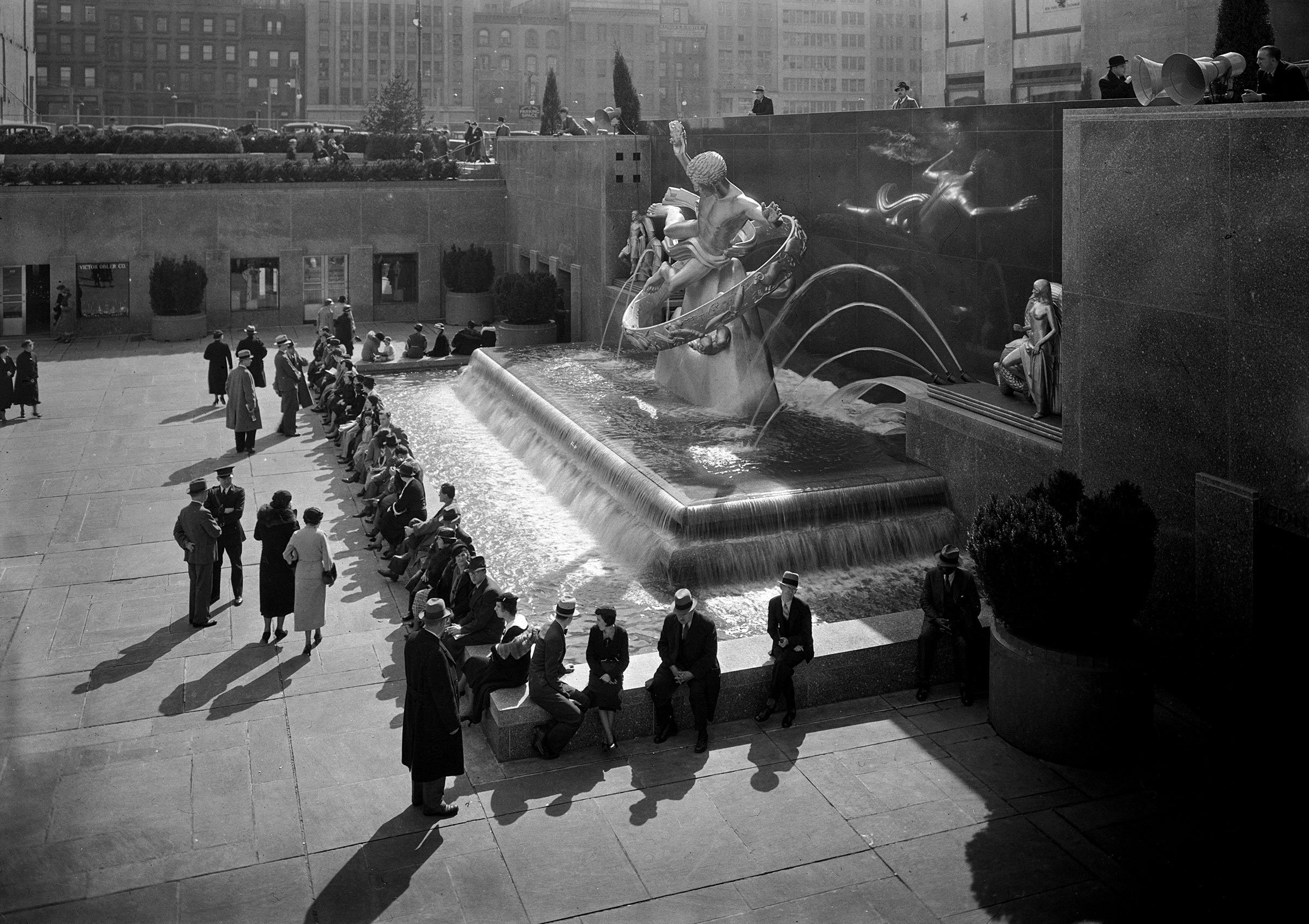
Prometheus is a 1934 gilded, cast bronze sculpture by Paul Manship, located above the lower plaza at Rockefeller Center in Manhattan, New York City.[1]

It was created by the Roman Bronze Works, a subsidiary of the General Bronze Corporation in Corona, Queens.[2][3][4][5][6][7] The Roman Bronze Works had long been a sub-contractor to Louis Comfort Tiffany's Tiffany Studios[8] which was then bought out by the General Bronze Corporation in 1928.[2][9][10] Under the ownership of General Bronze, the Roman Bronze Works produced some of its finest bronze artwork from sculptors like Paul Manship, Rene Chambellan, Gaston Lachaise and Lee Lawrie.[11][10][9]

The "Prometheus" is set against the west wall of a sunken plaza in front of 30 Rockefeller Plaza, and what was once the RCA Building. It is visible from Fifth Avenue. The "Prometheus Fountain," with its attendant restaurants, ice skating rink (winter), has become one of the most visited and photographed places in New York City, and certainly Rockefeller Center's most photographed, especially around Christmas time with the lighting of its Christmas Tree.[12]

The statue is 18 ft (5.5 m) tall and weighs 8 tons.[13] It depicts the Greek legend of the Titan Prometheus, who was the son of the Titan Iapetus and the Oceanid Clymene, brought fire to mankind by stealing it from the Chariot of the Sun, which resulted in Zeus chaining Prometheus and sending an eagle to prey upon his continually regenerating liver.[14]

Description

[edit]

The recumbent figure is in a 60-by-16-foot (18.3 by 4.9 m) fountain basin in front of a gray, rectangular wall in the Lower Plaza,[15] at the middle of Rockefeller Center.[16][17] Prometheus falls through a ring – representing the heavens, and inscribed with the signs of the zodiac - toward the earth (the mountain) and the sea (the pool).[18] The inscription – a paraphrase from Aeschylus – on the granite wall behind, reads: "Prometheus, teacher in every art, brought the fire that hath proved to mortals a means to mighty ends."[15][1]: 105 

Prometheus is considered the main artwork of Rockefeller Center, and is one of the complex's more well-known works. The seasonal Rockefeller Center Christmas Tree is erected above the statue every winter. During the rest of the year, Prometheus serves as the main aesthetic draw in the lower plaza's outdoor restaurant.[1]: 105 

Associated artworks

[edit]

The statue was initially flanked by Manship's Youth and Maiden - the "Mankind Figures" - which occupied the granite shelves to the rear.[19] They were relocated to Palazzo d'Italia from 1939 to 1984 because Manship thought they did not fit visually.[15][1]: 101  Originally gilded, they were given a brown patina when restored. They were moved to the staircase above the skating rink in 2001, as if they are "announcing Prometheus".[20] Today their original locations are covered with plants. Four Prometheus maquettes exist: one at the Smithsonian Institution's Smithsonian American Art Museum,[21] one at the Minnesota Museum of Art, and two in private collections.[22] A full-scale replica existed at Jakarta's Grand Indonesia Shopping Town in the Entertainment District's Fountain Atrium, but it has been removed in late 2019 due to the new LED Screen display.

History

[edit]

Manship's early passion for Ancient Greece's mythological heroes, most notably Heracles, can be attributed to his apprenticeships of two Danish-American brothers — Gutzon and Solon Borglum — and later to Isidore Konti.[23] It was these masters who taught Manship the classical "archaic Greek figurative sculpture which is so much more abstract than Hellenistic or Roman art, and particularly impressed Manship," according to Harry Rand.[23]

Throughout his travels to Italy and Greece during the early 1900s, Manship's drawings from that time period illustrate how he was inspired with "archaic Greek" fundamentals. He was the "first American sculptor to exalt such principles over the classical art of Phidias and Polykleitos."[23] Manship was transfixed by the archaic style and simplicity as seen in the Artemision Bronze, a statue of either Zeus or Poseidon, on display at the National Archaeological Museum in Athens, Greece.[23] Manship's "Spear Thrower"[24] and his "Atalanta," exhibit these same graceful, sublime curves, as seen in the Artemision Bronze.[23]

Manship's Atalanta, 1921, Smithsonian American Art Museum, Washington, D.C.

When he was notified by the Rockefeller Center architects that he was chosen over countless others, he wasn't surprised. It was a moment Manship had prepared himself for all his life. According to Rand, "the Rockefeller Center architects knew that he alone was the only sculptor that they could count on."[23] What had been marvelous in his "archaic" apprenticeships became magical in his Prometheus.[23]

"Manship produced truly derivative work; he had studied the sculptors of other ages firsthand, and the distillate of his observations formed the elements of his style. The process Manship went through was the same "as any Greek artist who had been taught to accept the canons of art formulated by the Masters""

Harry Rand, Paul Manship, p. 144.

The sculpture was regilded in 2025.[25][26]

Models

[edit]

The model for the full-scale Prometheus sculpture was Leonardo Nole (c. 1907–1998), an Italian-American lifeguard from New Rochelle who modeled for college art classes. He spent three months posing for this assignment in the spring of 1933. After World War II, he became a postal worker.[27] Manship's assistant Angelo Colombo did most of the detail work when Nole was posing. Henry Kreis, another assistant, sculpted the hair.[N 1] Artist's model Ray Van Cleef evidently posed for the original small-scale rendering that the full-scale sculpture was based on.[30]

[edit]

See also

[edit]

References

[edit]
[edit]
Revisions and contributorsEdit on WikipediaRead on Wikipedia
from Grokipedia
Prometheus is a monumental gilded cast by American artist , completed in 1934 and depicting the Greek Titan Prometheus as he steals from the gods to bestow it upon humanity, symbolizing progress, civilization, and human ingenuity. Standing 18 feet tall and weighing eight tons, the dynamic figure is shown in mid-plunge from the heavens, clutching a torch while encircled by zodiac signs representing the passage of time, and it bears an inscription from : “Prometheus, teacher in every art, brought the fire that hath proved to mortals a means to mighty ends.” Installed above the Lower Plaza at in , —directly overlooking the iconic rink—the work serves as the centerpiece of the complex's public art program, which emphasizes themes of “New Frontiers and the March of Civilization” during the era. Manship (1885–1966), renowned for his neoclassical style influenced by and , drew on mythological narratives to create this piece as part of 's ambitious architectural and artistic ensemble, commissioned by . The sculpture's creation involved casting in followed by to achieve its luminous golden finish, a technique that enhances its visibility and grandeur in the urban setting. As one of Manship's most celebrated works, has become the best-known sculpture at and the most photographed monumental artwork in , recognized as the fourth most in the United States and a enduring of the site's cultural and historical significance.

Overview

Description

The sculpture by is an 18-foot (5.5 m) tall gilded cast bronze figure weighing 8 tons, depicting the Titan in a dynamic, nude pose as he falls headfirst through a ring inscribed with the zodiac signs. The figure's body exhibits a twist, with streaming hair and an outstretched right arm holding a with the stolen fire, conveying a sense of vigorous motion and descent. Positioned above a fountain basin in the Lower Plaza of , the sculpture integrates with its watery base to evoke a dramatic visual impact. As of November 2025, the sculpture is undergoing regilding to restore its finish. Behind the fountain, a granite wall bears an inscription paraphrasing Aeschylus's Prometheus Bound: "Prometheus, teacher in every art, brought the fire that hath proved to mortals a means to mighty ends." This element enhances the sculpture's immediate aesthetic presence without altering its core form.

Location and Setting

The Prometheus sculpture by Paul Manship is situated above the Lower Plaza at Rockefeller Center in Manhattan, New York City, directly overlooking the iconic ice skating rink and the Channel Gardens pathway. This placement positions the work as a focal point within the complex's sunken plaza, drawing visitors downward from street level into a more intimate urban oasis. Architecturally, the sculpture is mounted on a pedestal integrated into a basin that operates seasonally, flowing with water during the warmer months when the lower plaza transforms from its winter skating configuration. Its gilded form is prominently visible from , offering glimpses to passersby, and it complements the holiday ambiance when paired annually with the illuminated . The surrounding environment enhances the sculpture's role in the site's landscape, enveloped by the buildings of , primarily designed by architect , whose streamlined designs emphasize verticality and elegant limestone facades. The Lower Plaza functions as a dynamic public gathering space, fostering social interaction amid seasonal events and art installations, with nearby outdoor dining options like the Rink-level restaurants providing al fresco seating for visitors.

Design and Symbolism

Artistic Elements

Paul Manship's Prometheus exemplifies style through its sleek, streamlined forms and decorative elegance, while incorporating archaic Greek and Roman motifs to evoke . The sculpture features stylized with elongated limbs and a lithe , rendered in smooth, polished surfaces that emphasize fluidity and modernity. Encircling the figure is an ornate zodiac ring, blending astronomical symbolism with geometric patterning typical of Art Deco ornamentation. The work was cast in by Roman Bronze Works, a subsidiary of General Bronze Corporation, renowned for its expertise in fine art foundry production during the early . Manship employed the technique, which allowed for the precise reproduction of intricate details such as the flowing hair of and the textured clutched in his hand. This method, rooted in ancient practices but refined for modern scalability, ensured the sculpture's eight-ton form retained sharp contours and subtle surface variations upon gilding. Compositionally, the captures asymmetrical dynamism through Prometheus's falling pose, as he dives forward with one leg extended and arms outstretched in a gesture of descent and offering. This energetic imbalance contrasts sharply with the stable, circular form of the zodiac hoop, creating visual tension that draws the viewer's eye across the figure's arc. Originally conceived as part of a larger ensemble including flanking figures representing mankind receiving , the central was ultimately separated and repositioned for proportional in the final installation.

Mythological References

The sculpture of by draws directly from the ancient Greek myth recounted in Hesiod's and Aeschylus's , where the Titan , son of the Titan , creates humanity from clay and water, endows them with practical arts and intellectual faculties such as and writing, and defies by stealing fire from the gods on using a fennel stalk to deliver it to mortals, thereby enabling technological and cultural advancement. In retaliation, orders chained to a rock in the , where an eagle devours his regenerating liver daily as eternal punishment for his benevolence toward humankind. Manship's depiction captures the pivotal moment of 's descent from Olympus, torch in hand, emphasizing the act of gifting fire rather than the ensuing torment. Manship adapts the classical narrative by portraying Prometheus as an unbound, heroic figure symbolizing enlightenment and human progress, stripping away the myth's tragic elements to highlight his role as a noble benefactor who empowers against divine authority. This interpretation aligns with Manship's neoclassical style, influenced by his studies of and , where Prometheus embodies the sculptor's own as a creator shaping from raw materials. The encircling zodiac ring, adorned with signs, the hours of the day, and the four elements, rests on symbolizing , representing the cosmic order that frames human achievement and the cyclical of existence. An inscription from on the granite wall behind the figure reinforces this: "Prometheus, teacher in every art, brought the fire that hath proved to mortals a means to mighty ends," underscoring the transformative power of . At , the fire carried by serves as a for industrial innovation and untapped , resonating with the complex's vision of "New Frontiers" in commerce, architecture, and culture during the era. This thematic choice reflects the family's ambitions to position the center as a beacon of modern progress, where the Titan's defiant parallels the era's emphasis on technological triumph and capitalist over mythological suffering. By elevating as a symbol of for collective advancement, Manship ties the ancient tale to contemporary ideals of creativity and societal elevation.

Creation Process

Commission and Development

The sculpture Prometheus was commissioned in early 1933 by as part of the ambitious development in , a project initiated amid the economic hardships of the following the 1929 . , who had taken over the venture after the original plan for a new house fell through, sought monumental to symbolize progress and resilience, envisioning the sunken plaza as a vibrant entry point to the complex's shopping concourse beneath . Paul Manship, a leading American sculptor at the time, was selected for his established reputation in creating large-scale public works that blended classical motifs with modern aesthetics. Known for pieces such as the Paul J. Rainey Memorial Gate at the Zoo—a ensemble of animal and plant motifs completed around 1932–1934—Manship had already demonstrated his ability to produce intricate, thematic sculptures for institutional patrons. His prior commissions, including a 1918 bust of John D. Rockefeller Sr. and the 1933 inaugural medal, further recommended him to the for this high-profile role. The development process unfolded rapidly from 1933 to 1934, with Manship working in his East 72nd Street studio to refine the concept into a feasible design. The conceptual evolution began with initial ideas for a larger sculptural ensemble in the plaza, including a central figure integrated with flanking elements to enhance the space's grandeur. Manship's longstanding fascination with , drawn from his studies of Greek and during travels in , profoundly shaped the theme, portraying Prometheus as a dynamic Titan bringing to humanity in a stylized, lithe form. This choice aligned with the modern patronage of , where industrial-era supported art as a beacon of cultural and economic renewal during the Depression.

Models and Fabrication

The creation of Paul Manship's Prometheus sculpture involved an iterative modeling process that began with human figures and progressed through scale models to the full-scale fabrication. For the primary full-scale figure, Manship employed Leonardo Nole, a 25-year-old Italian-American from , who posed nude for three months in 1933 while balancing on one foot to capture the dynamic pose of the Titan descending from the heavens. Nole's sessions allowed Manship to refine the anatomy and movement, with the artist's assistant handling much of the detailed sculpting during these poses, while another assistant, Henry Kreis, specialized in crafting the intricate hair details. For an earlier small-scale version, artist's model Ray Van Cleef served as the pose reference, providing the foundational proportions that informed the larger work. Manship produced multiple scale models, or maquettes, to develop and approve the design, including versions at approximately 1:10 scale that facilitated planning for the monumental installation. These preparatory pieces varied in size and material, with surviving examples demonstrating the evolution from initial sketches to refined forms. Four such maquettes are known to exist today: one held by the , a small cast measuring about 6½ inches tall that captures the essential composition; another at the Minnesota Museum of American Art; and two in private collections. These models were crucial for presenting the concept to the commissioners and refining technical aspects before scaling up. The fabrication transitioned from these studies to a full-scale model, which Manship and his team constructed in his New York studio to achieve the final 18-foot height and dynamic composition. This version served as the mold for the in bronze at the Roman Bronze Works foundry in , New York, a facility renowned for handling large-scale commissions during the era. The process ensured fidelity to the details, resulting in an eight-ton bronze figure. Following , the surface was gilded with to achieve the luminous golden finish symbolic of divine fire, applied in thin layers over a preparatory coat for durability and sheen. This post-casting enhanced the sculpture's visibility and thematic resonance upon its 1934 installation.

Installation and Associated Works

Installation History

The Prometheus sculpture by was installed and unveiled in 1934 in the Lower Plaza of , where it served as the focal point overlooking the newly constructed rink. Originally, the gilded figure was positioned with two accompanying heroic-sized statues—a and a maiden—depicting humanity receiving the gift of , mounted on shelves flanking the main work to complete the . The dedication ceremony emphasized the sculpture's symbolic role as the artistic centerpiece of the expanding complex, which had begun opening to the the previous year amid the . In 1935, Manship ordered the removal of the flanking figures, citing their disproportionate scale relative to the central Prometheus, leading to a reconfiguration of the installation that left the main sculpture solitary above the plaza fountain. The companion pieces were relocated to a rooftop garden at the nearby Palazzo d'Italia building, where they remained for nearly five decades. Over the ensuing years, from the completion of the core buildings in 1939 through various plaza modifications in the mid-20th century, the Prometheus statue experienced minor positional adjustments as part of broader site redesigns, including adaptations to accommodate evolving public use of the lower level. By 1984, during a significant renovation of the sunken plaza that introduced new restaurants around the rink, the flanking figures were restored—cleaned of decades of weathering—and reinstalled adjacent to Prometheus, partially restoring the original grouping. Further refinements occurred in 2001, when the companion statues were repositioned to the top of the stairs descending to the plaza and given a natural bronze patina, while the main sculpture underwent conservation to realign the overall composition more closely with Manship's envisioned dynamic tableau. This adjustment enhanced visibility and integration with the fountain below, solidifying the work's prominence in the plaza. In 2025, the Prometheus statue underwent regilding in preparation for the holiday season. As part of the original ensemble for the Prometheus sculpture at Rockefeller Center, Paul Manship created two heroic-sized bronze figures known as Youth and Maiden, or the Mankind Figures, in 1933 to represent humanity receiving the gift of fire. These works, originally gilded, were initially installed in 1934 on granite shelves flanking the central statue in the Lower Plaza. Due to Manship's dissatisfaction with their visual fit, they were relocated shortly after installation, first to the Palazzo d'Italia arcade in 1939, where they remained until 1984, and later stored on the roof garden of the British Empire Building. In 1983, the figures were rescued, restored with a brown patina, and temporarily placed near the skating rink before their permanent reinstallation in 2001 above the Rink, framing the view of Prometheus from the Channel Gardens. Four known maquettes of the Prometheus sculpture, small-scale models used in the design process, survive today. One is held by the in , another by the Minnesota Museum of American Art in St. Paul, and the remaining two in private collections. These or studies, dating to the early 1930s, illustrate Manship's iterative approach to the composition, capturing the dynamic pose of the falling Titan. A full-scale gilded replica of the statue was installed in 2007 in the Fountain Atrium of Jakarta's , serving as a centerpiece for the mall's and evoking the original's mythological theme. The approximately 18-foot-tall figure, cast to match the original, was removed in late 2019 to accommodate a larger LED screen display. Manship's Prometheus and its associated works integrate into Rockefeller Center's expansive art program, which commissioned over 100 pieces from leading artists of the era to unify the complex's architecture and symbolism. While Manship's primary contributions centered on the plaza ensemble, his classical motifs influenced related decorative elements, such as zodiac-inscribed panels and entrance motifs across the buildings, reinforcing themes of and mythology throughout the site.

Preservation and Maintenance

Restoration Efforts

Early maintenance efforts for the Prometheus sculpture began in the 1940s, including a regilding in 1947, and continued into the 1950s, prompted by that affected its original after installation in 1934. In 1958, the statue underwent a three-week cleaning and regilding process using 23-karat to restore its appearance following exposure to the elements. Additional regildings occurred in 1974 and 1983. A major full regilding occurred in 1999 as part of a broader renovation at , addressing a dirty and scratched exterior along with internal on the elements. The 8-ton statue was hoisted by crane to street level for the work, which included removing the old , cleaning the underlying , repairing damages, and reapplying by hand at Roussel Studios; it was returned to its plaza position by early summer that year. In October 2025, a comprehensive regilding project commenced to counteract the accumulated over more than 90 years of outdoor exposure, ensuring the sculpture's luster for ongoing public viewing. Conservators removed the existing , cleaned the surface, and began hand-applying approximately 20,000 sheets of 23¾-karat , each 0.2 mils thick, using traditional leafing techniques; the process is coordinated with Rockefeller Center's holiday preparations and expected to conclude by late 2025, ahead of the lighting on December 3.

Ongoing Care

The ongoing care of the Prometheus sculpture is managed by , the owners of , in partnership with specialized conservators such as John Canning & Co., who handle periodic treatments like applications. Routine preservation includes annual cleanings, traditionally conducted before , to remove accumulated grit and inspect the structure for signs of and structural issues, ensuring the integrity of the gold leaf coating. Preventive measures encompass these regular cleanings to mitigate , as well as seasonal shutdowns of the adjacent lower plaza during winter months to prevent freeze-thaw damage to the surrounding infrastructure and sculpture base. The sculpture contends with challenges from urban pollution, severe weather exposure, and intense tourist interaction, as it is the most photographed monumental artwork in , which accelerates wear on the delicate and necessitates interventions like the recent 2025 regilding project detailed in restoration efforts. During high-traffic events, temporary protective barriers and crowd management are employed to limit direct contact.

Cultural Impact

Iconic Status

The Prometheus sculpture stands as one of 's most recognized landmarks, designated as part of the complex by the New York City Landmarks Preservation Commission in 1985. It is widely regarded as the most photographed monumental sculpture in the city, drawing countless snapshots from tourists and locals alike due to its striking gilded form and central placement. As a key element of , which attracts approximately 125 million visitors annually, Prometheus plays a pivotal role in the site's appeal. The serves as a prominent photo backdrop during the annual lighting ceremony, featured prominently in holiday promotions that highlight the plaza's festive atmosphere. Symbolizing human progress and ingenuity, Prometheus was created amid the to embody optimism and forward momentum for a recovering society. Its themes of resilience and enlightenment resonated deeply in the post-Depression era, positioning it as an enduring icon of perseverance. The recent regilding completed in 2025, using 20,000 sheets of 23¾-karat ahead of the holiday season, has restored its luminous sheen, further amplifying its visibility and allure during peak tourist periods.

Representations in Media

The Prometheus sculpture by has appeared prominently in several films and television productions, often serving as a backdrop to highlight New York City's iconic urban landscape. In the 1992 film 2: Lost in New York, the is featured in scenes set at during the holiday season, with the camera panning across the lower plaza to capture Kevin McCallister's arrival amid the Christmas tree lighting festivities. Similarly, in the 1984 comedy , the sculpture is visible in exterior shots as the protagonists exit the complex after containing a entity, underscoring the site's role in everyday New York narratives. On television, the frequently appears in NBC's annual Christmas in Rockefeller Center holiday specials, broadcast since 1951, where it frames performances and the tree-lighting ceremony, symbolizing the center's festive tradition. In advertising and contemporary art, the Prometheus has been leveraged for promotional materials tied to Rockefeller Center events, such as holiday campaigns and seasonal promotions that emphasize its gilded form against the ice rink and plaza. It has also inspired modern artistic reinterpretations, including references in public art exhibitions that explore Art Deco legacies, like the 2011 Public Art Fund display of Manship's works surrounding the original sculpture. More recently, in 2025, proposals emerged for oversized replicas of the statue, including a 450-foot version advocated by tech entrepreneurs as part of a broader movement to erect monumental public sculptures celebrating innovation and mythology. Within literature and popular culture, the sculpture is routinely highlighted in travel guides as a quintessential Art Deco landmark, such as in descriptions of Center's architectural ensemble that praise its dynamic pose and mythological symbolism. Essays on often cite as an exemplar of 1930s stylistic fusion, blending classical motifs with modern materials, as explored in analyses of its role in urban iconography. In pop culture, it has been parodied in cartoons, where its golden sheen and leaping figure are exaggerated for humorous effect, appearing in satirical illustrations that riff on themes of rebellion and enlightenment.

References

Add your contribution
Related Hubs
User Avatar
No comments yet.