


Community hub
Recent from talks
Contribute something
Nothing was collected or created yet.
Vickers Vildebeest
View on Wikipedia
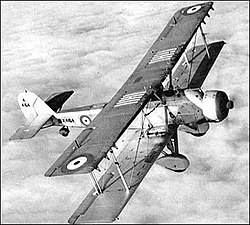
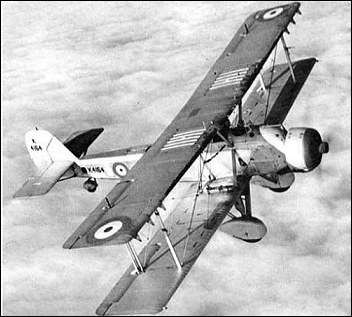
The Vickers Vildebeest and the similar Vickers Vincent are single-engined British biplanes designed and built by Vickers and used as light bombers, torpedo bombers and in army cooperation roles.[Note 1] First flown in 1928, they remained in service at the start of the Second World War, with the last Vildebeests flying against Japanese forces over Singapore and Java in 1942.
Key Information


Design and development
[edit]Vildebeest
[edit]Designed against Air Ministry Specification 24/25 for the Royal Air Force (RAF), for a land-based torpedo bomber to replace the Hawker Horsley, the prototype Vildebeest, an all-metal fuselage aircraft with single-bay unstaggered fabric-covered wings and tail, was first flown in April 1928 as the Vickers Type 132, powered by a Bristol Jupiter VIII radial engine.[2]
After initial evaluation, the Vildebeest was shortlisted for comparison with the Blackburn Beagle and Handley Page Hare. As the Jupiter VIII was prone to vibration, a second prototype, the Vickers Type 204[3] was fitted with an Armstrong Siddeley Panther IIA engine and after further testing, the Vickers design was confirmed as the winner of the contest[4] but engine problems persisted until the type was tested with a new version of the Jupiter, which later became known as the Bristol Pegasus.[5] An initial production order was placed in 1931 for nine aircraft, with the first production aircraft flying in September 1932.[5]
Further production ensued, with an improved version fitted with a 635 hp (474 kW) Pegasus IIM3 entering service but after only 30 examples had been produced the Air Ministry requested a modification (Specification 15/34) which added a third crew position, thus creating the Vildebeest Mk III, of which 150 examples being built for the RAF.[6]
The Mark IV introduced the much more powerful 825 hp (615 kW) Bristol Perseus sleeve valve radial engine enclosed in a NACA cowling which significantly improved performance, increasing maximum speed to 156 mph (251 km/h) and rate of climb to 840 ft/min (4.3 m/s).[7] In this version, the Perseus had cooling problems and was deemed unsuitable for tropical service[8] with production limited to 18 aircraft, all of which served with the home based squadrons.[9]
Vincent
[edit]
In 1931, Vickers designed as a private venture a General Purpose version of the Vildebeest to replace the RAF's Westland Wapitis and Fairey IIIFs, supporting the Army in the Middle East. Successful trials were conducted in the Middle East, Sudan and East Africa with a converted Vildebeest I in the General Purpose role during 1932–1933, and Specification 16/34 was drawn up based on the three man Vildebeest, which was named the Vickers Vincent: differences from the Vildebeest were minimal (the first production Vincent was, converted from a Vildebeest MkII), principally removal of torpedo equipment, provision for an auxiliary fuel tank, message-pick-up and pyrotechnic signalling gear.
Powered by a 660 hp (490 kW) Bristol Pegasus IIM3[10] the Vincent was unveiled to the general public for the first time at the 1935 RAF flying display at Hendon, but deliveries had already been made to No. 8 Squadron at Aden in late 1934.
Between 1934 and 1936, 197 Vincents were built for or converted from Vildebeests for the RAF.[11]
Operational history
[edit]United Kingdom
[edit]
The Vildebeest was purchased in moderately large numbers by the Royal Air Force from 1931 and used as a torpedo bomber. It entered service with No. 100 Squadron at RAF Donibristle in Scotland in October 1932, replacing the Hawker Horsley.[12] Four frontline torpedo-bomber squadrons were equipped with the Vildebeest, two at Singapore (100 Squadron, which moved from the United Kingdom in 1933 and 36 Squadron, which replaced its Horsleys in 1935), and two more in the United Kingdom.[13] The Vincent entered service with No. 84 Squadron RAF at Shaibah, Iraq in December 1934, re-equipping General Purpose squadrons throughout the Middle East and Africa.[14] By 1937, it equipped six squadrons in Iraq, Aden, Kenya, Sudan, and Egypt.[15] At the outbreak of the Second World War, 101 Vildebeests were still in service with the RAF. The two British-based squadrons flew coastal patrol and convoy escort missions until 1940 when their Vildebeests were replaced by the Bristol Beaufort.[16]
The two Singapore-based squadrons were still waiting for their Beauforts when Japan invaded Malaya in December 1941 and the obsolete biplanes had to be deployed against the Japanese attackers, making an abortive torpedo attack on a Japanese cruiser off Kota Bharu on 8 December.[9][17] The Vildebeests continued to attack the Japanese as their forces advanced down Malaya, sustaining heavy losses from Japanese fighters, particularly when no fighter cover could be provided. On 26 January 1942, the Japanese landed at Endau, 250 miles from Singapore, and 12 Vildebeests of 100 and 36 Squadrons were sent to attack the landings. Despite an escort of Brewster Buffalo and Hawker Hurricane fighters, five Vildebeests were lost. The attack was repeated later that day by eight Vildebeests of 36 Squadron and three Fairey Albacores, resulting in six more Vildebeests and two Albacores being shot down.[9][18][19]

The surviving Vildebeests were withdrawn to Java on 31 January and attacked another Japanese landing force off Rembang, claiming eight ships sunk but sustaining further losses. The final two Vildebeests of 36 Squadron attempted to escape to Burma on 6 March but were lost over Sumatra. The last Vildebeests in RAF service, operated by 273 Squadron at Ceylon were retired in March 1942.[9][20]
While the Vincent had started to be replaced by more modern aircraft such as the Vickers Wellesley and Bristol Blenheim bombers, 84 remained in service with the RAF on the outbreak of the Second World War.[14] Vincents were used for bombing missions against Italian forces in the East African Campaign and for coastal patrols from Aden, one attacking the Italian submarine Galileo Galilei.[15] Other Vincents bombed Iraqi forces during the Anglo-Iraqi War of 1941.[21] The last frontline Vincents retired in January 1943, with the type continuing in second line service (which included pesticide spraying against locusts in Iran) until 1944.[15]
Spain
[edit]The Vildebeest was ordered by the Spanish Republic in 1932 and licence production of 25 Vildebeest for the Spanish Republican Navy was undertaken in Spain by CASA most receiving the Hispano-Suiza HS 600 inline engine, though some other engines were also used. Around 20 survived to fight with the Spanish Republican Air Force on the Republican side of the Spanish Civil War, some equipped with floats.
A Vildebeest was the first victim of Francoist ace Joaquin Garcia-Morato.[22]
New Zealand
[edit]12 Vildebeests were purchased by the Royal New Zealand Air Force in 1935 for coastal defence, with a further 27 acquired from RAF stocks in 1940–41.[23] In addition, 60 or 62 of these machines, (depending on source), were passed on to the RNZAF.[15][23]
New Zealand Vildebeests were also used for photo mapping. A few were used for maritime patrols against German surface raiders, and Japanese submarines, (a handful were based in Fiji in December 1941), but the main wartime role of the New Zealand aircraft was as particularly unwieldy pilot trainers, until replaced by North American Harvards in 1942.
Variants
[edit]
- Type 132
- Prototype built at Weybridge with a Jupiter VII engine.
- Type 192
- Prototype modified as a Series II with a Jupiter XF engine.
- Type 194
- Prototype modified as a Series III with a Jupiter XIF engine.
- Type 204
- Second private venture prototype as Series IV later to Air Ministry
- Type 209
- Prototype modified as a Series V with a Jupiter XIF engine.
- Type 214
- Prototype modified as a Series VI with a Jupiter XFBM engine.
- Type 216
- Prototype Series VII modified with an Hispano-Suiza 12Lbr engine and flown with floats.
- Type 217
- Second prototype to have been modified to Series VII but not converted.
- Vildebeest Mark I
- Type 244 – Initial production version, a two-seat torpedo-bomber powered by a 600 hp (448 kW) Bristol Pegasus IM3 engine.[24] 22 built for the RAF between 1932 and 1933.[25]
- Vildebeest Mark II
- Type 258 – Variant with more powerful (635 hp (474 kW)) Pegasus IIM3 engine.[24] 30 built for RAF and delivered 1933.[26]
- Vildebeest Mark III
- Type 267 – Three seat torpedo-bomber. 150 built for RAF, delivered 1935–36. 15 ex-RAF aircraft (including one converted Mark II) diverted to RNZAF later.[26]
- Type 277 – Twelve aircraft with folding wings and the ability to carry drop tanks for RNZAF delivered in 1935.
- Vildebeest Mark IV
- Type 286 – Two seat version powered by 825 hp (615 kW) Bristol Perseus engine.[24] Eighteen built for RAF, 12 of which were sold to New Zealand.[26]
- Type 245 Vildebeest
- Series IX, Torpedo bomber for Spanish Navy, powered by 600 hp (448 kW) Hispano-Suiza 12L water cooled V-12 engine. First prototype Vildebeest modified to this standard and flew in this form in June 1930, with 26 licence built in addition to the prototype.[27]
- Type 263
- One Vildebest I modified with a Pegasus 1M3 engine.
- Vincent
- Type 266 – Three-seat General Purpose version for RAF. Pegasus IIIM3 engine.[28] 197 built new or converted.[11]
Operators
[edit]
- Royal Iraqi Air Force – six Vickers Vincents donated in 1940. Due to their poor condition, only five were ever operated.[29]
- No. 2 Squadron RIrAF[30]


 United Kingdom

- Royal Air Force
- No. 5 Squadron RAF – Vincent
- No. 7 Squadron RAF – Vildebeests used for trials
- No. 8 Squadron RAF – Vincent
- No. 22 Squadron RAF – Vildebeest
- No. 27 Squadron RAF – Vincent
- No. 28 Squadron RAF – Vincent
- No. 31 Squadron RAF – Vincent
- No. 36 Squadron RAF – Vildebeest
- No. 42 Squadron RAF – Vildebeest
- No. 45 Squadron RAF – Vincent
- No. 47 Squadron RAF – Vincent
- No. 55 Squadron RAF – Vincent
- No. 84 Squadron RAF – Vincent.[29] Vildebeests used for tropical trials
- No. 100 Squadron RAF – Vildebeest
- No. 207 Squadron RAF – Vincent
- No. 223 Squadron RAF – Vincent
- No. 244 Squadron RAF – Vincent
- No. 273 Squadron RAF – Vildebeest
- No. 1430 Flight RAF
Surviving aircraft
[edit]A Vildebeest/Vincent composite airframe is being restored by the Air Force Museum of New Zealand at Wigram Aerodrome in Christchurch, from the substantially complete remains of Vildebeest Mark III NZ102, incorporating parts from Vildebeest NZ105 and Vincents NZ355 and 357.[23][31] A Vincent (NZ311) has nearly completed restoration to static display by the Subritzky family near Auckland, New Zealand.[citation needed] A Spanish Vildebeest is rumoured to have survived.[citation needed]
Specifications (Vildebeest III)
[edit]Data from Vickers Aircraft since 1908.[32]
General characteristics
- Crew: three, pilot, navigator, and observer
- Length: 36 ft 8 in (11.18 m)
- Wingspan: 49 ft 0 in (14.94 m)
- Height: 14 ft 8 in (4.47 m)
- Wing area: 728 sq ft (67.6 m2)
- Empty weight: 4,773 lb (2,165 kg)
- Gross weight: 8,500 lb (3,856 kg)
- Powerplant: 1 × Bristol Pegasus II-M3 nine-cylinder air-cooled radial engine, 635 hp (474 kW)
Performance
- Maximum speed: 143 mph (230 km/h, 124 kn)
- Range: 1,250 mi (2,010 km, 1,090 nmi) at 122 mph (106 kn; 196 km/h)
- Service ceiling: 19,000 ft (5,800 m) (absolute ceiling)
- Rate of climb: 630 ft/min (3.2 m/s) 7.5 min to 5,000 ft (1,500 m)
Armament
- Guns: 1 × fixed, forward-firing .303 in (7.7 mm) Vickers machine gun and 1 × flexible, rearward-firing .303 in (7.7 mm) Lewis Gun
- Bombs: 1,100 lb (500 kg) of bombs or 1 × 18 in (457 mm) torpedo
See also
[edit]Aircraft of comparable role, configuration, and era
Related lists
Notes
[edit]- ^ The official Afrikaans name was Wildebeest (today Wildebees), it was often written Vildebeeste, after a spelling mistake in official correspondence.[1]
Citations
[edit]- ^ Andrews and Morgan 1988, pp. 273–274.
- ^ Mason 1994, p. 200.
- ^ Jarrett Aeroplane Monthly February 1995, p. 18.
- ^ Mason 1994, pp. 200–201.
- ^ a b Mason 1994, p. 201.
- ^ Mondey 1982, pp. 213–214.
- ^ Andrews and Morgan 1988, p. 285.
- ^ Jarrett Aeroplane Monthly February 1995, pp. 19–20.
- ^ a b c d Mason 1994, p. 202.
- ^ Mason 1994, pp. 256–257.
- ^ a b Andrews and Morgan 1988, p. 289.
- ^ Thetford Aeroplane Monthly April 1995, p. 37.
- ^ Thetford Aeroplane Monthly April 1995, p. 42.
- ^ a b Thetford Aeroplane Monthly March 1995, p. 20.
- ^ a b c d Thetford Aeroplane Monthly March 1995, p. 22.
- ^ Thetford Aeroplane Monthly April 1995, p. 38.
- ^ Richards and Saunders 1954, p. 20.
- ^ Richards and Saunders 1954, p. 37.
- ^ Flight 28 October 1955, pp. 675–676.
- ^ Thetford Aeroplane Monthly April 1995, pp. 38–39.
- ^ Mason 1994, p. 257.
- ^ Zhirohov, Mihail. "Joaquin Garcia-Morato: Best Ace of Spanish Civil War." Archived 16 October 2009 at the Wayback Machine WW II Ace Stories, 7 September 2007. Retrieved: 1 July 2009.
- ^ a b c "Vickers Vildebeest". Air Force Museum of New Zealand. Archived from the original on 27 March 2009. Retrieved 26 March 2021.
- ^ a b c Jarrett Aeroplane Monthly February 2005, p. 19.
- ^ Andrews and Morgan 1988, pp. 516–517.
- ^ a b c Andrews and Morgan 1988, p. 517.
- ^ Andrews and Morgan 1988, pp. 279, 517–518.
- ^ Jarrett Aeroplane Monthly February 2005, pp. 20–21.
- ^ a b Sipos & Cooper 2020, p. 25
- ^ Sipos & Cooper 2020, p. 24
- ^ "Restoration of the Air Force Museum of NZ Vildebeest". Vimeo. 22 March 2021. Retrieved 26 March 2021.
- ^ Andrews and Morgan 1988, p. 290.
Bibliography
[edit]- Andrews, C. F. and E. B. Morgan. Vickers Aircraft since 1908. London: Putnam, 1988. ISBN 0-85177-815-1.
- Arraez Cerda, Juan (January 1995). "Les Vickers Vildebeest espagnols (1ère partie)" [The Spanish Vickers Vildebeests]. Avions: Toute l'aéronautique et son histoire (in French) (23): 20–27. ISSN 1243-8650.
- Jarrett, Philip. "By Day and By Night: Vildebeest and Vincent". Aeroplane Monthly Volume 23, No. 2, Issue 262, February 1995, pp. 16–22. ISSN 0143-7240.
- Jarret, Philip (March 1996). "Les Vickers Vildebeest et Vincent (1e partie)" [The Vickers Vildebeest and Vincent]. Avions: Toute l'aéronautique et son histoire (in French) (36): 22–27. ISSN 1243-8650.
- Jarret, Philip (April 1996). "Les Vickers Vildebeest et Vincent (2e partie)". Avions: Toute l'aéronautique et son histoire (in French) (37): 29–35. ISSN 1243-8650.
- Jarret, Philip (May 1996). "Les Vickers Vildebeest et Vincent (3ème partie)". Avions: Toute l'aéronautique et son histoire (in French) (38): 2–7. ISSN 1243-8650.
- Jarret, Philip (June 1996). "Les Vickers Vildebeest et Vincent (4ème partie)". Avions: Toute l'aéronautique et son histoire (in French) (39): 35–38. ISSN 1243-8650.
- Mason, Francis K. The British Bomber since 1914. London: Putnam Aeronautical Books, 1994. ISBN 0-85177-861-5.
- Mondey, David. Hamlyn Concise Guide to the British Aircraft of World War II. Chancellor, 1982. ISBN 1851526684
- "No. 100 Squadron". Flight, 28 October 1955, pp. 673–676, 678.
- Richards, Denis and Hilary St. G. Saunders. Royal Air Force 1939–1945: Volume II The Fight Avails. London: Her Majesty's Stationery Office, 1954.
- Sipos, Milos; Cooper, Tom (2020). Wings of Iraq, Volume 1: The Iraqi Air Force, 1931-1970. Warwick, UK: Helion & Company Publishing. ISBN 978-1-913118-74-7.
- Thetford, Owen. "By Day and By Night: Vincents in Service". Aeroplane Monthly, Volume 23, No. 3, Issue 263, March 1995, pp. 18–22. ISSN 0143-7240.
- Thetford, Owen. "By Day and By Night: Vildebeests in Service". Aeroplane Monthly, Volume 23, No. 4, Issue 264, April 1995, pp. 36–42. ISSN 0143-7240.
External links
[edit]
Vickers Vildebeest
View on GrokipediaDesign and development
Background and initial design
In 1925, the Air Ministry issued Specification 24/25 calling for a three-seat day bomber capable of general-purpose duties and torpedo-carrying operations, intended to replace the Hawker Horsley as the Royal Air Force's primary land-based torpedo bomber.[1] Vickers responded with the Type 132 design, a large single-engine biplane emphasizing long-range reconnaissance and the delivery of aerial torpedoes or bombs from coastal bases.[6] The initial design featured an all-metal fuselage for durability, fabric-covered wings, and a single-bay unstaggered biplane configuration with equal-span rectangular wings to provide stability during low-speed torpedo runs.[7] The aircraft accommodated a crew of three—a pilot in the forward cockpit, an observer/navigator amidships, and a rear gunner—allowing for effective coordination in reconnaissance and attack roles.[1] Key trade-offs prioritized payload capacity, with provisions for up to 1,100 lb of bombs or a single 18-inch aerial torpedo slung externally beneath the fuselage, over outright speed, resulting in a maximum velocity of around 122 mph that suited its defensive maritime role but limited agility.[6] The prototype, serial N230, was completed at Weybridge and made its first flight in April 1928 at Brooklands, powered by a 460 hp Bristol Jupiter VIII radial engine.[8] Initial testing revealed vibration issues with the Jupiter, prompting evaluations of alternative powerplants, though the design's robust structure and crew accommodations proved well-suited to its intended torpedo-bomber mission.[1]Prototypes and production
The prototype Vickers Type 132 Vildebeest, first flown on 4 April 1928 at Brooklands, was subjected to service trials at the Aeroplane and Armament Experimental Establishment at Martlesham Heath starting on 14 September 1928, where it competed against the Blackburn Beagle and Handley Page H.P.34 Hare for Air Ministry Specification 24/25.[1] Initial testing revealed significant engine overheating problems with the fitted 460 hp Bristol Jupiter VI and subsequent Jupiter VIII radials, which prompted extensive modifications including a redesign of the cooling system and airframe components to address vibration and performance deficiencies.[1] A second prototype, built as a private venture in 1930 and powered by a 525 hp Armstrong Siddeley Panther IIA radial, underwent further trials at HMS Donibristle in 1931, achieving a top speed of approximately 122 mph in early evaluations but still suffering from overheating that necessitated additional refinements to the engine installation and propeller setup.[7] Following successful resolution of these issues with the adoption of the Bristol Pegasus radial, the Air Ministry placed the first production order in October 1931 for 22 Mk I aircraft under Specification 22/31, with deliveries commencing in late 1932 to No. 100 Squadron RAF.[9] The Mk I featured a 600 hp Bristol Pegasus IM3 engine, providing improved reliability over prior radials, though production was handled by Vickers-Armstrongs at Weybridge. In December 1933, an order for 30 Mk II aircraft followed, incorporating a more powerful 635 hp Pegasus IIM3 engine and minor tail modifications for better stability, with deliveries spanning July to December 1934.[1] Overall, Vickers-Armstrongs manufactured a total of 209 Vildebeest aircraft across all marks, including 111 Mk III and 18 Mk IV units equipped with the 825 hp Bristol Perseus VIII sleeve-valve radial and a Rotol three-bladed variable-pitch propeller on later batches for enhanced takeoff and climb performance.[9][10] Development and production faced notable challenges, including delays from persistent engine reliability concerns during the transition from Jupiter to Pegasus powerplants, as well as Air Ministry demands for upgraded bomb-aiming provisions in the ventral position to improve torpedo and dive-bombing accuracy.[11] These factors extended timelines, with the first production Mk I not entering service until 1933 despite the 1928 prototype flight. Regarding exports, initial overseas interest led to a single license agreement in 1932 for Spain to produce 25 aircraft locally through Construcciones Aeronáuticas SA (CASA), adapted with Hispano-Suiza 12L engines, but subsequent orders were confined to British Empire operators such as the Royal New Zealand Air Force, reflecting imperial procurement preferences and export restrictions.[7]Vincent adaptation
In response to Air Ministry Specification G.4/31 issued in 1931, which sought a general-purpose aircraft to replace the Westland Wapiti and Fairey IIIF in army cooperation, reconnaissance, and light bombing roles, Vickers adapted the Vildebeest design into the Vincent.[2][12] The prototype, modified from Vildebeest Mk I serial S1714, first flew on 21 December 1932 under the guidance of designer Rex Pierson, demonstrating suitability for tropical operations with its enhanced endurance.[2][13] Production began with an initial order in December 1933 for 51 aircraft, originally intended as Vildebeest Mk IIs but redirected to Vincent standard before completion, effectively converting existing airframes.[2] This was followed by a 1934 contract for 113 new-build Vincents and a 1935 order for 33 more, resulting in a total of 197 units produced or converted between 1934 and 1936, with the last delivery in October 1936.[2][14] The Vincent entered RAF service in December 1934, primarily equipping overseas squadrons for multi-role duties.[13] Key modifications distinguished the Vincent from the Vildebeest, focusing on versatility for general reconnaissance and army support. The torpedo release gear was removed to accommodate an auxiliary external fuel tank, extending the maximum range to 1,250 miles while cruising at economic speeds, a significant improvement over the Wapiti's capabilities.[2][15] The airframe was reinforced to carry a bomb load of up to 1,056 pounds, typically comprising eight 112-pound and eight 20-pound bombs, mounted under the wings and fuselage.[2] Provisions for improved radio equipment and oblique cameras were added to enhance reconnaissance functions, while a message pickup hook facilitated supply drops in remote areas.[2][16] Engine standardization centered on the Bristol Pegasus radial, with the Mk I Vincent powered by the 635-horsepower Pegasus IIM3 variant, providing reliable performance in hot climates.[2][13] Later examples incorporated tropical adaptations, including dust filters on the air intakes and reinforced undercarriage for desert operations in the Middle East and Africa.[14][2] The Vincent's frontline service with the RAF declined as modern monoplanes became available, with most units withdrawn by 1942; however, some were retained until 1943 for target towing duties by squadrons like No. 244.[2][14]Operational history
Royal Air Force service
The Vickers Vildebeest entered Royal Air Force service in 1932 with No. 100 Squadron at RAF Donibristle, Scotland, marking the first torpedo-bomber unit to receive the aircraft for operational familiarisation and training.[1] By 1937, the type had equipped multiple frontline squadrons, including Nos. 22, 36, 42, and 100, with additional units like No. 273 operating it for specialised roles.[1] These squadrons primarily conducted coastal defence duties, with No. 22 Squadron performing anti-submarine patrols from Thorney Island and No. 42 Squadron providing convoy protection along the east coast of Britain. In the Far East, Nos. 36 and 100 Squadrons at RAF Seletar, Singapore, carried out torpedo exercises and maritime reconnaissance, while the aircraft also participated in the 1935 Fleet Air Arm review, demonstrating its capabilities in naval cooperation scenarios.[17][18] At the outset of the Second World War, Vildebeests remained in service with several squadrons for coastal patrols and general reconnaissance, but their obsolescence became evident as modern threats emerged. Nos. 36 and 100 Squadrons, deployed to Singapore, were thrust into combat against Japanese forces invading Malaya in December 1941, alongside a small detachment of three Vildebeests at Hong Kong operating with Royal Australian Air Force Lockheed Hudsons.[7][3] The Hong Kong aircraft were destroyed on the first day of fighting, 8 December 1941. They conducted desperate torpedo and bombing attacks on Japanese invasion convoys and troop concentrations, but suffered catastrophic losses due to encounters with superior Japanese fighters like the Mitsubishi G3M and G4M bombers, as well as Zero fighters; for instance, during the 8 December 1941 raid on Kota Bharu, multiple aircraft were destroyed, and the 26 January 1942 Endau landing attack saw approximately 21 participating Vildebeests from the two squadrons suffer 10 losses. Only two aircraft from No. 36 Squadron escaped to Java in late January 1942, where they continued limited operations before being destroyed while attempting to withdraw to Burma in March.[1][17] In the East African campaign, the related Vickers Vincent variant supported ground operations with No. 47 Squadron, which detached a flight of seven aircraft for army cooperation duties against Italian forces in Somaliland from late 1940 to 1941.[19] These Vincents conducted bombing and reconnaissance missions on Italian positions, contributing to Allied advances despite the harsh operating environment and limited resources, before the squadron transitioned to more capable types like the Bristol Blenheim.[20] By mid-1942, the Vildebeest and Vincent had been fully withdrawn from RAF frontline service, replaced by advanced torpedo-bombers such as the Bristol Beaufort, with overall combat losses estimated in the dozens across theatres, primarily from the Malayan campaign.[1][12]Spanish Civil War
In 1932, the Spanish Republican government signed a licensing agreement with Vickers for the production of the Vildebeest torpedo bomber, designated as the Type 245 for the Spanish Navy. Construcciones Aeronáuticas SA (CASA) manufactured 27 aircraft between 1934 and 1935, powered by the 600 hp (450 kW) Hispano-Suiza 12L water-cooled V-12 engine, differing from the radial engines used in British variants. These license-built machines, known as the "Vickers Spanish Vildebeest," incorporated local modifications including Spanish radio equipment and a lighter armament configuration consisting of one forward-firing Vickers machine gun and one rear Lewis gun.[21][22][23] The aircraft were assigned to the 1a Escuadrilla de Torpederos, based at San Javier, and employed primarily for coastal reconnaissance and attempted torpedo attacks against Nationalist shipping during the early phases of the Spanish Civil War from 1936 to 1937. Approximately 20 Vildebeests remained operational at the war's outset, some fitted with Supermarine floats for maritime roles. They participated in operations supporting Republican naval efforts, such as patrols along the Mediterranean coast, but achieved minimal success in torpedo strikes due to persistent mechanical unreliability stemming from the unproven Hispano-Suiza engine integration and the aircraft's inherent obsolescence.[24][25] Combat effectiveness was severely hampered by Nationalist air superiority, with at least 10 Vildebeests destroyed in action, including notable losses such as T-10 shot down by a Nationalist Nieuport 52 on 12 August 1936 and T-6 downed on 29 July 1936. Additional aircraft were lost to enemy fighters and anti-aircraft fire during reconnaissance missions, leading to the squadron's operational cessation by 1938. Survivors were either scrapped, captured by Nationalist forces, or rendered non-airworthy, with no confirmed examples remaining in flying condition today.[23][26][27]Royal New Zealand Air Force service
The Royal New Zealand Air Force (RNZAF) acquired a total of 39 Vickers Vildebeest aircraft between 1935 and 1941, comprising 12 brand-new Mk III models delivered in 1935 and 27 ex-Royal Air Force examples arriving in 1940–1941 as part of the force expansion under the Empire Air Training Scheme. These aircraft, serialled NZ101 to NZ139, were shipped in crates and assembled at RNZAF Hobsonville and Wigram stations, enabling the service to bolster its capabilities amid growing regional tensions. Additionally, the RNZAF operated 62 Vickers Vincents alongside the Vildebeests, though the latter formed the core of early acquisitions for multi-role duties. This procurement supported New Zealand's commitment to train aircrew for Commonwealth efforts, with the Vildebeests playing a key role in the RNZAF's rapid growth from a small peacetime force to a wartime entity capable of Pacific operations.[28] Initially, the Vildebeests served primarily in bomber training roles at No. 2 Flying Training School (FTS) at Woodbourne, where they provided essential instruction for pilots and observers on general reconnaissance and light bombing tactics from 1937 onward. By 1940, as the RNZAF expanded its operational footprint, several Vildebeests were allocated to general reconnaissance (GR) squadrons, including No. 1 GR Squadron at Whenuapai and No. 7 GR Squadron at Waipapakauri, for coastal patrols and anti-submarine warfare exercises. In November 1941, elements of No. 5 Squadron deployed to Fiji with Vildebeests, alongside Vincents and Short Singapore flying boats, to conduct maritime reconnaissance over the South Pacific; the squadron flew anti-submarine patrols and search missions from Laucala Bay until 1943, contributing to the defense of Allied supply lines against potential Axis raiders. These duties highlighted the aircraft's endurance for long-range operations, though their obsolescence limited them to secondary tasks compared to frontline RAF units. Combat involvement was minimal, with Vildebeests engaging in limited encounters during Japanese reconnaissance probes in the Pacific theater; for instance, on 30 October 1942, NZ122 from No. 7 GR Squadron went missing presumed lost at sea during an anti-submarine patrol off Northland.[29] Overall, the low loss rate—despite approximately half the fleet being written off in accidents—reflected their restricted combat exposure, with only isolated incidents like the presumed downing of NZ122 amid broader patrols. Notable non-combat events included the crash of NZ104 into Lake Ellesmere on 9 June 1939 during bombing practice at the Ellesmere range, where the wing struck the water, though both crew survived; this incident underscored early training risks as the RNZAF integrated the type. Such experiences, alongside routine operations, aided the service's expansion, training hundreds of aircrew who later served in advanced units. By mid-1943, the Vildebeests were deemed obsolete and progressively replaced by Lockheed Hudsons in GR roles, with the last examples withdrawn from No. 7 GR Squadron in May 1943. Most surviving airframes were reduced to spares or instructional use at maintenance units like Rongotai through 1944, supporting post-war demobilization and aircraft preservation efforts; one example, NZ102, remains under restoration at the Air Force Museum of New Zealand as a testament to their contributions.Royal Iraqi Air Force service
In the 1930s, Britain supplied the Royal Iraqi Air Force with Vickers Vincent aircraft as part of its efforts to build and support Middle Eastern air forces under ongoing treaty obligations following Iraq's nominal independence in 1932.[30] Deliveries began in 1936 with 6 aircraft, and additional units arrived through the late 1930s, eventually totaling around 29 by 1939.[30] These were operated primarily by No. 1 Squadron and No. 4 Squadron, based at locations such as Mosul, reflecting Britain's strategic interest in maintaining stability in the region through aerial army cooperation capabilities similar to those employed by the Royal Air Force in desert operations.[30] The Vincents served in non-combat roles suited to their general-purpose design, which emphasized reliability over speed in tropical and arid environments.[31] They conducted reconnaissance flights, border patrols, and support missions over Iraqi territories, including areas near the North-West Frontier and Kurdish regions, as well as training exercises at No. 4 Flying Training School.[30] No significant combat engagements were recorded for these aircraft in Iraqi service, aligning with their primary function as tools for internal security and surveillance rather than frontline warfare.[30] To operate effectively in Iraq's harsh desert conditions, the Vincents were tropicalized with sand filters on their Bristol Pegasus engines, reinforced undercarriages for rough-field landings, and other modifications enhancing durability in dusty, high-temperature environments.[30] Armament typically included twin rearward-firing Lewis machine guns for defensive purposes, though the focus remained on observation rather than offensive strikes.[31] By the early 1940s, as Anglo-Iraqi relations evolved amid World War II and shifting regional dynamics, many Vincents were grounded or phased out due to wear, obsolescence, and maintenance challenges.[30] None of these aircraft survive today, with the type fully retired from Iraqi service by the mid-1940s as the air force transitioned to more modern equipment under continued British influence until full operational independence.[30]Variants and operators
Vildebeest variants
The Vickers Vildebeest production variants evolved from the initial design to address performance limitations, with progressive upgrades to engine power, propeller systems, and structural features for better torpedo-bombing capabilities. These marks shared a basic all-metal biplane airframe but differed in powerplant output, crew accommodations, and aerodynamic refinements, reflecting lessons from early service testing.[1] The Mk I was the first production variant, with 21 aircraft built between 1931 and 1932. It was powered by a 600 hp Bristol Pegasus IM3 radial engine driving a fixed-pitch propeller and carried a crew of three in open cockpits. This mark achieved a top speed of 140 mph at sea level, suitable for its role but limited by the basic propeller and radiator setup.[1][17] The Mk II followed, with 30 examples produced in 1933, introducing a more powerful 635 hp Bristol Pegasus IIM3 engine and a two-bladed propeller for improved climb and speed. It also featured an enhanced radiator for better cooling efficiency over the Mk I. In total, 51 aircraft of the Mk I and Mk II marks were manufactured, forming the backbone of early RAF deployments.[1][32] Building on these, the Mk III saw 111 units built between 1935 and 1936 (out of 162 ordered, with 51 completed as Vincents), retaining the 635 hp Pegasus IIM3 engine but adding a variable-pitch propeller for optimized performance across altitudes and strengthened bomb racks to handle heavier loads, including torpedoes. This variant became the standard equipment for RAF torpedo-bomber squadrons, with the addition of a dedicated navigator position improving mission accuracy.[1][33] The final production mark, the Mk IV, comprised 18 aircraft completed between 1936 and 1937 and was fitted with an 825 hp Bristol Perseus VIII engine, along with faired undercarriage legs to reduce drag. These changes boosted the top speed to 156 mph, making it the fastest Vildebeest variant, though its tropical service was limited due to engine issues; 12 were later sold to New Zealand. Unlike earlier marks, the Mk IV had a two-crew layout.[1][7]| Variant | Production (Year) | Engine (hp) | Propeller | Key Airframe/Performance Differences | Crew |
|---|---|---|---|---|---|
| Mk I | 21 (1931–1932) | Pegasus IM3 (600) | Fixed-pitch | Basic radiator; top speed 140 mph | 3 |
| Mk II | 30 (1933) | Pegasus IIM3 (635) | Two-bladed | Improved radiator for better cooling; total Mk I/II 51 | 3 |
| Mk III | 111 (1935–1936) | Pegasus IIM3 (635) | Variable-pitch | Enhanced bomb racks for torpedoes; standard RAF torpedo bomber | 3 |
| Mk IV | 18 (1936–1937) | Perseus VIII (825) | Two-bladed | Faired undercarriage; top speed 156 mph; two-seat | 2 |
Vincent variants
The Vickers Vincent Mk I was the primary production variant, with a total of 197 aircraft produced between 1934 and 1936, including new builds and conversions from Vildebeest airframes (notably 51 from an altered Mk II order). Powered by the 635 hp Bristol Pegasus IIM3 radial engine, these incorporated long-range fuel tanks in place of the Vildebeest's torpedo crutches and a dedicated camera bay to support reconnaissance missions, aligning with Air Ministry Specification 16/34 for general-purpose roles.[2] Tropicalized adaptations featured dust filters on the engine intake and reinforced undercarriage to withstand desert conditions, primarily for Middle East deployments such as those with the Royal Air Force in Iraq. A small batch was briefly supplied to South Africa before reallocation.[2][34] Following 1940, several Vincents underwent modifications for target-towing duties, including the addition of winches, and remained in use for training in the United Kingdom until 1945.[2] Overall, the 197 Vincent aircraft saw phased withdrawal from service by 1944 as more modern types became available.[2]Military operators
The Royal Air Force was the primary operator of the Vickers Vildebeest, receiving approximately 180 aircraft for use as torpedo bombers and general reconnaissance platforms across several squadrons, including Nos. 22, 36, 42, 100, 207, and 209 Squadrons.[12][17] The related Vickers Vincent, with allocations to the RAF totaling part of the 197 produced, served in general-purpose roles with Nos. 8, 47, 55, 84, and 244 Squadrons, among others, primarily in the Middle East and Africa.[13][14] The Royal New Zealand Air Force operated a total of 39 Vildebeests, comprising 12 new Mk III models delivered in 1935 and 27 ex-RAF aircraft arriving between 1940 and 1941, assigned to units such as Nos. 2 Flying Training School, 5 Squadron, and various general reconnaissance squadrons for coastal defense and training duties. The RNZAF also operated 62 Vincents for similar roles. All Vildebeests were retired from RNZAF service by 1944.[33][35] The Spanish Republican Navy acquired 25 license-built Vildebeests, designated Type 245 and produced by Construcciones Aeronáuticas SA (CASA) with Hispano-Suiza 12L engines, which equipped the 1a Escuadrilla de Torpederos for maritime operations during the Spanish Civil War.[25][36] The Royal Iraqi Air Force received six Vickers Vincents as a donation from the United Kingdom in 1940, with five entering limited service with No. 2 Squadron for general reconnaissance and light bombing roles from 1940 until their retirement around 1945.[37][38] Evaluation trials of the Vildebeest were conducted in Australia and South Africa during the early 1930s, but neither country adopted the type for operational service.[12]Preservation and specifications
Surviving aircraft
The only known surviving remnants of a Vickers Vildebeest are those of RNZAF serial NZ102, a Mark III variant that represents the most complete airframe from the 39 operated by the Royal New Zealand Air Force between 1935 and 1944.[39] Acquired by the Air Force Museum of New Zealand in Christchurch in 1986, these include the fuselage—repaired after a 1939 crash at Wigram—and minor components salvaged from other RNZAF Vildebeests and related Vickers Vincents.[39][5] Restoration of NZ102 began in earnest in mid-2020 as a priority project due to the aircraft's rarity, with the goal of assembling a full skeletal airframe using original structure where possible.[39] By 2023, progress included a nearly complete fuselage frame and the mating of the lower centre-section frame with undercarriage struts, aided significantly by the loan of a part-restored Vickers Vincent (K6357/NZ311) from the Subritzky collection, which provided reference parts and a 3D model for reverse engineering.[39][28] Both aircraft share the Bristol Pegasus engine, with components sourced to support the rebuild, though detailed engineering drawings remain scarce, limiting available information to about 20 percent.[28] The project continues in the museum's Wigram restoration hangar, with ongoing work on wing spars, centre sections, and undercarriage; it is viewable during daily behind-the-scenes tours.[39] Public talks on the project were held as recently as September 2024.[40] No complete Vildebeest airframes survive elsewhere, and there are no confirmed recoveries of wrecks from Pacific operational sites.[39] Preservation efforts are led by the Air Force Museum of New Zealand, in collaboration with RNZAF historical initiatives, emphasizing the type's significance as New Zealand's first modern torpedo bomber.[39] As of 2023, the restoration remains active with completion projected within the 2020s, though exact timelines depend on sourcing additional parts.[28]Technical specifications
The Vickers Vildebeest III was a three-seat biplane torpedo bomber with the following principal dimensions: length of 36 ft 8 in (11.18 m), wingspan of 49 ft (14.94 m), height of 14 ft 8 in (4.47 m), and wing area of 728 sq ft (67.6 m²).[1][3] It was powered by a single Bristol Pegasus IIM3 nine-cylinder air-cooled radial engine producing 635 hp (474 kW).[1] The empty weight was 4,773 lb (2,165 kg), while the maximum takeoff weight reached 8,500 lb (3,856 kg).| Category | Specification |
|---|---|
| Performance | Maximum speed: 143 mph (230 km/h) at 5,000 ft (1,524 m) Range: 1,250 mi (2,010 km) Service ceiling: 19,000 ft (5,791 m) Rate of climb: 630 ft/min (3.2 m/s) |
| Armament | 1 × .303 in (7.7 mm) Vickers machine gun (forward-firing) 1 × .303 in (7.7 mm) Lewis gun (rear cockpit) Up to 1,100 lb (499 kg) of bombs or 1 × 18 in (457 mm) aerial torpedo |