Hubbry Logo
R100R100Main
Open search
R100
Community hub
R100
logo
8 pages, 0 posts
0 subscribers
Be the first to start a discussion here.
R100
R100
from Wikipedia

His Majesty's Airship R100 was a privately designed and built British rigid airship made as part of a two-ship competition to develop a commercial airship service for use on British Empire routes as part of the Imperial Airship Scheme. The other airship, the R101, was built by the British Air Ministry, but both airships were funded by the Government.

Key Information

R100 was built by the Airship Guarantee Company, a specially created subsidiary of the armaments firm Vickers-Armstrongs, led by Commander Dennis Burney. The design team was headed by Barnes Wallis, later famous for his invention of the bouncing bomb. The design team also included Nevil Shute Norway as the senior stress engineer.[Note 1]

R100 first flew in December 1929. It made a series of trial flights and a successful return crossing of the Atlantic in July–August 1930, but following the crash of R101 in October 1930 the Imperial Airship Scheme was terminated and R100 was broken up for scrap.

Background

[edit]

R100 was built as part of a British government programme to develop airships to provide passenger and mail transport between Britain and the countries of the British Empire, including India, Australia and Canada. This had its origin in Dennistoun Burney's 1922 proposal for a civil airship development programme to be subsidised by the Government and carried out by a specially established subsidiary of Vickers. When the General Election of 1923 brought Ramsay MacDonald’s Labour administration to power, the new Air Minister, Lord Thomson formulated the Imperial Airship Scheme in its place. This called for the building of two experimental airships: one, R101, to be designed and constructed under the direction of the Air Ministry, and the other, R100, to be built by the Vickers subsidiary under a fixed price contract.

Design and development

[edit]
Composite image representing R100 passing over the Jacques Cartier Bridge in Montreal, August 1930

R100 was constructed at the former RNAS Air Station Howden in Yorkshire, a remote location 3 mi (5 km) from Howden and 25 mi (40 km) from Hull. Design work began in 1925 while at the same time the somewhat rundown site was put in order and a hydrogen-generating plant installed.

The specially established subsidiary of Vickers, the Airship Guarantee Company, faced substantial difficulties. The contract for R100's construction was a fixed price one and it was obvious from very early on that the project would incur a loss, and so economies were made; for instance, only a dozen machine tools were in use for construction of the airship. There were also difficulties in finding skilled workers due to the remoteness of the location, and a large proportion of the workers were local people who had to be trained. Conditions in the unheated airship shed were also poor: the roof leaked, ice formed on the girders in winter, and condensation caused corrosion of the airship's duralumin structure, so that the girders had to be varnished. For three years the assembly work was close behind that of the designers, and the progress of the design work was the determining factor in speed of construction.

Airframe

[edit]
R100 at Cardington, April 1930. The German Graf Zeppelin is seen in the background.

Since wind tunnel tests showed that a 16-side transverse section had about the same drag as a circular one, both R100 and R101 used a smaller number of longitudinal girders than previous airships to simplify stress calculations. Even so, the calculations for the transverse frames required hand computation that took two or three months to produce a solution for each frame. The thoroughness of the stressing calculations was a consequence of new Air Ministry criteria for the strengths required of airships, formulated after the catastrophic structural failure of R38 in 1921. Fewer longitudinal girders resulted in larger unsupported panels of fabric in the envelope, and flight trials were to prove that the R100's covering was barely adequate. The envelope of R101 was also unsatisfactory and a failure in its cover was possibly a cause of its crash.

Barnes Wallis created the frame of the airship using only 11 standard components. The 16 longitudinal girders were formed of three tubes each, formed from strips of Duralumin wound into a helix and riveted together. These connected 15 polygonal transverse frames, which were held in shape by wire bracing connected to a central longitudinal girder running the length of the ship.[1] A further consequence of the new rules for airframe stress design was that a new way of harnessing the lifting force of the gasbags had to be found. Wallis's solution to this problem later led to his innovative geodesic airframe fuselage and wing design for the Wellesley, Wellington, Warwick and Windsor bombers.

The elevators were aerodynamically balanced but the rudders were unbalanced. When the designers learned that R101 had been fitted with servo motors at a substantial cost in weight and money they thought that they had made a mistake and rechecked their calculations. They eventually concluded that their calculations had been correct: when R100 was flown the controls proved both light and effective, and its control characteristics were compared favourably with those of R101 by Nöel Atherstone, First Officer of R101.[2] R100 was built suspended from the roof of its shed. The individual transverse frames were assembled horizontally then lifted up and slung from roof-mounted trackways before being slid into position and attached to the adjacent frames by the longitudinal girders. The ship remained suspended until the gasbags were inflated with hydrogen.[3]

By mid-1929 the ship's structure was nearly complete and its gasbags were inflated. Following inflation of the gasbags, the outer covering of linen fabric painted with aluminium aircraft dope was put in place, and it was completed at the beginning of November.[3] Lift and trim trials were carried out on 11 November: empty weight was 105.52 long tons (107.21 t) and gasbag volume was 5,156,000 cu ft (146,000 m3), giving a standard gross lift of 156.52 long tons (159.03 t) and so a disposable lift of 51.00 long tons (51.82 t). Deducting 18 long tons (18 t) for the service load (crew, stores and ballast) this meant the weight available for fuel and payload was 33.00 long tons (33.53 t).[4]

Propulsion

[edit]

It had originally been intended to design special engines for R100 which would be fuelled by hydrogen and kerosene but after a year's work it was realised that the engine would not be developed in time and it was decided to fit the Beardmore Tornado diesel engine that was being developed for the Air Ministry for installation in R101. At an early stage the Tornado was judged unsuitable because of its weight and other problems, and Wallis settled on the use of six reconditioned Rolls-Royce Condor petrol engines even though the fuel, with its lower flash point, was considered to be a fire risk under tropical conditions.[5] The engines were contained in three gondolas, each with one engine driving a 17 ft (5.18 m) diameter tractor propeller, a second driving a 15 ft (4.57 m) diameter pusher propeller, and a third smaller engine in the middle of the car driving a dynamo for electrical power. The engines driving the pusher propellers were fitted with a gearbox to provide reverse thrust for docking the airship.[6]

Passenger and crew accommodation

[edit]

The passenger and crew accommodation were arranged on three decks occupying a single bay of the structure and entirely contained within the airship's envelope. The lower deck contained the crew accommodation. The second deck had a dining room, which doubled as the passenger lounge, plus the kitchen, 18 four-berth passenger cabins and a gallery on either side for passengers to enjoy the view through the windows built into the skin. The third deck consisted of a gallery running around the dining room and 14 two-berth cabins.[6]

Operational history

[edit]

First flights

[edit]

R100 made its maiden flight in the morning of 16 December 1929. After departing Howden at 07:53, it flew slowly to York then set course for the Royal Airship Works at Cardington, Bedfordshire, running on five engines since one of the engines had to be shut down because of a cracked water jacket, and completing the mooring process at 13:40.[7] A second flight was made the next day, with the intention of making a flight to London, but shortly after slipping the mast, a strip of fabric became detached from the lower fin, and the flight was limited to a cruise around Bedfordshire to test control response, lasting 6 hr 29 min. The following day, R100 was taken from the mast to No.2 shed at Cardington and work on modifying the wiring holding the cover in place begun: this took until 11 January 1930.[8]

During a test on 16 January 1930, R100 achieved a speed of 81.5 mph (131.2 km/h).[9] At speed, a problem with the outer covering became apparent: it tended to ripple and flap excessively in the form of a standing wave. During a fourth flight on 20 January, a film was taken of this phenomenon, which occurred because of the large areas of unsupported fabric; the effect is also visible in some photographs.

A further short flight was made on 20 January before an endurance flight, starting at 09:38 on 27 January when R100 slipped the mast at Cardington and ending at 15:26 on 29 January after more than 53 hours in the air.[10] Following this flight, the airship was returned to the shed for work on the cover to be carried out. At the same time, the original reconditioned Condor IIIA engines were replaced by six new Condor IIIBs and some weight was eliminated by reducing the amount of passenger accommodation. The work was complete by the end of April, but on 24 April, R100 was caught by a gust while being walked out of the shed, damaging the tail surfaces. The wind prevented the ship being returned to the shed, so it was moored to the mast.[11] It was not possible to return the R100 to the shed for repairs until the morning of 27 April. Repairs took longer than expected, and the airship remained in the shed until 21 May, when it made a 24-hour flight intended to test the new engine installation and modifications to the cover.

R100's contract had originally called for a demonstration flight to India. The decision to use gasoline engines resulted in a change in destination to Canada, as it was considered that a flight to the tropics with gasoline aboard would be too hazardous. Barring any difficulties, the R100 was scheduled to set off for Canada on 25 May; however, during the flight of 21 May, the conical tail section of the airship collapsed due to unexpected aerodynamic pressure, and the R100 was returned to the shed where the original tail section was replaced by a hemispherical cap designed and made by the Royal Airship Works,[12] reducing the airship's length by 15 ft (4.6 m)

Transatlantic voyage to Canada

[edit]
R100 over Canadian Bank of Commerce building in Toronto, Ontario, then the highest building in the British Empire (August 1930). The rippling of the airship's cover is visible.
R-100 Approaching mast, St. Hubert, Quebec after flight from Toronto. Aug. 1930

Shortly before R101's flights in June 1930, the Cardington engineers suggested that the long flights of the R100 to Canada and R101 to India might be postponed until 1931 on the grounds that neither of the airships was fit to make a lengthy flight at their current developmental stage.[13] The R100 team replied that their airship was perfectly capable of flying to Canada, and that the Canadian flight was a part of their contract.[14] R100 departed for Canada on 29 July 1930, reaching its mooring mast at the St-Hubert, Quebec Airport (outside Montreal) in 78 hours, having covered the great circle route of 3,300 mi (5,300 km) at an average ground speed of 42 mph (68 km/h). The R100 remained in Montreal for 12 days with over 100,000 people visiting the airship each day while it was moored there, and a song was composed by La Bolduc to mock the people's fascination with the airship.[14]

While in Canada, the R100 also made a 24-hour passenger-carrying flight to Ottawa, Toronto, and Niagara Falls. On 13 August, the airship departed Montreal on its return flight, reaching Cardington 57½ hours later. Nevil Shute Norway later suggested in Slide Rule: Autobiography of an Engineer that the success of R100's Canadian flight indirectly led to the R101 disaster. Prior to the transatlantic flight, R100's engineers could have suggested that neither airship was ready for a performance of such duration; however, when R100 returned from Canada in triumph, the R101 team had to either make the flight to India or admit defeat – which would have meant discredit with the consequent danger of losing their jobs. Shute Norway later said that R100's team "guessed that their ship (R101) was a bad airship, but did not realise" (because of secrecy at Cardington) "how bad the other ship was."[14]

The end of the British airships

[edit]

The tale of the design of R100 and its claimed superiority to R101 is told in Shute Norway's Slide Rule: Autobiography of an Engineer, first published in 1954. Although flawed and not quite as overwhelmingly superior as Shute Norway implied, R100 represented the best that conventional airship technology in Britain had to offer at the time.[citation needed] R101 suffered in comparison partly because of its many groundbreaking but ultimately dubious innovations, and also because of the weight of its diesel engines. In lifting efficiency, both dirigibles were inferior to the smaller LZ 127 Graf Zeppelin. After R101 crashed and burned in France, en route to India on 5 October 1930, the Air Ministry ordered R100 grounded. The airship remained in its shed at Cardington for over a year whilst three options were considered: a complete refit of R100 and continuation of tests for the eventual construction of R102; static testing of R100 and retention of about 300 staff to keep the programme "ticking over"; or retention of staff and the scrapping of the airship. In December 1931, the R100 was broken up and sold for scrap. The framework of the ship was dismantled, flattened by a steamroller and cut up into sections,[15] and sold for less than £600 (approximately $2,720)

Specifications (as first flight)

[edit]
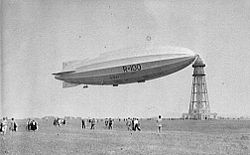
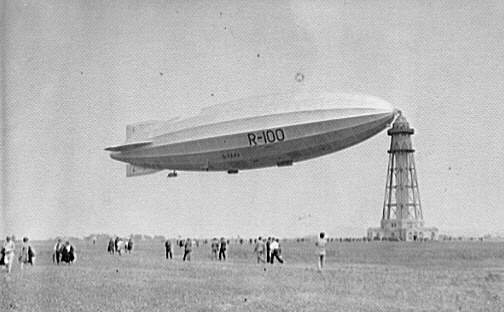
R100 at Cardington mooring mast

Data from Masefield[16]

General characteristics

  • Crew: 37
  • Capacity: 100
  • Length: 719 ft 9.5 in (219 m)
  • Diameter: 133 ft 4 in (41 m)
  • Volume: 5,156,000 cu ft (146,000 m3)
  • Empty weight: 236,365 lb (107,215 kg)
  • Useful lift: 350,607 lb (159,400 kg)
  • Powerplant: 6 × Rolls-Royce Condor IIIB 12 cylinder, 650 hp (485 kW) each

Performance

  • Maximum speed: 81.5 mph (131 km/h, 70.8 kn) [17]
  • Range: 4,095 mi (6,590 km, 3,558 nmi) with 3 tons payload
  • Endurance: 64 hours

See also

[edit]

Aircraft of comparable role, configuration, and era

Related lists

References

[edit]
[edit]
Revisions and contributorsEdit on WikipediaRead on Wikipedia
from Grokipedia
His Majesty's Airship R100 was a pioneering constructed in Britain and completed in November 1929 as part of the government-backed Imperial Airship Scheme to develop commercial passenger and mail services linking the . Designed by a team led by engineer and built by the Airship Guarantee Company—a subsidiary of —at the Royal Naval Air Station in , , the R100 measured 709 feet (216 meters) in length with a diameter of 133.5 feet (40.7 meters) and a gas volume of 5,156,000 cubic feet filled with for lift. Powered by six Rolls-Royce Condor IIIB engines each producing 650 horsepower, it achieved a cruising speed of 64 miles per hour (103 km/h) and was designed to accommodate up to 100 passengers in luxurious quarters, along with a crew of about 40. The airship's innovative geodetic lattice framework, a lightweight and strong structure pioneered by Wallis, contributed to its overall efficiency and stability. The R100's took place on December 16, 1929, from , marking the culmination of two years of and testing under a competitive program that pitted it against the government-built R101. In a landmark achievement, the R100 completed a successful round-trip transatlantic voyage to , , between July 29 and August 16, 1930, covering approximately 6,600 miles (10,620 km) in 158 hours of flight time, including 78 hours and 49 minutes for the eastward leg. This journey, which included stops in , and , , showcased the airship's reliability and drew widespread public enthusiasm, with the vessel often described as a "flying hotel" due to its opulent interior features like a grand dining room seating 56, promenade decks with panoramic windows, and comfortable cabins ranging from two- to four-berth arrangements. Despite its successes, the R100's operational history was short-lived. The Imperial Airship Scheme aimed to rival ocean liners by providing faster imperial connectivity to destinations like , , and , but the program was abruptly terminated following the catastrophic crash of the over , France, on October 5, 1930, which killed 48 of the 54 people aboard and exposed ongoing risks with hydrogen-filled rigid . In the aftermath, the R100 was grounded at Cardington, , and never flew again; it was dismantled and scrapped in December 1931, with its components sold for salvage. The event symbolized the end of Britain's ambitious airship era, shifting focus to heavier-than-air amid advancing technology and safety concerns.

Historical Context

Imperial Airship Scheme

The Imperial Airship Scheme originated from proposals made in 1922 by Dennistoun Burney, a Conservative MP and airship advocate, who envisioned a government-subsidized program for developing civil s to establish regular air routes connecting Britain to distant parts of the , including , , and . Burney's plan, known initially as the Burney Scheme, called for the construction of multiple airships by a private consortium to facilitate faster imperial communications and travel. Following the Labour Party's victory in the 1923 general election, the scheme was formalized under the new Air Minister, Lord Thomson of Cardington, who prioritized airships as a symbol of technological progress and imperial unity. Thomson rejected the broader Burney Scheme in favor of a more focused initiative, securing initial government funding of £350,000 through a supplementary estimate to support the construction of two prototype airships. This allocation reflected the post-election shift toward state-backed innovation in , with Thomson championing airships over aeroplanes for long-haul imperial routes. To encourage competition between public and private expertise, the scheme divided responsibilities: R101 was to be designed and built by the at the Royal Airship Works in Cardington, while R100 was contracted to the private subsidiary, the Airship Guarantee Company, at in , under a fixed-price agreement to promote efficiency. This structure aimed to test innovative designs, with engineers such as contributing to the private effort at Howden. The primary goals of the Imperial Airship Scheme were to demonstrate the commercial viability of rigid for transcontinental passenger and mail services, thereby strengthening ties across the by reducing travel times to remote . Successful prototypes were intended to form the basis for a subsidized imperial network, operated in partnership with governments, to handle high-value cargo and elite passengers where speed was paramount.

Conception of R100

The R100 project was initiated in 1925 as the private-sector counterpart to the government-led under the broader Imperial Airship Scheme, aimed at developing commercial transimperial air travel. Construction commenced in 1927 at the former Royal Naval Air Station (RNAS) in , , a repurposed facility selected for its existing infrastructure despite its isolation from major industrial centers. This location, approximately 3 miles from the town of and 25 miles from Hull, facilitated the work of the Airship Guarantee Company (AGC), a specially formed by Ltd. to handle the build. Leadership fell to Commander Sir Dennistoun Burney, the AGC's managing director and a vocal advocate for airship development, who oversaw the project's strategic direction. Key technical contributions came from Norway, who joined in 1924 as chief calculator and later served as deputy chief engineer and chief stress engineer, applying rigorous to ensure the airship's integrity. The team emphasized engineering precision to meet the Air Ministry's specifications for a reliable vessel capable of carrying 100 passengers and freight across the Atlantic or to . The fixed-price contract, valued at approximately £350,000 and awarded to in , imposed severe cost constraints from the outset, compelling the team to implement economies that risked overruns and strained resources. Howden's remote setting exacerbated these pressures, with humid, unheated sheds causing material corrosion, limited access to skilled labor, and logistical difficulties in sourcing components, all while adhering to a tight timeline. Despite these hurdles, construction in led to steady progress, culminating in the airship's completion by November 1929, just in time for initial trials. Early design goals centered on achieving superior reliability through private-sector , allowing greater autonomy from bureaucratic oversight compared to the state-managed R101. This approach prioritized proven practices, such as a conventional rigid structure inspired by designs, while incorporating novel efficiencies to demonstrate the viability of commercial operations without excessive government intervention. The focus on cost-effective reliability ultimately positioned R100 as a showcase for industrial ingenuity in imperial connectivity.

Design and Construction

Airframe Development

The airframe of R100 was designed by , incorporating geodetic-inspired principles to achieve structural efficiency and lightness. This innovative approach utilized only 11 standardized components for the rigid framework, consisting of 16 longitudinal —each formed from three tubes—and connected to 15 polygonal transverse frames with wire bracing and a central for added stability. Construction of the began in 1927 at the facility in by the Airship Guarantee Company, a subsidiary, and was uniquely suspended from the shed's roof to accommodate the assembly process within the existing structure. The individual transverse frames were built horizontally on the ground before being hoisted into position and riveted to the longitudinal girders, requiring approximately 58,200 feet of tubing, 5 million rivets, and 400,000 bracing wires in total. By mid-1929, the 15 hydrogen gasbags, providing a total lift volume of 5,156,000 cubic feet, were inflated within the completed framework, after which the outer envelope was covered in doped fabric to form a weatherproof skin. Aerodynamic considerations were central to the design, with the transverse sections adopting a 16-sided polygonal to approximate a circle while minimizing the number of longitudinal girders compared to earlier airships, thereby reducing weight and drag. This configuration was informed by tests conducted following the 1921 R38 disaster, which highlighted structural vulnerabilities under stress and prompted refinements in frame geometry for better resistance to aerodynamic loads. The resulting streamlined oval cross-section allowed R100 to achieve lower drag without sacrificing rigidity. Extensive stress analyses were performed manually for each transverse frame, adhering to specifications and taking 2 to 3 months per calculation to ensure the structure could withstand operational forces. These computations addressed potential failure points identified in prior incidents, such as those from the R38 breakup, contributing to the airframe's overall robustness. However, the larger unsupported fabric panels between the reduced number of girders led to observed rippling in the outer covering during later flights, though this did not compromise structural integrity.

Propulsion and Power Systems

The propulsion system of R100 was originally conceived to utilize hydrogen-kerosene engines, a design intended to leverage the lifting properties of hydrogen as part of the fuel mixture for enhanced efficiency. However, developmental delays with the planned Beardmore Tornado diesel engines, which were ultimately deemed unsuitable, led to a switch to six reconditioned Rolls-Royce Condor IIIA petrol engines, each delivering 650 horsepower. These engines were later upgraded to Condor IIIB variants prior to the transatlantic flight. This change prioritized reliability and availability, as the Condor series was a proven design already in production for aviation applications. The engines were housed in three separate gondolas positioned along the lower part of the hull: one beneath the hull and one on each side attached to the ninth transverse frame. Each gondola contained two engines in configuration, with the forward engine driving a 17-foot-diameter tractor propeller and the rear engine powering a 15-foot-diameter propeller. This arrangement provided balanced thrust and improved maneuverability. The propellers were equipped with gearboxes enabling reversible thrust, allowing the airship to be backed away from masts or obstacles without relying solely on or assistance. Fuel for the petrol engines was stored in 18 internal tanks with a total capacity of 9,300 imperial gallons, distributed along the length of the hull to maintain trim as consumption occurred. This load supported a range of 4,095 miles while carrying a 3-ton , sufficient for transatlantic operations with reserves. However, the use of volatile petrol raised safety concerns, particularly for routes through tropical regions where its low increased the risk of fire in the event of leaks or structural failure. The total power output of 3,900 horsepower enabled a maximum speed of 81.5 mph, though operational limits were set at 70 mph to conserve and reduce stress on the structure. Early flight trials revealed some reliability challenges with the setup, including an failure on the in December 1929, which required operation on five engines for portions of subsequent tests. Additionally, overheating issues were noted in the gondolas during prolonged high-power runs, prompting modifications to cooling systems and ventilation before for overseas voyages. These adjustments ensured the system performed adequately during the 1930 , where one was shut down mid-flight but did not compromise the mission.

Internal Layout and Accommodation

The R100 featured a three-deck internal arrangement within its , designed to provide luxurious accommodation for transcontinental imperial travel while accommodating operational needs. The lower deck housed quarters for the 37 members, along with utility spaces such as storage and access points, ensuring separation from passenger areas to maintain privacy and efficiency. The middle deck served as the primary social and dining hub, including a double-height lounge that doubled as a dining room seating up to 56 passengers at small configurable tables, evoking a club-like atmosphere with rugs and electric lighting throughout. Adjacent to the lounge was an electric with a serving , supporting , while 18 four-berth cabins provided more economical sleeping options for groups or families. This deck emphasized comfort through features like heating systems and panoramic promenade areas with curved for natural light and views. On the upper deck, 14 two-berth cabins offered premium privacy, each equipped with bunks, porthole-style lighting, chairs, and luggage storage in a nautical theme, overlooking a gallery connected to the promenade below. Observation windows along the promenade decks allowed passengers to enjoy expansive vistas, enhancing the sense of luxury akin to a small . The total capacity accommodated 100 passengers, prioritizing amenities developed by the private-sector team to focus on commercial viability and passenger experience rather than experimental innovations seen in government projects. Navigation facilities included a room integrated into the structure for communication, with the main suspended below the envelope housing instruments for and overall command, accessible via stairways from areas. Interiors utilized lightweight wire-and-fabric partitions to divide spaces while providing basic against noise, reflecting the airship's overall of 709 feet (216 meters) that enabled such expansive habitable volumes.

Operational History

Initial Trials and Flights

The R100 completed its on 16 December 1929, departing from the construction site at in and proceeding to the Royal Airship Works at Cardington in , where it lasted 5.5 hours at an average speed of 58 mph. During this initial voyage, the operated primarily on five of its six engines after one suffered a cracked , marking the first of several minor propulsion issues encountered early in testing. Subsequent short flights addressed basic handling and procedures, with the second flight on 17 December 1929 revealing detached fabric from the lower tail fin, necessitating immediate repairs to the structure. Speed trials conducted on 16 January 1930 demonstrated the airship's maximum velocity of 81.5 mph, though they also highlighted rippling in the outer fabric cover under high aerodynamic loads, which required reinforcement to prevent further deterioration. These tests validated key design features, such as the lightweight frame and non-rigid gas cell arrangement, confirming their suitability for sustained operations. The endurance trial, commencing on 27 January 1930 from Cardington and concluding on 29 January, covered approximately 3,000 miles over 53 hours at an average of around 50 mph, despite encounters with thick that tested navigational reliability. Additional challenges during this flight included tail fin damage attributed to icing conditions and intermittent engine failures, both of which prompted post-flight inspections and adjustments to enhance resilience and reliability. Following resolution of these issues through targeted repairs, the R100 underwent formal certification by aviation authorities and further testing, with handover to the occurring in April 1930 after extensive trial flights accumulating over 100 hours of airborne time. This period of intensive testing established the airship's operational readiness for extended voyages, with cumulative data underscoring its structural integrity and performance margins.

Transatlantic Crossing to Canada

The R100 departed from its base at RAF Cardington in , , on the evening of 29 July 1930, under the command of Captain Ralph Sleigh Booth, marking the first for a British rigid airship under the Imperial Airship Scheme. The voyage covered 3,364 miles (5,410 km) along the route, arriving at the mooring mast at Saint-Hubert near , , after 78 hours 49 minutes on 1 August 1930, with an average speed of about 42 miles per hour (68 km/h). Aboard were a of around 40 members and 20 passengers, including dignitaries, engineers, and journalists, who experienced relatively comfortable conditions despite the airship's vast size and the inherent challenges of early long-distance aerial travel. Following mooring at Saint-Hubert, the R100 served as a symbol of imperial technological prowess, embarking on a 24-hour publicity flight on 10 August that showcased it to Canadian audiences. The itinerary included flyovers of , where it was greeted by Prime Minister ; , drawing crowds to the waterfront; and , providing dramatic views of the cascades below. Returning to Montreal the next day, the flight highlighted the airship's maneuverability and stability, carrying additional passengers for the demonstration while the full crew managed operations. The visit generated immense public enthusiasm across and , with nearly 1.5 million Canadians witnessing the airship during its 13-day stay, underscoring its role as a spectacle amid the . In alone, over 100,000 visitors toured the R100 daily while it was moored, marveling at its luxurious interiors designed for 100 passengers, including smoking rooms and promenade decks. Extensive media coverage in newspapers like the Montreal Gazette portrayed the event as a triumph of British engineering, while cultural responses included the satirical folk song "Toujours l'R-100" by renowned Quebec singer , which humorously captured the local obsession with the "flying hotel." Navigation during the outbound crossing presented challenges from variable Atlantic weather, including headwinds and occasional turbulence that required adjustments to altitude and course, though the flight remained largely uneventful compared to later disasters. Senior stress engineer Norway later recounted in his autobiography that the successful voyage intensified political pressures on the Imperial Airship Scheme, prompting rushed preparations for the competing R101's flight and contributing to broader program strains. The return leg departed Saint-Hubert on 13 August 1930, taking 57 hours 56 minutes to cover 2,955 miles (4,755 km) and arrive back at Cardington without major incidents, further validating the R100's design reliability.

Fate Following R101 Disaster

The crash of on 5 October 1930, during its maiden voyage to , occurred near , , where the struck the ground at approximately 2:08 a.m. GMT and burst into flames, killing 48 of the 54 people on board, including Lord Christopher Thomson and Director of Civil Aviation Sir Sefton Brancker. The disaster, attributed primarily to gas leakage from forward gasbags due to a torn outer cover and exacerbated by poor weather and ballast issues, prompted the immediate suspension of the Imperial Airship Scheme by the . In the wake of the tragedy, R100 was ordered grounded at its hangar in Cardington, , shortly after the crash on 5 1930, and remained deflated there for over a year while the program's future was debated. Despite inspections confirming its structural integrity and airworthiness—contrasting with R101's design flaws—the deemed continued operation untenable amid public safety concerns and economic pressures. Dismantling began in late 1931, with the framework methodically broken up using steamrollers; brief proposals for salvaging parts or preserving it for museum display were rejected in favor of full scrapping to cut costs. The process was completed in February 1932, with the remains sold as scrap metal for under £600, providing only three months of employment for workers at Cardington. The R101 disaster sparked a formal led by Sir John Simon, which concluded on 5 December 1930 and was published in March 1931, highlighting political haste over technical readiness without assigning personal blame. This led to intense political fallout, including the replacement of Thomson by Lord Amulree as Air Secretary, and ultimately terminated all British government-funded development, shifting focus to airplanes amid the .

Technical Specifications

Structural Dimensions

The R100 airship measured 719 feet 9.5 inches (219.2 meters) in overall length, providing the elongated form necessary for stable transoceanic flight. Its maximum diameter was 133 feet 4 inches (40.6 meters), achieved at the widest point of the hull, while the hull fineness ratio was 5.33, optimizing aerodynamic efficiency by minimizing drag relative to lift. The structure was divided into 18 main gasbags with a total capacity of 5,156,000 cubic feet (146,000 cubic meters) of , enabling buoyancy in varying atmospheric conditions. At its first flight, the R100 generated a gross lift of about 156 long tons from the hydrogen fill, sufficient to offset the empty weight of about 102 long tons and deliver a useful of about 54 long tons for , , and . Registered as G-FAAV, the was constructed by ' Airship Guarantee Company at , , employing a rigid framework of girders to maintain structural integrity under flight stresses. This configuration underscored the R100's design emphasis on reliability for imperial air routes, balancing size with operational practicality.

Performance Metrics

The R100 achieved a maximum speed of 81 mph during its acceptance trials on 16 1930, demonstrating its capability for rapid transoceanic travel under favorable conditions. Its cruising speed was rated at 64 mph (103 km/h), a figure optimized for economical operation over extended distances while maintaining stability in varying weather. These performance characteristics were validated through a series of rigorous flight tests totaling over 100 hours, including endurance runs that confirmed the airship's reliability for commercial service. The airship's design range extended to 4,095 miles with a 3-ton payload, enabling non-stop transatlantic crossings such as the demonstrator flight to in July 1930, which covered 3,300 miles in 78 hours despite headwinds and adverse conditions. Endurance at cruising speed was specified at 64 hours, supported by efficient fuel management; for instance, trials indicated a consumption of approximately 23 tons of for a 2,500-mile journey, highlighting the R100's suitability for long-haul efficiency in an era of limited refueling infrastructure. The return voyage from to in August 1930 further underscored this capability, completing the 3,100-mile leg in 58 hours at an average speed of around 53 mph. Propulsion was provided by six Rolls-Royce Condor IIIB petrol engines, each delivering 650 hp for a total installed power of 3,900 hp, arranged in three engine gondolas each with a forward tractor (17 ft ) and an aft (15 ft ), with engines featuring gearboxes enabling reverse for precise maneuvering during docking. Post-trial modifications included adjustments to enhance reverse performance, addressing minor handling issues observed during initial landings and improving operational . Due to the inherent of rigid airships, climb rate and service were not primary emphases, with operations typically conducted at altitudes below 5,000 feet to optimize lift and passenger comfort.

Legacy and Impact

Comparison to R101

The R100 and represented contrasting approaches within the British Imperial Airship Scheme, with the R100 constructed by the private firm at emphasizing a conventional, reliability-focused design inspired by established practices, while the was built by the government-operated Royal Airship Works at Cardington under the , prioritizing experimental innovations such as gasbag wiring systems and steel strip girders. The R100's structure featured fewer girders and extensive stress testing with proven components like tubular booms and spiral riveting, contributing to its robust build, in contrast to the R101's heavier, more complex framework with deep unbraced frames and untested diesel engines that compromised overall reliability. In terms of dimensions, the R100 measured 709 feet (216 m) in length with a gas volume of 5,156,000 cubic feet, slightly shorter than the R101's 777 feet (237 m) and expanded volume of about 5.5 million cubic feet, which included an additional bay for extra lift but added weight and instability. Performance-wise, the R100 achieved a top speed of 81.5 mph using six reliable Rolls-Royce petrol engines, enabling efficient cruising at around 60 knots, whereas the R101's design, burdened by its heavier structure and five developmental Beardmore diesel engines, managed a maximum of only 71 mph despite similar power output, resulting in reduced range and maneuverability. Operationally, the R100 demonstrated its design strengths through a successful round-trip to in July 1930, covering approximately 6,600 miles (10,620 km) without major incidents despite challenging weather, underscoring its stable handling and crew confidence. In stark contrast, the R101's attempt at a proving flight to in 1930 ended in disaster when it crashed at , , killing 48 people, highlighting vulnerabilities in its experimental features and inadequate pre-flight trials. Following the R101 disaster, retrospective analyses praised the R100's superiority in build quality and handling, viewing it as more robust and likely to have withstood similar conditions, with potential for further development. Nevil Shute Norway, chief calculator on the R100 project, detailed in his 1954 autobiography how the ship's conservative engineering and relaxed piloting experience far outperformed the R101's troubled, politically rushed construction, reinforcing perceptions of the private effort's technical edge.

Influence on Airship History

The successful of R100 in 1930 demonstrated the practical feasibility of long-distance travel, covering over 10,000 kilometers round-trip to without incident and highlighting the potential for reliable intercontinental operations under challenging conditions such as in the St. Lawrence Valley. This achievement provided a benchmark for reliability when supported by thorough testing and experienced crews, influencing early 20th-century perceptions of as viable alternatives to emerging technology for imperial communications and passenger transport. Although R100 relied on for lift, its operational success underscored the scalability of rigid designs, indirectly encouraging global experimentation with lighter-than-air vehicles, including helium-based non-rigid blimps in the that prioritized amid hydrogen's flammability risks. Key innovations in R100's construction, particularly Barnes Wallis's geodetic framing for the gasbag wiring and structural lattice, optimized weight distribution and volume efficiency, allowing for greater payload capacity and stability compared to traditional Zeppelin-inspired methods. These techniques were later refined by Wallis for aircraft applications, notably in the bomber during , where the provided exceptional strength-to-weight ratios and resilience to battle damage, influencing post-war aviation engineering principles. Wallis's subsequent designs, such as the used in the Dambusters Raid, built on the structural insights gained from R100, extending geodetic concepts to munitions and reinforcing their legacy in British engineering. The R101 disaster in October 1930 overshadowed R100's accomplishments, leading to the abrupt termination of Britain's Imperial Airship Scheme by 1931 and a decisive policy shift toward heavier-than-air aircraft for commercial and military aviation, as rigid airships were deemed too risky despite R100's proven track record. This pivot marked the end of state-sponsored rigid airship development in the United Kingdom, redirecting resources to airplane innovation and contributing to the global decline of hydrogen-based dirigibles in favor of safer, faster alternatives. Culturally, R100's story endures through Nevil Shute Norway's 1954 autobiography Slide Rule, which details his role in the project and critiques government oversight versus private enterprise, shaping historical narratives on engineering accountability and airship rivalries. In the 21st century, engineering analyses have revisited R100's geodetic structures for their innovative load-bearing efficiency, informing discussions on lightweight frameworks in modern aerospace. Amid 2020s conversations on climate mitigation in , R100's efficient design—achieving transatlantic speeds with relatively low fuel consumption—has been referenced in conceptual studies for low-emission rigid airships, such as hybrid electric models drawing from its passenger-carrying precedents to reduce carbon footprints by up to 90% on short-haul routes compared to . These reassessments highlight R100's enduring relevance in debates, emphasizing or hybrid systems to revive airships as eco-friendly options for remote and travel without extensive ground .

References

Add your contribution
Related Hubs
User Avatar
No comments yet.