Hubbry Logo
Vienna Boys' ChoirVienna Boys' ChoirMain
Open search
Vienna Boys' Choir
Community hub
Vienna Boys' Choir
logo
8 pages, 0 posts
0 subscribers
Be the first to start a discussion here.
Vienna Boys' Choir
Vienna Boys' Choir
from Wikipedia

The Vienna Boys' Choir (German: Wiener Sängerknaben) is a choir of boy sopranos and altos based in Vienna, Austria. It is one of the best known boys' choirs in the world. The boys are selected mainly from Austria, but also from many other countries.

Key Information

The choir is a private, non-profit organization. There are approximately 100 choristers between the ages of nine and fourteen. The boys are divided into four touring choirs, named after Austrian composers Bruckner, Haydn, Mozart and Schubert, which combined perform about 300 concerts each year before almost 500,000 people. Each group tours for about nine to eleven weeks.[1] Some pieces include "Good Morning" and "Merry Christmas from Vienna Boys".

Early history

[edit]
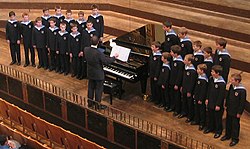
The Vienna Boys' Choir in 1970
Palais Augarten has served since 1948 as a boarding school for the choir

The choir is the modern-day descendant of the boys' choirs of the Viennese Court, dating back to the late Middle Ages. The Wiener Hofmusikkapelle was established by a letter from Emperor Maximilian I of the Holy Roman Empire on 30 June 1498, instructing court officials to employ a singing master, two basses and six boys. George Slatkonia became the director of the ensemble. The role of the choir (numbering between 24 and 26) was to provide musical accompaniment for the church mass. Additionally, the Haydn brothers were members of the St. Stephen's Cathedral choir, directed at the time by Georg Reutter II, who used this choir in his duties for the imperial court, which at the time had no boy choristers of its own.

Over the centuries, the choir has worked with many composers, including Heinrich Isaac, Hofhaimer, Biber, Fux, Caldara, Gluck, Salieri, Mozart, Schubert and Bruckner.[1]

In 1920, following the fall of the Austrian Empire, the Hofkapelle (court orchestra) was disbanded. However, the rector at the time, Josef Schnitt, sought a continuation of the tradition. In 1924, the Vienna Boys' Choir was officially founded, and it has evolved into a professional music group. The choir adopted the now-famous blue-and-white sailor suit, replacing the imperial military cadet uniform that included a dagger.[2] The composer HK Gruber is one of the graduates of the reformed choir.[3]

While touring in Australia in 1939, the boys became stranded in Perth when their ship returning them to Austria was seized. Germany had just invaded Poland and Australia had entered the Second World War. The catholic archbishop of Melbourne, Dr Daniel Mannix, organised the boys' foster care as long as they formed a choir at St Patrick's Cathedral in Melbourne. Staying together in Australia saved them from conscription into the German army as they came of age during the war. Only one of the boys returned to Vienna after the war.[4]

Since 1948, Palais Augarten has served as the rehearsal venue and boarding school, which goes from kindergarten level up to middle school level.

In 1961, Walt Disney filmed Almost Angels, a fictional drama about (and starring) the Vienna Boys' Choir, set and filmed in the Palais Augarten. It was Disney who, for cinematographic reasons, persuaded the Austrian government to allow the boys to legally wear the Austrian national emblem on the breast of their uniform, a tradition that continues to this day.

In 2004, The Vienna Girls' Choir were founded. They receive the same training as the Vienna Boys' Choir. The choirs perform independently.

Recent history

[edit]
G. Mahler, Symphony of a Thousand – Vienna Boys' Choir – Wiener Singverein – Slovenský filharmonický zbor – Staatskapelle BerlinPierre BoulezWiener Musikverein (April 2009)

Gerald Wirth became the choir's artistic director in 2001. However, since then, the choir has come under pressure to modernize and has faced criticism of their musical standards, leading to a split with the Vienna State Opera. The choir has for the first time had to advertise for recruits after a rival choir school was established by Ioan Holender, director of the opera company. He complained of both falling standards and poor communication with the choir. He said that the State Opera sometimes trained boys for particular stage roles, only to find out on the day of performance that they were unavailable as they had gone on tour with the choir. Some boys were attracted to the rival choir school by the prospect of a more relaxed atmosphere and of performance fees being paid directly to them.[5]

The Vienna Boys' Choir has sought to update its image, recording pop music selections and adopting an alternative uniform to the sailor suits used since the 1920s, allowing the boys to dance as they sing.[6] After Eugen Jesser died in May 2008, Walter Nettig became the choir's president. Gerald Wirth has been the artistic director since 2001, and he also became the choir's president in 2013.[1] The current President is Erich Arthold, who started serving this position in Dec 2022.

The Vienna Boys Choir Music Academy (VBCMA) is the official music academy of the Vienna Boys Choir (VBC) with its headquarters located in Hong Kong. VBCMA carries on with the pedagogical traditions of the Vienna Boy Choir, offering year-round music programmes with songs from different cultures and in different languages. Classes are conducted from September every year to July next year in schools, community venues and online.[7]

The Vienna Boys Choir Music Academy Foundation (VBCMAF) is a registered charitable organization under the Section 88 of the Inland Revenue Ordinance in Hong Kong. The 'Hong Kong - Vienna Music Festival' was set up by the Foundation in 2016, promoting the exchange of musicians from both places and presenting joint performances by them, such as the 'Mahler Symphony No 8' and the 'Beethoven from Day to Night - Piano Sonatas Marathon". The Festival also presented the 'Summer Music Academy' every year (except the pandemic years in 2020-2022), where a team of international conductors leads a weekly music camp for students from 7–25 years old.[8]

In 2010, following sexual abuse allegations from two former choristers stemming from the late 1960s and early 1980s, the Vienna Boys' Choir opened a confidential phone and e-mail hotline to allow others to come forward. Eight possible victims came forward saying they were abused, either by staff or other choir members.[9]

Selected discography

[edit]

Christmas

[edit]
  • Frohe Weihnachten (2015)
  • Wiener Sängerknaben Goes Christmas (2003)
  • Frohe Weihnacht (Merry Christmas) (1999)
  • Christmas in Vienna / Heiligste Nacht (1990)
  • Merry Christmas from the Vienna Choir Boys (1982)
  • Christmas with the Vienna Choir Boys (with Hermann Prey)
  • Christmas with the Vienna Boys' Choir, London Symphony Orchestra (1990)
  • Weihnacht mit den Wiener Sängerknaben (Hans Gillesberger 1980)
  • The Little Drummer Boy (TV 1968)
  • Die Wiener Sängerknaben und ihre Schönsten ... (1967)
  • Frohe Weihnacht (1960)
  • Christmas Angels (RCA Gold Seal)
  • Silent Night

Pop music

[edit]
  • I Am from Austria (2006)
  • Wiener Sängerknaben Goes Pop (2002)

Other recordings

[edit]

The Vienna Boys' Choir performed the song "The Little Drummer Boy" in the Rankin/Bass TV special of the same name.

Feature films

[edit]
[edit]

Smaller works based on anthologies

[edit]

See also

[edit]

References

[edit]
[edit]
Revisions and contributorsEdit on WikipediaRead on Wikipedia
from Grokipedia
The Vienna Boys' Choir (German: Wiener Sängerknaben) is a choir of boy sopranos and altos based in , , with roots tracing to the Imperial Chapel where boys have sung since 1296, formally established in 1498 by Emperor Maximilian I as part of the court musical ensemble. Comprising about 100 choristers aged 9 to 14, selected primarily from but also internationally and divided into four touring groups, the choir maintains a rigorous schedule of approximately 300 performances per year, reaching nearly 500,000 spectators in 97 countries through concerts featuring classical repertoire, often accompanied by major orchestras such as the . Historically linked to composers including and Schubert who served as boy choristers, the ensemble was reorganized as a private nonprofit in the 1920s following the collapse of the , enabling global tours beginning with its first U.S. visit in 1932 and a world tour in 1934; it has since produced over 150 recordings, including a long-term partnership with since 2015, and operates its own concert venue, MuTh, opened in 2012. The choir's prestige has been tempered by controversies, notably 2010 allegations of by supervisors reported by multiple former members, leading the organization to acknowledge the possibility of past incidents and establish a victim hotline that received eight claims.

History

Origins and Early Development

The Vienna Boys' Choir traces its origins to 1498, when I relocated his court from to and established the Hofmusikkapelle, the imperial court music , incorporating a dedicated ensemble of boy singers for liturgical performances. This foundation formalized a tradition of boy sopranos at the Viennese court, with records indicating boys singing in the as early as 1296, though 's decree structured the group under Habsburg patronage to emphasize sacred polyphony in the Netherlandish style prevalent at the time. He specifically provided for 12 boy sopranos among the chapel's musicians, ensuring a core of trained trebles to support daily masses and court ceremonies. In its initial decades, the choir—known as the Hofsängerknaben—operated under the direction of court , focusing on motets and masses composed or arranged for the ensemble's high voices. The boys, recruited from across the empire and aged approximately 8 to 14, received comprehensive training in vocal technique, sight-singing, basic instrumental skills, and academic subjects like to prepare them for both musical and clerical roles. This regimen, supported by imperial funding, maintained a stable complement of singers who performed exclusively for the Habsburg court, including at the Hofburgkapelle, reinforcing the chapel's status as a center for sacred music amid the Reformation's cultural shifts. By the 16th and early 17th centuries, the choir adapted to evolving musical demands under emperors such as Ferdinand I and Rudolf II, incorporating works by composers like and expanding occasional secular repertory for diplomatic events, while enduring disruptions from the that temporarily reduced personnel but preserved the institution's continuity through dedicated recruitment. The ensemble's early development thus laid the groundwork for its enduring role in Habsburg musical life, prioritizing vocal purity and ensemble precision over instrumental dominance.

Imperial and Interwar Periods

During the , spanning from the late 15th century through the dissolution of the in 1918, the Vienna Boys' Choir functioned primarily as the vocal ensemble for the Imperial Court Chapel in Vienna's Palace, delivering for Sunday masses, high holidays, and other religious observances. The boys, typically numbering around 20 to 30 at any given time and aged 8 to 14, performed polyphonic motets, masses, and antiphons drawn from masters like as well as works by court composers such as Antonio Caldara and Georg Reutter, under the direction of kapellmeisters appointed by the emperor. Their role extended to secular entertainments, including choruses and private concerts for the imperial family, with Emperor Franz Joseph I (r. 1848–1916) maintaining the tradition despite financial strains from the empire's multi-ethnic expanse and military commitments. Renowned alumni like (member circa 1740–1748) and (circa 1808–1810) highlight the choir's role in nurturing musical talent, though training emphasized vocal purity and discipline over formal composition during this era. The choir's exclusivity to court service persisted until 1918, limiting public exposure but ensuring high standards through imperial patronage, which covered recruitment from Austrian and Hungarian provinces, housing in the , and integration with the Vienna Boys' School for academic instruction alongside daily rehearsals. Performances often featured the boys alongside the Hofkapelle orchestra, contributing to 's status as a musical capital, with documented appearances at state events like coronations and diplomatic receptions under emperors from Maximilian I to Charles I. disrupted operations, with some choristers serving as messengers or facing shortages, yet the ensemble continued sporadic chapel services amid Austria-Hungary's collapse. In the , the choir confronted existential threats following the 1918 Treaty of Saint-Germain, which ended the Habsburg dynasty and prompted the to nationalize the Court Opera's adult components while excluding the boys due to their specialized child status and lack of immediate fiscal utility. On the brink of disbandment, Franz Wöss, a and music educator, restructured it in 1924 as the independent Wiener Sängerknaben association, securing private funding from industrialists like August Thonet to sustain 24 choristers initially. This pivot enabled survival through diversified revenue, including retained duties under state contract and inaugural public concerts from 1926 onward, featuring sacred motets alongside secular lieder and children's operas requested by the boys themselves. By the late , amid Austria's economic volatility under the First , the choir began limited international tours, performing in to build acclaim, though Nazi annexation in 1938 imposed ideological pressures, including temporary alignment with regime propaganda before .

Post-World War II Reconstruction

Following the end of in 1945, the Vienna Boys' Choir, severely reduced in numbers due to wartime disruptions including the of older members into , began immediate efforts to resume operations. The , which had dwindled to a single choir amid Allied bombings and other war-related challenges, performed its first post-war concert on August 19, 1945, at the under the direction of Hans Gillesberger, who had served as from 1942 to 1945. Reconstruction focused on recruiting new choristers from and rebuilding the choir's structure as a private institution, independent since the . The Augarten Palace in Vienna's second district became the permanent home and for the boys following the war, providing stability for training and education. International tours in the immediate post-war period proved essential for re-establishing the choir's financial viability, enabling expansion and the maintenance of multiple performing groups. By the late , the choir had regained momentum, continuing its tradition of performing at the Imperial Chapel while broadening its repertoire and global presence, laying the foundation for its modern operations.

Late 20th Century to Present

In the late , the Vienna Boys' Choir marked its 500th anniversary in 1998 with extensive international tours, including performances across the , and recordings such as a commemorative featuring works by , Schubert, Haydn, and Salieri conducted by Agnes Grossmann, who served as a key choirmaster during this period. The choir, comprising around 100 boys aged 9 to 14 divided into four ensembles, continued its tradition of over 300 annual performances, reaching audiences of nearly 500,000 through tours spanning , , , and the Americas. Leadership transitioned in 2001 with Gerald Wirth, a former chorister, assuming the role of , a position he has held since, emphasizing innovative training methods and expanded repertoire; he later became president in 2013. Under Wirth's tenure, the choir opened its dedicated MuTh concert hall in Vienna's in 2012, accommodating 400 seats for regular performances. In 2015, a long-term with yielded albums including holiday music and, in 2018, works by the dynasty; further releases like the 2021 album Together featured 19 tracks blending classical and contemporary pieces. The period also saw allegations of historical abuse emerge publicly in 2010, when former members reported by supervisors during the 1980s, prompting the choir to establish a that received claims from at least eight individuals detailing incidents such as forced and other assaults. The acknowledged the possibility of such abuses occurring under past leadership but has not detailed specific convictions or internal reforms in public statements, though operations under Wirth have emphasized structured oversight with each touring group accompanied by a choirmaster, tutor, and accompanist. In recent years, the choir has maintained high visibility through major events, including a 2023 appearance at the Vienna Philharmonic's New Year's Concert under Franz Welser-Möst, alongside the Wiener Chormädchen. Each of the four choirs undertakes 9 to 11 weeks of international touring annually, sustaining the ensemble's global reach while basing operations at the Palais. Current president Erich Arthold oversees the board of trustees, ensuring continuity amid these activities.

Organizational Structure

Membership and Recruitment

The Vienna Boys' Choir comprises 100 choristers aged 9 to 14 years, divided into four ensembles that rotate touring and performance duties while maintaining continuous operations. These boys reside and attend school at the in , where the choir's facilities integrate boarding, education, and musical training. The organization operates a primary and serving approximately 330 children aged 6 to 19, providing a foundation for potential choristers through early exposure to alongside standard academics. Recruitment emphasizes boys with a genuine passion for , supported by strong family commitment, as membership demands relocation, rigorous schedules, and long-term dedication. Prospective members undergo competitive auditions focused on innate vocal , pitch accuracy, rhythmic sense, and overall musicality, rather than advanced technical skills like or music notation proficiency. Auditions are open to boys entering (typically years 1–4, with boarding available from year 4 and local options for younger residents), advancing to full choir status around age 9 via examinations strictly evaluating vocal and musical potential without religious prerequisites. While historically drawing predominantly from , the choir now selects from dozens of countries worldwide, reflecting global outreach but prioritizing those demonstrating exceptional qualities suited to its classical repertoire. Successful recruits commit to a multifaceted regimen combining daily rehearsals, performances (up to 300 annually), and formal education, with departure typically occurring upon around age 14.

Training Regimen and Education

The Vienna Boys' Choir operates a specialized at Palace, integrating general academic with intensive musical training for its choristers, who are boys aged approximately 9 to 14. The follows Austrian national standards but features a flexible timetable adjusted for rehearsals, performances, and tours, ensuring academic progress amid a demanding schedule. Boarding facilities support full-time residency, with staff and teachers maintaining oversight during travel. Daily routines begin early, with boys rising around 6:45 a.m. for school starting at 7:30 a.m., encompassing core subjects alongside music-focused elements. Afternoon rehearsals typically last two hours, with additional one-hour sectionals; some accounts report up to four hours total daily practice to refine choral technique, vocal control, and cohesion. Individual voice lessons occur weekly, and classes are held twice per week for one hour each. Evenings allow limited , such as sports or correspondence with family, whom choristers see periodically under supervised conditions. Tours comprise about 11 weeks of the academic year, during which performances—averaging 80 per boy annually—continue, with portable education ensuring continuity; each of the four concert choirs rotates touring duties. This regimen prioritizes vocal preservation and discipline, drawing from centuries-old traditions formalized in the , while admitting boys irrespective of , , or socioeconomic background to promote via auditions assessing musical . The overall system, balancing rigor with holistic development, received recognition as in 2019 for its enduring educational and choral practices.

Performance Ensembles and Operations

The Vienna Boys' Choir operates through four touring ensembles, each named after an Austrian —Bruckner, Haydn, , and Schubert—and comprising choristers of equal standing across the groups. These ensembles collectively feature approximately 90 active choristers aged 9 to 14, who share responsibilities for tours, local appearances in , and recording projects. Each ensemble is led by a dedicated choirmaster and supported by two tutors or prefects who accompany the boys on tours, ensuring continuity in performance and supervision. Typically, two choirs are on tour simultaneously, with each tour lasting about three months and individual groups undertaking 9 to 11 weeks of international travel per year, often accompanied by a nurse in addition to the choirmaster and tutor. This rotational system allows the choir to maintain a rigorous schedule of nearly 300 concerts annually across multiple continents. Operations emphasize balanced participation, with ensembles alternating between global tours—spanning over 100 countries since 1924—and home performances, including regular concerts at the MuTh Concert Hall in Vienna's . The structure supports sustained vocal and musical output without overburdening any single group, facilitating the choir's extensive performance commitments while integrating educational oversight during travel.

Repertoire and Performance Practices

Core Classical Repertoire

The core classical repertoire of the Vienna Boys' Choir emphasizes motets, sacred choral works, and lieder suited to boys' voices, drawing heavily from , Classical, and Romantic composers associated with Vienna's musical heritage. This foundation reflects the choir's 500-year tradition of performing in the Imperial Chapel, where by composers like , Haydn, Schubert, Bruckner, and Gluck forms a staple, often including masses, , and polyphonic motets. Haydn himself sang as a chorister in the ensemble during the , influencing its emphasis on works blending technical precision with expressive lyricism. Key examples include Mozart's sacred pieces such as the "Laudate Dominum" from Vesperae solennes de confessore, K. 339 (1780), and sections from his Coronation Mass, K. 317 (1779), which highlight the choir's clarity in polyphony and soprano lines. Schubert's lieder, like "Der Gondelfahrer", D. 249 (1815), and "Gute Nacht" from Winterreise, D. 911 (1827), exemplify the secular art songs integral to their programs, showcasing Romantic-era intimacy and narrative depth. Vivaldi's motet "Nulla in mundo pax sincera", RV 630 (c. 1716–28), represents Baroque contributions, with its virtuosic soprano solos tailored to youthful agility. The ensemble's touring choirs—named after Bruckner, Haydn, , and Schubert—regularly feature these works alongside Haydn's masses and Bruckner's motets, maintaining a balance of sacred and secular pieces that prioritize unaltered classical authenticity over modern arrangements. Recordings such as Choral Classics (1985) underscore this focus, including Palestrina-inspired motets like "Exultate Deo" and Rossini's "Laudi alla Vergine Maria" (1844), reinforcing the choir's role in preserving unaltered interpretations of European .

Adaptations and Contemporary Works

While the Vienna Boys' Choir's core repertoire emphasizes motets, lieder, and classical works suited to boys' voices, it incorporates contemporary compositions to broaden its artistic scope, ranging from experimental choral pieces to newly commissioned works. British composer specifically wrote The Golden Vanity, a for boys and based on an , for the choir in 1966; it premiered on June 3, 1967, at the under Britten's direction. More recent inclusions feature Latvian composer Ēriks Ešenvalds's choral works, known for their ethereal textures and performed in programs blending sacred and secular elements. In 2025, the choir premiered two new commissions by Joanna Marsh during its 137th U.S. tour, emphasizing festive and innovative pieces alongside traditional holiday repertoire. Adaptations form a key extension of the choir's programming, with arrangements of modern and tailored to its and ensemble structure. The 2002 album Vienna Boys' Choir Goes Pop, arranged and conducted by Gerald Wirth and Richard Oesterreicher, features choral renditions of contemporary hits, reflecting efforts to modernize the choir's image beyond classical confines. These adaptations often draw from global influences, including and folk traditions reimagined for , as heard in recordings spanning arias to experimental fusions. Such works, while secondary to the choir's historical focus, demonstrate versatility in applying traditional techniques to non-classical sources, including pop standards like arrangements of Celine Dion's "." This approach has enabled performances of experimental and crossover pieces, maintaining relevance amid evolving musical landscapes.

Achievements and Recognition

Major Performances and Collaborations

The Vienna Boys' Choir has collaborated extensively with leading orchestras and conductors worldwide, including the Vienna Philharmonic Orchestra, Vienna Symphony Orchestra, and . They have performed under the direction of renowned figures such as , , , , , , and . Notable appearances include regular participation in the Vienna Philharmonic's New Year's Concert, with a performance in 2023 led by Franz Welser-Möst, and concerts at the . In 2010, the choir sang for during celebrations marking the fifth anniversary of his pontificate. The ensemble maintains a rigorous touring schedule, with four sub-choirs collectively delivering approximately 300 concerts annually to nearly half a million attendees. Since 1924, they have completed over 1,000 international tours across more than 100 countries. Recent tours encompass in 2024, supported by the Embassy of in , and in 2025, featuring performances in eight cities. High-profile venues include , where they celebrated 525 years of in 2023.

Awards, Honors, and Milestones

The Vienna Boys' Choir received the European Cultural Award in 2024, jointly with the Vienna Girls' Choir, from the European Cultural Forum in recognition of its artistic achievements and dedication to preserving . The choir's longstanding tradition has been designated as an intangible element of Austria's by . Choristers contributed to the 1970 Grammy Award for Best Choral Performance, earned by the recording of Johann Sebastian Bach's , BWV 232, under conductor Nikolaus Harnoncourt and choir director Hans Gillesberger. Key milestones include the choir's 525th anniversary in 2023, marking over five centuries since its founding in 1498; the opening of its dedicated concert hall, MuTh, in 2012; and, since reorganization as a private entity in , hosting 2,482 choristers who have undertaken more than 1,000 tours across 97 countries. The ensemble has performed at the Vienna Philharmonic's New Year's Concert in select years, including 2012, 2016, and 2023. In 2015, it secured a long-term recording contract with , leading to releases such as holiday music compilations and albums featuring works by .

Media Presence

Discography and Recordings

The Vienna Boys' Choir initiated sound recordings in 1907 with wax cylinders, marking the beginning of an extensive discographic output that has spanned over a century. By the mid-20th century, the ensemble had produced 43 records and 55 singles, transitioning to long-playing records with 128 LPs issued through various international labels. This prolific catalog expanded further into the digital era, yielding 152 CDs that encompass classical masterpieces, folk songs, and commissioned works, often in with orchestras such as the or Philharmonia Hungarica. The choir's recordings have appeared on nearly every major label, reflecting partnerships with entities like Decca, , and , which facilitated global distribution of their interpretations of Austrian composers including , Haydn, and Schubert. In the modern period, the choir secured a long-term recording contract with Deutsche Grammophon in 2015, emphasizing high-fidelity productions of their core repertoire alongside innovative programs. Notable releases under this arrangement include Together (2022), which reunited pandemic-disrupted ensembles for a blend of sacred and secular pieces, and the 525th anniversary live album (2023) on Decca, featuring 14 world or choir-premiere recordings with full ensemble participation and instrumentalists. Earlier highlights encompass Angelic Voices (1998, Deutsche Grammophon), a 22-track compilation of traditional choral favorites, and Simply Classical (2020), a 61-minute survey from medieval polyphony to contemporary compositions, including 11 debut recordings by the choir. These efforts underscore the choir's commitment to preserving historical fidelity while adapting to evolving production technologies, such as multi-track engineering for enhanced vocal clarity. Specialized recordings extend to thematic explorations, such as the Milken Archive's 2000 sessions capturing American Jewish liturgical music like "Shalom aleychem," performed with period-appropriate arrangements. Overall, the discography prioritizes empirical preservation of the choir's and dynamics, with sales exceeding millions and enduring availability through streaming platforms and reissues.

Films, Broadcasts, and Other Appearances

The Vienna Boys' Choir has appeared in several feature films, often providing choral performances or serving as the narrative focus. In the 1962 Disney production Almost Angels, directed by Steve Previn, the story centers on a boy's audition and challenges within the choir's rigorous selection process, with actual choir members portraying roles and performing music. Their voices were featured in the 1968 Rankin/Bass animated television special The Little Drummer Boy, where they sang the title song and accompanying carols. The choir's recordings have been incorporated into soundtracks of films such as Primal Fear (1996) and Milk (2008), enhancing scenes with their classical repertoire. Documentaries have chronicled the choir's history, training, and performances. The film Bridging the Gap, directed by Curt Faudon, examines the choir's global appeal through interviews with members discussing the purpose of singing. Mehrstimmig: Die Wiener Sängerknaben (2015) depicts the daily lives of young choristers, balancing rehearsals, travel, and recreation. Other notable documentaries include 525 Years of the Vienna Boys' Choir, which traces the ensemble's evolution from its 1498 founding to modern tours, and The Vienna Boys' Choir - A Polyphonic Youth, exploring their public image versus internal dynamics. Television broadcasts and specials have showcased the choir's live and recorded performances. The 1995 special Christmas with the Vienna Boys Choir, directed by Alfons Stummer, featured holiday repertoire performed in Viennese venues. They collaborated with on "Silent Night" for the 2020 CW documentary Silent Night – A Song for the World, broadcast on December 10. Appearances on PBS's Great Performances include a 2025 rendition of "The Elves Song" from Offenbach's The Rhine Nixies. The choir has also performed in televised concerts, such as with in Christmas - Live from the . Other media include guest spots on variety shows like in the mid-20th century and contributions to recording sessions documented in short films, such as the 2003 Milken Archive piece on sessions from May 2000 featuring works by . By 2015, the choir had participated in 26 films and 17 television documentaries, reflecting their extensive media footprint.

Controversies

Sexual Abuse Allegations and Institutional Responses

In March 2010, two former members of the Vienna Boys' Choir publicly alleged in the Austrian newspaper that they had been sexually abused by supervisors during their tenure in the choir in the , describing instances of molestation and violence within the residential setting. The reports emerged amid a broader wave of disclosures about in and , prompting the choir's management to acknowledge that such abuses by supervisors "cannot be ruled out" in its past. The choir responded by establishing an emergency on , , to collect accounts from potential victims, urging former members to come forward. By March 17, eight former choirboys had contacted the , with some detailing , including one account of an older choir member coercing between 1985 and 1987, and another involving a now-deceased clergyman. However, choir officials noted that the majority of calls focused on excessive physical discipline rather than , characterizing the latter as less prevalent in the submissions received. On March 22, 2010, choir president Johannes H. H. Trumler issued a public apology on behalf of the institution, expressing regret for any harm suffered and committing to investigate the claims thoroughly, though no criminal convictions directly stemming from these choir-specific allegations have been documented in subsequent reports. The hotline inquiries totaled around 11 by late March, but the organization emphasized a distinction between verified and reports of a "terror and fear atmosphere" from rigorous training practices. No major institutional reforms or further public disclosures beyond the initial response have been reported since 2010, despite ongoing scrutiny of similar cases in European boys' choirs.

Financial Vulnerabilities and Reforms

The Vienna Boys' Choir, operated as a private non-profit association, has faced recurrent financial vulnerabilities stemming from its heavy reliance on revenue from international tours, concerts, and recordings, which expose it to disruptions like pandemics and economic downturns. In 2020, the ensemble projected by September due to the near-total cancellation of performances amid the , which halted its primary income streams and amplified fixed costs such as personnel and maintenance. Persistent high operational expenses, including salaries for over 300 staff and housing for choristers, further strained resources without a buffer of regular public subsidies. Earlier pressures included a 2013 dispute over rent for the , its historic base, where proposed annual payments of 200,000 euros threatened sustainability given the choir's limited endowment and dependence on variable tour earnings. By late 2023, inflation-driven cost increases compounded these issues, pushing the organization toward collapse despite ownership of valuable real estate assets like properties in . The absence of steady government funding, unlike for other Austrian cultural institutions, left it particularly susceptible, as tour revenues—historically accounting for the bulk of income—proved volatile. In response to the 2023 crisis, the Austrian federal government provided 800,000 euros in emergency aid on December 30 to avert immediate , marking a shift toward state intervention for this nominally independent entity. This one-time infusion addressed acute shortfalls but highlighted the need for structural changes; officials indicated potential for future regular subsidies to stabilize operations, diverging from prior policy that withheld ongoing support. Internally, the choir has explored diversifying income through enhanced commercialization of its brand and assets, though critics argue its traditional model—prioritizing artistic tours over financial prudence—requires deeper overhaul to mitigate recurring risks. These measures aim to preserve the institution's viability without compromising its core mission, amid broader debates on adapting century-old cultural enterprises to modern economic realities.

Cultural Impact

Influence on Choral Tradition and Education

The Vienna Boys' Choir has preserved and perpetuated a distinct Austrian choral rooted in the of sacred for the Habsburg court, originating with its formal establishment in 1498 by Emperor Maximilian I as part of the Imperial Chapel choir. This emphasizes a pure, blended sound achieved through rigorous technical training, blending motets with later secular and operatic repertoire, and continues to influence contemporary interpretations of Viennese classical works by alumni composers such as and , who sang in the choir during their youth. In 2017, recognized this educational and choral heritage as an element of Austria's , highlighting its role in sustaining a 500-year-old practice of courtly sacred music at the Hofburgkapelle while adapting to global demands. The choir's educational model integrates intensive musical with standard academics, serving as a benchmark for residential choral schools worldwide by balancing approximately four hours of daily rehearsals with formal schooling up to the examination. Choristers, numbering around 100 boys aged 10 to 14 from diverse nationalities, receive training in healthy vocal production, two orchestral instruments, and , alongside rituals such as uniform presentations after fourth-grade completion and farewell ceremonies upon , which foster and group identity essential to choral cohesion. This holistic approach, reformed in the to modernize outdated methods and prioritize vocal health amid a schedule of about 80 performances per boy annually, has informed pedagogical practices in other boys' choirs by demonstrating the feasibility of high-volume touring—up to 11 weeks per group—without compromising educational outcomes or singer welfare. Through international tours initiated in , the has exported its methods, inspiring the establishment and standards of similar ensembles globally by exemplifying the viability of independent, non-ecclesiastical boys' s focused on professional-level performance and cultural ambassadorship. Its emphasis on technical precision and repertoire versatility has contributed to the broader revival of children's choral , influencing programs that prioritize early specialization in classical techniques while accommodating multicultural participation, as evidenced by the choir's to boys regardless of origin since its post-World War I reconstitution. Alumni frequently pursue advanced musical careers, perpetuating the tradition's causal chain from court origins to modern and reinforcing the choir's status as a foundational model for sustaining the distinct and discipline of prepubescent male voices in Western choral art.

Global Reach and Legacy

The Vienna Boys' Choir maintains an extensive international presence through its four touring ensembles, collectively performing approximately concerts annually across multiple continents. These groups, which travel while the main body remains in for education and local performances, have undertaken over 1,000 tours to more than 100 countries, accumulating in excess of 28,000 concerts historically. Annual itineraries include multi-week engagements in regions such as the , where fall tours span up to 19 states and 37 performances, and recurring visits to , exemplified by sold-out hall tours in marking the 70th anniversary of their first appearance there in 2025. These efforts draw nearly half a million live spectators yearly, sustaining the choir's role as a cultural exporter of Austrian musical heritage. The choir's legacy, rooted in its 1498 founding as the imperial Kapelle ensemble, extends its influence beyond performance to the preservation and dissemination of choral traditions. Originally tasked with sacred music for the Habsburg court, it has evolved into an enduring model of boys' voice training, integrating rigorous daily education with global exposure since resuming international touring in 1926 to fund operations. Notable alumni include composers and , who served as boy sopranos, alongside figures like conductor Clemens Krauss, embedding the choir within the lineage of Viennese development. Its emphasis on polyphonic mastery and repertoire spanning motets to modern works has inspired similar institutions worldwide, while collaborations with premier orchestras reinforce its status as a benchmark for youthful vocal excellence. By 2023, marking 525 years, the choir had performed in the world's leading venues, underscoring its adaptation from courtly origins to a self-sustaining global entity amid post-imperial financial necessities.

References

Add your contribution
Related Hubs
User Avatar
No comments yet.