Hubbry Logo
Vijay Kumar ChaudharyVijay Kumar ChaudharyMain
Open search
Vijay Kumar Chaudhary
Community hub
Vijay Kumar Chaudhary
logo
8 pages, 0 posts
0 subscribers
Be the first to start a discussion here.
Vijay Kumar Chaudhary
from Wikipedia

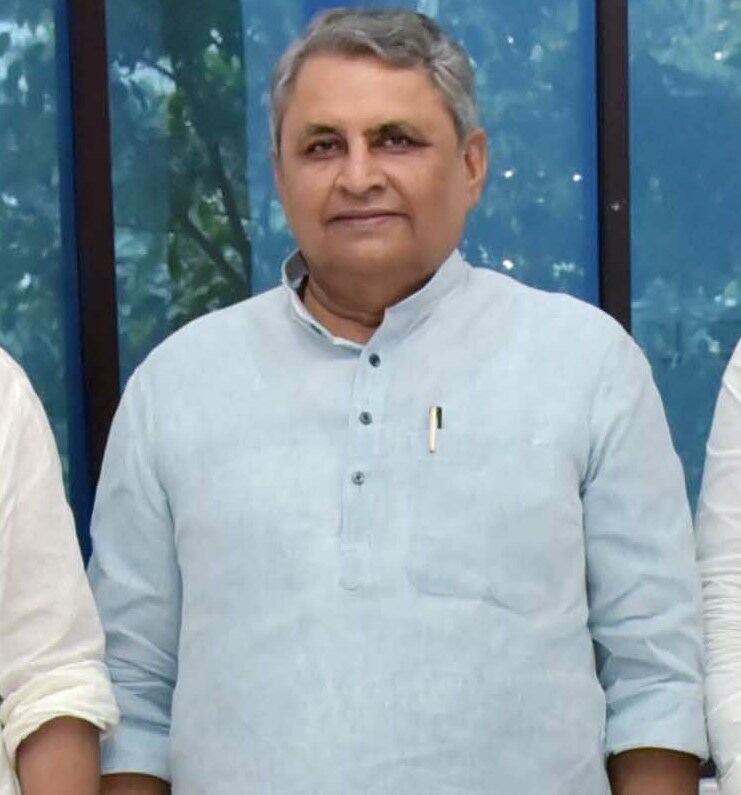
Vijay Kumar Chaudhary (born 8 January 1957) is an Indian politician. He has been a member of Bihar Legislative Assembly since 1982, and is currently serving as the Cabinet Minister for Water Resources and Parliamentary Affairs ministries in the Government of Bihar.

Key Information

He has previously held the posts of Speaker of Bihar Vidhan Sabha, Leader of Janata Dal (United) Legislature Party in Bihar Legislative Assembly[2] and the Minister for Finance, Commercial Taxes, Education, Building Construction, Transport, Rural Development, Rural Works Engineering, Information & Public Relations, Agriculture, Animal and Fish Resources ministries in the Government of Bihar.[3] He is considered to be the Number 2 in JDU's pecking order of the Bihar cabinet and is a member of Nitish Kumar's core committee which shapes policies of the Government and the party.[4][5]

Chaudhary served as the Home Minister-in-charge, putting forth the Government's stand on home affairs in Bihar Legislative Assembly.[6][7] Known for being an efficient administrator and a soft-spoken person with a clean image, he is a close confidante of Nitish Kumar and was speculated to succeed him as Chief Minister of Bihar following the latter's resignation after the 2014 Lok Sabha polls.[8][9][10][11][12]

Early life and career

[edit]

Choudhary was born in Dalsinghsarai, Samastipur district of Bihar in a Bhumihar Brahmin family. His father, Jagdish Prasad Chaudhary, had been a freedom fighter, an Indian National Congress politician and a three term member of the Bihar Legislative Assembly from the Dalsinghsarai constituency.[13] He completed his Master of Arts in history from Patna University in 1979 and joined the State Bank of India as a Probationary Officer in Trivandrum in the same year.

Political career

[edit]

After the demise of his legislator father in 1982, Chaudhary resigned from his job and won the subsequent by-election from Dalsinghsarai on a Congress ticket. He was re-elected from Dalsinghsarai for two more terms in 1985 and 1990. During this stint as a legislator from 1982 to 1995, he served as the Deputy Chairman of Bihar State Industrial Development Corporation (BSIDC) and Deputy Chief Whip of the Congress Legislature Party (CLP). He sought re-election again from Dalsinghsarai in 1995 and 2000 but lost the polls. Chaudhary served as General Secretary of Bihar Pradesh Congress Committee from 2000 to 2005. He joined JD(U) in 2005 and unsuccessfully contested the October 2005 Bihar Legislative Assembly election from Sarairanjan. He was appointed as the General Secretary and Chief Spokesperson of the party in 2008. He continued to serve in this capacity until February 2010, when he was nominated as the President of Bihar JD(U) and led the party during its victory in 2010 Bihar Legislative Assembly election.[14][15][16] He himself won the election from Sarairanjan (Vidhan Sabha constituency) with a margin of 17557 votes and was inducted as the Water Resources Minister in the newly formed cabinet,[17] assuming charge on 26 November 2010.[16]

He tendered his resignation from the Council of Ministers on 7 February 2015 to protest the continuance of Jitan Ram Manjhi as Chief Minister despite the election of Nitish Kumar as the Leader of JD(U) Legislature Party.[18]

He was elected as the Leader of JD(U) Legislature Party in the Bihar Legislative Assembly and staked claim to the opposition status. He was subsequently recognized as the Leader of Opposition on 19 February 2015 by then Speaker Uday Narayan Chaudhary.[19] Post victory in the trust vote and Nitish Kumar assuming charge as Chief Minister for the fourth time, he was inducted as the Cabinet Minister for Water Resources with the additional charge of Agriculture, Information & Public Relations and Animal and Fish Resources Departments.[20]

He retained his Sarairanjan (Vidhan Sabha constituency) in 2015 elections with a margin of 34044 votes. He was elected unopposed to the post of Speaker of Bihar Legislative Assembly on 2 December 2015 after consensus was generated on his name among all political parties of the state, including the Opposition BJP.[21] He was re-elected from Sarairanjan (Vidhan Sabha constituency) in the 2020 elections. He was inducted in the Cabinet of Nitish Kumar on 16 November 2020 and allotted the portfolios of Water Resources, Rural Works, Rural Development, Information & Public Relations and Parliamentary Affairs Departments.

Achievements

[edit]

As Water Resources Minister, Chaudhary is credited with the completion of Durgawati Reservoir in 2014, a massive irrigation project started in 1976 which got delayed by 38 years due to land acquisition and environmental clearance related issues.[22] His tenure (2010–2015) saw no major floods after the 2008 Bihar flood. Under his leadership, the Water Resources Ministry launched eight river-linking projects at a cost of Rs 4442 crores.[23]

As Speaker of the Legislative Assembly, Chaudhary brought 44 amendments to the Rules of Procedure and Conduct of Business, the most significant of them being the introduction of the concept of 'Confidence Motion' under Rule 109(A), wherein the Government of the day can move a motion to seek confidence from the House. Bihar is the only state in the country with a rule to deal with confidence motion moved by Government of the day. The Nitish Kumar government, with BJP and other NDA constituents as allies, was the first to move a confidence motion in the Assembly, on 28 July 2017, to prove its majority in the lower House. He also amended rules to allow inclusion of MLCs in House Committees dealing with financial matters.[24][25]

He introduced a Question Reply Management System (QRMS) for online receipt of questions from MLAs and provision of answers by concerned Government departments through the same channel. To bring transparency in the recruitment policy of the Legislative Assembly Secretariat, he divested the Office of Speaker of powers of recruitment and awarded the job to a Central agency, also responsible for recruitment in Parliament of India through a competitive and fair process.[26] He has also initiated the implementation of the National e-Vidhan Application Project to make Bihar Legislative Assembly paperless.[27]

He organized workshops to facilitate dialogue between the civil society and legislators for more informed lawmaking. He has also been organizing blood donation camps on the Assembly's foundation day wherein legislators donate blood for use by needy patients.[28]

Under his leadership as the Chairman of the Commonwealth Parliamentary Association Bihar Chapter, the Bihar Legislative Assembly successfully organised the annual conference of Commonwealth Parliamentary Association India Region, attended by both national and international dignitaries, including Chairperson of the Commonwealth Parliamentary Association Emilia Monjowa Lifaka.[29]

Personal life

[edit]

He is married to Ganga Choudhary. The couple has a son and a daughter.

References

[edit]
[edit]
Revisions and contributorsEdit on WikipediaRead on Wikipedia
from Grokipedia
Vijay Kumar Chaudhary is an Indian politician and senior leader of the Janata Dal (United) who has represented constituencies in the Bihar Legislative Assembly since winning a by-election from Dalsinghsarai in 1982 following his father's death. He was re-elected multiple times, shifting to the Sarairanjan constituency, and served as Speaker of the Bihar Legislative Assembly from 2015 to 2022. Chaudhary, a close confidant of Chief Minister Nitish Kumar, currently holds the positions of Cabinet Minister for Parliamentary Affairs and Water Resources in the Government of Bihar.

Early Life and Background

Birth and Family Origins

Vijay Kumar Chaudhary was born on 8 January 1957 in Dalsinghsarai, a town in Samastipur district, Bihar. He belongs to a Bhumihar Brahmin family, a community historically associated with landownership and scholarly pursuits in eastern India. His father, Jagdish Prasad Chaudhary, was a freedom fighter who participated in India's independence movement and later served as a three-term Member of the Bihar Legislative Assembly from the Dalsinghsarai constituency on an Indian National Congress ticket. No public records detail his mother's background or siblings, though the family's political legacy influenced Chaudhary's early entry into public life following his father's death in 1982.

Education and Formative Influences

Chaudhary completed his secondary education with from the in 1971, followed by intermediate from Mithila University in 1973. He then obtained a (Honours) degree from in 1976 and a from the same institution in 1980, establishing a foundation in during his formative years in . His educational path reflected the academic opportunities available in post-independence Bihar, where institutions like served as key centers for higher learning among aspiring public figures from regional backgrounds. Chaudhary's progression from at the intermediate level to advanced studies in suggests an early adaptability in scholarly pursuits, aligning with his later self-declared profession of social service as noted in election affidavits. Formative influences included his upbringing in a family in Dalsinghsarai, , where his father, Jagdish Prasad Chaudhary, a fighter and early activist, exemplified commitment to national causes and political engagement. This paternal legacy likely shaped Chaudhary's orientation toward from an early age, fostering a sense of duty amid Bihar's socio-political landscape of the mid-20th century, though specific personal anecdotes or mentors beyond family are not documented in available records.

Pre-Political Career

Initial Professional Engagements

Vijay Kumar Chaudhary commenced his professional career immediately after obtaining a degree in history from in 1979, joining the (SBI) as a probationary officer posted in Trivandrum (now ), . This entry-level banking role marked his initial engagement in the formal workforce, aligning with the typical career path for graduates entering public sector banking in India during that era, which emphasized administrative and financial operations. Chaudhary's tenure at SBI lasted approximately three years, during which he gained experience in core banking functions amid the institution's expansion under nationalized banking policies post-1969. No records indicate involvement in specialized departments or promotions beyond the probationary phase, reflecting a brief but stable professional foundation before transitioning to public life. In 1982, Chaudhary resigned from his position as a bank manager at SBI, prompted by the untimely death of his father, Jagdish Prasad Choudhary, which necessitated his return to to contest a from the Dalsinghsarai constituency on an ticket. This abrupt exit from banking underscores the causal link between familial obligations and his pivot toward electoral politics, with no subsequent returns to private or professional employment documented.

Entry into Public Service

Following the completion of his degree in history from in 1979, Chaudhary entered public service by joining the as a probationary officer, initially posted in Trivandrum. This role in India's largest public sector bank marked his initial professional engagement in a structured government-aligned , where probationary officers undergo training in banking operations, , and before assuming substantive duties. His tenure at SBI was brief, aligning with his subsequent pivot to electoral politics; by 1982, at age 25, he contested and won his first election from the Sarairanjan constituency as a affiliated with the . This transition from banking to legislative service reflected the era's common pathway for young professionals in , where experience often preceded involvement in regional politics amid the state's evolving post-Emergency political landscape. No detailed records specify the exact duration of his SBI service or reasons for departure, though such short stints were not uncommon for aspiring politicians securing nominations.

Political Trajectory

Affiliation with Indian National Congress

Vijay Kumar Chaudhary entered politics with the (INC) in 1982, contesting and winning the election from the Sarairanjan constituency () following the sudden death of his father, who was the incumbent MLA. He resigned from his position at the to pursue the seat, securing victory on the INC ticket in a triggered by his father's passing. Chaudhary retained the Sarairanjan seat for the INC in the subsequent general elections of 1985 and 1990, serving continuously as an MLA from 1982 to 1995. During this period, he held organizational roles within the party, including Deputy of the Legislature Party (CLP) in the Assembly and Deputy Chairman of the Bihar State Industrial Development Corporation (BSIDC). His tenure reflected active involvement in legislative opposition during non-INC governments in . From 2000 to 2005, Chaudhary served as General Secretary of the (BPCC) and as a member of the (AICC), positions that elevated his profile within the party's state and national structures. This phase marked the culmination of his direct organizational contributions to the INC before his departure from the party in favor of the Janata Dal (United).

Transition to Janata Dal (United)

Vijay Kumar Chaudhary served as General Secretary of the Bihar Pradesh Congress Committee from 2000 to 2005, rising as a key organizational figure within the party during a period of political flux in Bihar. In 2005, amid growing alignments in state politics, Chaudhary left the Indian National Congress and joined the Janata Dal (United), a move attributed to his developing proximity to JD(U) leader Nitish Kumar. The transition occurred shortly before the October 2005 Bihar Legislative Assembly elections, enabling Chaudhary to contest from the Sarairanjan constituency on a JD(U) ticket, though he faced defeat in that poll. This switch reflected broader patterns of defections in Bihar's fragmented political landscape at the time, where leaders sought alliances promising greater electoral viability and governance influence under Nitish Kumar's emerging NDA coalition. Despite the initial electoral setback, the affiliation positioned Chaudhary for future roles within JD(U), leveraging his administrative experience and regional networks in .

Electoral Contests and Victories

Vijay Kumar Chaudhary first entered electoral politics by winning the Sarairanjan constituency in the on an ticket. He secured re-election from the same seat in the 1990 assembly polls, also representing . Following his switch to Janata Dal (United) in 2005, Chaudhary contested the October 2005 Bihar assembly election from Sarairanjan but lost. He achieved victory in the 2010 election from the constituency as the JD(U) candidate. Chaudhary won re-election in Sarairanjan during the 2015 Bihar Legislative Assembly election, marking his fifth term as MLA. In the 2020 polls, he defended the seat for JD(U), polling 72,666 votes (43.5% of valid votes) and defeating Rashtriya Janata Dal's Arbind Kumar Sahni by a margin of 3,624 votes. No other electoral defeats are recorded in his career.

Legislative and Leadership Roles

Tenure as Member of Bihar Legislative Assembly

Vijay Kumar Chaudhary began his legislative career as a Member of the in 1982, representing the Dalsinghsarai constituency under the banner. He secured re-election from the same seat in the 1985 and 1990 Bihar Assembly elections, maintaining his position through 1995. Following a period outside the assembly and a shift to Janata Dal (United), Chaudhary contested and won from the Sarairanjan constituency in Samastipur district starting with the 2010 election, defeating rivals with 53,946 votes. He retained the seat in the 2015 election as a five-term MLA at that point, and again in 2020, polling 72,666 votes amid a competitive field including Rashtriya Janata Dal candidates. Throughout his tenures, Chaudhary has focused on constituency-level issues in Sarairanjan, such as and agricultural support, while contributing to assembly proceedings on broader state matters including and , prior to assuming higher leadership roles. His repeated victories in Sarairanjan reflect consistent voter support in a region marked by alternating alliances between JD(U)-led coalitions and opposition fronts.

Speakership of Bihar Assembly

Vijay Kumar Chaudhary, a senior Janata Dal (United) legislator and close confidant of , was unanimously elected Speaker of the on December 2, 2015, for the 16th Assembly. His election followed consensus among all major parties, including the opposition , with no other nominations filed, marking a rare instance of cross-party support amid the -led coalition's formation with the . As a five-term MLA from the Sarairanjan constituency in , Chaudhary's selection underscored his long-standing loyalty to the JD(U) and experience in legislative matters. During his tenure from 2015 to 2020, Chaudhary presided over sessions of the 16th Bihar Assembly, which spanned the full five-year term until its dissolution ahead of the 2020 elections. He frequently addressed procedural challenges, including recurrent disruptions that hampered House proceedings, expressing concern in March 2017 over three consecutive days of interruptions that prevented substantive debates. No major controversies or landmark rulings directly attributed to his speakership were prominently reported, reflecting a tenure focused on routine administration rather than partisan conflicts, in contrast to subsequent assemblies. The assembly under his leadership handled key legislative business, such as sessions and bills related to the grand alliance government's priorities, though specific decisions emphasized maintaining order over innovative procedural reforms. Chaudhary's term concluded with the end of the 16th Assembly following the October-November 2020 elections, after which of the BJP was elected Speaker for the 17th Assembly on November 25, 2020. He continued as an MLA, contesting and winning re-election from Sarairanjan in 2020, but shifted to ministerial roles thereafter.

Ministerial Responsibilities

Vijay Kumar Chaudhary holds the positions of Cabinet Minister for and Minister for Parliamentary Affairs in the , roles he assumed following the portfolio allocation in the Nitish Kumar-led ministry formed on January 28, 2024. In the portfolio, he directs efforts to mitigate Bihar's recurrent flooding, oversee infrastructure development, and implement river embankment strengthening projects, given the state's exposure to overflows from major rivers such as the Ganga, Kosi, and Gandak, which affect millions annually. The department under his charge manages approximately 6,000 kilometers of embankments and coordinates with central agencies for and relief, with experiencing floods impacting over 70 districts in peak years like 2020. As Minister for Parliamentary Affairs, Chaudhary facilitates coordination between the state executive and the , including drafting bills, managing question hours, and resolving procedural disputes to ensure legislative efficiency. This role involves bridging gaps during sessions, particularly amid coalition dynamics in the (NDA) government, and has positioned him as a key spokesperson on policy implementation. His oversight extends to aspects of legislative outreach, emphasizing accountability in assembly proceedings. Chaudhary's prior experience in these domains dates to earlier tenures, including responsibilities since November 2010, during which he contributed to embankment repairs and minor schemes that expanded cultivable by over 1 million hectares in by 2020. These efforts align with state priorities for resilience against climate-induced water challenges, though implementation faces constraints from funding dependencies on central grants, totaling around ₹10,000 crore annually for flood management as of 2024.

Policy Contributions and Developments

Water Resources and Infrastructure Initiatives

As Bihar's Minister for since 2022, Vijay Kumar Chaudhary has focused on projects to combat recurrent ing, enhance , and avert projected , given the state's transition from water surplus (5,000 cubic meters availability) to stressed conditions (1,000 cubic meters). He has warned that risks becoming water-deficient by 2050 without remedial actions, emphasizing the need for structural interventions amid excessive exploitation and damages affecting northern districts bordering . The Department's budget for 2025-26 stands at Rs 7,451.14 , allocated toward mitigation and expansion. Chaudhary has advanced barrage construction on key rivers to regulate flows, store water for , and reduce risks in districts including East Champaran, West Champaran, , Madhubani, , and . Specific proposals include barrages on the Gandak at Areraj, Masan in West Champaran, Bagmati at Dheng, Kamala at Jainagar, Kosi at Dakmara, and Mahananda at Taiyabpur, with detailed project reports submitted to the for approval and funding under a Rs 11,500 management allocation. These initiatives build on prior India-Nepal agreements for upstream structures, shifting toward state-led downstream controls to enable year-round and management, including a proposed to excavate riverbed for prevention. River interlinking projects under Chaudhary's oversight include the Kosi-Mechi link, reviewed via in September 2025 with union ministers, aimed at diverting surplus Kosi water to the Mechi River over 41 km, reviving the Eastern Main Canal, and irrigating 2.15 hectares in Seemanchal while providing long-term relief; the , costing Rs 6,282.32 , had its foundation stone slated for laying by Prime Minister on September 15, 2025. Additional links, such as Kamala-Purani Kamala-Bagmati and Burhi Gandak-None-Baya-Ganga, are in planning to optimize water distribution. Complementary efforts involve embankment reinforcements, despite six breaches reported in 2024 , and central collaborations for data-driven . In June 2025, Chaudhary conducted a comprehensive review of protection and schemes exceeding Rs 5 , directing officials to finalize designs before tenders, submit quarterly action plans, monitor budget utilization proportionally, and enforce accountability through show-cause notices and disciplinary actions against delaying contractors or officers. These measures underscore a push for timely execution amid Bihar's annual vulnerability, with Rs 924.40 released by the centre in July 2025 for related river-linking and mitigation works.

Education and Administrative Reforms

During his tenure as Bihar's Minister of Education from 2020 to 2022, Vijay Kumar Chaudhary focused on addressing systemic deficiencies in the state's sector, which has historically lagged in national rankings due to inadequate infrastructure, teacher shortages, and outdated curricula. In February 2021, responding to assembly queries on declining educational outcomes, Chaudhary publicly acknowledged Bihar's low standards, attributing them to inherited challenges from prior administrations while pledging targeted interventions to elevate quality. He emphasized the need for evidence-based improvements, including better teacher training and , though specific metrics for progress during his term remain limited in official records. To foster expertise-driven enhancements, Chaudhary in 2021 urged academics and stakeholders to provide actionable recommendations for boosting and research quality, aiming to bridge gaps in institutions plagued by underfunding and governance issues. Concurrently, he collaborated with state authorities on curriculum modernization; in discussions with the , he advocated revising university syllabi to incorporate practical skills and industry relevance, countering criticisms of rote-learning dominance in Bihar's system. Administrative efforts under Chaudhary included tackling corruption in higher education . In November 2021, amid multiple allegations of graft against vice-chancellors involving irregular appointments and fund misuse, he met with the to push for stricter oversight and mechanisms, securing assurances for investigations without detailing implemented structural changes. Later, as Finance Minister from 2023, Chaudhary highlighted fiscal constraints on reforms, criticizing the central government's reduction of its funding share for schemes from 90% to 60%, which he argued hampered state-level initiatives like infrastructure upgrades and teacher recruitment drives. These positions underscored a pragmatic approach prioritizing fiscal realism over expansive promises, though independent evaluations of lasting impacts, such as enrollment rates or learning outcomes, show persistent challenges in post his education portfolio.

Economic and Poverty Alleviation Efforts

During his tenure as Bihar's Finance Minister from approximately 2021 to early 2024, Vijay Kumar Chaudhary oversaw the presentation of state prioritizing high fiscal utilization and development spending, with the government reporting 99% expenditure of the Rs 2,35,000 estimated for 2022-23. This approach aimed to support infrastructure and welfare schemes contributing to economic stability, though independent assessments of long-term efficacy remain limited. Chaudhary has credited state government policies under Chief Minister with lifting 3.7 crore people out of multidimensional poverty, referencing data showing Bihar's poverty rate declining from 51.89% in 2015-16 to 26.59% in 2019-21 based on metrics. He emphasized sustained governance efforts as key drivers, including targeted welfare allocations in budgets he managed, though causal links to specific interventions like rural or programs require further empirical validation beyond aggregate trends. In statements as Water Resources Minister in June 2025, Chaudhary cited World Bank reports acknowledging India's overall poverty reduction of 171 million people since 2011, positioning Bihar among select states with outsized contributions through accelerated economic activities and policy continuity. He linked this to broader fiscal strategies fostering per capita income growth and sectoral shifts. Chaudhary highlighted Bihar's economic transformation in September 2025, noting the industrial sector's growth surpassing for the first time, which has propelled the state's overall expansion among India's highest rates and elevated . These developments, he argued, stem from prior budgetary investments in diversification, though challenges like dependency on central funds and uneven district-level outcomes persist in official data. He has repeatedly advocated for to enhance resource inflows, contending it would address Bihar's structural barriers to sustained poverty alleviation and industrialization.

Controversies and Political Criticisms

Allegations in Education Sector

In November 2021, during Vijay Kumar Chaudhary's tenure as Bihar's , allegations surfaced of financial irregularities and graft involving vice chancellors of state universities, including scams for examination materials. Chaudhary demanded an investigation into Vice-Chancellor Archana of , citing complaints of corruption, and skipped a Raj Bhavan award function honoring university performers to avoid association with the accused. He met Phagu Chauhan to urge stern action, receiving assurances of legal proceedings against those found guilty. The episode highlighted tensions between the state government and Raj Bhavan over university oversight, with Nitish Kumar writing to the governor for probes and opposition activists alleging political favoritism in vice chancellor appointments. Chaudhary maintained that thorough inquiries were essential, positioning the government as committed to accountability amid claims of systemic in higher education funding and operations. No evidence linked Chaudhary personally to the irregularities, which centered on vice chancellors appointed under gubernatorial . Teacher recruitment processes under Chaudhary's department also drew scrutiny for alleged malpractices. In April 2022, officials identified suspicious documents for 445 candidates in primary teacher hiring, contrasting with 932 verified as genuine; Chaudhary announced ongoing verification to address potential fraud. Earlier, in STET-2019 results, CPI(ML) legislators alleged irregularities favoring unqualified candidates, prompting a to meet Chaudhary for intervention, though the party attributed systemic lapses to departmental oversight failures. Chaudhary admitted delays in university academic sessions in June 2022, attributing them to administrative hurdles amid coalition debates, which fueled opposition criticism of inefficiency in educational governance. These issues reflected broader challenges in Bihar's education system, including persistent fraud risks, but Chaudhary defended recruitment achievements against opposition attacks, emphasizing detections as evidence of proactive measures.

Partisan Statements and Alliance Dynamics

Vijay Kumar Chaudhary has frequently articulated JD(U)'s commitment to the (NDA) amid overtures from opposition blocs. On June 5, 2024, he stated that the Nitish Kumar-led JD(U) was being courted by both the NDA and the alliance but would remain steadfast with the NDA, emphasizing loyalty to the coalition despite external pressures. This position was reiterated in the context of post-Lok Sabha election dynamics, where JD(U)'s pivotal role in the NDA's national arithmetic drew speculation about potential shifts. Chaudhary's statements have occasionally underscored internal NDA tensions while defending the alliance. In August 2022, amid strains between JD(U) and BJP over issues like the caste census, he backed BJP president JP Nadda's criticism of dynastic politics, implicitly targeting opposition parties like RJD, as a means to mend intra-coalition rifts. However, earlier in July 2023, shortly before Nitish Kumar's realignment from the Mahagathbandhan to the NDA, Chaudhary accused the BJP of attempting to destabilize Bihar's government akin to political maneuvers in Maharashtra, rejecting calls for Deputy CM Tejashwi Yadav's resignation amid CBI investigations into corruption allegations. This remark highlighted JD(U)'s then-partisan defense of its opposition alliance, reflecting the fluid dynamics of Bihar's coalitions under Nitish Kumar, which have shifted four times since 2015 based on pragmatic power-sharing rather than ideological consistency. In public discourse, Chaudhary has criticized opposition tactics as fear-mongering, particularly targeting vulnerable groups. On July 22, 2025, he lambasted opposition parties for instilling panic among the poor over policy changes, framing such rhetoric as electoral manipulation rather than substantive critique. Similarly, on October 1, 2025, he asserted that Bihar's minority communities were aligning with the NDA and , countering narratives of alienation propagated by rivals like RJD. These pronouncements, while bolstering JD(U)'s NDA positioning ahead of the 2025 Bihar assembly elections, have drawn accusations from opponents of overlooking lapses in favor of alliance preservation, underscoring the transactional nature of Bihar's political partnerships where personal and party loyalty to often supersedes broader ideological coherence.

Personal Life and Public Image

Family and Personal Relationships

Vijay Kumar Chaudhary was born on , 1957, to the late Jagdish Prasad Chaudhary and Sushila Chaudhary in Keota village, Dalsinghsarai, , . His father, a freedom fighter affiliated with the , represented constituencies in the for three terms, including victories in the 1980 elections. Chaudhary hails from a , with his entry into politics in 1982 following his father's legacy. He is married, and his is identified as a in official election declarations, with no further public details on her name or assets beyond spousal property disclosures. No verifiable information exists on children or additional personal relationships in credible sources.

Public Engagements and Ideology

Vijay Kumar Chaudhary has participated in various public forums, including legislative conferences and ministerial briefings, to advocate for 's developmental priorities. In December 2016, he commented at the PRS Legislative Research's Annual Conference on the need to strengthen state legislatures for effective governance. He has repeatedly called for enhanced central support for , such as demanding a special financial package in July 2024 due to the state's resource constraints ahead of the Union Budget. Chaudhary's public statements often defend the Nitish Kumar government's achievements in poverty alleviation and . In June 2025, he highlighted 's role among states contributing to national through targeted policies. He endorsed the Union Budget's provisions for in February 2025, emphasizing their alignment with state-led growth initiatives. In May 2025, he anticipated accelerated development from Narendra Modi's visit to . Ideologically, Chaudhary espouses principles of and equitable development, consistent with JD(U)'s social-democratic orientation. In February 2024, he asserted that the NDA government in upholds social justice politics amid political realignments. He defended the 2023 Bihar survey as a tool for social justice, questioning Union Home Minister Amit Shah's criticisms in November 2023 and arguing it addresses empirical inequities rather than political motives. Chaudhary has critiqued perceived communal polarization efforts, interpreting Prime Minister Modi's June 2023 remarks on the as an attempt to divide communities amid opposition unity. He has opposed the politicization of sensitive issues, such as criticizing RJD leader in May 2025 for questioning criteria for martyr status, insisting on established central standards. Additionally, in August 2022, he supported BJP president JP Nadda's remarks against family-centric political parties, signaling alignment against dynastic politics within the NDA framework.

References

Add your contribution
Related Hubs
User Avatar
No comments yet.