Hubbry Logo
W76W76Main
Open search
W76
Community hub
W76
logo
8 pages, 0 posts
0 subscribers
Be the first to start a discussion here.
W76
W76
from Wikipedia

The W76 is an American thermonuclear warhead, designed for use on the UGM-96 Trident I submarine-launched ballistic missiles (SLBMs) and subsequently moved to the UGM-133 Trident II as Trident I was phased out of service. The first variant, the W76 mod 0 (W76-0) was manufactured from 1978 to 1987. It was gradually replaced by the W76 mod 1 (W76-1) between 2008 and 2018, completely replacing the Mod 0 in the active stockpile. In 2018, it was announced that some Mod 1 warheads would be converted to a new low-yield W76 mod 2 (W76-2) version. The first Mod 2 warheads were deployed in late 2019.

Key Information

History

[edit]

The warhead was initially manufactured from 1978 to 1987 and designed by Los Alamos National Laboratory. It was initially fitted to the Trident I SLBM system, but after the Rocky Flats plant where its successor the W88 was being made was shut down in 1989 after a production run of only 400 warheads, it was decided to transfer W76 warheads to Trident II.[3]

A life extension program (LEP) for 800 warheads was approved by the US government in 2000, then later increased to 2,000.[4] The purpose of the LEP was to extend service life by 20 years and add new safety features. In September 2008, production on the W76-1 started. In December 2018, the National Nuclear Security Administration completed updating all W76-0 warheads to the W76-1 design.[5]

The 2018 Nuclear Posture Review announced that a new variant, the W76-2, would be manufactured.[6] The W76-2 variant is described as a low-yield warhead, estimated at 5-7 kilotons of TNT equivalent.[7] In January 2019, the National Nuclear Security Administration announced that it had started to manufacture the W76-2. Initial operating capability was expected in the final quarter of 2019,[8] and manufacturing is expected to last through FY2024[9] at the Pantex Plant.[10]

According to the FAS, the W76-2 warhead was first deployed with USS Tennessee during its late 2019 operational patrol.[11] In February 2020, the US Department of Defense confirmed that the W76-2 had been 'fielded'.[12]

The warhead is currently the most numerous weapon in the US nuclear arsenal,[13] having replaced the 50 kt W68 that was fitted to the Poseidon SLBM in that capacity.

The United Kingdom operates a nuclear weapon based on the W76 mod-1 design, under the name "Holbrook".[14][15]

Design

[edit]
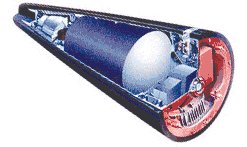
A W76-1

The Mk4 reentry vehicle is 130 cm long and 40 cm in diameter.[16] The dimensions of the W76 thermonuclear warhead are unknown.

The W76-0 had a design yield of 100 kt. Its replacement, the W76-1, has a yield of 90 kt. The W76-2 has an estimated yield of 5 to 7 kt.[17]

The W76-0 was fitted inside a Mk4 reentry vehicle (reentry body in US Navy parlance). The W76-1 and -2 are fitted inside the new Mk4A reentry vehicle. The reentry vehicle and warhead weight is estimated to be approximately 95 kilograms (209 lb).[1]

During the W76-1 LEP, the warhead was fitted with a new MC4700 arming, fuzing and firing (AF&F) system, the so-called "super-fuze". The MC4700 AF&F system increases warhead kill probabilities against hard targets such as silos and bunkers. It achieves this by first calculating the range to the target outside of the atmosphere (i.e. before the atmosphere can alter the warhead's trajectory) and then continuously calculates its position on a line based on acceleration.[18]

If the contact fuze is actuated, such as falling short or striking on target, the warhead detonates. If the fuze calculates it has overshot the target, it detonates the warhead before it can leave the kill radius of the target. The kill radius is a sphere, not a circle. In comparison, a warhead without such a smart fuze would continue flying when overshooting a target, leaving the kill radius, where detonating would destroy the target, and impact the ground. This would actuate the impact fuze and detonate the warhead, outside of the kill radius.[19]

See also

[edit]

References

[edit]
[edit]
Revisions and contributorsEdit on WikipediaRead on Wikipedia
from Grokipedia
The W76 is a thermonuclear in the United States nuclear arsenal, designed for deployment aboard submarine-launched ballistic missiles of the family, providing a key element of the sea-based strategic deterrent. Introduced into service in 1978 as the W76-0 with a yield of approximately 100 kilotons, it is packaged in the lightweight Mk4 reentry vehicle, enabling multiple independently targetable reentry vehicles on each missile. The W76-1 program refurbished the original design, incorporating updated components such as an insensitive high explosive secondary and enhanced safety features while preserving the warhead's yield and characteristics for continued reliability through the mid-21st century. In response to perceived gaps in addressing limited nuclear aggression by adversaries like , the W76-2 variant was developed with a reduced yield of about five kilotons and fielded in on select II D5 missiles to offer a tailored, discriminate response option without requiring new delivery systems. As the most prolific warhead type in the U.S. , with over a thousand units, the W76 underscores the emphasis on stealthy, survivable second-strike capability from Ohio-class submarines, though the low-yield W76-2 has sparked debate over whether it strengthens deterrence or risks escalating conflicts by blurring the line between conventional and nuclear thresholds—debate informed by official assessments rather than unsubstantiated media narratives.

Historical Development

Initial Design and Production

The W76 thermonuclear warhead was developed by (LANL) as a lightweight, intermediate-yield option for multiple independently targetable reentry vehicles (MIRVs) deployed on submarine-launched ballistic missiles, primarily the I C4 system. Development began in May 1973 under senior designer Charles C. Cremer, with production engineering initiated in November 1975. The design employed a two-stage configuration featuring a beryllium-reflected primary stage boosted by deuterium-tritium gas, paired with a lightweight uranium radiation case enclosing the secondary stage to optimize weight and performance for naval deployment constraints. The nominal yield was engineered for 100 kilotons, balancing destructive power with the need for multiple warheads per missile to enhance targeting flexibility amid post-SALT I limitations on megaton-class SLBMs. Initial production units were completed in June 1978 at the Pantex Plant near , marking the warhead's entry into the U.S. nuclear stockpile. Quantity production commenced in November 1978, continuing until July 1987 and yielding approximately 3,400 warheads in total. Deployment began that same year on Ohio-class submarines equipped with Trident missiles, replacing heavier predecessors like the to increase loadouts from eight to potentially more warheads per missile under regimes. The overall development effort cost $128 million, though it encountered hurdles such as suboptimal yields during full-scale testing and early concerns over fuzing system reliability against . Non-nuclear components, including arming, fuzing, and firing systems, were concurrently engineered by to ensure compatibility with the Mk4 reentry vehicle.

Life Extension Program

The W76-1 Life Extension Program (LEP), managed by the (NNSA), refurbished the original W76-0 warhead to extend its service life from 20 years to 60 years while maintaining its operational capabilities for submarine-launched ballistic missiles. The program addressed age-related degradation in components such as the conventional high explosives, arming, fuzing, and firing subsystems, and incorporated modernized safety and security features without altering the warhead's yield or military characteristics. Planning for the W76-1 LEP began in 1999, with formal approval in March 2000 initially covering 800 warheads, later expanded to approximately 2,000 units to support Trident II (D5) missile deployments. Production activities involved collaboration across NNSA sites, including for physics package refurbishment, Plant for assembly and disassembly, and for secondary components, with the arming, fuzing, and firing subsystem production completed on schedule in October 2017. The first production unit was certified and entered the prior to full-scale production, enabling certification through non-nuclear testing under the Stockpile Stewardship Program. Full production wrapped up in January 2019, ahead of the scheduled completion date, with the refurbished W76-1 warheads certified to meet all mission requirements for U.S. Navy strategic deterrence without requiring nuclear explosive testing. Despite earlier concerns raised by the Government Accountability Office in 2009 regarding cost, schedule, and technical risk management for the program, the NNSA achieved its objectives within planned parameters, enhancing the warhead's reliability for deployment on Ohio-class submarines.

Low-Yield Variant Development

The W76-2 low-yield variant emerged from recommendations in the U.S. Department of Defense's 2018 Nuclear Posture Review, which argued for developing a submarine-launched ballistic missile warhead with reduced yield to address potential adversary strategies involving limited nuclear strikes, thereby enhancing deterrence flexibility without necessitating full-scale high-yield responses. The variant modifies the existing W76-1 design by altering the physics package to achieve an estimated explosive yield of approximately 5 kilotons, compared to the W76-1's roughly 90 kilotons, while retaining compatibility with Trident II (D5) missiles. This adjustment aimed to provide U.S. strategic forces with graduated response options against scenarios like Russian employment of low-yield weapons on tactical targets. Development proceeded on an accelerated schedule under the (NNSA), leveraging the mature W76 platform to minimize new testing requirements under the framework. Production commenced in 2019 at the Pantex Plant in , where the first production unit was completed in February 2019. NNSA reported being on track to produce the full low quantity of warheads—intended for limited deployment across a small number of missiles—and deliver them to the by the end of 2019, a timeline achieved within 17 months from initiation to completion of the production run. The W76-2 achieved initial operational capability with delivery to the U.S. Navy in late 2019, followed by deployment on Ohio-class submarines. The first operational patrol occurred in February 2020 aboard the USS Tennessee, with each equipped submarine typically carrying W76-2 warheads on one or two of its 20 II missiles, while the remainder retain higher-yield W76-1 variants. This limited integration preserved the overall high-yield posture of the force while introducing the low-yield option for tailored deterrence. No full-scale nuclear testing was conducted for the variant, relying instead on computer simulations, hydrodynamic tests, and processes validated through the Stockpile Stewardship Program.

Technical Design

Physics Package and Components

The physics package of the W76 constitutes the core nuclear explosive assembly, comprising a two-stage thermonuclear design developed by between 1973 and 1987. This package integrates a primary fission stage, an interstage region, and a secondary fusion-fission stage, encased within a radiation case engineered for minimal mass to enable efficient mediated compression during detonation. The overall yield for the standard W76-0 and W76-1 configurations reaches approximately 100 kilotons, achieved through staged energy release from fission and fusion processes. The primary stage employs an implosion mechanism to compress a core, augmented by a reflector to enhance economy and deuterium-tritium gas boosting to increase fission yield through additional fusion . Surrounding the core are precision-machined lenses of PBX-9501, a TATB-HMX composite insensitive high that provides two-point , minimizing accidental high-order risks from isolated impacts. This boosted fission primary alone delivers a yield of about 5 kilotons in the W76-2 variant, where the secondary stage is intentionally disabled via modifications to limit output for tailored deterrence scenarios. The interstage region utilizes , a classified low-density silica-based foam, to absorb and re-radiate x-rays from the primary explosion, ensuring uniform of the secondary's without premature mixing of materials. Production challenges with Fogbank during the W76 life extension program (2005–2019) stemmed from lost manufacturing knowledge after initial runs ended in , necessitating reverse-engineered replication to sustain refurbishment. The secondary stage incorporates lithium-6 deuteride as the principal fusion fuel, compressed by -induced implosion to initiate deuterium-tritium fusion reactions, with subsequent fission of the jacket amplifying total energy release. A central or sparkplug aids ignition, while a depleted or tamper maintains compression. The case, lined with plastic foam for , withstands extreme pressures for microseconds before vaporizing, a vulnerability noted in analyses of potential deformation effects on yield performance. Refurbishments under the program preserved these components' configurations without altering fundamental physics package geometry, relying on non-nuclear testing and simulations for certification.

Safety, Arming, and Fuzing Mechanisms

The W76 incorporates an Arming, Fuzing, and Firing (AF&F) subsystem designed to prevent accidental nuclear detonation while enabling reliable operation under authorized launch conditions. This subsystem integrates environmental sensors, stronglink mechanisms, and fuzing electronics to enforce multiple interlocks, ensuring the warhead remains in a safe configuration during storage, transport, and handling. Stronglinks, electromechanical devices developed by , function as redundant barriers analogous to vault doors, blocking electrical paths to the firing circuits unless specific coded signals—derived from presidential authorization codes—are received, thereby maintaining a "weak link" in the safe position against unauthorized or accidental arming. In the original W76-0 variant, the MC2912 AF&F system, engineered by Sandia, combines arming/safing logic with Navy-provided environmental sensing devices, such as launch accelerometers that detect exceeding specified thresholds (typically on the order of tens of g-forces) to initiate arming sequences only post-launch. Safing features include batteries that activate solely on command, preventing power to detonators in non-operational states, and the system adheres to one-point standards, where accidental of the high explosive at a single point yields no more than 4 pounds of TNT-equivalent nuclear output, verified through hydrodynamic testing and modeling with probabilities below 1 in 10 million per event. Fuzing employs and contact modes for airburst or ground impact , optimized for soft targets with fixed height-of-burst timing. The W76-1 program replaced the MC2912 with the MC4700 AF&F subsystem, a modernized electro-mechanical assembly comprising five printed wiring assemblies, six flat flex cables, electronics, a , and , encapsulated for environmental resilience. This preserves core interlocks, including stronglinks and enhanced nuclear surety against aging or insult scenarios like and impact, while extending from 20 to 60 years without altering fundamental yield or design. The MC4700 introduces a "super-fuze" capability with burst-height compensation, using altimetry to dynamically adjust detonation altitude for hardened targets, improving kill probability against by factoring in reentry deviations, yet it maintains equivalent one-point margins through reused qualified components and certification via non-nuclear testing.

Manufacturing and Refurbishment Processes

The original W76 (designated W76-0) warheads were manufactured starting in 1978, with assembly conducted at the Pantex Plant in as part of the U.S. nuclear stockpile production efforts managed by the Department of Energy's predecessor agencies. Production involved integrating the physics package, developed by , with non-nuclear components engineered by , including precise machining and assembly processes to ensure reliability under submarine-launched ballistic missile conditions. Full-scale quantity production began in November 1978 and continued until 1988, yielding approximately 1,200 units before transitioning to maintenance phases. Refurbishment of the W76 primarily occurs through the W76-1 Program (LEP), initiated to address aging components and extend the warhead's from an original 20 years to 60 years without altering its fundamental design or yield capabilities. The process begins with disassembly of retired W76-0 warheads at the Pantex Plant to inspect for degradation in materials such as electronics, conventional explosives, and fuzing systems, followed by targeted replacements using modernized, high-reliability parts produced across (NNSA) facilities. Key components refurbished include the arming, fuzing, and firing subsystem, manufactured at the and completed on schedule in October 2017, as well as neutron generators redesigned by Sandia in the to mitigate reliability issues identified in surveillance testing. Reassembly incorporates advanced measures, including non-nuclear testing with Joint Test Assemblies (JTAs) that simulate flight conditions via diagnostic in place of the nuclear package, enabling through the Stockpile Stewardship Program without underground nuclear explosions. The W76-1 LEP achieved its first production unit in September 2008 and full production completion at in December 2018, delivering over 700 refurbished warheads to the by 2019, under and ahead of schedule relative to initial projections. Ongoing alterations, such as the low-yield W76-2 variant, utilize similar processes at , with the first unit produced in 2019 by modifying W76-1 components for reduced yield configurations. These efforts, supported by surveillance data from Los Alamos and Sandia, ensure continued safety, security, and performance amid stockpile reductions.

Specifications and Capabilities

Physical Dimensions and Weight

The W76 , integrated with the Mk-4 reentry vehicle (RV), comprises a package weighing 362 pounds (164 kilograms). This mass includes the physics package, arming and fuzing components, and RV structure, enabling up to eight such units per Trident II (D5) missile while adhering to treaty-limited constraints. The Mk-4 RV is a , ablative designed for atmospheric reentry, with the overall package dimensions classified but estimated at approximately 1.52 meters in length and a base diameter of 0.41 meters to fit the missile's 2.11-meter body. The W76-1 life-extended variant uses the similar Mk-4A RV, maintaining comparable dimensions and a under kilograms for the armed package, prioritizing reduced observables and enhanced features without significant size increase. Exact measurements for the bare physics package remain restricted, reflecting standard practices for U.S. nuclear components to protect sensitivities. These specifications underscore the W76's role as a compact, high-density system derived from earlier low-yield designs adapted for deployment.

Yield Configurations

The W76 warhead, in its original W76-0 configuration, has an estimated maximum yield of approximately 100 kilotons of . The W76-1 variant, produced through the program completed in 2019, features a slightly reduced yield estimated at 90 kilotons, achieved via modifications to extend service life while preserving core performance characteristics. The W76-2, introduced as a low-yield option in 2019, derives from the W76-1 design but limits detonation to the primary fission stage, excluding the secondary fusion stage, resulting in an estimated yield of 5 kilotons. This configuration provides a selectable lower-yield capability for submarine-launched ballistic missiles without requiring new reentry vehicle development. Exact yields remain classified, with public estimates derived from unclassified analyses of design modifications and historical data. These configurations enable flexible employment options on Trident II D5 missiles, where W76-2 warheads are typically loaded alongside higher-yield W76-1 or variants on the same to address perceived gaps in limited nuclear scenarios. No variable-yield dialing mechanism is publicly confirmed for the W76 series; yields are fixed per variant.

Reliability and Testing Data

The W76 undergoes annual surveillance testing as part of the U.S. nuclear program, involving disassembly of select units for component , environmental testing, and to assess degradation in materials, , and physics packages. This process draws on empirical data from over 1,000 full-scale nuclear tests conducted prior to the testing moratorium, combined with non-nuclear hydrotests, subcritical experiments, and computational simulations to predict reliability without yields. Federal assessments, including those from the Department of Energy's (NNSA), have consistently certified the W76 variants as reliable for operational deployment since entering the stockpile in 1978. In the W76-1 Life Extension Program (LEP), initiated to extend by refurbishing components such as the arming, fuzing, and firing assembly, reliability was verified through accelerated aging tests on electronics and non-nuclear flight tests simulating delivery conditions. conducted a dedicated Stockpile Evaluation Program, testing eight W76-1 samples at the Weapon Evaluation Test to validate non-nuclear subsystem performance under stress, yielding data that supported first production unit certification in 2009 and full production completion in 2019. A parallel 30-year study, begun in 2006, monitors real-time electronics aging in operational-like environments, confirming no systemic failures that would compromise detonation probability. These evaluations inform presidential annual assessments affirming the W76's safety, security, and reliability, with no reported stockpile-wide issues necessitating design recalls or retirements as of 2023. While exact probabilistic reliability metrics remain classified, the integration of historical nuclear test data—encompassing over 100 W-series warhead detonations—and ongoing surrogate testing supports confidence in single-warhead success rates exceeding design baselines established in the 1970s. Independent reviews, such as those by the JASON advisory group, have endorsed the stewardship approach's validity for maintaining performance absent live nuclear tests.

Deployment and Operations

Integration with Delivery Systems

The W76 warhead is integrated into the U.S. Navy's Trident I (UGM-96 C4) and Trident II (UGM-133 D5) submarine-launched ballistic missiles (SLBMs) through the Mark 4 (Mk4) reentry vehicle, which encapsulates the warhead, provides aerodynamic reentry protection, and interfaces with the missile's post-boost vehicle for independent targeting. This design allows the W76 to function as part of a multiple independently targetable reentry vehicle (MIRV) payload, with each Trident II D5 missile capable of deploying up to eight Mk4/W76 reentry vehicles, though treaty-limited operational configurations typically employ fewer to adhere to arms control limits such as New START. The Mk4 reentry vehicle maintains backward compatibility with both Trident missile variants, originating with the C4 system introduced in the early 1980s and adapted for the more accurate and longer-range D5 deployed from 1989 onward. Integration involves mating the W76 physics package to the vehicle's arming, fuzing, and firing subsystem within the Mk4 , followed by loading onto the missile's bus during preparation; this process supports rapid retargeting and ensures survivability through the missile's solid-propellant boost phase and separation dynamics. Variants such as the W76-1 (with enhanced safety features certified in ) and W76-2 (low-yield option deployed in 2020) retain the same Mk4 envelope, preserving seamless interchangeability without missile modifications. Deployment occurs exclusively on Ohio-class (SSBN-726) submarines, each equipped with 20 vertical launch tubes housing Trident II D5 missiles as of post-2018 treaty adjustments reducing from 24 tubes. The submarines' design facilitates underwater launch via gas generator ejection, with the W76/Mk4 enduring the associated stresses; ongoing life-extension programs, including the Mk4A and Mk4B variants, focus on refurbishing reentry vehicle components to sustain compatibility through the 2040s amid Ohio-class extensions to 42 years. No integration exists with air- or ground-launched systems, confining the W76 to sea-based deterrence roles.

Submarine Platforms and Stockpile

The W76 warhead, in its primary variants W76-1 and W76-2, is deployed solely on the U.S. Navy's Ohio-class submarines (SSBNs) as part of the sea-based leg of the . These platforms integrate the warhead with the UGM-133A Trident II (D5) (SLBM), which entered service in 1990 and has undergone life-extension upgrades to the D5LE configuration. Each of the 14 active Ohio-class SSBNs—displacing approximately 18,750 tons submerged—can accommodate up to 24 missile launch tubes but operates under New START Treaty limits with a maximum of 20 missiles per submarine, enabling a potential payload of up to 90–100 warheads per boat depending on MIRV loading (typically 4–5 warheads per missile). The Ohio-class fleet, commissioned between 1981 and 1997, remains the sole current platform for W76 deployment, with submarines based at Naval Base Kitsap-Bangor (Washington) and (Georgia). The W76-1, a refurbished version of the original W76 with an enhanced yield of approximately 90 kilotons, supports strategic deterrence missions, while the W76-2 low-yield variant (approximately 8 kilotons) was introduced in 2019 to address perceived gaps in limited nuclear response options against adversary non-nuclear or low-yield threats. Deployment of the W76-2 began on select Ohio-class submarines in late 2019, with initial loading on a single per missile to comply with accountable limits. As of 2024 estimates, the U.S. nuclear stockpile includes approximately 1,511 warheads, 25 W76-2 warheads, and supporting reserves tailored for D5 missiles, comprising the majority of the roughly 1,920 active SLBM warheads overall (with the balance being high-yield warheads). These figures reflect ongoing life-extension programs under the (NNSA), which have refurbished W76 units since 2009 to extend service life beyond 2030, amid a total U.S. stockpile of 3,748 warheads as of September 2023. Stockpile management prioritizes reliability through surveillance and limited production of new components, with W76 warheads stored at Strategic Weapons Facility Pacific (Bangor) and Atlantic (Kings Bay) for loading onto patrolling submarines, which maintain continuous at-sea deterrence with about half the fleet deployed at any time. Transition to the Columbia-class SSBN, with lead boat delivery expected in 2027–2028, will sustain W76 compatibility via upgraded D5LE2 missiles, ensuring platform continuity through the 2080s.

Operational History and Readiness

The W76 warhead entered the nuclear stockpile in 1978 for deployment aboard Ohio-class ballistic missile submarines equipped with I C-4 submarine-launched ballistic missiles (SLBMs). Production of approximately 2,000 W76 units occurred between 1978 and 1987, with initial integration supporting continuous at-sea deterrence patrols as part of the sea-based leg of the . Subsequent adaptations enabled compatibility with the II D-5 SLBM, enhancing range and accuracy while maintaining the warhead's role in countering fixed and mobile targets. The W76-1 Life Extension Program (LEP), initiated to refurbish existing W76-0 units, extended the warhead's certified service life from an original 20 years to 60 years through component replacement, improved safety features, and retention of baseline military capabilities. Production milestones included completion of the Mk4A arming, fuzing, and firing subsystem in 2017 and full program wrap-up in 2019, with refurbished units entering the stockpile for Trident II D-5 integration on Ohio-class submarines. This refurbishment addressed age-related degradation via non-nuclear testing and surveillance, ensuring operational compatibility through at least the 2040s amid the planned transition to Columbia-class submarines. A low-yield variant, the W76-2, underwent rapid production starting with the first unit in February 2019, followed by deployment of operational warheads on Trident II D-5 missiles. The initial at-sea deployment occurred during the USS Tennessee's patrol in late 2019, marking the variant's entry into operational service to address perceived gaps in limited nuclear response options. As of 2020, the W76-2 had been certified for stockpile inclusion, with limited numbers integrated into submarine loadouts to support flexible deterrence postures without altering overall Trident missile architecture. Readiness of the W76 family relies on ongoing , including annual surveillance at facilities like , where warheads undergo disassembly, component evaluation, and simulated performance assessments to verify reliability absent live nuclear testing. The (NNSA) reports high confidence in W76-1 performance post-LEP, with refurbished units meeting all original yield, safety, and delivery specifications through refurbished plutonium pits and enhanced fuzing systems. In the broader U.S. military stockpile of approximately 3,700 warheads as of January 2025, W76 variants constitute a significant portion of the approximately 1,000 operational warheads allocated to SLBMs, enabling sustained submarine patrols and rapid response capabilities.

Strategic Implications

Role in Nuclear Deterrence

The W76 warhead constitutes the majority of the U.S. nuclear stockpile deployed on Trident II D5 , forming the backbone of the sea-based leg of the and enabling continuous at-sea deterrence through Ohio-class ballistic missile submarines (SSBNs). These submarines' stealth and mobility provide a highly survivable second-strike capability, ensuring the U.S. can retaliate with devastating force against any nuclear aggressor even after absorbing a disarming first strike. The W76-1 variant supports strategic deterrence by delivering precise, high-confidence strikes against hardened military and urban-industrial targets, upholding the doctrine of mutually assured destruction while complicating adversary preemptive calculations due to the unpredictability of SSBN patrol locations. The introduction of the W76-2 low-yield variant in 2020, deployed on select missiles, addresses perceived gaps in deterrence against limited nuclear scenarios, such as those enabled by Russia's extensive tactical nuclear arsenal. U.S. Department of Defense officials have stated that this supplemental capability "strengthens deterrence by denying potential adversaries any mistaken confidence that limited nuclear employment against the or its allies would 'disarm' their nuclear capabilities." By offering options—ranging from low-yield counters to proportional escalation threats to full strategic salvos—the W76 family enhances the credibility of U.S. extended deterrence commitments to allies and Indo-Pacific partners, signaling resolve against coercion or limited aggression without necessitating a disproportionate strategic exchange. Proponents within the defense community, including analyses from , contend this adaptability counters Russia's "escalate to de-escalate" strategy, restoring equilibrium in intra-war deterrence dynamics.

Doctrinal Debates and Proponent Views

The deployment of the W76-2 low-yield warhead variant, with an estimated yield of 5-7 kilotons, has centered doctrinal debates on its capacity to bolster U.S. nuclear deterrence amid adversaries' development of limited nuclear employment options, particularly Russia's emphasis on "escalate to de-escalate" tactics in regional conflicts. Proponents within the Department of Defense contend that without such capabilities, U.S. responses to low-level nuclear aggression might compel either inaction—ceding initiative—or disproportionate strategic escalation, both undermining credibility. This perspective, outlined in the 2018 Nuclear Posture Review, posits the W76-2 as a survivable, submarine-launched option that denies adversaries "any mistaken confidence that limited nuclear employment can provide a useful advantage over the and its allies." Advocates emphasize the warhead's integration into existing Trident II (D5) missiles, requiring no new delivery systems and thus minimizing fiscal and developmental risks while enhancing operational flexibility. Fielded in January 2020 after first production in February 2019, approximately 50 W76-2 units were produced for limited allocation across Ohio-class submarines, ensuring a small but credible posture without altering the strategic stockpile's primary high-yield focus. In proponent doctrine, this tailorable response restores proportionality, countering perceptions—fueled by Russia's tactical nuclear deployments—that the U.S. lacks viable non-strategic counters, thereby reinforcing extended deterrence to allies in Europe and Asia. U.S. Strategic Command officials have argued that the W76-2's basing provides assured penetration and second-strike reliability superior to vulnerable or tactical options, enabling controlled escalation signaling to deter initial adversary use. This aligns with broader causal reasoning in : credible limited options prevent threshold-crossing by making adversary cost-benefit calculations favor restraint, as empirical assessments of Russian exercises indicate reliance on sub-strategic strikes to achieve gains without full . Proponents dismiss escalation risks by noting that deterrence efficacy depends on perceived resolvability, not absolutist thresholds, with the W76-2 serving as a discriminator rather than a proliferator of nuclear norms.

Criticisms and Opposing Perspectives

Critics of the W76 warhead, particularly its W76-2 low-yield variant deployed in 2020 with a yield of approximately 5-8 kilotons, argue that it lowers the threshold for nuclear weapons use by providing U.S. military planners with options perceived as more "usable" in limited scenarios, such as countering hypothetical Russian tactical nuclear strikes in . This perspective, advanced by arms control organizations like the and the , posits that introducing lower-yield options erodes the longstanding taboo against nuclear employment, potentially encouraging adversaries to pursue similar capabilities and accelerating an dynamic. A central strategic concern is the indistinguishability of W76-2 launches from standard W76-1 or higher-yield warheads during flight, as submarine-launched ballistic missiles (SLBMs) provide no signaling mechanism to convey limited intent. Opponents, including analysts at the , contend that an adversary detecting an SLBM launch—regardless of yield—would likely attribute it to a full-scale strategic attack and respond with overwhelming force, rendering the low-yield option escalatory rather than de-escalatory. This risk is compounded by the vulnerability of the launching Ohio-class submarine, whose position becomes exposed post-firing, inviting preemptive counterstrikes. Furthermore, detractors highlight that the "low-yield" designation is misleading, as a 5-8 kiloton detonation remains catastrophically destructive—equivalent to or exceeding the bomb's 15-kiloton yield—and inflicts widespread radiation, firestorms, and long-term environmental damage disproportionate to any tactical gain. House Armed Services Committee Ranking Member criticized the 2020 deployment as destabilizing, asserting it heightens miscalculation risks without enhancing U.S. , especially given Russia's of potential first-use in regional conflicts. Groups like the International Campaign to Abolish Nuclear Weapons (ICAN) warn that such deployments undermine global non-proliferation efforts by normalizing sub-strategic nuclear roles. Opposing views from non-proliferation advocates emphasize opportunity costs, including the diversion of resources from conventional defenses or toward warhead modifications estimated at tens of millions of dollars, without of deterrence efficacy against limited threats. These critiques, drawn from think tanks and congressional testimony, underscore a broader apprehension that the W76-2 embodies flawed strategic thinking prioritizing perceived flexibility over verifiable stability in crisis dynamics.

Empirical Evidence on Effectiveness

The W76 underwent at least eight full-yield nuclear tests during and after its development in the , validating its design for a nominal yield of approximately 100 kilotons and confirming reliable performance. These tests, conducted prior to the 1992 moratorium on explosive nuclear testing, included diagnostic evaluations that weapons laboratories at Los Alamos and cited as demonstrating an "extreme test record" with no failures to detonate. One early test reflected a temporary design modification that reduced yield, but subsequent reversions and retesting restored intended performance. Analyses of classified test data indicate high reliability, with conservative estimates suggesting at least 70% of W76 warheads would detonate as designed in operational use, and more optimistic projections placing the figure higher based on multiple-warhead targeting redundancies that achieve over 90% target destruction probability. A statistical evaluation derived from development-era tests estimated that 95% of warheads would achieve at least 60 kilotons—60% of design yield—with only a 10% reduction in lethal radius against hardened targets, preserving overall effectiveness. However, critics including former Los Alamos physicist Richard L. Morse have argued that a potential in the warhead's thin case, inferred from hydrodynamic modeling tied to test observations, could lead to premature fuel mixing and yield degradation in a subset of units. Since 1992, empirical evidence has derived from non-explosive activities, including disassembly, joint test assemblies in flight tests, and subcritical experiments, which inform annual assessments certifying the W76's ongoing reliability, , and . The W76-1 program, initiated in 2008 and completed by 2019, refurbished aging components to extend service life from 20 to 60 years while maintaining original yield and performance margins, with surveillance data identifying and mitigating degradation issues without requiring new explosive validation. Laboratories maintain that this approach, grounded in historical test baselines, sustains effectiveness, though the absence of full-yield testing introduces model-dependent uncertainties not directly empirically resolved.

References

Add your contribution
Related Hubs
User Avatar
No comments yet.