


Community hub
Recent from talks
Contribute something
Nothing was collected or created yet.
The W84 is an American thermonuclear warhead initially designed for use on the BGM-109G Gryphon Ground Launched Cruise Missile (GLCM).
Key Information


History
[edit]The weapon was designed by Lawrence Livermore National Laboratory beginning in September 1978 for the Ground Launched Cruise Missile program. Production engineering began in December 1980 and first production began in June 1983 with full-scale production starting in September 1983.[1] Though the exact number is disputed, either 350 or 530 warheads were produced.[1][2]
The warhead suffered post-deployment design issues after the weapon produced an unexpectedly low yield in a simulated ageing test. This issue was corrected without redesign of the nuclear explosive sub-assembly. One test of the weapon was 2 August 1984 shot Fusileer Correo at a depth of 1,099 feet (335 m), producing a yield of less than 20 kilotonnes of TNT (84 TJ).[1]
With the signing of the Intermediate-Range Nuclear Forces Treaty (INF Treaty) in 1987, the GLCMs that carried the W84 were destroyed and the warheads put into the inactive reserve stockpile. These warheads have been used to study the effects of long-term ageing on TATB and polymer-bonded explosives.[2]
The W84 was briefly considered alongside the B61 Mod 12 for the Long-Ranged Stand Off Missile (LRSO) program, but a new modification of the W80, the W80 Mod 4 was chosen instead as neither system met the dimension and weight requirements for the program.[3]
Design
[edit]The W84 is a derivative of the B61 nuclear bomb design and is a close relative of the W80 warhead used on the AGM-86 ALCM, AGM-129 ACM, and BGM-109 Tomahawk SLCM cruise missiles. It is a two-stage radiation implosion warhead with a variable yield ranging from 0.2 kiloton up to 150 kilotons. The W84 was designed at Lawrence Livermore National Laboratory while the B61 nuclear bomb the design is thought to be based on originated at Los Alamos National Laboratory.[1]
The warhead is 13 inches (33 cm) in diameter and 34 inches (86 cm) long which is slightly wider and longer than the W80 warhead used on other cruise missiles from this era. It weighs 388 pounds (176 kg), almost 100 pounds (45 kg) pounds heavier than the W80.[4] The warhead contains TATB-based LX-17 polymer bonded explosive in its primary stage, which is an insensitive high-explosive (IHE) designed to reduce the chance of detonation in an accident.[1][2] Other explosive present in the warhead include ultra-fine powdered TATB (UF-TATB) and LX-16,[2] a PETN-based conventional polymer-bonded high explosive.[5]
The W84 has all eight of the modern types of nuclear weapon safety features identified as desirable in nuclear weapon safety studies. It is the only US nuclear warhead which has all eight features. These include: insensitive high-explosives, a fire resistant pit, Enhanced Nuclear Detonation Safety (ENDS/EEI) with detonator stronglinks, Command Disable, and the most advanced Cat G Permissive Action Link (PAL).[6][7]
A 2001 declassified report states that the W84 does not use a Canned Subassembly (CSA) and that the weapon's secondary stage is not sealed.[8]
Gallery
[edit]-
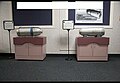 W84 warhead (left) on display at the Nuclear Weapons Instructional Museum
 -
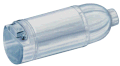 A LLNL drawing of the W84
 -
 The GLCM missile showing the W84 location (LLNL drawing)
 -
 Storage container and PAL coder-decoder for the W84 warhead.


See also
[edit]References
[edit]- ^ a b c d e Sublette, Carey (1 September 2001). "The W-84 Warhead". Nuclear Weapon Archive. Retrieved 10 September 2021.
- ^ a b c d "W84". Global Security. 24 July 2011. Archived from the original on 24 September 2021. Retrieved 10 September 2021.
- ^ Action Needed to Address the W80-4 Warhead Program's Schedule Constraints (PDF) (Report). United States Government Accountability Office. July 2020. p. 31. GAO-20-409. Archived (PDF) from the original on 17 July 2021. Retrieved 6 November 2021.
- ^ Sublette, Carey (12 June 2020). "Complete List of All U.S. Nuclear Weapons". Nuclear Weapon Archive. Retrieved 10 September 2021.
- ^ Foltz, M F; Reyes, P; Foster, P A (24 August 1999). CRT compatibility evaluation of LX-16 and Halthane 73-18 (Report). Lawrence Livermore National Laboratory. Archived from the original on 10 September 2021. Retrieved 6 November 2021.
- ^ "Scrapping the Safe Nuke?". FAS Strategic Security Blog. 6 October 2010. Archived from the original on 9 October 2010. Retrieved 13 October 2010.
- ^ Sandia Weapon Review: Nuclear Weapon Characteristics Handbook (PDF) (Report). Sandia National Labs. September 1990. p. 78. SAND90-1238. Archived (PDF) from the original on 12 January 2022. Retrieved 28 October 2023.
- ^ Robert B Bonner; Stephan E Lott; Howard H Woo (January 2001). Secondary Lifetime Assessment Study (PDF) (Report). Sandia National Labs. p. 10. SAND2001-0063. Archived (PDF) from the original on 6 November 2021.
The terms "Canned Sub-Assembly" (CSA) and "secondary" are not synonymous. All CSAs contain secondaries, but not all secondaries are CSAs since some secondaries are not sealed in a "can" (e.g., W84).
Historical Development
Inception and Strategic Rationale
The W84 thermonuclear warhead program originated in 1978, when the U.S. Department of Energy assigned design responsibilities to Lawrence Livermore National Laboratory to develop a variable-yield warhead for the Ground-Launched Cruise Missile (GLCM), a variant of the BGM-109 Tomahawk. This initiative aligned with U.S. efforts to equip NATO's theater nuclear forces with modernized, survivable delivery systems capable of countering Soviet intermediate-range capabilities. The design drew from proven physics packages, emphasizing compactness for cruise missile integration and enhanced safety features to mitigate accidental detonation risks during mobile ground operations.[2] The strategic rationale for the W84 stemmed from the Soviet Union's deployment of SS-20 (RSD-10 Pioneer) intermediate-range ballistic missiles starting in 1976, which introduced mobile, MIRV-equipped systems with ranges of 4,000–5,500 km, threatening NATO targets in Western Europe while evading detection and preemption. By the late 1970s, over 100 SS-20 launchers had proliferated across the Warsaw Pact, creating an asymmetry in theater nuclear forces that undermined deterrence by enabling selective Soviet strikes without risking their strategic arsenal. U.S. and NATO analysts concluded that existing systems, such as aging Pershing Ia missiles, lacked the accuracy, survivability, and penetration needed to hold Soviet command nodes, airfields, and mobile targets at risk, necessitating a complementary cruise missile option.[7][8] NATO's Dual-Track Decision of December 12, 1979, formalized this response by endorsing the deployment of 464 GLCMs—each carrying four W84-armed missiles—alongside 108 Pershing II ballistic missiles in Europe, while pursuing arms control talks to eliminate such systems. The GLCM-W84 pairing prioritized causal deterrence through dispersion via transporter-erector-launchers, low-observable flight profiles hugging terrain to evade air defenses, and selectable yields (0.05–150 kilotons) for proportional response, thereby restoring balance without immediate escalation to intercontinental strikes. This approach aimed to couple U.S. strategic guarantees to the European theater, compelling Soviet restraint by raising the costs of limited aggression. Deployments began in 1983, with the W84 achieving initial operational capability that year, though the entire program was later eliminated under the 1987 Intermediate-Range Nuclear Forces Treaty.[9][8][2]Design and Testing
The W84 was a two-stage thermonuclear warhead employing a radiation implosion mechanism, designed by Lawrence Livermore National Laboratory (LLNL) to arm the BGM-109G Gryphon ground-launched cruise missile (GLCM).[2] Development of the design was initiated in 1978, focusing on compatibility with the missile's dimensions and requirements for variable yield, estimated to range from 0.2 to 150 kilotons through adjustable boosting and fusion staging.[1] [10] The warhead incorporated advanced safety features, including a fire-resistant plutonium pit within the primary stage, shielded by a metal shell to contain material in the event of fire or impact and minimize accidental dispersal.[11] These enhancements represented early implementation of insensitive high explosives and environmental hardening, making the W84 the first U.S. warhead to integrate all recommended one-point safety criteria against accidental nuclear detonation.[3] Physical integration emphasized ruggedness for mobile ground deployment, with the warhead's cylindrical form—approximately 34 inches long and 13 inches in diameter—weighing 388 pounds to fit within the GLCM's reentry vehicle.[1] The design drew from the W61's exterior configuration but advanced internal components for improved reliability under launch stresses, including vibration-resistant arming sequences and permissive action link (PAL) security to prevent unauthorized use.[1] These elements addressed strategic needs for a low-observable, terrain-following missile system, prioritizing deterrence against armored targets while enhancing survivability against pre-launch threats.[11] Testing progressed through phases of component validation, subsystem integration, and full-system demonstrations without requiring post-deployment nuclear explosions for certification, leveraging prior data from related designs. Non-nuclear evaluations included hydrodynamic simulations and high-explosive trials at LLNL facilities to verify implosion symmetry and yield variability. In January 1983, three integrated flight tests successfully confirmed warhead-missile compatibility, operational sequencing, and performance under simulated combat conditions, bolstering design confidence ahead of stockpile entry later that year.[12] The W84's development engineering phase concluded with these milestones, enabling production without identified reliability issues necessitating further nuclear experimentation at the time.[13]Production and Initial Deployment
Production of the W84 warhead began with the completion of the first units in June 1983 at the Pantex Plant in Texas.[1] Quantity production followed in September 1983, continuing until approximately 1988.[1] [6] The warhead was assembled for the U.S. Air Force's BGM-109G Gryphon ground-launched cruise missile (GLCM), with non-nuclear components costing about $239,500 per unit excluding fissile materials.[2] Sources report varying totals for W84 units manufactured, with estimates of 350 or 530 warheads.[1] [2] The discrepancy may arise from differing counts of active versus reserve stockpile entries, but production aligned with planned GLCM deployments in Europe to counter Soviet SS-20 missiles.[6] Initial deployment of W84-armed GLCMs occurred in December 1983, with missiles stationed at sites such as RAF Greenham Common in the United Kingdom and other NATO bases in Western Europe.[1] This marked the operational fielding of the system amid heightened Cold War tensions, though full-scale deployment was curtailed by the 1987 Intermediate-Range Nuclear Forces Treaty, which mandated elimination of the GLCM platform.[6] Many W84 warheads remained in U.S. storage rather than overseas deployment, rendering them redundant prior to production's end.[6]Technical Design
Physical Specifications
The W84 warhead was engineered as a compact, cylindrical device to integrate with the forward section of the BGM-109G Ground Launched Cruise Missile, sharing design lineage with the W80 but adapted for terrestrial storage and launch environments. Exact dimensions remain partially classified, but declassified assessments indicate a length of approximately 41 inches (104 cm) and a diameter similar to the W80's 11.8 inches (30 cm).[1] The warhead's weight exceeded that of the W80, which ranges from 290 to 315 pounds (132-143 kg), with the W84 estimated at around 388 pounds (176 kg) to accommodate enhanced safety and arming components.[1]| Parameter | Value |
|---|---|
| Length | ~41 in (104 cm) |
| Diameter | ~11.8 in (30 cm) |
| Weight | ~388 lb (176 kg) |