Hubbry Logo
W47W47Main
Open search
W47
Community hub
W47
logo
8 pages, 0 posts
0 subscribers
Be the first to start a discussion here.
W47
W47
from Wikipedia
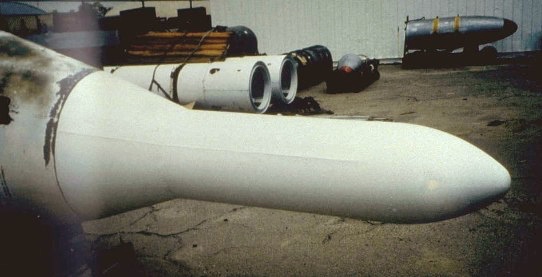
The W47 warhead reentry vehicle

The W47 was an American thermonuclear warhead used on the Polaris A-1 submarine-launched ballistic missile system. Various models were in service from 1960 through the end of 1974. The warhead was developed by the Lawrence Radiation Laboratory between 1957 and 1960.[1]

The W47 was 18 in (460 mm) in diameter and 47 in (1,200 mm) long, and weighed 720 lb (330 kg) in the Y1 model and 733 lb (332 kg) in the Y2 model. The Y1 model had design yield of 600 kilotons and the Y2 model had a doubled design yield of 1.2 megatons. [2] The W47 was the first warhead with a new, miniaturized pit.[3] A cone-shaped extension at the base of the reentry vehicle provided stability of orientation during descent. Two small rocket motors were used to spin the warhead for better stability and symmetry during reentry.

Design

[edit]

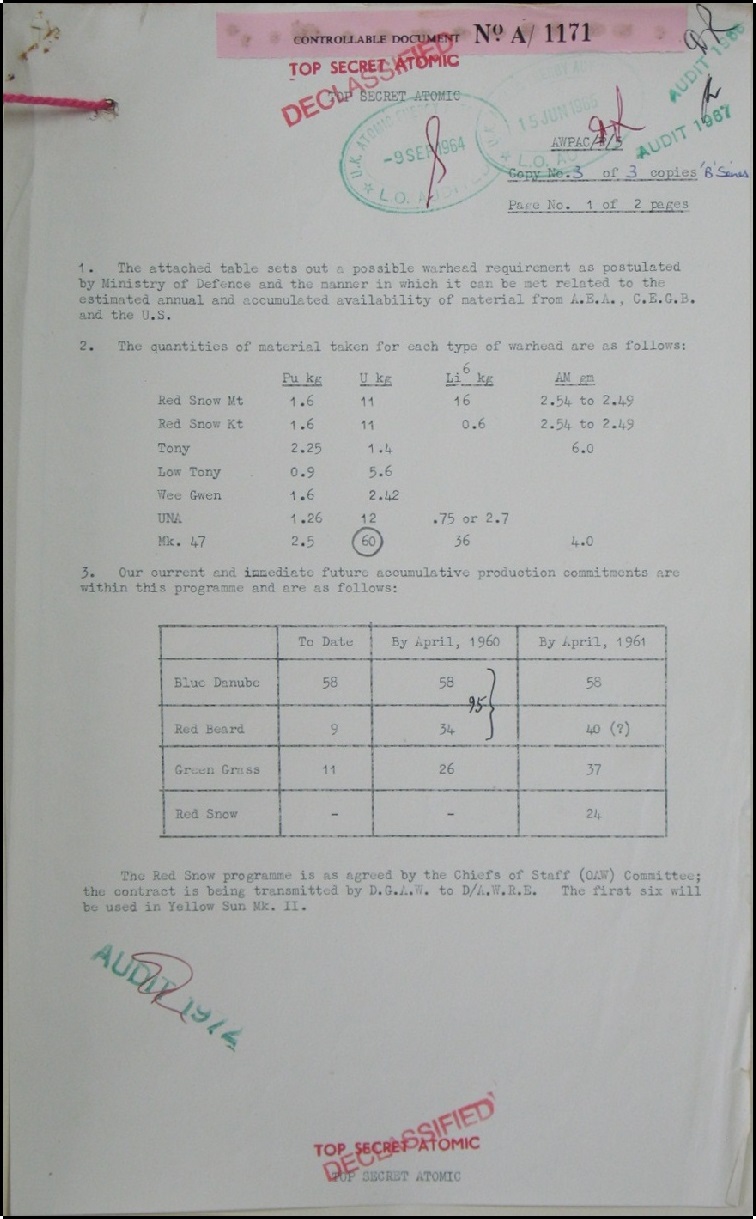
Declassified British documents indicate that the W47 contained 2.5 kilograms (5.5 lb) of plutonium, 60 kilograms (130 lb) of uranium, 36 kilograms (79 lb) of lithium deuteride and 4 grams (0.14 oz) of tritium.[4]

Live fire testing

[edit]
Shot Frigate Bird, as viewed from the submarine USS Carbonero.

The W47 is the only US ICBM or SLBM warhead to have been live fired in an atmospheric missile and warhead test, on May 6, 1962. This event took place during shot Frigate Bird which was part of the Dominic test series. While stationed about 6,000 kilometres (3,700 mi) southwest of Los Angeles, the American submarine USS Ethan Allen fired a Polaris-A2 missile at an open ocean target point 920 kilometres (570 mi) short of the then British Kiritimati (Christmas Island), south of Hawaii.[5] The missile traveled a distance of 1,020 nmi (1,890 km; 1,170 mi). The test was observed by two submerged US submarines stationed approximately 30 miles (48 km) from the target point, USS Carbonero and USS Medregal. The missile warhead detonated at 23:30 GMT on May 6, 1962, approximately 1.2 miles (2 km) from the designated target point, and at the target altitude of 11,000 ft (3,400 m). The detonation was successful and had the full design yield of the W47Y1 at approximately 600 kilotons. The shot was designed to improve confidence in the US ballistic missile systems, though even after the test there was considerable controversy. This was partly because it was revealed that the warhead selected for the test had undergone modifications before testing and was not necessarily representative of the stockpile.[6][page needed]

Reliability controversy

[edit]

The W47 warhead had a series of serious reliability problems with the warhead design. 300 of the EC-47 production prototype model were produced from April 1960 through June 1960, and were all promptly retired in June 1960 due to reliability concerns. Production of Y1 and Y2 models then proceeded in 1960 through 1964. A total of 1060 Y1 and Y2 models were produced, but they were found to have so many reliability problems that no more than 300 were ever in service at any given time. In 1966, 75% of the stockpiled Y2 warheads were thought to be defective and unusable. Repair programs continued for some time.[citation needed]

A number of the Polaris warheads were replaced in the early 1960s, when corrosion of the pits was discovered during routine maintenance.[citation needed]

Failures of the W45, W47, and W52 warheads are still an active part of the debate about the reliability of the US nuclear weapons force moving into the future, without ongoing nuclear testing.[7]

A one-point safety test performed on the W47 warhead just prior the 1958 moratorium (Hardtack/Neptune) failed, yielding a 100-ton explosion. Because the test ban prohibited the testing needed for inherently safe one-point safe designs, a makeshift solution was adopted: a boron-cadmium wire was folded inside the pit during manufacture, and pulled out by a small motor during the warhead arming process. This wire had a tendency to become brittle during storage, and break or get stuck during arming, which prevented complete removal and rendered the warhead a dud. It was estimated that 50-75% of warheads would fail. This required a complete rebuild of the W47 primaries.[8] The oil used for lubricating the wire also promoted corrosion of the pit.[9]

See also

[edit]

References

[edit]
[edit]
Revisions and contributorsEdit on WikipediaRead on Wikipedia
from Grokipedia
The W47 was an American thermonuclear warhead designed for the Polaris A-1 (SLBM), marking a pivotal advancement in compact nuclear weaponry for naval deployment. Developed by the between 1957 and 1960, it achieved a yield of approximately 600 kilotons while weighing only about 600 pounds, allowing integration into the constrained space of missile tubes. This lightweight, high-yield design facilitated the first survivable sea-based nuclear deterrent, with initial deployment aboard the USS George Washington in November 1960. Approximately 1,360 W47 warheads were produced and served on A-1 and A-2 missiles until their phase-out by 1974, when they were succeeded by the on the Polaris A-3 for improved multiple independently targetable reentry . The warhead's innovation stemmed from shared primary designs like the "Robin" and advanced physics that balanced power with miniaturization, enabling submerged launches and enhancing strategic stability during the . Full-scale testing, including the Operation Frigate Bird detonation in 1962—the only full-yield SLBM test—validated its performance, though later assessments revealed reliability concerns with components like internal wiring, contributing to its eventual retirement.

Development and Design

Origins and Strategic Context

The U.S. Navy initiated the Polaris program in response to the growing Soviet nuclear threat during the early Cold War, seeking a sea-based deterrent that could survive a first strike and guarantee retaliation. By the mid-1950s, Soviet acquisition of atomic bombs in 1949 and thermonuclear weapons by 1955, followed by the Sputnik launch in October 1957 demonstrating intercontinental reach, exposed the limitations of U.S. land-based bombers—vulnerable to improving Soviet air defenses and interception—and emerging fixed ICBM silos at risk of preemption. The Special Projects Office, established in December 1955, drove the Fleet Ballistic Missile effort to field submarine-launched ballistic missiles (SLBMs) hidden beneath oceans, providing empirical assurance of second-strike capability to underpin deterrence stability and avert incentives for Soviet aggression. The W47 warhead's origins tied directly to requirements for a lightweight thermonuclear device compatible with the A-1 missile's constraints, formalized when the program launched in December 1956 with an accelerated timeline post-Sputnik. In June 1957, the Navy tasked with its design and development, capitalizing on the lab's innovations in compact high-yield configurations to achieve operational s by October 1960 for initial submarine deployment. This effort addressed the imperative for a under 1,000 pounds delivering substantial yield, enabling SLBMs to target Soviet assets from concealed platforms and thus fortify U.S. strategic posture against vulnerabilities.

Technical Design Features

The W47 warhead employed a two-stage thermonuclear configuration, with a boosted fission primary initiating the reaction sequence and a secondary stage incorporating fusion fuel compressed by from the primary. The primary, designated as the Robin in initial models and later replaced by the in upgraded variants, utilized a miniaturized implosion-type pit to achieve efficient multiplication and energy release within a compact volume. This staging allowed for high , where x-rays from the primary's ablated the secondary's pusher, enabling hydrodynamic compression of deuteride fuel to ignition temperatures. Key to the W47's yield-to-weight optimization was the selection of an enriched tamper surrounding the secondary, the first such application in a U.S. , supplanting traditional depleted uranium-238. Enriched U-235 enhanced fast--induced fission in the tamper, increasing the fission contribution to total yield while permitting a thinner layer for equivalent boosting effect, thereby reducing mass without sacrificing neutron reflection or . This material choice stemmed from calculations balancing tamper density, fission cross-sections, and hydrodynamic behavior to minimize requirements in the overall assembly and maximize energy output per unit weight. Physically, the warhead measured 18 inches in diameter and 46.6 inches in length, with the Y1 variant weighing 717-720 pounds and the Y2 at 733 pounds, specifications tailored for integration into the A-1 and A-2 missiles' constraints. The Y1 achieved a design yield of 600 kilotons , while the Y2 doubled to 1.2 megatons, reflecting refinements in secondary compression efficiency and tamper fission yield. These parameters prioritized compact hydrodynamic efficiency and neutron economy, enabling deployment with constrained volume and mass limits.

Innovations in Thermonuclear Configuration

The W47 warhead represented a breakthrough in thermonuclear design through adaptations of the Teller-Ulam configuration tailored to the Polaris missile's requirement for a physics package under 600 pounds and 18 inches in diameter. This two-stage arrangement featured a compact boosted fission primary that initiated compression of a cylindrical secondary stage, achieving yields of 600 kilotons in the Y1 variant and up to 1.2 megatons in the Y2 variant while maintaining reentry vehicle compatibility. The secondary incorporated deuteride as the primary fusion fuel, enabling efficient thermonuclear burn in a lightweight assembly informed by prior tests demonstrating solid-state fusion viability. A key innovation was the substitution of for traditional in the secondary's tamper and sparkplug components, which enhanced fast-fission efficiency and boosted the overall fission yield fraction without proportionally increasing mass. This material choice, leveraging higher fissile content for neutron-initiated reactions, allowed the secondary to contribute substantially to total energy release while adhering to SLBM weight limits, marking an early application of highly enriched uranium in such roles beyond pure fission devices. Empirical data from pre-1958 test series, including operations, validated these trade-offs by quantifying tamper performance under varying compression conditions. Designers balanced high-yield assurance against inadvertent initiation risks by selecting high explosives with improved stability margins, drawing on one-point safety evaluations from earlier programs that highlighted detonation propagation thresholds. These configurations prioritized causal reliability in implosion symmetry and multiplication, with components employed as low-density reflectors to optimize return and further compact the assembly without compromising performance metrics established in laboratory hydrotests.

Testing and Validation

Nuclear Yield Tests

The principal nuclear yield certification for the W47 warhead occurred during with the Frigate Bird shot on May 6, 1962, when a submerged launched a A1 carrying a W47 Y1 variant, which detonated at an altitude of 11 kilometers over the South Pacific with a measured yield of 600 kilotons. This full-end-to-end test, spanning over 1,900 kilometers from launch to detonation, validated the warhead's thermonuclear performance under operational missile delivery conditions, confirming reliable staging from primary fission initiation to secondary . Supporting yield tests in included the Harlem shot on June 12, 1962, which evaluated a higher-yield W47 Y2 configuration, achieving 1.04 megatons and demonstrating a yield-to-weight of 3.42 kt/kg through enhanced fusion efficiency. Earlier drop and tower shots, such as those in the Swordfish subseries, provided partial validation of the W47's primary and boost mechanisms, with yields scaled to full configurations via hydrodynamic and radiochemical diagnostics. These diagnostics, involving post-detonation debris analysis for production and fission product s, empirically verified the compression-ignition causal sequence, aligning observed outputs with pre-test physics models derived from prior thermonuclear experiments. No full-yield tests followed the 1963 Partial Test Ban Treaty, but data established baseline confidence in the W47's performance, with extrapolated efficiencies indicating 50-70% fusion yield relative to theoretical maxima for the era's lithium-deuteride secondaries. Yield uncertainties were minimized through redundant instrumentation, including airborne and ship-based , ensuring certification for stockpile deployment despite the absence of repeat missile-integrated detonations.

Live-Fire and Missile Integration Tests

The integration of the W47 warhead with the A-1 (SLBM) required rigorous non-nuclear testing to validate separation mechanisms, arming sequences, and structural endurance under hypersonic reentry conditions exceeding Mach 10. Development flight tests began in September 1958 at the Atlantic Missile Range (now ), initially employing scale-model reentry vehicles to assess aerodynamic stability and performance before progressing to full-scale Mk 1 reentry vehicle (RV) prototypes. Early launches encountered failures in staging and RV deployment, prompting iterative engineering adjustments to post-boost separation systems and spin-stabilization motors, which used small thrusters to enhance reentry symmetry. Submarine-based reduced-range tests simulated operational underwater launches, focusing on warhead integrity during ascent, separation at apogee, and simulated reentry stresses via lofted trajectories. The USS George Washington achieved the first successful submerged A-1 launch on July 20, 1960, in the Atlantic Ocean, confirming end-to-end system compatibility including RV release and arming initiation without nuclear components, as indicated nominal structural loads and guidance handover. Subsequent tests from adapted submarines like the USS Observation Island incorporated instrumented RVs to measure deceleration forces and thermal profiles, achieving consistent separation success rates that supported initial deployment certification later that year. Environmental qualification occurred at facilities including , where joint test assemblies—non-nuclear surrogates mimicking W47 internals—underwent vibration, pyroshock, and acceleration simulations replicating launch and reentry environments, alongside saltwater immersion for submarine storage effects. These protocols identified and rectified early sensitivity issues to transient shocks, with redesigns incorporating hardened electronics that passed qualification thresholds by late 1959, enabling Polaris A-1/W47 operational readiness. Telemetry from over 20 developmental flights demonstrated RV survival exceeding design margins under peak heating fluxes, validating the lightweight warhead's (approximately 600 pounds) resilience for fleet integration. The program culminated in full-system confidence prior to 1960 deployment, though a 1962 operational verification from USS further affirmed missile-warhead synergy under realistic flight profiles.

Deployment and Operations

Integration with Polaris SLBM

The W47 thermonuclear warhead was engineered for seamless integration with the U.S. Navy's Polaris A-1 SLBM, achieving initial operational capability in 1960 aboard George Washington-class submarines. This process entailed packaging the warhead within the Mk 1 reentry vehicle, a lightweight ablative structure designed to protect the payload during atmospheric reentry and deliver it over a nominal range of 1,200 nautical miles with a single-warhead configuration yielding approximately 600 kilotons. Adaptations for the Polaris A-2 variant, deployed in 1962, extended the missile's range to 1,500 nautical miles while retaining the Mk 1 and W47's single , prioritizing aerodynamic stability and thermal resistance through cone-shaped base extensions on the reentry . These modifications addressed submarine-launch constraints, including encapsulation in pressurized canisters to mitigate underwater ejection stresses and ensure arming sequences post-surface breach. Production ramped up to approximately 1,060 units between June 1960 and July 1964, with final assembly at the Pantex Plant involving precise mating of high-explosive lenses, physics packages, and safing mechanisms under Department of Energy oversight to verify SLBM compatibility. The warhead's dimensions—roughly 18 inches in diameter and under 5 feet long—permitted 16 missiles per SSBN, with loading executed via overhead cranes at facilities like or via at-sea tenders transferring encapsulated s into vertical tubes for alignment and securing. This logistical framework supported 60- to 90-day deterrence patrols, ensuring overlapping submarine presence for round-the-clock sea-based second-strike capability.

Service History and Stockpile Numbers

The W47 entered operational service in November 1960, when the USS George Washington (SSBN-598) embarked on its first deterrent patrol from Naval Weapons Station Charleston, armed with 16 Polaris A-1 missiles each carrying a W47 warhead. The Navy had accepted delivery of the initial 16 production warheads in July 1960, enabling this milestone deployment that established the U.S. sea-based second-strike capability. Stockpile production reached a total of 350 warheads, primarily for the Polaris A-1 and A-2 SLBMs, with numbers peaking in the mid-1960s to equip the expanding fleet of George Washington-class and Ethan Allen-class SSBNs. These warheads armed up to 10 submarines at peak operational tempo, supporting continuous patrols with each SSBN carrying 16 missiles. During the Cuban Missile Crisis of October 1962, five submarines fitted with W47-armed missiles were at sea on patrol, bolstering U.S. deterrence by ensuring survivable nuclear forces that influenced Soviet decision-making and contributed to de-escalation without direct confrontation. The W47 remained in service without combat use through routine SSBN operations until retirement commenced in July 1967, as the Polaris fleet upgraded to the A-3 variant with warheads and later transitioned to SLBMs employing warheads by the early 1970s. Declassified reports indicate sustained high availability for patrols during this period, reflecting effective integration into naval operations prior to phase-out.

Reliability and Safety Assessments

One-Point Safety Evaluations

The W47 warhead's one-point safety evaluations, conducted amid the 1958 nuclear testing moratorium, demonstrated significant vulnerabilities in its primary stage implosion system. A critical test during , designated Shot Neptune on October 26, 1958, at the , involved single-point initiation of the high explosives, resulting in an unintended nuclear yield of approximately 100 tons . This outcome violated established criteria, which mandate that detonation at any single point in the explosive train yields no exceeding 4 pounds with a probability greater than 1 in 10^6. The elevated yield stemmed from the primary's heightened sensitivity to asymmetric , exacerbated by imperfections in the conventional explosive lenses—typically , a relatively sensitive mix prone to premature compression under partial initiation—and the absence of insensitive high-explosive formulations or robust boosting mechanisms prevalent in later designs. Post-test diagnostics highlighted these causal factors, including uneven shock wave propagation that partially compressed the plutonium pit, leading to low-order fission rather than complete fizzle. In contrast, subsequent W-series warheads incorporated polymer-bonded explosives like PBX-9404 and enhanced safety interlocks, achieving near-zero yields in analogous tests and meeting inherent one-point safety without reliance on external environmental sensing. The W47's shortcomings reflected the era's design trade-offs, where rapid for submarine-launched ballistic missiles prioritized compact yield over perfected safety margins. U.S. military evaluations, as documented in declassified assessments, accepted the W47 for deployment despite these deficiencies, reasoning that operational protocols and arming sequences minimized accidental single-point initiation risks to negligible levels—far below the 10^{-9} threshold for probabilistic failure in storage or transit. Empirical data from U.S. accidents through the , including fires and impacts, recorded no inadvertent nuclear yields, underscoring that theoretical vulnerabilities did not manifest in practice. Redesign efforts in the late addressed the issues through primary reconfiguration, with confirmatory tests verifying compliance with one-point standards prior to extended use.

Corrosion and Maintenance Challenges

The W47 warhead's plutonium pits suffered corrosion during routine maintenance inspections in the early 1960s, prompting the replacement of affected primaries across the inventory. This degradation, linked to exposure in the humid, salt-laden submarine launch environment, compromised the integrity of fissile components and raised concerns over potential inconsistencies in fission yield performance due to material oxidation and mass loss. Approximately 20% of deployed Mk 47 reentry vehicle primaries, housing the W47, required replacement as a result. To address these issues, modifications were implemented in the Robin primary assembly, incorporating barriers to prevent recurrent from environmental factors. protocols entailed periodic disassembly and at specialized facilities, including Naval Weapons Stations, with the full W47 undergoing rebuilds to rectify not only but also vulnerabilities in the mechanical safing mechanisms. These efforts, conducted under Department of Energy oversight, ensured that degraded units were culled and refurbished to meet reliability thresholds, though the pioneering lightweight materials initially selected for compatibility proved susceptible to long-term maritime stressors. U.S. government assessments, including those reported to , affirmed that while posed logistical burdens, proactive interventions preserved stockpile efficacy without undermining the system's strategic deterrent role during its service life from 1960 to the mid-1970s. The incidents underscored the trade-offs in early thermonuclear designs prioritizing compactness over extended durability in corrosive conditions, yet empirical data from inspections demonstrated effective through targeted .

Overall Stockpile Confidence Metrics

Declassified evaluations of the W47 stockpile emphasized its operational reliability for deterrence purposes, sustained by pre-1963 nuclear tests that resolved initial design vulnerabilities, including neutron-induced performance degradation and early one-point safety shortcomings. The pivotal Operation Frigate Bird test on May 6, 1962— the sole full end-to-end atmospheric detonation of a U.S. SLBM —involved a live W47 yield of approximately kilotons from a A-1 launched by USS , validating missile integration and functionality under realistic flight conditions. This empirical demonstration, conducted prior to the Partial Test Ban Treaty, underpinned confidence in the warhead's yield performance despite subsequent limitations on atmospheric testing. Post-deployment audits identified corrosion-related safing circuit degradation as a primary concern, yet nuclear tests of severely corroded units confirmed minimal impact on primary yield efficacy, allowing retention of serviceable weapons while retiring compromised ones. Redundant features, including enhanced arming sequences, mitigated risks from these flaws, with no verified instances of inadvertent nuclear yields across the approximately 700 W47s fielded from 1960 to 1974. Such outcomes affirmed deterrence value, as the warhead's lightweight design (around 400 pounds for 600-kiloton yield) enabled Polaris submarines to maintain credible second-strike posture without operational failures. Debates persist regarding the 1963 testing moratorium's influence on addressing latent stockpile degradation, with analyses noting that while pre-ban tests empirically supported W47 deployment over indefinite delays, restricted full-yield verification potentially amplified uncertainties in aging components. Conservative assessments, drawing from historical fixes for W47-like issues via explosive testing, contend that data-driven certification outweighed moratorium-induced risks, prioritizing rapid fielding for strategic edge amid Soviet buildup. In contrast to Soviet SLBM warheads, which achieved comparable thermonuclear maturity later (e.g., SS-N-6 Mirny entering service in 1969 with inferior yield-to-weight ratios until 1970s refinements), the W47 exemplified U.S. primacy in compact, reliable submarine-launched designs, enhancing overall triad deterrence efficacy.

Retirement and Legacy

Phase-Out Process

The phase-out of the W47 warhead commenced in 1964 alongside the U.S. Navy's transition from Polaris A-1 and A-2 missiles, which employed the W47, to the Polaris A-3 variant equipped with the more reliable warhead. This initial reduction addressed emerging reliability concerns, including chemical corrosion in the W47's fissile components that compromised yield performance and safing mechanisms. By 1971, the introduction of the C-3 missile, compatible with the higher-yield warhead offering (MIRV) capabilities, accelerated the W47's withdrawal to align with strategic needs for enhanced payload and accuracy against evolving Soviet defenses. Full retirement occurred by the late 1970s, as corrosion data and post-1963 Limited Test Ban Treaty restrictions limited remedial testing and certification, prompting stockpile reductions without disrupting sea-based deterrence continuity. Dismantlement operations for retired W47 units were conducted at the Pantex Plant in , the primary U.S. facility for nuclear warhead disassembly, where high explosives were separated, fissile pits removed for interim storage or recycling, and non-fissile components disposed of per environmental protocols. Cost-benefit evaluations prioritized replacement over refurbishment, given the W68's superior yield (40-50 kilotons per reentry vehicle versus the W47's approximately 100 kilotons) and MIRV configuration enabling up to 10 warheads per missile, which better countered hardened targets amid rising Soviet missile silo deployments. This empirical shift ensured no capability gaps, as systems maintained or exceeded Polaris-era operational tempos during the transition period.

Contributions to Deterrence and Technological Advancements

The W47 warhead's integration with the Polaris SLBM validated the feasibility of submarine-launched ballistic missiles as a resilient pillar of the U.S. nuclear triad, providing a concealed second-strike force that fortified deterrence against Soviet first strikes. By November 1960, the first Polaris-equipped SSBN, USS George Washington, commenced patrols, ensuring a portion of the arsenal—initially one submarine with 16 missiles—remained undetectable at sea, thereby enhancing the credibility of mutual assured destruction as outlined in Secretary of Defense Robert McNamara's 1960s strategic guidance. This capability shifted deterrence dynamics, with declassified analyses crediting the sea-based leg for maintaining stability through assured retaliation amid escalating Cold War tensions into the mid-1960s. Technologically, the W47 advanced compact thermonuclear by achieving yields of 100-600 kilotons in a package weighing 600-850 pounds, yielding efficiencies around 1 kt/lb that enabled the missile's constrained reentry vehicle. Its lightweight physics package, incorporating innovative implosion and boosting mechanisms, set precedents for in submarine environments, directly shaping designs for follow-on warheads such as the deployed on SLBMs in the 1970s. The W47's enriched tamper innovations further propagated to enhance yield-to-weight performance in efficient, variable-yield systems like the series for missiles. These contributions underscored U.S. technological superiority in SLBM deterrence, where the W47's benchmarks in compactness and reliability—despite initial hurdles—sustained strategic advantages over adversaries, prioritizing high-efficiency architectures that informed decades of evolution.

References

Add your contribution
Related Hubs
User Avatar
No comments yet.