



Community hub
Recent from talks
Contribute something
Nothing was collected or created yet.
Walk Right Back
View on Wikipedia| "Walk Right Back" | ||||
|---|---|---|---|---|
 | ||||
| Single by The Everly Brothers | ||||
| from the album The Golden Hits of The Everly Brothers | ||||
| A-side | "Ebony Eyes"[1] | |||
| Released | 1961 | |||
| Genre | Rock and roll | |||
| Length | 2:18 | |||
| Label | Warner Bros.[1] | |||
| Songwriter | Sonny Curtis[1] | |||
| Producer | Wesley Rose[1] | |||
| The Everly Brothers singles chronology | ||||
| ||||
"Walk Right Back" is a 1961 song by Sonny Curtis that was recorded by The Everly Brothers, and went to No. 7 on the U.S. Billboard Hot 100 chart.[2] Overseas, the song went to No. 1 on the UK Singles Chart for three weeks.[1] Originally it was the B-side, then it was changed to the A-side.
In an interview he did with Jim Liddane of the International Songwriters Association, Sonny Curtis said about the song:[3]
Well, I wrote most of that one Sunday afternoon, while I was doing my basic training in California, just after I went in the army, although I had the guitar riff for a while, and then, Lady Luck stepped in. I never was much for guns, and still am not really into them, but out of 250 men in our unit in basic training, six of us fired expert, and I was one of the six!
Anyway, for firing expert, they gave me a three-day pass, and I went straight down to Hollywood, and the Crickets were there, and so were Don and Phil, who were doing some acting classes for movies – they had just signed for Warner Brothers. So, J.I. (Jerry Allison of the Crickets) told me to sing the song for Don – actually I had only one verse written – and Don called Phil down, and they worked out a gorgeous harmony part. So, they said, 'If you write another verse. we'll record it'.
Anyway, I went back to base, and wrote a second verse, and put it in the mail to them, and next morning, I got a letter from J.I. to tell me that the Everlys had already recorded the song before they got my letter – they had simply recorded the first verse twice! And that's the version that was released, and that's the version that was the hit!
The joke is that Perry Como and Andy Williams and a whole bunch of others including myself, recorded the song with the second verse included, but when Anne Murray did it in 1978, she just did the same as the Everlys, just the one verse – and that was a big hit all over again – so maybe the second verse was never meant to be!
(It goes:
These eyes of mine that gave you loving glances once before, change to shades of cloudy gray. I want so very much to see you, just like before. I've got to know you're coming back to stay. Please believe me when I say, 'It's great to hear from you,' but there's a lot of things a letter just can't say, oh, me. Walk right back to me this minute ...,
etc.)
Other versions
[edit]- Bobby Vee and The Ventures - for the album Bobby Vee Meets The Ventures (1963) [4]
- The Move - at a BBC session (13 November 1969)
- Harry Nilsson - on a BBC TV special The Music of Nilsson (1971), sung in counterpoint with "Cathy's Clown."
- Andy Williams - for his album Solitaire (1973)
- Perry Como - a single release which reached #33 on the UK charts and #19 on the Irish Singles Charts in 1973.[5][6]
- Val Doonican - for the album Some of My Best Friends Are Songs (1977).[7]
- Mud recorded the song for their Rock On album in 1978.[8]
- In 1978, the song was a #4 US Country hit (#3 US AC and #2 Canada Country) for Anne Murray. (Anne Murray discography). Murray also performed a version of her song on The Muppet Show.
- Daniel O'Donnell and Mary Duff - for their album Timeless (1996)[9]
- Brenda Holloway - for her album It's a Woman's World (1999) [10]
Charts
[edit]- The Everly Brothers
| Chart (1961) | Peak position |
|---|---|
| Australia | 8 |
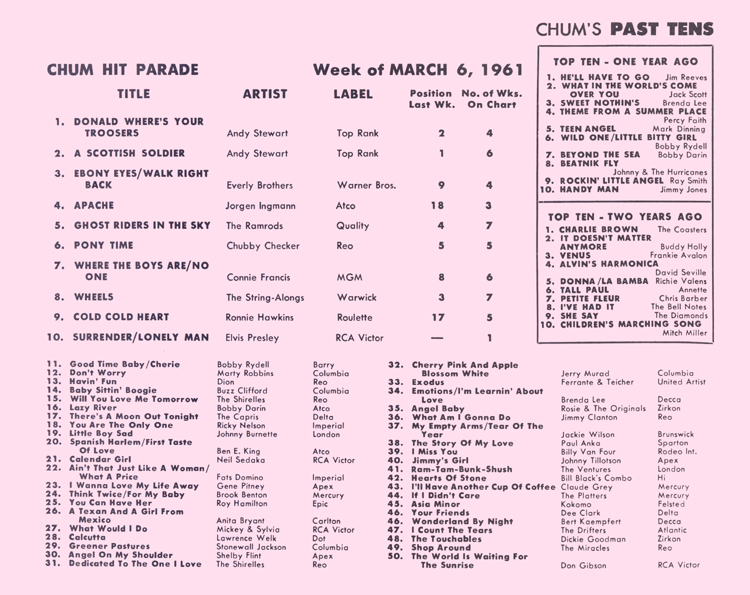
| Canada (CHUM) [11] | 3 |
| New Zealand (Lever Hit Parade)[12] | 1 |
| Norway (VG-lista)[13] | 10 |
| UK Singles (OCC)[14] | 1 |
| US Billboard Hot 100[15] | 7 |
- Anne Murray
| Chart (1978) | Peak position |
|---|---|
| Canada RPM Top Singles [16] | 32 |
| Canada RPM Adult Contemporary [17] | 3 |
| Canada Country [18] | 2 |
| US Billboard Hot 100[15] | 103 |
| US Billboard Adult Contemporary | 3 |
| US Billboard Country | 4 |
References
[edit]- ^ a b c d e Rice, Jo (1982). The Guinness Book of 500 Number One Hits (1s ed.). Enfield, Middlesex: Guinness Superlatives Ltd. p. 56. ISBN 0-85112-250-7.
- ^ Whitburn, Joel (2004). The Billboard Book of Top 40 Hits: Eighth Edition. Record Research. p. 214.
- ^ Liddane, Jim. "Sonny Curtis Interview". International Songwriters Association.
- ^ "Bobby Vee Meets The Ventures". Discogs.com. 1963. Archived from the original on 2019-05-02. Retrieved November 17, 2020.
- ^ Roberts, David (2005). British Hit Singles & Albums (18th ed.). London: Guinness World Records. p. 117. ISBN 1-904994-00-8.
- ^ "The Irish Charts - All there is to know". Irishcharts.ie. Retrieved 2023-06-30.
- ^ "Val Doonican – Some Of My Best Friends Are Songs". Discogs.com. 1977. Retrieved January 19, 2018.
- ^ "Mud – Rock On". Discogs.com. 1978. Retrieved January 19, 2018.
- ^ "Daniel O'Donnell & Mary Duff – Timeless". Discogs.com. 1996. Retrieved January 19, 2018.
- ^ It's a Woman's World - Brenda Holloway | Album | AllMusic, retrieved 2025-06-02
- ^ "CHUM Hit Parade - March 6, 1961".
- ^ "Flavour of New Zealand - search lever". Flavourofnz.co.nz. Retrieved September 20, 2025.
- ^ "The Everly Brothers – Walk Right Back". VG-lista.
- ^ "The Everly Brothers: Artist Chart History". Official Charts Company.
- ^ a b "The Everly Brothers Chart History (Hot 100)". Billboard.
- ^ "RPM Magazine - May 6, 1978 - Page 19" (PDF).
- ^ "RPM Magazine - April 8, 1978 - Page 37" (PDF).
- ^ "RPM Magazine - April 15, 1978 - Page 39" (PDF).


Walk Right Back
View on GrokipediaBackground and songwriting
Origins and inspiration
Sonny Curtis (1937–2025), a longtime friend and early collaborator of Buddy Holly from their teenage years in Lubbock, Texas, began his musical career as the lead guitarist in Holly's pre-Crickets band, contributing to recordings such as "Blue Days, Black Nights" in 1956.[10] Following Holly's death in February 1959, Curtis joined The Crickets as lead guitarist and vocalist, performing with original members Jerry Allison and Joe B. Mauldin, and continued with the group intermittently for decades thereafter.[10] Curtis composed "Walk Right Back" during his U.S. Army basic training at Fort Ord, California, in 1959, shortly after receiving his draft notice while on tour backing the Everly Brothers.[11] The song emerged as a simple, heartfelt plea for reconciliation and companionship, drawing from a musical phrase Curtis had conceived prior to his enlistment, to which he added lyrics during a quiet Sunday afternoon on base using an inexpensive Sears Roebuck guitar.[11] Though Curtis later reflected uncertainty about the precise spark of inspiration—suggesting the words might have come to him in a dream—the military context of separation and longing infused the tune's intimate, yearning tone, aligning well with the harmonious, emotive style of the Everly Brothers' earlier successes like "Cathy's Clown."[11][12] At the time of composition, the song lacked a complete second verse; Curtis had drafted only the opening lines and melody, intending to expand it later.[12] During a three-day pass from training, he shared the incomplete demo with Don and Phil Everly in Los Angeles, who quickly adapted it into their signature close-harmony arrangement, ultimately recording it with the first verse repeated in place of a second.[11][12]Development by Sonny Curtis
During his basic training in the U.S. Army in 1959, Sonny Curtis finalized the initial structure of "Walk Right Back" during a Sunday afternoon session, where he paired a pre-existing musical lick with lyrics using a worn guitar.[12] The melody drew from country and early rock and roll influences shaped by his time with The Crickets, including collaborations with Buddy Holly that blended Western swing, bluegrass, and emerging rock elements.[13] Recognizing the song's brevity with only one verse and a chorus, Curtis opted to repeat the verse for the demo he shared, enhancing its catchiness without expanding the lyrics at that stage.[12] Later, after the original recording, he composed an additional second verse—"These eyes of mine that gave you loving glances now are filled with tears of sadness. Nothing in this world could make me stay away"—but it remained unused in The Everly Brothers' version, preserving the song's concise, looping form.[12] The close bond with the Everly Brothers, built on collaborative performances and Holly's influence on their harmonious styles, made the offering a natural extension of their professional and personal rapport.[14] The song's chorus, centered on the imperative "Walk right back to me this minute, bring your love to me, don't send it," employs a simple, repetitive structure that underscores themes of profound loneliness and urgent reconciliation, with the direct plea amplifying the emotional rawness of separation and longing for reunion.[12] This lyrical economy, paired with the verse's everyday imagery of isolation, captures the universal ache of romantic estrangement in a way that resonated broadly.[15]Recording and production
Studio sessions
The recording of "Walk Right Back" occurred on September 17, 1960, at RCA Victor Studio B, located at 1611 Hawkins Street in Nashville, Tennessee. Key session musicians included renowned guitarist Chet Atkins, alongside standard Nashville players such as drummer Buddy Harman and bassist Floyd "Lightnin'" Chance, contributing to the track's backing.[16] The session unfolded spontaneously when songwriter Sonny Curtis played an unfinished demo of the song for Don and Phil Everly during a visit to Nashville; the brothers immediately expressed interest in recording it, despite Curtis noting that he had only completed one verse and promised to send a second.[12] With time limited during the booked studio slot, the Everlys opted to proceed by repeating the single verse twice, a decision made on the spot that shaped the final recording's structure.[12] Don Everly handled lead vocals, complemented by Phil Everly's high harmony, showcasing the duo's trademark close-harmony style that defined their sound.[16] The arrangement remained straightforward, emphasizing acoustic guitar, upright bass, and minimal drums to highlight the vocal interplay, resulting in a concise runtime of 2:18.[7]Musical arrangement
"Walk Right Back" is classified as rock and roll with strong country influences, characteristic of the Everly Brothers' signature blend of genres.[17] The song employs a mid-tempo 4/4 time signature at 136 beats per minute, providing a steady, driving rhythm that supports its pleading narrative without overwhelming the vocals.[18] The harmonic structure relies on simple major chords, primarily in G major, such as G, C, and D, which create an accessible and uplifting progression.[19] This foundation, combined with the Everly Brothers' tight vocal harmonies, imparts a bittersweet tone that balances the song's light melody with underlying emotional depth.[20] Instrumentation emphasizes intimacy through prominent acoustic guitar strumming that carries the rhythmic pulse, subtle upright bass lines for warmth, and light percussion to maintain a gentle groove.[21] A piano riff introduces the iconic hook, adding a playful touch without introducing heavy rock elements.[22] This arrangement echoes the Everly Brothers' earlier hits like "Wake Up Little Susie" but adopts a lighter, more playful vibe that complements the lyrics' yearning plea.[20]Release and chart performance
Single release details
"Walk Right Back" was issued as a single by the Everly Brothers on Warner Bros. Records in early 1961, bearing the catalog number 5199 in the United States.[23] The track was originally positioned as the B-side to "Ebony Eyes," which served as the intended A-side, but robust radio airplay for "Walk Right Back" prompted Warner Bros. to flip the designation and promote it as the primary track.[24] This double-sided release capitalized on the duo's harmonious style, with both songs benefiting from the era's pop-rock sensibilities. The single marked a key entry in the Everly Brothers' Warner Bros. catalog, following their blockbuster "Cathy's Clown" from the previous year. It was subsequently featured on the 1962 compilation album The Golden Hits of the Everly Brothers, marking its first appearance on a full-length record. Promotional efforts for the single included live television performances that amplified its reach among audiences. Notably, the Everly Brothers showcased "Walk Right Back" on The Ford Show, Starring Tennessee Ernie Ford on April 13, 1961, delivering an energetic rendition that aligned with the program's family-friendly format and helped sustain radio momentum.[25] These appearances underscored the label's strategy to leverage visual media for chart success in the pre-MTV era.Commercial success and charts
"Walk Right Back" achieved significant commercial success upon its release, peaking at No. 7 on the US Billboard Hot 100 chart in 1961 and remaining on the chart for 13 weeks.[4] The single, released as a double A-side with "Ebony Eyes," became a million-seller, contributing substantially to The Everly Brothers' reputation as one of the era's top-selling acts.[26] In the United Kingdom, the single topped the Official Singles Chart for three weeks in March 1961, marking The Everly Brothers' second No. 1 hit there following "Cathy's Clown" in 1960; it spent a total of 16 weeks on the chart.[5] This performance underscored the duo's strong international appeal during their Warner Bros. period. The song also performed well across various international markets, reaching notable positions on regional charts. For instance, it peaked at No. 8 on the Australian Kent Music Report Top 100 in 1961.[27] In the Netherlands, it reached No. 3 on the Dutch Singles Chart, while in Norway, it climbed to No. 10 on the VG-lista chart.[28][29] These achievements highlighted the track's global reach and helped solidify The Everly Brothers' string of hits in the early 1960s.| Country | Chart | Peak Position | Year |
|---|---|---|---|
| United States | Billboard Hot 100 | 7 | 1961 |
| United Kingdom | Official Singles Chart | 1 | 1961 |
| Australia | Kent Music Report Top 100 | 8 | 1961 |
| Netherlands | Dutch Singles Chart | 3 | 1961 |
| Norway | VG-lista | 10 | 1961 |