Hubbry Logo
HM Prison LiverpoolHM Prison LiverpoolMain
Open search
HM Prison Liverpool
Community hub
HM Prison Liverpool
logo
8 pages, 0 posts
0 subscribers
Be the first to start a discussion here.
HM Prison Liverpool
HM Prison Liverpool
from Wikipedia

HM Prison Liverpool (formerly Walton Gaol) is a category B local men's prison in Walton, Liverpool, England. It is operated by His Majesty's Prison Service.

Key Information

History

[edit]

Liverpool Prison (originally known as Walton Gaol) was constructed between 1848 and 1855 to the designs of John Weightman borough surveyor (not to be confused with his near contemporary John Grey Weightman )[2] to replace an 18th-century establishment in the centre of Liverpool, which had become too small for current needs. It originally housed male and female inmates.[3]

On 4 February 1939 the IRA attempted, but failed, to break a wall of the prison during the S-Plan bombing campaign in Britain that year.

During the Liverpool Blitz of World War II, on 18 September 1940, German high explosive bombs falling on a wing of the prison partially demolished it, killing 22 inmates. The body of one was not found until 11 years later when rubble was finally cleared.[4]

The prison was the site of 62 judicial executions, from 1887 to 1964. The last execution at the prison was that of Peter Anthony Allen. He and his accomplice Gwynne Owen Evans were convicted for the murder of John Alan West in April 1964. They were simultaneously hanged on 13 August 1964; Allen was hanged at Walton Gaol, and Evans at Strangeways in Manchester.[3] Capital punishment for murder was abolished fifteen months later.

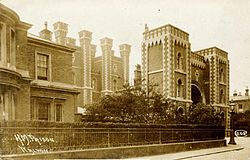
View of the prison gatehouse in 2020

In May 2003 an inspection report from His Majesty's Chief Inspector of Prisons severely criticised Liverpool Prison for its overcrowding and poor industrial relations which had led to an unacceptable regime. The inspection found that parts of the jail were generally unclean, had cockroach infestations and broken windows. Inmates were able to shower and change their clothes just once a week at the prison.[5]

A further inspection report in February 2010, stated that drugs, bullying and violence were still prevalent at Liverpool Prison, despite the prison improving in other areas.[6] Days later, it emerged that the Prison Service had refunded nearly £10,000 to inmates at HMP Liverpool, who were being overcharged for watching television in their cells. The prison was charging £1 per prisoner per week instead of per cell, meaning that inmates who were sharing a cell were paying more than they needed to.[7]

In January 2015, three prison officers were hospitalised after being attacked by prisoners.[8]

The prison today

[edit]

HM Prison Liverpool is a local prison for remand and sentenced adult males in the Merseyside area. The prison has eight wings, all of which have been refurbished to include integral sanitation. As of May 2009, its population was 1,184, one of the largest in the UK, but smaller than a peak population of 1,443 in 2008.

Liverpool Prison offers education and training courses, provided by Novus as well as workshops and programmes organised by the prison's Psychology Department. The establishment houses a hugely successful in cell radio programme 'Walton Radio', offering prisoners radio production qualifications, music technology qualifications, along with emphases on rehabilitation through employability upskilling. A Listener Scheme, supported by the Samaritans, operates for prisoners who are at risk from suicide or self-harm. There is a resettlement unit at HMP Liverpool which comprises a Citizens' Advice Unit, Connexions, Shelter and Job Centre Plus. All healthcare services at Liverpool Prison are commissioned through Liverpool Primary Care Trust. A new all-purpose 28-bed inpatient and primary care service was opened in summer 2007. In October 2017 Lancashire Care NHS Foundation Trust announced that they were to end their contract to provide healthcare services by April 2018, with a new provider to be arranged in the near future.[9]

Entrance of HMP Liverpool in 2012

In October 2017, the prison's governor, Peter Francis, was dismissed from his role for 'operational reasons' after a snap inspection by His Majesty's Inspectorate of Prisons.[10] He had previously been labelled a 'questionable leader' and 'lacking in credibility' in reports by HMI Prisons.[citation needed] The prison was reported in 2017 to be rat and cockroach infested and basic maintenance such as repairing toilets and leaking sinks had in too many cases not been carried out.[11] There are claims that prisoners have died or been seriously injured through poor care.[12] Peter Clarke wrote in a report, "I found a prisoner who had complex mental health needs being held in a cell that had no furniture other than a bed. The windows of both the cell and the toilet recess were broken, the light fitting in his toilet was broken with wires exposed, the lavatory was filthy and appeared to be blocked, his sink was leaking and the cell was dark and damp. Extraordinarily, this man had apparently been held in this condition for some weeks." Clarke also wrote, "We saw clear evidence that local prison managers had sought help from regional and national management to improve conditions they knew to be unacceptable long before our arrival, but had met with little response."[13] Local MP Dan Carden called the situation in the prison a "state failure of the highest magnitude".[14]

Exterior wall of HMP Liverpool in 2015

On 24 January 2018, the Justice Select Committee of the House of Commons held a one off hearing on the conditions in Liverpool Prison with the Governor and senior representatives from HM Prison and Probation Service and NHS England. Following the hearing the Committee produced a report which cited concerns about the lack of follow-up after previous poor inspections.[15] That report was followed by a debate in the House of Commons Chamber[16] led by the Chair of the Committee Sir Robert Neil and the Justice Minister, Rory Stewart. The committee's work resulted in HM Inspectorate of Prisons being given additional funding to follow up on its own inspections.[17]

In 2018, it was reported that prisoners with psychiatric needs are at risk according to a psychiatrist, they have to wait too long to be seen and do not get proper care due to lack of staff.[18] Two workers at the prison expressed concerns when a new policy required them to work alone. They feared prisoners could steal their tool box and use the tools as weapons. They were dismissed for raising this concern. An employment tribunal ruled this dismissal was unfair.[19]

In January 2020, a report following an inspection concluded that conditions at the prison had "improved dramatically" since 2017.[20]

Notable former inmates

[edit]

References

[edit]
[edit]
Revisions and contributorsEdit on WikipediaRead on Wikipedia
from Grokipedia
HM Liverpool, formerly Walton Gaol, is a Category B men's local located in the Walton district of , , . It opened in 1855 as a replacement for earlier facilities on Great Howard Street, designed on the radial principle to facilitate separate confinement and of inmates. Operated by His Majesty's and Probation Service, it primarily holds adult male prisoners serving sentences from the courts, with an operational capacity of around 1,300. The has a long history of housing both convicted and remand prisoners, including notable executions until the abolition of in the , with the last hanging occurring in 1964. It sustained damage during bombing but continued operations, reflecting its enduring role in the British penal system. Official inspections have repeatedly identified significant challenges, including , poor , prevalent illicit drugs, and elevated levels, prompting targeted interventions by the Service. These issues underscore systemic pressures on local prisons like , exacerbated by high remand populations and resource constraints, though improvements in areas such as and healthcare have been noted in follow-up reports.

History

Origins and Construction

HM Prison Liverpool, originally designated Walton Gaol, was constructed between 1848 and 1855 to serve as the city's second major amid surging incarceration needs. The project replaced an earlier 18th-century facility unable to accommodate the scale of detentions required in Liverpool's burgeoning industrial and port economy. Designed by borough surveyor John Weightman, the structure embodied the era's penal reform ideals, prioritizing efficient oversight and individual isolation over communal housing. The architectural layout followed the radial or Panopticon principle, featuring cell wings radiating from a central hub to enable guards to monitor multiple inmates simultaneously from one vantage point. This configuration drew directly from the Pentonville model prison, which emphasized separate confinement as a mechanism for moral rehabilitation through enforced solitude, reflection, and labor. Proponents of the system argued that isolation minimized corrupting influences among prisoners, theoretically reducing recidivism by fostering personal accountability without physical punishment. Liverpool's rapid urbanization during the exacerbated crime rates, particularly dock-related theft and vagrancy, necessitating expanded facilities beyond the existing Preston Gaol's capacity. Walton Gaol's establishment aligned with broader 19th-century shifts toward centralized, purpose-built prisons to handle urban offender s, reflecting causal links between , population influx, and elevated penal demands.

19th-Century Operations and Executions

Liverpool Borough Prison, which formed the core of what became HM Prison (Walton Gaol), opened in 1855 and implemented the separate confinement system by 1856, aiming to enforce isolation for moral reformation through silence, reflection, and without prisoner interaction. , driven by 's status as a major port city with elevated rates of petty , , and , frequently undermined this , compelling authorities to permit association in work areas or multiple occupancy per cell, such as three males or two females sharing spaces by 1863. In 1869, for instance, 358 women were placed in uncontrolled association, directly frustrating the prison's foundational isolation objectives despite its design for separation. The facility processed high volumes of short-term inmates reflecting port-driven offenses, with approximately 10,000 annual admissions by 1857, including 1,526 prostitutes committed in the first nine months of 1864 alone, many exhibiting with 30 to 60 prior convictions. Women comprised a significant portion, often over 40% of prisoners, such as 9,084 out of 21,602 in 1884, frequently for drunkenness or linked to the city's transient population and Irish immigrant communities. Among 2,023 prisoners sentenced to in 1869, 399 were deemed medically unfit, highlighting operational strains from rapid turnover and inadequate screening for underlying conditions like or hereditary predispositions. Reports of emerged as a byproduct of prolonged isolation attempts, with cases investigated by prison surgeons; in 1864, seven prisoners displayed symptoms severe enough for , resulting in three transfers to Asylum at a cost of £115. Such incidents, including disruptive behaviors like those of inmate Charlotte Oakley in 1893, prompted debates on whether separation exacerbated mental decline, though officials often attributed disorders to pre-existing factors rather than policy, leading to disciplinary measures or exemptions from labor rather than systemic overhaul. Executions at Walton Gaol commenced in 1887 following the national shift to private hangings inside prisons under the Capital Punishment Amendment Act of 1868, serving as a deterrent for capital crimes amid the era's retributive penal philosophy. Eight individuals—six men and two women—were hanged there before 1900, including Elizabeth Berry on 14 March 1887 for poisoning her daughter, Patrick Gibbons on 17 August 1892 for ing his mother, Margaret Walber on 2 April 1894 for killing her husband, and William Miller on 4 June 1895 for stabbing Edward Moyse. These proceedings, conducted in a dedicated chamber after the gallows relocated from Kirkdale Gaol in 1892, underscored the prison's role in enforcing ultimate penalties for , with executions spaced irregularly to affirm judicial authority without public spectacle.

20th-Century Developments

Following the end of , HM Prison Liverpool, previously damaged by bombing—including a high-explosive strike on 18 September 1940—underwent reconstruction efforts, with inmates assisting in rebuilding affected wings to restore operational capacity. The facility continued its role as a local prison, increasingly focused on adult males held on remand or short sentences, which corresponded to emerging Category B classification standards for medium-security containment of such populations by the mid-20th century. intensified during this period, driven by elevated committal rates from Liverpool's socioeconomic conditions, including industrial decline and urban poverty, straining the Victorian-era designed for fewer inmates.) Inmates participated in structured labor regimes, such as canvas workshops producing materials for institutional use, alongside dismantling and carpentry tasks, which served disciplinary purposes and provided rudimentary vocational training amid economic pressures limiting external employment opportunities.) On 17 April 1961, disturbances commenced when seven of 161 prisoners in the canvas workshop abruptly halted work, seized chairs to shatter windows, and were subsequently confined to cells without further resistance; later that day, 240 inmates gathered in the exercise yard but dispersed on command, followed by evening outbursts of shouting and banging that subsided by 11:15 p.m.) The next day, 40 young prisoners refused tools in the dismantling shop—resuming except for two—while a deliberate but minor fire was set in their carpenters' workshop.) Authorities attributed the events partly to overcrowding, swiftly restoring order through restraint and police involvement in charging one participant; the governor imposed disciplinary measures on most involved, while seven canvas shop instigators were remanded to the visiting committee for further punishment, underscoring reliance on internal adjudication to maintain control.) These incidents prompted Home Office review of discipline and overcrowding with prison commissioners, highlighting tensions in adapting outdated facilities to rising demands.)

Post-2000 Reforms and Challenges

The prison population in England and Wales surged from approximately 66,000 in early 2001 to over 85,000 by 2010, fueled by policy shifts including longer determinate sentences, increased remand populations, and a broader use of custody for public order offenses under successive Labour governments. HMP Liverpool, as a reception prison serving the North West, faced acute overcrowding as a result, operating well beyond its certified normal accommodation amid these national pressures, which depleted resources for basic maintenance and regime delivery in its Victorian fabric. This systemic strain manifested in early 2000s critiques from HM Inspectorate of Prisons (HMIP) on inadequate physical conditions and operational shortfalls, though specific security lapses were not yet at crisis levels. By the mid-2010s, these pressures intensified under the National Offender Management Service framework established in to integrate prison and functions, yet initial efforts—such as targeted staffing boosts and minor tweaks—proved inadequate against escalating demands. A 2015 HMIP revealed dramatic deterioration, including 11 unnatural deaths over 14 months, elevated rates, and failures in basic security protocols like cell searches and intelligence sharing. across categories, from assaults to fights, rose steadily, linked directly to and under-resourced staff, with prisoners spending excessive time locked in cells amid regime breakdowns. The prelude to the nadir saw unchecked escalation, with HMIP documenting pervasive security vulnerabilities, including unchecked contraband flows and poor perimeter controls, alongside a tripling of incidents since prior inspections. Policy-driven population peaks, without commensurate capacity expansions at legacy sites like , overwhelmed managerial capacity, fostering a cycle of reactive measures rather than structural overhauls, as national targets prioritized throughput over site-specific resilience. These challenges highlighted the limits of centralized HM oversight in adapting antiquated facilities to modern custodial volumes.

Physical Infrastructure

Architectural Design and Layout

HM Prison Liverpool, formerly known as Walton Gaol, was constructed between 1848 and 1855 on a 22-acre site in the Walton district of , employing a radial design based on the principle to enable centralized surveillance and control. The layout features wings extending like spokes from a central hub, allowing guards in a watchtower to observe multiple areas simultaneously, a configuration intended to enhance security through constant potential visibility. This design replaced earlier linear prison models, reflecting mid-19th-century reforms emphasizing separation and discipline. Key structural elements include a lengthy east-west main range, approximately 800 feet long and five storeys high, from which shorter wings project northward and southward, forming enclosed yards for and segregation. I Wing notably incorporates a dedicated execution facility, comprising the condemned cell and gallows chamber, built to standard specifications for judicial hangings conducted from 1887 to 1964. Subsequent modifications during the Victorian period added ancillary buildings, such as administrative blocks and workshops, without altering the fundamental radial configuration that prioritizes oversight and containment. Modern adaptations, including segregation units, integrate into existing wings while preserving the original perimeter walls and for perimeter security.

Facilities and Capacity

HM Prison Liverpool functions as a Category B local primarily holding adult male , with a current operational capacity of approximately 800 to 840 prisoners distributed across eight wings. This reduced figure reflects post-2017 interventions, including a deliberate population cut of 41% by through refurbishments that decertified substandard cells and limited intake to improve . Historically, the prison supported higher volumes, with operational capacity listed at up to 1,370 and certified normal accommodation at 1,186 as of the early , often resulting in populations exceeding 1,200 and straining resources. Ongoing refurbishments, including one wing taken offline in 2023, have maintained this lower threshold amid national pressures, though occupancy frequently reaches or surpasses limits due to regional remand demands. Facilities encompass dedicated education blocks managed by Novus, providing instruction in core subjects like English and alongside vocational options such as plastering, IT, digital skills, and , which saw 1,038 enrollments and a 90% completion rate in 2023. Industrial workshops support practical training in goods production, operations, and repair, with four additional workshops planned for activation in 2024 and a hospitality unit accredited by City & Guilds. Healthcare provisions include a multidisciplinary team handling physical and services, processing 36 applications in 2023—a 32% decline from prior years—though extended stays in care units (up to 377 days for some cases) highlight infrastructural constraints. Cell accommodations blend single-occupancy and shared units within the original Victorian framework, upgraded through phased refurbishments to meet basic standards for , storage, and bedding, yet limited by insufficient accessible designs for disabled prisoners. Recreational spaces feature a weights , exercise apparatus, sports hall, and outdoor pitches to accommodate needs. Future expansions, outlined in 2022, aim to recommission 350 out-of-use places alongside cell upgrades to address persistent capacity shortfalls.

Current Operations

Prisoner Regime and Categories

HM Prison Liverpool functions as a Category B local , primarily holding adult male prisoners on remand or serving determinate sentences. The inmate population, numbering around 840 across eight wings, consists mainly of local offenders from the region, with a significant proportion convicted of - or drug-related offences typical of criminal profiles. The daily regime structures inmates' time around work, education, and limited association to promote routine and skill-building. Prisoners are generally unlocked at approximately 8:00 AM for breakfast, after which they proceed to assigned jobs or classes until lunch around 12:00 PM. Afternoon periods involve further activities or cell confinement, with unlock resuming at about 5:00 PM for evening meals served at 5:30 PM, followed by association from 6:00 PM to 7:00 PM for socialization, gym access, or other permitted uses. Final lockup occurs around 7:30 PM. Work placements emphasize practical skills, including industrial workshops for leatherwork and laundry, alongside vocational training in areas such as plastering, catering, and IT. Education, delivered by the provider Novus, focuses on core subjects like English and , plus job-relevant skills aligned with Merseyside's local economy. Good behaviour is incentivized through the national Incentives Policy Framework, which grants privileges for regime compliance, sentence plan adherence, and positive conduct to foster engagement and responsibility. Release planning integrates careers guidance and employment-focused training to aid reintegration, while family contact supports broader reduction objectives. Sentenced prisoners receive up to two visits per month, bookable in one-hour slots with 48-hour notice, contributing to that family visits decrease reoffending odds by 39% compared to non-visiting .

Security and Staff Management

Security at HM Prison Liverpool incorporates across key areas, routine cell searches, and visitor screening protocols including security dogs for detecting . In 2023, prison staff conducted 300 cell searches, resulting in 115 positive detections of illicit items, such as 132 mobile phones, 4,319 grams of , and 74 grams of synthetic . Enhanced gate measures, including scanners installed in July 2023 and formalized procedures from October 2023, aim to intercept smuggled goods, though drone incursions persisted at 117 sightings that year, down from 191 in 2022. Staffing challenges have undermined these protocols, with high absence rates and vacancies contributing to operational disruptions, including regime closures and delayed responses to incidents. The prison's use-of-force incidents rose to 334 in 2023 from 270 the prior year, with 78% recorded via body-worn cameras, but incomplete documentation in 31% of cases highlighted procedural gaps exacerbated by personnel shortages. Assaults on staff increased to 51 incidents in 2023 from 31 in 2022, reflecting heightened risks amid understaffing. In early 2025, the Prison Officers' Association reported four officers hospitalized following separate assaults at the facility, underscoring ongoing vulnerabilities in staff management and the causal link between low staffing ratios and elevated violence. These pressures have prompted concerns over insufficient resources to sustain preventive controls, though no successful escapes have been recorded in recent years, attributable in part to perimeter monitoring and intelligence-led interventions.

Inspections, Conditions, and Reforms

Historical and Recent Inspection Findings

An unannounced inspection by HM Inspectorate of Prisons (HMIP) from 4 to 15 September 2017 found HMP Liverpool in severely degraded conditions, with widespread filth, infestations of including rats, broken windows allowing weather ingress, and overflowing toilets due to inadequate maintenance; these issues contributed to judgments of 'poor' for and purposeful activity, and 'not sufficiently good' for and rehabilitation and release planning. was prevalent, with high assault rates and prisoners reporting feeling unsafe, exacerbated by at over 1,200 inmates against a capacity of around 1,200 but with outdated infrastructure. Subsequent HMIP inspections in 2019 noted some limited improvements but persistent squalor and safety concerns, though without achieving overall positive ratings. By the unannounced HMIP inspection from 18–19 and 25–29 July 2022, following a deliberate reduction in prisoner numbers to under 800, the prison presented a markedly transformed environment: calm, well-ordered, and with a positive staff-prisoner culture, earning ratings of reasonably good outcomes overall, including improvements in safety and respect compared to prior visits. Purposeful activity had deteriorated slightly, with limited time and access, while illegal use remained a priority concern, evidenced by high mandatory drug testing positive rates exceeding 20% and widespread availability. As of the latest available data through 2024, HMIP annual reports indicate ongoing systemic challenges in adult male prisons like , including elevated prevalence and metrics, though prison-specific progress visits post-2022 affirmed sustained stability in basic order and cleanliness. The Independent Monitoring Board at HMP Liverpool reported in 2023 continued positive advancements in and support for rehabilitation, positioning the facility for further enhancements amid national pressures.

Criticisms of Conditions and Management

In May 2024, a whistleblower at HM Prison Liverpool reported critically low staffing levels, describing them as "frighteningly low" and warning that the situation placed both staff and prisoners at risk, with officers fearing an imminent major incident due to inadequate resources for maintaining order. This echoed broader management concerns, as subsequent reports in early 2025 highlighted escalating staff assaults, chronic shortages, and mental and physical exhaustion among officers, with one experienced prison officer claiming conditions had deteriorated further, rendering the governor's position unsustainable amid daily operational breakdowns. Multiple have identified systemic contributing to deaths in custody at the prison. In the 2017 into 'Ned' O'Donnell, a concluded his was contributed to by , stemming from inadequate care during incarceration, including failures in oversight for a vulnerable . Similarly, the 2016 for Ashley , who died from an attack, found in the lack of a proper care and records upon transfer, exacerbating his chronic condition despite known risks. These findings point to persistent lapses in health and safety protocols, though root causes include decisions prolonging sentences and insufficient prison capacity expansion, which strain local management to prioritize basic containment over individualized . Drug management has faced criticism for ineffective controls, mirroring national trends where illegal substances destabilize operations and hinder rehabilitation efforts. While specific positivity rates for remain underreported in recent public data, whistleblower accounts and inspection histories indicate failures in flow control, such as porous perimeter security and insufficient enforcement, allowing ingress to fuel debts, , and health declines—issues compounded by beyond the prison's 1,100 operational capacity limit. Staff-prisoner associations have shown strains akin to 19th-century patterns of unrest from unmet , with from low staffing ratios fostering frustration and non-compliance, though such dynamics do not absolve agency in exploiting systemic gaps.

Achievements in Improvements and Rehabilitation

Following a reduction to approximately 70% of capacity and extensive refurbishment, HM Prison Liverpool demonstrated marked improvements in operational and order by early 2020, as noted in follow-up inspections responding to prior deficiencies identified in 2018. The inmate was cut by 41%, from around 1,150, enabling better and reduced that had previously exacerbated poor conditions. Inspectors highlighted this turnaround as "dramatic," with enhanced cleanliness, pest control, and basic amenities contributing to a more stable environment. By 2022, these efforts had fostered a positive cultural shift, with HM Inspectorate of Prisons reporting a calm, well-ordered atmosphere and strong staff-prisoner relationships, marking an "impressive transformation" from earlier squalor. Only 13% of prisoners reported feeling unsafe, a significant decline from previous inspections, reflecting effective mitigation through targeted management and refurbishments. Facilities showed "commendable improvement," supporting expanded purposeful activities such as and vocational , which inspectors deemed adequate for rehabilitation potential despite historical shortfalls.

Notable Incidents and Controversies

Riots, Disturbances, and Escapes

In April 1961, a disturbance erupted at Walton Gaol (now ) when seven of the 161 inmates in the canvas workshop abruptly stopped work, seized chairs, and smashed windows, escalating into broader unrest that required intervention to restore order. On 26 September 2017, inmates initiated two days of riots, setting fires in multiple cells and staging protests on anti-suicide netting, which injured two prisoners and caused significant damage before being contained by prison authorities and reinforcements. Escapes from HM Prison Liverpool have been rare, with security breaches typically involving external assistance rather than internal breaches. In February 2017, convicted murderer Shaun Walmsley absconded during a scheduled visit when two armed men confronted guards outside the facility, holding him for 18 months until his recapture in August 2018. In March 2005, an attempted breakout was foiled after a cherry picker was observed positioned against the prison wall, prompting an immediate alarm and securing of the perimeter.

Drug Issues, Assaults, and Deaths in Custody

Drug into HM Prison Liverpool remains a persistent challenge, facilitated by methods including drones, corrupt staff, and external conspiracies. In October 2025, Curtis Carney was jailed for eight years after his arrest on the , where police recovered drone equipment and packages linked to over 50 flights delivering drugs and mobile phones into HMP Liverpool and nearby facilities; the plot involved £300,000 worth of , underscoring vulnerabilities in perimeter and detection. Earlier in 2025, a was imprisoned for tobacco concealed in her and alcohol in , while the prison's independent monitoring board chair faced charges for conspiring to introduce and other list A/B items. These incidents reflect broader enforcement lapses, with mandatory drug tests at comparable facilities yielding 33.5% positives and suspicion-based testing reaching 77%, often correlating with debt-driven rather than isolated use. Assaults on staff highlight operational strains from unchecked and . In February 2025, four officers required hospitalization following separate attacks at HMP , amid union reports of daily unrest including a female staff member's from a blunt object; the Prison Officers Association attributed this to cumulative staffing shortages and prior unaddressed incidents. Inmate-on-inmate , frequently tied to debts and affiliations, includes a October 2025 filmed assault where one prisoner was racially abused and repeatedly punched, prompting an internal investigation; such micro-level aggressions differ from organized disturbances by their opportunistic nature but contribute to a cycle of retaliation enabled by poor and segregation failures. Deaths in custody at HMP Liverpool often involve self-inflicted acts or medical oversights, with data—drawn from family perspectives—emphasizing systemic delays over prisoner-specific risks like prior issues. Daniel Fielding died by self-inflicted means on 19 January 2024 while on remand, with a June 2025 noting procedural gaps in observation despite known vulnerabilities. Historical cases include Ashley Gill's 2015 asthma-related death, ruled contributory due to absent care plans during transfer, and Hayden's 2023 passing, probed for lapses in healthcare response; a 2017 recorded four deaths, three self-inflicted, against a national trend where drugs exacerbate via intoxication or withdrawal, though causal attribution requires distinguishing institutional failures from inmates' agency. Recent s, such as Stephen Bird's in March 2025, cited "numerous failures" in , yet evidence points to under-resourced monitoring rather than deliberate malice, with 's systemic critiques potentially overweighting state accountability relative to empirical patterns of remand suicides.

Notable Prisoners

Historical Figures

Elizabeth Berry, a 31-year-old nurse from , was the first person executed at Walton Gaol on March 14, 1887, for the murder of her 11-year-old daughter Florence by to fraudulently claim a £6 policy. Convicted after a revealing her purchase of under false pretenses and symptoms consistent with poisoning in the child, Berry maintained her innocence but was hanged by James Berry in the prison's purpose-built , marking the shift to private hangings inside the facility. Her case highlighted familial driven by financial motive, common in industrial-era poverty, and the efficacy of in resolving such premeditated crimes through swift judicial process. Margaret Walber, aged 53, followed as the second and last woman executed there in the 19th century, hanged on April 2, 1894, for shooting her 55-year-old husband John in their home in what prosecutors argued was a deliberate locked-room killing motivated by marital discord and possible inheritance. Despite claims of accidental discharge during a struggle, including powder burns and her prior threats led to ; James Billington performed the execution without press witnesses, underscoring the prison's procedural rigor in handling domestic homicides. Alongside these, six men were executed at the gaol between 1887 and 1899 for murders typically involving violence in Liverpool's port districts, such as stabbings or bludgeonings amid or brawls, totaling eight capital sentences carried out privately within the walls. These executions exemplified for egregious offenses, reinforcing the deterrent effect of certain punishment in an era of rising , without the procedural delays or appeals that later characterized 20th-century cases. The gaol's role in promptly ending lives of convicted killers—often after high-profile trials covered in local —affirmed its function as an instrument of societal retribution, distinct from contemporary custodial focuses on rehabilitation.

Modern Inmates

, born Michael Gordon Peterson, was sentenced to seven years in 1974 for armed robbery with an and initially incarcerated at HM Prison (then Walton Gaol). While serving there, he assaulted another inmate using a glass jug, leading to an additional nine months added to his sentence. Bronson's case highlights the management of persistently violent offenders, as his pattern of in-custody attacks—stemming from an original index offense involving aggravated burglary and firearm possession—extended his overall imprisonment to over 50 years without successful escape from . The facility's containment measures proved effective during his early term, containing his aggression internally rather than allowing external breach, though transfers followed due to escalating risks.

References

Add your contribution
Related Hubs
User Avatar
No comments yet.