Hubbry Logo
WardairWardairMain
Open search
Wardair
Community hub
Wardair
logo
7 pages, 0 posts
0 subscribers
Be the first to start a discussion here.
Wardair
Wardair
from Wikipedia

Wardair Canada was a privately run Canadian airline, founded by Max Ward in 1952 under the name Wardair Ltd, before formally changing its name to "Wardair Canada" in 1976. The airline was acquired by and merged into Canadian Airlines in 1989.

Key Information

History

[edit]

In 1946, Maxwell W. Ward founded the Polaris Charter Company in Yellowknife, NWT. In 1952 the airline was formed as Wardair and operations began on 6 June 1953 using a single engine de Havilland Canada Otter. In 1962, it entered the trans-atlantic charter market and changed its name to Wardair Canada Ltd. On January 1, 1976, the name was changed to Wardair Canada (1975) Ltd and yet again on June 10, 1977, to Wardair International Ltd.[1]

Wardair provided domestic service in Quebec, Manitoba, Ontario, British Columbia, and Alberta, as well as international service to Europe, the United States, and several Caribbean and South American countries. On March 31, 1989, the Canadian Transportation Agency approved the sale of Wardair to Canadian Airlines International.

Wardair had its roots in the air charter business in the Yukon and the Northwest Territories. From a modest start as Polaris Charter Company in the mid 1940s operating small bi-planes such as the De Havilland DH.83 Fox Moth.[2] With service as a passenger and cargo charter company, the airline expanded into the more populous regions of Canada. And from 1962 onward, was transformed into a holiday charter airline.[citation needed]

Wardair was not a discount airline but an airline providing good service at lower-than-average prices. They were known for high quality meals and friendly staff. "Steak & Champagne" flights was a popular advertising tag line in the 1980s, and won various awards from magazines for their service (Holiday Which? magazine charter airline of the year 1985, and scheduled carrier of the years 1986 and 1987). Flight attendants served food on Wardair-branded Royal Doulton china on tray-table tablecloths on the passenger tray. The seats featured generous pitch.[citation needed]

This Wardair Boeing 707, seen at London's Gatwick Airport, served the airline from 1969 until 1978.

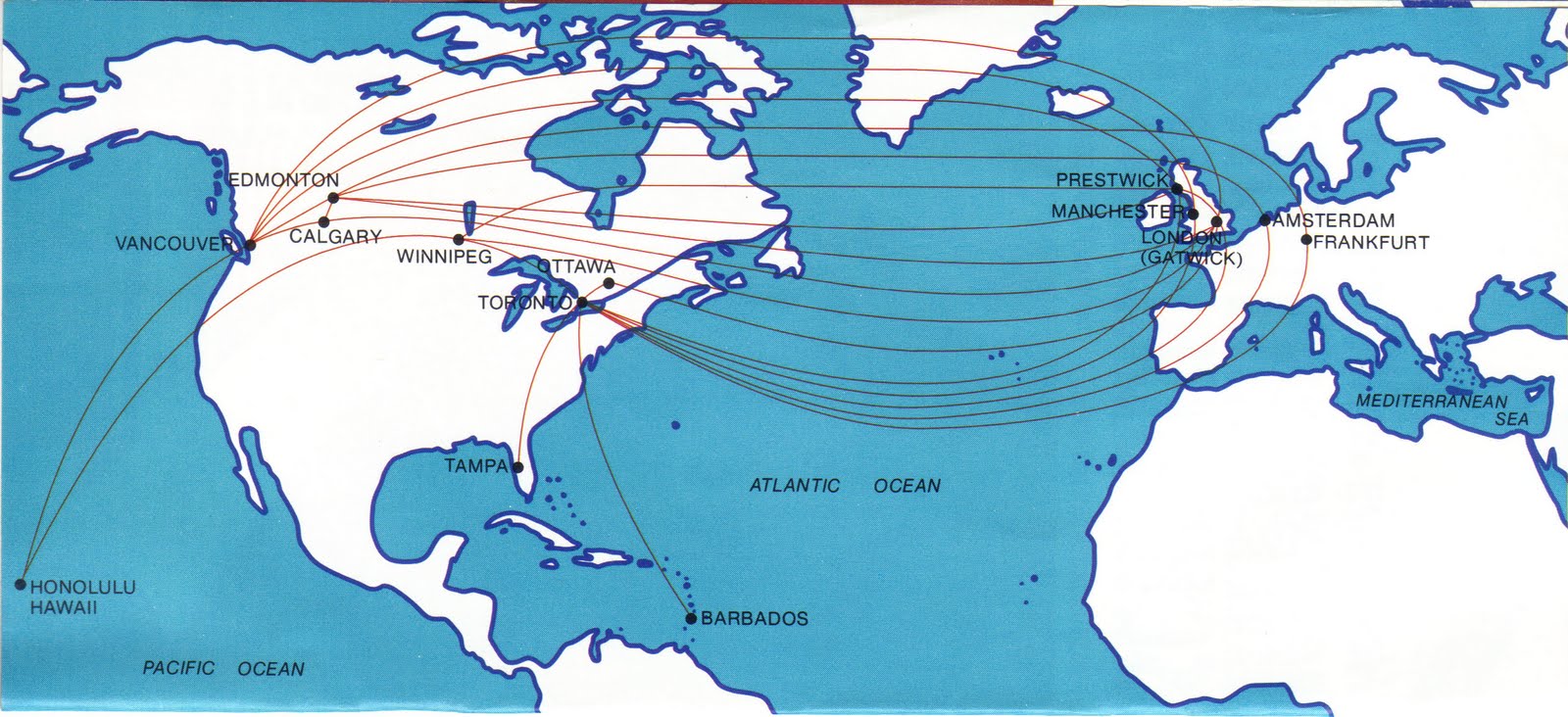
The operations from the early 1950s were small bush-type runs based in Edmonton, Alberta, and Yellowknife, NWT. Wardair's first large aircraft was a four engine Douglas DC-6B propliner, leased in summer 1962, which started the airline's emphasis on charter flights — to Europe in summer and to Mexico, California, etc. in winter. In 1966, the airline began operating its first jet, a Boeing 727-100 — Canada's first Boeing 727 — used to operate flights to and from Europe with a refuelling stop en route.[3] The Boeing trijet was followed by the first intercontinental Boeing 707 (thus allowing non-stop flights to Europe) in 1968, and the first Boeing 747 jumbo jet in 1973. Although initially centred on Edmonton, many long-haul flights were relocated to concentrate on Vancouver and Toronto as primary destinations, while Edmonton would continue to connect other major Canadian cities. Nonetheless, Edmonton continued to operate as a major transatlantic hub for Wardair, with flights to Prestwick, London Gatwick, Amsterdam Schiphol, and Frankfurt. Honolulu, Hawaii, became a significant winter destination, with London Gatwick becoming a major summertime destination with direct flights from Vancouver, Edmonton, Calgary, Winnipeg, Ottawa, and Toronto.[4]

In 1970, the mainline fleet consisted of two 707s and one 727. By 1980, the fleet had grown to include four Boeing 747s and two intercontinental McDonnell Douglas DC-10-30 wide body jetliners. Wardair was a small but steadily growing company. In 1987, building on a fleet of seven jets, Wardair undertook a major expansion, ordering 38 jet aircraft including 14 Airbus A310s, 12 McDonnell Douglas MD-88s, and 12 Fokker 100s which represented an exponential expansion of operations that would ultimately prove to be financially unsustainable. The MD-80 and 100 jetliners were never delivered or operated by the airline.

Only the first 12 Airbus A310s had been delivered — the remaining A310s as well as all of the MD-88 and 100 deliveries were cancelled after the takeover.[5]

The airline added scheduled passenger service to its charter service flights in 1986. Rapid expansion, problems with their computer booking system, and failure to attract business customers, who had developed customer loyalty to frequent flier programs on competing airlines, led the airline into financial difficulties, ultimately resulting in Wardair Canada being sold to Canadian Airlines (which operated as Canadian Airlines International) in 1989.

Destinations

[edit]
Wardair DC-10 landing

Wardair served the following destinations at various times during its existence:

Domestic

[edit]

International

[edit]

Scheduled service destinations in 1989

[edit]

According to its 1989 scheduled service route map, Wardair was serving the following destinations with scheduled passenger flights:[6]

Charter service destinations in 1989

[edit]

According to its 1989 charter service route map, Wardair was serving the following destinations with charter passenger flights:[7]

Historical fleet

[edit]

Fleet in 1970

[edit]
Wardair Canada fleet in 1970[11]
Aircraft Total Orders Notes
Boeing 707-320 (B707-311C & B707-396C) 2 0
Boeing 727-100 1 0
Bristol Freighter 3 0
de Havilland Canada DHC-3 Otter 1 0
de Havilland Canada DHC-6 Twin Otter 2 0
Douglas DC-6B 1 0
Total 10 0

See also

[edit]

References

[edit]
[edit]
Revisions and contributorsEdit on WikipediaRead on Wikipedia
from Grokipedia
Wardair was a Canadian international airline founded in 1953 by aviation pioneer Maxwell W. Ward as a small bush operation in , , which evolved into one of the country's largest carriers by specializing in flights and later scheduled services across domestic, transatlantic, and vacation destinations before its acquisition in 1989. Initially incorporated as Wardair Ltd. in , the airline began operations with a single DHC-3 aircraft for freight and passenger charters in remote northern regions, reflecting Ward's background as a bush pilot. By 1962, it had rebranded as Wardair Ltd. and shifted focus to larger-scale charter services, introducing aircraft for transatlantic routes to , which marked its entry into international . The airline's growth accelerated in the late 1960s and , becoming a in 1967 and expanding its fleet to include advanced wide-body jets such as the Boeing 707 in 1968, in 1973, and in 1978, enabling efficient long-haul operations to popular vacation spots in the UK, , and the . Wardair earned a reputation for superior customer service, winning the (IATA) International Service Award for four consecutive years in the , and innovated with features like onboard entertainment and Clipper Class cabins that set industry standards for passenger comfort. A notable milestone came in 1967 when it achieved the first wheeled aircraft landing at the , highlighting its capabilities in polar and remote operations. In 1976, the company renamed itself Wardair International Ltd. and had established subsidiaries in 1972 like Wardair (UK) Ltd. for European marketing and Intervac for vacation packages, further solidifying its position as Canada's third-largest by the with over 2,600 employees and annual sales exceeding $491 million as of 1986. It transitioned to scheduled flights in 1984 for transatlantic routes and received regulatory approval for domestic and international scheduled services in 1986, operating from hubs in and . However, rapid expansion and technical issues with its reservation system led to financial strains, culminating in its $250 million acquisition by rival International on January 19, 1989, with operations fully integrated and wound up by April 1990.

History

Founding and early bush operations

Wardair was founded in 1953 by Maxwell W. Ward, a former pilot and bush flyer, in , , where he established the company with a single for services in remote northern areas. Ward, who had previously operated a small business called Polaris in the late 1940s, secured a Class 4B air license from the Air Transport Board in May 1953 and took delivery of the brand-new Otter on June 1, which arrived in on June 6. The company was formally incorporated as Wardair Ltd. on July 22, 1953, marking the official start of operations focused on . Early services centered on transporting prospectors, miners, hunters, trappers, and essential supplies to isolated locations, with key routes linking to active camps and exploration sites across the . The versatile , configured for wheels, skis, or floats depending on seasonal conditions, proved essential for accessing frozen lakes, , and rough airstrips in the harsh northern environment, where Wardair filled a critical gap in connectivity for resource industries. These charter flights not only supported booms but also included occasional scheduled mail runs to sustain remote communities, as operators like Wardair often held contracts for such vital links. Throughout the 1950s, Wardair grew by acquiring additional aircraft to meet rising demand, including a in June 1954 for shorter routes and further Otters in 1955 and 1956 to expand capacity. The airline navigated significant challenges, including extreme weather that limited flying windows and regulatory hurdles from the Air Transport Board, which required ongoing license approvals and safety compliance in the unregulated northern skies. A milestone came in April 1957 with the delivery of a , enabling the haulage of heavier equipment and bulk supplies to mining operations, which bolstered Wardair's reputation for reliability in bush logistics. By the early 1960s, these foundations positioned the airline for broader charter expansions beyond pure bush work.

Charter expansion and international entry

In 1962, Wardair pivoted from its northern bush operations to enter the charter market, leasing its first large aircraft, a Douglas DC-6B propliner, to facilitate transatlantic flights to . This move marked the airline's initial foray into holiday charters, targeting organized groups such as unions or clubs for seasonal summer services from major Canadian cities like to destinations including and , often with technical stops in Gander, Newfoundland, for refueling. The DC-6B's capacity for up to 102 passengers enabled Wardair to transport thousands annually, transforming it from a regional operator into a burgeoning leisure carrier focused on affordable group travel. The introduction of jet aircraft accelerated Wardair's international expansion. In 1966, the airline acquired its first jet, a Boeing 727-100 named Cy Becker (CF-FUN), which became Canada's inaugural 727 in service and allowed one-stop transatlantic charters from Toronto to London or Frankfurt without intermediate stops beyond initial fueling requirements. This trijet's efficiency and speed—cruising at over 500 mph—reduced flight times significantly compared to the piston-powered DC-6B, boosting appeal for European affinity charters and carrying groups of up to 149 passengers on routes that previously demanded multi-leg journeys. By enabling faster, more comfortable service, the 727 helped Wardair capture a niche in the competitive transatlantic leisure market, where it began rivaling established carriers like Air Canada through lower fares and group-focused packages. The 1970s saw further growth with the addition of Boeing 707s, starting in 1968, which supported non-stop transatlantic operations and expanded Wardair's charter portfolio to winter sun destinations such as , the , and . These long-range jets, including models like the 707-320C, facilitated all-inclusive vacation packages that emphasized fun, affordability, and onboard entertainment, such as lively crew interactions and themed flights, attracting middle-class Canadians seeking escapes from harsh winters. Passenger volumes surged, driven by this diversification into leisure markets and intensified competition with , which Wardair challenged through innovative pricing and service on popular routes. By 1974, Wardair ranked as Canada's third-largest airline, with its charter model solidifying its reputation for accessible international travel.

Shift to scheduled services

In the early 1980s, Wardair, primarily a operator, began exploring scheduled services amid evolving regulatory pressures and market opportunities in the Canadian sector. The pivotal shift occurred following the Canadian government's announcement on May 10, 1984, of major air policy changes that relaxed operating restrictions for scheduled airlines and opened the market to carriers like Wardair. This enabled Wardair to secure its first scheduled operating authority on June 29, 1984, for routes between and to , marking the airline's initial foray into fixed timetables using its existing fleet for long-haul operations. Building on this, Wardair expanded into transatlantic scheduled flights after receiving permission on May 10, 1985, for Canada-UK routes, with services commencing on December 9, 1985, from to Gatwick. Domestic scheduled operations followed with a license granted on March 20, 1986, and the first flights launching on May 4, 1986, connecting western hubs like and to , including and , again leveraging 747s for efficiency on these transcontinental legs despite their size. allowed Wardair to directly challenge incumbents and CP Air on key routes, such as -, where it introduced competitive fares and its signature leisure-oriented service. By 1987, the airline had integrated transatlantic scheduled flights into its core offerings, with additional permissions for routes to France in 1988, fostering a network that peaked at over 20 destinations across , the , and . However, this rapid pivot to scheduled operations brought significant challenges, as Wardair lacked prior experience in managing rigid timetables and year-round demand fluctuations. Rising fuel costs in the mid-to-late , exacerbated by global oil price volatility, strained the airline's finances, particularly given the fuel inefficiency of its 747s on partially loaded scheduled runs. Labor disputes compounded these issues, including ongoing tensions with s and pilots over wages and working conditions during the expansion phase, echoing earlier strikes like the 1981 walkout that disrupted operations. The financial strains from aggressive fleet investments and to capture without established business traveler loyalty programs ultimately led to mounting debts by 1988, highlighting the risks of transitioning from seasonal charters to competitive scheduled services.

Acquisition and closure

In the mid-1980s, Wardair encountered mounting financial pressures stemming from aggressive fleet modernization efforts, including the acquisition of wide-body aircraft, and the costly transition to scheduled passenger services that strained its traditional model. These initiatives led to cash-flow shortages, operational disruptions from a faulty reservation system, and accumulating losses, culminating in the airline being described as debt-laden by 1988. On January 19, 1989, Canadian Airlines International (CAI), owned by PWA Corporation, launched a bid for Wardair valued at CAD 250 million (USD 207 million), offering CAD 17.25 per share in a mix of cash and stock. The deal was accepted by Wardair's board and founder Max Ward, who retained his role as chairman during the initial phase, ensuring continuity in leadership. The subsequent integration absorbed Wardair's international routes, particularly to and , and its jet fleet into CAI's operations, while Wardair continued as a separate entity temporarily to maintain service stability. This process involved significant restructuring, including substantial layoffs affecting its workforce of approximately 2,600 employees, and the elimination of its low-fare charter policies in favor of CAI's pricing structure. Wardair's branding was phased out by February 1990, with full operational wind-down completed by April. Following the acquisition, regulatory concerns over reduced competition prompted a competing bid from in April 1989, sparking brief legal and oversight disputes, though the CAI deal ultimately prevailed after approval by the Canadian Transportation Agency on March 31, 1989. Wardair conducted its last flight on January 15, 1990, marking the end of its independent operations.

Operations

Business model and services

Wardair operated primarily as a charter airline, specializing in leisure travel packages that bundled flights with accommodations and meals to appeal to middle-class vacationers seeking affordable escapes to sun destinations. This model emphasized all-inclusive holiday offerings under the "Wardair Holidays" brand, which promoted seasonal charters to popular leisure spots in Europe, the Caribbean, and Mexico, differentiating the carrier from the more formal, business-oriented services of competitors like Air Canada. The airline's "fun in the skies" philosophy centered on a relaxed, entertaining onboard experience, featuring live entertainment such as bingo games and complimentary cocktails to create a festive atmosphere on long-haul flights. In-flight amenities included gourmet meals served on , with multi-course options like , salmon Wellington, a dessert trolley, and selections of fine wines poured into real glasses, all provided even in to enhance the vacation feel. Relaxed dress codes were encouraged on these leisure-oriented routes, allowing passengers to comfortably without the stiff formality of traditional carriers. Marketing efforts highlighted affordability and customer-centric perks, especially after Canadian aviation deregulation in the late 1970s, positioning Wardair as a fun alternative to Air Canada's structured approach through promotions like discounted holiday bundles and flexible ticketing. The carrier earned the IATA International Service Award for four consecutive years in recognition of its high-quality charter operations. In the 1980s, Wardair evolved from group-oriented charters to accommodating more individual bookings as it expanded into scheduled services, maintaining strong performance with system load factors averaging around 80% and reaching higher in peak charter seasons.

Domestic destinations

Wardair established its primary domestic hubs in and , , serving as bases for scheduled flights connecting to eastern and central regions. These hubs facilitated transcontinental connectivity, with functioning as the airline's operational center since its early years. Key scheduled routes included non-stop service from to , introduced in 1983 to enhance direct access between western and eastern Canada, alongside connections from to and from both hubs to . These routes built on earlier expansions, providing reliable east-west linkages that supported and travel across the country. Seasonal northern services, such as to , , maintained ties to Wardair's origins while serving remote communities. By 1989, Wardair's scheduled domestic network extended to eight major cities, including , , , , , , , and , reflecting its growth into a major Canadian carrier following regulatory approval for scheduled services in 1986. Domestic operations accounted for an increasing share of the airline's activity, rising from about 5% of passengers in 1981 to over 10% of revenue by 1984 as scheduled flights expanded. In addition to scheduled services, Wardair operated variations for domestic , including ad-hoc flights to areas in and , catering to vacationers seeking seasonal escapes within .

International destinations

Wardair's international network emphasized transatlantic to and services to warm-weather destinations, reflecting its origins in vacation-oriented operations. Beginning in 1966, the airline developed key European gateways with the introduction of , focusing on major cities that facilitated group tours and individual from Canadian hubs. These routes primarily utilized 707s, 747s, and later A310s for efficient long-haul service across the Atlantic. Primary transatlantic destinations from 1966 onward included London Gatwick as a central entry point, where Wardair's Boeing 727-100 enabled non-stop charters from western Canada after refueling stops in Gander or Greenland; a notable 1973 flight from Windsor, Ontario, to Gatwick set a world record for the 3,930-mile distance. Amsterdam Schiphol, Frankfurt, and Birmingham served as additional core gateways, supporting seasonal charters that connected Toronto, Edmonton, and other bases to continental Europe. Paris and Manchester joined the scheduled network by the late 1980s, expanding options for UK and French markets with direct flights from major Canadian cities. By 1989, these scheduled services encompassed approximately 9 major international points in Europe, including Amsterdam, Birmingham, Frankfurt, London-Gatwick, Manchester, Munich, Paris, Shannon, and Zürich, bolstered by charters to over 20 additional seasonal locations. Complementing European routes, Wardair's sun destination charters targeted leisure travelers seeking escapes from Canadian winters, operating from and to , , Nassau in , and various islands. The network also included scheduled services to select U.S. cities such as and in the late . These flights, often packaged with hotels and tours, utilized wide-body jets like the for high-capacity group travel to beach resorts and cultural sites, with services intensifying during winter months. International operations, particularly vacation charters, accounted for a substantial share of Wardair's passenger volume by the late , underscoring the airline's pivot toward global holiday markets.

Fleet

Early piston and turboprop aircraft

Wardair commenced operations in 1953 with a single , a versatile single-engine bush aircraft capable of seating up to 14 passengers and equipped for float or ski operations in the remote Arctic regions of Canada's . This aircraft, acquired by founder Max Ward and based in , supported essential bush services including the transport of prospectors, medical teams, food supplies, and machinery to isolated mining camps and communities, often under challenging weather and terrain conditions. Over the mid-1950s, Wardair expanded its piston-engine fleet to meet growing demand for regional and cargo services, adding Douglas DC-3/C-47 aircraft configured for up to 21 passengers or mixed mail and cargo loads, alongside de Havilland DHC-2 Beaver utility planes and Viking Twins for shorter regional hops. In 1962, Wardair leased Douglas DC-6B aircraft, four-engine pistonliners seating up to 100 passengers, enabling its first transatlantic charter flights to Europe. By 1958, the airline operated at least four DHC-3 Otters, supplemented by two Beavers and a Bristol Freighter for heavier freight, resulting in a total early fleet peaking at 5-7 aircraft with high utilization rates in harsh northern environments. Maintenance proved particularly demanding due to the remote locations, limited infrastructure, and extreme cold, requiring on-site repairs and frequent overhauls to ensure reliability for STOL operations on unprepared strips or water landings.

Jet aircraft evolution

Wardair entered the jet era in 1966 with the delivery of a single , registered CF-FUN and named Cy Becker, which became Canada's first and the first privately operated jet in the country. This facilitated one-stop transatlantic flights, enhancing the airline's capacity for medium-haul international operations and supporting its shift from to global leisure travel. The aircraft remained in service until 1973, leased briefly to other carriers during that period. In 1968, Wardair expanded its capabilities with the introduction of the 707, enabling non-stop transatlantic service and further streamlining long-haul charters. The airline operated two 707-300 series convertible variants, registrations C-FFAN (707-311C) and CF-ZYP (707-396C), designed as convertible for mixed passenger and freighter roles to meet varying demand in and traffic. By 1970, Wardair's jet fleet consisted of these two 707s and the single 727, reflecting a transitional phase as older propeller were phased out. The advent of widebody jets marked a pivotal growth phase for Wardair, beginning in April 1973 with the arrival of its first 747-100, registered C-FDJC and named Phil Garratt, often celebrated as the "Queen of the Skies" for its iconic status and luxurious passenger experience. Over the next decade and a half, the built a fleet of five 747s—three -100 models (C-FDJC in 1973, C-FFUN in 1974, and C-FTOB in 1986) and two -200s (C-GXRA in 1978 and C-GXRD in 1979)—which provided substantial capacity for high-density leisure routes and became synonymous with the carrier's reputation for comfort. These jumbos, featuring Wardair's distinctive red, white, and blue , operated without major conversions but were configured for all-economy seating to maximize holiday passenger loads. To boost operational efficiency in the late 1970s and supplement the 747s while replacing the 707s, Wardair introduced the McDonnell Douglas DC-10-30 in 1978, acquiring three units including new deliveries C-GXRB and C-GXRC, plus a second-hand example C-GFHX from Singapore Airlines. These trijets offered versatile widebody performance for intercontinental charters, contributing to a peak jet fleet of seven aircraft by the mid-1980s focused on long-haul expansion. Wardair's jet operations concluded with its acquisition by International in 1989, leading to fleet integration where the majority of the 747s were repainted in CAI colors and reassigned to the successor's network, while the DC-10s continued in service until the early .

References

Add your contribution
Related Hubs
User Avatar
No comments yet.