


Community hub
0 subscribers8 pages, 0 posts
Recent from talks
All channels
Be the first to start a discussion here.
Be the first to start a discussion here.
Be the first to start a discussion here.
Be the first to start a discussion here.
Contribute something
Welcome to the community hub built to collect knowledge and have discussions related to Wave pool.
Nothing was collected or created yet.
Wave pool
View on Wikipediafrom Wikipedia
Not found
Wave pool
View on Grokipediafrom Grokipedia
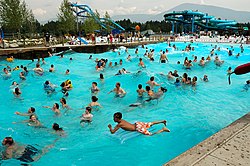
A wave pool is an artificial body of water, typically found in water parks or dedicated surf facilities, where mechanical or hydraulic systems generate waves to mimic ocean surf for recreational swimming, surfing, and other aquatic activities.[1] Unlike natural beaches, these pools use chlorinated water, concrete or artificial sand shores, and precisely timed wave cycles that arrive every few minutes.[1]
The origins of wave pools trace back to the mid-19th century, when King Ludwig II of Bavaria electrified a private lake using an artificial wave machine during his reign (1845–1886), with the Venus Grotto constructed in the 1870s.[2] The first commercial wave pool opened in 1927 at the Gellért Baths in Budapest, Hungary, employing a simple tilting mechanism to create gentle waves for bathers.[2] Significant advancements occurred in the late 20th century, with the 1969 opening of Big Surf in Tempe, Arizona—the first U.S. facility designed specifically for surfing, producing 3-foot waves via hydraulic pumps.[2] By the 1990s, larger installations like Japan's Seagaia Ocean Dome (1993), the world's largest indoor water park at the time, showcased waves up to 10 feet high using pneumatic technology.[2]
Wave generation technologies vary widely, including pneumatic systems that release compressed air into chambers to push water outward, hydraulic pumps that rapidly displace volumes like 90,000 gallons per cycle, and mobile hydrofoils that tow through the pool to form breaking waves.[1][3] Modern designs, such as those using modular paddles or circular fans, allow for customizable wave shapes and sizes, enabling everything from beginner-friendly rollers to professional-level barrels.[4]
As of 2025, over 100 wave pools and surf parks are operational or under development globally, with a record seven new facilities opening in 2025, transforming surfing into a year-round, accessible sport while raising concerns about water usage in drought-prone regions.[4][5][6] Notable examples include Kelly Slater's Surf Ranch in Lemoore, California, which produces 45-second rides on a 700-yard pool using a 100-ton hydrofoil,[2][7] and Siam Park in Tenerife, Spain, generating waves up to 11 feet for thrill-seekers.[2][8] These facilities often hold millions of gallons of water—such as the 2 million gallons in some U.S. pools—and consume significant resources, with daily evaporation losses reaching 250,000 gallons in arid areas.[1][4]
where is the wave speed, is the acceleration due to gravity (approximately 9.8 m/s²), and is the water depth; this non-dispersive speed ensures all wave components travel together. Energy dissipates in these confined spaces primarily through viscosity, bottom friction, and boundary reflections, causing waves to lose intensity rapidly compared to open ocean propagation.[17][16][18]
Overview
Definition and Uses
A wave pool is an artificial body of water, typically a swimming pool, equipped with mechanical or pneumatic systems to generate periodic waves that mimic ocean surf, providing a controlled environment for water-based activities.[1] These facilities create waves through methods such as pressurized air bursts or water displacement, allowing for repeatable and adjustable wave patterns in a sanitized setting distinct from natural oceans.[1][9] Wave pools serve multiple primary purposes, with recreation being the most common, where visitors engage in swimming and body surfing within theme parks and water attractions.[1] They also facilitate specialized surfing training and competitions, offering consistent wave conditions that enable skill development and fair events, as seen in professional leagues like the World Surf League.[10] The purpose of wave pools has evolved historically from early 20th-century leisure attractions focused on general water fun to modern venues optimized for surf sports, reflecting advancements in wave technology that prioritize rideable swells over simple undulations.[11] Initially built for broad recreational appeal in municipal pools and early water parks, they have shifted toward high-performance surfing environments that host global competitions and training programs.[2] Economically, wave pools play a vital role as flagship attractions in water parks, significantly boosting tourism revenue through high visitor draw and associated spending on tickets, concessions, and lodging; for instance, they contribute to over 60% of revenue in family entertainment segments of the global market.[12] This economic impact is amplified in surf parks, where user fees and event hosting generate substantial income, supporting broader regional development.[13]Physics of Artificial Waves
Artificial waves in wave pools represent a controlled form of mechanical waves on water surfaces, where energy is transferred through oscillatory motion without significant net displacement of the water medium itself. Water particles move in roughly circular orbits—rising to the crest, moving forward, descending to the trough, and returning—propagating the wave's energy forward. Key properties include wavelength, the horizontal distance between consecutive crests; amplitude, the maximum vertical displacement from the equilibrium level; frequency, the number of waves passing a point per second; and period, the time for one complete wave cycle, which is the inverse of frequency.[14][15] Unlike ocean waves, which arise from complex interactions of wind, gravity, and tidal forces leading to irregular patterns and varying directions, artificial waves are highly periodic and unidirectional, generated by mechanical means to produce consistent, repeatable oscillations. This lack of natural variability ensures predictable wave behavior but eliminates the chaotic energy inputs from atmospheric conditions, resulting in waves that maintain uniform amplitude over shorter distances before dissipating. In recreational settings, this controlled periodicity allows for safe, repeatable surfing experiences.[16] In enclosed pool environments, waves propagate across the water surface and interact with boundaries, leading to reflections that superimpose with incoming waves to form interference patterns—constructive where crests align to amplify height, or destructive where they cancel to flatten the surface. Pool depth and shape significantly influence propagation: shallower depths slow waves and steepen them, while tapering designs spread energy over a widening area, reducing amplitude toward the edges. The speed of shallow water waves, applicable to most pool conditions where wavelength exceeds depth, is given bywhere is the wave speed, is the acceleration due to gravity (approximately 9.8 m/s²), and is the water depth; this non-dispersive speed ensures all wave components travel together. Energy dissipates in these confined spaces primarily through viscosity, bottom friction, and boundary reflections, causing waves to lose intensity rapidly compared to open ocean propagation.[17][16][18]
Historical Development
Early Concepts and Inventions
The earliest conceptual forerunners of wave pools emerged in the late 19th century, with King Ludwig II of Bavaria constructing the Venus Grotto at Linderhof Palace in the 1870s. This artificial cave featured an electrified wave-making device powered by one of Europe's first hydroelectric plants, generating gentle ripples in a subterranean lake for the king's private amusement aboard a golden swan boat.[11] Although not a public facility, this installation represented an innovative use of emerging electrical technology to simulate water motion, predating practical recreational applications by decades.[19] The first practical wave pool inventions appeared in early 20th-century Europe, driven by engineers seeking to enhance bathing experiences in public facilities. In 1905, the Undosa system debuted at a lakeside resort in Starnberg, near Munich, Germany, where steam-powered pontoons were raised and lowered to press against the water in a 60-by-15-meter basin, creating waves up to 1 meter high alongside an artificial beach and diving platform.[20] This mechanism, developed by Berlin heating engineer Hermann Recknagel and constructed by the Dresden firm Wayss & Freytag, marked the initial patentable technology for artificial waves in a controlled environment.[21] By 1912, the Bilzbad in Radebeul, Germany, adopted the Undosa design under naturopath Friedrich Eduard Bilz, generating hourly waves in an in-ground pool that remains operational today after renovations.[20] These pendulum-like systems relied on mechanical leverage rather than electricity, reflecting the era's technological constraints. Further advancements followed in the 1920s, with the 1927 wave pool at Gellért Baths in Budapest, Hungary, introducing compressed air to agitate water through underwater chambers, producing rhythmic swells in an outdoor setting.[22] Designed by architect Artúr Sebestyén as part of the Art Nouveau complex, it expanded public access to wave simulation for therapeutic and recreational purposes.[23] In 1929, an indoor wave pool opened in Munich, Germany, utilizing a series of paddles behind a net to propel water across the basin, as captured in contemporary newsreels showing bathers riding modest waves.[24] European engineers like Recknagel pioneered these patents, focusing on simple hydraulic principles to mimic ocean motion without advanced power sources.[21] Early wave pools faced significant challenges due to pre-widespread electrification and material limitations, resulting in inconsistent wave patterns and high maintenance demands. Steam-driven mechanisms like Undosa often suffered mechanical breakdowns, leading to the Starnberg pool's closure in 1921 from repair costs exceeding operational benefits.[20] Scale was restricted to small basins, as larger installations risked structural erosion or uneven energy distribution, confining innovations to experimental or localized use in Europe before broader adoption.[11]20th Century Expansion
Following World War II, the popularity of wave pools surged in the United States as part of a broader post-war leisure boom, with the opening of Big Surf in Tempe, Arizona, in 1969 marking a pivotal moment. Financed by Clairol to promote a "surfer look" amid the surf culture craze, this 2.5-acre facility featured the nation's first modern wave pool, designed by engineer Phil Dexter using a hydraulic "pump and dump" system that filled elevated tanks with 3.8 million gallons of water and released it through 15 gates to create traveling waves up to five feet high.[25] The innovation allowed for surfing-like experiences in the desert, drawing crowds and setting the stage for commercialization.[11] In the 1970s, wave pool technology advanced with the adoption of pneumatic systems, exemplified by WaveTek Engineering's installation at Point Mallard Park in Decatur, Alabama, in 1970, which used compressed air to generate consistent waves across a large basin and remains operational today.[26] This period also saw integration into major theme parks, boosting accessibility; for instance, parks under the Six Flags banner began incorporating wave pools in the early 1980s, such as the one at Six Flags Atlantis in Hollywood, Florida, which opened in 1983 as part of a 65-acre water kingdom featuring a massive lagoon for family play. However, early safety challenges emerged, notably at Action Park in Vernon, New Jersey, which debuted its Tidal Wave Pool in 1978 and reported multiple drownings and injuries in the 1980s due to powerful, unpredictable waves requiring lifeguards to perform dozens of rescues daily.[27] Expansion extended internationally in the late 20th century, with Asia leading growth; in 1988, the Marui Wavepool Pro, an Association of Surfing Professionals (ASP) World Tour event, was held at the Nagaoka New City Leisure Pool in Japan, attracting international competitors and highlighting one of the earliest professional surfing contests on artificial waves.[28] Europe followed suit, with installations in recreational centers across the UK and Germany by the mid-1980s, adapting pneumatic and hydraulic methods for public pools.[2] Culturally, wave pools evolved into staple family entertainment venues, contributing to theme parks' record attendances; by the late 1980s, facilities like those at Kings Island and Great America drew over 1.7 million visitors annually, with wave pools serving as central attractions that blended thrill and relaxation for millions across the decade.[29]Contemporary Advancements
The 2000s marked a pivotal shift in wave pool technology, driven by innovations aimed at replicating high-quality ocean waves for surfing. In 2015, professional surfer Kelly Slater's Surf Ranch opened in Lemoore, California, utilizing a 700-meter-long basin equipped with a 300-ton hydrofoil system that generates a propagating wave lasting up to 45 seconds. This hydrofoil, submerged and towed beneath the water surface, displaces volume to create a peel that mimics natural reef breaks, revolutionizing artificial surfing by producing one of the longest and most consistent rides available at the time. Concurrently, Wavegarden introduced its lagoon designs in 2011, featuring a submerged pneumatic chamber and foil mechanism in a 160-meter-wide basin to generate peeling waves for multiple surfers, emphasizing scalability for commercial surf parks. These developments catalyzed the surfing revolution, transitioning wave pools from recreational novelties to elite training and competition venues. The 2020s have witnessed accelerated global expansion, with seven new surf parks opening between 2023 and 2025, bringing the worldwide total to 33 operational facilities as of late 2025. Notable examples include the Wave Park in Siheung, South Korea, which reopened and expanded operations in 2024 as Asia's largest surf center, accommodating up to 1,000 waves per hour in a 160-by-160-meter lagoon powered by Wavegarden Cove technology. In the United States, HTX Surf in Houston, Texas, is planned to open in 2027 (with groundbreaking in 2026), featuring a 5.5-acre lagoon with 52 modules capable of producing waves up to 7 feet high, integrated into a broader beachfront development.[30] This growth reflects surging investor interest, with 2024 alone seeing nine to twelve new openings across continents, nearly doubling the prior inventory and highlighting wave pools' role in urban entertainment and tourism. Technological innovations have focused on efficiency and integration with professional circuits. Energy-efficient systems, such as those in Wavegarden Cove installations, incorporate solar panels covering 2,500 square meters to reduce annual power consumption by 50%, amortizing costs within four years while minimizing environmental impact. Since 2018, the World Surf League (WSL) has incorporated wave pools into its Championship Tour, starting with the Surf Ranch Pro, which standardized judging in controlled environments and elevated artificial waves to Olympic-caliber status. These advancements enable lower operational costs and broader accessibility, with facilities like Surf Ranch hosting WSL events that draw global audiences. Global trends underscore a move toward sustainable designs, prioritizing water recycling, algae-resistant liners, and renewable energy integration to address ecological concerns amid rapid proliferation. Projections for 2025 indicate over 20 new projects in development or under construction worldwide, fueled by advancements in wave realism and efficiency, positioning wave pools as a cornerstone of the $10 billion surf industry by decade's end.Design and Technology
Wave Generation Methods
Wave generation in artificial wave pools relies on several core technologies designed to displace water in controlled patterns, mimicking ocean swells while allowing for customization based on user needs. These methods primarily fall into pneumatic, mechanical, and hydraulic categories, each offering distinct advantages in wave consistency, energy efficiency, and scalability.[31] Pneumatic methods utilize compressed air released into sealed chambers or caissons to create bursts of pressure that propel water outward, generating waves along the pool's perimeter. In systems like PerfectSwell by American Wave Machines, air pressure is directed through a series of underwater caissons embedded in the pool walls, producing sequential waves up to 3 meters high with intervals as short as 6 seconds. This approach enables high-volume output, such as 10 large waves per minute, and is noted for its reliability due to minimal moving parts in contact with water. Similarly, Endless Surf employs pneumatic technology where air is pushed sequentially through caissons to form varied wave shapes, supporting up to 500 waves per hour.[31][32][33] Mechanical methods involve physical displacement of water via moving components, such as rotating paddles, panels, or towed hydrofoils, to generate propagating waves. For instance, Wavegarden Cove uses interchangeable electromechanical modules with paddle-like mechanisms that inject energy into the water continuously, creating waves up to 2 meters in height across a lagoon-shaped pool. These systems produce rides lasting 15-30 seconds and support high throughput, with up to 1,000 waves per hour. Hydrofoil systems, exemplified by Kelly Slater Wave Co.'s Surf Ranch, tow a large submerged foil along a 700-meter track at varying speeds, displacing water to form peeling waves that enable extended rides of approximately 45 seconds in a 150-meter-wide pool, simulating point breaks with consistent energy profiles. Rotating paddle systems, an earlier mechanical variant, push water directly to form swells, though they are less common in modern installations due to higher maintenance needs.[34][31][35] Hydraulic methods, often categorized under mechanical for their water-based actuation, release stored volumes from elevated tanks to simulate tsunami-like surges or directional waves. In Disney's Typhoon Lagoon, the Barr + Wray SurfKing system fills multiple chambers with water via pumps, then opens valves to dump the contents sequentially, generating waves up to 1.8 meters high every 90 seconds across a 2.75-million-gallon pool. This technique is effective for broad, bodysurfing-friendly swells but offers less precision for surfing-specific shapes compared to pneumatic or foil systems.[31][36] Performance metrics for these systems emphasize efficiency and adaptability. Large-scale pools typically consume 250-450 kilowatts during peak operation, with pneumatic methods like Wavegarden Cove using about 0.3-1 kWh per wave—roughly 10 times less energy than traditional pneumatic alternatives for equivalent output. Wave customization is achieved through integrated software, such as Endless Surf's Swell Studio, which allows operators to program wave patterns in real-time, including A-frame peaks for advanced surfing by adjusting timing, amplitude, and sectional intensity based on skill levels and session demands.[37][38]Construction and Operational Features
Wave pools are engineered with specific design elements to optimize wave propagation and user safety. Pool shapes are tailored to the intended use: rectangular or linear configurations are common for surfing-oriented facilities to facilitate directional wave travel, while lagoon-style or circular designs suit recreational wave pools for omnidirectional wave distribution. These structures typically employ reinforced concrete as the primary material, featuring thick slabs (up to 24 inches) and walls (14 inches) reinforced with multiple layers of rebar (such as #5, #7, and #8 bars) to withstand the dynamic forces of waves up to 8 feet high generated every 45 seconds. Waterproofing is achieved through liners like plastic sheeting, textile membranes, or polymer-modified cement, ensuring long-term durability against constant water exposure and pressure.[39][9] Scale is a critical factor in wave pool engineering, with typical surface areas ranging from 5,000 to 15,000 square meters for mid-sized installations to balance capacity and feasibility. Water volume management relies on advanced filtration and circulation systems that maintain hygienic conditions while minimizing resource use; these systems recycle nearly all the water through processes like UV sanitation, microfiltration (removing particles larger than 1-5 microns), and low-chemical dosing with chlorine and CO2, achieving up to 95% reduction in chemical consumption compared to traditional pools and daily water loss under 1 cubic meter. Turbidity is kept below 5 NTU even during active wave generation, with full sanitation cycles completing in under one hour for the entire volume.[40][41] Operational logistics involve structured daily cycles, where waves are typically activated for 1-2 hour sessions to accommodate user groups, producing 400-700 waves per hour depending on the system. Maintenance routines focus on debris removal via automated vacuuming (capable of covering 10,000 square meters in three hours), chemical balancing through automated sensors, and periodic calibration of wave machinery to ensure consistent performance. Software-based diagnostics and remote monitoring minimize downtime, with many designs featuring low-mechanical components located outside the water to reduce wear.[9][40][42] Construction costs for mid-sized wave pools generally range from $10 million to $50 million, encompassing site preparation, concrete pouring, rebar installation, and integration of waterproofing and filtration infrastructure; for instance, a standard lagoon design may cost around $20 million, scaling to $30 million for larger variants. Operational expenses are dominated by energy consumption, which accounts for 20-30% of the annual budget due to wave generation and water circulation, though efficient pneumatic or hydraulic systems can limit usage to 0.6-1.2 kWh per wave. Routine maintenance and chemical costs add to ongoing expenses, but designs emphasizing energy recovery and minimal water loss help control totals.[43][44][45]Types and Global Installations
Categorization by Purpose and Technology
Wave pools can be categorized by their primary purpose, which influences their design and wave characteristics. Recreational wave pools are typically integrated into water parks or family entertainment venues, generating mild, gentle waves suitable for general swimming, bodyboarding, and casual play to enhance leisure experiences.[46] Surfing-specific wave pools, often found in dedicated surf parks, produce high, consistent, and tunable waves that mimic ocean conditions, catering to beginners through professional surfers for skill development and competitions.[46] Hybrid wave pools combine elements of recreational and surfing functionalities, offering adjustable wave settings for diverse users, while some incorporate therapeutic applications such as surf therapy programs to support mental health, physical rehabilitation, and accessibility for adaptive surfers.[46][47][48] Technological classifications further delineate wave pools based on wave generation mechanisms, affecting wave quality, capacity, and environmental footprint. Lagoon-style systems utilize open-water designs with submerged foils or hydrofoils moved along tracks to create breaking waves along a pier, ideal for longer rides in expansive settings.[49] Pneumatic reef technologies employ air compression chambers or pistons embedded in reefs or walls to displace water rapidly, enabling versatile wave shapes from gentle swells to steep barrels.[49] Ramp and paddle methods, often in closed or semi-enclosed pools, use mechanical paddles or ramps powered by compressed air to propel waves across the pool, providing frequent, uniform sets for high-throughput operations.[49] Advanced systems incorporate AI-controlled software to dynamically adjust wave parameters in real-time, optimizing for skill levels, frequency, and energy efficiency across various pool configurations.[49] Environmental variants address operational and experiential differences in water composition and enclosure. Freshwater wave pools predominate due to reduced corrosion on equipment, lower maintenance costs, and simpler filtration systems, though they offer less buoyancy compared to saltwater, requiring surfers to adjust board volume for stability.[50][51] Saltwater variants, less common, enhance authenticity by replicating ocean buoyancy and sensory experience but demand corrosion-resistant materials to mitigate accelerated wear from salt ions.[50] Indoor wave pools, often linked to controlled environments like water parks, provide year-round access regardless of weather but may limit scale due to space constraints.[51] Outdoor installations, prevalent in surfing-focused designs, leverage natural settings for larger lagoons but are subject to climatic variations.[51] As of 2025, industry trends emphasize multi-use facilities that integrate surfing with events, wellness, and hospitality to maximize revenue and community engagement, transforming wave pools into comprehensive lifestyle destinations.[52][6] This shift coincides with a surge in surfing-oriented developments, including seven new surf pools opening in 2025—the highest annual total to date—amid over 30 operational facilities worldwide, reflecting the growing prioritization of accessible, skill-specific surfing experiences.[6][52]Prominent Examples
One of the most renowned wave pools is the Wave Palace at Siam Park in Tenerife, Spain, which opened in 2008 and spans over 13,500 square meters, generating waves up to 3 meters high using Murphys Waves technology.[53] This facility, integrated into a Thai-themed water park, accommodates up to 900 people and offers varying wave intensities for different skill levels, making it a benchmark for family-oriented artificial surfing experiences.[54] In California, Kelly Slater's Surf Ranch in Lemoore, which debuted in 2015, revolutionized wave pool design with its 700-meter-long lagoon producing consistent, barreling waves lasting up to 45 seconds.[35] Developed by the 11-time world champion, the site uses a hydrofoil mechanism to propel water along the pool's length, creating high-performance waves that mimic ocean barrels and attract elite surfers.[55] The Wave in Bristol, United Kingdom, operational since 2019, exemplifies urban integration of wave pool technology as Europe's first commercial Wavegarden Cove installation, featuring a 150-meter lagoon suitable for all skill levels in a landlocked setting.[56] Located near the M5 motorway, it provides year-round access to clean, consistent waves, fostering community surfing programs and events despite facing operational challenges leading to its sale in 2025.[57] Among recent developments, Wave Park in Siheung, South Korea, established as Asia's largest surf park with a 220-meter by 240-meter lagoon, reopened for its 2024 season and has since hosted over 600,000 visitors, generating up to 1,000 waves per hour via Wavegarden Cove technology.[58] Just 30 minutes from Incheon Airport, it serves as a luxury marine complex centerpiece, boosting regional tourism with sessions for beginners to advanced surfers.[59] In the United States, the proposed Neptune Beach Surf Club in Alameda, California, announced in 2025, plans a 2-acre Endless Surf-powered lagoon targeting a 2029 opening on former naval land, emphasizing skill progression and community programming for up to 50 surfers at a time.[60] Similarly, a $175 million surf park in El Segundo, California, revealed in 2025, will feature a 2.2-acre lagoon holding 5 million gallons of water, aiming to create high-quality waves adjacent to the Pacific Ocean to draw local and international visitors.[61] Regionally, Alaïa Bay in Sion, Switzerland, launched in 2021 as continental Europe's inaugural Wavegarden Cove, spans 8,300 square meters amid the Alps and offers accessible barreling waves up to 1.8 meters for intermediate to advanced users, reopening seasonally in 2025 to promote year-round surfing in a mountainous locale.[62] In South America, Surfland Brasil in Garopaba, operational since 2023, stands as Latin America's largest surf park with a Wavegarden lagoon producing waves up to 1.9 meters, integrated into a resort featuring 278 apartments and a 78-room hotel to enhance family leisure and economic growth in Santa Catarina.[63] These installations, like URBNSURF Melbourne, which marked five years in 2025 with over 10 million waves generated and drawing 25% of visitors from interstate, significantly stimulate local economies through tourism and job creation.[64] Wave pools have also become key competition venues, with Surf Ranch hosting World Surf League (WSL) events annually since 2018, including the Freshwater Pro, where perfect, repeatable waves enable precise judging and have influenced professional surfing rankings.[65]Safety Considerations
Potential Hazards
Wave pools present several physical risks primarily due to the powerful and unpredictable nature of artificially generated waves, which can overwhelm swimmers and lead to drowning. Sudden wave forces have historically caused fatalities, such as the three drownings reported in the Tidal Wave Pool at Action Park in New Jersey during the 1980s, where victims were unable to surface amid chaotic wave patterns.[27] Injuries from collisions with other swimmers or pool features are also common, as waves can knock individuals off their feet, resulting in impacts that cause broken bones, concussions, or lacerations; for instance, in 2019, a malfunction at a wave pool in China's Shuyiyun Water Park injured 44 people, including cases of fractured ribs from swimmers being hurled into each other.[66] Environmental hazards in wave pools often stem from water quality issues, including bacterial and parasitic contamination that can lead to severe infections. Pathogens such as Pseudomonas aeruginosa thrive in inadequately treated pool water, causing skin, ear, and respiratory infections, with studies showing high contamination rates in sampled swimming pool environments, including wave features.[67] More critically, rare but fatal cases of primary amebic meningoencephalitis from the brain-eating amoeba Naegleria fowleri have occurred in wave pools, such as the 2018 death of a swimmer at the BSR Surf Resort in Texas after exposure to contaminated water.[68] Structural failures, particularly in older pneumatic wave generation systems that rely on compressed air to create waves, pose additional risks; equipment malfunctions can produce uncontrolled "rogue" waves, as seen in the 2019 China incident where a generator failure flooded the pool area and injured dozens.[66] User-related factors exacerbate these dangers, especially in wave pools where overcrowding during peak seasons heightens the likelihood of collisions and disorientation. Children and non-swimmers are particularly vulnerable, as the dynamic wave environment can separate them from guardians or push them into deeper water, contributing to higher drowning risks among inexperienced participants.[69] Incident data from water parks indicate that wave pools account for a disproportionate share of submersion events compared to other attractions, with U.S. Consumer Product Safety Commission reports estimating thousands of annual nonfatal drowning injuries in pool settings, many involving wave-like conditions that mimic ocean hazards.[70] underscoring the scale of these risks in high-traffic facilities.Mitigation Strategies and Regulations
Operational strategies in wave pools emphasize structured supervision to minimize risks associated with dynamic water conditions. A common lifeguard-to-swimmer ratio is 1:25, adjusted based on pool size, user density, and wave activity to ensure effective monitoring.[71] Facilities often implement zoned areas, dividing the pool into sections tailored to skill levels—such as beginner zones with gentler waves and advanced areas for experienced surfers—to facilitate targeted oversight and reduce overcrowding in high-risk spots.[72] Automated drowning detection systems, such as the WAVE Drowning Prevention System, supplement human surveillance by using wearable headbands that alert lifeguards via vibrating bracelets and audible alarms if a swimmer remains submerged for an extended period, typically reducing response times to under 30 seconds in monitored environments.[73] These systems have been deployed in over 160 aquatic facilities worldwide, including pools with turbulent waters, enhancing detection in turbulent waters.[73] Technological aids further support safe operations by enabling rapid intervention and maintaining environmental standards. Emergency shut-off switches, often positioned as wave pause buttons near lifeguard stations, allow immediate cessation of wave generation during incidents, with standards requiring at least two accessible units per facility.[74] Water clarity sensors monitor turbidity levels, ensuring they remain below 5 nephelometric turbidity units (NTUs) to preserve visibility for lifeguards and prevent hidden hazards from debris or algae buildup.[74] Regulations governing wave pools have evolved to standardize safety across jurisdictions, particularly with the approval of ASTM F3556-25 in October 2025, which provides a comprehensive framework for surf park design, construction, operation, and maintenance, including wave generation equipment protocols to mitigate operational risks.[75] This standard addresses liability concerns and encourages adoption by developers for consistent compliance. The International Association of Amusement Parks and Attractions (IAAPA) offers guidelines on capacity limits for aquatic features like wave pools, recommending restrictions during peak hours to maintain social distancing and prevent overcrowding, as outlined in their COVID-19 reopening protocols that remain influential for general operations.[76] Training and education form the cornerstone of risk mitigation, with mandatory pre-session briefings for users—often delivered via video or lifeguard-led sessions—covering rules such as collision avoidance and proper positioning in the wave zone.[72] Staff certification is required, including training in aquatic emergency response, chemical safety, and equipment handling per guidelines from bodies like the Centers for Disease Control and Prevention (CDC), ensuring lifeguards hold qualifications equivalent to Model Aquatic Health Code (MAHC) standards or open-water rescue protocols.[74] These measures collectively promote a proactive safety culture in wave pool environments.Records and Future Prospects
Current Records
The largest wave pool by surface area is Surf Abu Dhabi in the United Arab Emirates, measuring 73,139 m² and certified by Guinness World Records on 20 November 2024.[77] This surpasses previous records, including Siam Park in Tenerife, Spain, which held the title with 13,600 m² until the Abu Dhabi facility's opening.[77] In terms of wave height, Surf Abu Dhabi also set the current record for the highest artificial wave in a pool at 3.769 m, achieved on 6 October 2025 and verified by Guinness World Records.[78] This eclipses the prior benchmark of 3.3 m at Siam Park's Wave Palace, which remains one of the most powerful pneumatic wave systems globally.[78] For wave length, Surf Abu Dhabi holds the Guinness World Record for the longest artificial surfing wave at 375.4 m, established on 20 November 2024.[79] Meanwhile, Kelly Slater's Surf Ranch in Lemoore, California, offers the longest individual ride in a wave pool, extending approximately 700 m over 45 to 60 seconds, enabled by its hydrofoil propulsion system.[35] Regarding attendance, Disney's Typhoon Lagoon in Orlando, Florida, attracts the most annual visitors among wave pools, with an estimated 1.8 million in 2024 and similar figures projected for 2025 based on Disney World trends.[80] No wave pool has yet qualified as an official Olympic venue, with the 2028 Los Angeles Games scheduled to use the ocean break at Lower Trestles instead.[81]| Record Category | Holder | Measurement | Date Verified | Source |
|---|---|---|---|---|
| Largest by Area | Surf Abu Dhabi (UAE) | 73,139 m² | 20 Nov 2024 | Guinness World Records |
| Tallest Wave | Surf Abu Dhabi (UAE) | 3.769 m | 6 Oct 2025 | Guinness World Records |
| Longest Artificial Wave | Surf Abu Dhabi (UAE) | 375.4 m | 20 Nov 2024 | Guinness World Records |
| Longest Ride | Surf Ranch (USA) | ~700 m (45-60 s) | Ongoing | Kelly Slater Wave Co. |
| Most Annual Visitors | Typhoon Lagoon (USA) | ~1.8 million | 2024 est. | Disney Statistics |