



Community hub
Recent from talks
Contribute something to knowledge base
Content stats: 0 posts, 0 articles, 1 media, 0 notes
Members stats: 0 subscribers, 0 contributors, 0 moderators, 0 supporters
Subscribers
Supporters
Contributors
Moderators
Hub AI
Elasmosauridae AI simulator
(@Elasmosauridae_simulator)
Hub AI
Elasmosauridae AI simulator
(@Elasmosauridae_simulator)
Elasmosauridae
Elasmosauridae, often called elasmosaurs or elasmosaurids, is an extinct family of plesiosaurs that lived from the Hauterivian stage of the Early Cretaceous to the Maastrichtian stage of the Late Cretaceous period (c. 130 to 66 mya). The taxon was initially erected in 1869 by Edward Drinker Cope to include the type genus Elasmosaurus with the related Cimoliasaurus, although he did not argued in detail why. Over the following years, many authors recognized this classification on the basis of predominantly postcranial features, becoming one of the three groups in which plesiosaurs were often classified during the 19th century, along with the Pliosauridae and the Plesiosauridae. However, most of these traits led to many genera since recognized as belonging to other plesiosaur families being classified as elasmosaurids. Another family historically considered as distinct, the Cimoliasauridae, has since 2009 been recognized as a junior synonym of the Elasmosauridae. Along with the Polycotylidae, elasmosaurids represent the few plesiosauroids that lived until the Cretaceous–Paleogene extinction event.
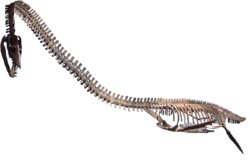
With a maximum length ranging from 5 to 12 m (16 to 39 ft) depending on the genera, elasmosaurids have a streamlined body with paddle-like limbs, mostly having a short tail, a small head, and an extremely long neck. The necks of these marine reptiles are supported by a very large number of cervical vertebrae, Elasmosaurus and Albertonectes being the only known vertebrates to have more than 70. The skull of elasmosaurids appears mainly slender and triangular, the majority of them having large fang-like teeth at the front, and smaller teeth towards the back. The Aristonectinae subgroup nevertheless has different morphological traits, having more numerous but smaller teeth and having a shorter neck. Elasmosaurids were well adapted for aquatic life, and used their flippers for swimming. Contrary to earlier depictions, their necks were not very flexible, and could not be held high above the water surface. It is unknown what their long necks were used for, but they may have had a function in feeding. Elasmosaurids probably ate small fish and marine invertebrates, seizing them with their long teeth, and may have used gastroliths (stomach stones) to help digest their food.
Like many plesiosaurs, elasmosaurids are easily recognizable by their compact, streamlined bodies, long paddle-like limbs, short tails, proportionately small heads, and very elongated necks. The oldest known representative, Jucha, dating from the Hauterivian stage of the Lower Cretaceous, would have measured 5 m (16 ft) long. Most representatives dating from more recent periods nevertheless adopt sizes ranging from more than 8 m (26 ft) in length. The largest known member of this family, Albertonectes, would have reached a length of 12.1 metres (40 ft) with a body mass of 4.8 metric tons (5.3 short tons). A referred specimen of Aristonectes that was discovered in Seymour Island, Antarctica, numbered as MLP 89-III-3-1, is view to be one of the largest and heaviest plesiosaurs identified to date, estimated in 2019 at between 11 and 11.9 metres (36 and 39 ft) long for body mass of 10.7–13.5 metric tons (11.8–14.9 short tons).
The skull of elasmosaurids are mainly slender and triangular in shape. The lateral edges of the orbits are characterized by a convex lateral edge. A large majority of representatives of the group have a their generally heterodont (irregular throughout the jaws) dentition, with the teeth becoming progressively smaller from front to back, with the larger ones shaped like large fangs. These representatives have generally five teeth in the premaxillae (which form the front of the upper jaw), 14 teeth in the maxillae (the largest tooth bearing bone of the upper jaw), and between 17 and 19 in the dentary bones (the main part of the lower jaw). Aristonectines teeth are more numerous but are considerably smaller, having a homodont dentition, all the teeth being similar in shape.
One of the most easily recognizable characteristics of elasmosaurids is their long neck formed by a fairly considerable number of cervical vertebrae, of which a large majority of genera have between 50 and 70. The type genus Elasmosaurus and its close relative Albertonectes are the only representatives currently known to have more than 70, precisely 72 and 76 respectively, an unequaled number among all known vertebrates. In spite of their many neck vertebrae, the necks of elasmosaurids were less than half as long as those of the longest-necked sauropod dinosaurs. Additionally, the Aristonectinae subgroup has cervical vertebrae that are wider than they are long, and their necks are therefore shorter than those of other representatives. Apart from aristonectines, other elasmosaurids have a longitudinal ridge on the cervical vertebrae which served to anchor the neck musculature. One of the identifying features of elasmosaurids is that their shoulder girdle has a large heart-shaped opening located between the coracoids, known as the intercoracoid embayment. As with other plesiosaurs, they have swimming paddles made up of very long digits. The paddles at the front (the pectoral paddles) were longer than those at the back (the pelvic paddles). Since the last tail-vertebrae of elasmosaurids were fused into a structure similar to the pygostyle of birds, it is possible this supported a tail-fin, but the shape it would have had is unknown.
Though Edward Drinker Cope had originally recognized Elasmosaurus as a plesiosaur, in an 1869 paper he placed it, with Cimoliasaurus and Crymocetus, in a new order of sauropterygian reptiles. He named the group Streptosauria, or "reversed lizards", due to the orientation of their individual vertebrae supposedly being reversed compared to what is seen in other vertebrate animals. He subsequently abandoned this idea in his 1869 description of Elasmosaurus, where he stated he had based it on Leidy's erroneous interpretation of Cimoliasaurus. In this paper, he also named the new family Elasmosauridae, containing Elasmosaurus and Cimoliasaurus, without comment. Within this family, he considered the former to be distinguished by a longer neck with compressed vertebrae, and the latter by a shorter neck with square, depressed vertebrae.
In subsequent years, Elasmosauridae came to be one of three groups in which plesiosaurs were classified, the others being the Pliosauridae and Plesiosauridae (sometimes merged into one group). In 1874 Harry Seeley took issue with Cope's identification of clavicles in the shoulder girdle of Elasmosaurus, asserting that the supposed clavicles were actually scapulae. He found no evidence of a clavicle or an interclavicle in the shoulder girdle of Elasmosaurus; he noted that the absence of the latter bone was also seen in a number of other plesiosaur specimens, which he named as new elasmosaurid genera: Eretmosaurus, Colymbosaurus, and Muraenosaurus. Richard Lydekker subsequently proposed that Elasmosaurus, Polycotylus, Colymbosaurus, and Muraenosaurus could not be distinguished from Cimoliasaurus based on their shoulder girdles, and advocated their synonymization at the genus level.
Seeley noted in 1892 that the clavicle was fused to the coracoid by a suture in elasmosaurians, and was apparently "an inseparable part" of the scapula. Meanwhile, all plesiosaurs with two-headed neck ribs (the Plesiosauridae and Pliosauridae) had a clavicle made only of cartilage, such that ossification of the clavicle would turn a "plesiosaurian" into an "elasmosaurian". Samuel Wendell Williston doubted Seeley's usage of neck ribs to subdivide plesiosaurs in 1907, opining that double-headed neck ribs were instead a "primitive character confined to the early forms". Charles Andrews elaborated on differences between elasmosaurids and pliosaurids in 1910 and 1913. He characterized elasmosaurids by their long necks and small heads, as well as by their rigid and well-developed scapulae (but atrophied or absent clavicles and interclavicles) for forelimb-driven locomotion. Meanwhile, pliosaurids had short necks but large heads, and used hindlimb-driven locomotion.
Elasmosauridae
Elasmosauridae, often called elasmosaurs or elasmosaurids, is an extinct family of plesiosaurs that lived from the Hauterivian stage of the Early Cretaceous to the Maastrichtian stage of the Late Cretaceous period (c. 130 to 66 mya). The taxon was initially erected in 1869 by Edward Drinker Cope to include the type genus Elasmosaurus with the related Cimoliasaurus, although he did not argued in detail why. Over the following years, many authors recognized this classification on the basis of predominantly postcranial features, becoming one of the three groups in which plesiosaurs were often classified during the 19th century, along with the Pliosauridae and the Plesiosauridae. However, most of these traits led to many genera since recognized as belonging to other plesiosaur families being classified as elasmosaurids. Another family historically considered as distinct, the Cimoliasauridae, has since 2009 been recognized as a junior synonym of the Elasmosauridae. Along with the Polycotylidae, elasmosaurids represent the few plesiosauroids that lived until the Cretaceous–Paleogene extinction event.
With a maximum length ranging from 5 to 12 m (16 to 39 ft) depending on the genera, elasmosaurids have a streamlined body with paddle-like limbs, mostly having a short tail, a small head, and an extremely long neck. The necks of these marine reptiles are supported by a very large number of cervical vertebrae, Elasmosaurus and Albertonectes being the only known vertebrates to have more than 70. The skull of elasmosaurids appears mainly slender and triangular, the majority of them having large fang-like teeth at the front, and smaller teeth towards the back. The Aristonectinae subgroup nevertheless has different morphological traits, having more numerous but smaller teeth and having a shorter neck. Elasmosaurids were well adapted for aquatic life, and used their flippers for swimming. Contrary to earlier depictions, their necks were not very flexible, and could not be held high above the water surface. It is unknown what their long necks were used for, but they may have had a function in feeding. Elasmosaurids probably ate small fish and marine invertebrates, seizing them with their long teeth, and may have used gastroliths (stomach stones) to help digest their food.
Like many plesiosaurs, elasmosaurids are easily recognizable by their compact, streamlined bodies, long paddle-like limbs, short tails, proportionately small heads, and very elongated necks. The oldest known representative, Jucha, dating from the Hauterivian stage of the Lower Cretaceous, would have measured 5 m (16 ft) long. Most representatives dating from more recent periods nevertheless adopt sizes ranging from more than 8 m (26 ft) in length. The largest known member of this family, Albertonectes, would have reached a length of 12.1 metres (40 ft) with a body mass of 4.8 metric tons (5.3 short tons). A referred specimen of Aristonectes that was discovered in Seymour Island, Antarctica, numbered as MLP 89-III-3-1, is view to be one of the largest and heaviest plesiosaurs identified to date, estimated in 2019 at between 11 and 11.9 metres (36 and 39 ft) long for body mass of 10.7–13.5 metric tons (11.8–14.9 short tons).
The skull of elasmosaurids are mainly slender and triangular in shape. The lateral edges of the orbits are characterized by a convex lateral edge. A large majority of representatives of the group have a their generally heterodont (irregular throughout the jaws) dentition, with the teeth becoming progressively smaller from front to back, with the larger ones shaped like large fangs. These representatives have generally five teeth in the premaxillae (which form the front of the upper jaw), 14 teeth in the maxillae (the largest tooth bearing bone of the upper jaw), and between 17 and 19 in the dentary bones (the main part of the lower jaw). Aristonectines teeth are more numerous but are considerably smaller, having a homodont dentition, all the teeth being similar in shape.
One of the most easily recognizable characteristics of elasmosaurids is their long neck formed by a fairly considerable number of cervical vertebrae, of which a large majority of genera have between 50 and 70. The type genus Elasmosaurus and its close relative Albertonectes are the only representatives currently known to have more than 70, precisely 72 and 76 respectively, an unequaled number among all known vertebrates. In spite of their many neck vertebrae, the necks of elasmosaurids were less than half as long as those of the longest-necked sauropod dinosaurs. Additionally, the Aristonectinae subgroup has cervical vertebrae that are wider than they are long, and their necks are therefore shorter than those of other representatives. Apart from aristonectines, other elasmosaurids have a longitudinal ridge on the cervical vertebrae which served to anchor the neck musculature. One of the identifying features of elasmosaurids is that their shoulder girdle has a large heart-shaped opening located between the coracoids, known as the intercoracoid embayment. As with other plesiosaurs, they have swimming paddles made up of very long digits. The paddles at the front (the pectoral paddles) were longer than those at the back (the pelvic paddles). Since the last tail-vertebrae of elasmosaurids were fused into a structure similar to the pygostyle of birds, it is possible this supported a tail-fin, but the shape it would have had is unknown.
Though Edward Drinker Cope had originally recognized Elasmosaurus as a plesiosaur, in an 1869 paper he placed it, with Cimoliasaurus and Crymocetus, in a new order of sauropterygian reptiles. He named the group Streptosauria, or "reversed lizards", due to the orientation of their individual vertebrae supposedly being reversed compared to what is seen in other vertebrate animals. He subsequently abandoned this idea in his 1869 description of Elasmosaurus, where he stated he had based it on Leidy's erroneous interpretation of Cimoliasaurus. In this paper, he also named the new family Elasmosauridae, containing Elasmosaurus and Cimoliasaurus, without comment. Within this family, he considered the former to be distinguished by a longer neck with compressed vertebrae, and the latter by a shorter neck with square, depressed vertebrae.
In subsequent years, Elasmosauridae came to be one of three groups in which plesiosaurs were classified, the others being the Pliosauridae and Plesiosauridae (sometimes merged into one group). In 1874 Harry Seeley took issue with Cope's identification of clavicles in the shoulder girdle of Elasmosaurus, asserting that the supposed clavicles were actually scapulae. He found no evidence of a clavicle or an interclavicle in the shoulder girdle of Elasmosaurus; he noted that the absence of the latter bone was also seen in a number of other plesiosaur specimens, which he named as new elasmosaurid genera: Eretmosaurus, Colymbosaurus, and Muraenosaurus. Richard Lydekker subsequently proposed that Elasmosaurus, Polycotylus, Colymbosaurus, and Muraenosaurus could not be distinguished from Cimoliasaurus based on their shoulder girdles, and advocated their synonymization at the genus level.
Seeley noted in 1892 that the clavicle was fused to the coracoid by a suture in elasmosaurians, and was apparently "an inseparable part" of the scapula. Meanwhile, all plesiosaurs with two-headed neck ribs (the Plesiosauridae and Pliosauridae) had a clavicle made only of cartilage, such that ossification of the clavicle would turn a "plesiosaurian" into an "elasmosaurian". Samuel Wendell Williston doubted Seeley's usage of neck ribs to subdivide plesiosaurs in 1907, opining that double-headed neck ribs were instead a "primitive character confined to the early forms". Charles Andrews elaborated on differences between elasmosaurids and pliosaurids in 1910 and 1913. He characterized elasmosaurids by their long necks and small heads, as well as by their rigid and well-developed scapulae (but atrophied or absent clavicles and interclavicles) for forelimb-driven locomotion. Meanwhile, pliosaurids had short necks but large heads, and used hindlimb-driven locomotion.
Recent media
Recent media