Hubbry Logo
PliosauridaePliosauridaeMain
Open search
Pliosauridae
Community hub
Pliosauridae
logo
8 pages, 0 posts
0 subscribers
Be the first to start a discussion here.
Pliosauridae
Pliosauridae
from Wikipedia

Pliosauridae
Temporal range: Late Triassic (Rhaetian) - Late Cretaceous (Turonian) 205–89.3 Ma
Liopleurodon ferox mounted skeleton, Museum of Paleontology, Tübingen
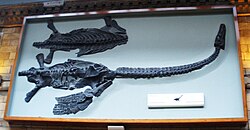
Cast of the primitive pliosaur Attenborosaurus conybeari (NHMUK R1339), Natural History Museum
Scientific classification Edit this classification
Kingdom: Animalia
Phylum: Chordata
Class: Reptilia
Superorder: Sauropterygia
Order: Plesiosauria
Suborder: Pliosauroidea
Family: Pliosauridae
Seeley, 1874
Subgroups

Pliosauridae is a family of plesiosaurian marine reptiles from the Latest Triassic to the early Late Cretaceous (Rhaetian to Turonian stages). The family is more inclusive than the archetypal short-necked large headed species that are placed in the subclade Thalassophonea, with early, primitive forms resembling other plesiosaurs with long necks.

The largest thalassophonean pliosaurs reached 10–11 metres (33–36 ft), in length, with around a quarter of this length being the head. Thalassophonean pliosaurs represented the largest marine predators during their existence, spanning more than 80 million years.[1]

Pliosaurs went extinct during the early Late Cretaceous and were subsequently replaced by the mosasaurs.

Taxonomy

[edit]

Pliosauridae was formally named by Harry G. Seeley in 1874.[2]

Pliosauridae is a stem-based taxon defined in 2010 (and in earlier studies in a similar manner) as "all taxa more closely related to Pliosaurus brachydeirus than to Leptocleidus superstes, Polycotylus latipinnis or Meyerasaurus victor".[3] The family Brachauchenidae has been proposed to include pliosauroids which have very short necks and may include Brachauchenius and Kronosaurus.[4] However, modern cladistic analyses found that this group is actually a subfamily of pliosaurids,[5] and possibly even the "crown group" of Pliosauridae.[6]

Within Pliosauridae, there is a more derived clade called Thalassophonea. Thalassophonea was erected by Roger Benson and Patrick Druckenmiller in 2013. The name is derived from Greek thalassa (θάλασσα), "sea", and phoneus (φονεύς), "murderer". It is a stem-based taxon defined as "all taxa more closely related to Pliosaurus brachydeirus than to Marmornectes candrewi".[7] It includes the short necked and large headed taxa that typify the family.[8][9]

The following cladogram follows an analysis by Benson & Druckenmiller (2014).[7]

Plesiosauria

References

[edit]
[edit]
Revisions and contributorsEdit on WikipediaRead on Wikipedia
from Grokipedia
Pliosauridae is a family of short-necked plesiosaurian marine reptiles within the clade Plesiosauria (Reptilia: ), distinguished by their large skulls, powerful jaws armed with robust conical teeth featuring prominent longitudinal ridges, and adaptations as apex predators that dominated marine ecosystems for over 90 million years. These carnivorous reptiles typically possessed 10–14 , a rigid trunk, and four paddle-like limbs for propulsion through ancient seas, with body lengths ranging from 3 to 15 meters depending on the species and geological period. Fossils of Pliosauridae, including isolated teeth, partial skeletons, and near-complete specimens, reveal a cosmopolitan distribution across Laurasian and Gondwanan continents, from and to and . The family originated near the Early-Middle Jurassic transition around 171 million years ago, with early macropredatory forms like Lorrainosaurus keileni marking the rise of large-bodied pliosaurids equipped for hunting sizable prey such as , ammonites, and other marine reptiles. Pliosauridae diversified during the Middle to (Bajocian–Tithonian stages), achieving peak abundance and morphological disparity in epicontinental seas like the Formation of and the Formation, where genera such as and exhibited elongate rostra, long mandibular symphyses, and up to 70 mandibular teeth for efficient prey capture. Diagnostic traits include a preorbital length exceeding the postorbital portion, absence of anterior interpterygoid vacuities, and vomer-pterygoid sutures that extend beyond the internal nares, features that distinguish them from related pliosauroids like rhomaleosaurids. Although Pliosauridae thrived globally through the , their diversity waned by the , with survivor lineages in the Brachaucheninae subfamily—such as lucasi, queenslandicus, and Megacephalosaurus eulerti—persisting as top predators in epicontinental seas until the stage around 90 million years ago. Phylogenetic analyses confirm Pliosauridae as a monophyletic within the superfamily and the broader Thalassophonea group, evolving independently from long-necked plesiosaurs and showcasing correlated trends in body size increase and locomotor adaptations like robust humeri for enhanced paddling efficiency. Their decline coincided with the diversification of mosasaurs and shifts in marine food webs, underscoring their pivotal role in shaping Jurassic- trophic structures before the end- extinction.

Anatomy and Morphology

Skull and Dentition

Pliosaurid skulls were large and robust, often comprising 20-25% of the total body length in advanced forms, with specimens of the genus reaching up to 2 meters in length. For instance, the skull of Pliosaurus kevani measures 1.995 meters along the dorsal midline, with a preorbital region accounting for 57% of its length, indicating a longirostrine profile adapted for powerful predatory strikes. These crania featured a generally triangular outline in dorsal view, characterized by an elongated temporal region that housed expansive adductor muscle chambers, contributing to enhanced bite mechanics. Large orbits provided acute essential for targeting prey in marine environments. The of pliosaurids consisted of conical to trihedral teeth with fine apicobasal serrations in the form of enamel ridges, optimized for puncturing and gripping large prey such as other marine reptiles and . These teeth, particularly in anterior positions, could reach lengths of up to 30 cm in large species like , with robust crowns featuring labiolingually compressed profiles and deep alveolar sockets for secure anchorage. replacement followed a cyclical pattern, with anterior caniniform teeth exhibiting longer cycles (period of 4) and symmetrical resorption, while posterior teeth showed shorter cycles (period of 2) and asymmetrical wear, allowing continuous functionality during feeding. mechanics involved an akinetic construction with a broad, low profile and a wide gape, enabling post-symphyseal bites; finite element analyses estimate bite forces exceeding 10,000 Newtons in large individuals, with maximum values up to 48,000 Newtons at posterior positions, far surpassing those of modern crocodilians. Variations in skull morphology occurred across pliosaurid subclades, reflecting adaptations to different predatory niches. Early forms possessed more gracile, slender snouts with narrow preorbital regions and less robust temporal fenestrae, suited to a broader range of prey including fish. In contrast, Late Jurassic apex predators like Pliosaurus evolved massive, robust crania with broader temporal regions and shorter mandibular symphyses (6-15 alveoli), emphasizing power over speed in capturing large, struggling prey. These differences highlight a trend toward increased cranial robusticity in later subclades, enhancing their role as top macropredators.

Postcranial Skeleton

The postcranial skeleton of Pliosauridae exhibits specialized adaptations for marine predation and locomotion, emphasizing a compact, hydrodynamic . The neck is short and robust, typically composed of 10–22 , representing a marked reduction from the 70 or more in ancestral long-necked plesiosaurians such as elasmosaurids. This shortened cervical series, with massive, amphicoelous centra that are short relative to their height and width, enabled rapid lateral head movements for ambushing prey while maintaining structural strength against torsional forces during strikes. The vertebral column is sturdy and elongated, comprising approximately 40–60 presacral vertebrae (cervical plus dorsal) in larger taxa, with ball-and-socket (heterocoelous) articulations in the posterior regions that conferred flexibility for undulating without compromising rigidity. Dorsal vertebrae feature broad neural spines and robust zygapophyses for muscle attachment, while the transition to sacral and caudal series includes reinforced to support the body's mass in water. The , formed by 30 or more caudal vertebrae with elongated, downward-projecting chevrons, functioned primarily for steering and fine maneuvering, contributing to the overall tapered posterior profile. The limbs are transformed into four large, wing-like paddles optimized for flight, with hyperphalangy—increased phalangeal counts beyond the ancestral condition—evident in the autopods, particularly the mesopodials and epipodials, allowing for extended surface area. Propodials (humeri and femora) are robust and elongated, often subequal in length, while the strong coracoids, scapulae, ilia, and pubes/ form expansive girdles that anchored powerful axial musculature for thrust generation. These features supported dynamic swimming speeds and maneuvers essential for pursuing agile prey. Pliosaurid body sizes vary widely, with total lengths ranging from 5 to 15 meters across the family, and mass estimates for the largest species, such as Pliosaurus funkei, reaching up to 30 tons derived from 3D volumetric reconstructions of skeletal proportions. Recent discoveries, such as the Abingdon specimen from the Formation (estimated at 13–14 m in length as of 2023), highlight the upper end of size variation in the family. for appears in variations of morphology among conspecific specimens, including differences in rib length and thoracic breadth that may reflect sex-specific body shapes or reproductive adaptations, though further analysis is needed to confirm.

Evolutionary History

Origins and Early Forms

Pliosauridae was originally established as a family by Harry Govier Seeley in 1874 based on shared cranial and dental characteristics among short-necked plesiosaurs. A modern stem-based phylogenetic definition, proposed in 2010, delineates Pliosauridae as all plesiosaurians more closely related to brachyspondylus than to dolichodeirus or Polycotylus latipinnis, emphasizing its position within the broader clade . The origins of Pliosauridae trace back to the Rhaetian stage, approximately 205 million years ago, evolving from rhomaleosaurid-like ancestors within , a superfamily of short-necked plesiosaurians that emerged shortly after the end-Triassic extinction. These ancestors, such as early rhomaleosaurids, exhibited intermediate morphologies bridging basal plesiosaurians and more derived forms, with fossils indicating an initial radiation in shallow marine environments of the Tethys Sea. Among the earliest known pliosaurids is Rhaeticosaurus mertensi from the Rhaetian of , representing a basal member with transitional features including a neck of 21 and a relatively small (~25 cm long in the juvenile ) adapted for initial piscivorous habits. Similarly, Attenborosaurus conybeari from the (Hettangian-Sinemurian) of the displays primitive traits such as around 20 —shorter than the approximately 40 in ancestral long-necked plesiosaurians but longer than the 12 typical of advanced pliosaurids—and a modestly enlarged head suited for grasping prey. These forms highlight key evolutionary shifts, including a progressive reduction in cervical vertebrae count to enhance streamlined swimming and the early expansion of skull size to support a diet dominated by soft-bodied aquatic vertebrates. Fossil evidence from Lower Jurassic (Hettangian-Sinemurian) deposits in , such as those in Luxembourg, Belgium, and the , documents basal pliosaurids coexisting with dominant ichthyosaurs like , suggesting niche partitioning in early post- marine ecosystems where pliosaurids occupied mid-level predatory roles. These assemblages indicate that pliosaurids rapidly integrated into diverse coastal faunas, filling ecological gaps left by the Triassic mass extinction.

Diversification and Peak

The diversification of Pliosauridae accelerated during the , particularly in the Bajocian to stages (~170–165 Ma), marking the emergence of the thalassophonean subclade characterized by extreme short necks, massive skulls, and robust dentitions adapted for macropredatory lifestyles. This radiation followed an Early-to-Middle Jurassic turnover event around the Aalenian-Bajocian boundary (~174–168 Ma), where thalassophoneans supplanted earlier pliosaurid forms and rhomaleosaurids, transitioning from smaller-bodied ancestors to larger, more specialized predators. Early representatives, such as Lorrainosaurus keileni from the upper Bajocian of , exhibited mandibular lengths exceeding 1.3 m, signaling the onset of within this group. Pliosaurids reached their peak abundance and ecological dominance in the , spanning the Oxfordian to stages (~163–152 Ma), where they became the primary apex predators in marine ecosystems, displacing declining ichthyosaur groups like temnodontosaurs. During this interval, thalassophoneans filled top trophic niches across epicontinental seas, with assemblages reflecting high diversity and widespread distribution from to equatorial regions, including . The Formation in exemplifies this peak, yielding abundant remains of multiple genera and showcasing the group's role in reshaping Jurassic marine food webs. Adaptive radiations within Pliosauridae during this period involved the evolution of predation strategies, facilitated by powerful jaws and conical-to-trihedral teeth suited for seizing large prey such as and marine tetrapods. Body sizes increased dramatically, with genera like attaining lengths of 12–15 m, enabling them to exploit a broad range of prey and dominate coastal and shelf environments. Evidence of niche partitioning emerges from elevated dental disparity in the , where coexisting species differentiated by tooth morphology and size, allowing resource segregation among apex predators amid the decline of ichthyosaurs.

Decline and Extinction

The decline of Pliosauridae began in the and continued into the , with diversity sharply reduced by the Berriasian stage (~145 Ma), leaving primarily macropredatory forms as the dominant survivors. This contraction in taxonomic richness coincided with increasing competition from long-necked plesiosauroids, which expanded into similar ecological niches, and the sparse fossil record of Early Cretaceous pliosaurids suggests a diminished role in marine ecosystems compared to their Jurassic peak. Phylogenetic analyses indicate that pliosaurids exhibited low rates of morphological during this period, potentially exacerbating their vulnerability to environmental shifts and biotic pressures. Pliosaurid survival persisted into the , with the youngest definitive records from the stages (~100–89 Ma), including indeterminate remains from the Yezo Group in , . These fossils, comprising vertebrae and other postcranial elements from large individuals (estimated skull lengths up to ~1.5 m), document the clade's presence on Pacific margins during this interval, crossing the Cenomanian–Turonian boundary without apparent . However, no post-Turonian fossils have been identified, marking the group's complete disappearance by approximately 89 Ma. Several factors contributed to the pliosaurids' extinction, centered on mid-Cretaceous environmental perturbations during the Cenomanian–Turonian transition. Climatic volatility, including extreme global warming and ocean anoxia (Oceanic Anoxic Event 2), disrupted marine food webs and selectively elevated extinction rates among large, fast-swimming predators like pliosaurids. Sea-level fluctuations reduced shallow marine habitats preferred by many pliosaurids, while biotic competition intensified from faster-swimming squamates such as early mosasaurs and short-necked plesiosauroids (polycotylids), which exhibited higher evolutionary rates and niche overlap. These events represent precursor disturbances to the later Cretaceous–Paleogene boundary crisis, fully replacing pliosaurids as apex predators with mosasaurs by the late Turonian. Phylogenetically, the prolonged survival of more basal pliosaurid lineages into the contrasts with the earlier decline of advanced thalassophoneans, highlighting differential persistence among subclades amid global turnover. Brachauchenine pliosaurids, representing the last thalassophonean survivors, underscore this pattern but ultimately succumbed to the mid-Cretaceous pressures, with no evidence of post-Turonian radiation.

Classification and Systematics

Taxonomic History

The taxonomic history of Pliosauridae traces back to the early , when initial plesiosaurian discoveries in marine deposits of highlighted short-necked forms distinct from long-necked plesiosaurs. In 1824, William D. Conybeare described and illustrated four large vertebrae from the Kimmeridge Clay Formation near , which were among the first recognized pliosaurid remains, though initially not assigned to a specific . These specimens, housed in the , represented early evidence of large-bodied, predatory marine reptiles from the . Subsequently, in 1841, formally named the genus (meaning "more lizard") based on postcranial elements from the Formation, including vertebrae and limb bones that emphasized the group's robust build and short cervical region compared to . Owen's description established as the for short-necked plesiosaurs, drawing from specimens collected in and distinguishing it from the contemporaneous . The family Pliosauridae was erected by Harry G. Seeley in 1874 to accommodate Pliosaurus and allied genera, primarily based on fossils exhibiting large skulls, short necks, and powerful limbs adapted for underwater propulsion. Seeley's classification grouped these taxa as a distinct lineage within Plesiosauria, emphasizing their predatory morphology and separating them from long-necked forms. Throughout the late 19th and 20th centuries, taxonomic confusion persisted as Pliosaurus became a , absorbing diverse pliosauroid fossils without rigorous distinction, which led to numerous synonyms and misassignments. For instance, Liopleurodon, named in 1873 by Henri Émile Sauvage based on isolated teeth and vertebrae from the Callovian of , was initially treated as a separate genus but later synonymized with Pliosaurus by authors like Andrews () due to overlapping morphology. This lumping obscured species boundaries and contributed to instability in pliosaurid nomenclature until cladistic approaches emerged. Significant revisions occurred in the early through phylogenetic analyses that stabilized the group's definition. Druckenmiller and Russell () redefined Pliosauridae as a stem-based comprising all plesiosaurians more closely related to Pliosaurus brachyspondylus than to Plesiosaurus dolichodeirus or Polycotylus latipinnis, incorporating new material and emphasizing its position as a grade leading to more derived forms. Building on this, Benson et al. (2012) clarified Pliosauridae's within the broader pliosauroid radiation, integrating it into a framework of high early diversity and low disparity during the Triassic- boundary, while highlighting its role in Jurassic marine ecosystems. Post-2020 research has incorporated new discoveries, such as isolated pliosaurid teeth and vertebrae from the Cenomanian-Turonian Yezo Group in , , extending the family's temporal range into the mid-Cretaceous and underscoring its persistence in the Western Pacific before dominance. These Asian finds refine the global distribution and longevity of Pliosauridae, previously thought to wane after the . Ongoing debates address the validity of genera like Megalneusaurus, named in 1898 from the Oxfordian Sundance Formation of , with recent reassessments of type material (e.g., limb bones and vertebrae) questioning its distinction from other North American pliosaurids due to fragmentary preservation but generally upholding it as a valid .

Phylogeny

Pliosauridae is a family of plesiosaurs within the superfamily , positioned as the to Rhomaleosauridae in analyses of Plesiosauria interrelationships. This placement is supported by comprehensive morphological datasets encompassing over 100 taxa and hundreds of characters, resolving as a monophyletic diverging early from other plesiosaur lineages such as the long-necked . Key synapomorphies diagnosing Pliosauridae include a reduced number of (fewer than 20, contrasting with the 20–70+ in basal plesiosauromorphs) and enlarged temporal fenestrae associated with robust skulls adapted for macropredation. These features reflect adaptations for powerful mechanics and shortened necks, distinguishing pliosaurids from their rhomaleosaurid relatives, which retain slightly longer necks (around 20–25 cervicals). Phylogenetic analyses reveal a basal split within Pliosauridae into early pliosauromorphs and the derived thalassophonean clade, with the latter encompassing advanced short-snouted forms. Basal genera such as Hauffiosaurus and Marmornectes branch early in parsimony and Bayesian trees, often scoring as successive outgroups to more derived members based on character matrices emphasizing cranial and vertebral traits. In contrast, the thalassophonean clade includes an advanced subclade uniting Pliosaurus and Liopleurodon, characterized by extremely short snouts (less than 25% of skull length) and massive body sizes exceeding 10 meters, supported by high nodal support in recent datasets. Recent cladistic studies, including Bayesian implementations of morphological matrices with 270+ characters, consistently recover Pliosauridae as monophyletic, with strong posterior probabilities (>0.95) for key nodes. For instance, analyses incorporating Early–Middle Jurassic taxa affirm the monophyly while highlighting regional endemism, such as Gallardosaurus from the Oxfordian of Cuba nesting as a South American vicariant closely allied to Peloneustes. Uncertainties persist regarding the phylogenetic position of indeterminate Cretaceous pliosaurid fragments, which may represent late-surviving thalassophoneans or convergent forms, as current matrices yield unresolved polytomies for these isolated elements due to limited preservational data.

Genera and Species

Pliosauridae encompasses approximately 10–15 valid genera, though taxonomic revisions continue to refine this number, with some early forms potentially reassignable to Rhomaleosauridae. The family is characterized by short-necked plesiosaurs with large skulls, and its genera span the to early , primarily from marine deposits in , , , and beyond. Key genera include basal and derived forms, with ongoing debates over species boundaries based on fragmentary material. Attenborosaurus is a basal pliosaurid known from the (Sinemurian-Pliensbachian) of the , represented by the Attenborosaurus conybeari. This genus is distinguished by a relatively long neck combined with a large head, featuring widely separated coracoids, and is based on the NHMUK PV R1135, an incomplete skeleton from Dorset. It represents an early, transitional form within the family. Hauffiosaurus is a basal pliosaurid from the () of the and , with species including H. longneck (holotype LEICT G50.2007.0001, ~3.4 m length) and H. zhanggutangensis from . It features a moderately large and around 15 . Marmornectes is known from the () Formation of , represented by the type species Marmornectes candrewi (holotype LEICT G154.2006, partial skeleton with long narrow snout). It is a basal member with ~17 . Liopleurodon, a (Callovian) genus from Europe, includes the Liopleurodon ferox, known from the Formation of and . Characterized by a up to 6-7 m long with conical teeth and 6-7 symphyseal tooth positions, its is NHMUK PV 31778, a partial including a . Liopleurodon pachydeirus has been synonymized with L. ferox in some revisions due to overlapping morphology. Peloneustes is a () genus from the of , with species such as P. philarchus (holotype CAMSM J.45187, multiple skulls known). It has a robust build, ~5-6 m length, and ~20 , often considered a pliosaurid or close relative. Simolestes is from the () of , with the type species S. ke superficialis (holotype NHMUK PV R.1673, partial ). It features a large with ~50 teeth and is a derived pliosaurid. Pliosaurus, the eponymous with a global distribution, is the most species-rich within Pliosauridae, with six valid species recognized: P. brachyspondylus (, ; neotype CAMSM J.35991, ~60 mandibular teeth, robust vertebrae), P. brachydeirus (, ; holotype OUMNH J.9245, ~70 mandibular teeth), P. macromerus (-Tithonian, ; neotype NHMUK PV 39362, ~50 mandibular teeth), P. funkei (Volgian, ; holotype PMO 214.135, up to 15 m body length with Type I retroarticular process), P. kevani (, ; based on "Sea Dragon" specimen), and P. rossicus (Volgian, ; holotype PIN 157/1549, uncertain validity in some analyses). The is defined by trihedral teeth and 8-12 symphyseal positions, with the original NHMUK PV R286 (a ). Several former species, such as P. andrewsi and P. irgisensis, have been reclassified as non-pliosaurids or indeterminate. Gallardosaurus, from the (Oxfordian) seaway, comprises the single Gallardosaurus iturraldei, based on MNHNCu P3005 (incomplete and postcrania) from the Jagua Formation of . It forms a with and features a hemispherical occipital condyle and low jaw articulation. Megalneusaurus, a (Oxfordian) North American genus from the Sundance Formation of , , includes the Megalneusaurus rex ( UW 4602, isolated limb bones indicating 7-9 m length). It represents one of the largest pliosaurids in the region and is based on material rediscovered from excavations. Lorrainosaurus, an early macropredatory pliosaurid from the (Bajocian) of , includes the L. keileni ( MNHN.F.1963.6.1, isolated cranial elements), marking the origin near the Early-Middle Jurassic transition around 171 Ma. The Brachaucheninae subfamily includes forms such as (B. lucasi, , ; KUVP 485, partial skeleton), (K. queenslandicus, , ; QM F1004, large skull), and Megacephalosaurus (M. eulerti, , ; FHSM VP-2114, near-complete skeleton). These represent survivor lineages until the . Among dubious or reclassified taxa, Stenorhynchosaurus munozi (Early Cretaceous, Colombia) was proposed as a pliosaurid based on a partial skeleton (holotype unknown in detail), but its narrow snout and fragmentary nature render it a possible nomen dubium pending further review. Acroplite is an obsolete synonym of Pliosaurus, based on misidentified material now incorporated into the latter genus.

Paleobiology and Distribution

Habitat and Geographic Range

Pliosaurids primarily inhabited shallow epicontinental seas, lagoons, and open marine environments across the and periods, reflecting their adaptation to diverse coastal and shelf settings in oceans. records indicate a sparse presence in the , with the earliest known specimens from Rhaetian-aged deposits in , marking the initial diversification of the group. Abundance increased markedly during the Middle and , particularly in Laurasian regions encompassing and , where they thrived in expansive shallow marine basins. In contrast, occurrences are rarer and predominantly from Gondwanan landmasses, signaling a shift in distribution patterns. The latest records date to the stage of the , with remains documented in , , and northern . Notable fossil localities highlight this spatiotemporal spread. The Formation in preserves Late Jurassic pliosaurid material from shallow shelf seas associated with the Anglo-Paris Basin. In , the Vaches Noires cliffs along the coast have yielded Middle Jurassic specimens from nearshore to lagoonal deposits of the stage. The Neuquén Basin in west-central contains Oxfordian-aged remains from epicontinental marine sediments of the Formation. Farther east, the Yezo Group in , , records pliosaurid remains from deep-marine forearc settings. Biogeographically, pliosaurids dominated Laurasian paleoprovinces during the , with Gondwanan extensions appearing by the and , likely facilitated by faunal interchange across the Tethys Sea and its connections to the proto-Atlantic. These distributions align with preferences for warm tropical to subtropical waters prevalent in low- to mid-latitude epicontinental settings.

Diet and Behavior

Pliosaurids were apex predators that primarily consumed a diverse array of marine prey, including fishes, cephalopods, and other marine reptiles such as plesiosauroids and possibly ichthyosaurs. Evidence from stomach contents in specimens reveals ingested remains of cephalopods, fishes, and even terrestrial elements like dermal armor, indicating a generalist carnivorous diet capable of tackling prey up to half the predator's body length. Bite marks on plesiosauroid bones, characterized by deep punctures matching the conical teeth of pliosaurids, further confirm predation on fellow marine reptiles. Their hunting strategies emphasized tactics, leveraging short necks for rapid, powerful strikes and massive skulls optimized for crushing and inertial feeding. Finite element analysis of pliosaurid crania, such as that of Pliosaurus kevani from Dorset, , demonstrates bite forces ranging from 9,600 to 48,000 N, concentrated at posterior teeth for post-symphyseal biting rather than tearing or shaking prey. Gastroliths found in association with some plesiosaurian remains, including pliosaurids, suggest these stones aided in grinding ingested prey within the , supporting a diet that included hard-shelled or bony organisms. Coprolites attributed to plesiosaurians, though challenging to link specifically to pliosaurids, contain fish scales and bones, reinforcing piscivory as a core component of their feeding . Social behavior in pliosaurids remains poorly understood, with limited direct evidence for gregariousness or pack hunting. Growth series from ontogenetic studies indicate rapid growth rates, with bone histology in related plesiosaurs suggesting they reached full size within a few years. in pliosaurids is inferred to be , consistent with evidence from closely related plesiosaurians that gave birth to live young rather than laying eggs on land. A specimen of the plesiosauroid Polycotylus latipinnis preserves a near-term within the adult, providing definitive proof of in the broader Plesiosauria , which likely extended to pliosaurids given their fully aquatic adaptations. This reproductive strategy would have allowed females to produce a single large offspring, minimizing risks associated with terrestrial egg-laying in a marine environment. Pliosaurids engaged in intense ecological interactions, including predation on plesiosauroids and competition with other top predators like thalattosuchian crocodylomorphs for similar large-prey niches during the . As dominant macropredators, they reshaped marine food webs by outcompeting or preying upon contemporaries, with their rise correlating to declines in earlier groups. Sensory adaptations, such as a complex rostral neurovascular system with dense peripheral rami, likely enhanced prey detection through electroreception or mechanosensory input akin to a system, aiding in locating hidden or moving targets in murky waters.

References

Add your contribution
Related Hubs
User Avatar
No comments yet.