


Community hub
Recent from talks
Contribute something
Nothing was collected or created yet.
Obotrites
View on Wikipedia | You can help expand this article with text translated from the corresponding article in German. (March 2014) Click [show] for important translation instructions.
|
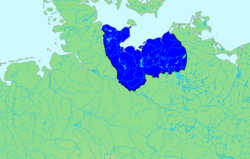
The Obotrites (Latin: Obotriti, Abodritorum, Abodritos) or Obodrites, also spelled Abodrites (German: Abodriten), were a confederation of medieval West Slavic tribes within the territory of modern Mecklenburg and Holstein in northern Germany (see Polabian Slavs).[1] For decades, they were allies of Charlemagne in his wars against the Germanic Saxons and the Slavic Veleti. The Obotrites under Prince Thrasco defeated the Saxons in the Battle of Bornhöved (798). The still-Pagan Saxons were dispersed by the emperor, and the part of their former land in Holstein north of Elbe was awarded to the Obotrites in 804, as a reward for their victory. This however was soon reverted through an invasion of the Danes. The Obotrite regnal style was abolished in 1167, when Pribislav was restored to power by Duke Henry the Lion, as Prince of Mecklenburg, thereby founding the Germanized House of Mecklenburg.
Key Information


Etymology
[edit]Obotrites / Abodrites is widely analysed from the Slavic root *bodr- ‘cheerful, lively, brave; vigorous; alert’ (cf. Bulg. бодър, Rus. бодрый, Pol. bodry (arch.), OCS бодръ). As an ethnonym, Bodriči/Obodrity ≈ “the spirited/brave ones” or “the encouraged ones,” with o- as a common Slavic prefix and -it-/-ič- a people-name suffix.[2]
History
[edit]Obotritic confederation
[edit]The Bavarian Geographer, an anonymous medieval document compiled in Regensburg in 830, contains a list of the tribes in Central Eastern Europe to the east of the Elbe. The list includes the Nortabtrezi (Obotrites) - with 53 civitates. Adam of Bremen referred to them as the Reregi because of their lucrative trade emporium Reric. In common with other Slavic groups, they were often described by Germanic sources as Wends.
.jpg)
The main tribes of the Obotritic confederation were:[3]
- the Obotrites proper (Wismar Bay to Lake Schwerin);
- the Wagrians (the eastern Holstein as part of Saxony);
- the Warnower (the upper Warnow and Mildenitz);
- the Polabians proper (between the Trave and the Elbe).
Other tribes associated with the confederation include:[3]
- the Linonen near Lenzen,
- the Travnjane near the Trave,
- the Drevani in the Hanoverian Wendland.
- the Ukrani in Prenzlau.

As allies of the Carolingian kings and the empire of their Ottonian successors, the Obotrites fought from 808 to 1200 against the kings of Denmark, who wished to rule the Baltic region independently of the empire. When opportunities arose, for instance upon the death of an emperor, they would seek to seize power; and in 983 Hamburg was destroyed by the Obotrites under their king, Mstivoj. At times they levied tribute from the Danes and Saxons. Under the leadership of Niklot, they resisted a Christian assault during the Wendish Crusade.
German missionaries such as Vicelinus converted the Obotrites to Christianity. In 1170 they acknowledged the suzerainty of the Holy Roman Empire, leading to Germanisation and assimilation over the following centuries. However, up to the late 15th century most villagers in the Obotritic area were still speaking Slavic dialects (Polabian language), although subsequently their language was displaced by German. The Polabian language survived until the beginning of the 19th century in Hanoverian Wendland, eastern Lower Saxony (bordering modern Mecklenburg-Western Pomerania).[4] The ruling clan of the Obotrites kept its power throughout the Germanisation and ruled their country (except during a short interruption in Thirty Years' War) as House of Mecklenburg until the end of monarchies in Germany in November Revolution 1918. Previously, the Obodrites were dominated by the Naconids; Eastern (Far) Pomerania was ruled by the Pomeranian House (Grifichi).
List of Obotrite leaders
[edit]
| Ruler | Reign | Notes |
|---|---|---|
| Witzlaus | ?–ca. 795 | |
| Thrasco | ?–ca. 795–810 | |
| Slavomir | ?–810–819 | Ally of the Frankish Empire. In 816, he joined the rebellion of the Sorbs. Eventually captured and abandoned by his own people, being replaced by Ceadrag in 818. |
| Ceadrag | 819–after 826 | Ally of the Frankish Empire. He rebelled against the Franks with alliance with the Danes, but later was reconciled with Franks. |
| Selibur | ||
| Nako | 954–966 | Nako and his brother Stoigniew were defeated at the Raxa river (955) by Otto I, after which Stoigniew was beheaded and Nako accepted Christianity, resulting in thirty years of peace. |
| Mstivoj and Mstidrag | 966–995 | Sons of Nako. They abandoned Christianity and revolted against the Germans (Great Slav Rising). |
| Mieceslas III | 919–999 | in 995 defeated by Otto III, Holy Roman Emperor. |
| Mstislav | 996–1018 | |
| Udo or Przybigniew | 1018–1028 | |
| Ratibor | 1028–1043 | |
| Gottschalk | 1043 to 1066 | |
| Budivoj | 1066 and 1069 | |
| Kruto | 1066–1069 and 1069–1093 | |
| Henry | 1093–1127 | |
| Canute & Sviatopolk | 1127–1128 | |
| Sviatopolk | 1128–1129 | |
| Zwinike | 1129–1129 | |
| Canute | 1129–1131 | Great-great-great-great-grandson of Mstivoj |
| Niklot | 1131–1160 | Born around 1090. Also ruled the subdued Polabian Slav tribes of Kessinians and Circipanians. |
| Pribislav | 1160–1167 | Last Obotrite prince. Accepted Saxon suzerainty in 1167. |
The rulers of Obotrite lands were later the dukes and grand dukes of Mecklenburg.
See also
[edit]Notes
[edit]- ^ Compared to the original old Slavic religion, the pagan religion of Polabian Slavs was "reformed" (improved) by wooden temples and priesthood as a high social class with political influence. Almost every Polabian tribe had its own pagan cult of a deity of military function or some version of the supreme god, whose high priests had sometimes military retinue and were equal to the chiefs or politically stronger. This made a pagan cults more organized and the Polabian Slavs more resistant to Christianization than other Slavic peoples who had less organized paganism and was practiced as a folk religion. It also caused the creation of a local theocracies.
References
[edit]- ^ Jensen, Carsten Selch (2006). "Abodrites" (PDF). In Alan V. Murray (ed.). The Crusades: An Encyclopedia. Vol. 1. Santa Barbara: ABC-CLIO. p. 3. OCLC 70122512.
- ^ The Editors of Encyclopaedia Britannica. "Obodrite". Encyclopedia Britannica, 20 Jul. 1998, https://www.britannica.com/topic/Obodrite. Accessed 6 September 2025.
- ^ a b Herrmann 1970, pp. 7–8
- ^ Polabian language
Literature
[edit]- Herrmann, Joachim (1970). Die Slawen in Deutschland (in German). Berlin: Akademie-Verlag GmbH.
- Müller-Wille, Michael (2002). "Zwischen Kieler Förde und Wismarbucht: Archäologie der Obodriten vom späten 7. bis zur Mitte des 12. Jahrhunderts." In: Bericht der Römisch-Germanischen Kommission, vol. 83, pp. 243–264.
- Turasiewicz A., Dzieje polityczne Obodrzyców od IX wieku do utraty niepodległości w latach 1160–1164, Warszawa, 2004, ISBN 83-88508-65-2 (in Polish)
External links
[edit] Works related to Geographus Bavarus at Wikisource
- Emperor Charles the Great in 804 gave Saxon land to Obodrites, dispersed Saxons
| East Slavs | .svg) | |
|---|---|---|
| West Slavs | ||
| South Slavs | ||
| International | |
|---|---|
| National | |
| Other | |

Obotrites
View on GrokipediaEtymology and Identity
Name and Tribal Composition
The Obotrites, recorded in Latin as Abodriti or Abotrites in Frankish sources from the late 8th century, derived their ethnonym from the Proto-Slavic obodriti, stemming from the root bodrъ signifying "brave," "vigilant," or "alert," consistent with warrior confederations in early medieval Slavic nomenclature.[3] Alternative interpretations link it to a locative form near the Odra (Oder) River, as obъ Odrě ("by the Odra"), though linguistic reconstruction favors the adjectival root tied to vigor and readiness for conflict.[4] This self-designation distinguished them from neighboring Germanic tribes like the Saxons, emphasizing an endogenous Slavic identity rather than exonyms imposed by outsiders. The Obotrites formed a loose confederation of West Slavic tribes primarily in the Elbe-Baltic littoral, encompassing the core Obotrites proper (or Reregi) around Wismar Bay and Lake Schwerin, the Wagrians in eastern Holstein, and the Polabians along the lower Elbe.[5] Additional subgroups included the Linonen and Circipanen, bound by shared kinship, defensive alliances, and princely overlordship rather than centralized governance, as evidenced by varying tribal responses to external pressures in 9th-10th century records.[6] This structure reflected empirical patterns of tribal aggregation among Polabian Slavs, where smaller groups coalesced for mutual protection amid migrations and expansions from the 7th century onward. Linguistically and archaeologically, the Obotrites belonged to the northwestern Polabian branch of West Slavs, marked by retention of Proto-Slavic features in toponyms and material culture distinct from the southern Lutici (Liutizi) or eastern Pomeranians, with settlement evidence from fortified sites and pottery styles indicating 6th-8th century influxes replacing vacated Germanic territories post-Völkerwanderung.[7] Their confederative identity, rather than monolithic tribal unity, is corroborated by inconsistent alliances and internal princely rivalries, underscoring causal dynamics of geographic proximity and adaptive realism over ideological cohesion.[6]Geography and Settlement
Territorial Extent
The Obotrites occupied a core territory in northern Germany consisting of lowland plains between the lower Elbe River to the west and the Baltic Sea to the north, extending eastward into areas now comprising Mecklenburg and eastern Holstein.[8] This region was characterized by fertile alluvial soils along river valleys, dense forests, and extensive wetlands, which provided natural defenses against incursions from the Frankish Empire and Saxon tribes to the southwest.[2] The Elbe River functioned as a primary western boundary, its broad floodplain and seasonal flooding deterring large-scale crossings, while coastal lagoons and inlets along the Baltic shore offered defensible harbors yet exposed flanks to naval threats from Danes.[9] Rivers such as the Trave, Warnow, and Recknitz traversed the landscape, forming interconnected waterways that enhanced strategic mobility for the confederation's forces and delimited tribal subgroups within the Obotrite alliance, including the Wagrians in the west and Polabians along the Elbe.[10] These hydrological features, combined with forested uplands like the Mecklenburg Lake District, impeded enemy advances by channeling assaults into predictable corridors, thereby bolstering the defensive coherence of the confederation against both landward expansions from the Holy Roman Empire and eastward pressures from the Lutici. Archaeological evidence from fortified settlements underscores the utilization of these terrains for ringworks and hillforts positioned at confluences and promontories.[11] At its zenith in the early 9th century under leaders like Thrasco, the territory expanded westward beyond the Elbe into former Nordalbingian Saxon lands following military victories, incorporating additional coastal stretches for enhanced maritime projection.[12] However, by the 10th century, political fragmentation and Frankish interventions reduced control to a diminished heartland centered on Mecklenburg, with eastern limits abutting the Peene River and Lutician domains rather than reaching the Oder.[12] The strategic positioning astride Baltic trade routes and adjacent to imperial frontiers underscored the territory's role in buffering Slavic polities from Carolingian assimilation while enabling opportunistic expansions.Key Settlements and Fortifications
Reric, situated near Groß Strömkendorf on Wismar Bay, served as a major Obotrite trading settlement and multi-ethnic emporium until its destruction by Danish King Godfred in 808 AD, an event documented in the Royal Frankish Annals.[13] Archaeological investigations at the site have confirmed layers of settlement activity, including structures indicative of commercial functions prior to the raid.[13] Schwerin functioned as a significant early settlement, featuring an Obotrite fort on an island within Lake Schwerin, with the earliest historical references dating to 973 AD.[14] The site's strategic island location provided natural defenses supplemented by constructed barriers, contributing to its role in regional control. Oldenburg, known anciently as Starigard and located in Holstein, represented a core hillfort for the Wagri subgroup of Obotrites, enclosing approximately 1.4 hectares within concentric ringwalls during its initial phase from the 8th century.[15] Extensive excavations have revealed 8th- and 9th-century wooden buildings forming manorial complexes, alongside Slavic pottery, weapons, and traces of palisades and moats that underscored defensive adaptations.[16][15] These settlements and fortifications, characterized by earth-and-timber ringwalls and elevated positions, facilitated Obotrite defensive strategies against Frankish and Danish incursions, as evidenced by structural remnants and artifact distributions from digs.[17] The integration of moats and palisades in sites like Oldenburg highlighted geographic leveraging for territorial cohesion, with pottery and armament finds attesting to sustained occupation and preparedness.[16][15]Society and Economy
Social Organization
The Obotrites maintained a decentralized social structure centered on kinship-based tribes and clans, with authority exercised by elders and chieftains rather than a unified monarchy. This confederative system encompassed subgroups such as the Wagrians, Polabians, and proper Obotrites, where decision-making involved tribal assemblies and consensus among leaders. Princes rose from the warrior nobility through demonstrated prowess, as seen in the leadership of figures like Thrasco, who ruled circa 795–809 and expanded the confederation's influence.[6] Social hierarchy distinguished a landed nobility from a large body of free tribesmen, who participated in communal affairs and warfare, while lacking the feudal bonds of later European systems. Slavery existed, primarily comprising war captives integrated as unfree laborers to support households and agriculture, contrasting with the rights of free kin groups. Historical records of raids, such as those against Saxons, document the capture and enslavement of enemies by Obotrite forces.[18] Gender roles adhered to patriarchal customs typical of early medieval Slavic societies, with men dominating leadership, warfare, and public assemblies, while women managed household production and family lineages. Archaeological evidence from contemporaneous West Slavic burials reveals differentiation through grave goods—weapons and tools for males signifying status as warriors, and jewelry or domestic items for females—indicating inherited social positions within clans, though specific Obotrite sites yield limited data due to later disruptions.Economic Activities and Trade
The Obotrites sustained their economy through agriculture and animal husbandry in the fertile lowlands of Mecklenburg, cultivating staple crops such as rye, barley, and oats adapted to the region's temperate climate and sandy soils. Livestock rearing focused on pigs, cattle, sheep, and horses, providing meat, dairy, hides, and draft power for plowing. Fishing in the Baltic lagoons and rivers, along with gathering wild resources like honey and beeswax, complemented these activities, ensuring a degree of self-sufficiency despite the absence of advanced metallurgical production.[9] Trade networks linked the Obotrites to Frankish, Danish, and Scandinavian partners, with exports of slaves captured during inter-tribal conflicts and raids, furs, honey, and Baltic amber exchanged for essential imports like iron tools, weapons, salt, and luxury textiles. The coastal emporium of Reric served as a pivotal hub for these exchanges until its destruction by the Danish king Godfred in 808 CE, after which activities shifted to sites like Hedeby. Adam of Bremen noted the Obotrites' prosperity from such commerce, dubbing them Reregi in reference to Reric's role.[3][19] Archaeological evidence, including silver hoards containing fragmented Islamic dirhams and European denarii deposited before 1000 CE, underscores wealth accumulation from raids and long-distance trade, with dirhams likely obtained via slave exports to Viking intermediaries routing eastward. These hoards, concentrated in Mecklenburg and adjacent Pomerania, reflect integration into Baltic circuits despite limited local minting, highlighting raids' role in supplementing agrarian output rather than reliance on tribute systems.[20][21]Religion and Culture
Pre-Christian Beliefs and Practices
The pre-Christian religion of the Obotrites encompassed polytheistic worship of tribal patron deities and ancestral spirits, centered on nature-based rituals rather than a codified doctrine. Accounts derive primarily from Helmold of Bosau's Chronica Slavorum (c. 1170), a near-contemporary Latin chronicle by a Saxon priest familiar with Polabian Slavic customs through missionary contexts, though filtered through Christian interpretive lenses that emphasized idolatry over indigenous cosmology.[22] This source highlights the absence of a monolithic Slavic mythology, with cults varying by subgroup such as the Wagrii, who venerated Prove as their paramount god, depicted with an idol in a sacred grove adjacent to Starigard fortress (Oldenburg in Holstein, c. 8th-12th centuries).[23] Helmold likened Prove to Jupiter, noting offerings of food, drink, and animal sacrifices to secure fertility, protection, and victory, conducted without temples but in open-air precincts forbidden to outsiders.[22] Rituals emphasized communal propitiation at groves (kontsy) and wooden idols, involving blood libations and feasts to invoke divine favor for harvests, warfare, and health; Helmold records instances of human sacrifice in crises, such as during Saxon incursions in the 10th century, though archaeological corroboration remains sparse and debated.[24] Other attested deities included Podaga, associated with local Wagrian sites like Plön, and the goddess Zhiva (rendered Siwa by Helmold), linked to love and life forces among Obotritic tribes.[23] These practices reflected causal ties to agrarian cycles and martial needs, with empirical traces in toponyms like Prove-derived place names in Holstein-Mecklenburg, but lacked the hierarchical cosmology of later reconstructed pan-Slavic narratives, prioritizing localized spirits over abstract pantheons.[22] Priests, termed żreci (sacrificers) in Slavic terminology, functioned as ritual specialists and advisors to princes, interpreting omens via divination (e.g., horse entrails or bird flights) and mediating between elites and supernatural forces; their authority stemmed from hereditary roles and ritual efficacy, occasionally wielding veto power over military decisions, as implied in Helmold's depictions of pagan resistance to Christianization.[24] Burial customs, evidenced by 8th-10th century inhumations in Mecklenburg (shifting from earlier cremations), included grave goods like iron weapons, amber beads, and pottery vessels—indicating beliefs in a continued existence requiring sustenance and status continuity—without overt idol inclusions but aligned with animistic views of permeable realms.[25] Artifacts from sites like Reric and Dobin yield no monumental temples, underscoring decentralized, grove-centric piety over centralized priesthoods, with Helmold's bias toward demonizing idols necessitating cross-verification against such material sparsity.[22]Christianization Efforts and Resistance
Christianization efforts among the Obotrites began in the 8th and 9th centuries, often intertwined with Frankish military campaigns against the Saxons, where Obotrite princes like Thrasco allied with Charlemagne, facilitating initial exposure to Christianity through political cooperation rather than widespread voluntary adoption.[26] By the 9th century, Archbishop Ansgar of Hamburg-Bremen extended missions northward, establishing ecclesiastical oversight over Slavic territories including the Obotrites, though persistent raids by Obotrites and Danes disrupted these endeavors and limited penetration.[27] These early initiatives yielded sporadic successes, such as alliances with Christian-leaning Slavic clans, but faced inherent resistance as pagan practices remained dominant, with conversions largely confined to elites seeking Frankish favor.[28] Under Otto I, military victories solidified Christian imposition; following the 955 Battle on the Raxa, where Obotrite forces under Prince Nako were defeated, Otto enforced tribute and nominal baptisms, yet this coercion sparked immediate backlash, culminating in the 983 Slavic revolt that expelled missionaries and destroyed churches across Obotrite lands.[29] In the 11th century, Prince Gottschalk promoted Christianity, supporting missions, but his assassination in 1066 triggered a pagan resurgence, underscoring how conversions were perceived as threats to tribal autonomy and cultural identity.[30] The 12th century saw intensified efforts, including Vicelinus's mission among the Wagrian Obotrites starting around 1127, where he preached, built churches like at Lübeck, and attracted converts through persuasion amid Saxon expansion, though his work was repeatedly devastated by wars.[31][32] Prince Niklot exemplified resistance, renouncing Christianity after the death of Christian Prince Henry around 1127, viewing it as a vector for Germanization; he fortified pagan strongholds and evaded full subjugation during the 1147 Wendish Crusade, despite ostensible mass baptisms under duress at sites like Dobin.[33][34] Elite shifts, such as Niklot's son Pribislav's conversion for political alliance with Saxons by 1167, accelerated formal adoption, but grassroots resistance persisted, fostering syncretic practices blending Christian rites with Slavic folklore and cults into later centuries.[35][36] This pattern of coercion, elite pragmatism, and cultural fusion, rather than pure voluntary faith, characterized the protracted process, with pagan revolts directly tied to perceived threats of cultural erasure.[37]Political Structure
Confederation Governance
The Obotrite confederation functioned as a decentralized alliance of West Slavic tribes, including the eponymous Obotrites, Wagrians, and Polabians, coordinated under a high prince who exercised limited overarching authority rather than absolute rule. This structure emphasized pragmatic cooperation for mutual defense and external diplomacy over centralized unity, with the prince relying on subordinate tribal leaders to enforce local decisions.[2][38] Major collective decisions, particularly regarding warfare and tribute distribution, were deliberated through traditional tribal assemblies that constrained princely power and preserved egalitarian elements from early Slavic societal norms. These mechanisms reflected the confederation's internal weaknesses, where fragmented loyalties hindered sustained territorial control or resource mobilization.[38] Without codified written laws, governance adhered to oral customary traditions governing interpersonal relations, property, and obligations, supplemented by tribute systems in which the high prince collected levies from constituent tribes to redistribute as incentives for allegiance and to fund alliances. This approach fostered adaptability to geopolitical pressures, as seen in early 9th-century pacts with the Franks that positioned the Obotrites as a buffer against Danish incursions, contrasting with the more rigid resistance of inland Polabian groups like the Lutici, who lacked similar border-driven flexibility.[2][38]Leadership and Succession
The Obotrite confederation was led by hereditary princes drawn from dominant clans, who functioned as supreme military commanders, tribal mediators, and diplomatic representatives in dealings with external powers such as the Franks and Saxons. These rulers maintained authority through a combination of familial lineage and acclamation by tribal assemblies, reflecting the confederative nature of the polity where consensus among subtribes like the Polabians and Wagrians helped legitimize succession. Archaeological evidence, including high-status burials with imported prestige goods and weaponry from the 8th to 10th centuries, underscores the princes' elevated role, marked by symbols of centralized power amid decentralized tribal structures. Early leadership exemplified this model with figures like Prince Thrasco (fl. 795–810), who succeeded his father and forged alliances with Charlemagne, leveraging Obotrite forces to defeat Saxon rebels at the Battle of Bornhöved on October 7, 798, thereby securing territorial gains north of the Elbe.[1] In the 12th century, Niklot (d. 1160) ascended as prince around 1130–1131, unifying the core Obotrite groups with adjacent Kissini and Circipani tribes under his command, emphasizing defensive mediation against Saxon incursions.[1] Succession disputes often fragmented the confederation, as princes divided lands among heirs following partible inheritance practices adopted from neighboring Germanic customs, evident in post-Niklot partitions that weakened unified governance. After Henry of the Nakonid dynasty's death in 1127, interim rivalries paved the way for Niklot's rise, but later divisions among his sons, including Pribislav, accelerated territorial splintering by the mid-12th century.[39] Such conflicts, chronicled in contemporary accounts like those of Helmold of Bosau, highlight how hereditary claims clashed with tribal autonomies, contributing to the confederation's vulnerability to external conquests.[1]Military Organization
Warriors and Tactics
The Obotrite military relied on a levy system drawing from free male householders, who formed the bulk of infantry forces during campaigns. These warriors typically carried spears for thrusting and throwing, one-handed axes for close combat, and round shields constructed from wood or leather frames reinforced with central iron umbos, as evidenced by grave goods and settlement finds from early medieval sites in Mecklenburg.[40] Elites and princely retainers supplemented this with limited horse-mounted contingents, providing scouting and pursuit capabilities, though cavalry remained secondary to foot troops unlike the heavy armored knights of Frankish armies.[41] Tactics favored irregular, defensive engagements over pitched battles, leveraging the marshy forests and river networks of their territory for ambushes and hit-and-run raids to disrupt invaders. Warriors emphasized personal valor in skirmishes, operating in loose formations that prioritized mobility and terrain advantage rather than rigid shield walls or coordinated charges seen in Carolingian warfare.[41] Naval operations involved flat-bottomed boats suited for coastal and riverine maneuvers, enabling raids across the Baltic and support for land forces, as demonstrated by Obotrite fleets clashing with Danish shipping in the early 9th century.[6]Alliances and Conflicts
The Obotrites engaged in opportunistic alliances with the Danes to counter Saxon incursions, leveraging shared interests in maintaining autonomy against Germanic expansion. These partnerships were fluid, driven by pragmatic mutual defense rather than enduring loyalty, allowing the Obotrites to exploit divisions among neighbors for territorial gains.[2] Similarly, they forged pacts with the Franks, providing auxiliary forces in campaigns against common foes like the Saxons and Veleti in exchange for protection and recognition of their confederation's authority.[2] Such arrangements underscored a strategy of buffering against stronger powers through selective cooperation. Intertribal raids were a persistent feature of Obotrite warfare, involving skirmishes with neighboring Slavic groups to secure livestock, grain, and captives amid competition for arable land and resources. Responses to expansionist threats from Saxons or other tribes often combined defensive fortifications with tribute offerings, enabling the confederation to delay conquest while preserving military strength for counteroffensives.[2] Economic incentives permeated these conflicts, with raids frequently targeting human captives for the thriving Baltic slave trade, where Slavic prisoners fetched high value among Viking and Arab merchants as corroborated by archaeological evidence of fortified emporia and contemporaneous annals documenting captive exchanges.[42] This practice not only supplemented tribute revenues but also incentivized low-intensity warfare over decisive battles, sustaining the confederation's economy amid chronic instability.[2]Historical Development
Early Interactions with Franks and Saxons (8th-9th centuries)
The Obotrites, a West Slavic confederation inhabiting regions north of the Elbe River, first encountered significant Frankish pressure during Charlemagne's campaigns against Slavic groups in 789. Following revolts among the neighboring Wilzi Slavs, Charlemagne advanced beyond the Elbe, subduing resistant tribes and compelling the Obotrites to submit, providing hostages and tribute as signs of vassalage.[43][44] This interaction positioned the Obotrites as a buffer against further Saxon unrest, with Frankish annals recording their pragmatic acknowledgment of Carolingian overlordship rather than immediate cultural or religious overhaul.[45] Under Prince Thrasco, who ruled from approximately 795 to 810, the Obotrites allied with the Franks against the Nordalbingian Saxons, culminating in the Battle of Bornhöved in 798. Obotrite forces, leveraging their knowledge of the terrain, contributed decisively to the Frankish victory, dispersing Saxon rebels and enabling territorial gains for the confederation.[1] This collaboration reinforced Obotrite autonomy under nominal Frankish suzerainty, as evidenced by continued tribute payments that secured military protection without full integration into the Frankish realm.[2] Tensions escalated in 808 when Danish King Godfred invaded Obotrite territory, destroying the key trading center of Reric to undermine Frankish economic interests and relocate its merchants to Danish-controlled sites.[45] Godfred's forces ravaged coastal areas, but following his assassination in 810, his successor Hemming negotiated the Treaty of Heiligen with Charlemagne, establishing the Eider River as a boundary and implicitly affirming Obotrite vassal status as a Frankish-aligned buffer against Danish expansion.[46][47] The Royal Frankish Annals depict these arrangements as strategic equilibria, prioritizing border stability and tribute extraction over ideological impositions.[45]Expansion and Internal Dynamics (10th century)
During the reign of Otto I (936–973), the Obotrites experienced a period of internal consolidation following military setbacks, transitioning from sporadic revolts to stable vassalage within the Ottonian realm. In 955, Prince Nako of the Nakonid lineage, alongside his brother Stoigniew, led a Slavic confederacy in rebellion against German overlordship, allying with elements of the Lutici and Circipani tribes. Otto's forces decisively defeated them at the Battle of the Raxa (also known as Recknitz) on October 16, resulting in Stoigniew's execution and Nako's submission; yet the Obotrite core survived intact, with Nako converting to Christianity and pledging tribute, thereby preserving the confederation's autonomy under imperial suzerainty.[1][9] This post-defeat stability fostered territorial consolidation around key strongholds, particularly Mecklenburg, which emerged as Nako's principal seat and a nascent princely court by the late 10th century. The Nakonids centralized authority, leveraging familial succession—Mstivoj and Mstidrag as Nako's heirs—to mitigate tribal fragmentation, while maintaining the confederative structure of subtribes like the Wagrians and Polabians. Such dynamics ensured internal cohesion amid external pressures, as princely courts served as administrative hubs for tribute collection and dispute resolution, reducing the risk of dissolution seen in less unified Slavic groups.[1] Peace with the Empire post-955 enabled economic incentives that bolstered Obotrite resilience, including expanded trade along Baltic routes linking inland settlements to Scandinavian and Saxon markets. Emerging marketplaces at sites like Mecklenburg facilitated commerce in amber, furs, and slaves, yielding surpluses that strengthened princely power without necessitating full cultural assimilation; interactions remained pragmatic, with Obotrites retaining Slavic customs and governance amid selective Christian influences. This equilibrium supported demographic recovery and fortified defenses, positioning the confederation as a buffer against further eastern revolts until the early 11th century.[9][48]Decline and Conquest (11th-12th centuries)
The Wendish Crusade, launched in 1147 under papal authorization from Eugene III and promoted by Bernard of Clairvaux, targeted pagan West Slavic tribes including the Obotrites, enabling Saxon dukes and Danish kings to pursue territorial conquests under the guise of religious conversion.[49] Forces under Saxon Duke Henry the Lion and Danish claimants invaded Obotrite lands, facing resistance from Prince Niklot, who preemptively attacked Wagria and defended key strongholds like Schwerin.[49] Despite temporary truces and Niklot's nominal baptism, the campaign fragmented Obotrite unity, as Saxon aggression prioritized land seizure over genuine evangelization, with Danish forces even targeting Slavic Christians.[49] Niklot sustained resistance against Henry the Lion through the 1150s, allying selectively with Saxon counts to counter internal rivals like his son Pribislav, but escalating conflicts eroded Obotrite autonomy.[50] In August 1160, Niklot was killed in an ambush during a campaign against Henry near Werle, precipitating the partition of Obotrite territories among his sons Wratislaw and Pribislav.[50] This event marked the effective collapse of centralized Obotrite control east of the Elbe, as Henry exploited the succession crisis to impose direct overlordship.[51] Pribislav, initially displaced, forged an alliance with Henry the Lion, who restored him in 1167 as Prince of Mecklenburg, encompassing former Obotrite core areas like Schwerin, Rostock, and Kessin, under feudal vassalage to Saxony.[9] This integration abolished the independent Obotrite princely title, subordinating Slavic elites to German feudal structures and initiating German settlement, though Pribislav's house retained Slavic origins in the hybrid Mecklenburg principality.[9] The conquest's causal drivers—Saxon military superiority and Danish naval support—ensured the Obotrites' absorption into the Holy Roman Empire by the late 12th century, ending their confederative independence.Legacy
Archaeological Evidence
Excavations across Mecklenburg-Vorpommern have identified over 600 Slavic fortified settlements, or gords, many attributable to the Obotrites, featuring earthen ramparts and wooden palisades constructed between the 8th and 12th centuries. These Feldberg-type strongholds, such as those documented in systematic surveys, enclosed areas up to 20 hectares and included internal dwellings, workshops, and storage facilities, indicating centralized control and defense against incursions from Franks and Danes.[52][53] At Groß Raden, a key Obotrite site, digs uncovered a 10th-century wooden temple structure measuring approximately 15 by 10 meters, alongside settlement remains yielding pottery sherds, iron tools, and cult artifacts consistent with Slavic pagan practices.[54] The site's reconstruction as an open-air museum preserves evidence of log cabins and wattle-and-daub houses, with radiocarbon dating placing occupation from the 8th to 11th centuries.[55] The trading emporium of Reric, identified near Wismar and associated with Obotrite elites, has produced archaeozoological finds including cattle, sheep, and pig bones, alongside imported goods like amber and glass beads, attesting to Baltic commerce from the 8th century until its destruction around 808 CE.[56] Weapons such as iron axes and spearheads recovered from these and similar sites, like those near Schwerin, reflect warrior equipping aligned with historical accounts of Obotrite military engagements.[57] 20th- and 21st-century excavations, including those at Groß Strömkendorf, confirm persistent settlement patterns with no archaeological signs of abrupt depopulation; instead, stratified layers show gradual incorporation of Frankish trade items like Carolingian coins amid indigenous Slavic pottery styles.[15] Limited ancient DNA from early medieval burials in adjacent Usedom indicates predominant haplogroups (e.g., R1a) linked to Slavic expansions, with post-12th-century admixture from Germanic settlers, supporting continuity rather than replacement.[58]Historiographical Debates and Regional Impact
Historiographical interpretations of the Obotrites have evolved from 19th-century German nationalist narratives, which portrayed their assimilation into Germanic society as a largely peaceful outcome of cultural and technological superiority during the Ostsiedlung, to modern scholarship emphasizing Slavic political agency and the violence inherent in conquest.[59] Early accounts, influenced by Prussian expansionism, downplayed resistance by Obotrite princes such as Niklot, framing Germanization as inevitable progress; however, evidence from chronicles and archaeological sites of fortified settlements reveals sustained military opposition, including alliances with Danes against Saxon incursions in the 12th century.[9] Frankish primary sources, such as the Annales Regni Francorum, exhibit bias as products of Carolingian imperial propaganda, depicting Obotrites primarily as tributaries or pagan adversaries to justify expansion and Christianization, while understating their confederative structures and diplomatic maneuvers.[60] Scholars caution against overreliance on these texts due to their conqueror perspective, advocating cross-verification with neutral indicators like treaty records; conversely, Slavic oral traditions, preserved fragmentarily in later hagiographies, offer limited reliability owing to retrospective Christian overlays and lack of contemporaneous documentation.[9] The Obotrites' regional legacy endures in the toponymy of Mecklenburg-Vorpommern, where Slavic-derived names like Rostock (from Proto-Slavic razvitъ 'branching' or 'division') and numerous -itz suffixes (e.g., Gustrow) attest to their linguistic imprint amid later German settlement.[61] This heritage influenced Pomeranian identity, with medieval dynasties such as the Nikloting House of Mecklenburg tracing legitimacy to Obotrite princely lines, fostering a hybrid socio-political continuity despite assimilation.[62] Obotrite resistance patterns, marked by guerrilla tactics and temporary Saxon retreats in the 10th-12th centuries, have drawn scholarly parallels to anti-colonial dynamics, highlighting causal factors like geographic strongholds enabling prolonged autonomy against numerically superior invaders.[59]References
- https://en.wiktionary.org/wiki/Obotrite