Hubbry Logo
Wilson current mirrorWilson current mirrorMain
Open search
Wilson current mirror
Community hub
Wilson current mirror
logo
7 pages, 0 posts
0 subscribers
Be the first to start a discussion here.
Wilson current mirror
from Wikipedia

A Wilson current mirror is a three-terminal circuit (Fig. 1) that accepts an input current at the input terminal and provides a "mirrored" current source or sink output at the output terminal. The mirrored current is a precise copy of the input current.

It may be used as a Wilson current source by applying a constant bias current to the input branch as in Fig. 2. The circuit is named after George R. Wilson, an integrated circuit design engineer who worked for Tektronix.[1][2] Wilson devised this configuration in 1967 when he and Barrie Gilbert challenged each other to find an improved current mirror overnight that would use only three transistors. Wilson won the challenge.[3]

Circuit operation

[edit]
Fig. 1: Wilson current mirror
Fig. 2: Wilson current source

There are three principal metrics of how well a current mirror will perform as part of a larger circuit.

  • The first measure is the static error, i.e., the difference between the input and output currents expressed as a fraction of the input current. Minimizing this difference is critical in such applications of a current mirror as the differential to single-ended output signal conversion in a differential amplifier stage because this difference controls the common mode and power supply rejection ratios.
  • The second measure is the output impedance of the current source or equivalently its inverse, the output conductance. This impedance affects stage gain when a current source is used as an active load and affects common mode gain when the source provides the tail current of a differential pair
  • The last metric is the pair of minimum voltages from the common terminal, usually a power rail connection, to the input and output terminals that are required for proper operation of the circuit. These voltages affect the headroom to the power supply rails that are available for the circuitry in which the current mirror is embedded.[citation needed]

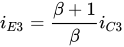
An approximate analysis due to Gilbert[3] shows how the Wilson current mirror works and why its static error should be very low. Transistors Q1 and Q2 in Fig. 1 are a matched pair sharing the same emitter and base potentials and therefore have and . This is a simple two-transistor current mirror with as its input and as its output. When a current is applied to the input node (the connection between the base of Q3 and collector of Q1), the voltage from that node to ground begins to increase. As it exceeds the voltage required to bias the emitter-base junction of Q3, Q3 acts as an emitter follower or common collector amplifier and the base voltage of Q1 and Q2 begins to rise. As this base voltage increases, current begins to flow in the collector of Q1. All increases in voltage and current stop when the sum of the collector current of Q1 and base current of Q3 exactly balance .[dubiousdiscuss] Under this condition all three transistors have nearly equal collector currents and therefore approximately equal base currents. Let . Then the collector current of Q1 is ; the collector current of Q2 is exactly equal to that of Q1 so the emitter current of Q3 is . The collector current of Q3 is its emitter current minus the base current so . In this approximation, the static error is zero.

Difference of input and output currents

[edit]

A more exact formal analysis shows the expected static error. We assume:

  1. All transistors have the same current gain β.
  2. Q1 and Q2 are matched, and they share the same base-emitter voltage, so their collector currents are equal.

Therefore, and . The base current of Q3 is given by, and the emitter current by,

... (1)

From the sum of currents at the node shared by the emitter of Q3, the collector of Q2 and the bases of Q1 and Q2, the emitter current of Q3 must be:

... (2)

Equating the expressions for in (1) and (2) gives:

... (3)

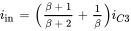
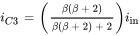
The sum of currents at the input node implies that . Substituting for from (3) leads to: or .

Because is the output current, the static error, the difference between the input and output currents, is:

... (4)

With NPN transistors, the current gain, , is of the order of 100, and, in principle, the mismatch is about 1:5000.

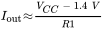
For the Wilson current source of Fig. 2, the input current of the mirror is . The base-emitter voltages, , are typically between 0.5 and 0.75 volts so some authors[1] approximate this result as . The output current is thus substantially dependent only on VCC and R1 and the circuit acts as a constant current source, that is, the current remains constant with variations in the impedance of the load. However, variations in VCC or changes in the value of R1 due to temperature will be reflected in variations in the output current. This method of direct generation of a reference current from the power supply using a resistor rarely has adequate stability for practical applications and more complex circuits are used to provide reference currents independent of temperature and supply voltages.[4]

Equation (4) substantially underestimates the differences between the input and output currents that are generally found in this circuit for three reasons. First, the emitter-collector voltages of the inner current mirror formed by Q1 and Q2 are not the same. Transistor Q2 is diode-connected and has , which is typically on the order of 0.6 to 0.7 volts. The collector emitter voltage of Q1 is higher by the base-emitter voltage of Q3 and therefore is about twice the value across Q2. The Early effect (base-width modulation) in Q1 will force its collector current to be slightly higher than that of Q2. This problem can be essentially eliminated by the addition of a fourth transistor, shown as Q4 in the improved Wilson current mirror of Fig. 4a. Q4 is diode-connected in series with the collector of Q1, lowering its collector voltage until it is approximately equal to for Q2.

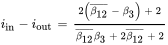
Second, the Wilson current mirror is susceptible to mismatches in the current gain, , of its transistors, particularly the match between and the current gains of the matched pair Q1 and Q2.[3] Accounting for differences among all three transistors, one can show that where is the harmonic mean of the current gains of Q1 and Q2 or . Beta mismatches of five percent or more are reported[3] to be common, causing an order of magnitude increase in the static error.

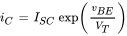
Finally, the collector current in a bipolar transistor for low and moderate emitter currents conforms closely to the relation where is the thermal voltage and is a constant dependent on temperature, doping concentrations, and collector-emitter voltage.[5] Matched currents in transistors Q1 and Q2 depend on conformity to the same equation but observed mismatches in are geometry dependent and range from percent.[6] Such differences between Q1 and Q2 lead directly to static errors of the same percentage for the entire mirror. Careful layout and transistor design must be used to minimize this source of error. For example, Q1 and Q2 may each be implemented as a pair of paralleled transistors arranged as a cross-coupled quad in a common-centric layout to reduce effects of local gradients in current gain.[3] If the mirror is to be used at a fixed bias level, matching resistors in the emitters of this pair can transfer some of the matching problem from the transistors to those resistors.
Input and output impedances and frequency response

[edit]
Fig. 3: Small-signal model for impedance calculation

A circuit is a current source only to the extent that its output current is independent of its output voltage. In the circuits of Fig. 1 and Fig. 2, the output voltage of importance is the potential from the collector of Q3 to ground. The measure of that independence is the output impedance of the circuit, the ratio of a change in output voltage to the change in current it causes. Fig. 3 shows a small signal model of a Wilson current mirror drawn with a test voltage source, , attached to the output. The output impedance is the ratio: . At low frequency this ratio is real and represents an output resistance.

In Fig. 3, transistors Q1 and Q2 are shown as forming a standard two-transistor current mirror. It is sufficient for calculating the output impedance[1][3] to assume that the output current of this current mirror sub-circuit, , is equal to the input current, , or . Transistor Q3 is represented by its low-frequency hybrid-pi model with a current controlled dependent current source for the collector current.

The sum of currents at the emitter node of Q3 implies that:

... (5)

Because the dynamic resistance of the diode-connected transistor Q2, the input resistance of the two-transistor current mirror, is much smaller than , the test voltage, , effectively appears across the collector-emitter terminals of Q3. The base current of Q3 is . Using equation (5) for , the sum of currents at the collector node of Q3 becomes . Solving for the output impedance gives:

... (6)

In a standard two-transistor current mirror, the output impedance would be the dynamic early resistance of the output transistor, the equivalent of which in this case is . The Wilson current mirror has an output impedance that is higher by the factor , on the order of 50 times.

The input impedance of a current mirror is the ratio of the change in input voltage (the potential from the input terminal to ground in Fig. 1 and Fig. 2) to the change in input current that causes it. Since the change in output current is very nearly equal to any change in input current, the change in the base-emitter voltage of Q3 is . Eq. (3) shows that the collector of Q2 changes by nearly the same amount, so . The input voltage is the sum of the base-emitter voltages of Q2 and Q3; the collector currents of Q2 and Q3 are nearly equal implying that . The input impedance is . Using the standard formula for leads to:

... (7)

where is the usual thermal voltage, the product of the Boltzmann constant and absolute temperature divided by the charge of an electron. This impedance is twice the value of for the standard two-transistor current mirror.

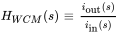
Current mirrors are frequently used in the signal path of an integrated circuit, for example, for differential to single-ended signal conversion within an operational amplifier. At low bias currents, the impedances in the circuit are high enough that the effect of frequency may be dominated by device and parasitic capacitances shunting the input and output nodes to ground, lowering the input and output impedances.[3] The collector-base capacitance, , of Q3 is one component of that capacitive load. The collector of Q3 is the output node of the mirror and its base is the input node. When any current flows in , that current becomes an input to the mirror and the current is doubled at the output. Effectively the contribution from Q3 to the total output capacitance is . If the output of the Wilson mirror is connected to a relatively high impedance node, the voltage gain of the mirror may be high. In that case the input impedance of the mirror may be affected by the Miller effect because of , although the low input impedance of the mirror mitigates this effect.

When the circuit is biased at higher currents that maximize the frequency response of the transistor current gain, it is possible to operate a Wilson current mirror with satisfactory results at frequencies up to approximately one tenth of the transition frequency of the transistors.[3] The transition frequency of a bipolar transistor, , is the frequency at which the short-circuit common-emitter current gain falls to unity.[7] It is effectively the highest frequency for which a transistor may supply useful gain in an amplifier. The transition frequency is a function of the collector current, increasing with increasing current until a broad maximum at a collector current slightly less than what causes the onset of high injection. In simple models of the bipolar transistor when the collector is grounded, shows a single-pole frequency response so is also the current gain-bandwidth product. Crudely this implies that at , . By equation (4) one might expect the magnitude of the ratio of output to input current at that frequency to differ from unity by about 2%.

The Wilson current mirror achieves the high output impedance of equation (6) by negative feedback rather than by emitter degeneration as cascoded mirrors or sources with resistor degeneration do. The node impedance of the only internal node of the mirror, the node at the emitter of Q3 and the collector of Q2, is quite low.[3] At low frequency, that impedance is given by . For a device biased at 1 mA having a current gain of 100, this evaluates to 0.26 ohms at 25 °C. Any change in output current with output voltage results in a change in the emitter current of Q3 but very little change in the emitter node voltage. The change in is fed back through Q2 and Q1 to the input node where it changes the base current of Q3 in a way that reduces the net change in output current, thus closing the feedback loop.

Circuits that contain negative feedback loops, whether current or voltage loops, with loop gains near or above unity may exhibit undesirable anomalies in frequency response when the phase shift of the signal inside the loop is sufficient to convert negative into positive feedback. For the current feedback loop of the Wilson current mirror this effect appears as a strong broad resonant peak in the ratio of the output to input current, , at about . Gilbert[3] shows a simulation of a Wilson current mirror implemented in NPN transistors with GHz and current gain that shows a peak of 7.5 dB at 1.2 GHz. This behavior is very undesirable and can be largely eliminated by further modification of the basic mirror circuit. Fig. 4b show a possible variant on the Wilson mirror that reduces this peak by disconnecting the bases of Q1 and Q2 from the collector of Q2 and adding a second emitter to Q3 to drive the bases of the internal mirror. For the same bias conditions and device type, this circuit exhibits flat frequency response to 50 MHz, has a peak response less than 0.7 dB at 160 MHz and falls below its low-frequency response at 350 MHz.
Minimum operating voltages

[edit]

The compliance of a current source, that is, the range of output voltage over which the output current remains approximately constant, affects the potentials available to bias and operate the circuitry in which the source is embedded. For example, in Fig. 2 the voltage available to the "Load" is the difference between the supply voltage and the collector voltage of Q3. The collector of Q3 is the output node of the mirror and the potential of that collector relative to ground is the output voltage of the mirror, that is, and the "load" voltage is . The "load" voltage range is maximized at the minimum . Also, when a current mirror source is used as an active load for one stage of a system, the input to the next stage is often directly connected between the source output node and the same power rail as the mirror. This may require that the minimum be kept as small as possible to simplify biasing the succeeding stage and to make it possible to turn that stage fully off under transient or overdrive conditions.


The minimum output voltage of the Wilson current mirror must exceed the base emitter voltage of Q2 by enough that Q3 will operate in active mode rather than saturation. Gilbert[3] reports data on a representative implementation of a Wilson current mirror that showed constant output current for an output voltage as low as 880 millivolts. Since the circuit was biased for high frequency operation (), this represents a saturation voltage for Q3 of 0.1 to 0.2 volts. By contrast, the standard two-transistor mirror operates down to the saturation voltage of its output transistor.

The input voltage of the Wilson current mirror is . The input node is a low impedance node so its voltage remains approximately constant during operation at volts. The equivalent voltage for the standard two-transistor mirror is only one base-emitter drop, , or half that of the Wilson mirror. The headroom (the potential difference between the opposite power rail and the input of the mirror) available to the circuitry that generates the input current to the mirror is the difference of the power supply voltage and the mirror input voltage. The higher input voltage and higher minimum output voltage of the Wilson current mirror configuration may become problematic for circuits with low supply voltages, particularly supply voltages less than three volts as are sometimes found in battery powered devices.

A four-transistor improved mirror

[edit]
Fig. 4a) Four transistor Wilson current mirror; 4b) Variant that removes peak in high-frequency response.

Adding a fourth transistor to the Wilson current mirror as in Fig. 4a equalizes the collector voltages of Q1 and Q2 by lowering the collector voltage of Q1 by an amount equal to VBE4. This has three effects: first, it removes any mismatch between Q1 and Q2 due to the Early effect in Q1. This is the only first order source of mismatch in the three-transistor Wilson current mirror[8] Second, at high currents the current gain, β, of transistors decreases and the relation of collector current to base-emitter voltage deviates from . The severity of these effects depends on the collector voltage. By forcing a match between the collector voltages of Q1 and Q2, the circuit makes the performance degradation at high current on the input and output branches symmetric. This extends the linear operating range of the circuit substantially. In one reported measurement on a circuit implemented with a transistor array for an application requiring 10 mA output, the addition of the fourth transistor extended the operating current for which the circuit showed less than 1% difference between input and output currents by at least a factor of two over the three transistor version.[9]
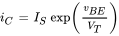
Finally, equalizing the collector voltages also equalizes the power dissipated in Q1 and Q2 and that tends to reduce mismatch from the effects of temperature on VBE.

Advantages and limitations

[edit]

There are a number of other possible current mirror configurations in addition to the standard two-transistor mirror that a designer may choose to use.[10] These include ones in which the mismatch from base current are reduced with an emitter follower,[3] circuits that use cascoded structures or resistor degeneration to lower the static error and raise output impedance, and gain-boosted current mirrors that use an internal error amplifier to improve the effectiveness of cascoding. The Wilson current mirror has the particular advantages over alternatives that:

  • The static error, the input-output current difference, is reduced to very small levels attributable almost entirely to random device mismatches while the output impedance is raised by a factor of simultaneously.
  • The circuit uses minimum resources. It does not require additional bias voltages or large area resistors as do cascoded or resistively degenerated mirrors.
  • The low impedance of its input and internal nodes makes it possible to bias the circuit for operation at frequencies up to .
  • The four-transistor version of the circuit has extended linearity for operation at high currents.

The Wilson current mirror has the limitations that:

  • The minimum potentials from input or output to the common rail connection that are needed for proper operation are higher than for the standard two-transistor mirror. This reduces the headroom available to generate the input current and limits the compliance of the output.
  • This mirror uses feedback to raise the output impedance in such a way that the output transistor contributes collector current fluctuation noise to the output. All three transistors of the Wilson current mirror add noise to the output.
  • When the circuit is biased for high frequency operation with maximum , the negative feedback loop that maximizes the output impedance may cause peaking in the frequency response of the mirror. For stable, low-noise operation it may be necessary to modify the circuit to eliminate this effect.
  • In some applications of a current mirror, particularly for biasing and active load applications, it is advantageous to produce multiple current sources from a single input reference current. This is not possible in the Wilson configuration while maintaining an accurate match of the input current to the output currents.

MOSFET implementation

[edit]
Fig. 5: NMOS Wilson current mirror. M3 equalizes the drain-source voltages of M1 and M2

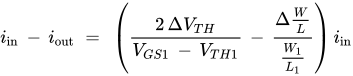
When the Wilson current mirror is used in CMOS circuits, it is usually in the four transistor form as in Fig. 5.[10] If the transistor pairs M1/M2 and M3/M4 are exactly matched and the input and output potentials are approximately equal, then in principle there is no static error, the input and output currents are equal because there is no low frequency or DC current into the gate of a MOSFET. However, there are always mismatches between transistors caused by random lithographic variation in device geometry and by variations in threshold voltage between devices.

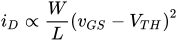
For long-channel MOSFETs operating in saturation at fixed drain-source voltage, , the drain current is proportional to device sizes and to the magnitude of the difference between the gate-source voltage and the device threshold voltage as[1]

... (8)

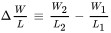
where is the device width, is its length and the device threshold voltage. Random lithographic variations are reflected as different values of the ratio of each transistor. Similarly threshold variations appear as small differences in the value of for each transistor. Let and . The mirror circuit of Fig. 5 forces the drain current of M1 to equal the input current and the output configuration assures that the output current equals the drain current of M2. Expanding equation (8) in a two-variable Taylor series about and truncating after the first linear term, leads to an expression for the mismatch of the drain currents of M1 and M2 as:

... (9)

The statistics of the variation in threshold voltage of matched pairs across a wafer have been studied extensively.[11] The standard deviation of the threshold voltage variation depends on the absolute size of the devices, the minimum feature size of the manufacturing process, and the body voltage and is typically 1 to 3 millivolts. Therefore, to keep the contribution of the threshold voltage term in equation (9) to a percent or less requires biasing the transistors with the gate-source voltage exceeding the threshold by several tenths of a volt. This has the subsidiary effect of lowering the contribution of the mirror transistors to the output current noise because the drain current noise density in a MOSFET is proportional to the transconductance and therefore inversely proportional to .[12]

Similarly, careful layout is required to minimize the effect of the second, geometric term in (9) that is proportional to . One possibility is to subdivide transistors M1 and M2 into multiple devices in parallel that are arranged in a common-centric or interdigitated layout with or without dummy guard structures on the perimeter.[13]

The output impedance of the MOSFET Wilson current mirror can be calculated in the same way as for the bipolar version. If there is no body effect in M4, the low frequency output impedance is given by .[10] For M4 not to have a body-source potential, it must be implemented in a separate body well. However, the more common practice is for all four transistors to share a common body connection. The drain of M2 is a relatively low impedance node and this limits the body effect. The output impedance in that case is:

... (10)

As in the case of the bipolar transistor version of this circuit, the output impedance is much larger than it would be for the standard two-transistor current mirror. Since would be the same as the output impedance of the standard mirror, the ratio of the two is , which is often quite large.

The principal limitation on the use of the Wilson current mirror in MOS circuits is the high minimum voltages between the ground connection in Fig. 5 and the input and output nodes that are required for proper operation of all transistors in saturation.[10] The voltage difference between the input node and ground is . The threshold voltage of MOS devices is usually between 0.4 and 1.0 volts with no body effect depending on the manufacturing technology. Because must exceed the threshold voltage by a few tenths of a volt to have satisfactory input-output current match, the total input to ground potential is comparable to 2.0 volts. This difference is increased when the transistors share a common body terminal and the body effect in M4 raises its threshold voltage. On the output side of the mirror, the minimum voltage to ground is . This voltage is likely to be significantly greater than 1.0 volts. Both potential differences leave insufficient headroom for the circuitry that provides the input current and uses the output current unless the power supply voltage is higher than 3 volts. Many contemporary integrated circuits are designed to use low voltage power supplies to accommodate the limitations of short-channel transistors, to meet the need for battery operated devices and to have high power efficiency in general. The result is that new designs tend to use some variant of a wide swing cascode current mirror configuration.[10][14][15] In the case of extremely low power supply voltages of one volt or less, the use of current mirrors may be abandoned entirely.[16]

See also

[edit]

References

[edit]

Further reading

[edit]
Revisions and contributorsEdit on WikipediaRead on Wikipedia
from Grokipedia
The Wilson current mirror is a three- analog circuit configuration used in electronic design to replicate an input current with high precision at its output, functioning as either a or sink, and serving as an improvement over the basic two- current mirror by employing to enhance and minimize errors due to mismatches or voltage variations. Invented in 1967 by George R. Wilson, an analog engineer at , the circuit originated from efforts to address limitations in early current mirroring techniques, such as base current errors and sensitivity to the in bipolar junction (BJTs). In its standard BJT implementation, the configuration consists of two matched transistors (Q1 and Q2) forming the core mirror, with a third transistor (Q3) connected in a arrangement to shield the output from collector voltage fluctuations, ensuring the output current remains nearly equal to the input current—typically within 1% accuracy—and achieving an on the order of 90 MΩ, far superior to the basic mirror's 1 MΩ. This design's mechanism effectively cancels base current discrepancies and stabilizes operation across a useful voltage range starting above approximately 1 V, making it widely applicable in operational amplifiers, circuits, and precision analog systems. Variants include PNP configurations for complementary applications and four-transistor enhancements that further reduce output current error to about 0.6%, while analogs adapt the principle for processes, maintaining high performance at low voltages and across current levels from weak to strong inversion.

Introduction and History

Overview

The Wilson current mirror is a three-terminal analog circuit employing three bipolar junction transistors (BJTs) to replicate an input reference current at the output with high precision and minimal error. In its basic configuration, the circuit features an input transistor Q1 that sets the reference current, while transistors Q2 and Q3 form the output branch; Q3 provides negative feedback by connecting its collector to the bases of Q1 and Q2, thereby equalizing the base-emitter voltages across Q1 and Q2 to ensure the output current closely tracks the input. This feedback mechanism enhances the circuit's accuracy compared to simpler two-transistor mirrors, which suffer from base current errors in finite β conditions. The primary purpose of the Wilson current mirror is to serve as a stable or sink in analog integrated circuits, facilitating applications such as generation, , and amplification. By achieving a high —typically on the order of β times that of basic mirrors—it minimizes variations in output current due to changes in load voltage, making it particularly valuable in operational amplifiers and other precision analog blocks where consistent biasing is essential. Invented in 1967 by George R. Wilson during a design challenge at , the circuit was first detailed in a seminal publication the following year.

Invention and Development

The Wilson current mirror was invented in 1967 by George R. Wilson, an engineer at , Inc., in . The development stemmed from a friendly challenge between Wilson and his colleague Barrie Gilbert to design a superior current mirroring circuit using just three bipolar junction transistors, addressing limitations in accuracy and found in earlier two-transistor mirrors. This effort was motivated by the growing demands of precision analog circuitry in oscilloscopes and early monolithic at , where improved current sources were essential for stable performance without extra passive components. Wilson's innovation was first detailed in a technical paper presented at the 1968 IEEE International Solid-State Circuits Conference and published in the December issue of the IEEE Journal of Solid-State Circuits. Titled "A Monolithic Junction FET-NPN Operational Amplifier," the article described the mirror as a key building block within a novel hybrid combining junction inputs with bipolar transistors for enhanced and gain. In this context, the three-transistor configuration was introduced to provide a high-compliance, low-error that minimized base current errors and variations, marking a significant advancement in techniques for analog ICs. Following its publication, the Wilson current mirror gained rapid recognition among analog designers for its superior precision and simplicity, becoming a foundational element in architectures during the late 1960s and 1970s. It influenced the evolution of monolithic op-amps by enabling higher gain stages and better matching in integrated designs, as evidenced by its integration into subsequent and industry-wide circuits that prioritized low-offset and high-output resistance. This early adoption underscored its role in advancing the reliability of in emerging technologies.

Basic Circuit Operation

Circuit Configuration

The standard Wilson current mirror employs three identical bipolar junction transistors (BJTs), typically NPN types labeled Q1, Q2, and Q3, arranged to replicate an input reference current with high accuracy. The emitters of Q1 and Q2 connect directly to the common ground terminal, while the bases of Q1 and Q2 interconnect at a single node, with Q1 diode-connected by tying its collector to this common base node. The base of Q3 connects to this common base node. The input terminal resides at the collector of Q3, where the reference IinI_\text{in} applies current into the circuit. The emitter of Q3 connects to the collector of Q2, establishing a feedback path. The output terminal is the collector of Q2, delivering the mirrored output current IoutI_\text{out} to an external load, with the common ground serving as the third terminal. In the ideal schematic, IinI_\text{in} flows from a into the collector of Q3, and IoutI_\text{out} exits the collector of Q2 to a load or equivalent, assuming all transistors operate in the with high current gain β\beta. The transistors are assumed to be matched with identical characteristics to minimize mirroring errors. This topology incorporates a feedback loop via Q3 to regulate base voltages and equalize collector-emitter conditions between Q1 and Q2.

Current Mirroring Mechanism

The Wilson current mirror achieves precise current replication through a mechanism that enhances accuracy beyond basic two-transistor mirrors. In this configuration, transistors Q1 and Q2 form the core mirroring pair with their bases connected together and emitters grounded, while Q3 serves as a feedback element. The input current IinI_{\text{in}} is applied to the collector of Q3, which flows through Q3 to its emitter connected to the collector of Q2. This setup allows Q3 to sense deviations in the output current at Q2's collector and adjust the common base voltage accordingly. The feedback role of Q3 is to monitor the voltage at the Q2 collector node, which is tied to Q3's emitter, and dynamically adjust the base voltages of Q1 and Q2 to equalize their base-emitter voltages VBEV_{BE}. If the output current IoutI_{\text{out}} tends to deviate from IinI_{\text{in}}, the resulting change in Q3's base-emitter voltage alters the common base potential, forcing Q1 and Q2 to operate with matched VBEV_{BE} and thus identical collector currents despite finite current gain β\beta. This equalization minimizes mismatches from base current extraction, as Q3 effectively buffers and compensates for the base currents of Q1 and Q2, reducing systematic errors in current copying. Qualitatively, the input current IinI_{\text{in}} establishes the collector current of Q3, which sets the current at the output node. Through the shared base bias, it initially sets the collector current of Q1. Q3's feedback loop then intervenes: any imbalance causes Q3 to conduct more or less, adjusting the voltage at Q2's collector to maintain equilibrium where IoutIinI_{\text{out}} \approx I_{\text{in}}. This closed-loop action not only replicates the current with but also partially compensates for output voltage variations by stabilizing the collector-emitter voltages of Q1 and Q2, mitigating the Early effect's influence on current matching.

Static Error Analysis

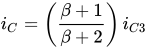
The static error in a Wilson current mirror arises from the finite current gain (β) of the transistors, leading to a mismatch between the input current (I_in) and output current (I_out). This error is defined as ΔI = I_out - I_in, and for matched transistors, the relative error ΔI / I_in ≈ -2 / β², representing a second-order effect that is significantly smaller than the first-order error (∼2/β) in simpler configurations. To derive this, apply Kirchhoff's current law (KCL) at the key nodes, assuming identical bipolar junction transistors with finite β and neglecting the Early effect (infinite output resistance). The input current I_in = I_C3 + I_B3, but since I_C3 = β I_B3, I_in = I_B3 (β + 1). The emitter current of Q3 I_E3 = I_in (β + 1)/β = I_out + I_B2 (since I_E3 flows to Q2 collector and base of Q2, but feedback adjusts). With matched Q1 and Q2, I_C1 = I_C2 (1 - 1/β + ...), but the feedback makes the base currents compensated to second order. Standard analysis yields I_out / I_in = 1 / (1 + 2/β(β + 2)) ≈ 1 - 2/β² for large β. The error depends strongly on β; for example, with β = 100 (typical for integrated BJTs), the relative error is approximately 0.02%, far superior to the ∼2% error in a basic two-transistor mirror. This analysis assumes identical transistors (matched β and saturation currents) and neglects the Early effect, which would introduce additional voltage-dependent errors if considered. The negative feedback mechanism in the Wilson configuration, where Q3 senses and corrects the base current loading, is primarily responsible for suppressing the error to second order.

Performance Characteristics

Input and Output Impedances

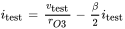
The input impedance of the Wilson current mirror is low and current-dependent, approximately Zin2(kT/q)IinZ_{in} \approx \frac{2 (kT/q)}{I_{in}}, resembling that of a diode-connected . This value arises from the small-signal resistance seen at the input port, where the configuration effectively presents the parallel base-emitter paths of the mirroring transistors, scaled by the thermal voltage kT/qkT/q (approximately 26 mV at ) and inversely proportional to the input current IinI_{in}. The , in contrast, is a key advantage of the Wilson , given by Zout(β/2)rO3Z_{out} \approx (\beta / 2) r_{O3}, where β\beta is the current gain and rO3r_{O3} is the output resistance of the third (typically rO3=VA/ICr_{O3} = V_A / I_C, with VAV_A the Early voltage and ICI_C the collector current). This expression is approximately β/2\beta / 2 times higher than the rOr_O of a simple current mirror, providing better current stability against output voltage variations. This high output impedance results from negative feedback in the small-signal model. To derive it, apply a test voltage vxv_x at the output port (collector of the second ) with a test current ixi_x, yielding Zout=vx/ixZ_{out} = v_x / i_x. The feedback loop—through the base of the third sensing output current changes and adjusting the voltage—creates a loop gain that boosts the effective resistance. Specifically, the third operates in a configuration, and the mirroring action amplifies the intrinsic rO3r_{O3} by the factor β/2\beta / 2, as the base current modulation reinforces the output current rejection. Detailed small-signal , incorporating hybrid-pi models for all s and assuming matched devices with high β\beta, confirms this enhancement without requiring emitter degeneration. For instance, with β=100\beta = 100 and rO3=100kΩr_{O3} = 100 \, \mathrm{k}\Omega, the output impedance reaches approximately 5 MΩ\Omega, compared to 100 kΩ\Omega in a standard two-transistor , demonstrating the substantial improvement in compliance.

Frequency Response

The of the Wilson current mirror is governed by its small-signal AC model, which reveals second-order dynamics arising from pole-zero interactions in the feedback loop. The model incorporates capacitances, resulting in a dominant pole and a high-frequency non-minimum-phase zero that introduces additional phase lag. This configuration leads to frequency-dependent errors that increase beyond the mirror's bandwidth, as the zero shifts closer to the pole in smaller-geometry transistors, degrading the . A notable characteristic is the potential for gain peaking at approximately fT/3f_T / 3, where fTf_T is the transistor's transition , caused by phase shifts in the path. This peaking can cause in high-speed applications unless addressed, with simulations showing overestimated phase margins (e.g., 35.14° without the zero versus 26.7° with accurate modeling). The mirror's bandwidth is generally limited to about fT/10f_T / 10 for reliable operation without excessive error or ; for instance, transistors with fT=3f_T = 3 GHz yield a bandwidth of around 300 MHz. To mitigate these effects, the Wilson current mirror is best suited for low-frequency applications where signals are well below the transition frequency. Alternatively, adding compensation capacitors across critical nodes can stabilize the response by adjusting the pole-zero placement and suppressing peaking, though values must be determined empirically to avoid overcompensation.

Minimum Operating Voltages

The Wilson current mirror exhibits higher minimum operating voltages than simpler two-transistor configurations, primarily due to the stacking of transistors and the loop that enhances current accuracy but consumes additional headroom. For saturation-free operation in (BJT) implementations, the minimum input voltage Vin,minV_{in,min} is determined by the need to keep all transistors in the , given by Vin,min2VBE+VCE(sat)V_{in,min} \approx 2 V_{BE} + V_{CE(sat)}, where VBEV_{BE} is the base-emitter voltage and VCE(sat)V_{CE(sat)} is the collector-emitter saturation voltage. At for typical BJTs, with VBE0.7V_{BE} \approx 0.7 V and VCE(sat)V_{CE(sat)} small (often 0.05–0.1 V), this approximates to 1.4 V. The minimum output voltage Vout,minV_{out,min} follows similarly, requiring Vout,minVBE+2VCE(sat)V_{out,min} \approx V_{BE} + 2 V_{CE(sat)} to maintain active-mode operation across the output branch transistors and feedback element. Using the same typical values for BJTs at , this yields approximately 0.88 V. These thresholds exceed those of the basic , where the input minimum is roughly VBE0.7V_{BE} \approx 0.7 V, owing to the extra voltage drops from the additional and feedback path in the Wilson design. These minimum voltages are influenced by temperature variations, as VBEV_{BE} decreases by approximately 2 mV/°C with rising , thereby reducing the overall headroom requirements but potentially affecting matching if not compensated. Additionally, the Early voltage (VAV_A) impacts the effective minima by altering the boundaries of the ; a higher VAV_A allows operation closer to saturation with minimal current deviation, effectively extending usable headroom before significant errors occur.

Improved Variants

Four-Transistor Enhanced Mirror

The four-transistor enhanced Wilson current mirror addresses residual errors in the basic three-transistor configuration by adding a fourth transistor, Q4, as a on the input transistor Q1. This setup isolates the input from voltage variations and equalizes the V_{CE} between Q1 and Q2, minimizing modulation of the output current due to transistor mismatches. The circuit employs four matched bipolar junction transistors (BJTs), with Q1 and Q2 forming the core mirroring pair, Q3 providing feedback, and Q4 connected with its base to Q3's base, emitter to Q1's collector, and collector to the reference current input. In operation, the input reference current I_{REF} flows through Q4 and Q1, establishing equal base-emitter voltages for Q1 and Q2, while the feedback from Q3's collector to the bases of Q1 and Q2 corrects for base current mismatches. Q4 equalizes the V_{CE} of Q1 and Q2, both approximately equal to V_{BE}, reducing Early effect-induced current variations regardless of output voltage changes. This configuration upholds the mechanism of the original Wilson mirror while enhancing stability against load fluctuations. Key benefits include further reduced output current error to approximately 0.6%, extended output compliance range, and significantly increased to approximately \beta r_O / 2, where \beta is the current gain and r_O is the small-signal output resistance, providing superior performance in integrated circuits. However, this enhancement introduces trade-offs, including a higher minimum voltage requirement in the reference current path, adding an extra V_{CE(sat)} drop beyond the standard Wilson mirror, which can limit its use in low-voltage applications. Despite this, the four-transistor design remains a preferred choice for precision analog circuits demanding high and minimal error from mismatches.

Comparison to Other Current Mirrors

The Wilson current mirror offers significant improvements over the simple two- current mirror in terms of accuracy and . In the simple mirror, the relative output current error due to finite current gain β\beta is approximately 1/β1/\beta, whereas the Wilson configuration reduces this to 1/β21/\beta^2 for unity gain through that minimizes base current effects. Additionally, the of the simple mirror is roughly rOr_O, the output resistance, while the Wilson mirror achieves approximately βrO/2\beta r_O / 2, providing better performance. However, this enhancement comes at the cost of increased voltage headroom requirements, with the Wilson needing a minimum output voltage of about VBE+VCE,sat0.8V_{BE} + V_{CE,sat} \approx 0.8 V compared to roughly VCE,sat0.2V_{CE,sat} \approx 0.2 V for the simple mirror to maintain operation in the . Compared to the Widlar current source, which is a variant of the simple mirror modified with an emitter on the output to generate current ratios, the Wilson excels in precision unity-gain applications without requiring such . The Widlar is particularly suited for producing small output currents from a larger reference via a logarithmic relationship set by the value, but it introduces non-linearity and additional complexity for exact ratios. In contrast, the Wilson provides a more straightforward, resistor-free approach for equal currents, achieving higher accuracy and suitable for integrated circuits where component matching is feasible. The Wilson current mirror shares similarities with the current mirror in enhancing to approximately βrO/2\beta r_O / 2, both using stacked s to increase effective resistance through cascode effect. However, the requires additional bias circuitry for the upper to ensure proper operation, potentially complicating layout in integrated designs and demanding larger voltage headroom similar to the Wilson. The Wilson avoids these bias needs by employing feedback from its third , offering comparable performance with simpler biasing while maintaining low . Overall, the Wilson current mirror strikes an optimal balance for precision unity-gain current mirroring in integrated circuits, particularly where moderate supply voltages are available and high accuracy without extra passive components is prioritized over the minimal headroom of simpler topologies.

Implementations and Applications

Bipolar Junction Transistor Version

The bipolar junction transistor (BJT) implementation of the Wilson current mirror utilizes three matched NPN or PNP transistors configured to provide a high output impedance and precise current replication, minimizing errors from base current mismatches inherent in simpler two-transistor mirrors. For optimal performance, the transistors must exhibit identical current gain β, base-emitter voltage V_BE, and output resistance r_O (influenced by the Early voltage V_A), as mismatches in these parameters introduce systematic DC errors in the output current ratio. In particular, variations in β lead to base current imbalances that are largely corrected by the feedback action of the third transistor, but residual errors scale with mismatches in V_BE (typically 1-2 mV across a chip) and r_O, which can cause up to 1% deviation in mirroring accuracy without compensation. Integrated circuit fabrication significantly aids matching by placing transistors in close proximity on the same silicon die, reducing gradients in doping, temperature, and process variations. Design considerations for BJT Wilson mirrors in discrete applications emphasize selecting transistors with high β (>100) and low V_BE spread from the same lot, often achieved through emitter degeneration resistors to stabilize against β variations. In monolithic integrated circuits, precise matching is obtained via area-matched diffusions, where emitter areas are scaled identically (e.g., using identical layouts) to ensure uniform β and V_BE; gradients are minimized by symmetrical layouts and proximity to reduce self-heating effects, which can otherwise alter r_O by 10-20% per 10°C rise. compensation, when required for precision applications, involves circuit techniques like matched dissipation or proximity-based coupling rather than active elements, as the mirror's inherent feedback provides some stability against moderate drifts. A representative application of the BJT Wilson current mirror is as an in differential stages, where it mirrors the input bias current I_in to the output I_out to maintain balance and high gain. For instance, in the classic μA741 op-amp, a Wilson mirror configuration (transistors Q5, Q6, and Q7) serves as the active load for the input differential pair, ensuring equal collector currents for the two sides and enabling a exceeding 90 dB while supporting output swings close to the rails. This setup leverages the mirror's high (typically > β * r_O, or 1-10 MΩ) to boost stage gain without additional components. Regarding noise performance, the BJT Wilson current mirror introduces base from all three transistors, which is somewhat amplified by the loop connecting the third transistor's base to the first, contributing thermal and components at the output. The feedback may increase output compared to basic two-transistor mirrors due to impedance effects.

MOSFET Version

The MOSFET version of the Wilson current mirror adapts the classic topology for CMOS integrated circuits by substituting bipolar junction transistors with , either NMOS for current sinks or PMOS for current sources. In this arrangement, M1 functions as the input transistor, accepting the reference current IinI_\text{in} at its drain with its source connected to the common terminal (ground for NMOS). The gates of M1, M2, and M3 are interconnected, while M2 and M3 constitute the output branch: M2 has its source to the common terminal and drain connected to the source of M3, with the output current IoutI_\text{out} drawn from the drain of M3. Feedback is established by linking the drain of M3 to the common gate node, which regulates the gate-source voltage and enhances mirroring accuracy. Under ideal conditions with matched transistors and ignoring secondary effects, the MOSFET Wilson current mirror achieves exact current replication, where Iout=IinI_\text{out} = I_\text{in}, free from the static discrepancies seen in the bipolar counterpart due to the absence of currents in . This zero current eliminates loading errors at the input, allowing precise current transfer without additional correction mechanisms. In real implementations, however, non-idealities introduce errors, predominantly from channel-length modulation arising from parameter mismatches between M2 and M3, as well as threshold voltage VTHV_\text{TH} variations due to process gradients. The channel-length modulation effect, characterized by the parameter λ\lambda, causes the drain current to vary with drain-source voltage VDSV_\text{DS}; with mismatched λ\lambda, the relative error approximates ΔI/Iin(λ3λ2)\Delta I / I_\text{in} \approx (\lambda_3 - \lambda_2), where λ3\lambda_3 and λ2\lambda_2 correspond to M3 and . Threshold voltage mismatches similarly perturb the gate-source voltages, leading to proportional deviations in IoutI_\text{out}. This configuration excels in environments owing to its ultralow power draw from negligible static gate currents and compatibility with advanced nanoscale processes for compact, high-density integration. The is significantly higher than that of a basic mirror, approximately (gm3ro3)ro2(g_{m3} r_{o3}) r_{o2}, where ro=1/(λIout)r_o = 1/(\lambda I_\text{out}), offering robust performance against output voltage swings in bias and reference circuits.

Practical Applications

The Wilson current mirror finds widespread application in analog and mixed-signal integrated circuits where high-precision current replication is essential. In (op-amp) design, it serves as an for differential amplifiers, facilitating single-ended output conversion while enhancing (CMRR) through its high and balanced current steering. For instance, in BiCMOS op-amps for switched-capacitor video filters, a modified bipolar Wilson current mirror at the differential pair output achieves large bandwidth and improved gain by minimizing common-mode variations. Similarly, NMOS differential amplifiers employing a modified Wilson current mirror as a passive load demonstrate enhanced output power and linearity in biomedical . In biasing circuits, the Wilson current mirror provides stable current sources for integrated circuits such as analog-to-digital converters (ADCs) and sensors by accurately mirroring reference currents, ensuring consistent operation across varying conditions. This is particularly useful in pixel-level ADCs for image sensors, where the mirror integrates into comparators to maintain precise and timing in Nyquist-rate conversions. Its role extends to multi-channel integrating ADCs, where it supports current-mode operation for low-voltage, high-resolution signal processing in sensor interfaces. Contemporary implementations leverage the Wilson current mirror in low-power op-amps, where low-voltage variants enable efficient biasing and load configurations in sub-1V designs, supporting applications in portable and energy-constrained systems. Recent developments include improved Wilson mirrors in ultra-low voltage level shifters designed in 55 nm technology (as of 2024) and high-accuracy, low-power designs for energy-efficient applications. It also appears in bandgap voltage references, often paired with compensation techniques to generate temperature-stable currents for in mixed-signal ICs. Furthermore, the circuit has been extended to (CML) schemes, utilizing Wilson-type mirrors with emitter degeneration for low-noise, high-speed in data converters and transimpedance amplifiers. Historically, following its invention in 1967 by George Wilson at , the was adopted in precision amplification stages of oscilloscopes, contributing to improved accuracy in deflection circuits in post-1967 models.

Advantages and Limitations

Key Advantages

The Wilson current mirror exhibits superior precision compared to simple two-transistor mirrors, where the static current error due to finite current gain β is reduced from (approximately 2/β) to second-order (approximately 2/β²). For a typical β of 100, this results in an output-to-input current ratio error of about 0.02%, achieving a precision on the order of 1:5000, which minimizes deviations attributable to base current mismatches. A key strength is its high , typically enhanced by a factor of approximately β relative to the simple mirror's single output resistance ro, yielding values around β ro for high β. This elevated impedance, arising from loops in the configuration, improves current stability and enables higher gain in cascaded stages without requiring additional . The design's simplicity is evident in its use of only three matched transistors, eliminating the need for resistors or supplementary circuits that complicate basic mirrors. This minimal topology reduces sensitivity to component variations while maintaining effective for current equalization. Its versatility stems from the low component count, making it highly suitable for integration in monolithic analog ICs where space and matching are critical, facilitating scalable generation across multiple circuit blocks.

Principal Limitations

The Wilson current mirror requires a minimum input voltage of approximately 1.4 V to maintain proper operation in its (BJT) configuration, consisting of two base-emitter voltage drops (each ~0.7 V) plus a small saturation voltage, which significantly limits its applicability in low-voltage designs such as those in sub-1 V processes. In MOSFET implementations, the headroom is similarly constrained by multiple gate-source overdrive voltages, typically exceeding 1 V, further restricting use in modern low-power integrated circuits targeting supply voltages below 1 V. At high frequencies, the circuit exhibits potential due to phase shifts introduced by the loop and parasitic capacitances at the feedback node, leading to frequency peaking and reduced bandwidth compared to simpler mirrors. This asymmetry in charging and discharging currents at the base () node, particularly with small base currents (~2I_B), exacerbates the issue, potentially causing oscillations without additional stabilization. The mirror is sensitive to transistor mismatch, as it assumes identical characteristics for the paired devices (e.g., equal β in BJTs or W/L ratios in MOSFETs); even small offsets in (<10 mV) or aspect ratios can result in substantial output current errors, up to several percent. Temperature variations further degrade accuracy, as changes in V_BE (for BJTs) or (for MOSFETs) affect the feedback path, introducing drift despite the loop's compensatory mechanism. Additionally, the feedback loop amplifies noise from collector (or drain) current fluctuations across all three transistors, increasing overall output noise compared to basic two-transistor mirrors. Power dissipation is higher than in simple current mirrors due to the stacked transistor configuration, which imposes greater voltage drops across the devices and requires additional headroom, leading to increased static power consumption in the feedback path.

References

Add your contribution
Related Hubs
User Avatar
No comments yet.