Hubbry Logo
Wind roseWind roseMain
Open search
Wind rose
Community hub
Wind rose
logo
8 pages, 0 posts
0 subscribers
Be the first to start a discussion here.
Wind rose
Wind rose
from Wikipedia
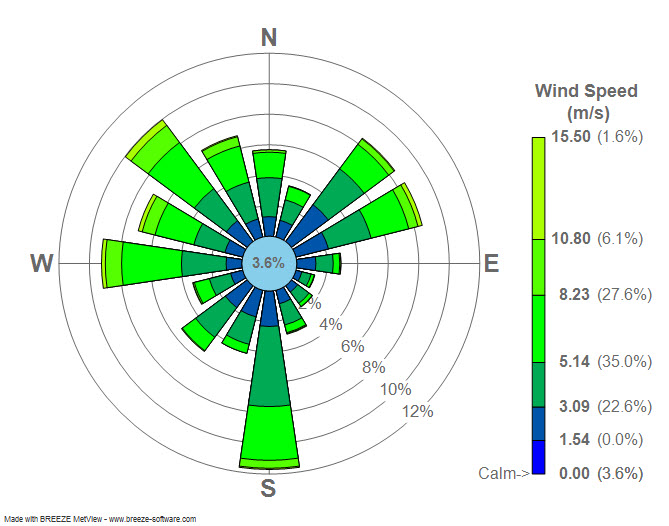
Wind rose plot for LaGuardia Airport (LGA), New York, New York, 2008

A wind rose is a diagram used by meteorologists to give a succinct view of how wind speed and direction are typically distributed at a particular location. Historically, wind roses were predecessors of the compass rose (also known as a wind rose), found on nautical charts, as there was no differentiation between a cardinal direction and the wind which blew from such a direction. Using a polar coordinate system of gridding, the frequency of winds over a time period is plotted by wind direction, with colour bands showing wind speed ranges. The direction of the longest spoke shows the wind direction with the greatest frequency, the prevailing wind.

History

[edit]
Four charts of the wind, 18th-century illustration based on medieval wind roses

The Tower of the Winds in Athens, of about 50 BC is in effect a physical wind rose, as an octagonal tower with eight large reliefs of the winds near the top. It was designed by Andronicus of Cyrrhus, who seems to have written a book on the winds. A passage in Vitruvius's chapter on town planning in his On Architecture (De architectura) seems to be based on this missing book. The emphasis is on planning street orientations to maximize the benefits, and minimize the harms, from the various winds. The London Vitruvius, the oldest surviving manuscript, includes only one of the original illustrations, a rather crudely drawn wind rose in the margin. This was written in Germany in about 800 to 825, probably at the abbey of Saint Pantaleon, Cologne.[1]

Before the development of the compass rose, a wind rose was included on maps in order to let the reader know which directions the 8 major winds (and sometimes 8 half-winds and 16 quarter-winds) blew within the plan view. No differentiation was made between cardinal directions and the winds which blew from those directions. North was depicted with a fleur de lis, while east was shown as a Christian cross to indicate the direction of Jerusalem from Europe.[2][3]

Use

[edit]

Presented in a circular format, the modern wind rose shows the frequency of winds blowing from particular directions over a specified period. The length of each "spoke" around the circle is related to the frequency that the wind blows from a particular direction per unit time. Each concentric circle represents a different frequency, emanating from zero at the center to increasing frequencies at the outer circles. A wind rose plot may contain additional information, in that each spoke is broken down into colour-coded bands that show wind speed ranges. Wind roses typically use 16 cardinal directions, such as north (N), NNE, NE, etc., although they may be subdivided into as many as 32 directions.[4][5] In terms of angle measurement in degrees, North corresponds to 0°/360°, East to 90°, South to 180° and West to 270°.

Compiling a wind rose is one of the preliminary steps taken in constructing airport runways, as aircraft can have a lower ground speed at both landing and takeoff when pointing against the wind.

See also

[edit]

References

[edit]
[edit]
Revisions and contributorsEdit on WikipediaRead on Wikipedia
from Grokipedia
A wind rose is a graphical tool employed in to summarize the frequency, direction, and speed of winds at a specific over a defined period, typically presented in a circular format resembling a . The diagram features radial "spokes" extending from the center, where each spoke corresponds to a (e.g., north, northeast), its length proportional to the percentage of time winds blow from that direction, and color-coded segments or overlays indicating ranges, such as 1-4 knots in light blue or 7-11 knots in dark blue. The concept of the wind rose traces its origins to ancient civilizations, with early examples appearing in Babylonian astrometeorology around 3000–300 B.C., where diagrams depicted winds in eight principal directions oriented toward south and north. By the classical period in ancient Greece and Rome, more refined wind roses with 12 or more directions were used in navigation and maritime charts, evolving through the Middle Ages into standardized tools for sailors and cartographers. In the modern era, wind roses became integral to systematic meteorological observation, particularly from the 19th century onward with the advent of weather stations and data compilation by institutions like the Smithsonian Institution. Wind roses serve critical applications across various fields, including for assessing orientations and takeoff patterns based on , air quality modeling to predict dispersion directions, and planning to evaluate sites for wind turbines by identifying consistent high-speed wind regimes. They are constructed from hourly observations collected by networks such as the U.S. Automated Surface Observing System (), enabling analysts to interpret seasonal or annual trends in wind behavior for informed in environmental and operational contexts.

Fundamentals

Definition

A wind rose is a graphical , typically presented in a circular format, that summarizes the distribution of directions and speeds at a particular over a specified time period. It employs a to visually represent prevailing wind patterns, with radial axes indicating directions and segments or colors denoting the frequency of winds from those directions as well as their associated speeds. The primary purpose of a wind rose is to offer a concise visual overview of local wind regimes, facilitating the identification of dominant directions and intensities without relying on extensive tabular data. This tool enables meteorologists and researchers to quickly discern patterns, such as predominant winds or seasonal variations, supporting analyses in climate studies and environmental assessments. Key characteristics include the division of the 360-degree circle into directional bins, commonly 8, 12, or 16 sectors corresponding to compass points like N, NNE, NE, and so forth, where the length of each segment reflects the percentage of time originate from that direction. Wind speeds are further categorized into discrete ranges that vary by (often in meters per second or knots), often differentiated by color or shading to highlight intensity distributions within each directional bin.

Components

A wind rose diagram is structured around radial directional axes that divide the circular plot into segments corresponding to compass directions, typically using a 16-point where each segment spans 22.5° intervals to represent the origin of winds, such as north (), northeast (NE), or east-northeast (ENE). The length or area of each radial segment, often depicted as bars or wedges extending from the center, is proportional to the frequency of winds blowing from that direction, expressed as a of total observations, allowing for quick visual assessment of predominant wind patterns. Wind speed is encoded within these directional segments through concentric bands, color gradients, or subdivided bars that categorize velocities into discrete ranges that vary by source, often color-coded with lighter shades for lower speeds and darker for higher (e.g., for 1-4 s, dark for 4-7 s, dark for 7-11 s), enabling differentiation of calm breezes from stronger gusts alongside directional . remains the primary metric, with speed categories layered to show not just how often winds occur from a direction but their intensity distribution, often using a to clarify thresholds like s (where 1 equals approximately 1.15 mph). At the diagram's core lies a central feature representing calm or no-wind periods, commonly illustrated as a small whose size is proportional to the percentage of calm conditions, excluding these instances from the radial segments to focus on directional data. Optional labels, such as abbreviated points (e.g., "N" for north) at segment ends and numerical thresholds for speed bands, enhance without altering the core structure. Standardization in wind rose formats emphasizes the 16-point compass for broad applicability in meteorological analysis, with segments proportioned linearly to frequency percentages (e.g., a 20% frequency bar extending halfway across a standardized radius), ensuring consistency across datasets from sources like national weather services. Variations may adjust point counts (e.g., 8 or 36 points) or color schemes, but the radial-frequency core remains invariant for reliable interpretation.

Historical Development

Origins

Early concepts of wind representation trace back to ancient civilizations, with the earliest known examples in Babylonian astrometeorology around 3000–300 B.C., featuring diagrams of winds in eight principal directions oriented toward south and north. The term "wind rose" originates from its visual similarity to the found on nautical maps, with the earliest recorded use of the phrase to describe a or table indicating wind frequencies from various directions dating to the 1590s. Early of wind representation trace back to ancient civilizations, where wind directions were documented for practical purposes such as and agriculture. In ancient Greece, for instance, the poet referenced four principal winds— (north), (south), (east), and (west)—in his epics, associating them with mythological figures, though classical literature recognized up to 32 winds while standardizing eight for maritime use. A seminal ancient precursor is the in , constructed around 50 BCE by the architect Andronikos of Kyrrhos as an octagonal marble structure, each face bearing reliefs of one of the eight principal wind deities to indicate prevailing wind directions, accompanied by sundials, a , and a now-lost bronze weathervane atop the roof. This structure served as the world's earliest known meteorological station, blending wind observation with timekeeping for civic and navigational utility. By the 4th century BCE, Greek navigator Timosthenes, chief pilot of Ptolemy II's Egyptian fleet, further advanced wind charting by devising systematic representations of winds on maps to aid seafaring. In the medieval period, pre-modern precursors emerged in navigational tools, including portolan charts—hand-drawn nautical maps originating in the Mediterranean around the late among Italian and Catalan cartographers. These charts featured wind roses as central compass-like diagrams with radiating lines denoting 8, 16, or 32 directions, often color-coded and labeled with classical wind names derived from Greek and Roman traditions, such as Tramontana for north; the earliest surviving example appears on a 1311 chart by Petrus Vesconte. Similarly, Islamic astrolabes from the 8th to 15th centuries incorporated symbols inscribed on their rims or plates, adapting Greco-Roman wind nomenclature to aid astronomers, navigators, and prayer orientation toward , with notable examples from scholars like enhancing the device's utility for directional computations. These tools, while not full frequency diagrams, laid the groundwork for visualizing patterns by integrating symbolic roses with practical measurements. The initial motivations for developing wind roses stemmed from the demands of naval navigation and agricultural planning during the Age of Sail, when accurate wind predictions were essential for optimizing trade routes, avoiding storms, and timing crop sowing based on seasonal breezes; ancient and medieval mariners, for example, relied on these diagrams to reduce voyage times and risks in the Mediterranean and beyond. By the , the wind rose evolved toward its modern meteorological form as a frequency-based , with American naval officer formalizing its use in 1853 through his "Wind and Current Charts" series, which aggregated thousands of ship log entries to plot prevailing wind directions and speeds across ocean basins, revolutionizing global maritime meteorology.

Evolution

In the late 19th and early 20th centuries, wind roses gained institutional adoption in meteorological practice, particularly through the U.S. Signal Service—predecessor to the U.S. Weather Bureau (now part of NOAA)—where they were used to summarize prevailing wind patterns in annual reports. This period marked a shift from qualitative wind descriptions to quantitative diagrammatic representations for climatological summaries. German Rudolf advanced the application of wind roses in the 1920s, integrating them into microclimatology to analyze localized wind regimes near the ground surface. In his foundational 1927 text Das Klima der bodennahen Luftschicht (translated as The Climate Near the Ground), Geiger employed wind roses to depict frequency distributions of wind directions and speeds in microenvironments, emphasizing their utility for studying terrain-influenced flows and ecological impacts. These refinements highlighted wind roses' role beyond macro-scale summaries, focusing on fine-scale variations essential for and site-specific forecasting. World War II spurred further evolution, with wind roses becoming integral to and meteorology for tasks such as runway design and . The demands of aerial navigation and bombing missions necessitated reliable wind pattern analyses, prompting refinements in diagram construction to incorporate calm periods (zero wind speeds) and leading to broader standardization efforts. This era also saw technological transitions from manual sketching to mechanical plotting devices in , which automated the alignment of directional segments. This era also saw the adoption of 16-direction formats as a common standard for global consistency in wind frequency reporting. Key publications solidified these advancements, including Charles H. Brown's Meteorology for Masters and Mates (first editions in the ), which featured Baillie wind roses to illustrate nautical wind frequencies for maritime training. Postwar WMO guidelines further established conventions for constructing wind roses using frequency-based proportions, where segment lengths represent the percentage of time winds occur from each direction, often binned into speed categories to convey both directionality and intensity. These texts and standards emphasized proportional scaling to ensure comparability across datasets, prioritizing seminal observational methods over exhaustive computations.

Construction Methods

Data Collection

Primary sources for wind rose data consist of meteorological observations collected from anemometers, which measure , and wind vanes, which determine direction, typically installed at weather stations at a standard height of 10 meters above ground level. These instruments provide continuous or periodic recordings, often at 1- to 10-second intervals, aggregated into hourly averages to capture representative wind patterns. Data from automated weather stations (AWS), buoys, or airport facilities are commonly used, with examples including the NOAA Solar and Meteorological Surface Observation Network (), which compiles hourly observations over multi-decadal periods for climatological analysis. Key parameters include in degrees from 0° to 360° (measured clockwise from ) and speed in meters per second (m/s), kilometers per hour (km/h), or knots, with resolutions of 0.1–0.5 m/s for speed and 1°–10° for direction. For wind rose construction, raw data are processed into frequency counts, binned by directional sectors—commonly 22.5° intervals yielding 16 sectors—and speed classes, such as 1 m/s increments (e.g., 0–2 m/s, 2–4 m/s) or aligned with the . This binning aggregates occurrences to quantify the proportion of time winds fall into each category, ensuring the diagram reflects distributional patterns rather than instantaneous values. Quality control is integral, involving regular instrument calibration—such as wind tunnel tests every 6–18 months depending on the platform—to maintain accuracy within ±0.5 m/s or 5% for speed and ±5° for direction. Missing data, which must not exceed 10% for validity, are handled through flagging, interpolation from nearby sites, or exclusion, while checks ensure temporal consistency and reject anomalies like excessive directional variability. Averaging techniques prioritize vector methods for mean direction to account for circular statistics, though frequency distributions for wind roses rely on scalar counts to avoid biasing calm periods. Time scales vary by purpose: short-term datasets, such as seasonal or campaign-specific hourly records from buoys or airports, suit event analysis, while long-term climatological spanning 1–30 years provide robust representativeness of prevailing regimes. For instance, a minimum one-year period is recommended for site assessments, with five consecutive years preferred for regulatory modeling to capture interannual variability. Processed from these scales feed into visualization tools to generate the final rose diagram.

Visualization Techniques

Visualization techniques for wind rose diagrams begin with the binning and aggregation of wind data into directional and speed categories to summarize frequency distributions. Wind directions are typically divided into 8 to 36 sectors, often 16 sectors of 22.5° each covering 360°, while speeds are binned into intervals such as 0-5 m/s, 5-10 m/s, and higher, depending on the dataset's resolution. Aggregation involves counting occurrences within each bin and calculating the frequency as f=occurrences in bintotal observations×100f = \frac{\text{occurrences in bin}}{\text{total observations}} \times 100, expressed as a percentage to represent the proportion of time winds occur in that category. This process transforms raw hourly or 10-minute observations into a compact form suitable for plotting, ensuring that calm periods (winds below a threshold like 0.5 m/s) are often excluded or noted separately to focus on prevailing patterns. Graphically, wind roses are constructed as polar plots centered on a , with each directional sector represented by a radial segment whose length corresponds to the . The radial extent rr is determined by r = f \times \text{scale_factor}, where the scale_factor normalizes the maximum to the plot's , often set so the longest segment reaches 100% or a fixed length. Subdivisions for speed classes are incorporated via stacked bars along each segment, where inner portions represent lower speeds and outer portions higher speeds, or through color gradients (e.g., light shades for low speeds, dark for high). Alternatively, feather-like barbs or indicators may denote speed intensity, though stacked formats are more common for multi-class displays. These elements create a symmetric or asymmetric "rose" that visually encodes both directionality and magnitude. Interpreting a wind rose involves identifying the dominant wind direction from the longest segment, which indicates the sector with the highest , while overall or reveals variability—highly symmetric roses suggest uniform multidirectional winds, whereas elongated single segments denote prevailing unidirectional flow. Speed distributions are assessed through segment subdivisions or colors, with darker or outer portions signaling stronger winds; for instance, a segment showing 20% at low speeds versus 5% at high speeds highlights calm-dominant conditions. Common pitfalls include overemphasizing rare high-speed events due to their visual prominence in outer segments, despite their low contribution, and misinterpreting directionality, as roses always show winds "from" rather than "to" a direction. Non-uniform data within broad bins can also distort representations, particularly in varied . Historically, manual construction relied on plotting over circular or protractors to proportion segments based on calculated frequencies, a labor-intensive process for aggregating thousands of observations. Early automated aids, such as mechanical calculators or rudimentary tabulation tools, served as precursors to digital methods by simplifying percentage computations, but visualization remained hand-drawn until computational advancements.

Applications

and

In , wind roses serve as essential tools for short-term by visualizing prevailing wind directions and speeds, enabling meteorologists to predict local phenomena such as sea breezes. For instance, wind rose diagrams constructed from hourly observations can model the diurnal reversal of sea and land breezes in coastal regions, where onshore flows during the day and offshore flows at night are quantified by frequency and intensity sectors, aiding in the anticipation of temperature and humidity shifts. Similarly, in monsoon-prone areas, wind roses derived from station data help forecast seasonal wind patterns, such as northwesterly flows during active phases, supporting predictions of rainfall distribution and storm tracks over periods of hours to days. In , wind roses compile annual or decadal data to establish climate normals, aligning with (WMO) standards that require 30-year averages of wind parameters for representative baselines. These diagrams summarize long-term wind frequency and variability, often revealing climatic trends; for example, comparative wind roses from equatorial stations can illustrate weakening or directional shifts in during El Niño events, where reduced easterly components correlate with altered regimes. Such summaries, typically segmented by season or decade, provide benchmarks for detecting anomalies in global circulation patterns. Wind roses also facilitate research in synoptic meteorology by analyzing large-scale wind regimes and their interactions with local features. In synoptic studies, roses segmented by pressure systems or frontal passages help dissect how upper-level jet streams influence surface winds, with elongated westerly sectors indicating enhanced flow under jet maxima. For urban heat islands, comparative wind roses between urban and rural stations reveal modified regimes, such as reduced speeds and altered directions due to building-induced channeling, which exacerbate nighttime warming by limiting ventilation. The (NOAA) incorporates wind roses into its atlases for U.S. stations, offering interactive tools to generate seasonal diagrams from hourly data. These visualizations highlight variations like dominant winter at mid-latitude sites, where roses show peak frequencies from the west-northwest, contrasting with calmer summer patterns and aiding in regional assessments.

Renewable Energy

Wind roses play a crucial role in evaluating site suitability for generation by visualizing the frequency and directionality of , allowing developers to identify areas with consistent that support efficient turbine operation. High concentrations of wind frequency from specific directions, such as , indicate potential for viable turbine placement, as they ensure turbines can be oriented to capture maximum while avoiding turbulent zones influenced by local or obstacles. Sites with consistent moderate to high wind frequencies in optimal directions are often deemed suitable for commercial-scale development, enabling preliminary assessments of potential before detailed measurements. In power estimation, wind rose data is integrated with turbine power curves and statistical models like the to forecast energy output and capacity factors. The parameters—shape (k) and scale (c)—are fitted to distributions within each directional sector of the rose, providing a probabilistic representation of regimes that accounts for variability and directionality. This sector-specific fitting allows for accurate calculation of annual energy production (AEP) by weighting power curve outputs against observed frequencies, yielding capacity factors that reflect real-world performance; for example, sites with k values around 2 and c exceeding 8 m/s in dominant sectors can achieve capacity factors above 30%. Such integrations are essential for economic feasibility studies, as they quantify the expected yield under varying conditions. Case studies in the highlight the practical application of wind roses in planning, where the region's strong, directional winds support large-scale offshore projects. Analyses of wind roses for sites like those near Hornsea One reveal predominant southerly and westerly flows with frequencies greater than 20% for speeds over 10 m/s, contributing to high resource potential and enabling the farm's 1.2 GW capacity to generate approximately 4 TWh annually. These visualizations guided array design, confirming the area's suitability for fixed-bottom installations and informing grid integration strategies. Optimization through micrositing leverages wind rose-derived insights into and directionality to minimize wake effects, where downstream experience reduced speeds from upstream ones. By aligning rows perpendicular to dominant wind directions indicated in the rose, layouts can reduce wake losses by up to 10-15%, enhancing overall farm efficiency; analytical models integrating Gaussian wake formulations with full wind rose data enable rapid evaluation of thousands of configurations for optimal spacing and orientation. This approach has been applied in simulations for diverse terrains, demonstrating improved AEP without extensive computational resources.

Environmental Planning

Wind roses play a crucial role in air quality modeling by providing directional and speed-based meteorological data that integrates with Gaussian plume models to predict pollutant dispersion from point sources, such as industrial stack emissions. These models, like AERMOD, rely on wind rose plots to represent prevailing wind frequencies and seasonal variations, enabling accurate simulations of downwind concentration patterns for pollutants including NO₂, SO₂, and suspended particulate matter (SPM). For instance, in assessments of coke oven emissions, wind roses reveal how southwest prevailing winds during summer and rainy seasons lead to higher pollutant concentrations up to 2-3 km downwind, with concentrations decreasing inversely with wind speed—reducing by 76-85% at 10 m/s compared to 1 m/s—thus informing mitigation strategies for stack releases. In , wind roses assess ventilation efficiency and canyon effects in densely built environments, guiding designs that enhance to reduce stagnation and pollutant buildup. By mapping prevailing wind directions, such as north-northwest in coastal cities like , planners align building orientations and layouts to promote natural ventilation, mitigating urban heat islands and informing revisions to building codes like Egypt's Law No. 119 (2008). In high-density areas like Nanjing's Southern New Town, site-specific wind roses—showing east-northeast winter winds at 2.7 m/s and south-southeast summer winds at 2.4 m/s—reveal how perpendicular flows to street canyons increase by up to 10.44%, prompting adjustments in high-rise configurations to avoid ventilation blocks and support pedestrian comfort. Ecological applications of wind roses extend to habitat studies, where they delineate wind corridors influencing and dust transport in arid regions. For migratory species like Bar-tailed Godwits, wind rose plots along Pacific corridors illustrate how tailwind frequencies and directions—derived from near-surface data—facilitate extreme non-stop flights, such as from to , by aligning routes with vector-averaged winds up to 10 m/s. In arid ecosystems, wind roses from datasets spanning 1966-2003 highlight pathways, as seen in where prevailing winds drive particulate transport, aiding assessments of habitat degradation and erosion in semi-arid zones. Regulatory frameworks, particularly under the U.S. Environmental Protection Agency (EPA), mandate wind roses in permit applications for industrial sites to evaluate emission risks and ensure compliance with management standards. Per 40 CFR Part 270, applicants must submit wind roses as part of topographic maps at a scale of 1 inch to 200 feet (1:2400), extending 1,000 feet around the facility, in RCRA Part B permit applications for management facilities, including those involving open burning or detonation units, depicting prevailing speeds and directions to assess downwind receptor exposure and operational restrictions. For example, in evaluations of facilities, wind roses inform air dispersion modeling by integrating with meteorological data from NWS or on-site stations to assess potential exposure risks, consistent with meteorological considerations required under 40 CFR 264.601 for preventing releases.

Modern Variations

Digital Implementations

In the contemporary era, digital implementations of wind roses have revolutionized their creation through specialized software tools that automate plotting from raw sources such as CSV files containing and direction measurements. Open-source libraries like Python's windrose package, built on and , enable users to generate polar rose plots, probability density functions, and Weibull distributions for wind analysis with minimal coding. Similarly, R's openair package provides the windRose function within a comprehensive framework for air quality and meteorological , allowing interval-based visualizations of and direction frequencies directly from data frames. These tools facilitate and customization, such as adjusting color schemes or binning strategies, far beyond traditional manual drafting. Integration with large-scale databases has further enhanced digital wind rose generation, permitting seamless access to historical and near-real-time meteorological records for dynamic visualizations. For instance, the NOAA Integrated Surface Database (ISD), which archives global hourly surface observations including wind parameters from thousands of stations dating back to 1901, can be directly imported into software like WindRose PRO3 for automated rose plotting. This connectivity supports real-time updates from ongoing observations and GIS overlays, where wind roses are superimposed on spatial maps using platforms like to contextualize patterns with geographic features such as or urban layouts. Compared to manual construction methods, digital tools offer significant advantages in interactivity and versatility, enabling users to zoom into specific directional sectors, compare roses across multiple sites or time periods simultaneously, and export outputs in scalable vector formats like for web embedding or high-resolution printing. For example, libraries such as extend Python's windrose capabilities to produce interactive charts that respond to user inputs, revealing underlying data distributions without regenerating entire plots. These features streamline iterative analysis, reducing errors and time from days to minutes while supporting reproducible workflows through scripted code. The adoption of digital wind rose implementations surged in the post-1990s era, coinciding with the maturation of geographic information systems (GIS) that integrated meteorological visualization into broader spatial analytics. Esri's ArcGIS, released in 1999 as an evolution of earlier GIS software, introduced wind rose plugins and tools around 2000, allowing environmental professionals to generate and overlay roses within mapping environments for applications in site assessment and planning. This timeline marked a shift from analog to computational paradigms, driven by increasing availability of digital weather data and computing power.

Advanced Features

Advanced wind rose diagrams extend traditional representations by incorporating three-dimensional structures and animations to capture temporal dynamics. Three-dimensional wind roses visualize speed and direction in a space-time , enabling of sequential patterns over time that influence wind behavior. For instance, these models integrate radial segments with time as the vertical axis, where color gradients represent speed intensity across temporal sequences, derived from historical data. Such representations aid in discovering sequential wind patterns, as demonstrated in interactive tools. Time-lapse animations further enhance this by the rose over diurnal or seasonal cycles, illustrating shifts in ; these dynamic visualizations, often implemented in geospatial software, reveal periodic behaviors in wind regimes. Multivariate enhancements integrate additional environmental variables into wind rose segments, providing layered insights into correlated atmospheric processes. Color coding on radial bars can denote ranges, with warmer hues for higher values, while textures or line widths overlay levels to highlight moisture-laden wind sectors. In pollution studies, segments are scaled by contaminant concentrations, creating "pollution roses" that map emission transport pathways; for example, darker shading indicates elevated particulate matter from specific directions under low- conditions. These overlays facilitate holistic assessments of air quality impacts, combining data with scalar fields like relative to predict formation or inversion layers. Such techniques prioritize perceptual clarity, using distinct visual channels to avoid overload while revealing interdependencies, as in for ventilation corridors. Specialized variants like joint probability wind roses model the coupled distribution of direction, speed, and auxiliary variables, offering probabilistic forecasts beyond frequency counts. These employ bivariate or multivariate density functions, such as mixtures of Weibull for speed and von Mises for direction, to compute occurrence probabilities; for instance, the probability of high-speed southerly s co-occurring with elevated is visualized as contoured radial lobes. This approach, seminal in wind energy site assessment, accounts for directional dependencies and null s, improving accuracy over independent marginal models. Polar histograms extend this for non-circular data distributions, where wind regimes exhibit due to topographic channeling; bins are adjusted for elliptical or skewed angular probabilities, rendering roses that correct for bias in valley flows or coastal , ensuring equitable representation of . Emerging technologies leverage to generate predictive wind roses from -derived datasets, forecasting future distributions for climate modeling. frameworks, including convolutional neural networks trained on imagery, nowcast wind vectors at high resolution, enabling extrapolated roses that project diurnal evolutions or storm-induced shifts. In climate software like ECMWF integrations, these AI models assimilate reanalysis data to simulate multivariate roses under scenarios of warming, visualizing changes in directional persistence or speed extremes. For example, the European Centre for Medium-Range Weather Forecasts (ECMWF) made its Forecasting System (AIFS) operational in February 2025, providing ML-based predictions including wind parameters that support advanced wind rose applications. networks process geostationary sequences to predict profile alterations, supporting adaptive renewable layouts. This predictive capability enhances , with outputs rendered as probabilistic radial fields.

References

Add your contribution
Related Hubs
User Avatar
No comments yet.