Hubbry Logo
YESCOYESCOMain
Open search
YESCO
Community hub
YESCO
logo
8 pages, 0 posts
0 subscribers
Be the first to start a discussion here.
YESCO
YESCO
from Wikipedia

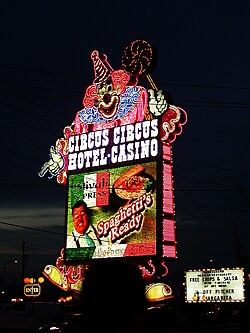
The Circus Circus Las Vegas sign by YESCO

Key Information

Vegas Vic sign by YESCO
Welcome to Fabulous Las Vegas sign, owned by YESCO

YESCO is a manufacturer of electric signs based in Salt Lake City, founded by Thomas Young in 1920. The company provides design, fabrication, installation and maintenance of signs.

Many notable sign projects have been produced by YESCO, including the NBC Experience globe in New York City, the historic El Capitan Theatre and Wax Museum marquees in Hollywood, the Reno Arch, and in Las Vegas, Vegas Vic, the Fremont Street Experience, the Astrolabe in The Venetian, the Wynn Las Vegas resort sign, the Welcome to Fabulous Las Vegas sign, and the Aria Resort & Casino.[1]

History

[edit]

The company was created by Thomas Young on March 20, 1920.[2] The young sign painter had left the United Kingdom just a decade earlier to immigrate with his family to Ogden, Utah. In the beginning, his shop specialized in coffin plates, gold leaf window lettering, lighted signs and painted advertisements.

In 1933, YESCO opened a branch office in the Apache Hotel in Las Vegas. The company erected its first neon sign in Las Vegas for the Boulder Club.[3][4]

It erected the first neon sign in Las Vegas for the Boulder Club in the late 1930s, and in 1995, it completed the four-block-long Fremont Street Experience canopy in Las Vegas.

In recent years, YESCO has built an outdoor digital media (billboard) division of its business.[5]

YESCO has approximately 1,000 employees, more than 40 offices, and operates three manufacturing plants featuring automated and custom equipment. Additional smaller manufacturing and service facilities are located in the United States and Canada.

YESCO offers sign and lighting service franchises in states east of Colorado and throughout Canada.

In 2015, Young Electric Sign Company sold YESCO Electronics, a subsidiary company, to Samsung Electronics of America, Inc., which rebranded the division as Prismview.

Landmark Signs

[edit]

The NBC Experience Store Globe

[edit]

NBC created a new YESCO “message globe” in its NBC Experience store, located at Rockefeller Center, New York City.

From the outside of the building, it looks like an illuminated globe. The 35’-diameter hemisphere is covered with LEDs. The animations were provided by YESCO's media services group. When it was first turned on, it stopped traffic on West 49th Street.[citation needed]

Vegas Vic

[edit]

As a well-known electronic sign,[6][7] Vegas Vic was designed by and built by YESCO. Upon its installation in 1951 over the Pioneer Club on historical Fremont Street, the 40'-tall electronic neon sign became Las Vegas's unofficial greeter.

Wynn Las Vegas

[edit]

The 135-foot (41 m) tall marquee features a 100-foot (30 m) high, 50-foot (15 m) wide, concave, double-faced LED message center with a first-of-its-kind “moving eraser.” Conceived by Steve Wynn, the massive eraser glides up and down over the LED message center, appearing to change the graphics as it goes. The eraser weighs 62,000 pounds, and is counterbalanced by a 62,000-pound weight inside the sign.[8]

The sign uses 4,377,600 LEDs and the eraser is powered by a 300 horsepower (220 kW) motor at its base that runs a gear and cable system. The firm of FTSI engineered the 62,000-pound eraser's movement, which is capable of speeds up to 10 feet per second (3.0 m/s).[8]

The Fremont Street Experience

[edit]

In 1995 YESCO engineered and installed the original Fremont Street Experience. With more than 1.9 million lamps, it was the largest and most unique video display in the world.

Welcome to Fabulous Las Vegas

[edit]

YESCO owns the Welcome to Fabulous Las Vegas sign.

Other projects

[edit]

YESCO designed and installed the signs and light-up strips at Allegiant Stadium, the home of the Las Vegas Raiders and UNLV Rebels Football.[9] The company also designed and installed the signage at the Raiders' headquarters and practice facility in Henderson, Nevada.

The company has provided support to the Neon Museum, which is dedicated to preserving the neon signs and associated artifacts of Las Vegas.[10] Some of the retired signs include the sign for the Silver Slipper casino and Aladdin's lamp from the first version of the Aladdin Casino.

Key individuals

[edit]

Founder

[edit]

Born in Sunderland, United Kingdom, in 1895, Thomas Young was 15 years old when his family emigrated to Ogden, Utah. The boy applied his passion to making signs. He began by creating wall-lettering and gold-leaf window signs, working for the Electric Service Company and the Redfield-King Sign Company in Ogden.

Young married Elmina Carlisle in 1916. In 1920, he founded his own sign company: Thomas Young Sign Company, which specialized in coffin plates, gold window lettering, lighted signs and painted advertisements.

In 1932, Young expanded his business to Las Vegas, and within two years, he purchased the Ogden Armory for $12,000 to expand the production capacity. He also opened a branch in Salt Lake City that year.

Young was elected president of the National Sign Association in 1936, serving for two terms. A year later, in 1937, he moved his family and YESCO headquarters to Salt Lake City, Utah, and continued the business.

Today, helmed by the third and fourth generations of Young's family, YESCO creates, services and maintains award-winning displays for some of the world's most prestigious brands.

Designers

[edit]

Some of YESCO's most prominent signage designers have included:

References

[edit]
[edit]
Revisions and contributorsEdit on WikipediaRead on Wikipedia
from Grokipedia
YESCO, formally known as the Young Electric Sign Company, is an American manufacturer, designer, installer, and maintainer of custom electric signs, lighting systems, and display solutions, headquartered in , . Founded on March 20, 1920, by Thomas Young in , with an initial investment of $300, the company began as a small operation specializing in lighted signs and gold-leaf lettering, quickly adopting the "YESCO" acronym and establishing itself as a leader in the sign industry. Over its century-long history, YESCO has grown into a family-owned now led by the third and fourth generations of the Young family, employing over 1,200 people across 36 company-owned locations and 59 franchise locations covering over 200 territories throughout the and (as of 2025). The company's expansion began in with a branch in , , where it played a pivotal role in shaping the city's iconic neon-lit skyline by pioneering production and later transitioning to LED and digital displays. Notable projects include the 40-foot-tall cowboy sign in 1951, the Stardust Resort's atomic-inspired sign in 1958, the Welcome to Fabulous sign in 1959, and modern installations like the signage for in the 2020s. YESCO has also contributed to historical preservation by restoring vintage signs, such as those from the and Silver Slipper, in partnership with institutions like . In addition to its core signage services for casinos, resorts, and commercial clients, YESCO offers energy-efficient lighting solutions, award-winning interior displays, outdoor billboards, and maintenance programs, emphasizing innovation, quality, and customer integrity as core values. Key milestones include acquisitions like Nevada Outdoor Sign in the 1940s and Federal Sign in the 1970s, the introduction of franchising in 2011, and recognition such as Thomas Young's induction into the Gaming Hall of Fame and a 2016 episode of Undercover Boss. Following the passing of second-generation board chairman Thomas Young Jr. in 2023, YESCO continues to innovate, with recent projects including the 2025 refurbishment of the Rose Bowl Stadium signage. Today, YESCO sets industry standards for custom fabrication and service across North America.

History

Founding and Early Development

Young Electric Sign Company (YESCO) was founded on March 20, 1920, in , by Thomas Young, a 25-year-old sign painter who borrowed $300 from his father to start the business. Initially operating as Thomas Young Sign Company, it specialized in hand-painted wall advertisements, gold-leaf window lettering, and basic lighted signs using incandescent bulbs. The venture began modestly in a small shop, reflecting Young's expertise in traditional sign craftsmanship amid the post-World War I economic recovery. In the late 1920s, the company experienced early growth by transitioning to electric signs, prompting a name change to Young Electric Sign Company. This evolution coincided with Young's relocation of the headquarters and family to in 1929, positioning the business closer to larger markets in the . In the late 1920s, partners Henry Schutte and Ben Jones joined Thomas Young and his brothers George, Jack, and Fred, leading to an expansion into tube manufacturing. The company adopted the YESCO acronym in . This partnership strengthened the company's capabilities as technology gained popularity, with YESCO becoming one of the first firms to produce signs for regional clients. The 1930s marked YESCO's initial focus on electric and signage during the neon era's rise, securing major contracts for local businesses such as theaters and banks in . For instance, the company created Ogden's largest for First , showcasing its growing technical prowess. These projects capitalized on neon's vibrant appeal for commercial advertising, helping establish YESCO's reputation in the burgeoning sign industry. The Great Depression posed significant economic challenges following the 1929 stock market crash, yet YESCO adapted by sustaining demand for essential signage like theater marquees, which remained popular for entertainment venues. The company diversified its operations to include repair and maintenance services for existing signs, providing steady revenue amid reduced new installations. This strategic shift, combined with expansion into neighboring states, enabled YESCO to weather the downturn and lay the foundation for postwar growth.

Expansion and Key Milestones

Following , YESCO experienced significant growth amid the boom of the and , capitalizing on the expanding entertainment industry in . In 1945, the company established its branch, enabling deeper penetration into the burgeoning casino market and facilitating the production of iconic neon installations that defined the city's skyline. This expansion included acquiring the Nevada Outdoor Sign Company during the decade, which bolstered YESCO's regional presence and manufacturing capabilities, including a new plant in . By the , YESCO had further solidified its operations through acquisitions like the Rainbow Sign Company in 1955, supporting increased demand for custom signage across the U.S. Key milestones marked YESCO's evolution into a national leader. In 1970, the company celebrated its 50th anniversary with events honoring founder Thomas Young and the workforce, reflecting on five decades of innovation in electric . The 1990s brought advancements in digital technology, including the introduction of large-scale electronic message centers, such as four-color computerized displays installed at properties like , which expanded YESCO's offerings beyond traditional to dynamic advertising solutions. The company also marked its 75th anniversary during this period. Employee numbers grew substantially during this period, reaching 806 by the late , driven by diversified services and geographic expansion. Into the 21st century, YESCO continued scaling through strategic acquisitions and infrastructure development. The company established a presence in , in the early 1960s, which evolved into a full-service facility for signs, lighting, and billboards, complementing operations in ; this period also saw acquisitions of Sierra Neon and Western Neon. Facilities in , supported manufacturing and service expansion in the . To broaden service offerings, YESCO pursued partnerships and subsidiaries focused on maintenance and ; for instance, it launched a model in 2011 to enhance nationwide sign repair and upkeep, while its YESCO Electronics division (later acquired by in 2015 and rebranded as Prismview) advanced digital display capabilities. As of 2025, employee count remains around 1,000, underscoring the company's growth into a multifaceted enterprise with over 40 offices across the U.S. and . The 100th anniversary in 2020 was a pivotal celebration, featuring citywide events in , , , and , alongside an exhibition curated with the Las Vegas Convention and Visitors Authority highlighting YESCO's contributions to heritage. This milestone included restorations like the Vegas Vickie sign and recognitions from industry peers, affirming the company's enduring impact on signage innovation and urban landscapes. Acquisitions such as Reagan National Advertising in 2016 further integrated and digital services, positioning YESCO for sustained growth through the 2010s.

Operations and Innovations

Manufacturing Processes and Facilities

YESCO's manufacturing processes begin with custom design phases utilizing (CAD) software and in-house teams to develop detailed specifications for electric signs, displays, and billboards. These designs incorporate a range of materials, including tubing, LED modules, and traditional fabrication elements such as metal and acrylic, assembled through automated and custom equipment in climate-controlled environments to ensure precision and durability. The company employs principles to streamline production, minimizing waste while supporting both small-scale custom orders and large-format projects that require intricate assembly of illuminated components. The company's primary facilities include its corporate headquarters and main production site in , , which serves as the central hub for design, engineering, and high-volume manufacturing. A dedicated state-of-the-art production plant operates in Las Vegas, Nevada, at 5119 South Cameron Street, specializing in the fabrication of and LED signage tailored to the industry's demands. Additional regional centers, such as the facility in , at 800 Bennie Lane, support localized production and assembly, enabling efficient distribution across the and beyond. These sites are equipped for end-to-end fabrication, from prototyping to final quality checks. In the , YESCO launched a model focused on and services, enabling independent operators to leverage the company's branding, , and operational expertise for local markets. This approach allows franchisees to provide YESCO-standardized services without full manufacturing capabilities, expanding the network while maintaining through and support. As of 2025, the model includes 59 franchise locations alongside 36 company-owned operations, totaling nearly 100 sites across . YESCO's service offerings encompass the full lifecycle of signage projects, from initial and to professional installation and ongoing maintenance. Emphasis is placed on custom solutions for large-scale applications, such as displays and billboards, with maintenance programs including repairs, retrofits, and patrol services to ensure long-term functionality. This integrated model supports clients through time-and-materials-based repairs and comprehensive project management.

Technological Advancements

YESCO pioneered advanced techniques during the 1930s and 1950s, elevating the craft through custom glass bending to form intricate shapes and the integration of with electrical charges for illumination. As one of the first sign companies to manufacture its own customized tubing, YESCO created vibrant, eye-catching displays that transformed signage into an art form, blending precision craftsmanship with . In 1996, YESCO transitioned to LED technology, marking a significant shift that enabled the creation of energy-efficient, programmable displays capable of dynamic content updates. This innovation facilitated the development of large electronic message centers, including some of the world's largest systems by the , which offered enhanced visibility and reduced operational costs compared to traditional . By the , the company adopted digital fabrication tools such as CNC machines for precise cutting and shaping of sign components, streamlining production processes and significantly reducing time and costs associated with custom manufacturing. YESCO's sustainability efforts have centered on LED's advantages, which consume far less energy than —often up to 80% less—while generating minimal waste and supporting eco-friendly operations. In recent projects, the company incorporates recyclable materials like recycled metals and responsibly sourced woods, alongside LED upgrades during repairs, to minimize environmental impact and promote principles in signage production.

Notable Projects

Iconic Las Vegas Signs

YESCO's contributions to signage have produced several enduring landmarks that define the city's neon heritage and visual spectacle, beginning in the mid-20th century. These projects showcase the company's expertise in neon fabrication, , and later LED integration, transforming ordinary advertisements into cultural icons that attract millions of visitors annually. One of the earliest and most recognizable is , a 40-foot-tall figure installed in 1951 atop the Pioneer Club on . Designed by Bill Clark and fabricated by YESCO, the sign features a waving arm, winking eye, and a cigarette clenched in its teeth, embodying the Wild West theme that resonated with post-war tourists. YESCO has restored multiple times, including a major overhaul in 2023 that replaced its aging tubes to restore full illumination and prevent further deterioration from weather exposure. These efforts have preserved its status as a symbol of downtown Las Vegas's gritty charm, often photographed as a gateway to the city's historic gaming district. The "Welcome to Fabulous Las Vegas" sign, installed in at the southern end of the Strip, represents another pinnacle of YESCO's early work. Designed by Betty Willis and constructed by YESCO through its acquisition of Western Neon Works, the 25-foot-tall structure features a starry crown, lettering, and a sparkling backdrop that has greeted over a billion visitors since its debut. YESCO owns the sign, leases it to Clark County, and has provided continuous maintenance for 65 years, including bulb replacements and structural reinforcements to withstand desert conditions. While the original remains intact, YESCO's upkeep ensures its reliability as a cultural touchstone, inspiring replicas worldwide and symbolizing the optimism of Las Vegas's boom. For the 2005 opening of , YESCO designed and installed a 135-foot-tall LED tower along with facade elements, featuring a 100-by-50-foot concave, double-faced message center that introduced the world's first "moving eraser" mechanism for seamless content transitions. These dynamic lighting effects, including programmable animations, integrated luxury branding with technological flair, setting a new standard for Strip resorts. The installations underscored YESCO's role in elevating Las Vegas's visual landscape during the era of mega-resort expansion. Extending its Vegas-inspired innovations beyond Nevada, YESCO created the rotating message globe for the NBC Experience Store at in in 2000, a 20-foot-diameter structure with LED messaging that evoked the spectacle of signage. This project marked an early foray into national high-profile installations, adapting neon-era drama to broadcast-themed environments and demonstrating YESCO's growing influence in urban landmark design.

Major Non-Las Vegas Projects

YESCO's early expansion outside centered on , where the company originated and built a reputation through for local businesses and landmarks. In the , shortly after its founding in Ogden, YESCO installed the city's largest for First , marking an early milestone in illuminated commercial displays. By the 1930s, the company had established a presence in , fabricating the prominent for the Salt Lake Tribune-Telegram building, which enhanced the visibility of the newspaper's headquarters. During the , YESCO created a innovative weather-flashing for the Walker Bank Building in , demonstrating early experimentation with dynamic lighting effects. The 1960s saw further iconic installations, including the rotating double cone sign for Snelgrove’s in , a playful and eye-catching design that became a local landmark. Additionally, YESCO crafted the massive electric sign for Sweet's Candy Company in , recognized as the largest of its kind in the at the time, underscoring the company's growing expertise in large-scale commercial during this era. In the realm of sports venues, YESCO contributed significantly to NBA and other facilities across the from the 1970s through the . A notable project in the involved installing a 360-degree at Denver's Pepsi Center, home of the NBA's , providing immersive video capabilities for fans. In , YESCO outfitted EnergySolutions Arena—venue for the NBA's —with advanced video displays during the , enhancing game-day experiences through high-resolution screens. The company also installed a video at Rice-Eccles Stadium for the in 2016, supporting college football and Olympic events with robust electronic integration. For baseball, YESCO completed comprehensive signage for the Colorado Rockies' in the 1990s, including directional and branding elements that improved navigation and team identity. Commercial projects highlighted YESCO's versatility in hospitality and corporate signage nationwide. In the 1990s, the company fabricated and installed the expansive 90-by-180-foot sign for the Flamingo Hilton in Reno, Nevada, a towering structure that defined the property's entrance. Building on this, YESCO delivered a neon spectacular and LED display for the Peppermill Reno Hotel Casino in the 2000s, combining traditional glow with modern digital elements to attract visitors. These efforts extended to broader chain implementations, such as facade and wayfinding signs for Hilton properties across various locations, emphasizing durable, branded solutions for national hotel operations. Public installations by YESCO included electronic message boards for highways and arenas, prioritizing safety and information dissemination in the 2000s. The company integrated dynamic LED message centers into arena environments, such as those supporting NBA teams like the , to provide real-time updates and enhance crowd management. For highways, YESCO's work focused on visible, weather-resistant boards that displayed traffic and emergency alerts, contributing to infrastructure projects in and surrounding states during this period. These systems, often customized for high-traffic areas, exemplified YESCO's role in without delving into exhaustive technical specifications.

Recent Developments

Following the COVID-19 pandemic, YESCO expanded its focus on digital signage solutions, capitalizing on heightened demand for durable outdoor LED displays that supported contactless communication and enhanced visibility in recovering public spaces. This shift aligned with broader industry trends toward energy-efficient, adaptable technologies, enabling YESCO to retrofit existing installations and deploy new ones. A notable project from this period was YESCO's fabrication and installation of signage for the University of Nevada, Reno's John Tulloch Business Building, part of the Mathewson Gateway initiative linking the historic campus to downtown Reno. Completed in coordination with Clark Construction as the general contractor in October 2025, the installation featured a prominent 10 ft x 20 ft dual-illuminated wolf head cabinet with Panaflex faces and edge-to-edge build, incorporating sustainable LED elements that allow the halo-lit portion to dim during regular operations and flash interactively on game days to celebrate Wolf Pack spirit. Visible from Interstate 80, this signage serves as an iconic, energy-conscious landmark fostering community engagement. Other key 2021-2025 installations included a fine-pixel-pitch LED display at Talking Stick Resort in Scottsdale, Arizona, in October 2025, demonstrating YESCO's continued emphasis on high-impact, versatile projects. In response to evolving market dynamics, YESCO grew its franchising model, reaching approximately 57 franchise locations alongside 42 company-owned sites as of late 2025, forming a network of 99 outlets across the for sign and lighting services. This expansion supported broader service coverage and adaptability to regional demands, including partnerships integrating with urban infrastructure, such as electronic displays for traffic and public service in environments. These collaborations enhanced YESCO's role in sustainable urban development, aligning with IoT-enabled systems for real-time dissemination. YESCO received the Gold Award in the 2023 Watchfire LED Sign Awards for excellence in design and effectiveness, recognizing innovations like adaptive content displays that optimize viewer engagement. Complementing this, the company established the YESCO Conservation Fund in 2024, committing $250,000 over five years to maintain and restore signs at the in , exemplifying by revitalizing historic artifacts—such as the relighting of the Hollywood Hotel & Casino sign in October 2024—for educational and cultural preservation. This initiative underscores YESCO's commitment to blending legacy craftsmanship with modern amid ongoing industry transitions.

Leadership and Personnel

Founders and Family Involvement

Thomas Young founded the Young Electric Sign Company (YESCO) on March 20, 1920, in , after borrowing $300 from his father to start a solo sign-painting operation specializing in hand-lettered and lighted signs. Born on May 26, 1895, in , , Young immigrated to the with his family at age 15, settling in Ogden where he honed his skills as a sign painter and artist. Under his leadership, the company evolved from a one-man shop into a regional leader in electric , incorporating technology in the 1920s and expanding operations amid the growth of . Young passed away on September 11, 1971, at age 76, leaving a legacy of craftsmanship that emphasized quality and innovation. In the 1930s and , Young's brothers—George, Jack, and Fred—played pivotal roles in scaling the business, contributing to operational expansion and the adoption of early electric sign technologies as the company relocated and grew. Their involvement helped YESCO navigate the economic challenges of the and , solidifying its foundation in manufacturing and installation services. By the mid-20th century, the brothers' collaborative efforts had transformed the firm into a multi-employee enterprise, setting the stage for further family-driven growth. Leadership transitioned smoothly to the second generation in the late 1960s and early 1970s, with Thomas Young Jr. appointed president in 1969, just before his father's death, and the company passing to sons including Michael T. Young, who emphasized continuity in values like innovation and meticulous craftsmanship. This succession ensured the preservation of family principles amid post-1971 expansions. By the 2020s, fourth-generation members such as Joshua M. Young, who served as and later president of YESCO starting in 2011, continued active involvement in strategic oversight. As of 2025, YESCO remains 100% owned and controlled by the Young family, with fourth-generation leaders like Ryan Young, who serves as president and CEO since 2021, Joshua, and on the , upholding multi-generational .

Key Designers and Executives

In , Henry Schutte and Ben Jones joined as partners with the Young brothers, professionalizing operations and facilitating the 's expansion into signage production, which renamed it the Young Electric Sign . Among early artists, Pat Denner stands out for crafting the silhouette of the iconic sign in , a 40-foot figure with moving arms that became a landmark on , and Wendover Will in 1952, another tall promoting a in . Rudy Crisostomo, who joined YESCO in 1978 as an for the Las Vegas branch, contributed to numerous award-winning projects, including the Rio All-Suite Hotel & Casino pylon, the Sands Hotel pylon, and the Circus Circus porte cochere, earning five national awards from the International Sign Association for his hand-rendered designs that blended artistry with functionality. In the , Mark Oatis has shaped YESCO's dynamic displays, collaborating on LED-enhanced restorations and custom animations, such as contributions to the American Sign Museum's expansion in 2024, drawing on over 17 years of experience in sign design. Executives like Steve Jones, who served as president of YESCO Custom Signs from 2013 and president of YESCO Sign & Lighting Service from approximately 2014 to 2021, later becoming of YESCO Sign & Lighting Service until his retirement on July 31, 2025, drove the adoption of LED technologies in the 2000s and beyond, overseeing upgrades for high-profile installations and pioneering service-focused expansions. Sam Fisher, as senior vice president of since 2021, has advanced YESCO's national growth through franchising initiatives, building on models established in the early to extend LED services and across multiple locations. As of 2025, non-family C-suite leaders include Chris Record as , managing fiscal strategies for in LED displays, and Paul Bradley as of , supporting talent development in sales and design teams.

References

Add your contribution
Related Hubs
User Avatar
No comments yet.