Hubbry Logo
YowieYowieMain
Open search
Yowie
Community hub
Yowie
logo
8 pages, 0 posts
0 subscribers
Be the first to start a discussion here.
Yowie
Yowie
from Wikipedia

Yowie
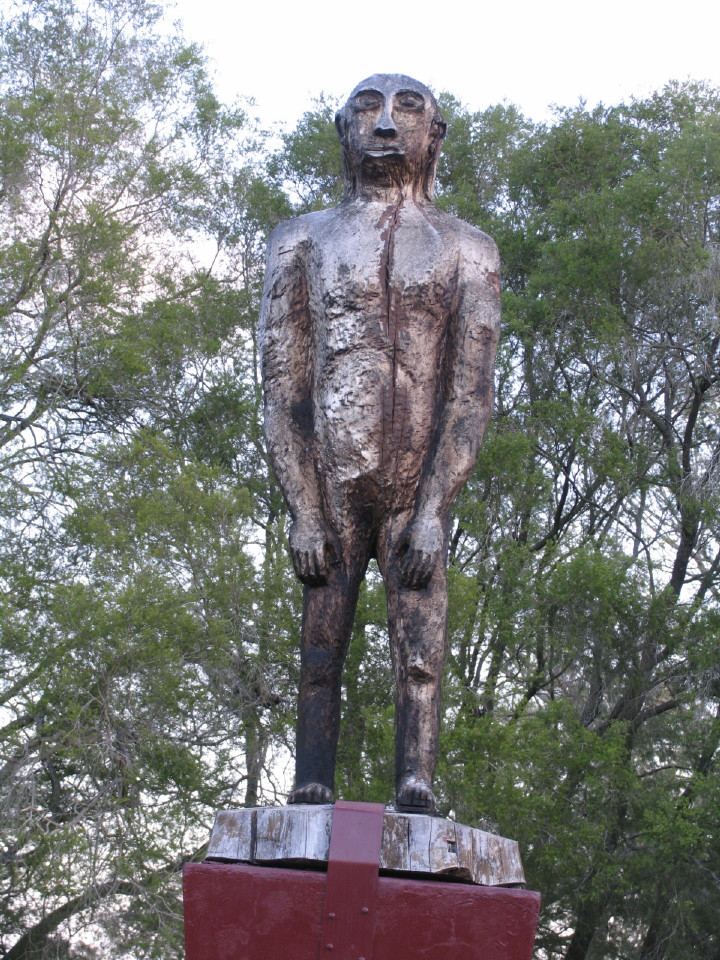
Statue of a yowie in Kilcoy, Queensland, Australia
Origin
CountryAustralia
RegionGreat Dividing Range
Northern Territory
Australian Capital Territory
South Australia
Western Australia
New South Wales
Queensland
Victoria

The Yowie is one of several names for an Australian folklore entity that is reputed to live in the Outback. The creature has origins in Aboriginal oral history.

Etymology and regional names

[edit]
  • In parts of Queensland, it is known as a Quinkin (or as a type of Quinkin), and as joogabinna.[1]
  • In parts of New South Wales, it is referred to by various names, including Ghindaring, Jurrawarra, Myngawin, Puttikan, Doolaga, Gulaga and Thoolagal.[1]
  • Other recorded names for similar entities include, Noocoonah, Wawee, Pangkarlangu, Jimbra and Tjangara.[1][2][3] Legends of Yowie-type creatures appear in Aboriginal Australian legends, particularly in the eastern Australian states.[4]

Description and reported characteristics

[edit]
Yaroma swallowing a man (1907 drawing)

The Yowie is typically described as a bipedal, hairy, and ape-like creature, standing upright at between 2.1 m (6 ft 11 in) and 3.6 m (12 ft).[5] Reports of Yowie footprints describe them as significantly larger than a human's,[6] but alleged Yowie tracks are inconsistent in shape and toe number.[7][8] The Yowie's nose is described as wide and flat.[9][10]

Descriptions of the Yowie's behavior vary; some accounts depict the Yowie as timid and reclusive, while others suggest it can be violent or aggressive.[6][11]

Origins of the term

[edit]

The exact origin of the name "Yowie" in reference to Australian hominid legends is uncertain. The term was documented in 1875 among the Gamilaraay people by Rev. William Ridley in Kámilarói and Other Australian Languages, where "Yō-wī"[a] was described as a spirit that roams the earth at night.[13]

Some researchers suggest that the term arose through Aboriginal legends of the "Yahoo". Nineteenth century European accounts describe the creature and deem it the Yahoo, specifically the entry of Robert Holden, who described it saying "The natives of Australia... believe in... [the] Yahoo."[14]

Another story about the terms origins come from an Aboriginal source. One account from Old Bungaree, a Gunedah elder, stating that the Yahoo was an ancient race that once inhabited Australia. He describes conflicts between Yahoos and Aboriginal people in an event called Dreamtime, claiming that the latter usually overpowered them, although the Yahoo is said to be a fast runner.[15]

Additionally, some scholars propose that the Yowie legend may have been influenced by European folklore. Possible sources for this claim include:

  • Jonathan Swift's yahoos from Gulliver's Travels, depicted as primitive, bestial humanoids
  • European myths of hairy wild men, describing hairy, ape-like beings
  • Early 19th century public excitement with captive orangutans for display, which sparked curiosity about large primates[16]

Historical sightings

[edit]
The "Bombala Anthropoid", seen by Charles Harper in southeast Australia in 1912. This fanciful drawing is based on his description in an interview in the Sidney Sun: "A huge man-like animal stood erect not 20 yards from the fire, growling, grimacing, and thumping his breast with his huge hand-like paws."[17]

Early reports (19th century)

[edit]

A 1987 column in The Sydney Morning Herald, columnist Margaret Jones suggest that the first reported Yowie sighting in Australian occurred as early as 1795.[18]

By the 1850s, accounts of "indigenous apes" appeared in the Australian Town and Country Journal. The earliest account in November 1876 asked readers "Who has not heard, from the earliest settlement of the colony, the blacks speaking of some unearthly animal or inhuman creature ... namely the Yahoo-Devil Devil, or hairy man of the wood?"[19]

In 1882, amateur naturalist Henry James McCooey claimed to have seen an "indigenous ape" on the New South Wales south coast, between Batemans Bay and Ulladulla. He described the creature as tailless, covered in long black hair, with reddish fur around the throat and chest. He estimated its height at nearly five feet tall when standing upright and noted that its small, restless eyes were partially obscured by matted hair. McCooey claimed to have thrown a stone at the creature, prompting it to flee.[20][21]

McCooey offered to capture an ape for the Australian Museum for a reward £40. According to researcher Robert Holden, a second outbreak of reported ape sightings appeared in 1912.[22]

The Yowie also appeared in Australian folklore and literature, including Donald Friend's Hillendiana, a collection of writings about the goldfields near Hill End, New South Wales, where it was described as species of bunyip.[23] Holden also cites the appearance of the Yowie's presence in a number of Australian tall stories in the late 19th and early 20th centuries.[24]

20 and 21st century sightings

[edit]

Modern reports of the Yowie continue, often associated with cryptozoology investigations.

One such case involved "Top End Yowie investigator" Andrew McGinn who claimed the death and mutilation of a pet dog near Darwin could have been the result of an attack by the mythological Yowie.[25]

Regional sightings

[edit]

Northern Territory

[edit]

In the late 1990s, several reports of Yowie sightings emerged in the area around Acacia Hills.[11]

  • 1997: Mango farmer Katrina Tucker claimed she had been having been just metres away from a hairy humanoid creature on her property.[11] Photographs of the large footprint were collected at the time.[11]

New South Wales

[edit]

Accounts of Yowie sightings in New South Wales include:

  • 1977: The Sydney Morning Herald reported that residents on Oxley Island, near Taree, recently heard unexplained screaming noises at night. Cryptozoologist Rex Gilroy planned to search for the mythological Yowie.[26]
  • 1994: Tim the Yowie Man claimed to have seen a Yowie in the Brindabella Ranges.[10][27][28]
  • 1996: A couple from Newcastle, while driving on a holiday, claim to have seen a shaggy, upright creature between Braidwood and the coast, describing it as at least 2.1 metres tall, with disproportionately long arms and no neck.[29]
  • 2000: a Canberra bushwalker, Steve Piper, filmed an unknown bipedal beast in the Brindabella Mountains. This footage is known as the 'Piper Film'.[10]
  • 2011: a witness reported to NSW National Parks and Wildlife Service seeing a Yowie in the Blue Mountains at Springwood. The witness had filmed the creature, and taken photographs of its footprints.[27]
  • 2012: an American television crew claimed to have recorded audio of a Yowie in a remote region on the NSW–Queensland border.[27][30]
  • 2013: a Lismore resident and music videographer claimed to have seen a Yowie just north of Bexhill.[31]

In the mid-1970s, the Queanbeyan Festival Board and 2CA offered a AU$200,000 reward for the capture and presentation of a Yowie. The reward remains unclaimed.[32][33]

Queensland

[edit]

The Springbrook region in south-east Queensland has had more Yowie reports than anywhere else in Australia.[10]

  • 1977: Former Queensland Senator Bill O'Chee reported to the Gold Coast Bulletin that he had seen a Yowie while on a school trip in Springbrook.[9][10] O'Chee compared the creature to Chewbacca from Star Wars.[34] He told reporters that the creature he saw had been over three metres tall.[35]
  • 2001: The Mulgowie Yowie was last reported as having been seen.[36]
  • 2014: Two Yowie researchers claimed to have filmed a Yowie in South Queensland using an infrared tree camera. They also collected fur samples and found large footprints.[37] Later that year, a Gympie man told media he had encountered Yowies on several occasions, including conversing with, and teaching some English to, a very large male Yowie in the bush north-east of Gympie,[38] and several people in Port Douglas claimed to have seen Yowies, near Mowbray and at the Rocky Point range.[39]

Australian Capital Territory

[edit]
  • 2010: A Canberra man said he saw a " juvenile covered in hair, with long arms trying to steal his car" in his garage. A friend later told him it could be an aboriginal person.[40]

Prominent Yowie researchers and enthusiasts

[edit]

Rex Gilroy

[edit]

Since the mid-1970s, paranormal enthusiast and self-described cryptozoologist Rex Gilroy attempted to popularize the Yowie legend.[41][42][43] He claimed to have collected over 3,000 reports of Yowie encounters and theorized that they represented a relict population of extinct apes or early Homo species.[44][45]

Rex Gilroy believed that the Yowie is related to the North American Bigfoot.[46] Along with his partner Heather Gilroy, he spent fifty years amassing his Yowie collection.[47]

Rex Gilroy died in April 2023.[48]

Tim the Yowie Man

[edit]

Tim the Yowie Man is a published author who claims to have seen a Yowie in the Brindabella Ranges in 1994.[27][49] Since then, Tim the Yowie Man has investigated Yowie sightings and other paranormal phenomena.[50]

He also writes a regular column in Australian newspapers The Canberra Times and The Sydney Morning Herald. In 2004, Tim the Yowie Man won a legal case against Cadbury, a popular British confectionery company.[51] Cadbury had claimed that his moniker was too similar to their range of Yowie confectionery.[52]

Gary Opit

[edit]

ABC Local Radio wildlife programmer and environmental scientist.[53]

Skepticism and alternate theories

[edit]

Graham Joyner's perspective

[edit]

Australian historian Graham Joyner has extensively researched the "yahoo", also referred to as the hairy man, Australian ape, or Australian gorilla, which was a subject of various reports in the nineteenth century. Joyner compiled these accounts in his 1977 publication, The Hairy Man of South Eastern Australia, aiming to shed light on this phenomenon.

In his research, Joyner suggests that the contemporary concept of the Yowie may have emerged from a misunderstanding or conflation with earlier "yahoo" reports. He posits that the Yowie was relatively unknown before the mid-1970s and that its rise in popular culture could be linked to misinterpretations of historical accounts.[54]

[edit]
  • Terror Australis: Call of Cthulhu in the Land Down Under, first published in 1987 as a supplement to the role-playing game Call of Cthulhu, includes the Yowie as one of several mythical monsters of Australia.
  • Season eight of the soap opera A Country Practice (1988) features a suspected Yowie sighting.
  • English-born writer Geoffry Morgan Pike devised the name and fictitious background for the Yowie brand of chocolates, launched in 1995.
  • An experimental rock band by the name of Yowie formed in St. Louis, Missouri in the year 2000. A Yowie is depicted on the cover art of their debut album Cryptooology.
  • In the 2001 video game Final Fantasy X, the Yowie appears as a reptilian enemy.
  • The main monster in the 2003 animated film Scooby-Doo! and the Legend of the Vampire is the Yowie Yahoo, which is depicted as a vampire living in the Australian desert under the name the “Yowie Yahoo”, rather than a Sasquatch-like monster simply called the Yowie.
  • Yowies appear as Australian magical creatures in the 2010 book Fablehaven: Keys to the Demon Prison.
  • The 2014 action-horror film Throwback centres on the discovery of, and battle with, a Yowie.
  • In season four of the animated series We Bare Bears (2018), the Booby Trapper (voiced by Jemaine Clement) confuses Charlie (voiced by Jason Lee) for a Yowie.
  • In the animated YouTube series The Big Lez Show, the titular character hangs out with Yowies named Sassy and Donny
  • The children's fiction book "Yowie Dreaming: A Tale of Friendship and Adventure (2025) is about the discovery of a baby Yowie. It is set in Kilcoy which is known for its Yowie statue.

See also

[edit]

Notes

[edit]

References

[edit]
[edit]
Revisions and contributorsEdit on WikipediaRead on Wikipedia
from Grokipedia
The Yowie is an ape-like cryptid in , depicted as a large, hairy, bipedal being inhabiting remote forested and rugged regions of eastern , with origins in Indigenous oral traditions dating back thousands of years. Often compared to the North American , it is typically described as standing between 2 and 3 meters tall, covered in dark fur, with a robust build, flat face, and powerful limbs, sometimes portrayed as nocturnal and elusive. The term "Yowie" is believed to derive from yuwi, meaning "dream spirit" in the Yuwaalaraay language of northeastern , though it may also adapt from "yahoos," referring to evil beings in 19th-century records. In Aboriginal lore, the Yowie embodies spiritual elements as a dream spirit, reflecting deep cultural connections to and the natural world. Modern accounts of Yowie sightings emerged in the late , particularly in and , with reports of footprints, eerie calls, and fleeting encounters fueling cryptozoological interest, though no physical evidence such as bones or specimens has ever been verified. These narratives blend Indigenous mythology with colonial-era tales, evolving into a symbol of Australia's mysterious interior, inspiring books, expeditions, and media portrayals while highlighting ongoing debates about versus undiscovered wildlife.

Etymology and Terminology

Origins of the Term

The term "Yowie" originates from Indigenous Australian languages, specifically deriving from "yuwi," meaning "dream spirit," in the Yuwaalaraay language spoken by Aboriginal people in northern . It is also connected to the Kámilarói language of the same region, where "yowie" refers to a nocturnal spirit that roams the earth. These linguistic roots reflect traditional Aboriginal beliefs in spiritual beings associated with the Dreamtime, influencing later interpretations of the Yowie as a mysterious, hairy entity. One of the earliest documented transcriptions of a related term appears in anthropological records from the . In 1875, Reverend William Ridley recorded “Yō-wī” in his book Kámilarói and Other Australian Languages, describing it as a spirit that roams over the at night among the Kámilarói people. This entry, on page 138, provides a key example of how Indigenous oral traditions were captured in written form by early European observers, preserving the term's cultural significance. Similar phonetic variations, such as "Yourie" or "Yowroos," were noted in regional dialects, linking it to broader of elusive, spirit-like figures. The modern English usage of "Yowie" emerged in the , popularized by Australian media and researchers drawing on these Indigenous stories. This adoption built on earlier 19th-century settler accounts that referred to comparable creatures as "Yahoo," a term possibly evolved from Aboriginal pronunciations of "yowie" and used to describe hairy, ape-like beings in colonial newspapers and reports. The shift to "Yowie" in the aligned with growing interest in , transforming the term from localized Indigenous lore into a national symbol of unexplained phenomena.

Regional Names and Variations

The Yowie is known by various names across Australian Indigenous languages and regions, reflecting the diversity of Aboriginal traditions. In , particularly among the people, the creature is referred to as "Quinkin," a term encompassing a class of beings depicted in ancient as tall, shadowy figures associated with the landscape and spiritual guardianship. In , it is called "Doolagahl" or "Dulagarl," meaning "great hairy man," portraying it as a venerated Dreamtime entity with magical attributes tied to creation stories. Further north, in the among Warlpiri communities, the analogous figure is the "Pangkarlangu," described in oral narratives as a nomadic, child-stealing ogre-like being that embodies warnings about straying from camp, differing from southern depictions by emphasizing predatory behavior over spiritual reverence. These names often vary in spelling and pronunciation due to the phonetic adaptations across groups; while , a prevalent in , incorporates hybrid terms blending Indigenous and English elements to describe similar elusive, hairy humanoids in contemporary . Such linguistic variations highlight local nuances, where southern names like Doolagahl imply a protective yet formidable presence linked to territorial guardianship, whereas northern ones like Pangkarlangu evoke fear through tales of nocturnal raids and isolation. In modern literature, these regional terms are frequently unified under the "Yowie" label to facilitate broader discussion of sightings and cultural parallels, drawing from early 20th-century collections of Indigenous accounts that cataloged the creature's equivalents without imposing a single identity. This adaptation preserves the essence of diverse oral traditions while emphasizing shared themes of an ancient, elusive hominid coexisting with human societies.

Description and Characteristics

Physical Appearance

Eyewitness accounts consistently describe the Yowie as a tall, bipedal humanoid creature, typically standing between 2 and 3 meters in height, with a muscular build covered entirely in thick, dark brown or black hair. The creature's physique features broad shoulders, long arms that often extend to or below the knees, and powerful legs supporting its upright posture, giving it an imposing, ape-like silhouette. Large feet are a hallmark trait, with reported tracks measuring 40 to 50 cm in length, sometimes showing four or five toes and occasionally described as backward-facing in orientation. Facial features reported in sightings include deep-set, glowing eyes, a flat and wide reminiscent of a gorilla's, and a prominent with thick , often with no discernible due to the sloping shoulders and dense . The is frequently noted as large and intimidating, contributing to descriptions of the Yowie as a fearsome, hairless-faced figure amid its otherwise furry body. While most reports emphasize dark fur, variations occur, such as reddish or observed in sightings from tropical or subtropical regions like , potentially reflecting environmental adaptations or regional differences in the creature's appearance. Overall, the Yowie shares superficial similarities with global like the North American in its hairy, humanoid form and scale, but accounts highlight unique Australian traits, such as a leaner build suited to dense navigation.

Behaviors and Habitats

The Yowie is commonly reported to exhibit nocturnal habits, with most encounters occurring at night when the creature is said to and move through its environment to minimize detection by humans. and eyewitness accounts describe it as possessing remarkable tree-climbing abilities, allowing it to scale tall trees for escape, observation, or accessing food sources high in the canopy. Its diet is described as omnivorous, encompassing scavenging for carrion, consumption of fruits and , and opportunistic predation on small to medium-sized animals. Vocalizations attributed to the Yowie include blood-curdling screams, deep howls that echo through the bush, and rhythmic wood knocks, which are believed to serve as communication signals or territorial warnings among individuals. The creature is characterized by its extreme elusiveness, generally avoiding direct human interaction but occasionally leaving behind large, human-like tracks and a strong musky in areas of activity. This is often described as pungent and lingering, similar to that of wet fur or decaying . Preferred habitats for the Yowie center on the rugged terrains of eastern , including dense subtropical rainforests, eucalyptus-dominated woodlands, and mountainous regions such as the Blue Mountains and in and . These environments provide thick cover, abundant water sources, and a variety of food resources suited to its reported lifestyle. Interactions with local are noted in reports, where the Yowie is said to prey on species like , potentially ambushing them in open clearings adjacent to forested areas.

Historical Sightings

19th-Century Reports

Early reports of the Yowie emerged in colonial Australian newspapers during the mid-19th century, often describing a wild, ape-like creature known as the "Yahoo" or "hairy man" that terrified settlers and Indigenous people alike. These accounts typically portrayed the entity as a large, hirsute being inhabiting remote , with sightings concentrated in and . Aboriginal communities frequently warned settlers of these bush spirits, interpreting them as dangerous guardians of the land, a tradition that influenced early European narratives of the Australian wilderness. One notable early encounter was documented in 1876 in the , where the creature was referred to as the "hairy man of the wood" or "Yahoo," a figure that Aboriginal people greatly feared for its nocturnal habits and elusive nature. Reports suggested that horses and cattle avoided areas where it was sighted, though direct attacks on were rarely confirmed. Such descriptions echoed Indigenous lore, where the Yahoo was seen as a malevolent spirit rather than a physical animal, highlighting the cultural clash between Aboriginal beliefs and settler rationalizations. In the 1880s, accounts from added to the lore, with reports of encounters with large, hairy beings in local papers like the Gympie Miner. The region became associated with such sightings. A pivotal report came from naturalist H.J. McCooey, who detailed his 1880 observation of an "Australian ape" between and Ulladulla on the south coast, published in the Australian Town and Country Journal. McCooey described one upright-walking figure nearly 5 feet tall, covered in long black hair except on the throat, breast, face, palms, and soles; he noted its human-like gait and facial features, proposing it represented an undiscovered species native to . This account, one of the most detailed of the era, spurred debate among colonial scientists and was accompanied by McCooey's sketches of the creature. These 19th-century reports were further preserved in colonial folklore collections, such as those compiled by ethnographers documenting Aboriginal oral traditions alongside settler anecdotes. Works like Edward Curr's "The Australian Race" (1886-1887) incorporated Indigenous stories of hairy bush beings, bridging cultural narratives and establishing the Yowie as a fixture in early Australian mythology.

20th-Century Encounters

During the early decades of the 20th century, rural sightings of Yowie-like creatures were reported sporadically in isolated areas of and , often by farmers and bushwalkers encountering large, hairy bipeds in forested regions. A notable example occurred in 1928 near Palen Creek, close to the - border, where local resident Bob Mitchell and a companion claimed to have observed a Yowie while horseback riding through around 10 a.m.; the creature was described as tall and ape-like, prompting immediate local discussion but limited wider attention at the time. Similar accounts from the 1930s in the region of involved farmers reporting glimpses of elusive, upright hairy figures near grazing lands, though these remained anecdotal and confined to regional until later compilations. The 1970s marked a significant surge in Yowie encounters, fueled by increased media coverage that transformed the phenomenon from rural legend to national curiosity, with reports concentrating in southeastern . High-profile incidents included the November 1977 sighting at in , where a group of schoolboys, including future senator Bill O'Chee, encountered a 6-to-9-foot-tall, grey-haired biped while ; the creature was observed foraging on a hillside before retreating into dense scrub, an account detailed in contemporary Gold Coast Bulletin reports and later verified through witness interviews. This event, one of several in the Lamington-Springbrook area that year, exemplified the era's pattern of multiple clustered sightings, often involving screams or rock-throwing behaviors, and garnered television coverage that amplified . In 1978, the Bega Valley region of experienced a wave of reports, with residents between Bega and describing encounters with large, hairy figures near coastal forests and farmlands; local newspapers like the Daily News documented at least a dozen accounts that year, including daytime observations of bipedal creatures crossing roads or approaching homesteads, contributing to heightened community vigilance. Footprint discoveries became more prominent from the 1960s onward, with cryptozoologist Rex Gilroy creating numerous plaster casts of oversized, human-like prints—measuring up to 45 cm in length—found in remote bush areas of and , such as those near Walcha in 1990, which he analyzed as evidence of non-human . Amateur investigations intensified in the 1980s and 1990s, as groups led by figures like Rex Gilroy organized expeditions into Yowie hotspots, including the Blue Mountains and Kangaroo Valley, employing tracking, night watches, and evidence collection to document vocalizations and traces. These efforts, often self-funded and collaborative, built on earlier reports and resulted in databases of casts and photos, though no conclusive proof emerged. By the end of the century, researchers Tony Healy and Paul Cropper had compiled over 200 documented sightings from the alone, drawn from eyewitness testimonies, newspaper archives, and field notes, underscoring the Yowie's persistence as a cryptozoological enigma.

Modern Sightings and Distribution

21st-Century Reports

In the , Yowie sightings have surged due to the proliferation of online platforms, enabling widespread sharing of eyewitness accounts through dedicated websites, , and forums. This digital shift has democratized reporting, allowing individuals to document encounters in real-time and connect with communities of enthusiasts, resulting in a marked increase in documented cases compared to previous decades. For instance, platforms like Australian Yowie Research have amassed hundreds of post-2000 reports from across the continent as of November 2025, highlighting hotspots in forested and rural areas. A prominent example of early 21st-century publicity came in 2000 from , , where local media covered multiple resident claims of ape-like figures near waterways, drawing national attention and spurring further investigations. This period also saw the rise of figures like Tim the Yowie Man, whose columns in outlets such as popularized Yowie lore through engaging narratives of potential encounters in the Australian Capital Territory region. Sightings were reported in nationwide. In 2021, three additional sightings were recorded in Queensland's forested areas, such as the Goomeri incident where a property owner observed a large, dark-furred creature in early morning light near rural paddocks. More recent developments include two significant 2025 incidents. In August, a group of eight young men camping in , , reported encountering a creature over two meters tall dragging an carcass through the underbrush, with the account detailed in eyewitness interviews. In November, near Dinner Plain close to Mt. Hotham in Victoria, an audio recording captured eerie vocalizations—described as deep whoops and growls—attributed to a Yowie by local observers during a nighttime hike. From the onward, technological aids have enhanced evidence collection, with trail cameras and apps enabling remote monitoring and geo-tagged reporting of anomalies like unusual footprints or vocalizations. Organizations such as Australian Yowie Research have deployed thermal imaging devices like FLIR cameras, yielding contested footage of heat signatures in Yowie hotspots, often shared via online videos. These 2020–2025 reports, frequently originating from podcasts, groups, and channels, provide contemporary documentation absent from earlier encyclopedic summaries, emphasizing audio, video, and communal verification over isolated anecdotes.

Regional Variations in Sightings

hosts the highest concentration of Yowie sightings in , with reports dating back to the late 1800s and numbering in the hundreds across various databases. The Gold Coast hinterland stands out as a primary hotspot, where encounters have been documented since the 1930s, often involving large, ape-like figures in subtropical rainforests and adjacent forests. regions, such as around Kilcoy, have also produced numerous accounts, contributing to 's overall dominance in sighting frequency compared to other states. In , sightings are concentrated in the Blue Mountains region west of , where the proximity to urban areas has led to frequent reports of encounters along trails and highways since the . These incidents often describe elusive, bipedal creatures in eucalypt woodlands, with a notable uptick in modern accounts near populated fringes. The state's reports, while second to in volume, highlight the Yowie's adaptability to both rugged wilderness and human-adjacent environments. Sightings in the remain sparse, primarily clustered around Acacia Hills in the late , where witnesses reported large, vocal creatures in rural paddocks and mango orchards. These isolated incidents suggest limited distribution in the territory's tropical savannas, with fewer than a dozen verified reports overall. The Australian Capital Territory and Victoria feature rare Yowie encounters, often tied to national parks; for instance, reports from in the 2000s describe shadowy figures in alpine bushland, while Victoria's High Country, including the Otways and Aberfeldy areas, has yielded sporadic sightings since the mid-19th century. These southern temperate zones account for a small fraction of national reports, emphasizing elusive, nocturnal activity in forested highlands. Emerging unconfirmed reports indicate potential expansion to western and island regions, including a 2020 encounter in Jarrahdale, , involving a tall, hairy figure in jarrah forests, and a 2024 sighting at Christmas Hills Reserve in , where a observed a bipedal form near rural trails. These post-2020 accounts, though limited, suggest possible Yowie presence in previously underreported areas like 's southwest woodlands and Tasmania's temperate bush. Regional descriptions exhibit subtle variations, with Queensland's tropical sightings often portraying denser, darker fur suited to humid conditions, contrasting with lighter or reddish coats reported in the temperate Blue Mountains of . Such differences may reflect environmental adaptations in witness accounts, though physical evidence remains elusive across all areas.

Researchers and Investigations

Key Proponents and Enthusiasts

Rex Gilroy (1944–2023) was a pioneering Australian cryptozoologist renowned for his lifelong dedication to Yowie research, which began in the late with early investigations into alleged footprints and eyewitness accounts in the Blue Mountains region. Over decades, Gilroy authored numerous books on the subject, including The Yowie Mystery: Living Fossils from the Dreamtime (1995) and Phantoms of the Bush: Historical Yowie Encounters of Pioneer (2017), compiling historical reports and his field findings to argue for the Yowie as a hominid species. He claimed to have documented and cast over 200 Yowie tracks during his expeditions, often collaborating with his wife Heather to exhibit casts and artifacts at public museums he established, such as the Historical Museum's cryptozoology displays. Gilroy's work extended into the 2020s, with his final manuscript, an autobiography titled Yowie Man: The Life and Times of Rex Gilroy, completed shortly before his death on April 9, 2023. Tim Coleman, better known as Tim the Yowie Man, emerged as a key enthusiast in the early 2000s through his popular column in , where he investigates and reports on cryptid sightings, including Yowies, across the Australian Capital Territory and surrounding areas. Drawing from his 1994 personal encounter in the Brindabella Ranges, Coleman has documented numerous Yowie-related reports, blending humor with fieldwork to engage the public via guided tours and media appearances. In the 2020s, he continued this advocacy, highlighting recent ACT sightings and environmental mysteries in columns and events. Gary Opit, a naturalist and environmental scientist, has led ongoing Yowie expeditions since the 1990s, focusing on southeastern 's rainforests and national parks like and Springbrook, where he collects evidence through audio recordings, casts, and witness interviews. Featured on Animal Planet's , Opit emphasizes ecological context for Yowie habitats, arguing for its possible existence as an undiscovered . From 2021 onward, he contributed to podcasts, including episodes on Sasquatch Tracks (2024) and Yowie Central (2022), sharing expedition insights and historical analyses of Australian cryptids. His work also includes guided Yowie tours, promoting conservation alongside cryptozoological inquiry. Dean Harrison founded Australian Yowie Research (AYR) in 1997 following a personal encounter near , establishing it as a central repository for Yowie data with a database now containing thousands of verified sightings from across . Through AYR's and Yowie Sightings – REAL Witnesses with REAL Stories (launched 2021), Harrison has cataloged over 5,000 reports, emphasizing geospatial mapping to identify hotspots in and . His post-2020 efforts include annual field investigations and collaborations with international researchers, updating the database with digital submissions to track patterns in sightings; as of 2025, the database continues to receive new submissions. Group efforts, such as those by the Yowie Hunters of , have sustained momentum in the 2020s through organized field trips and public awareness campaigns, often partnering with for expeditions in the Mountains and Hunter Valley regions. These collective outings, including multi-day tracking events in 2022–2024, focus on non-invasive evidence collection like trail cams and vocalization recordings, fostering a of volunteer enthusiasts dedicated to ethical Yowie pursuit.

Notable Contributions and Methods

Proponents of Yowie research have employed footprint analysis as a primary method for documenting potential , involving the creation of casts to preserve impressions and subsequent studies of their morphology and spacing to infer gait patterns. Rex Gilroy, a pioneering Australian cryptozoologist, collected and cast numerous large footprints attributed to the Yowie across and since the 1970s, often noting dermal ridges and toe configurations suggestive of a bipedal . Similarly, Dean Harrison has documented over 20 years of fieldwork, producing casts of prints measuring up to 45 cm in length with a reported stride indicating a heavy, upright locomotion, as observed in expeditions near the Gold Coast hinterland. These analyses aim to differentiate Yowie tracks from those of known fauna like bears or humans, though skeptics question their authenticity due to inconsistencies in ridge detail. Audio recordings of vocalizations, particularly howls and screams, represent another key investigative technique, with researchers capturing and spectrographically analyzing sounds to identify characteristics. Gary Opit, a zoologist and cryptozoologist, has examined multiple recordings from and in the , including a Gold Coast audio clip featuring prolonged, guttural calls that he described as inconsistent with local like or koalas, suggesting possible undiscovered vocalizations. Opit's work, featured in documentaries and wildlife programs, emphasizes acoustic profiling to map call distribution and frequency, contributing to databases of anomalous sounds reported since the early 2000s. Field expeditions form the backbone of empirical Yowie investigations, involving prolonged night vigils, thermal imaging, and baiting strategies in sighting hotspots to elicit responses or capture evidence. Dean Harrison led multi-day trips in southeast during the 2010s, such as a 2011 expedition in the Conondale Range where teams conducted overnight stakeouts with meat baits and trail cameras, reporting branch breaks and vocalizations but no direct visuals. These efforts, often spanning remote national parks, prioritize non-invasive observation to avoid , with participants logging environmental data to correlate activity peaks with lunar cycles or weather. Online databases have systematized Yowie research by aggregating eyewitness reports, enabling pattern analysis across regions and eras. The Australian Yowie Research (AYR) archive, maintained since 1997, compiles over 5,000 sightings from the 1800s colonial accounts to 2025 contemporary submissions, categorizing them by location, description, and evidence type to identify migration corridors like the . Hair samples collected during expeditions have been submitted for microscopic and DNA examination, but results remain inconclusive, with many debated as originating from or other native mammals rather than an unknown , and no confirmatory novel DNA sequences identified to date.

Skepticism and Explanations

Skeptical Perspectives

Skeptics argue that the absence of concrete physical evidence undermines claims of the Yowie's existence, despite numerous reports spanning centuries. No bodies, fossils, bones, or verified DNA samples have ever been documented or scientifically analyzed, which zoologists cite as a critical failure to meet basic standards for discovering a new mammalian species. This lack of tangible proof is particularly telling in Australia, where extensive ecological surveys and roadkill collections would likely yield remains of a large, elusive primate if it existed. Prominent Australian zoologist Colin Groves, a at the Australian National University, dismissed Yowie reports as misinterpretations of familiar animals, suggesting origins in sightings of or other native fauna distorted by . Similarly, skeptical experts view the Yowie as a rooted in Indigenous stories rather than a biological entity, emphasizing that no undiscovered large align with Australia's evolutionary history, which favors marsupials over placentals. These views align with broader that extraordinary claims require extraordinary evidence, which Yowie proponents have not provided. Many alleged sightings are attributed to misidentifications of known or s in remote areas. For instance, large standing upright, individuals living off-grid, or even rare escaped non-native could be mistaken for a bipedal hominid in low-light conditions, especially given the Yowie's described shaggy appearance resembling a distorted silhouette. like pigs or dogs have also been proposed as explanations for tracks and sounds, highlighting how Australia's diverse but well-studied can fuel errors in perception. Psychological factors further contribute to the phenomenon, with —the brain's tendency to impose familiar patterns, such as humanoid figures, onto ambiguous stimuli—playing a key role in bush settings where shadows and foliage create illusory shapes. Cultural priming from global lore, imported via media in the 20th century, may amplify expectations, leading observers to interpret fleeting glimpses through a lens of preconceived rather than objective reality. This is well-documented in cryptid investigations and explains why reports often cluster in areas with strong storytelling traditions. Hoaxes have also perpetuated the legend, particularly during the surge of reports in the when media hype encouraged fabrications. Examples include admitted pranks involving carved wooden tracks and individuals in suits, such as a case where a small-statured person donned a hairy with reflective eyes to mimic the creature near campsites. These deliberate deceptions, often motivated by attention or , have eroded credibility and demonstrated how easily physical "evidence" can be faked without forensic scrutiny.

Alternative Theories

One prominent alternative theory suggests that the Yowie represents a surviving descendant of , an extinct genus of giant ape that inhabited during the Pleistocene epoch, which may have migrated to across ancient land bridges or island chains during periods of lowered sea levels. This hypothesis draws parallels with similar explanations for other global hominid-like , positing that such primates could have dispersed southward from before the final separation of the Australian continent from Greater around 10,000 years ago. Proponents argue that evidence of , known from jawbones and teeth indicating a body size up to 3 meters tall, supports the possibility of bipedal, ape-like survivors adapting to Australia's isolation. Another explanation frames the Yowie as an undiscovered marsupial hominid, a large, bipedal primate-like marsupial that evolved independently on the Australian continent and survived the extinction of Pleistocene megafauna. This theory links the creature to extinct species such as Diprotodon optatum, the largest known marsupial at over 3 meters long and weighing up to 2,800 kilograms, suggesting convergent evolution toward a hominid form among Australia's unique fauna. Cryptozoologist Neil Frost, in his 2023 book Fatfoot: Encounters with a Dooligahl, advances this "marsupial hominoid hypothesis," proposing that the Yowie and related figures in Indigenous lore like the Dooligahl represent relict populations of gigantic predatory macropods persisting in remote habitats. Fringe theories emerging from 1980s occasionally crossover into , positing that Yowie sightings could involve extraterrestrial or interdimensional entities manifesting in remote areas, akin to broader speculations on as non-terrestrial phenomena. These ideas, influenced by researchers like and , suggest such beings might originate from parallel dimensions rather than physical evolution, though direct applications to the Yowie remain speculative and lack empirical support. Historian and researcher Graham Joyner views Yowie reports as preserving encounters with real extinct species, such as ancient , rather than inventions or hoaxes, emphasizing Indigenous oral traditions as evidence of historical reality. In his 2009 book Monster, Myth or Lost ?: The Search for the Australian in the Jungles of , and Language, Joyner argues that consistent descriptions across centuries reflect genuine observations of large, elusive or related animals that once roamed , transmitted through generations without fabrication. Cryptozoologist Rex Gilroy theorizes the Yowie as a surviving pre-human hominid, a relic branch of early hominins like that reached via ancient migrations and persisted in isolated ecological pockets. Drawing from over 3,000 investigated cases, Gilroy posits in works like Identifying the Yowie: Sixty Years (2018) that these beings represent an Australopithecine-like lineage predating modern humans, adapted to 's rugged terrain and evading detection through nocturnal habits and vast wilderness. He supports this with alleged finds and eyewitness accounts suggesting bipedal, tool-using traits consistent with archaic hominid survival.

Cultural Representations

In Folklore and Indigenous Lore

In Aboriginal Australian lore, the Yowie is often depicted as a dream spirit known as yuwi in the Yuwaalaraay language of northeastern , embodying ancestral beings tied to the Dreamtime . These spirits are portrayed as hairy, ape-like figures that serve dual roles as guardians of the land and dangerous entities, reflecting the complex interplay of protection and peril in Indigenous cosmologies. In Gamilaraay tales, closely related to Yuwaalaraay traditions, similar hairy ancestors appear as forebears who enforce natural laws, sometimes leading lost travelers astray to teach respect for . Oral histories across southeastern Australia emphasize warnings associated with these beings, particularly to children. In Dreaming stories, giant hairy men called Dooligah are said to have stolen and devoured straggling children during times of scarcity, such as droughts, prompting elders to instruct young ones to stay quiet, follow paths, and avoid breaking branches in the bush to evade detection. Smaller hairy figures, the Kuritjah, act as rescuers in these narratives, trapping the Dooligah in trees like Kurrajong to safeguard communities, thus reinforcing moral lessons about vigilance and harmony with the environment. Regional variations highlight the Yowie's equivalents in Queensland's Aboriginal myths, where Quinkin spirits—elongated, ghostly figures depicted in —are known as tricksters who lure or menace intruders in the sandstone landscapes of . These artworks, part of the Quinkan style, date back over 4,000 years and illustrate ancestral beings from the Dreamtime that embody both playful deception and territorial guardianship. Indigenous knowledge of these spirits significantly influenced early settler reports of the Yowie, as European accounts in the echoed Aboriginal descriptions of hairy bush-dwellers, blending oral traditions with colonial encounters to shape modern cryptozoological interest. Aboriginal communities view Yowies with respect and caution, often avoiding areas linked to them due to their potential danger. Contemporary discussions of these sacred stories must prioritize ethical principles, including respect for cultural protocols, community involvement, and ensuring research benefits without exploitation. This involves obtaining consent from knowledge holders and avoiding misrepresentation of lore central to identity and wellbeing. The Yowie has been a recurring figure in on since the 1970s, with pioneering works by Rex Gilroy popularizing the creature through detailed accounts of sightings and . Gilroy's books in the 1970s and Giants from the Dreamtime: The Yowie in Myth and Reality (2001) compile eyewitness reports and propose the Yowie as a surviving prehistoric hominid, drawing on Aboriginal traditions while emphasizing field investigations. In the 2020s, fictional narratives have expanded the Yowie's presence, including novels like Yowie by Margaretta James, which blends adventure and cultural elements to explore encounters in the . Television and podcast media have further amplified the Yowie's profile, often framing it as Australia's equivalent to . The Animal Planet series dedicated Season 3, Episode 8 ("Australian Yowie," aired December 30, 2012) to investigating reports in , where the team examined footprints and vocalizations in the Blue Mountains; the episode has been rebroadcast and streamed on platforms like HBO Max into 2025. Australian-focused content includes the Yowie Central, hosted by Sarah Bignell since 2021, which features witness interviews and research updates, amassing episodes on encounters across and through 2025. Online platforms have fostered a vibrant Yowie , with channels like "AUSTRALIAN YOWIE" by researcher Dan providing footage and analysis of expeditions since the early , garnering views on alleged evidence from remote areas. Memes depicting the Yowie as a humorous monster have proliferated on , often juxtaposing it with Australian wildlife for comedic effect, while dedicated groups such as Australian Yowie Research boast over 10,000 members sharing sightings and discussions as of 2025. A notable 2025 video from Dinner Plain, Victoria, circulated on , claiming to capture anomalous tracks during a winter hike, sparking debates in cryptid forums. Merchandise and capitalize on Yowie lore, promoting it as a draw for eco-adventures in . Guided Yowie tours, led by experts like Gary Opit, operate in areas like the Tweed Valley, offering hikes to alleged sighting hotspots and have been featured in media since the . Roadside "Yowie Crossing" signs in towns like Woodenbong serve as novelty markers, enhancing local , while annual events such as the Yowie Festival near incorporate cryptid themes with trail signage and community exhibits. Globally, the Yowie appears in cryptid anthologies as a analog to and the , highlighting parallels in bipedal, elusive traits across continents. Works like The Yowie: In Search of Australia's Bigfoot by Tony Healy and Paul Cropper (2006, reprinted 2013) position it within international hominid lore, noting similarities in reported behaviors like nocturnal activity and habitation.

References

Add your contribution
Related Hubs
User Avatar
No comments yet.