Hubbry Logo
YzerfonteinYzerfonteinMain
Open search
Yzerfontein
Community hub
Yzerfontein
logo
8 pages, 0 posts
0 subscribers
Be the first to start a discussion here.
Yzerfontein
Yzerfontein
from Wikipedia
Yzerfontein in 2006

Key Information

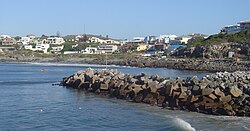
Yzerfontein, or Ysterfontein, is a small harbour town with about 1200 inhabitants on the west coast of South Africa about 90 km north of Cape Town. The name in Afrikaans means "Iron Fountain".The town started out when the farm 'Yzerfontein' was bought by the Katz-family in the 1930s. Then they started dividing the farm into plots. The main sources of income are tourism (especially during the wildflower season from August to October), mining and fishing.

Beach at Yzerfontein

Yzerfontein is known for its Sixteen Mile Beach, stretching north from the main beach of the town, to the West Coast National Park, which borders the town. Dassen Island, another nature reserve, is about 10 km offshore.

Yzerfontein is the landing point for the ACE and WACS submarine communications cables.

Outside of the town is the Darling Wind Farm. This is producing power and there are plans for expansion.

Pearl Bay suburb, a new development in the south of Yzerfontein

.

The Yzerfontein salt pan is a 116 hectares (287 acres) coastal salt pan, just northeast of the town.[2] It was formerly mined for salt, and is currently mined for gypsum.[3]

References

[edit]
[edit]
Revisions and contributorsEdit on WikipediaRead on Wikipedia
from Grokipedia
Yzerfontein is a small coastal located on the Atlantic seaboard of South Africa's province, approximately 85 kilometres northwest of along the R27 highway. With a permanent population of around 1,200 residents that swells significantly during holiday seasons, the town is renowned for its pristine 16 Mile Beach, one of the longest uninterrupted beaches in the country, offering stunning views of , Dassen Island, and the surrounding landscape. The area's local economy is primarily supported by , , and smaller-scale and activities, drawing visitors for (September to November), , kite surfing, , and hiking trails such as the Schaapeiland route. Positioned near the —established in 1985—the town serves as an accessible base for exploring the Cape West Coast Biosphere Reserve, with its rich biodiversity including indigenous flora, seabirds, and wildlife like and eland. Historically, the region has been inhabited by the people for thousands of years, with the name "Yzerfontein" (meaning "iron fountain" in Dutch) originating from an iron-rich freshwater spring discovered by early European settlers during the colonial era under the . The modern settlement emerged in the 1930s when the Katz family purchased the Yzerfontein farm, transforming it from a rural outpost used for farming and into a burgeoning harbour ; key historical sites include the Vishuis (Fish House), the oldest building in the area featuring archival photographs, and two lime kilns built in the 1940s—South Africa's only surviving examples—declared national monuments in 1980 for their role in producing quicklime from mussel shells. Today, Yzerfontein maintains a laid-back, community-oriented vibe, blending natural conservation efforts with recreational opportunities like horse riding, , and fresh markets.

Geography

Location and Setting

Yzerfontein is a coastal town situated on the Atlantic seaboard of , at coordinates 33°19′59″S 18°09′43″E. It lies approximately 85 km northwest of , accessible via the scenic R27 highway that winds along the West Coast. Administratively, Yzerfontein forms part of the Local Municipality within the province, falling under the broader West Coast District. The town occupies a strategic position along the Cape West Coast, bordering the to the north, which provides a natural extension of its coastal landscape. To the south, on clear days, Yzerfontein offers distant views of the iconic , enhancing its appeal as a gateway to both urban and natural attractions. Spanning an area of 6.68 km², Yzerfontein's is characterized by compact residential development concentrated near the harbor and main beach, interspersed with undeveloped coastal dunes and adjacent agricultural fields typical of the region. This mix supports a moderate , reflecting the balance between human settlement and preservation of open, natural spaces.

Climate and Environment

Yzerfontein experiences a characterized by warm, dry summers from to and cool, wet winters from May to . During summer, daytime temperatures typically range from 20°C to 25°C, while winter daytime highs vary between 10°C and 18°C, with cooler nights common. Rainfall is concentrated in the winter months, averaging 300-400 mm annually, with the wettest period in contributing the majority of . The , a system flowing northward along the west coast, significantly influences the local environment by generating coastal that provides essential moisture in this semi-arid and supports high marine through nutrient-rich waters. This , formed when warm air passes over the current, aids terrestrial ecosystems and contributes to the annual blooming season from to , triggered by winter rains. The area's ecological sensitivity stems from its position near marine protected areas and terrestrial reserves, including connections to the , prompting conservation initiatives such as the Yzerfontein Urban Conservancy to protect corridors and indigenous habitats from urban pressures.

Natural Features

Yzerfontein is characterized by its expansive Sixteen Mile Beach, a pristine white-sand shoreline stretching approximately 26 kilometers north from the town toward the boundary of the . This uninterrupted coastal feature forms part of a and exemplifies the region's dynamic dune systems and Atlantic-facing dunes. Inland, the Yzerfontein Salt Pan covers 116 hectares northeast of the town, serving as a coastal depression that supports unique saline habitats. Currently, the pan is utilized for extraction, contributing to the area's geological diversity while preserving its role as a seasonal water body influenced by local drainage patterns. Approximately 10 kilometers offshore to the west lies Dassen Island, a 273-hectare uninhabited provincial designated as a Ramsar site. The island hosts significant populations of African penguins and a variety of seabirds, including ten species endemic to , making it a critical breeding ground for marine avifauna. The nearby Darling Wind Farm, situated between Yzerfontein and the town of Darling, features four turbines generating 5.2 megawatts of , integrating into the rolling hillside landscape and symbolizing the region's shift toward sustainable power production. Yzerfontein borders the southern extent of the , where lagoon systems like the adjacent Langebaan Lagoon interface with diverse vegetation, fostering high through Mediterranean-climate shrublands and seasonal . This adjacency enhances the area's ecological connectivity, with the park's fynbos supporting endemic plant species and wetland habitats vital for migratory birds.

History

Early Settlement

The region surrounding Yzerfontein was long inhabited by indigenous peoples, including San hunter-gatherers who relied on coastal resources for sustenance. Archaeological excavations at the Ysterfontein 1 rock shelter reveal evidence of occupation dating back approximately 120,000 years, with stratified layers containing stone tools and remains indicative of early coastal practices by these ancestral populations. This site underscores the area's role in the evolution of human adaptation to marine environments long before European arrival. The name "Yzerfontein," also spelled "Ysterfontein" or "Eijzerfontein" in older Dutch forms, translates to "Iron Fountain" in Dutch and , originating from a prominent freshwater spring in the area discolored by deposits. This natural feature served as a vital source for both indigenous groups and early , marking the site's . European interest in the west coast emerged in the 17th century under the (VOC), which expanded beyond the Cape settlement to exploit like seals for oil and skins, with exploratory voyages along the coastline facilitating initial contacts. By the , the VOC granted loan farms in the region for pastoral purposes, and in 1732, Cornelius Heufke received permission to graze livestock on the land then known as Eijzerfontein, establishing it as an outlying grazing outpost without fixed boundaries or permanent ownership. This reflected broader VOC strategies to secure grazing lands northward from the amid growing settler demands. In the , following the VOC's decline, Yzerfontein transitioned to formal private ownership as a farmstead centered on grazing sheep and basic crop cultivation suited to the coastal plains. On 25 1842, Jacobus Marthinus Blanckenberg acquired the first legal title to the farm Yzerfontein, consolidating its use for agricultural purposes amid the British colonial administration's policies. The property changed hands several times thereafter but remained a single undivided farmstead focused on subsistence farming until subdivision in the early .

Modern Development

The modern development of Yzerfontein commenced in when the Katz family acquired the Yzerfontein farm and initiated its subdivision into residential plots, culminating in the town's official establishment in 1937 with the granting of town status by Abraham Katz's company. This foundational step transformed the former into a nascent seaside settlement, initially oriented toward accommodations with the creation of 330 properties for such purposes. Post-World War II expansion accelerated the town's growth, particularly from the 1950s through the 1970s, as demand for holiday homes surged among residents of nearby regions like the , drawn by its coastal appeal and scenic views of and Dassen Island. This period saw increased residential plotting and infrastructural basics to support seasonal visitors, solidifying Yzerfontein's identity as a destination while maintaining a modest permanent community. In the 2000s, Yzerfontein advanced technologically with the integration of global telecommunications via the landing of the West Africa Cable System (WACS) submarine cable at its dedicated cable landing station, enhancing connectivity as an alternative gateway to the primary Melkbosstrand site. Concurrently, residential projects like Pearl Bay in the southern area emerged, introducing boutique estates with beachfront villas and modern homes to attract long-term residents and investors. Key administrative milestones included the town's incorporation into the Swartland Local Municipality in 2000, following the dissolution of transitional local councils, which streamlined governance and development planning. By the 2010s, the population had stabilized at approximately 1,140 residents as of the 2011 census, reflecting a balance between seasonal influxes and controlled growth.

Demographics

Yzerfontein's population has grown steadily since its establishment as a holiday village in the 1930s, when the area consisted primarily of farmsteads with fewer than 100 permanent residents. By the 2001 , the population had reached 509 inhabitants across an area of 10.54 km². This figure more than doubled to 1,140 by the 2011 , reflecting boundary adjustments and increased residential development, with the area's extent revised to 6.68 km². Subsequent surveys indicate accelerated growth in the mid-2010s. The 2016 Community Survey recorded 659 households and a population of 1,384. A 2017 local census by the reported 891 households and a population of 2,170. By 2023, estimates placed the population at 2,701 across 1,286 households, yielding a density of about 404 per km². Key drivers of this expansion include seasonal , which temporarily boosts the effective through holiday rentals and visitors, and post-COVID trends toward that have encouraged permanent relocation to coastal areas like Yzerfontein. The town's appeal as a and destination has sustained an average annual growth rate of 3.3% since 2016.

Ethnic and Linguistic Makeup

Yzerfontein's ethnic composition, as recorded in the , reflects a predominantly population, comprising 81.4% of residents, followed by 8.9% African, 5.6% Coloured, 0.5% Indian or Asian, and 3.5% identifying as Other. This breakdown underscores the town's historical ties to European settlement patterns in the , with a notable minority presence from Coloured communities rooted in the region's mixed heritage. More recent demographic data from the 2022 is not yet available at the sub-place level for Yzerfontein. Linguistically, the community is overwhelmingly Afrikaans-speaking, with 71.5% of residents reporting it as their first language, while 25.3% speak English as their primary tongue, 1.2% isiXhosa, and 1.9% other languages. This distribution aligns with the broader Western Cape's linguistic landscape, where Afrikaans dominates among White and Coloured groups, reflecting cultural continuity from colonial and apartheid-era influences. The town's cultural fabric is shaped by its Afrikaans-speaking majority, incorporating elements of Cape Coloured heritage through shared traditions in local cuisine, music, and community events, alongside a small expatriate community attracted by the coastal lifestyle. Post-1994, Yzerfontein has experienced slight demographic diversification, driven by internal migration and tourism-related opportunities, increasing the Black African and expatriate proportions while preserving its rural Western Cape character.

Economy

Tourism Industry

Yzerfontein's tourism industry thrives on its natural seasonal spectacles, particularly the wildflower season from August to October, when the surrounding landscape bursts into vibrant displays of indigenous flora, drawing eco-tourists eager to explore the Cape Floral Region's biodiversity. This period coincides with the peak blooming in nearby reserves, making Yzerfontein a prime destination for guided walks and amid the colorful carpets of daisies, chincherinchees, and other endemic species. Complementing this, the whale-watching season from June to November positions the town as a key spot for observing southern right whales along the West Coast, with boat expeditions departing from the local harbor to view migratory pods in their feeding grounds; humpback whales are more commonly sighted from to . Accommodation options in Yzerfontein cater to a range of preferences, including holiday homes and self-catering cottages for families, cozy guesthouses offering personalized stays, and camping sites like the Yzerfontein Caravan Park for budget-conscious adventurers seeking proximity to the . These facilities support a steady influx of visitors, with the town attracting thousands annually, particularly during seasonal peaks; for instance, the Yzerfontein Sport and Recreation Club alone recorded 15,834 visitors during the 2022 wildflower season (July-September). The emphasis on sustainable, low-impact lodging aligns with the area's eco-focused appeal, enabling extended stays that allow visitors to briefly enjoy the expansive as part of their itinerary. Tourism serves as the primary revenue source for Yzerfontein, significantly bolstering the local economy through jobs such as guides, innkeepers, and service staff, which form a substantial portion of employment in this coastal community. As the only coastal town in the Municipality, it plays a vital role in regional visitor spending on accommodations, excursions, and dining. Marketing efforts by organizations like and West Coast Way promote Yzerfontein as an accessible gateway to the West Coast, highlighting scenic drives from , wildflower routes, and whale sightings to attract domestic and international travelers seeking authentic, nature-driven experiences.

Fishing, Mining, and Agriculture

Yzerfontein's fishing sector centers on small-scale operations at its modest harbor, where local fishers target species such as snoek (Thyrsites atun) and (Seriola lalandi) using boats launched from the or . These activities have historically provided sustenance for the community, with catches supporting household needs and local markets, particularly during seasonal runs near Dassen Island. Mining in the area revolves around the 116-hectare Yzerfontein salt pan northeast of the town, where extraction of —a soft used in and cement production—continues through operations involving crushing and washing. Salt at the pan, which dated back to at least the early with remnants of a 1911 shipping harbor still visible, ceased operations later in that century due to environmental and economic factors. Agriculture remains limited by the region's sandy, nutrient-poor soils, restricting large-scale cultivation and emphasizing activities like for , which trace back to early Dutch settlements in the . Nearby vineyards contribute to a wine industry, exemplified by producers such as Blake Family Wines, while emerging craft distilleries like Wright's Gin and breweries including Yzer Bru, all located within 4 kilometers of the town center, represent a growing niche in value-added agricultural products. The harbor infrastructure integrates traditional fishing with modern , serving as a landing station for international cables such as WACS and 2Africa, which connect to global networks and blend extractive industries with high-tech data transmission; 2Africa became operational in September 2025.

Government and Infrastructure

Local Governance

Yzerfontein is administered as part of the Swartland Local Municipality, a Category B municipality within the in the province of . This integration occurred as part of the post-apartheid transformation process initiated following the 1994 national elections, with Yzerfontein's former local council being converted to a Transitional Local Council in 1995 and fully incorporated into the Swartland structure by 2000 under the Municipal Structures Act of 1998. The town falls within Ward 5 of the municipality, which encompasses Darling, Yzerfontein, and surrounding rural areas, allowing for ward-based representation in local and provincial elections through elected councillors who participate in municipal council meetings and ward committees. A prominent local body in Yzerfontein is the Yzerfontein Residents' Association (YRA), established in 1963 to represent the interests of town residents. The YRA functions as an independent, volunteer-driven organization that advocates for sustainable community development and environmental conservation, serving as the officially recognized mouthpiece for residents in communications with the Swartland Municipality. It addresses key issues such as strains from growth, maintenance of bulk services like and electricity, and opposition to rezoning applications that could lead to excessive or inappropriate development, including the management of septic systems for approximately 500 undeveloped properties. Swartland Municipality's governance policies prioritize sustainable growth and environmental stewardship, particularly in coastal areas like Yzerfontein, through frameworks such as the Integrated Development Plan (IDP) and the Spatial Development Framework (SDF 2023-2027). The IDP outlines strategic goals for a healthy environment, including protection and reduction, aligned with the Cape West Coast Biosphere Reserve designation, while the SDF directs development to preserve ecological corridors and mitigate . Specific bylaws and the draft Integrated Programme (2020) enforce environmental protection measures, such as conservation park extensions linked to the , to balance tourism expansion with natural resource sustainability. Key municipal officials play central roles in implementing these policies for Yzerfontein. Executive Mayor Alderman Harold Cleophas, a Democratic Alliance member with prior experience as Ward 5 covering Yzerfontein, leads the council in addressing tourism-related pressures, such as seasonal demands on services, through initiatives like eco-tourism promotion and infrastructure investments in water and sanitation upgrades. The council, supported by the Municipal Manager and ward committees, prioritizes local needs including electricity supply enhancements via the 2017 Electricity Distribution Master Plan and sewerage improvements to resolve backlogs in .

Transportation and Utilities

Yzerfontein is primarily accessed via the R27 coastal highway, which connects the town to approximately 86 kilometers to the southeast, with a typical driving time of about 1 hour under normal conditions. Local roads branch off the R27 to provide access to nearby attractions, including the , located roughly 20 kilometers north of the town along the same highway. The town's small harbor supports limited fishing activities but relies on the broader road network for any related transport needs. Public transportation options in Yzerfontein are limited, with no regular bus services operating directly to or from the town; residents and visitors predominantly depend on private vehicles, , or tourist shuttles for mobility. These shuttle services, often arranged for airport transfers or day trips from , cater mainly to visitors exploring the coastal region. The town's water supply is sourced from local groundwater resources, including boreholes and potential wellfields, managed by the Swartland Municipality to meet residential and tourism demands. Electricity is provided through the national grid, with intermittent maintenance outages affecting the area, supplemented by from the nearby Darling Wind Farm, which feeds into the grid as South Africa's first commercial facility. Telecommunications infrastructure benefits from international cables, including the West Africa Cable System (WACS) and 2Africa, both landing at stations in Yzerfontein to support high-speed and connectivity across the region. Basic healthcare services are available at the Yzerfontein Satellite Clinic, a fixed point for mobile health outreach in the Swartland sub-district, while more comprehensive facilities, such as private primary healthcare clinics, are located in the nearby town of Darling, approximately 40 kilometers inland. Education is supported by Yzerfontein Primary School, a local institution serving the community's children in a rural setting.

Culture and Attractions

Beaches and Recreation

Yzerfontein's coastline features several beaches ideal for a range of recreational pursuits, with Sixteen Mile Beach serving as the primary draw for active visitors. This expansive stretch of white sand, extending approximately 16 miles from the town toward the West Coast National Park, supports swimming in its calm, Atlantic waters during summer months, as well as kitesurfing due to consistent winds and open space. Local operators provide lessons and equipment rentals for kitesurfing, making it accessible for beginners and experienced enthusiasts alike. Fishing from the rocks and beach is a traditional activity, where anglers target species like galjoen and kob, often requiring permits for sustainable practices. Sandboarding adventures are available nearby at the Atlantis Dunes, roughly 30 minutes from Yzerfontein, where participants slide down steep sand slopes on boards, combining elements of with the coastal terrain. Hiking and mountain biking trails originate from Yzerfontein and connect directly to the adjacent , offering routes like the Schaap Eiland Trail for scenic coastal walks and the more strenuous multi-day options such as the Postberg or Strandveld Trails. These paths wind through vegetation and provide opportunities for , particularly around the park's lagoons, where over 250 —including flamingos and African black oystercatchers—can be observed year-round, with peak diversity during migrations. Water-based recreation thrives in Yzerfontein's harbor and surrounding waters, with tours exploring the bay and encounters with dolphins. Seasonal whale-watching excursions, primarily from June to November, depart from the harbor to spot whales migrating along the coast, often accompanied by educational commentary on marine ecology. Boat trips to nearby Dassen Island facilitate close-up viewing of Cape fur seal colonies and African penguins, with some operators offering options amid the island's forests for immersive seal interactions. Amenities at Main Beach enhance visitor comfort, including designated picnic areas with tables and braai facilities, ample public parking, clean ablution blocks, and supervision during peak seasons. A beachfront provides casual dining options, while the proximity to the allows seamless integration of wildflower viewing during spring blooms along recreational routes.

Cultural and Historical Sites

!Khwa ttu, located approximately 15 kilometers from Yzerfontein on an 850-hectare , serves as a prominent San and center dedicated to preserving and promoting the heritage of South Africa's indigenous . The site's Heritage Centre Museum features three interconnected buildings that trace the San's history from ancient origins to contemporary life, including interactive exhibits on their traditional knowledge systems, spiritual beliefs, and survival skills in the landscape. Visitors can explore replicas of ancient , guided tours led by San descendants, and trails that highlight archaeological sites, fostering an understanding of the presence in the region dating back thousands of years. These elements emphasize cultural restoration and , with programs training San youth in guiding and hospitality to sustain community pride. Two 19th-century lime kilns, South Africa's only surviving examples, stand as prominent historical landmarks along the R315 road approaching Yzerfontein. Built to produce quicklime from mussel shells for construction during the colonial era, these structures were declared national monuments in 1980 and feature interpretive plaques, offering insight into the area's early industrial and maritime activities. Yzerfontein's historical markers reflect its evolution from a 19th-century outpost to a modern coastal village, with key remnants tied to its early development. The Vishuis (Fish House), the town's oldest surviving structure dating to the late 1800s, originally served as a and processing facility for local catches and now functions as the Yzerfontein Tourism Bureau, displaying historical photographs and artifacts that illustrate the harbor's role in the West Coast industry. Farm remnants from the Katz era, when the Katz family acquired the Yzerfontein in and subdivided it into residential plots to establish the town, include original homestead foundations and outbuildings that mark the transition from agricultural land to a destination. Heritage walking routes, such as the 2-kilometer Schaap Eiland starting from the main , weave through these sites and coastal paths, offering interpretive signage on the area's maritime and farming while skirting the village edges. Local arts in Yzerfontein thrive through community-driven events that celebrate West Coast traditions, blending music, crafts, and . Annual gatherings like the Yzerfontein Summer Festival and the I am Yzerfontein Market feature live music performances, artisan stalls with handmade textiles, , and inspired by regional motifs, and interactive workshops that engage visitors in traditional techniques. The Yzerfontein Art Route, highlighted during events such as the Oyster Festival, connects local studios and galleries showcasing contemporary works influenced by the coastal environment and cultural narratives, promoting artists who draw from and indigenous themes. These initiatives not only preserve craft heritage but also support emerging talents through markets and festivals that occur year-round, fostering a vibrant creative community. Culinary culture in Yzerfontein embodies the heritage of the West Coast, with a strong emphasis on fresh integrated into traditional dishes like braaied , with local flavors, and snoek patties served at community eateries. This cuisine reflects the town's fishing roots, where seasonal catches are prepared using wood-fired methods passed down through generations, often paired with fynbos-infused sides. Nearby distilleries and wineries act as cultural hubs, such as Wright's Distillery offering tastings with botanical tours, Yzer Bru Brewery's sessions highlighting hop varieties suited to the coastal climate, and Blake Family Wines' experiences that explore small-batch productions amid the strandveld. These venues host events blending food pairings with about regional agricultural traditions, enhancing the area's gastronomic identity.

References

Add your contribution
Related Hubs
User Avatar
No comments yet.